

A parent is unloading portable goals outside a sports hall when someone asks the question that starts many small-sided football debates: what size should a 5-a-side goal be? The answer depends on more than the number of players. A school hall, a community centre, an outdoor 3G pitch and a commercial leisure venue can all run 5-a-side football with noticeably different frames.
That variation can change the match. A lower goal gives the goalkeeper a smaller target and may suit a low-ceiling venue, while a taller frame creates more space for high finishes and demands different positioning. The practical task is to match the goal to the players, pitch, ceiling, surface and safety arrangements, rather than choosing a size from a product title alone.
Why the Goal Size Question Comes Up So Often
A league organiser may arrive early, measure the pitch, and discover that the two goals aren't the same height. A team captain may remember a previous match with a compact, low frame, then find that the next fixture uses a much taller target. The players haven't changed, but their shooting options, goalkeeper workload and defensive priorities have.
That happens because 5-a-side football isn't played in one standard environment. School gyms often have limited ceiling height. Community centres may use portable goals that are packed away after every session. Outdoor cages and 3G facilities usually have more room above the crossbar, but operators still choose frames according to their league format, equipment stock and local playing habits.
The confusion increases because “5-a-side goal” can describe several different products. A youth mini-soccer frame isn't automatically the right choice for an adult recreational league, and an adult frame may be unsuitable for a young goalkeeper or a cramped indoor court.
The venue changes the meaning of the measurement
Width and height matter together. A wide but low goal encourages players to pass across the face of goal and finish along the ground. A taller frame opens more room above the goalkeeper, particularly when players can shoot with power from outside the immediate goal area.
Pitch proportions matter too. FA guidance gives a five-a-side pitch layout of 40 yards by 30 yards, approximately 36.5m x 27.5m, as described in UK pitch guidance from Net World Sports. On a compact pitch, the goal occupies a large visual and tactical presence, so even a modest change in height can alter how defenders protect the area.
Practical rule: Don't ask only, “What is the standard 5-a-side goal?” Ask, “Who is playing, where is the goal going, and what can the venue safely accommodate?”
The rest of the decision becomes clearer once you separate official ranges from common UK practice. The FA provides a useful baseline, but regional associations, suppliers and venue operators also use different dimensions for youth, adult, indoor and recreational football.
The Official FA Rules for 5 a Side Goal Size
The first point to clarify is that Football Association rules use a range rather than one universal frame. Under The FA's Law 1 for 5-a-side, the distance between the inside edges of the posts must be a minimum of 3 metres and a maximum of 5 metres, while the height from the ground to the lower edge of the crossbar must be a minimum of 1.20 metres and a maximum of 2 metres. The same law specifies posts and a crossbar measuring 8cm wide and deep. See the FA Law 1 guidance for the playing area.
That range explains why two legitimate 5-a-side venues can look different. A frame at the smaller end can suit a hall or restricted area, while a frame near the upper end gives players a larger attacking target. The exact competition rules may also identify a preferred dimension, so organisers should check their league handbook before ordering equipment.
A separate FA guidance document identifies 3.66m wide by 1.83m high, or 12ft x 6ft, for mini-soccer 5v5 involving Under-7 and Under-8 age groups. That format is designed around youth development, not adult competitive football. UK equipment guidance also records traditional five-a-side frames at 4.88m x 1.22m for senior or youth use and 3.66m x 1.22m for junior or youth use in some standards, as outlined by Sports Equipment's traditional 5-a-side goal buying guide.
FA goal dimensions at a glance
| Format | Width | Height |
|---|---|---|
| FA 5-a-side Law 1 range | 3m to 5m | 1.20m to 2m |
| FA mini-soccer 5v5 for Under-7 and Under-8 | 3.66m, 12ft | 1.83m, 6ft |
The goal also has to be safe for the setting. It should be properly anchored, stable during contact and free from sharp edges or damaged fittings. For a broader introduction to the rules of small-sided football, the Fair Play Feed rules guide can help newer players understand how the equipment fits into the wider game.
Comparing Youth and Adult Goal Dimensions
Youth and adult goals don't differ in size. They create different technical problems for the players in front of them. The FA mini-soccer recommendation of 3.66m x 1.83m, or 12ft x 6ft, gives younger players a target that remains meaningful without making the goalkeeper's job impossible. The dimensions are part of a wider small-sided development approach, where players get repeated involvement in attacking and defending.
Traditional adult 5-a-side setups often use a wider, lower frame, including 4.88m wide by 1.22m high or 3.66m wide by 1.22m high in UK equipment standards. The difference is easy to feel. A low adult goal rewards accurate passes into shooting lanes and makes low finishes especially important, while a taller youth goal gives developing attackers a visible target above the goalkeeper's reach.
Youth versus adult 5-a-side goal sizes
| Age Group | Goal Size (ft) | Playing Effect |
|---|---|---|
| Under-7 and Under-8 mini-soccer 5v5 | 12 x 6 | Supports developing accuracy, finishing technique and goalkeeper confidence |
| Junior or youth traditional formats | 12 x 4 | Creates a lower target with a strong emphasis on placement |
| Senior or adult recreational formats | 16 x 4 | Offers width for combination play while keeping the target relatively low |
These are not rigid descriptions of every league. The FA's Law 1 allows a range from 3 metres to 5 metres wide and 1.20 metres to 2 metres high, so facility operators can select a frame that works with their pitch and venue. The FA mini-soccer guidance also helps explain why youth and traditional recreational goals don't always match.
A young team using a 12ft x 6ft goal can practise shooting into corners while the goalkeeper learns angles and set position. Adult players using a 16ft x 4ft frame may see more low, driven efforts and more attacks built around quick passes across the goalmouth. For parents choosing equipment, the guidance in football nets for kids is useful because the net must match the frame, not just the age label on the box.
A goal that challenges the strongest shooter can still be manageable for the goalkeeper. If it only frustrates the youngest player, the size is wrong for that group.
Why the Same Format Uses Different Goal Heights
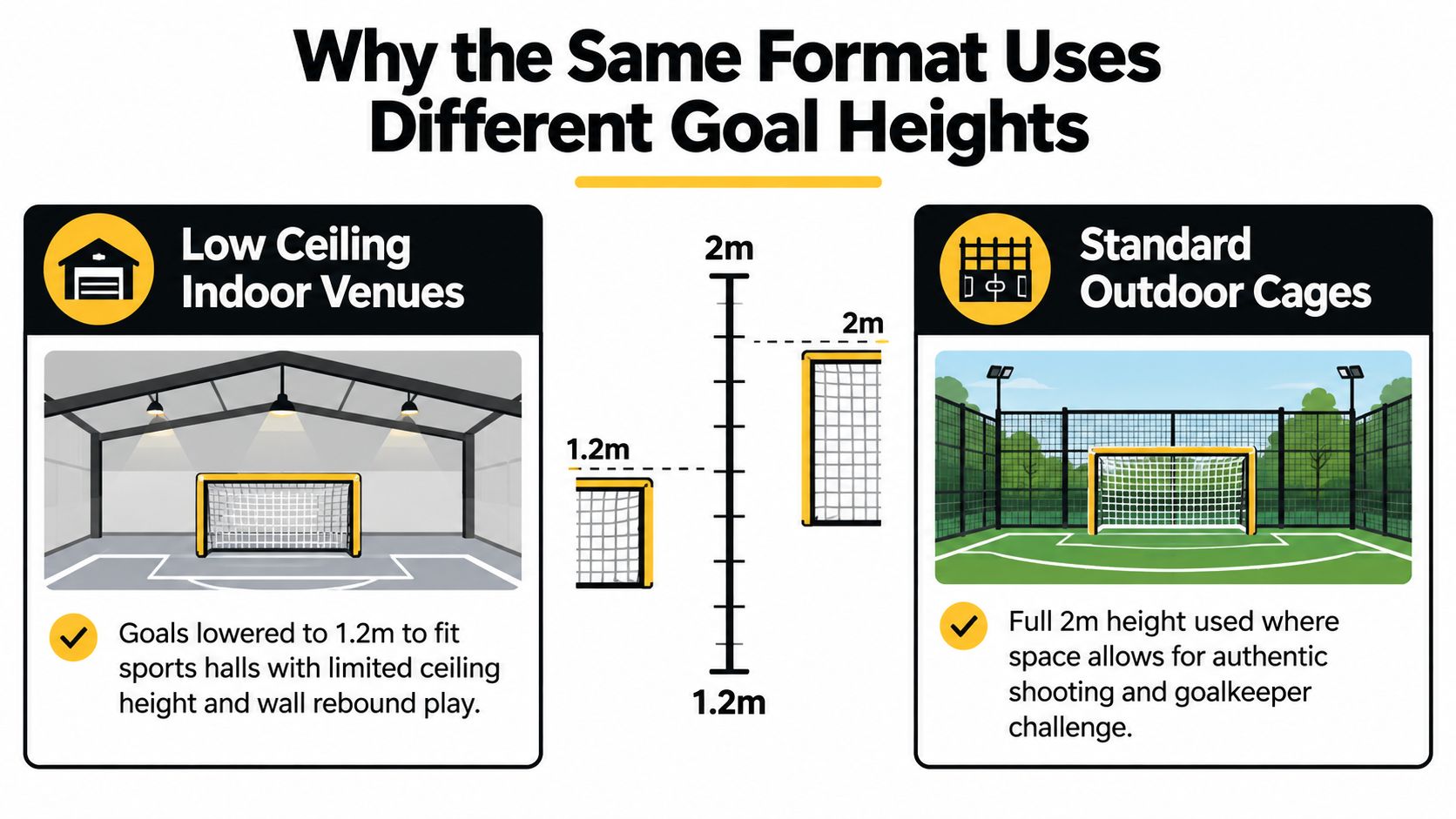
Goal height varies because venues solve different physical problems. The FA's guidance recognises that indoor venues with low ceilings may need smaller goals, while outdoor pitches can accommodate a frame closer to the permitted upper range. A sports hall may have roof structures, lighting, basketball equipment or wall clearance that make a taller goal impractical, even when the format is still described as 5-a-side.
Ceiling height is only one part of the decision
The permitted FA range reaches from 1.20 metres to 2 metres in height, so an indoor operator can choose a lower target without leaving the recognised rules framework. In a low-ceiling hall, the lower edge of the crossbar may also reduce the chance of contact with overhead structures and gives the venue more control over rebounds from nearby walls.
Surface affects the way the goal feels as well. On an outdoor 3G pitch, players may have more room to strike through the ball, and a taller frame can create a more natural high-finishing challenge. In a compact indoor venue, quick rebounds and crowded goalmouths may make a lower frame more suitable. The goalkeeper has less time to react in either setting, but the shape of the danger changes.
Commercial leagues sometimes choose a height based on the age mix of their bookings or the style of play they want to support. A frame used mostly by younger or mixed-ability groups may be kept lower, while an adult league may favour a wider target. Regional practice also differs. The Football Association of Wales recommends 2.44m x 1.22m, while the Irish Football Association recommends 3.66m x 1.22m, according to the Sports Equipment mini-soccer buying guide.
Safety and performance trade-offs
A lower crossbar can be more practical around inexperienced goalkeepers, especially where players dive or challenge near the goalmouth. It won't remove injury risk, so anchoring, padding where appropriate, supervision and clear run-off space still matter. Players should never treat the frame as climbing equipment, and damaged goals should be removed from use.
The right height is therefore a compromise between authentic shooting, keeper confidence, ceiling clearance, rebound behaviour and safe movement. A taller goal isn't automatically better. In some UK halls, a lower goal is the more responsible choice.
Matching Goal Size to Players and Playing Environment
Start with the players, then test the choice against the venue. For younger children playing mini-soccer, the FA recommendation of 3.66m wide by 1.83m high gives a clear reference point. It creates enough target area for developing attackers while asking them to place the ball rather than relying on close-range power.
For an adult recreational league, a wider or taller goal can produce a better attacking balance, particularly when players are physically stronger and can shoot from distance. But don't assume every adult booking needs the largest possible frame. If the pitch is cramped, the ceiling is low or the goalkeeper is inexperienced, a lower design may create a safer and more enjoyable match.
Three practical selection scenarios
- A youth club on a suitable outdoor pitch: Use a mini-soccer frame around 3.66m x 1.83m when it matches the age group and competition guidance. Check the net depth, anchoring and surrounding space before the first session.
- A school sports hall: Measure the available height and inspect nearby walls, lighting and equipment. A lower goal within the FA range may be the sensible option when a taller crossbar would restrict play or create a clearance problem.
- An adult outdoor cage: Consider the dominant playing style and the league's rules. A wider goal can reward combinations and finishing across the keeper, while a taller frame adds more scope for high shots, provided the area can accommodate it safely.
The squad's age mix matters when teams share one facility. A goal that suits older, confident shooters may overwhelm younger keepers. Conversely, a very low frame can make an adult session feel compressed and place too much emphasis on low finishing.
Selection rule: Pick the smallest goal that still challenges your strongest shooters without frustrating younger or less experienced goalkeepers.
Portability changes the installation question. A folding aluminium goal for a garden, driveway or school needs a dependable temporary anchoring method, while a fixed steel goal on a 3G pitch may use permanent fixings. The practical differences between these options are covered in folding football goals, particularly when storage space is limited.
Buying and Installing the Right 5 a Side Goal
A goal is only suitable when its frame, net, anchoring system and storage method work together. Start by confirming the required width and height, then check the manufacturer's actual assembled dimensions. Product names can describe a format broadly, so don't rely on “5-a-side” alone.
Work through the equipment choice
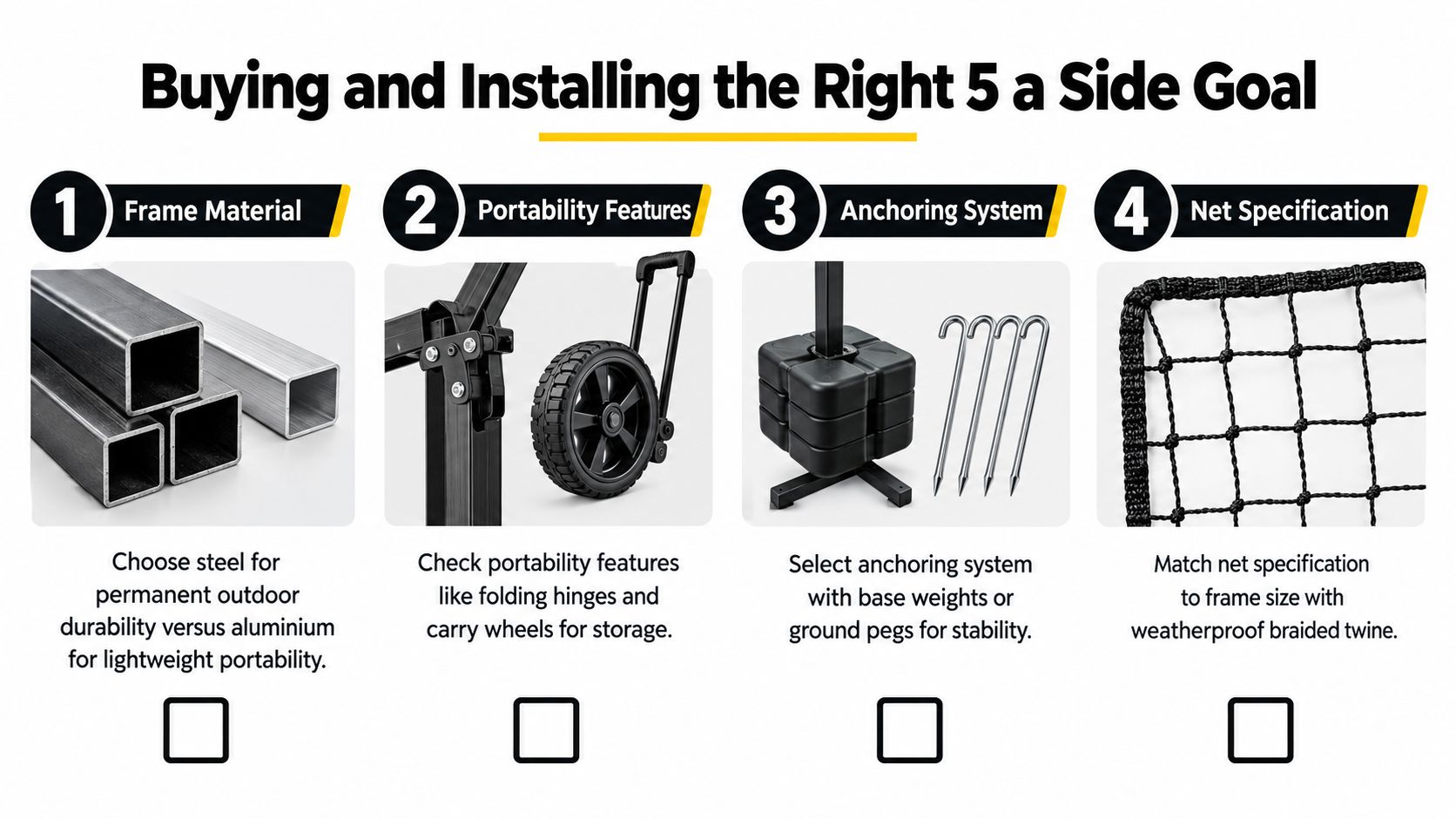
Steel suits permanent outdoor use. It offers a frame for a fixed pitch, but it adds weight and makes repeated movement less convenient. Aluminium is useful when staff or parents need to carry and store the goal regularly. PVC can suit lighter casual use, provided the product is appropriate for the players and is anchored securely.
Back-bracing supports stability. A rear frame or suitable support keeps the goal from folding or tipping when the net catches a shot. Folding hinges should close properly, and wheels or handles should not interfere with the base during play.
The net must match the frame. Check the net's width, height, fixing points and depth before ordering. Weather-resistant braided twine is a practical choice for equipment used outdoors, while a casual indoor setup may need a different specification. Weekly league use demands regular inspection regardless of material.
Install and inspect before play
Use ground pegs on suitable grass, approved base weights on hard surfaces, or permanent fixings where the venue permits them. Don't improvise with loose objects that players can trip over. On a portable goal, test the frame after anchoring by applying firm pressure to the base and checking that the structure stays stable.
A simple pre-match checklist should cover:
- Frame: Inspect joints, welds, hinges and locking pins for damage or looseness.
- Net: Check for tears, missing clips and sections pulling away from the posts.
- Anchoring: Confirm pegs, weights or fixings are present, correctly positioned and secure.
- Clearance: Keep players and spectators away from unsafe areas behind or beside the goal.
- Storage: Fold or dismantle the goal according to the manufacturer's method, never by forcing a hinge.
For equipment choices and setup ideas, see 5-a-side goals. A short visual demonstration can also help staff understand safe handling and positioning:
Getting the Most From Your 5 a Side Goal Setup
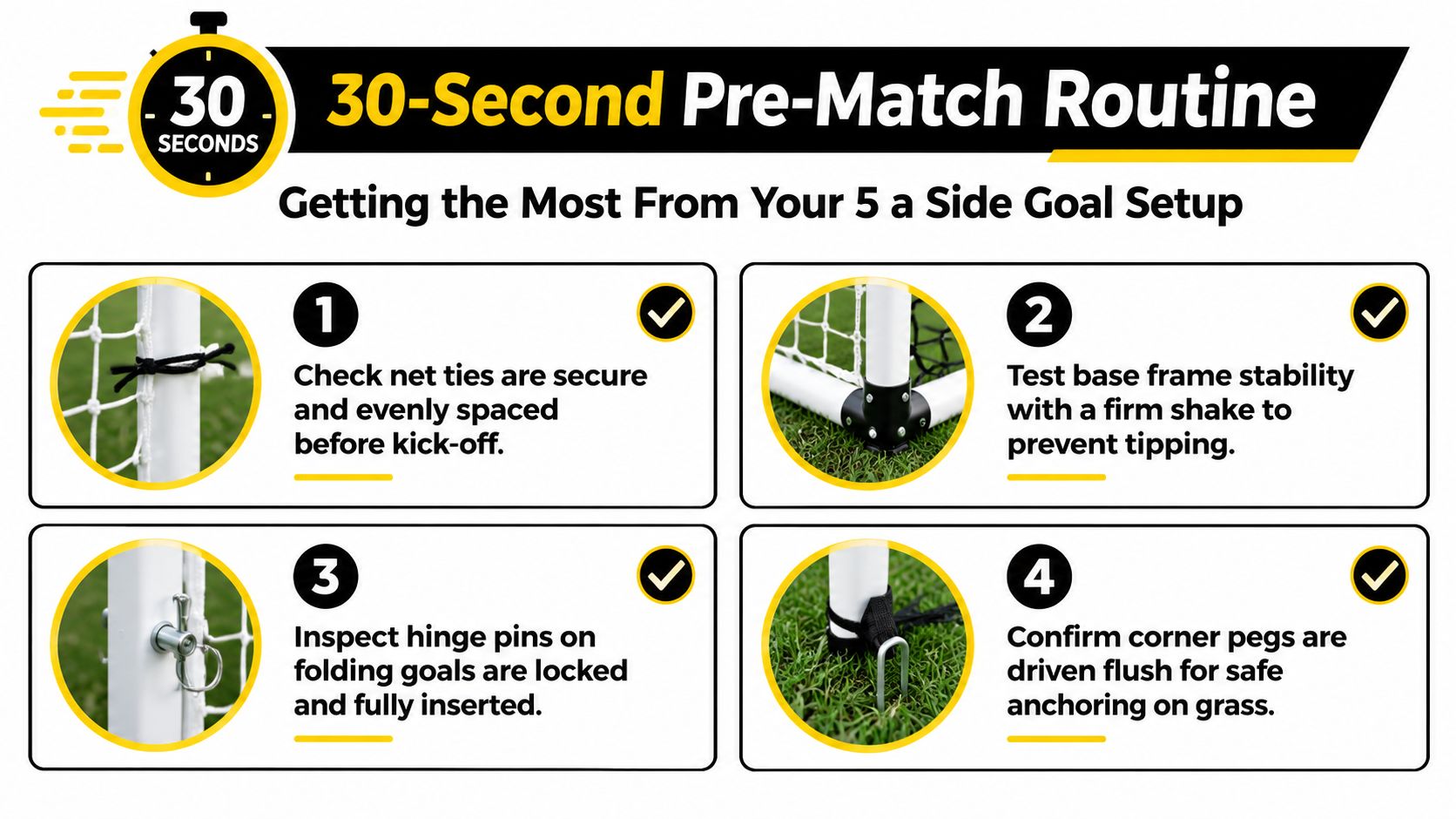
A reliable goal setup starts with a 30-second pre-match routine, not with the opening whistle. Check that net ties are secure, the base frame feels stable, folding-goal hinge pins are fully inserted, and corner pegs sit safely in the ground. Those small checks prevent equipment movement from becoming a distraction during play.
Protect the goal and the players
Players must never climb on the crossbar or hang from the frame. Spectators should remain behind the designated run-off area, and organisers should replace frayed nets before a split becomes large enough to affect play or create a snagging hazard.
The best 5-a-side football goal size is the one that fits the rules, the venue and the people using it. A careful organiser measures the space, checks the permitted FA range, confirms the competition's preferred dimensions and keeps spare net clips and anchors available for routine repairs. For ideas that make small-sided sessions more engaging, explore small-sided soccer games.
Take three practical actions today:
- Measure the available playing and clearance space.
- Match the result to the relevant FA range and your players' needs.
- Order spare anchors and net clips so a small failure doesn't cancel a session.
SoccerWares offers football goals, training essentials and related equipment for players, parents and organisers planning small-sided sessions. Visit SoccerWares to compare suitable football equipment and prepare a safer, more practical 5-a-side setup.