

A forward gets onto a through-ball and appears to have beaten the defender. One touch later, the defender closes the angle, the forward plants awkwardly, loses balance and allows the chance to disappear. From the stand, it looks like a lack of pace. On the pitch, the problem is often the moment between slowing down and moving again.
Agility in football isn't just fast feet or a quicker sprint over a straight line. It combines braking, balance, body control, perception, decision-making and re-acceleration. A player must recognise what an opponent is doing, organise their centre of mass, change direction and still execute the next football action.
English elite match data supports a practical conclusion. Players turn frequently, often at moderate speeds, so training should prepare them to control movement repeatedly rather than chase impressive-looking cone times in isolation.
Why Footballers Fail in One-on-One Situations
The winger receives the ball near the touchline and drives at the full-back. The first few steps are excellent, but the defender stays square. When the winger tries to cut inside, the plant foot lands too far ahead, the hips remain open and the next acceleration never arrives. The defender doesn't need to be faster. They only need to stay balanced for one extra moment.

That sequence exposes the weakness in many popular agility sessions. A player may complete a pre-planned pattern quickly, yet struggle when an opponent changes speed, closes space or shows a different angle. Straight-line speed helps create separation, but it doesn't decide every duel.
The moment before the turn
A successful one-on-one action usually contains several linked tasks:
- Perceive the threat: The player reads the defender's hips, feet and closing line rather than waiting for contact.
- Brake under control: The player lowers the centre of mass and reduces speed without standing upright or taking unnecessary steps.
- Reorient the body: The shoulders, hips and foot position point towards the next route.
- Accelerate again: The first step after the turn creates usable separation, with the ball kept within playing distance.
- Perform the football action: The player must still dribble, pass, shoot or protect the ball while changing direction.
A ladder can help a young player learn rhythm and foot placement. It can't reproduce an opponent's disguise. A cone pattern can teach a 45-degree cut, but it doesn't force the player to decide whether that cut is the right answer.
Practical rule: If the drill tells the player exactly where to go, it develops planned movement. Add a visual cue, a live opponent or a ball decision when you want the movement to transfer to a match.
The coach's job is to identify the actual failure. Does the player arrive too fast to brake? Do they lean away from the intended direction? Do they react late? Does the first touch take them into pressure? Each fault needs a different solution. Players looking for ball-centred examples can use these dribbling drills for football, but the session should still progress from controlled technique towards genuine uncertainty.
Agility isn't a personality trait and it isn't fixed by performing more repetitions at any speed. The player needs enough strength and coordination to absorb force, enough awareness to select an option and enough technical control to execute once the decision has been made.
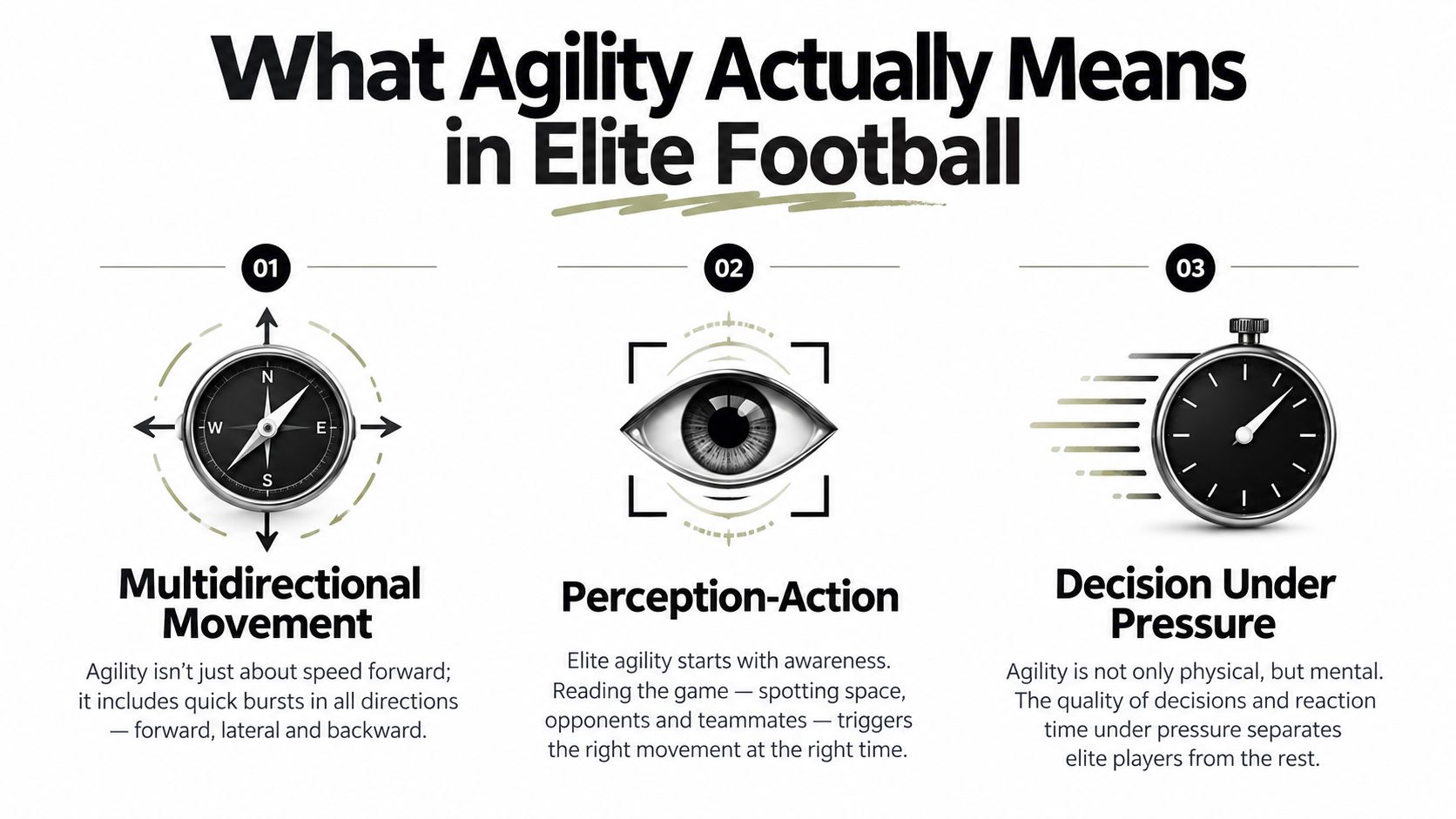
What Agility Actually Means in Elite Football
Elite football agility is a sequence of perception, braking, redirection and acceleration. It can happen forwards, laterally or backwards, with or without the ball, and the movement often begins before the player reaches top speed.
A study of one English Premier League team examined 18 competitive fixtures from the 2020–2021 season using LiDAR tracking technology. Central midfielders averaged approximately 38 turns per match, compared with roughly 18 to 27 turns for players in other positions, and about 90% of all recorded turns began at entry speeds below 5.5 m/s (English Premier League LiDAR tracking research). That challenges the idea that agility is mainly a test of maximum sprint speed.
Why moderate-speed turns matter
A player entering a turn at a manageable speed has more opportunity to:
- place the foot underneath the body rather than reaching for the ground;
- keep the trunk organised while scanning for the next pass;
- maintain contact with the ball;
- adjust the angle if an opponent blocks the first option;
- accelerate without wasting steps after the turn.
This doesn't make speed irrelevant. Higher entry velocity raises the braking and re-acceleration demand, especially when the player must turn through a larger angle. The useful quality is the ability to select and control the appropriate speed for the situation.
The same study classified approximately 63% to 70% of turns as high-angled changes of direction, while the broader research summarised within it reported around 600 turns of 0 to 90 degrees and approximately 100 turns of 90 to 180 degrees per player per match (the same match-turn analysis). Those figures describe a player constantly adjusting position, not waiting for one spectacular cut.
A central midfielder therefore needs more than a fast 10-metre sprint. They need to receive on the half-turn, slow before pressure arrives, move away from a passing lane, open the hips and repeat the action without losing technical quality. A centre-back may use agility to manage an attacker running across their body, while a wide forward may need to brake before attacking the full-back's blind side.
Core control supports these actions, but it shouldn't replace movement practice. Exercises such as those in core stability exercises for football are most useful when they support posture, force absorption and ball actions rather than becoming an isolated substitute for football movement.
The practical definition is simple: agility is the ability to solve a movement problem under pressure. The solution may be a small adjustment at moderate speed, not a dramatic sprint or a maximal 180-degree turn.
How to Properly Measure and Test Football Agility
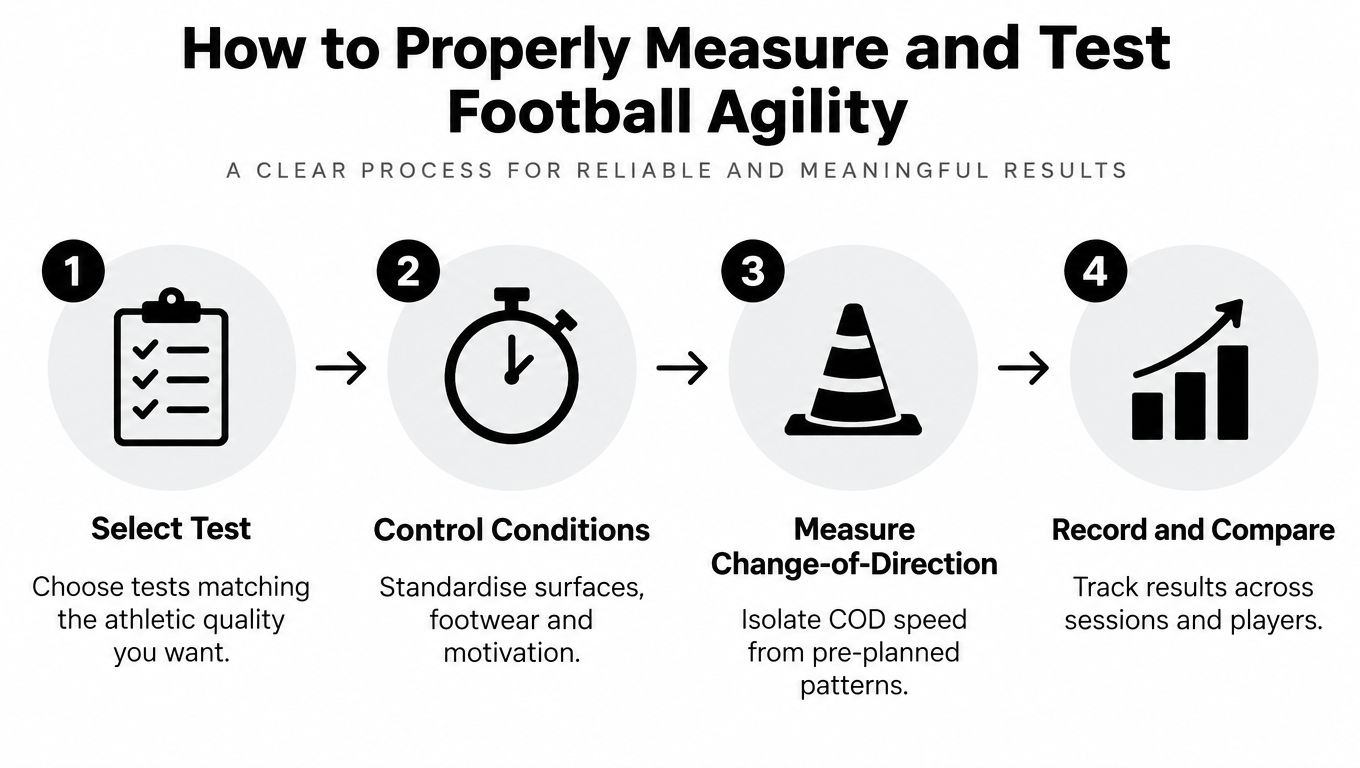
A test only tells you what it measures. A pre-planned shuttle can reveal change-of-direction speed, but it can't fully reveal how well a player reacts to an opponent or an unpredictable cue. That distinction matters because planned change of direction and reactive agility are related, but they aren't identical qualities.
Match-tracking research from an English professional team defined a significant turn using three criteria completed within one second: deceleration of at least 2 m/s², a directional change of at least 20 degrees and subsequent acceleration of at least 2 m/s² (professional football turn-demand research). This is a useful coaching definition because it separates a genuine braking-and-reacceleration action from a low-intensity positional adjustment.
Build a test battery
Start by deciding what you want to learn.
- Use a planned test for a planned question. A 505 test can help separate approach speed, braking, turning technique and acceleration after the turn. It shouldn't be presented as a complete measure of football agility.
- Add a reactive test. Use a coach's call, a light, a partner's movement or a ball release. The player should have to perceive information before choosing the direction.
- Repeat the action under controlled fatigue. A fresh single turn may look excellent while repeated turns reveal poor braking posture or declining technical execution.
- Record the conditions. Keep the surface, footwear, start position, cueing method and timing process consistent enough to make comparisons meaningful.
Elite youth players in the English Premier League academy system perform approximately 305 ± 50 changes of direction per match, with an average recovery interval of 19.2 ± 3.9 seconds (academy change-of-direction research). A useful assessment should therefore include repeated, intermittent actions rather than relying only on one best effort.
A cone set is practical for marking channels, gates and turning zones. The Football Training Cone Set, 20 / 40 / 60 Pack Agility Disc Cones for Kids and Adults uses lightweight PE cones, offers 20, 40 or 60-piece options with a stand, and is described for football, rugby, fitness circuits, warm-ups and change-of-direction work.
Wearable technology can add context where a club has access to it. Wearable football sensors may help coaches examine acceleration, deceleration and movement exposure, but the data still needs a clear question. A number without video, technical observation or knowledge of the player's role rarely explains why the turn succeeded or failed.
Position-Specific Agility Demands and Development
A goalkeeper, centre-back, midfielder and wide forward don't solve the same movement problems. Giving every player the same agility circuit may be convenient, but it can produce a poor match between training load and competition demand.
Research across Premier League, FA Cup, League Cup and Europa League matches found that central midfielders averaged about 35 turns per match, compared with approximately 23 for centre-backs, 21 for wide forwards and 5 for goalkeepers (position-specific turning research). Central midfielders also completed more low- and medium-speed turns and high-angle turns than other outfield positions.
Match the movement to the role
| Position | Useful agility emphasis |
|---|---|
| Central midfielder | Frequent scanning, half-turns, short redirections and rapid repositioning around the ball |
| Centre-back | Drop steps, lateral tracking, opening the hips and recovering after an attacker changes direction |
| Wide forward | Braking before a one-on-one, double movements and cutting inside or outside from a running start |
| Goalkeeper | Set-position adjustments, lateral pushes, low-level recovery and fast movement into the next action |
These are starting points, not rigid categories. A full-back may need the repeated turning profile of a wide player and the recovery skills of a defender. A forward who presses aggressively may require more deceleration exposure than their attacking label suggests.
Age changes the coaching decision. Research involving 86 male junior-elite players across an academy structure found that agility and reaction-time performance generally improved until approximately 14 years of age, around the estimated age of peak height velocity, after which performance temporarily plateaued (academy agility and maturation research). A temporary dip or plateau doesn't automatically mean a young player has become less committed or less talented. Growth can alter limb lengths, coordination and the feel of familiar movements.
Judge development over time
Coaches should compare a player's trend, movement quality and confidence rather than reacting to one poor result. During rapid growth, reduce the temptation to add intensity just because an athlete looks physically bigger. Keep bilateral work, expose both sides to turning tasks and adjust complexity when landing or braking becomes inconsistent.
For clubs that need a fuller picture of physical development, DEXA body composition testing in Manchester can provide a specialist assessment resource. It shouldn't replace football testing or coaching observation, but body-composition information may help qualified practitioners interpret changes in training response and maturation.
Position-specific examples can be built around the actions a player repeatedly performs. A coach working with defenders can use the principles in centre-back football training while still adding reactive cues, because a centre-back rarely knows the attacker's final direction in advance.
Building Safe and Effective Agility Progressions
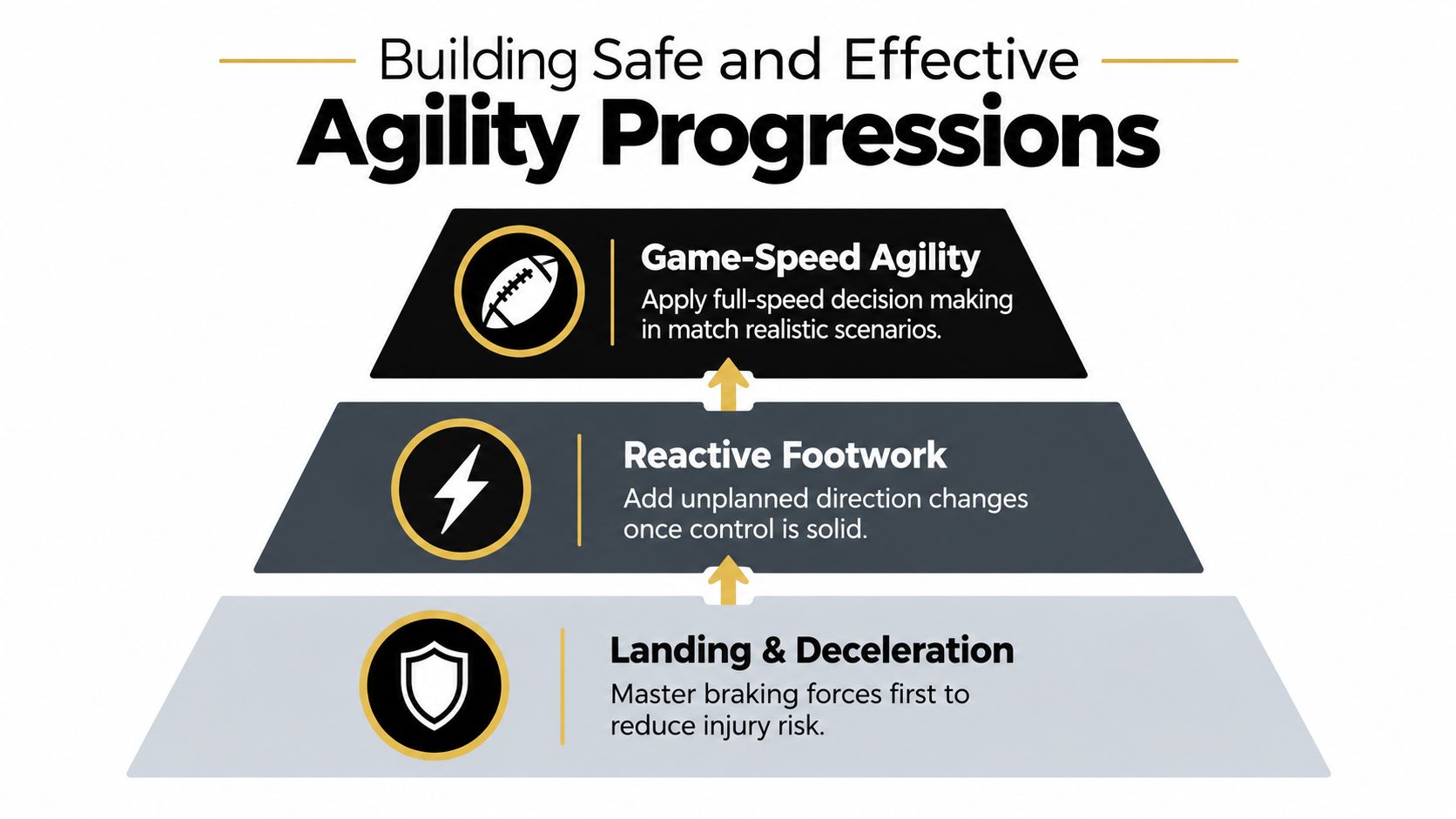
The first question shouldn't be, “How quickly can this player move their feet?” It should be, “Can this player stop, plant and land with control?” Faster footwork performed on top of poor braking mechanics gives the player more opportunities to lose alignment.
Coventry University research on 105 grassroots footballers aged 13 to 16 found that children rated poorly on functional movement skills were significantly more likely to show poor drop-landing mechanics, with the problem more pronounced in girls (Coventry University research on movement skills and landing mechanics). That finding supports a progression that starts with force absorption before adding chaotic, high-speed changes of direction.
Establish the base
Begin with quiet, balanced landings from low-level jumps, step-offs or controlled hops. The athlete should learn to keep the knee aligned with the foot, control the trunk and accept force without collapsing inward. Progress only when the player can repeat the position on both sides.
Deceleration comes next. Use short accelerations into a controlled stop, then add a gentle change of direction. The player should lower their body, shorten the final steps and avoid reaching far beyond the base of support. Coaches should watch the last two steps, not just the time through the drill.
Quality beats frantic speed. If a player can't brake cleanly at a controlled intensity, adding a faster cue usually hides the problem rather than solving it.
Add uncertainty carefully
Once the player can stop and redirect, introduce a coach's call or partner cue. Reactive skater hops, mirror movements and lateral shuffle into a ball release can teach the athlete to organise the body after receiving information. Keep the space manageable and stop the set when technique becomes careless.
Only then should the session move towards game-speed actions. Add the ball, an opponent, a passing decision or a finish. The player must be able to control the movement and the football task, not merely win a race through a cone pattern.
An adjustable ladder can be useful for rhythm, low-level coordination and warm-up variety, but it shouldn't become the centre of an agility programme. The same principle applies when a player reports discomfort. A coach shouldn't diagnose an injury on the training pitch, and an athlete dealing with knee symptoms should seek appropriate clinical guidance, including resources such as knee pain relief for athletes.
Maturation matters here too. A younger player may need simpler landing shapes and playful reactions, while an older player can handle greater speed, narrower decision windows and more football-specific pressure. The progression is not a race through stages. It is a way to ensure that intensity follows control.
Practical Programming for Match-Day Performance
A useful agility session has a clear purpose, a controlled entry point and enough variability to resemble football. It shouldn't turn into a competition to complete the most exhausting cone circuit.
Elite youth players in the English Premier League academy system average 49 changes of direction in a rolling 15-minute period and 16 changes in a five-minute period, while second-half change-of-direction frequency falls by 29 actions (academy change-of-direction match demands). Approximately 77% of their changes of direction involve angles of 90 degrees or less, so a session built only around dramatic 180-degree cuts misses much of the repeated, shallower work seen in matches.
Use a simple weekly rhythm
A practical sequence might look like this:
- Early training week: Use landing, braking and planned cuts while the player is fresh. Keep the emphasis on posture, foot placement and clean acceleration out of the turn.
- Main football session: Add visual or verbal cues, a ball and an opponent. Use short bouts that demand repeated decisions, then allow enough recovery for technical quality.
- Later pre-match work: Keep the volume low and the intent sharp. Use a few reactive accelerations, changes of direction and ball actions rather than a tiring conditioning block.
- Recovery or development session: Review video, practise weaker-side turns and complete lower-intensity coordination work when the player needs movement quality rather than overload.
Manipulate one variable at a time. Start with a controlled entry speed and a smaller angle, then increase the approach speed, widen the angle or reduce the available braking distance. If all three change together, the coach won't know why performance deteriorated.
Choose drills by the problem
A player who stands upright while stopping needs deceleration work. A player who brakes well but takes too long to leave the turn needs re-acceleration. Someone who moves efficiently in a pattern but reacts late needs a live cue. Someone who reacts well without the ball but loses possession needs a ball-based constraint.
A coach can use cones to create gates, channels and decision zones, while a ladder can provide a low-level rhythm stimulus during the warm-up. GPS or LiDAR data, where available, can help quantify whether the player is reaching the intended acceleration and deceleration exposure, but video remains essential for judging posture, foot contact and the decision itself.
Don't chase fatigue for its own sake. When the player can no longer control the final step, the session has stopped training the quality it was meant to develop. Reduce the space, simplify the cue or extend the recovery until the action becomes sharp again.
The best agility programme is specific without becoming repetitive. It prepares the player to slow down, turn, read the next problem and accelerate into the solution, whether that happens on a pristine academy surface or a muddy Saturday morning pitch.
SoccerWares offers training essentials such as agility equipment, football GPS trackers, rebounders, goals and indoor training mats, alongside club-inspired apparel and drinkware. Visit SoccerWares to compare practical tools for building more controlled, reactive football movement.