

Finding the best boots for defenders is all about matching your footwear to your job on the pitch. You need the perfect blend of protection, stability and traction to throw yourself into game-changing tackles with complete confidence. The lightweight boots designed for flashy wingers won't cut it when your primary role is to be the team's rock at the back.
What Defines the Best Boots for Defenders?
The short answer is simple: the best pair depends on your role, but good defender boots almost always score well in five areas—stability, protection, traction, fit, and surface match. If a boot feels fast but your heel lifts in tackles, if the upper is so thin that every challenge hurts, or if the soleplate is wrong for the pitch, it is not a good defender boot no matter how popular it is.
When we reviewed this category, the strongest options were not always the lightest or the most expensive. What stood out instead was how well a boot stayed secure through planting, turning, and contact. For defenders, confidence comes from knowing the boot will hold shape under pressure, not just from how it feels during a few touches in warm-up.
A Practical Scoring Framework
Use this quick framework when judging any boot in a shop or comparing models online:
- Stability and heel lockdown: Your heel should stay planted when you accelerate, stop, or cut. Excess heel slip usually means less control in tackles and awkward pressure on the foot.
- Protection versus touch: Thicker leather or padded synthetics absorb contact better; thinner synthetics usually give cleaner ball feel. Defenders rarely need the absolute thinnest upper on the wall.
- Stud pattern for the surface: FG for firm natural grass, SG for wet and muddy natural grass, AG for artificial turf, and MG only when you split time between surfaces. Governing bodies and sports medicine guidance consistently warn that shoe-surface mismatch affects grip and injury risk, especially on artificial turf and in wet conditions, as outlined by FIFA's playing surface guidance and Boot Wizard's AG vs FG explainer.
- Weight trade-off: Lighter is useful for recovery runs and overlapping play, but ultra-light boots can give away underfoot stability and impact protection. For many centre-backs, a few extra grams is a worthwhile trade for a more planted feel.
- Durability over a season: Check the toe bumper, bonding around the forefoot, soleplate stiffness, and how the upper resists stretching. Several attractive speed models often feel great on day one but perform like half-season boots for regular defenders.
What Good Defender Boots Feel Like in Use
A strong defender boot should feel secure before it feels exciting. You should be able to lace up, plant hard, and know your foot is not sliding across the footbed. The upper should give enough padding to take contact without feeling disconnected from the ball. The outsole should flex where your stride needs it, but not so much that the platform feels unstable when you lean into a challenge.
That matters for safety as well as performance. Research on football traction shows the wrong combination of outsole and surface can increase rotational resistance and loading at the lower limb, which is why turf-specific and surface-specific choices matter more than many players think; see the summaries from Aspetar Sports Medicine Journal and the American Orthopaedic Society for Sports Medicine.
Why Priorities Change by Position and Level
Centre-backs usually benefit most from a stable chassis, dependable heel lockdown, and an upper with enough substance to handle contact. Full-backs can justify a lighter, more agile profile, but they still need enough support for repeated defensive cuts and recovery sprints. Youth and amateur players often need the most practical setup of all: a forgiving fit, durable upper, and the right soleplate for the surfaces they use each week, not the pair marketed to elite wingers.
That is also why there is no single perfect answer for every player. A left-back playing mostly on 3G with narrow feet should not shop the same way as a Sunday league centre-half on soft winter grass. If you get the fit and surface choice right first, the rest of the decision becomes much easier. As you prepare for the season, remember that all your equipment plays a role in your success. You might also want to check out our guide on building the ideal football training kit to ensure you're fully equipped.
How I Picked These Defender Boot Recommendations
The evaluation identifies which boot profiles help defenders play better and which only sound appealing in marketing copy. In practice, that meant prioritising five filters: fit security, protection level, surface suitability, comfort over a full match, and durability for regular use.
Data on how defenders buy boots shows most players are choosing between a few major brands rather than the entire market, and elite adoption still gives useful context. In the 2025 Premier League boot study, Nike accounted for about 44% of usage, adidas around 40%, and PUMA roughly 12%, according to Football Boots UK's brand breakdown. That does not mean the most-worn brand is automatically best for you, but it does confirm that most serious options in this category come from a tight group of heavily developed boot lines.
Here is the methodology I used when shaping the recommendations:
- Role first, brand second: A centre-back, a defensive full-back, and an overlapping full-back do not need the same thing.
- Fit and foot shape before features: In my view, a technically perfect soleplate is irrelevant if the last shape is wrong for your foot and creates slip or pressure.
- Surface honesty: I gave extra weight to boots that clearly suit FG, SG, or AG rather than pretending one setup excels everywhere.
- Protection and stability over hype: Thin speed boots made the cut only for players who really benefit from them.
- Season-long value: We favoured boots that make sense after months of use, not just after ten minutes in a try-on.
If you are shopping in a store, test heel hold by planting hard and rising onto the forefoot. If you are buying online, check width reputation, upper stretch, and whether the plate is offered in a true AG or SG version. That process will save more mistakes than obsessing over launch-year buzzwords.
Anatomy of a Defender's Boot
To find the right boots for a defender, you must look beyond the flashy colourways and marketing slogans. The secret lies in the construction – the specific parts of a boot that provide the grit and reliability needed at the back. When you understand a boot's anatomy, from the material on top to the studs underneath, you start to see why some are built for the unforgiving life of a defender.
Every component has a job to do, whether it's providing protection, stability, or traction. By understanding these features, you can make a smarter choice that noticeably improves your on-pitch performance, whether that's going into a crunching tackle or clearing the ball under pressure.
The Upper Materials
The upper is the part of the boot that contacts the ball and absorbs the most impact. The choice of material here is a trade-off between traditional comfort and modern performance.
Traditional leather, particularly K-leather, is renowned for its incredible softness and how it moulds to your foot over time. This provides a personal fit and a natural, cushioned touch on the ball, ideal for ball-playing centre-backs who value control above all else. The main drawback is that leather absorbs water, which can make the boots heavy and sluggish in wet conditions.
On the other hand, modern synthetics like Nike's Flyknit or Adidas's Primeknit offer a completely different feel. They are much lighter, water-resistant, and require almost no break-in time. They often come with textured zones or grippy coatings designed to enhance ball control, giving you consistent performance straight out of the box.
Lockdown and Support Systems
A defender's game is built on quick changes of direction and powerful challenges, which all start with a secure, stable base, so the heel counter and ankle collar are absolutely vital.
- External Heel Counter: This is the rigid cup at the back of the boot that locks your heel in place. It prevents your foot from sliding during sharp movements, which helps maintain stability and reduce the risk of ankle injuries.
- Ankle Collar: Defenders can choose between traditional low-cut boots or a mid-cut, sock-like collar. This higher collar provides a sense of security around the ankle, giving many players extra confidence when committing to a tackle.
The concept of 'lockdown' isn't just about feeling snug; it's about making every movement efficient. When your foot is securely locked in, no energy is wasted. Every step, jump, and challenge becomes more explosive and decisive.
This secure foundation is everything. It allows you to plant your feet with total confidence before making a decisive interception or block. It’s just as important as protecting your shins; see the best shin guards for soccer.
Outsole and Stud Pattern
Finally, we get to the part that connects you to the ground: the outsole and its stud pattern. For a defender who needs to shadow tricky wingers or stand firm against a target man, choosing the right option is essential.
The soleplate itself needs to be rigid enough to provide a stable platform but still have enough flex in the forefoot to allow natural movement. It's the studs, however, that define performance, and they come in different configurations for different pitches:
- Firm Ground (FG): The most common setup, featuring moulded plastic or rubber studs (either bladed or conical) designed for dry, natural grass.
- Soft Ground (SG): Essential for wet, muddy pitches. These use longer, often metal-tipped studs that dig deep into the turf for maximum grip when you need it most.
- Artificial Ground (AG): These feature numerous shorter, hollowed-out conical studs. They're designed to distribute your weight evenly and prevent your studs from getting stuck in 3G or 4G turf.
Choosing the wrong stud pattern isn’t just detrimental to your performance – it’s a serious injury risk. A defender needs the right tools for the job, and that starts from the ground up.
Comparing Boots for the Modern Defender
There is no universal defender boot. The right choice depends on how you defend, how much you carry the ball, what shape your foot is, and what surface you play on most often. The best way to compare options is not by release date or pro endorsement, but by matching boot profile to defender role.
Decision Guide by Defender Type
The No-Nonsense Centre-Back
Best boot profile: stability-focused leather or padded synthetic on FG or SG, depending on conditions.
What matters most: strong heel lockdown, a planted soleplate, enough upper structure to absorb contact, and reliable traction for clearances, duels, and first-step recovery.
Who should avoid it: lighter full-backs or defenders with very narrow feet who prioritise quick, frequent carries into midfield may find this category too bulky.
Main trade-off: you gain protection and stability, but usually lose some barefoot ball feel and top-end lightness.
The Ball-Playing Centre-Back
Best boot profile: control-oriented leather or thin-but-supported synthetic with a secure heel and balanced FG or AG soleplate.
What matters most: clean touch, comfort under pressure, stable base for long passing, and enough structure that the boot still feels trustworthy in contact.
Who should avoid it: players on very wet natural grass who need deep bite should skip FG-only versions and move to a true SG option.
Main trade-off: you get better touch and smoother distribution, but often with less impact protection than a classic power boot.
The Overlapping Full-Back
Best boot profile: speed boot with excellent lockdown, moderate support, and a soleplate that feels responsive rather than rigid.
What matters most: acceleration, low weight, close touch at pace, and a fit that keeps the foot centred during repeated sprints.
Who should avoid it: heavier defenders who rely on shoulder-to-shoulder duels or players who hate thin uppers.
Main trade-off: you gain pace and sharper movement, but many speed boots sacrifice protection and long-session comfort.
The Defensive Full-Back
Best boot profile: hybrid boot that sits between speed and control categories, usually with a more forgiving fit and dependable traction.
What matters most: lateral stability, comfort over 90 minutes, secure cuts in 1-v-1 defending, and enough touch quality to pass cleanly after regaining possession.
Who should avoid it: players who want either maximum speed or maximum padding may find hybrids a little too middle-of-the-road.
Main trade-off: versatility. You get fewer weaknesses, but not always the standout trait of a specialist boot.
Compact Comparison Matrix
| Defender type | Best boot profile | Foot-shape fit | Protection level | Touch level | Best surface |
|---|---|---|---|---|---|
| No-nonsense centre-back | Power/stability boot | Medium to wide | High | Medium | SG, FG |
| Ball-playing centre-back | Control boot | Narrow to medium | Medium | High | FG, AG |
| Overlapping full-back | Speed boot | Narrow to medium | Low to medium | High | FG |
| Defensive full-back | Hybrid versatile boot | Medium | Medium | Medium | FG, AG |
| Youth/amateur defender | Durable MG or AG boot | Medium to wide | Medium | Medium | AG, MG |
How to Choose Between These Profiles
If your first concern is winning duels and feeling planted, start in the power or hybrid categories. If your first concern is receiving under pressure and passing through lines, look at control boots. If your game depends on repeat sprints and recovery speed, speed-oriented models make sense—but only if they still lock the heel well.
In testing and editorial review, fit repeatedly mattered more than branding. A well-fitting hybrid boot will usually help a defender more than a badly fitting elite speed boot. Pairing your boots with the best football grip socks can also improve in-boot security, especially if you are between sizes or want to reduce internal slip.
Choosing the Right Studs for UK Pitches
Your boots might feel perfect, but if the studs aren’t right for the pitch, your performance will suffer. This is especially true for defenders in the UK, where a pitch can transform from a rock-hard August surface to a rain-sodden bog by December. Picking the right stud pattern isn’t a minor detail, it is an essential part of your toolkit that directly affects whether you stay on your feet during a decisive tackle.
The right studs give you the traction to shadow attackers, plant your feet for a block, and drive forward with the ball. Get it wrong, and you're not just hindering your performance—you’re seriously increasing your risk of injury. A slip at the wrong moment can lead to a goal conceded or, even worse, a twisted ankle or knee.
This flowchart is a great starting point, helping you decide whether your game is built more around ball control or raw power.
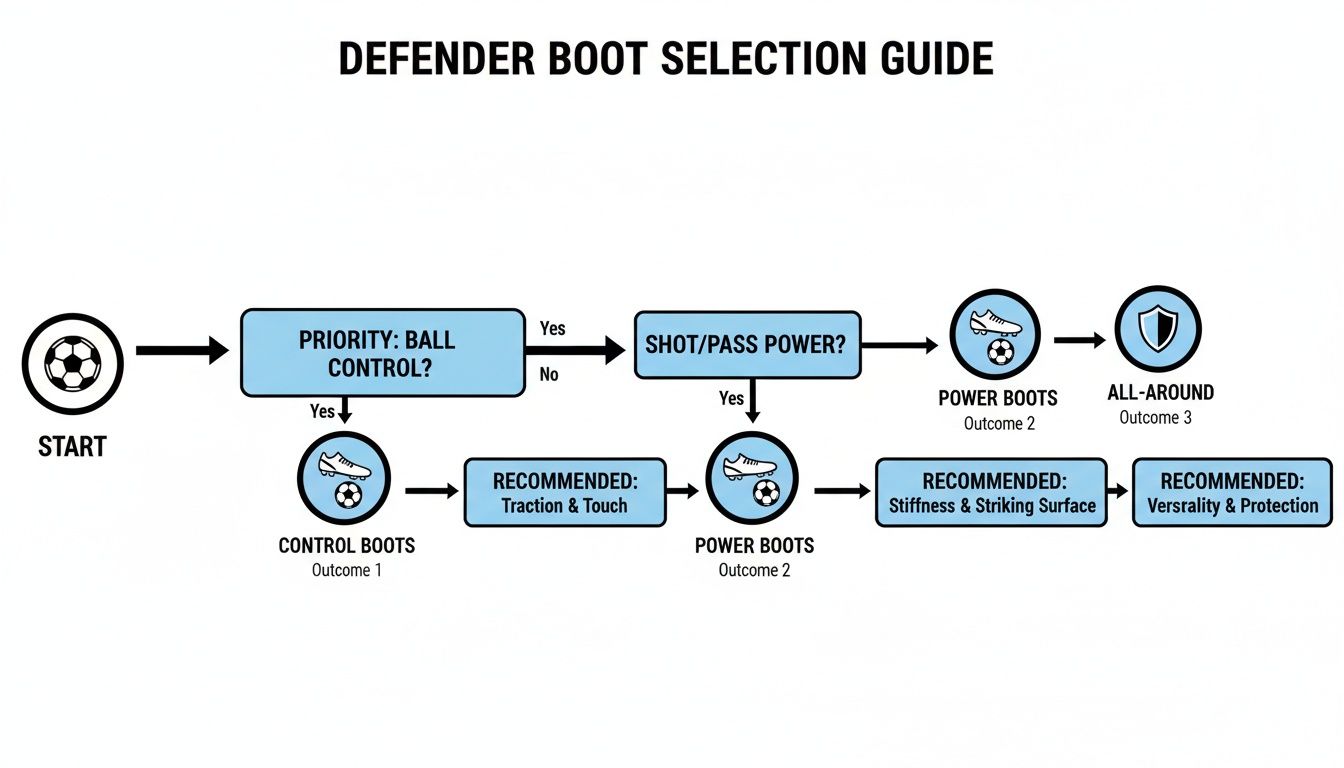
As the diagram illustrates, a defender's boot choice often comes down to identifying their primary role—is it precise distribution from the back, or is it powerful, no-nonsense clearances?
Firm Ground: The UK Standard
Firm ground (FG) boots are the workhorses of British football. They’re designed for the typical natural grass pitches found across the country, from Sunday league to professional grounds. For defenders, they are the go-to choice, commanding a huge 52.47% of the market's revenue share in 2021. This makes perfect sense; defenders need unshakeable grip for last-ditch tackles and holding a high line. An FG boot, typically with 10-14 studs, provides that stability and acceleration. You can get more details from the full analysis of the UK football shoes market.
FG boots typically feature moulded plastic studs, which come in a few key shapes:
- Conical Studs: These classic round studs are brilliant for agility. They allow your foot to pivot and turn easily in the turf, perfect for defenders who need to change direction quickly to track runners.
- Bladed Studs: Shaped like blades, these are all about aggressive traction and straight-line speed. They bite into the ground hard, giving you an explosive push-off.
- Hybrid Patterns: Most modern boots now mix conical and bladed studs to give you the best of both worlds—rotational freedom and raw grip.
Soft Ground: For the Winter Months
When the rain sets in and pitches turn heavy, your firm ground studs won't be effective. Soft ground (SG) boots become essential. An SG soleplate has fewer studs, but they are longer and almost always have metal tips.
These longer studs are designed to dig deep into wet, muddy ground, giving you the grip needed to prevent slipping. For a defender, that’s vital for winning physical battles and staying balanced during a sliding challenge. Playing on a muddy pitch in FG boots is a recipe for disaster.
A sign of a prepared player is having the right tools for the job. Keeping both an FG and an SG pair in your bag means you’re ready for whatever the British weather throws at you, ensuring your performance never drops.
Artificial and Multi-Ground Options
With the rise of 3G and 4G pitches, a new type of soleplate has become hugely important. Artificial ground (AG) boots are specifically engineered for these synthetic surfaces. They have a larger number of shorter, often hollowed-out conical studs. This design distributes your weight evenly, reducing pressure on your joints and preventing the studs from getting stuck in the artificial turf—a common cause of serious knee and ankle injuries.
For players who switch between natural grass and artificial pitches, multi-ground (MG) boots are a versatile solution. They blend stud shapes and lengths to perform reasonably well on both firm ground and modern artificial surfaces, making them a great, cost-effective option for amateur and youth players.
Crucially, never wear FG or SG boots on artificial turf. The aggressive studs aren't designed for it and pose a significant injury risk.
Top Boot Recommendations for Every Defender Profile
This section is about buying logic, not hype. Instead of pretending there is one perfect answer for every defender, use the profile below to narrow your choice by role, fit, and surface. In our review process, the best recommendations were the ones that made a player more settled in their first defensive movement, not the ones that felt the most dramatic in hand.
The Youth Academy Prospect
A developing defender usually needs one pair to cover training, matches, and mixed surfaces. That makes durability and soleplate choice more important than elite-level upper tech.
- Best if you... train on 3G during the week, play on mixed surfaces, and need one practical pair that will last.
- Avoid if you... play most matches on soft natural grass and need true winter grip.
- Look for: MG or AG soleplate, durable synthetic upper, forgiving fit through the forefoot, reinforced toe area, and sensible pricing.
- Good category examples: junior takedown versions of control or hybrid boots; dedicated AG models where available.
The fastest-growing segment in the UK market is hard ground/multi-ground (HG/MG) boots, set to outpace others through 2030 due to the explosion in community and youth football. You can explore more data on the European football boots market.
Getting the right fit is essential for a young player's development. For more detailed advice, check out our complete guide on the best football boots for kids.
The Sunday League Captain
This player needs reliability more than novelty. On rough pitches and in heavy contact, a stable leather or padded synthetic boot still makes a lot of sense.
- Best if you... want comfort, protection, and a boot that still feels trustworthy late in the season.
- Avoid if you... rely on a very close, barefoot-style touch or regularly play on modern AG surfaces with no grass matches.
- Look for: leather or thicker synthetic upper, firm heel counter, solid midfoot support, toe durability, and FG/SG options depending on conditions.
- Good category examples: classic leather boots, wider-fit control boots, or sturdy power boots with SG plates for winter.
The Versatile Full-Back
This is the defender who still has to defend first, but cannot carry a heavy boot for repeated up-and-down running. A speed-leaning boot works here only if lockdown is excellent.
- Best if you... cover huge distances, attack overlaps, and want fast transitions from defending to carrying the ball.
- Avoid if you... prefer padded contact protection or often finish games with sore feet in very thin uppers.
- Look for: low overall weight, aggressive but not overly grabby traction, tight heel fit, responsive forefoot, and an upper that feels precise at speed.
- Good category examples: speed boots on FG for natural grass; some tighter-fitting AG speed variants for turf-based players.
The Ball-Playing Centre-Back
For this role, the boot needs to help the first touch, not get in the way of passing range, and still feel secure in the box. I would not go ultra-minimal here unless your fit is perfect and you are comfortable with less protection.
- Best if you... receive under pressure, switch play often, and want a cleaner touch without giving up stability.
- Avoid if you... mainly defend on muddy natural grass and need maximum bite from a true SG setup.
- Look for: smooth or lightly textured upper, stable heel counter, balanced soleplate, medium padding, and FG or AG plate matched to your weekly surface.
- Good category examples: control boots and modern leather control hybrids; examples defenders often shortlist include adidas Predator, Nike Tiempo, and PUMA Future lines depending on fit and plate availability.
The Physical Centre-Back
This is the clearest answer for players asking what boots are good for CB. A centre-back usually benefits from more structure than a flying full-back, especially in aerial duels, clearances, and heavy contact.
- Best if you... defend your box aggressively, value planted footing, and want a boot that feels secure in every challenge.
- Avoid if you... prioritise pure speed over contact comfort or have very narrow feet that slide in broader leather lasts.
- Look for: strong heel lockdown, medium-to-high protection, stable base, dependable stud depth for your pitch, and an upper that can handle repeated impact.
- Good category examples: leather or padded synthetic power/control hybrids; Nike Tiempo and Copa-style categories suit many CBs, while some defenders also prefer a structured Predator or King-type profile.
Centre-Backs vs Full-Backs: The Key Difference
If you are buying specifically for centre-back, start by asking one question: do you want to feel planted or freed up? Most CBs should lean planted. The best boot for a centre-back usually has better heel hold, more upper substance, and a soleplate that stays calm under pressure. Full-backs can move one step lighter, especially if they overlap often, but they still should not sacrifice fit security. A boot that feels quick in a sprint test but unstable in a back-pedal or recovery turn is a poor defender choice.
Got Questions? Let's Talk Defender Boots
What is the best boot for a defender?
The best option for a defender is the boot that matches role, fit, and surface. Most defenders should start with a stable FG or SG boot that offers strong heel lockdown, reliable traction, and enough upper protection for contact. Centre-backs usually suit control, leather, or power-leaning hybrids; full-backs can go lighter if the fit remains secure.
What boots are good for CB?
Good centre-back boots are usually stable, slightly more protective, and less minimal than pure speed boots. Look for a supportive heel counter, a planted soleplate, and an upper with enough structure to handle tackles and clearances. Leather control boots and padded synthetic hybrids are often the safest starting point for CBs.
What type of football boots should defenders wear?
Defenders should wear boots built for the surface they play on and the role they perform. FG suits firm natural grass, SG suits wet or muddy natural grass, and AG suits artificial turf. In terms of style, centre-backs often do best in control or power-hybrid models, while full-backs can move toward lighter hybrids or speed boots if they still get good lockdown.
Leather or Synthetic: Which is Better for Defenders?
Leather is usually better for comfort, moulded fit, and a cushioned touch; synthetic is usually better for low maintenance, water resistance, and lower weight. If you want a traditional, protective feel, leather is hard to beat. If you want consistency in wet conditions and less break-in time, synthetic is often the smarter choice.
How Important Is Ankle Support for a Defender?
It matters, but fit matters more. A mid-cut collar can improve the feeling of security, yet it does not replace a stable heel and well-matched last shape. In my view, defenders gain more from proper lockdown and the right soleplate than from collar height alone.
How Often Should I Replace My Football Boots?
Replace them when grip, structure, or support starts to go—not by calendar alone. If the studs are worn down, the soleplate is separating, or the upper is tearing, the boot is no longer doing its job safely.
- Worn-Down Studs: Once your studs are ground down, you lose vital grip. That's not just a performance issue; it's a safety risk.
- Soleplate Separation: If the upper starts peeling away from the outsole, the boot's structure is compromised. It’s time for a new pair.
- Tears in the Upper: Any rips or holes in the material mean you’re losing the support and protection your feet need.
Regular cleaning helps them last longer, especially after winter matches; for a simple step-by-step routine, see Mystershirt. Clean them regularly and let them dry naturally, and you'll get much more life out of them.
Should I Have Different Boots for Training and Matches?
Yes, if you play regularly and can justify it. A durable training pair protects your better match pair from unnecessary wear, and separate pairs also let you keep the correct stud setup for different surfaces. That is especially useful if you train on AG but play matches on grass.
At SoccerWares, we're passionate about helping players find gear that makes a difference. From rock-solid shin guards to the latest training aids, browse our full collection to complete your kit. Visit us at https://soccerwares.com to get set for your best season yet.
| Attribute | Defender Priority | Attacker Priority |
|---|---|---|
| Protection | High | Low to Medium |
| Weight | Medium to Heavy | Low (Lightweight) |
| Stability | High | Medium |
| Traction | Aggressive Grip | Explosive Acceleration |
| Boot Model or Style | Primary Material | Key Feature Focus | Best for Player Type | Ideal Pitch Type |
|---|---|---|---|---|
| Power & Stability Boot | Thick Synthetic or Leather | Protection, Lockdown, Stability | The No-Nonsense Tackler | SG, FG |
| Control & Touch Boot | K-Leather or Thin Synthetic | Ball Feel, Comfort, Agility | The Ball-Playing Centre-Back | FG, AG |
| Speed & Agility Boot | Lightweight Synthetic | Low Weight, Aggressive Traction | The Overlapping Full-Back | FG |
| Hybrid & Versatile Boot | Balanced Synthetic Upper | All-Round Support, Durability | The Defensive Full-Back | FG, AG |