

Finding the best boots for defenders is all about matching your footwear to your job on the pitch. You need the perfect blend of protection, stability, and traction to throw yourself into game-changing tackles with complete confidence. The lightweight boots designed for flashy wingers simply won't cut it when your primary role is to be the team's rock at the back.
What Defines the Best Boots for Defenders?
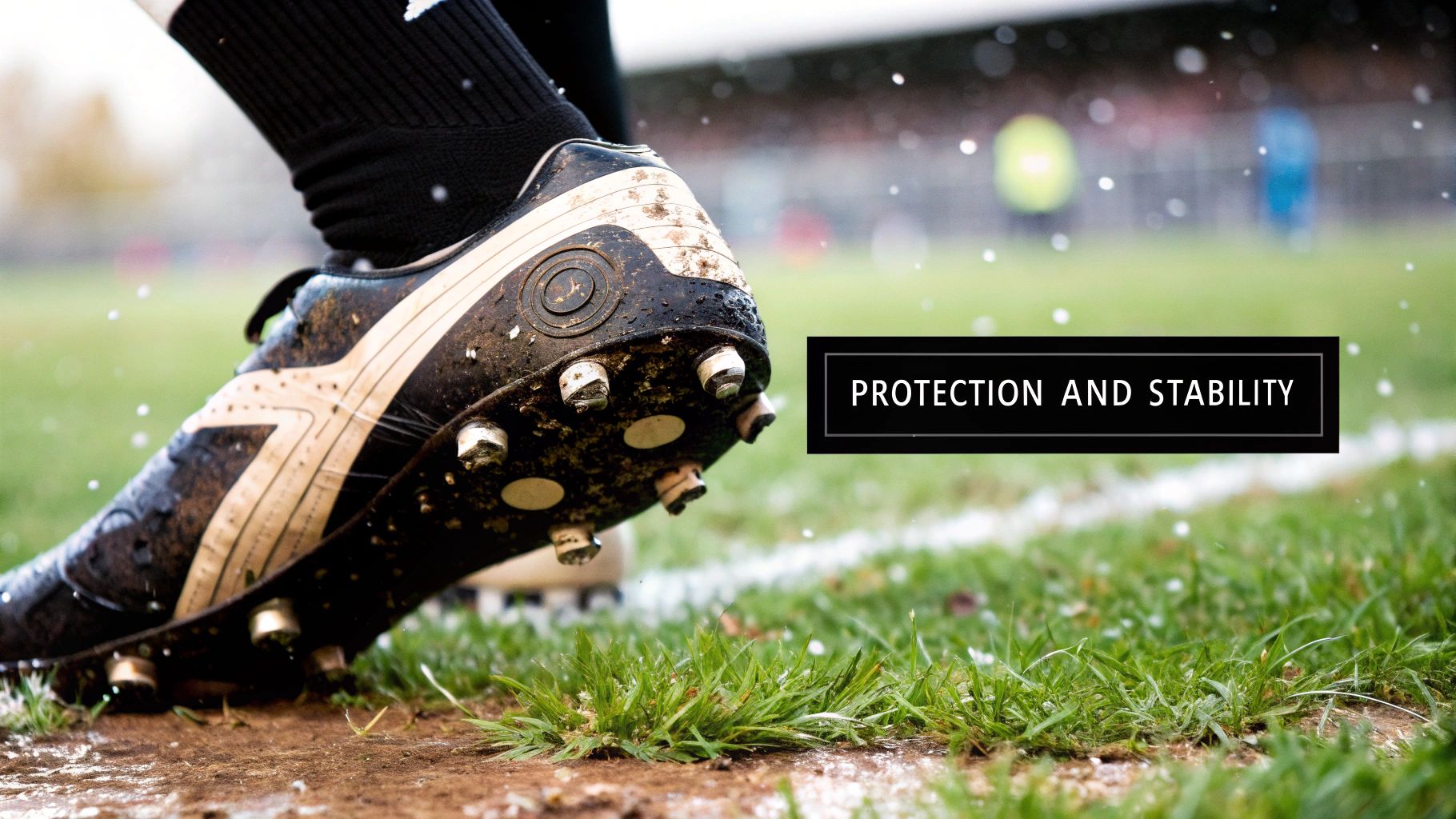
A defender’s game is built on strength, precision, and tactical awareness. Your boots are the most critical piece of your kit; they are the foundation for every tackle, interception, and commanding clearance you make. Trying to dominate an opponent in a flimsy boot designed purely for speed is a recipe for disaster.
The demands of modern defending require specialised footwear. It’s no longer just about brute force; today’s defender is a hybrid athlete. You need to be strong enough to win physical duels but also composed on the ball to launch an attack from deep. Your boots must support both sides of your game.
Core Attributes Every Defender Needs
To excel at the back, your boots must deliver in three key areas. Each one directly impacts your performance and, just as importantly, your safety on the pitch.
- Protection: Your feet are constantly in the line of fire. A robust upper and a reinforced heel counter will shield you from late challenges and stray studs, giving you the confidence to commit to every tackle.
- Stability: Quick changes of direction, last-ditch blocks, and winning headers all demand a secure, stable platform. A well-constructed boot with a strong soleplate prevents your foot from rolling and ensures your power is transferred efficiently.
- Traction: Grip is completely non-negotiable. Whether you’re holding your line or tracking a sprinting forward, the right stud pattern ensures you never lose your footing at a crucial moment.
The best boots for defenders act as both a shield and a weapon. They must be durable enough to absorb impact during a block tackle, yet sensitive enough to play a 40-yard diagonal pass to a winger.
Getting these fundamentals right is the first step towards finding your perfect pair. As you prepare for the season, remember that all your equipment plays a role in your success. You might also want to check out our guide on building the ideal football training kit to ensure you're fully equipped.
Comparing Defender Boot Priorities
To fully appreciate the unique needs of a defender, consider how your requirements differ from other positions. A winger might prioritise the lightest boot possible for raw speed, whereas a defender needs something far more substantial and protective.
| Attribute | Defender Priority | Attacker Priority |
|---|---|---|
| Protection | High | Low to Medium |
| Weight | Medium to Heavy | Low (Lightweight) |
| Stability | High | Medium |
| Traction | Aggressive Grip | Explosive Acceleration |
Anatomy of a Defender's Boot
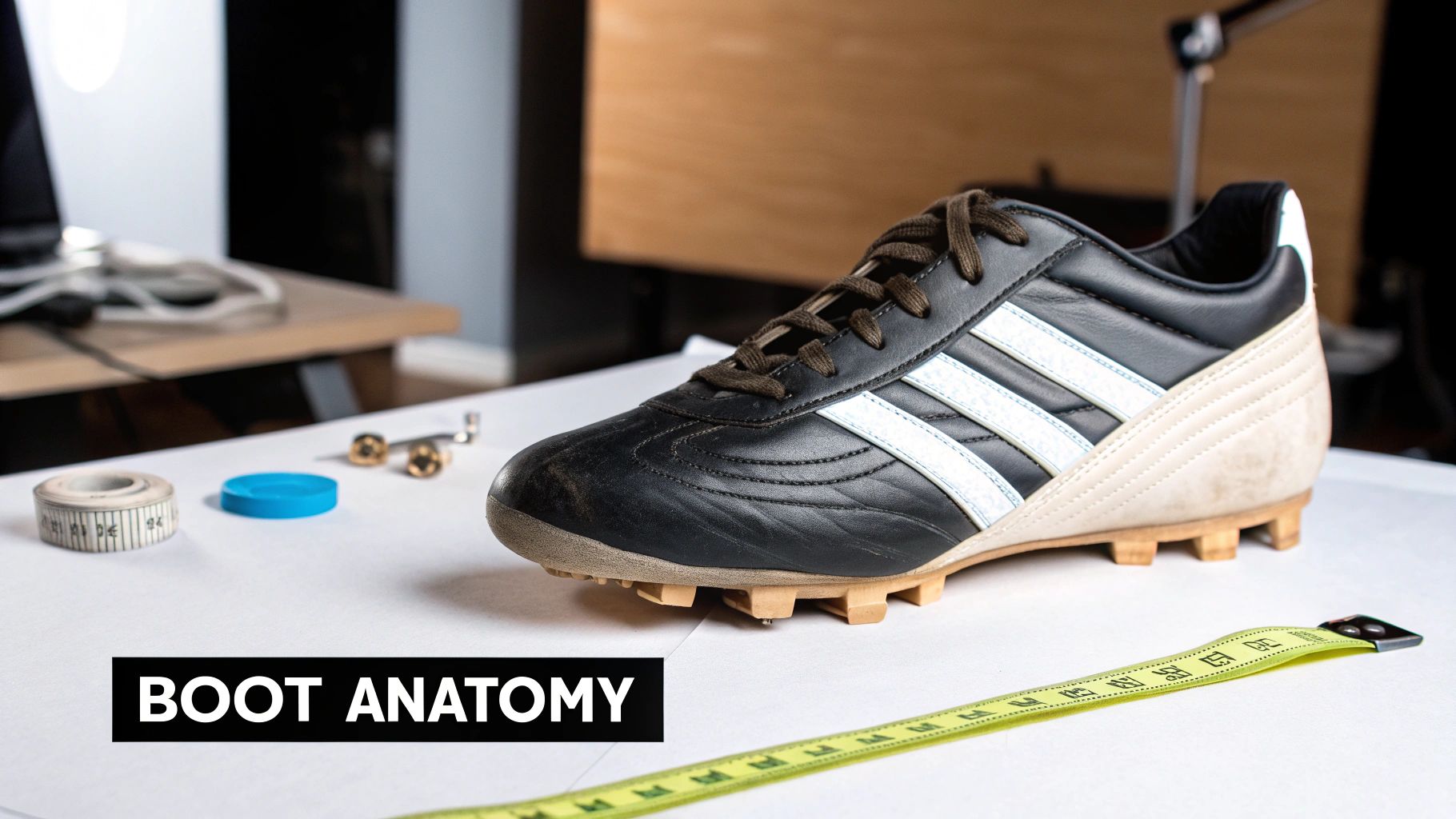
To find the right boots for a defender, you must look beyond the flashy colourways and marketing slogans. The secret lies in the construction – the specific parts of a boot that provide the grit and reliability needed at the back. When you understand a boot's anatomy, from the material on top to the studs underneath, you start to see why some are built for the unforgiving life of a defender.
Every component has a job to do, whether it's providing protection, stability, or traction. By understanding these features, you can make a smarter choice that genuinely improves your on-pitch performance, whether that's going into a crunching tackle or clearing the ball under pressure.
The Upper Materials
The upper is the part of the boot that contacts the ball and absorbs the most impact. The choice of material here is a trade-off between traditional comfort and modern performance.
Traditional leather, particularly K-leather, is renowned for its incredible softness and how it moulds to your foot over time. This provides a truly personal fit and a natural, cushioned touch on the ball – ideal for ball-playing centre-backs who value control above all else. The main drawback is that leather absorbs water, which can make the boots heavy and sluggish in wet conditions.
On the other hand, modern synthetics like Nike's Flyknit or Adidas's Primeknit offer a completely different feel. They are much lighter, water-resistant, and require almost no break-in time. They often come with textured zones or grippy coatings designed to enhance ball control, giving you consistent performance straight out of the box.
Lockdown and Support Systems
A defender's game is built on quick changes of direction and powerful challenges, which all start with a secure, stable base. This is where the heel counter and ankle collar are absolutely vital.
- External Heel Counter: This is the rigid cup at the back of the boot that locks your heel in place. It prevents your foot from sliding during sharp movements, which is crucial for maintaining stability and avoiding ankle injuries.
- Ankle Collar: Defenders can choose between traditional low-cut boots or a mid-cut, sock-like collar. This higher collar provides a sense of security around the ankle, giving many players extra confidence when committing to a tackle.
The concept of 'lockdown' isn't just about feeling snug; it's about making every movement efficient. When your foot is securely locked in, no energy is wasted. Every step, jump, and challenge becomes more explosive and decisive.
This secure foundation is everything. It allows you to plant your feet with total confidence before making that crucial interception or block. It’s just as important as protecting your shins, a topic we cover in our guide to the best shin guards for soccer.
Outsole and Stud Pattern
Finally, we get to the part that connects you to the ground: the outsole and its stud pattern. For a defender who needs to shadow tricky wingers or stand firm against a target man, getting this right is non-negotiable.
The soleplate itself needs to be rigid enough to provide a stable platform but still have enough flex in the forefoot to allow natural movement. It's the studs, however, that truly define performance, and they come in different configurations for different pitches:
- Firm Ground (FG): The most common setup, featuring moulded plastic or rubber studs (either bladed or conical) designed for dry, natural grass.
- Soft Ground (SG): Essential for wet, muddy pitches. These use longer, often metal-tipped studs that dig deep into the turf for maximum grip when you need it most.
- Artificial Ground (AG): These feature numerous shorter, hollowed-out conical studs. They're designed to distribute your weight evenly and prevent your studs from getting stuck in 3G or 4G turf.
Choosing the wrong stud pattern isn’t just detrimental to your performance – it’s a serious injury risk. A defender needs the right tools for the job, and that starts from the ground up.
Comparing Boots for the Modern Defender
Let's be clear: finding the single "best" boot for a defender isn't the goal. It's about matching the right tool to your specific role on the pitch. The modern defender is a chameleon; one minute you're a ball-playing centre-back starting an attack, the next you're a hard-tackling full-back making a last-ditch challenge.
So, instead of a simple ranked list, we’ll break down boot profiles based on how you actually play the game. This approach will help you identify which features will genuinely support you, turning your boots into an extension of your skills.
The No-Nonsense Tackler vs The Ball-Playing Centre-Back
At the heart of defence, two main styles have emerged: the old-school, rugged enforcer and the modern, composed playmaker. Their footwear needs could not be more different.
The no-nonsense tackler is all about one thing: defending. Winning headers, blocking shots, and putting in crunching (but fair!) challenges are their bread and butter. For this player, the boot is their fortress.
- Protection is paramount: They need a boot with a tough, often thicker upper. Think classic leather or a reinforced synthetic that can take a beating and protect the foot.
- Stability is a must: A rigid soleplate and a solid external heel counter are vital. This provides a rock-solid base for physical battles and desperate lunges.
- Grip for raw power: Look for an aggressive stud pattern, often with bladed or hybrid studs, to really dig into the turf and plant your feet with authority.
In contrast, the ball-playing centre-back is the team's first attacker. Their game is built on an excellent first touch, pinging long-range passes, and having the composure to play out from the back under pressure.
- Touch and feel are vital: A thinner, more sensitive upper—like a lightweight synthetic or premium K-leather—is the go-to for a closer, more natural feel on the ball.
- Comfort equals control: These boots often feature a snug, sock-like fit that lets the foot move naturally, which is crucial for dribbling out of tight spaces.
- Lighter for agility: While not as feather-light as a winger's boot, they are certainly less bulky than a traditional defender's to aid quicker, sharper movements.
The Overlapping Full-Back vs The Defensive Full-Back
The full-back role has also split into two distinct styles, each requiring different tools for the job.
The overlapping full-back is effectively a winger and a defender rolled into one. They need boots that can handle explosive sprints up the line, delivering crosses, and then tracking back at full speed. Their footwear should be light and aggressive, almost identical to what an attacker might wear. A streamlined design, a responsive soleplate, and bladed studs for straight-line speed are perfect.
The defensive full-back, however, is more of a classic defender playing out wide. Their number one job is to shut down the opposition's winger. They will benefit more from boots that offer greater stability for 1-v-1 duels and a secure lockdown for quick changes of direction. While they still need to be agile, their boot choice leans more towards security than pure, raw speed.
The modern game has blurred the lines. A centre-back might need the touch of a midfielder, while a full-back needs the speed of a winger. Your boot choice should reflect your own unique mix of defensive duties and attacking flair.
To see these differences more clearly, let's compare some boot features for these player types. Getting the right pair can make a huge difference, just as the right accessories can. For example, pairing your boots with the best football grip socks can give you that extra bit of in-boot stability and responsiveness.
Defender Boot Comparison by Playing Style
This table breaks down the ideal features for each defensive archetype, helping you pinpoint the boot style that best aligns with your on-pitch responsibilities.
| Boot Model or Style | Primary Material | Key Feature Focus | Best for Player Type | Ideal Pitch Type |
|---|---|---|---|---|
| Power & Stability Boot | Thick Synthetic or Leather | Protection, Lockdown, Stability | The No-Nonsense Tackler | SG, FG |
| Control & Touch Boot | K-Leather or Thin Synthetic | Ball Feel, Comfort, Agility | The Ball-Playing Centre-Back | FG, AG |
| Speed & Agility Boot | Lightweight Synthetic | Low Weight, Aggressive Traction | The Overlapping Full-Back | FG |
| Hybrid & Versatile Boot | Balanced Synthetic Upper | All-Round Support, Durability | The Defensive Full-Back | FG, AG |
Ultimately, the best boots for defenders are the ones that give you the confidence to do your job without a second thought. By taking a hard look at your own playing style and matching it against these profiles, you can see past the brand hype and choose boots that will actually improve your game where it matters most.
Choosing the Right Studs for UK Pitches
Your boots might feel perfect, but if the studs aren’t right for the pitch, your performance will suffer. This is especially true for defenders in the UK, where a pitch can transform from a rock-hard August surface to a rain-sodden bog by December. Picking the right stud pattern isn’t a minor detail; it's a non-negotiable part of your toolkit that directly impacts whether you stay on your feet during a crucial tackle.
The right studs give you the traction to shadow attackers, plant your feet for a block, and drive forward with the ball. Get it wrong, and you're not just hindering your performance—you’re seriously increasing your risk of injury. A slip at the wrong moment can lead to a goal conceded or, even worse, a twisted ankle or knee.
This flowchart is a great starting point, helping you decide whether your game is built more around ball control or raw power.
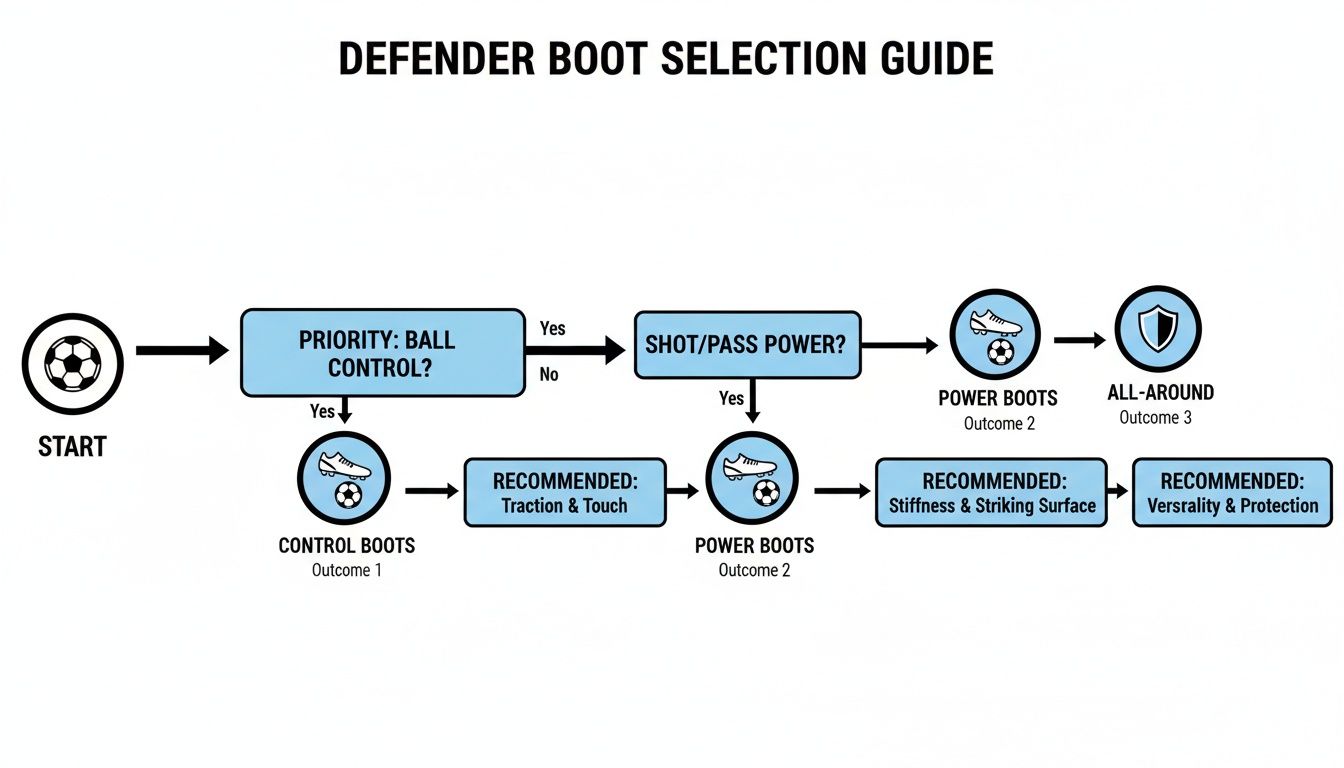
As the diagram illustrates, a defender's boot choice often comes down to identifying their primary role—is it precise distribution from the back, or is it powerful, no-nonsense clearances?
Firm Ground: The UK Standard
Firm ground (FG) boots are the workhorses of British football. They’re designed for the typical natural grass pitches found across the country, from Sunday league to professional grounds. For defenders, they are the go-to choice, commanding a huge 52.47% of the market's revenue share in 2021. This makes perfect sense; defenders need unshakeable grip for last-ditch tackles and holding a high line. An FG boot, typically with 10-14 studs, provides that stability and acceleration. You can get more details from the full analysis of the UK football shoes market.
FG boots typically feature moulded plastic studs, which come in a few key shapes:
- Conical Studs: These classic round studs are brilliant for agility. They allow your foot to pivot and turn easily in the turf, perfect for defenders who need to change direction quickly to track runners.
- Bladed Studs: Shaped like blades, these are all about aggressive traction and straight-line speed. They bite into the ground hard, giving you an explosive push-off.
- Hybrid Patterns: Most modern boots now mix conical and bladed studs to give you the best of both worlds—rotational freedom and raw grip.
Soft Ground: For the Winter Months
When the rain sets in and pitches turn heavy, your firm ground studs simply won't be effective. This is where soft ground (SG) boots become essential. An SG soleplate has fewer studs, but they are longer and almost always have metal tips.
These longer studs are designed to dig deep into wet, muddy ground, giving you the grip needed to prevent slipping. For a defender, that’s vital for winning physical battles and staying balanced during a sliding challenge. Playing on a muddy pitch in FG boots is a recipe for disaster.
A sign of a prepared player is having the right tools for the job. Keeping both an FG and an SG pair in your bag means you’re ready for whatever the British weather throws at you, ensuring your performance never drops.
Artificial and Multi-Ground Options
With the rise of 3G and 4G pitches, a new type of soleplate has become hugely important. Artificial ground (AG) boots are specifically engineered for these synthetic surfaces. They have a larger number of shorter, often hollowed-out conical studs. This design distributes your weight evenly, reducing pressure on your joints and preventing the studs from getting stuck in the artificial turf—a common cause of serious knee and ankle injuries.
For players who switch between natural grass and artificial pitches, multi-ground (MG) boots are a versatile solution. They blend stud shapes and lengths to perform reasonably well on both firm ground and modern artificial surfaces, making them a great, cost-effective option for amateur and youth players.
Crucially, never wear FG or SG boots on artificial turf. The aggressive studs aren't designed for it and pose a significant injury risk.
Top Boot Recommendations for Every Defender Profile
Choosing the right boot isn't about picking the flashiest brand—it’s about matching the tool to the job. A boot that feels perfect for a dominant, no-nonsense centre-back will feel clunky and slow on an overlapping full-back.
To cut through the noise, I’ve broken it down by the type of defender you are. This isn't a top-ten list; it's a practical guide based on real-world player profiles, from the youth academy pitches to the muddy battlegrounds of Sunday League.
The Youth Academy Prospect
This young player is still developing their game, training on everything from pristine grass to worn-out 3G pitches. Their boots must be tough enough for daily sessions, protective for growing feet, and versatile enough to handle different surfaces without needing three different pairs.
- Key Needs: Durability, protection, versatility, and a sensible price.
- Ideal Boot Type: A mid-tier, multi-ground (MG) or artificial ground (AG) boot is a perfect choice. These models borrow features from high-end boots but are constructed with more robust materials. The stud patterns are designed to provide reliable, safe traction on both natural grass and artificial turf.
The fastest-growing segment in the UK market is hard ground/multi-ground (HG/MG) boots, set to outpace others through 2030 due to the explosion in community and youth football. You can explore more data on the European football boots market.
Getting the right fit is crucial for a young player's development. For more detailed advice, check out our complete guide on the best football boots for kids.
The Sunday League Captain
This player is the heart and soul of the team, playing for the love of the game on pitches that are often unpredictable. They need a no-fuss boot that is comfortable, highly protective, and won't fall apart after a few heavy tackles in the mud.
- Key Needs: Maximum protection, comfort, and rugged durability.
- Ideal Boot Type: You can't go wrong with a classic leather boot. Models with K-leather or premium calfskin uppers mould to your foot over time, offering a custom fit and unmatched comfort. Their solid build provides excellent protection, and with an SG soleplate, they become a formidable tool on wet, heavy pitches.
The Versatile Full-Back
The modern full-back has two jobs: defend tenaciously, then attack with explosive pace. They cover more ground than almost anyone, so they need a boot that's light enough for sprinting but stable enough for 1-v-1 duels.
- Key Needs: A lightweight design, aggressive traction for quick acceleration, and a secure, locked-down feel.
- Ideal Boot Type: A speed-focused boot is the best match here, usually made from a thin, lightweight synthetic. These often feature bladed studs on an FG soleplate, designed to dig into the turf for instant, straight-line speed. The snug, sock-like fit locks your foot in, giving you the confidence to bomb up and down the wing all game long.
The Ball-Playing Centre-Back
This isn't just a defender; they're the team's deep-lying playmaker, launching attacks from the back with pinpoint passes. They need a boot that offers a clean touch on the ball without sacrificing the stability needed to command the penalty area.
- Key Needs: An excellent feel for the ball, a comfortable fit, and a stable soleplate.
- Ideal Boot Type: A "control" boot is the answer. These often have textured synthetic uppers or soft K-leather to improve grip and touch. They are lighter than old-school defensive boots but still have a strong heel counter and a supportive chassis. An FG or AG plate with a hybrid stud pattern provides the perfect mix of agility and secure footing for this modern role.
Got Questions? Let's Talk Defender Boots
Picking the right boots can feel like navigating a minefield of technical jargon and marketing hype. To cut through the noise, I've rounded up some of the most common questions defenders ask when searching for a new pair.
Think of this as a final checklist to ensure you're investing in boots that will genuinely support you on the pitch.
Leather or Synthetic: Which is Better for Defenders?
This is one of the biggest debates in the boot world, and there is no single right answer. It all comes down to what you value most: touch and comfort, or consistency and low maintenance.
Traditional K-leather boots are legendary for a reason. They offer an incredibly soft touch on the ball and mould to your feet over time for a custom-like fit. If you’re a ball-playing centre-back who loves pinging diagonals, that natural feel is hard to beat. The downside? Leather absorbs water, making the boots heavy in the rain and requiring more care to keep them in top shape.
Conversely, modern synthetic uppers are lightweight, water-resistant, and ready to go straight out of the box with zero break-in time. Many even feature textured surfaces to provide extra grip in wet weather. For no-nonsense defenders who just want a reliable boot that performs consistently week in, week out, synthetics are often the smarter choice.
How Important Is Ankle Support for a Defender?
Ankle support is a huge consideration for defenders. Your job involves aggressive tackles, sharp turns, and jumping for headers—all movements that put significant strain on your ankle joints.
Boots with a mid-cut collar, often called a "sock-like" fit, provide a fantastic locked-in feeling and an extra sense of security. It's important to remember they aren't a medical brace, but they do improve your brain's awareness of your ankle's position (proprioception). That small amount of extra feedback can make all the difference when you're committing to a 50/50 challenge.
An old-school, tough-tackling centre-back might love the structured feel of a mid-cut boot. In contrast, a rapid full-back who relies on pure agility for overlapping runs might prefer the total freedom of a classic low-cut design.
How Often Should I Replace My Football Boots?
There is no magic expiry date on a pair of boots. Their lifespan depends on how often you play, the quality of the boots, the pitches you play on, and how well you look after them.
As a general rule, if you’re playing or training two to three times a week, a quality pair should last you a full season. But instead of counting the months, learn to spot the tell-tale signs of a boot on its last legs.
- Worn-Down Studs: Once your studs are ground down, you lose vital grip. That's not just a performance issue; it's a safety risk.
- Soleplate Separation: If the upper starts peeling away from the outsole, the boot's structure is compromised. It’s time for a new pair.
- Tears in the Upper: Any rips or holes in the material mean you’re losing the support and protection your feet need.
A quick tip: using the wrong studs for the surface (like firm ground boots on artificial turf) will destroy them very quickly. Clean them regularly and let them dry naturally, and you'll get much more life out of them.
Should I Have Different Boots for Training and Matches?
For anyone playing regularly, this is a very smart move. While not essential, keeping separate pairs for training and matches has genuine practical benefits.
Training is where you put in the hard work and repetitive drills. Using a more durable, and often cheaper, pair for those sessions saves your best boots from unnecessary wear and tear. This means your premium match-day pair stays in prime condition for when it counts, giving you that extra confidence on game day.
It also allows you to be prepared for different conditions. Many players train on an artificial pitch but play their matches on grass, so having two pairs with the correct stud patterns makes perfect sense.
At SoccerWares, we're passionate about helping players find gear that truly makes a difference. From rock-solid shin guards to the latest training aids, check out our full collection to complete your kit. Visit us at https://soccerwares.com to get set for your best season yet.