

When you’re a defender, your boots aren't just footwear; they're your most important tools. The best ones offer a triple-threat of protection, stability, and aggressive traction. It's why models like the Nike Tiempo, Adidas Copa Pure, and Puma King Ultimate are mainstays in the backline. They're built tough and give you a locked-in fit without making you feel like you’ve got bricks on your feet—perfect for the physicality of the modern game.
What Defines the Best Football Boots for Defenders
Picking the right boot is a tactical decision, not just a matter of brand loyalty or flashy colours. The job demands crunching tackles, sudden changes of direction, and winning aerial duels. That means you need boots engineered for those specific moments. Unlike a winger’s feather-light speed boot, a defender’s boot needs to be both a weapon and a shield.
Every feature serves a purpose. A reinforced upper isn't just for show; it’s there to protect you when you throw your body in front of a rocket of a shot or go steaming into a 50/50 challenge. Likewise, a solid heel counter and a secure lacing system are non-negotiable. They stop your foot from sliding around inside the boot when you’re jockeying a tricky attacker, which is the last thing you want in a critical moment.
The Four Pillars of a Defender's Boot
To cut through the marketing noise, let's break it down into four core pillars. Get these right, and you'll have a boot that won't let you down when the whistle blows.
- Protection: Your boots are your first line of defence. You need a durable upper, maybe with some extra padding in high-impact zones, to absorb the force from tackles and big clearances. While you're kitting up, check out our guide on the best shin pads for football to complete your defensive armour.
- Stability: A locked-in feel is everything for balance and power. Look for boots with a firm soleplate, a supportive heel, and a snug fit that stops your foot from moving around. It’s what allows you to plant your feet with absolute confidence.
- Traction: You need an aggressive grip for quick bursts of acceleration and slamming on the brakes. The stud configuration must give you a reliable connection to the pitch, whether you’re tracking a run or making that last-ditch tackle.
- Comfort: For all the talk of toughness, comfort is king. A boot that fits well and doesn't cause blisters means you can stay focused on the match for the full 90 minutes, not on your aching feet.
Defender's Boot Feature Priority Checklist
To make your search easier, here's a quick checklist summarising the must-have features and explaining why they matter for your position. Think of this as your cheat sheet for finding the perfect pair of defender's boots.
| Feature | Why It's Critical for Defenders | What to Look For in a Boot |
|---|---|---|
| Durable Upper Material | Withstands tackles, blocks, and clearances while shielding the foot from impact. | Reinforced synthetics or robust leather uppers with protective elements. |
| Locked-In Fit & Support | Prevents foot slippage during quick pivots and changes of direction, reducing injury risk. | A secure lacing system, a firm heel counter, and a snug midfoot construction. |
| Aggressive Stud Pattern | Ensures maximum grip for explosive movements, standing tackles, and holding your ground. | Bladed or conical studs on a firm soleplate designed for stability. |
| Cushioning & Comfort | Absorbs impact during 90 minutes of play, reducing fatigue and preventing blisters. | A well-padded interior, a moulded sockliner, and a comfortable collar. |
This table gives you a solid foundation, but remember that the right boot is also a personal choice. What works for one centre-back might not suit another, so always prioritise what feels right for your foot and your style of play.
Your boots are crucial, but don't forget that peak physical conditioning is just as vital for a defender. Fuelling your body right is part of the job. Checking out some healthy recipes for athletes can give you great ideas for staying match-fit.
Why Specialised Defender Boots Are on the Rise
Long gone are the days when one boot was expected to do it all. The modern game is all about specifics, and defenders are finally getting the specialised tools they deserve. This isn't just a trend; it's a shift driven by a deeper understanding of player performance and a massive focus on preventing injuries, from Sunday league right up to the professional game.
As football gets faster and more physical, the demand for boots built for stability, protection, and aggressive traction has shot up. Brands are now engineering designs that cater directly to the needs of a centre-back throwing themselves into a last-ditch block or a full-back trying to contain a lightning-fast winger. For us defenders, this means more choice and, ultimately, better performance.
A Market Fuelled by Passion
The UK’s obsession with football is what's really pushing this innovation forward. The market for football boots isn't just big; it's growing. In fact, the United Kingdom's football boots market recently hit a valuation of USD 984.93 million, a number that truly reflects the country's passion for the beautiful game.
This massive market is projected to grow at a compound annual growth rate (CAGR) of 4.8%, which guarantees a steady flow of investment into new boot technology. You can read more about what’s driving these trends over at Cognitive Market Research. For defenders, this is brilliant news. It means manufacturers are putting more time and money into creating boots that meet our unique demands—things like proper ankle support and aggressive stud patterns—which in turn gets players spending and fuels even more innovation.
Access and Innovation for Modern Defenders
This growing market has also completely changed how we shop for boots. Online specialists like SoccerWares now give defenders access to a massive range of specialised boots that you just wouldn't find in a local sports shop. You're no longer limited by what's on the shelf; you can compare models from all over the world to find the perfect fit for your game.
This shift means that investing in a pair of the best football boots for defenders is now a strategic choice. It's about more than just buying new gear; it's about equipping yourself with technology specifically designed to make you a better defender.
At the end of the day, the rise of specialised boots gives you a real advantage on the pitch. The right pair can improve your stability in a 50/50 challenge, give you more confidence in your movement, and help reduce the risk of injury. It's a key part of mastering your position, and you can sharpen your skills even further by checking out our guide on essential drills for soccer defenders to go with your new boots.
Choosing the Right Soleplate for Defensive Dominance
Your connection to the pitch is everything. For a defender, the soleplate and stud setup isn't just a part of the boot; it’s the foundation for every single tackle, interception, and change of direction you make. Get this wrong, and you're risking a slip at the worst possible moment or, even worse, an injury.
Matching your boot to the ground you play on is non-negotiable. You'll mainly come across three types: Firm Ground (FG), Soft Ground (SG), and Artificial Ground (AG). Each one is built for a specific surface to give you the best possible grip and stability, so you can play with confidence no matter the conditions.
For most of us playing in the UK, Firm Ground boots are the go-to. They’re designed for the typical natural grass pitches you find from autumn through to spring—surfaces that are either dry or just a bit damp. Their versatility is why they're the most popular choice by a country mile.
The Firm Ground Advantage for Defenders
Firm Ground football boots dominate the global football footwear market, making up over 45% of all sales. These boots are engineered for natural grass and usually have between 10 to 14 studs, striking a perfect balance between grip and comfort. For defenders, whose job demands rock-solid stability for quick turns and strong ankle support during physical battles, the design of FG boots is a massive plus. You can find more details on this trend over at SkyQuestt.
This graphic gives you a quick look at how the market for defender-specific boots is growing, showing the market size, the UK's slice of the pie, and what to expect in the coming years.

The numbers make it clear: as the market gets bigger, we can expect even more innovation in boots designed just for defenders, offering players better options for stability and traction.
Stud Configurations: Conical vs Bladed
It's not just about the ground type; the shape of the studs themselves makes a huge difference to how a boot feels and performs. The two main shapes you’ll see are conical (round) and bladed (or chevron-shaped). Each one offers something different for specific defensive actions.
- Conical Studs: These classic round studs are brilliant for rotational freedom. This makes them perfect for defenders who need to pivot quickly, jockey attackers, and change direction without getting their studs caught in the turf. They provide a stable, reliable base for agile movement.
- Bladed Studs: These studs are shaped to really dig into the ground, giving you aggressive, straight-line traction. They're ideal for defenders who need that explosive burst of speed to track a forward or plant their feet firmly for a big standing tackle. The trade-off? You get less rotational agility compared to conical studs.
For the modern defender, a hybrid stud pattern often gives you the best of both worlds. Many of the top boots for defenders now mix conical studs for pivoting with bladed studs for aggressive stopping and starting, giving you a balanced and adaptable foundation for your game.
Defender's Guide to Soleplate and Stud Configurations
Choosing the right soleplate can feel complicated, but it all comes down to where you play and what you need from your boots. This table breaks down the main options to help you find the perfect match for your defensive style.
| Soleplate Type | Primary Playing Surface | Best For Defensive Action | Pros for Defenders | Cons for Defenders |
|---|---|---|---|---|
| Firm Ground (FG) | Natural grass (dry to slightly wet) | All-round defending, quick changes of direction | Versatile, balanced grip and stability, comfortable on most pitches. | Can lose grip on very wet or muddy surfaces. |
| Soft Ground (SG) | Natural grass (wet and muddy) | Last-ditch tackles, holding your ground in the wet | Unbeatable traction in mud, prevents slipping, metal tips dig in deep. | Can feel uncomfortable on firm pitches, higher injury risk on wrong surface. |
| Artificial Ground (AG) | 3G/4G artificial turf | Agile movements, rapid acceleration and deceleration | Numerous shorter studs distribute pressure evenly, reduces joint strain. | Not suitable for natural grass; lacks the bite needed for mud. |
| Multi-Ground (MG) | Hybrid of natural and artificial grass | Versatile play, switching between surfaces | A good compromise for players on different pitch types, durable. | Not a specialist; won't offer peak performance on either extreme. |
Ultimately, the best choice is the one that gives you the most confidence on the pitch. Think about your most common playing conditions and choose the soleplate that delivers the grip you need to dominate.
Making the Right Choice for Your Game
When picking a soleplate, be honest about the pitches you play on most often. If you’re battling it out on wet, muddy fields all winter, a pair of Soft Ground (SG) boots with their longer, metal-tipped studs is essential to stop you from sliding all over the place. On the flip side, if your league plays on 3G or 4G pitches, you absolutely need a pair of Artificial Ground (AG) boots for both safety and performance.
Your soleplate is your anchor. A centre-back who's constantly twisting and turning to shadow a striker might prefer the freedom of conical studs. In contrast, a full-back who lives and dies by explosive sprints up the wing will probably get more out of the aggressive bite from bladed studs. And to really complete that locked-in feel, check out our guide on how football grip socks can boost performance for that extra bit of stability inside your boot.
Leather vs Synthetic: Which Upper Is Best for Defenders?
The material wrapped around your foot—the upper—is more than just a cover. It dictates the fit, the feel on the ball, and how well your boots hold up after a crunching tackle. For defenders, this choice usually comes down to two camps: the old-school comfort of natural leather or the lightweight resilience of modern synthetics.
Each one brings something different to the pitch, and what's best for you really depends on your style of play.
A ball-playing centre-back who prizes a soft touch for spraying passes from the back might naturally gravitate towards a classic leather boot. On the other hand, a no-nonsense, old-school defender who spends 90 minutes battling strikers will probably prefer a tough, easy-to-clean synthetic. There's no single right answer here, just a series of trade-offs.
The Case for Classic Leather
For decades, premium kangaroo leather (K-leather) was the undisputed king of football boot uppers, and for good reason. Its superpower is its ability to mould perfectly to the unique shape of your foot over time. This creates a bespoke, glove-like fit that’s incredibly difficult for any man-made material to replicate, offering exceptional comfort that keeps you focused for the full match.
Leather also gives you a padded, cushioned touch on the ball that many defenders swear by. When you’re plucking a long ball out of the air under pressure or making a firm clearance, that forgiving feel can give you an extra layer of confidence. Boots like the Adidas Copa Mundial and Nike Tiempo have built their legacies on this exact principle, delivering reliable performance that players have trusted for generations.
But that premium feel comes with a bit of homework.
- Maintenance: Leather needs regular cleaning and conditioning to stop it from drying out, cracking, and losing its shape.
- Water Absorption: In the rain, leather tends to soak up water, making your boots heavier and take much longer to dry.
- Stretch: While that initial stretch is great for comfort, leather can sometimes overstretch, leading to a less secure fit later in its life.
The Rise of Modern Synthetics
In contrast, synthetic uppers are engineered for consistent performance with minimal fuss. They're almost always lighter than their leather counterparts and are seriously durable, standing up well to the scrapes and stamps that come with the territory. Synthetics are also highly water-resistant, meaning your boots won't get waterlogged and heavy during a rainy Sunday league mud-fest.
One of the biggest wins for synthetics is the innovation they allow. Brands can build specific technologies right into the upper, like textured grip zones designed to add extra purchase when you’re hoofing the ball clear. For example, boots like the Puma King Ultimate now use a synthetic "K-Better" upper, which tries to mimic the feel of leather while giving you all the perks of a modern material. This means you get a boot that needs virtually no break-in time and holds its shape for its entire lifespan.
The key trade-off with synthetics has always been the on-foot feel. While they've come a long, long way, they rarely achieve that same custom-moulded, second-skin fit that a premium K-leather boot offers after it's been properly broken in.
Making the Right Choice for Your Game
So, how do you decide? The choice between leather and synthetic uppers is one of the most important you'll make when picking the best football boots for defenders. It really boils down to your personal priorities on the pitch.
If your game is built on pure comfort and a first-class touch—and you don’t mind a bit of post-match boot care—then a classic leather boot is an outstanding choice. The way it shapes to your foot is an advantage that can make a real difference in how connected you feel to the ball.
However, if you put a premium on a lightweight feel, low maintenance, and reliable performance in all weather, a synthetic upper is probably the smarter bet. It gives you a durable, consistent platform that’s ready to go straight out of the box.
Ultimately, whether you choose the heritage of leather or the innovation of synthetics, make sure your choice is backed up by solid protection, like the durable shin guards available at SoccerWares, to stay safe in every challenge.
Top 3 Best Football Boots for Defenders
Right then, let's get into the boots. Now that we've broken down what defenders should be looking for, it's time to look at specific models that genuinely deliver on the pitch. We've split our top picks into defender 'archetypes', because let's be honest, the needs of a bruising, old-school centre-back are worlds apart from a modern, overlapping full-back.
This approach should help you cut through the marketing noise and find a boot that actually complements your style of play.
The global football boot market is booming, currently sitting at around USD 25.5 billion and on track to hit USD 50.2 billion by 2035. This isn't just about flashy new colourways; it's driving real innovation. We're seeing more specialised tech than ever, with things like reinforced lateral support and advanced traction systems becoming the norm. You can get into the nitty-gritty of the numbers in this football shoes market report.
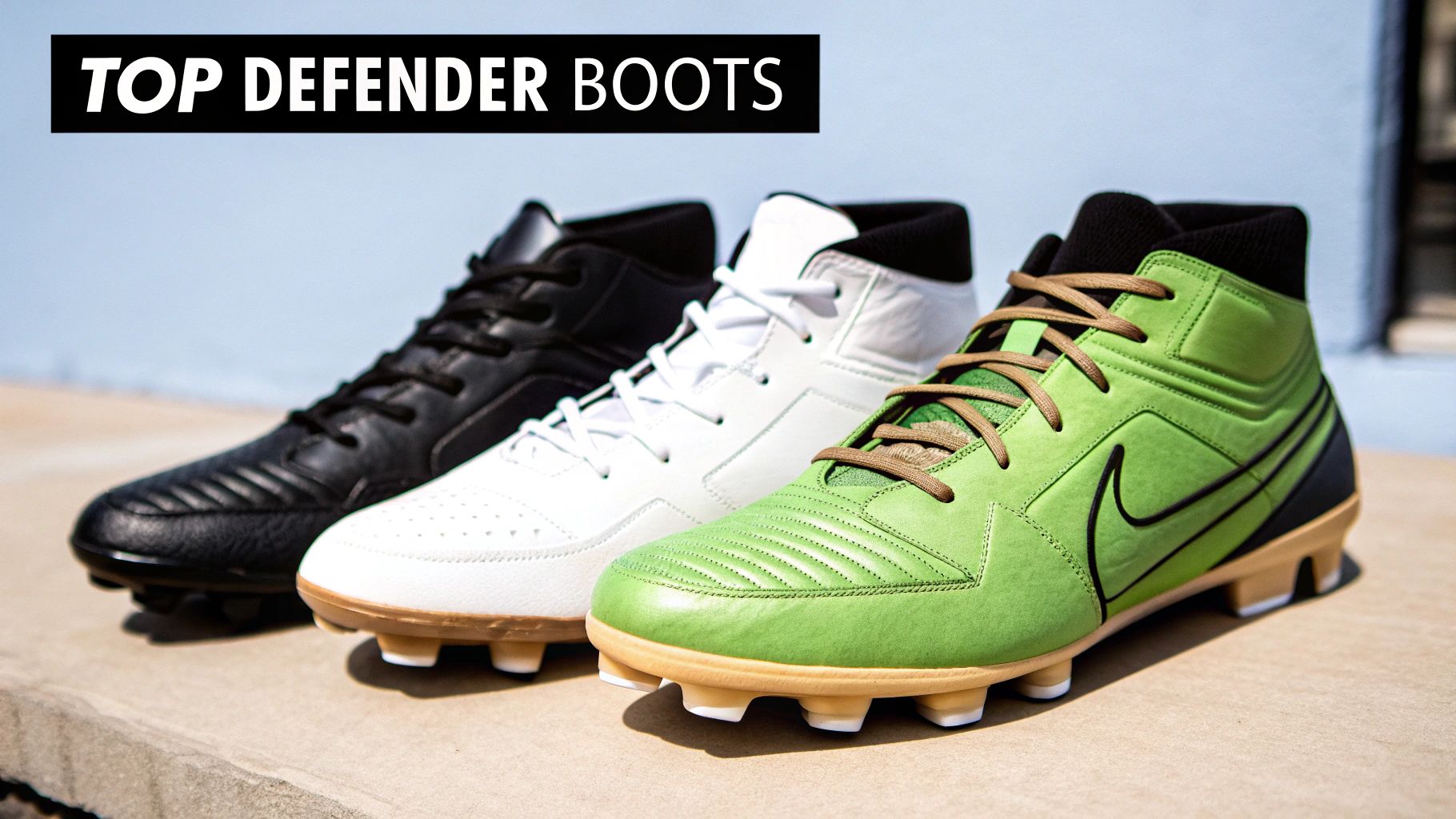
For the No-Nonsense Centre-Back
We all know this player. They're the rock at the heart of the defence, the one you can always rely on. Their game is built on strength, perfect positioning, and decisive, crunching tackles. They need a boot that offers maximum protection, a locked-in fit, and uncompromising stability for winning headers and standing their ground.
Our top pick for this role has to be the Nike Tiempo Legend. For years, the Tiempo has been the go-to for comfort and reliability, which is why you'll see players like Virgil van Dijk lacing them up.
- Key Feature – FlyTouch Plus: This synthetic upper is a smart move from Nike. It's engineered to be softer and more mouldable than the old leather versions, giving you a custom-like fit without absorbing water and getting heavy halfway through a wet game.
- Why It Works for Defenders: The padded upper gives you that bit of extra confidence and protection when you're throwing yourself into blocks and challenges. Plus, the classic stud pattern provides a solid, stable base for planting your feet. It's so comfortable you can forget you're wearing it and just focus on the game.
For the Ball-Playing Defender
This is the modern defender—just as comfortable spraying a 60-yard pass as they are making a last-ditch tackle. They start attacks from deep, so they need a boot that gives them a sensitive touch, fantastic comfort, and a clean striking surface for pin-point distribution.
The clear winner here is the Adidas Copa Pure. It's a boot worn by players who value control and finesse, blending that classic leather feel with modern performance.
- Key Feature – Fusionskin Leather: The quilted Fusionskin leather in the forefoot feels incredible. It offers a seamless, cushioned touch on the ball and moulds to your foot beautifully, giving you a personalised fit that genuinely enhances your control.
- Why It Works for Defenders: That clean, soft upper is perfect for taking the sting out of a pass and playing out from the back under pressure. The Torsionframe outsole gives you the stability you need to pivot and open up your body with confidence.
Choosing a boot is really about aligning the technology with your identity on the pitch. The no-nonsense centre-back needs a shield; the ball-playing defender needs a paintbrush. Once you understand your role, the right choice becomes much clearer.
For the Modern Full-Back
Today’s full-back is a different breed of athlete. They're part-winger, part-defender, constantly sprinting up and down the touchline. They need a boot that's lightweight for speed, offers aggressive traction for those sharp changes of direction, but still provides enough stability for one-on-one defending.
For this dynamic role, we recommend the Puma Ultra Ultimate. This boot is built for pure, explosive pace without ditching the support a defender desperately needs.
- Key Feature – ULTRAWEAVE Upper: This woven fabric is incredibly light but surprisingly durable. It’s designed to give you a secure, locked-in feel that offers support when you accelerate and brake hard—movements a full-back makes dozens of times a match.
- Why It Works for Defenders: Its featherlight construction helps reduce fatigue during those lung-busting runs. The aggressive soleplate gives you the bite needed to track tricky wingers and launch counter-attacks of your own.
Picking the right boot is the first step, but looking after your gear is just as important. To keep your new boots and other kit organised, check out our guide on finding the best football bags with a boot compartment.
Got Questions About Defender Boots? We’ve Got Answers
Picking the right boots for a defender is a big decision. It's about more than just looks; it's about finding the perfect balance of grip, stability, and protection. To help you nail your choice, we’ve tackled some of the most common questions that pop up when defenders are hunting for new gear.
How Often Should a Defender Replace Their Boots?
If you're playing regularly, say two or three times a week, a solid pair of boots should see you through a full season, maybe even two. But don't just go by the calendar—the real tell-tale signs are in the wear and tear.
It’s time for an upgrade when the studs are noticeably worn down, as that directly impacts your traction and stability. Other dead giveaways are the upper starting to pull away from the soleplate or the boot losing its shape and support. Trying to squeeze an extra few games out of worn-out boots is a false economy; it hurts your performance and seriously ups the risk of a slip or injury at a critical moment.
Are High-Cut Boots Actually Better for Defenders?
High-cut boots, with their sock-like collars, are a popular choice because they give you that connected, locked-in feeling between your leg and foot. A lot of defenders really rate this for the sense of stability it provides.
But it’s crucial to know that this collar does not provide mechanical ankle support like a proper brace would. Its job is comfort and fit, not injury prevention.
Ultimately, the choice between a high-cut and a traditional low-cut boot is pure personal preference. Some players love that secure feeling, while others find a low-cut design offers more freedom and flexibility around the ankle. The best thing to do? Try both styles on and see which gives you more confidence on your feet.
Can I Wear Firm Ground Boots on Artificial Grass?
This is a big one, and the short answer is: it’s really not a good idea. While you’ll see plenty of players doing it, wearing Firm Ground (FG) boots on modern 3G or 4G pitches is a risk. The longer, often bladed studs on FG boots are designed to dig into natural soil, not to sit on top of a synthetic surface.
This mismatch can lead to your studs getting caught or "stuck" in the artificial turf during quick turns or changes of direction. That massively increases the risk of joint injuries to your ankles and knees, and it can also void the boot's warranty. For your own safety, always go for an Artificial Ground (AG) soleplate on these pitches.
How Do I Get the Perfect Fit for Maximum Stability?
For a defender, a perfect fit isn't a luxury—it's essential for stability. When you're trying on boots, you're looking for a snug feel across the midfoot, with about a thumb's width of space between your longest toe and the very end of the boot. Make sure you try them on with your match-day socks to get a true sense of the fit.
Have a walk around and check for any heel slippage or uncomfortable pressure spots. Remember that leather boots will stretch and mould to your foot over time, but synthetics will pretty much keep their original shape. A secure, locked-in fit is what you’re after; it stops your foot from sliding around inside the boot during tackles and sprints, which is vital for keeping your balance.
Ready to find the perfect pair of boots to command the backline? Explore the full range of player essentials at SoccerWares and get the best gear for the modern defender. Visit us today at https://soccerwares.com.