

If you're looking for the best football for match play, the gold standard is a premium, thermally bonded ball with a FIFA Quality Pro stamp. Top-tier models like the Adidas Pro or Nike Flight deliver the flight consistency, water resistance, and responsiveness that a competitive game demands.
Why a True Match Ball Changes the Game
Ever stood in a sports shop, looked at the price of a proper match ball, and wondered if it's really worth the extra cash? A standard training ball is great for drills and a kickabout in the park, but a high-performance match ball is a completely different piece of kit. It’s engineered for one thing: peak performance when the whistle blows.
The difference isn't just clever marketing; it’s all about advanced materials and construction that give you a real edge on the pitch.
Imagine a ball that flies exactly where you aim it, responds instantly to the slightest touch, and holds its shape and weight even on a rain-soaked British pitch. That’s what a top-tier match ball offers. Your choice of ball is just as crucial to your game as your choice of boots—it directly impacts your control, accuracy, and confidence.
The Feel of Quality Materials
The secret starts with the outer casing. Elite match balls almost always use premium polyurethane (PU) materials. Unlike the harder, plasticky feel of cheaper PVC balls, this soft-touch PU casing gives a more cushioned, responsive touch. This means better control when you're dribbling at pace and a more predictable connection when you strike the ball.
This superior material ensures:
- Enhanced Grip: Textured surfaces, often with micro-grooves or dimples, give goalkeepers a better grip and help outfield players generate more spin on their shots and crosses.
- Softer Touch: The cushioned PU layer absorbs some of the impact, making it easier to trap the ball dead and take a perfect first touch.
- Durability: High-grade PU is incredibly resistant to scuffs and tears, so the ball can handle the rough and tumble of competitive football.
Construction Makes the Difference
Perhaps the biggest leap in football technology has been the move from old-school stitching to thermal bonding. Instead of sewing the panels together, this modern process uses heat to fuse them, creating a virtually seamless sphere. This innovation is a total game-changer for a few key reasons.
A thermally bonded ball can absorb as little as 10% of the water a stitched ball might take on in wet conditions. This means it maintains a consistent weight and flight characteristic throughout the entire 90 minutes, a massive advantage in unpredictable weather.
On top of that, the seamless surface creates a perfectly round shape and a much more predictable flight path. There are no stitches to cause unexpected drag or make the ball swerve when you don't want it to. This consistency lets strikers shoot with greater confidence and helps keepers judge the ball's trajectory more reliably.
How a Modern Football Is Built
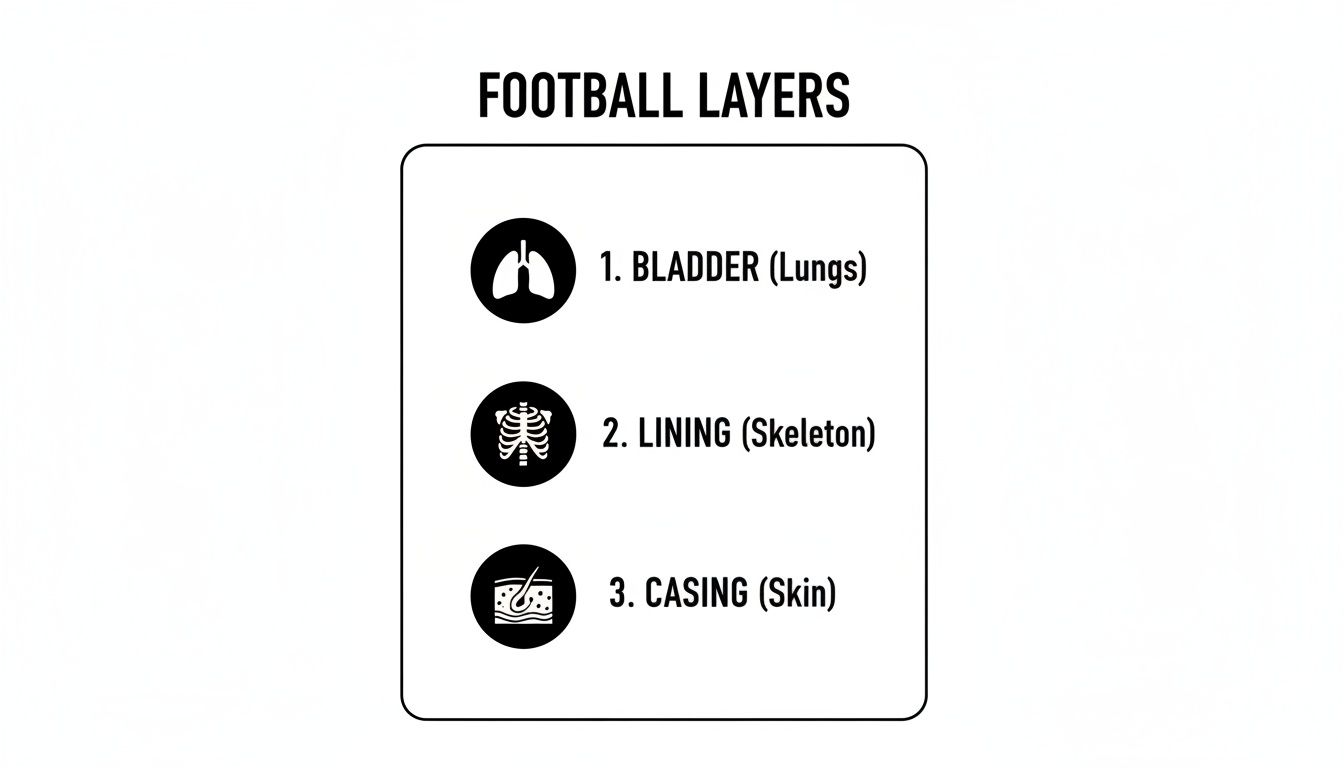
To really understand what separates a top-tier match ball from a cheap kickabout, you need to look under the surface. A modern professional football isn't just an inflatable sphere; it's a piece of precision-engineered equipment. The best way to think about its construction is like the human body: it has 'lungs', a 'skeleton', and 'skin', and each part has a critical job to do.
Inside, you have the bladder, which is the ball's lungs. It holds the air and gives the ball its bounce. Wrapped around that is the lining, a multi-layered 'skeleton' usually made of polyester or cotton. This gives the ball its structural integrity, keeps it perfectly round, and has a massive say in how it feels off the foot. Finally, you have the outer casing—the 'skin'—which is the part you actually kick. This determines durability, touch, and how the ball flies through the air.
The Casing: The Skin of the Game
The material used for the outer casing is one of the biggest factors in a ball's performance and feel. Cheaper training balls often use harder materials like PVC or basic thermoplastic polyurethane (TPU), but for proper match play, the undisputed champion is premium polyurethane (PU).
PU is softer, more responsive, and feels far better on the boot. That softness translates directly into better touch and control, whether you're killing a long pass dead or trying to curl a free-kick into the top corner. A good PU casing will also have a textured finish for extra grip, giving you confidence in all weather. While TPU is tough and scuff-resistant, it just can't compete with the performance of a high-grade PU casing you'll find on elite match balls.
Construction: Stitched vs. Thermally Bonded
How all these parts are put together is just as important as what they're made of. Today, there are two main ways to build a football, and the difference between them is massive, especially for players in the UK.
- Hand-Stitched: The traditional method. The panels are sewn together with thick, tough thread. The deep seams make for a durable ball that can take a beating on rough surfaces, but those same seams are also its biggest weakness when it rains.
- Thermally Bonded: This is now the standard for every top-level match ball. Instead of stitches, the panels are fused together with heat and glue. This creates a seamless, perfectly spherical surface.
This choice of construction has a real, documented impact on the game. Look at English football history: when the Premier League started in 1993, the move to standardised, high-quality balls like the Mitre Pro Max kicked off a new era. In fact, comprehensive data from over 11,000 matches since then shows seasons using official Adidas balls saw a 4.9% increase in goals per game. This was partly down to designs that were easier to see under UK floodlights, which meant fewer misplaced passes. You can explore more insights into English football records and see just how much equipment has shaped the game.
"A thermally bonded ball is a game-changer in wet conditions. It eliminates the stitches, which act like tiny sponges on a hand-sewn ball. The result is a ball that stays lighter, flies truer, and performs consistently from the first minute to the last."
This seamless construction gives you two huge advantages. First, it massively reduces water absorption. A stitched ball on a rainy Saturday afternoon can get heavy and waterlogged, making it feel like a medicine ball. A thermally bonded ball, on the other hand, barely soaks up any water, keeping its weight and feel consistent throughout the match.
Second, that perfectly round shape and seamless surface create an incredibly stable and predictable flight path. There are no stitches creating drag or causing the ball to swerve unexpectedly. This gives you the consistency needed to hit passes and shots with real precision.
What Do Those Official Stamps on a Football Mean?
When you’re looking for a proper match ball, you’ll notice small logos printed on the casing. They’re easy to overlook, but they aren't just for show. Think of them as a seal of approval from FIFA—a guarantee that the ball has been through a series of brutal, independent tests to prove its worth.
The most important one to look for comes from the FIFA Quality Programme. This was set up to make sure that footballs used in official competitions are consistent, reliable, and fair for every player, no matter where they are in the world. If a ball has a FIFA stamp, it means it's been scrutinised in a lab to ensure it’s ready for serious competition.
Decoding the FIFA Quality Pro Stamp
The absolute pinnacle of football certification is the FIFA Quality Pro mark. This is the stamp you’ll find on the official match balls used in the Premier League, the World Cup, and every other major professional league. It’s a clear signal that the ball is built for the elite game, having survived seven incredibly tough tests designed to replicate the worst a 90-minute match can throw at it.
These tests are ridiculously precise. A ball is checked for everything, from its exact circumference and roundness to how well it holds air over three days. It even has to survive being fired against a steel plate 2,000 times to prove its shape and seams won't give up under pressure.
A key test for us in the UK: a FIFA Quality Pro ball can only absorb a maximum of 10% of its weight in water. This is a huge deal for performance in wet weather, making sure the ball doesn't get heavy, waterlogged, and unpredictable halfway through a rainy Saturday match.
The Seven Tests for Football Perfection
To earn that coveted FIFA Quality Pro stamp, a ball must pass all seven of these lab assessments. The standards are incredibly high, and if a ball fails even a single test, it’s rejected. Only the best of the best make it through.
Here’s a breakdown of what each ball has to go through to get certified.
FIFA Quality Pro Testing Standards
| Test Parameter | FIFA Quality Pro Standard |
|---|---|
| Circumference | Must be between 68.5–69.5 cm to ensure a consistent feel. |
| Roundness | Measured in 16 places; the variation cannot exceed 1.5%. It has to be almost a perfect sphere. |
| Rebound | When dropped from 2 metres, it must bounce back between 135–155 cm. |
| Weight | Must weigh between 420–445 grams for a predictable flight. |
| Water Absorption | Cannot absorb more than 10% of its weight after being submerged and pressed 250 times. |
| Pressure Loss | Can't lose more than 20% of its air pressure over 72 hours. |
| Shape & Size Retention | Fired at a steel plate 2,000 times at 50 km/h. Seams, valve, and shape must remain intact. |
Seeing these strict benchmarks makes it clear why an official match ball costs what it does. You're not just paying for a brand; you’re investing in guaranteed performance, durability, and consistency that has been proven in a lab.
To see how these standards play out in the real world, take a look at our complete guide to match balls in size 5 and find the right one for your game.
Finding the Right Match Ball for You
So, you’ve got the lowdown on materials, construction, and those all-important FIFA stamps. Now it’s time to figure out which ball is actually right for you. This isn't about just grabbing the most expensive ball off the shelf; it's about matching the tool to the job. The ball that glides perfectly across a Premier League pitch might not be the smartest buy for a gritty Sunday league battle.
It really boils down to four things: your level of play, your pitch, the weather you play in, and your budget. Nail these, and you'll make a smart investment that genuinely improves your game.
Match Your Ball to Your Level of Play
First, be honest about the standard you're playing at. What a professional team needs is worlds away from what a grassroots club requires.
- Professional and Semi-Professional Leagues: If you're in a competitive, organised league, a FIFA Quality Pro ball is non-negotiable. These are the elite, thermally bonded models from brands like Adidas and Nike. They offer perfect roundness, a predictable flight path, and barely absorb any water—all crucial for high-level football.
- Amateur and Sunday Leagues: For most amateur and grassroots teams, a FIFA Quality or a top-end IMS (International Match Standard) ball is a far more practical choice. They've still been rigorously tested for performance but often bring a bit more durability. You'll find tough, hand-stitched options here that can handle less-than-perfect pitches.
- Youth and Academy Football: For younger players, the priority is getting the size right (Size 4 for U9-U13, Size 5 for U14+). A durable ball that holds its shape and air is far more important than a top-tier model. A good quality stitched or hybrid ball gives a great feel for the ball without the professional price tag.
Consider Your Playing Surface and Conditions
Where you play makes a huge difference to how a ball performs and how long it lasts. A pristine grass pitch and a muddy park field are two completely different beasts.
A top-tier, thermally bonded ball is engineered for one thing: a perfect, well-maintained natural grass pitch. Its seamless design and textured outer casing are built for true flight and grip on that kind of surface. Start using it regularly on abrasive 3G turf or concrete, and you'll wear that casing down in no time. For teams playing on varied or tougher surfaces, a hand-stitched or hybrid ball is often the smarter money.
Think of it like tyres on a car. You wouldn't put high-performance racing slicks on a Land Rover you use for driving down country lanes. In the same way, pick a ball that's built for the environment you actually play in.
And let's not forget the weather, especially here in the UK. If you're constantly playing in the rain, the minimal water absorption of a thermally bonded ball is a massive advantage. It stays light and consistent, whereas a stitched ball can get heavy and waterlogged. In dry conditions, the difference is less noticeable, making a quality stitched ball a perfectly good option.
Balancing Budget with Performance
Finally, the big one: budget. It’s tempting to want the exact same ball you see on Match of the Day, but it’s rarely the most sensible financial move for a team or an individual.
A top-flight FIFA Quality Pro ball is the pinnacle of football technology, and it has a price tag to match. For professional clubs, it’s a standard operating expense. For an amateur team buying their own gear, that cost can be a real barrier.
Here's the secret: a high-quality FIFA Quality or IMS-certified ball often gives you 80-90% of the performance for a fraction of the cost. These are the workhorses of amateur football. They offer brilliant durability and a reliable feel that's more than good enough for competitive games outside the pro ranks.
Speaking of tech, while the ball itself is evolving, it’s interesting to see where the future is headed. Check out our guide on the role of smart footballs in modern training to see what's next.
Our Expert Review of Top Match Footballs
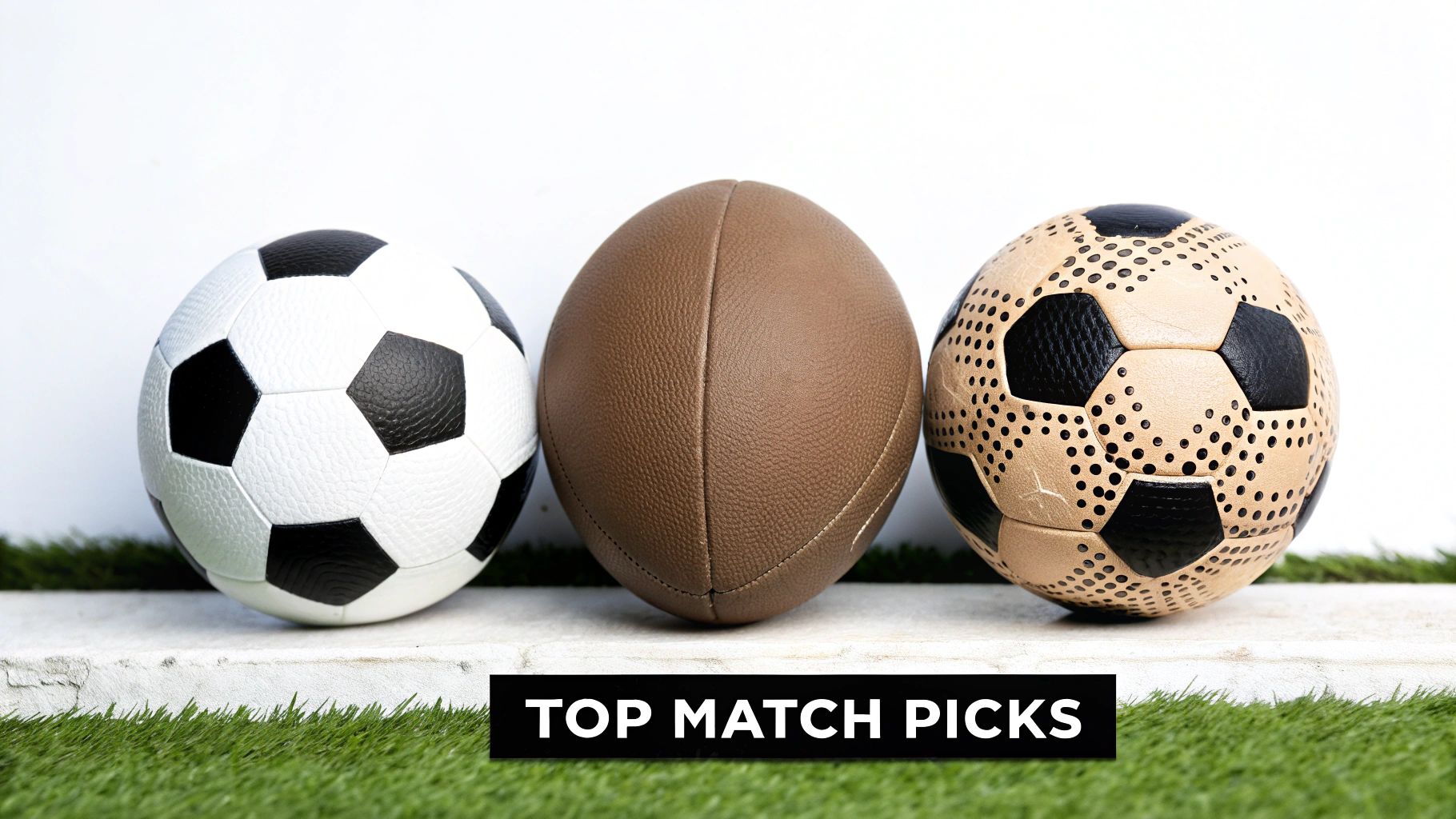
We've covered the science and the standards. Now for the fun part—putting that theory into practice. We’ve scouted the market's top models, focusing on the powerhouse brands that you see in the pro leagues and at the local park every weekend. This is where all that talk about materials, panel design, and approvals actually translates to how a ball feels at your feet.
For this breakdown, we’re looking at the latest and greatest from Adidas, Nike, and Puma, connecting their engineering to the on-pitch experience so you can pick the right ball with confidence.
Adidas Pro Official Match Balls
When you picture a top-tier football, chances are it's an Adidas. As the long-standing supplier for the FIFA World Cup and UEFA Champions League, their official match balls are the gold standard. Their latest models, like the Adidas Fussballliebe Pro from Euro 2024, are masterpieces of aerodynamic design.
The secret sauce is its innovative Speedshell panel design. This unique 20-panel shape, combined with micro and macro textures on the polyurethane casing, is engineered to cut through the air with less drag, giving it incredible flight stability. For a striker, that means a far more predictable flight path when shooting from distance or trying to bend a free-kick. Because it's thermally bonded, it meets the strict FIFA Quality Pro standards without breaking a sweat.
With Adidas, it's all about consistency. A player can trust that a shot struck in the 90th minute will fly just as true as one in the first, even if it's pouring down with rain.
Inside, a high-grade butyl bladder does a fantastic job of holding air, so you're not constantly reaching for the pump. The feel off the boot is second to none—you get that satisfying 'ping' that every player loves.
Nike Flight Official Match Ball
Nike came at the age-old problem of unpredictable flight from a completely different angle. Instead of just focusing on panel shapes, they introduced Aerowsculpt technology—a patented design with moulded grooves etched across the ball’s surface. Like the dimples on a golf ball, those grooves disrupt airflow, reducing wobble and creating a truer flight. Nike’s own testing showed this design results in a flight that's up to 30% truer than their previous top-end balls.
Here's what makes the Nike Flight stand out:
- Aerowsculpt Technology: Those signature grooves deliver an incredibly stable flight, making it a playmaker's dream for spraying long, accurate passes.
- 3D-Printed Ink Overlay: This adds a fine, grippy texture to the casing, which helps keepers get a better handle on it and gives outfield players more control on their first touch.
- All Conditions Control (ACC): This is a surface treatment that guarantees a reliable touch whether the pitch is bone dry or soaking wet—a must-have for playing in the UK.
The Nike Flight has a four-panel, fused construction, which creates a massive sweet spot for striking the ball. It uses a latex bladder wrapped in cloth, which gives it a slightly softer feel and more bounce, though it may need a top-up with air more often.
Puma Orbita Series 1 Match Ball
Puma has cemented its place at the top table with the Orbita series, the official match ball in top leagues like Spain's La Liga and Italy's Serie A. The Orbita is all about striking a balance between raw power and a delicate feel, making it a fantastic all-rounder.
It’s built around a unique 12-panel concept with large panels of equal size. This design creates deeper seams, which some players feel gives them more "whip" on curling shots. The PU outer casing has a 3D texture, which not only improves durability but also helps it stand up to scuffs, especially on 3G and 4G pitches.
The Puma Orbita also features a rubber bladder combined with Puma's Air Lock (PAL) valve technology. This duo provides brilliant air retention that’s on par with the best butyl systems. The result is a firm, responsive ball that’s perfect for powerful shooting while staying match-ready for longer.
How to Care for Your Match Ball
A top-quality match ball is a serious investment. Like any bit of premium kit, it needs proper looking after if you want it to last. A few simple steps will protect that investment, extending its life and keeping it match-ready for seasons to come.
Proper care starts before the ball even touches the pitch. The single most important rule? Look after the valve when you pump it up.
Inflation The Right Way
Always moisten the inflation needle before you push it in. A bit of glycerine, silicone oil, or even just water will do the job. A dry needle can easily tear the valve or push it right into the bladder, causing a slow, irreparable puncture. It’s a tiny action that prevents the most common form of damage.
Over-inflating is another classic ball-killer. Pumping a ball until it’s rock-hard might feel powerful, but you’re putting immense stress on the seams, whether they're stitched or thermally bonded. This can permanently stretch the outer casing and warp the ball’s shape.
Always use a pressure gauge to inflate your ball to the manufacturer’s recommended PSI (pounds per square inch). It’s usually printed right next to the valve and is the key to both top performance and protecting the ball's structure.
To get the pressure spot-on, our complete guide explains everything you need to know about correct football PSI pressure for that perfect match day feel.
Cleaning and Storage Best Practices
After a muddy 90 minutes, don't just chuck your ball in the bag and forget about it. Dirt and grit left caked on the surface will slowly degrade the outer material.
- Wipe it Down: Use a damp cloth to get rid of any mud, grass, and grime. For stubborn dirt, a little mild soap and water works wonders.
- Dry it Properly: Let the ball air dry naturally. Never use a radiator or a hairdryer, as extreme heat can weaken the casing and bonding materials.
- Store it Smartly: Keep your ball in a cool, dry place, away from direct sunlight and extreme temperatures. Leaving it in the boot of a car on a hot day or a freezing shed in winter can make the materials brittle.
Following these straightforward tips will keep your football in prime condition, ensuring you get consistent, top-level performance every time you step onto the pitch.
Your Match Ball Questions, Answered
Let's wrap up with a few quick-fire answers to the questions we hear all the time from players, parents, and coaches.
What’s the Right Pressure for a Match Ball?
For a standard size 5 ball, the pressure should be between 8.5 and 15.6 PSI (0.6 to 1.1 bar). Don’t guess—the manufacturer's exact recommendation is almost always printed next to the valve. Getting the pressure right is crucial; it affects how the ball flies, bounces, and feels at your feet.
Can I Use a Top-Tier Match Ball on AstroTurf?
You can, but it's not recommended for regular use. Elite, thermally bonded balls have a soft polyurethane casing designed for natural grass. The abrasive surface of a 3G or 4G pitch will scuff up the textured surface and graphics quickly, seriously shortening its lifespan. For artificial pitches, a tougher hand-stitched or hybrid ball is a much smarter choice.
How Do I Spot a Fake Match Ball?
It's all in the details. A genuine match ball feels premium. You'll see high-quality materials, perfectly crisp graphics, and the official FIFA Quality Pro stamp. The construction should be flawless, with no messy glue marks or dodgy stitching. Fakes, on the other hand, just feel cheap. The logos might be blurry or poorly printed, and they’ll usually lack that distinct textured surface. If the price seems too good to be true, it probably is.
Ready to find the right ball for your game? Head over to the premium collection at SoccerWares. We’ve got the gear to take your match day to the next level. Check out the full range at https://soccerwares.com.