

You've cleared the furniture from a narrow hallway, put a ball down on the laminate, and realised the product you bought may be better suited to a sports hall than your home. The rebounder slides, the ball thumps through the wall, and the mat curls at the edges. That's the reality behind choosing the best indoor soccer training equipment in the UK.
Indoor football is far from a niche format. A DCMS Grassroots Needs Assessment found that 42% of football players play indoor football, with indoor football accounting for 18% of football visits each year. The right kit can make year-round practice practical, but only if it suits your room, floor and neighbours.
Why Indoor Soccer Training Gear Feels Hard to Buy
Outdoor equipment gets judged by familiar questions: is it durable, full-sized and weather-resistant? Indoor equipment has a different set of problems. A product can be excellent in a hall and completely wrong for a flat, garage or spare bedroom.
Start with the space. A rebounder that looks compact in a product photograph can dominate a hallway once you add the safe striking distance and room for the ball to return. A pop-up goal may fit across a garage bay but leave no useful space behind it for retrieving shots. Storage matters just as much as the footprint during training.
Then consider the floor. Carpet grips equipment but can make a ball feel sluggish. Laminate and wooden floors give clean movement but expose every weakness in a frame, foot or mat edge. Lino and vinyl are easier to clean, yet some rubber bases leave marks or slide when a player strikes hard. Concrete gives a garage a stable foundation, but it's unforgiving on joints and equipment.
Noise is the decision most listings ignore. A low-bounce ball on a properly supported mat is manageable in a semi-detached home. A hard, lively ball hitting a stiff rebounder late in the evening is not. The same drill can feel controlled downstairs and sound like repeated hammer blows next door.
Coach's rule: choose for your floor and storage space first, then choose the training feature.
A UK participation report recorded indoor five-a-side participation among children aged 8 to 15, including 8% specifically taking part in indoor five-a-side, as reported in the Sportscotland participation analysis. That activity takes place in school halls, community centres and homes, so buying advice needs to reflect real indoor constraints rather than generic outdoor rankings.
The Five Core Types of Indoor Training Equipment
Most useful home setups are built from five equipment categories. You don't need every accessory. You need the categories that match your training goal and your available floor.
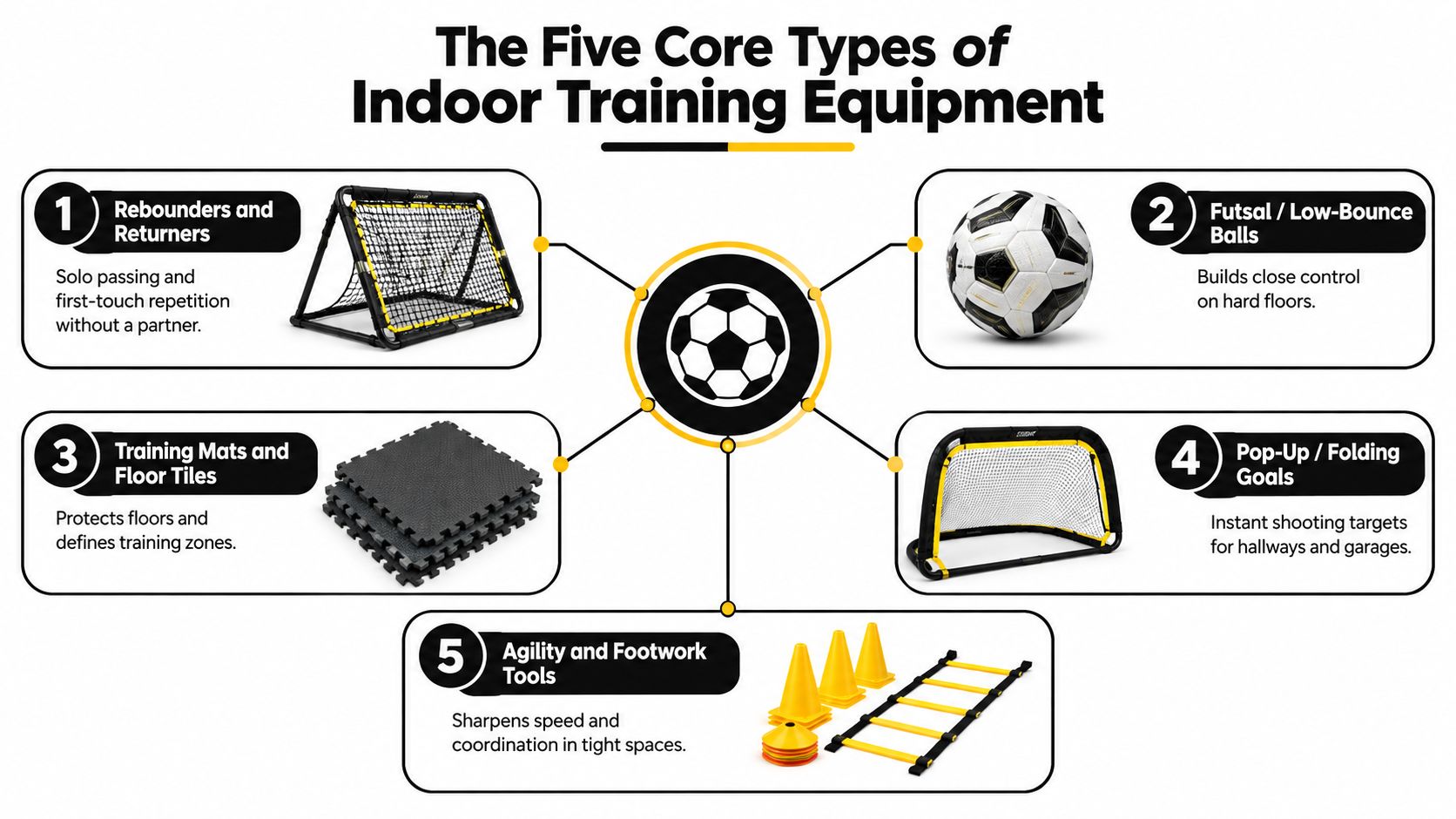
Rebounders and returners
A rebounder gives a solo player repeated passes without needing a partner. An angled board or net is useful for first touch, passing weight and receiving on the back foot. A flat return net offers a more direct response and works well for basic passing, while a downward angle makes the player control a quicker, more demanding return.
Use one in a garage, hall or a clear section of a larger room. In a small flat, the frame must have stable feet and enough padding behind it to protect the wall.
Futsal and low-bounce balls
A futsal ball is the most useful choice for hard indoor floors because its lower bounce supports close control and keeps touches compact. It suits sole rolls, inside-outside touches and short passing. Foam or soft-touch balls are quieter, but they won't always reproduce the weight and response of a proper training ball.
Children can benefit from a smaller ball when the room is tight, though the ball should still encourage clean contact rather than becoming a toy.
Training mats and floor tiles
Mats define the working zone, reduce slipping and protect joints. Interlocking tiles suit garages and permanent training corners. A roll-out mat stores more easily in a cupboard, while a carpet-style mat is often the quietest option for a flat.
Don't buy a mat because it looks thick. It needs to stay flat, grip the floor and provide a predictable surface for the ball.
Pop-up and folding goals
Small goals turn passing into finishing practice. They suit garages, halls and larger living rooms, but they need enough clearance around the frame to prevent shots striking furniture or walls. Use them for placement, passing gates and controlled finishing rather than full-power shooting in a cramped space.
Agility and footwork tools
Cones, dots, rings and ladders sharpen coordination, changes of direction and weak-foot movement. They work in the smallest spaces because they don't need a wall or permanent anchor point. Use SoccerWares' agility equipment guide for ideas, but keep the setup simple.
The usual mistake is buying all five categories at once. Start with a ball and a stable surface, add a rebounder if you train alone, then add a goal or footwork aids when your room can handle them. The broader equipment mistakes to avoid advice is useful here, especially its emphasis on stability and safe placement.
Matching Rebounders, Balls and Mats to Your Space
The best combination depends on what sits underneath your feet. A rebounder isn't automatically suitable for every floor, and a ball that feels controlled on carpet may become too lively on wood.
An angled rebounder is the better all-rounder for passing and first-touch work because it can return the ball into a usable receiving space. A flat net is more forgiving for direct passing but can become repetitive. For goalkeeper reaction drills, a fixed return angle can be useful because it creates a consistent target, but it offers less variety for a midfielder practising directional control.
Ball choice changes the noise and the required padding. A futsal ball works well for close control on hard floors. A foam or soft-touch ball is the neighbour-friendly choice for a flat, though it can feel less realistic. A low-bounce trainer ball sits between the two, giving a quieter response without becoming completely dead.
Match the surface to the floor
Interlocking foam tiles are comfortable and easy to expand, but some edges separate under repeated movement. Rubber tiles grip well and suit a garage, although they can transmit impact if the ball and rebounder are hard. Roll-out turf creates a more football-like visual zone, but it needs careful storage and a flat base.
The technical benchmark matters. UK indoor sports flooring guidance aligned with BS EN 14904 targets at least 25% shock absorption, 90% ball bounce compared with concrete, a 0.4 to 0.6 sliding-friction coefficient, and surface regularity within 3mm over 3m, as outlined in this UK rebound-board flooring guidance. Home mats won't automatically meet sports-floor specifications, so use those figures as a reminder that grip, ball response and cushioning must work together.
The harder the rebound, the more responsibility you place on the mat and the wall behind it.
| Setup | Laminate / Wood | Carpet | Lino / Vinyl | Concrete (Garage) |
|---|---|---|---|---|
| Angled rebounder | Use rubber feet and a mat to prevent sliding and impact noise | Stable, but check that the feet don't catch in the pile | Add a grippy base to stop movement | Excellent stability, but add cushioning for joints |
| Flat return net | Quietest with a low-bounce ball and padded base | Can sit securely, though returns may lose pace | Works if the frame has broad feet | Reliable for repeated passing |
| Futsal ball | Controlled, but still needs a soft landing zone | May feel slow | Good for close control | Durable response, but hard on knees |
| Foam or soft-touch ball | Best for neighbour-sensitive sessions | Very quiet, though less match-like | Suitable for gentle drills | Can feel too light outdoors but works for technique |
| Foam mats | Protect the floor and reduce noise | Often unnecessary unless the carpet is thin | Check for curling and staining | Useful, but choose a denser construction |
| Rubber tiles | Strong grip, possible marking risk | Usually too aggressive for carpet | Test for transfer marks | Best for a permanent training bay |
| Roll-out turf | Good for defined footwork zones | May move without an underlay | Practical if stored flat | Useful for a dedicated garage area |
For a fuller view of frame stability and return behaviour, compare the soccer rebounder reviews. My rule is simple: small flat, soft-touch ball and carpet-style mat; garage, futsal ball, rubber or dense foam tiles and a framed rebounder; wooden floor, low-bounce ball with a non-slip base.
Key Features That Actually Matter Indoors
Indoor equipment should be judged by the details that change movement, noise and safety. Marketing often highlights shot speed or a long warranty, but neither tells you whether the frame will stay put on laminate.
Look first at rebound angle. A fixed 90-degree return is useful for goalkeeper reactions and direct passing, but it frustrates players working on varied first touch. An adjustable angle gives more options, especially when the player has limited room and needs the ball to return safely rather than directly into a wall.
Frame weight and bar tension matter next. A heavier frame generally resists movement, while excessive net tension can make returns too sharp in a small room. UK guidance for small-sided football gives rebound boards a practical height benchmark of at least 1.2m, according to this rebound-board setup guide. That height supports useful return angles without forcing every home buyer towards a full-size structure.
The features worth checking
| Feature | Minimum to Accept | Why It Matters Indoors | Marketing Fluff to Ignore |
|---|---|---|---|
| Rebound angle | Adjustable, or a clearly suitable fixed angle | Controls the height and direction of returns | Claims about “professional” feel without a tested setup |
| Frame width | At least 1.2m where space allows | Gives passing returns a more realistic target | Inflated shot-speed claims |
| Feet and base | Rubberised feet or a compatible rubber mat | Prevents sliding and protects the floor | Decorative foot shapes |
| Ball cover | Predictable PU or soft-touch construction | Produces repeatable contact on a mat | Colour names and lifestyle imagery |
| Mat thickness | 10mm or more for garage use | Adds comfort over concrete and reduces harsh impact | Thickness without density or grip information |
| Base grip | Full anti-slip backing | Keeps the training zone fixed during footwork | A few isolated rubber dots |
| Ball construction | Stitched panels for heavy weekly use | Handles repeated striking better than weak bonded seams | Claimed durability without panel detail |
| Acoustic footprint | Quiet materials and padded contact points | Reduces impact through floors and walls | Vague “silent” wording without testing |
Ball cover material affects consistency. PU usually gives a more controlled, softer contact than a hard PVC cover, while felt can reduce noise but change the roll and touch. The ball must match the mat, not just the player's preference. Use this football pressure guide when checking inflation, but don't overinflate a ball for indoor work.
The specifications that deserve your money are stable feet, useful adjustability, reliable seams, safe storage and a grippy mat. A claimed shot-speed figure won't stop a rebounder crossing the room, and a long warranty won't protect a skirting board from a badly placed frame.
Sample Drills You Can Run in a Small Indoor Space
A 3m by 3m patch is enough for productive technical work if the session is organised around control rather than power. Clear ornaments, lamps and loose furniture before starting, then keep the ball close.
Start with a 60-second mastery circle
Place a size 4 futsal ball on a flat mat. Work around the ball with inside touches, sole rolls and outside touches, keeping the ball within a small circle. Change direction halfway through.
Keep your chest tall, soften the ankle and let the standing foot make small adjustments. Don't lean over the ball. Your eyes should move between the ball and the space ahead, even if that space is only a few metres.
Add passing and receiving
Stand 2m back from the rebounder. Pass with the inside of the foot, plant the non-kicking foot beside the ball, and receive with the back foot so the first touch moves across your body. Call out the surface used, such as inside, outside or sole, immediately after contact.
That verbal cue forces you to recognise your touch rather than switching off. Keep your hips open to the imagined pitch. The common mistake is stopping the ball underneath the body instead of directing it into the next action.
For more structured variations, use these indoor soccer training drills.
Recreate a wall pass
Angle the rebounder so the return arrives slightly to one side. Pass, move one step away from the expected return line, then receive across the body and play the next pass. The exercise mimics a one-two because the player must pass, move and prepare before the ball comes back.
Plant the supporting foot early and keep the head up during the movement. Don't chase the ball with a straight leg. Bend the knee and arrive balanced.
Finish with toe bursts
Angle the rebounder slightly downward. Work for 30 seconds, using rapid toe touches and short forward contacts against the return. Stay light on the feet and use the laces only when you have enough room to control the response.
Don't turn this into a sprint. The aim is quick contact and recovery, not maximum force. If the ball leaves the mat, the angle or intensity is wrong.
A simple living-room circuit is one minute of mastery, one minute of passing and one minute of toe bursts, repeated with short rests until the session reaches fifteen minutes. That's enough structure to train consistently without turning the room into a mini stadium.
What to Buy First on Any Budget
Buy in layers. A large kit looks exciting, but a player who can't set it up quickly won't use it often.
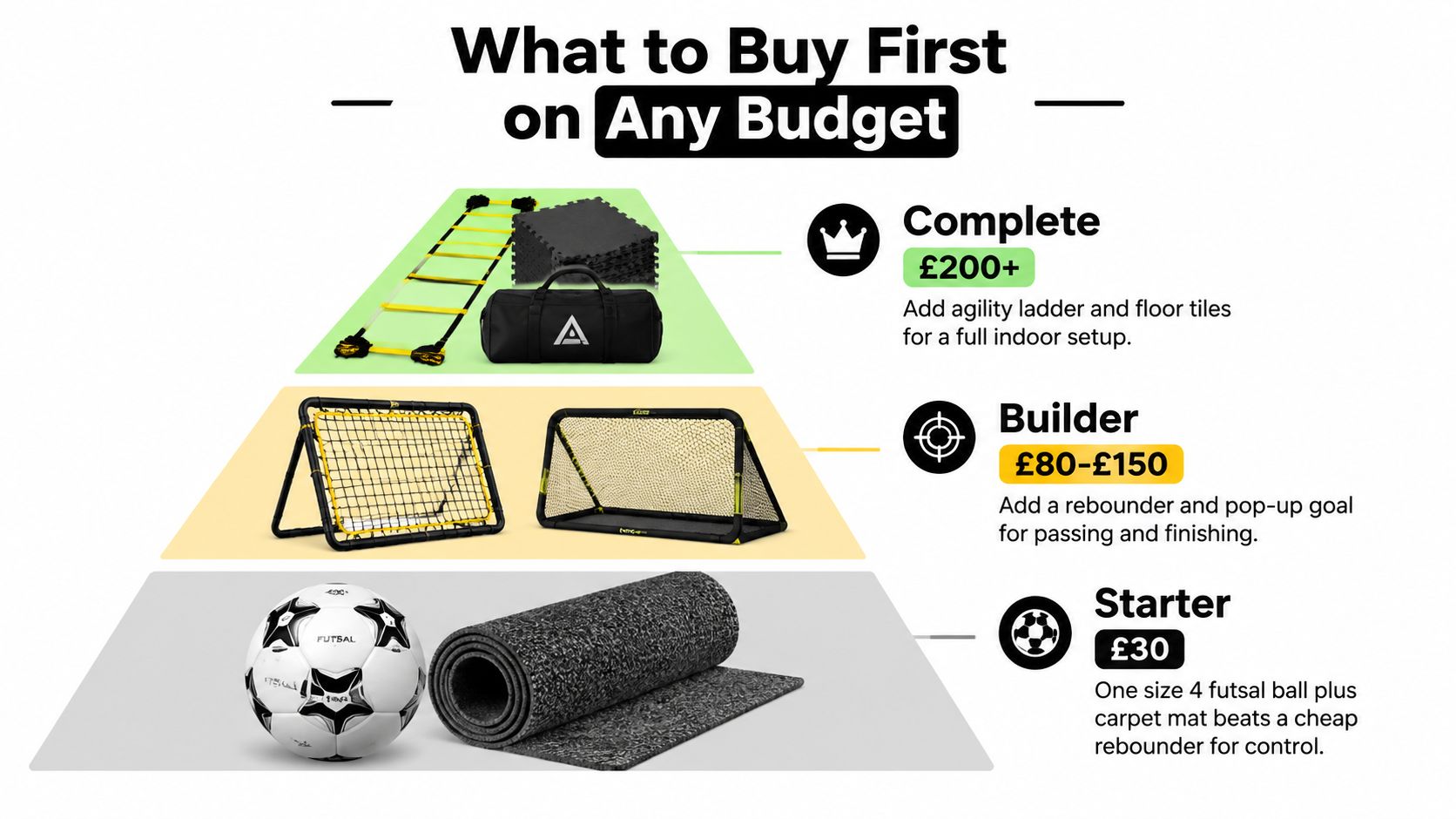
With £30, buy one size 4 futsal ball and a roll of carpet mat. That combination protects the floor, reduces noise and gives you enough equipment for close control, sole work and passing against a safe target. A cheap rebounder that slides is a poor first purchase because it creates more problems than repetitions.
At £100, add a foldable rebounder and a basic small-sided goal. The rebounder makes solo passing realistic, while the goal gives finishing a clear target. Choose a frame rather than a net alone, and check that the goal can be stored without bending or catching on furniture.
Build towards a complete home setup
At £250, upgrade the surface to a proper 10mm or thicker mat, add a second ball and include a passing belt or agility ring set. A home player has enough variety for control, passing, footwork and finishing without needing a partner for every session.
The 2-Pack Foldable Pop-Up Football Goals – Portable Kids Soccer Nets for Indoor & Outdoor Training is a compact option for children and casual training. The set contains two foldable goals with mesh nets, flexible fibreglass frames, ground pegs and a carry bag. The listed goal dimensions are 60cm by 40cm by 40cm, and the product is described as suitable for ages 3 and over. Ground stakes are intended for outdoor stability, so indoor users should secure the goals with a suitable non-marking base rather than pushing pegs into a floor.
Skip branded pump bundles if you already own a compatible pump. Avoid fold-flat goals that lose their shape quickly, and don't buy rebounder nets without a frame unless you have a safe, stable way to mount them. Each purchase should earn regular use before the next one arrives.
Caring for Your Indoor Training Kit
A winter of garage and hallway sessions exposes equipment to damp, dust and temperature changes. Store balls off cold concrete, dry goals fully before folding them and don't leave mats rolled tightly for long periods if the edges are already curling.
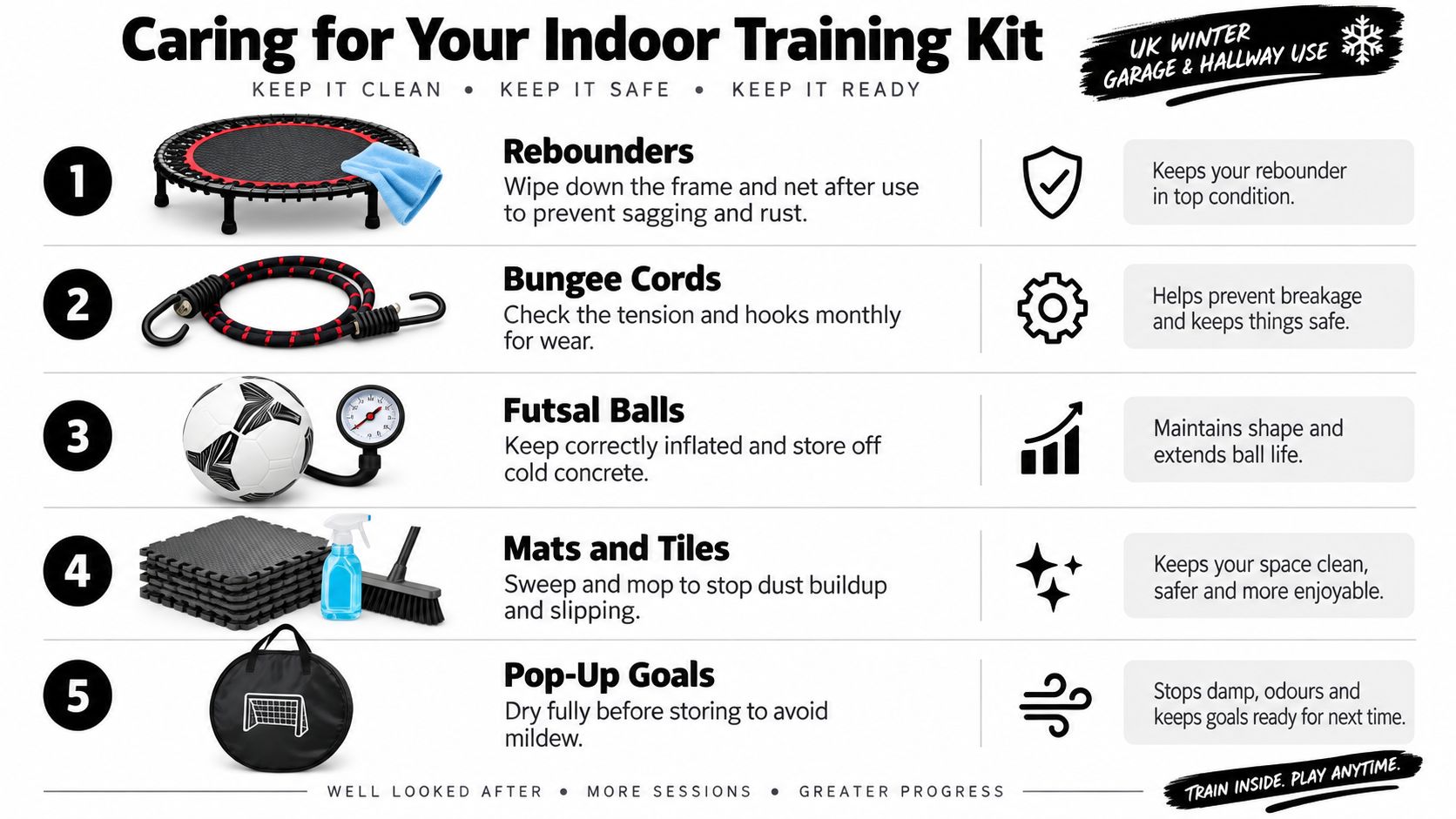
Wipe the rebounder frame and net after use. Check the bungee cords, hooks and replacement straps for stretching or fraying, because a small worn part can change the return angle before the whole rebounder needs replacing. Rotate the ball during repeated practice so one panel doesn't take every strike.
Wash slip socks and bibs at 30 degrees to help preserve their grip coating. Sweep and mop mats or tiles so dust doesn't create a slick surface, then let everything dry before storage.
Reduce the sound before it reaches the neighbours
Use rubber feet under goals, felt pads beneath mat edges and foam balls in flats where impact noise travels easily. In a semi-detached home, close the door and check whether the rebounder sits against a shared wall. Moving it even slightly into the room can reduce direct vibration.
Safety checks matter more than cosmetic wear. Look for loose net ties, exposed frame corners, slick mat edges on laminate and any crushing or shearing points around portable goals. UK sports equipment guidance says goals used for training and recreation must avoid crushing, shearing and finger, head or neck entrapment risks during use, transport and storage, as set out in this goal safety standards document.
For broader maintenance principles, this expert guide to equipment upkeep is a useful reference. Once a month, spend five minutes checking frames, ties, cords, mat edges, ball condition and storage dryness. Repair a loose strap or replace a worn bungee before it damages the net or sends a return into a wall.
Pulling It All Together
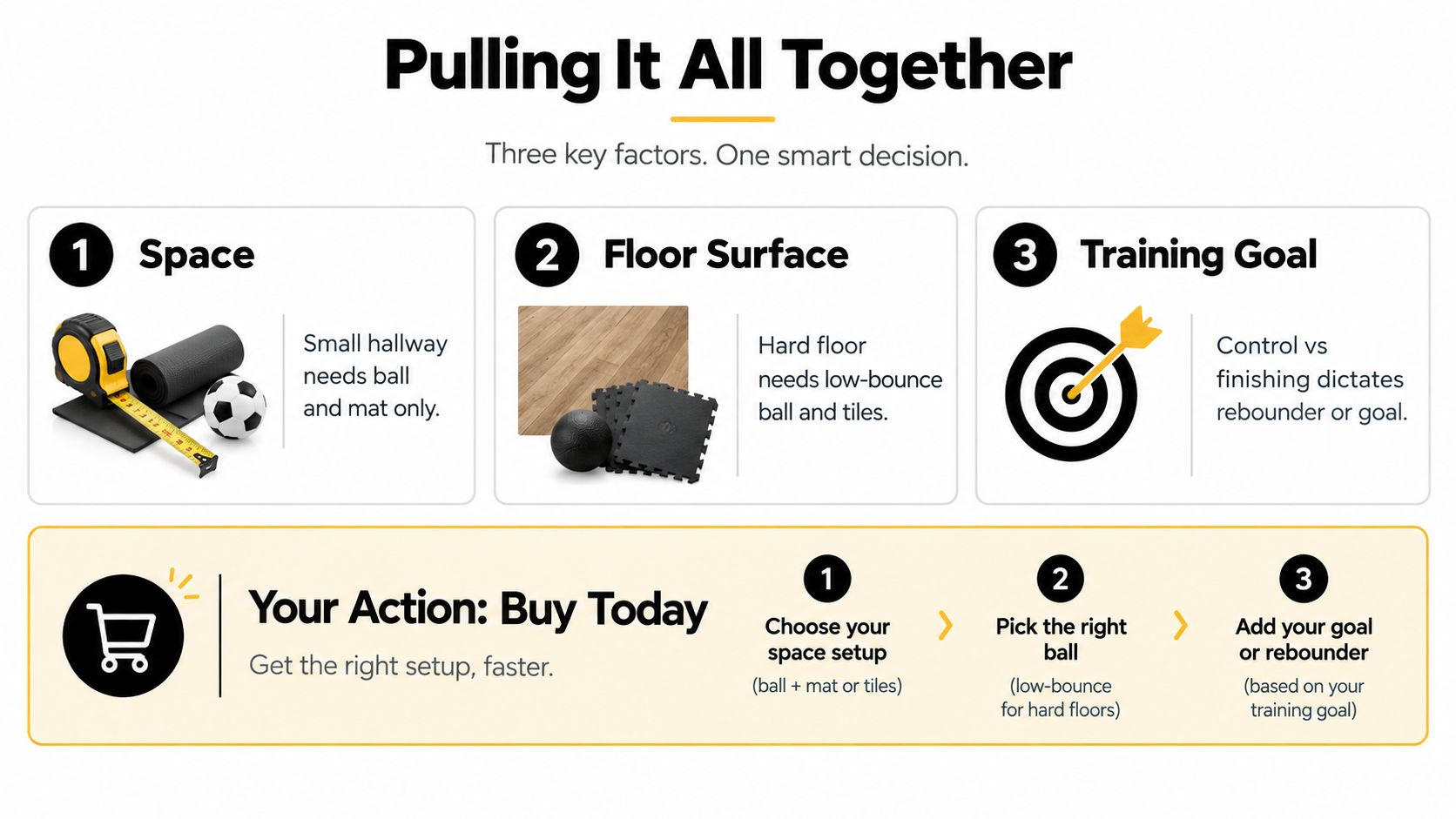
The buying decision comes down to three questions.
Match the kit to the constraint
Space: a narrow hallway needs a ball, a mat and compact footwork markers. A garage bay can take a framed rebounder and small goal.
Floor surface: hard flooring needs a low-bounce ball and a stable, non-slip base. Concrete needs more cushioning, while carpet may need less matting but more attention to ball response.
Training goal: choose a rebounder for first touch and solo passing, a goal for finishing, and cones or a ladder for footwork. Don't buy an interactive gadget because it looks engaging if it doesn't fit the drill you'll repeat.
The realistic minimum kit is one suitable ball and one surface that stays flat. Add the rebounder when solo passing is the priority, then introduce a goal or agility aids once storage and noise are under control.
The equipment to skip is equally clear. Avoid unstable nets, high-bounce balls on hard floors, bulky frames that can't be stored quickly and accessories that add setup time without adding a new training action. The FA's indoor grassroots guidance also shows how tightly indoor formats may need to be organised, with groups of more than six not mixing and indoor matches limited to 3 v 3 when that maximum applies, as stated in this FA indoor grassroots guidance. Scottish FA guidance has also specified non-contact indoor training and 2 metre physical distancing for players aged 12 and over, alongside sanitiser of at least 60% alcohol and cleaning products conforming to EN14476, in its indoor training guidance. Always check current venue and governing-body rules before organising group sessions.
If the gear can't be stored under a bed or in a hallway cupboard within five minutes, it won't get used.
SoccerWares brings together indoor training essentials such as rebounders, goals, indoor mats and performance accessories, alongside football merchandise for supporters. Visit SoccerWares to choose equipment that fits your floor, available space and training goal, then build your setup one useful piece at a time.