

In modern football, a solid defence is no longer just about last-ditch tackles and hoofing the ball clear; it’s a sophisticated, coordinated art form. From the high press of Premier League giants to the disciplined low block of Serie A tacticians, winning teams are built from the back. But how do you forge a defensive unit that is organised, aggressive, and intelligent? The answer lies in targeted, repetitive, and progressive training.
This guide moves beyond generic advice to provide a coach-ready roundup of eight essential defence football drills. We'll break down each exercise in detail, covering objectives, equipment, step-by-step instructions, and crucial coaching points. While mastering these drills requires tactical understanding, individual player development is equally vital. To truly excel, defenders must be physically robust, and incorporating tips for building strength and speed into their training can provide a significant competitive advantage on the pitch.
Whether you're coaching a youth team learning the fundamentals or a senior squad perfecting its tactical setup, these drills offer a complete blueprint. You will learn to implement exercises focused on everything from 1v1 marking and zonal positioning to executing a flawless offside trap. Our goal is to equip you with the practical knowledge to build a defence that not only stops goals but also launches attacks, turning your backline into a true tactical weapon. Let's dive into the drills that will help construct your impenetrable wall.
1. The 1v1 Gauntlet: Mastering Individual Duels
Individual defensive ability is the bedrock upon which all successful defensive units are built. The 1v1 Gauntlet is a classic for a reason; it isolates this fundamental skill, forcing defenders to rely on technique, timing, and intelligence to nullify an attacker. This is one of the most effective defence football drills for sharpening the essential tools a defender needs in their arsenal.
Objective
The primary goal is to prevent the attacker from scoring in a small goal or crossing a designated end-line. For the defender, success means making a clean tackle, forcing the attacker away from the goal, or shepherding the ball out of play.
Equipment
- Cones or markers to create the playing area (approx. 15x10 yards).
- One small portable goal (or two cones as a gate).
- A supply of footballs.
Drill Execution
- Set up a rectangular grid. Place the small goal at one end.
- An attacker starts with the ball at the opposite end of the grid from the goal. The defender starts five yards in front of them.
- The coach (or a server) passes the ball to the attacker to initiate the 1v1 duel.
- The defender’s job is to close the space quickly, adopt a low, side-on body position, and prevent the attacker from getting a shot off or dribbling past them.
- The drill ends when the attacker scores, the defender wins the ball, or the ball goes out of play. Players then rotate roles.
Coaching Cues
- "Get there fast, arrive slow": Close the distance to the attacker quickly, but slow down on approach to avoid being beaten by a quick change of direction.
- "Stay on your feet": Emphasise jockeying and patience. Only commit to a tackle when you are certain of winning the ball.
- "Show them one way": Angle your body to force the attacker towards the touchline or onto their weaker foot.
Common Mistakes
- Diving in: Young or impatient defenders often lunge for the ball too early, making it easy for the attacker to dribble past.
- Being "flat-footed": Standing square-on to the attacker makes it difficult to turn and react to their movements. A side-on stance is crucial.
- Watching the ball, not the player: Clever attackers use feints and body movements to unbalance defenders. Focus on the attacker's hips and centre of gravity.
2. Pressure and Cover Drill: Building a Defensive Partnership
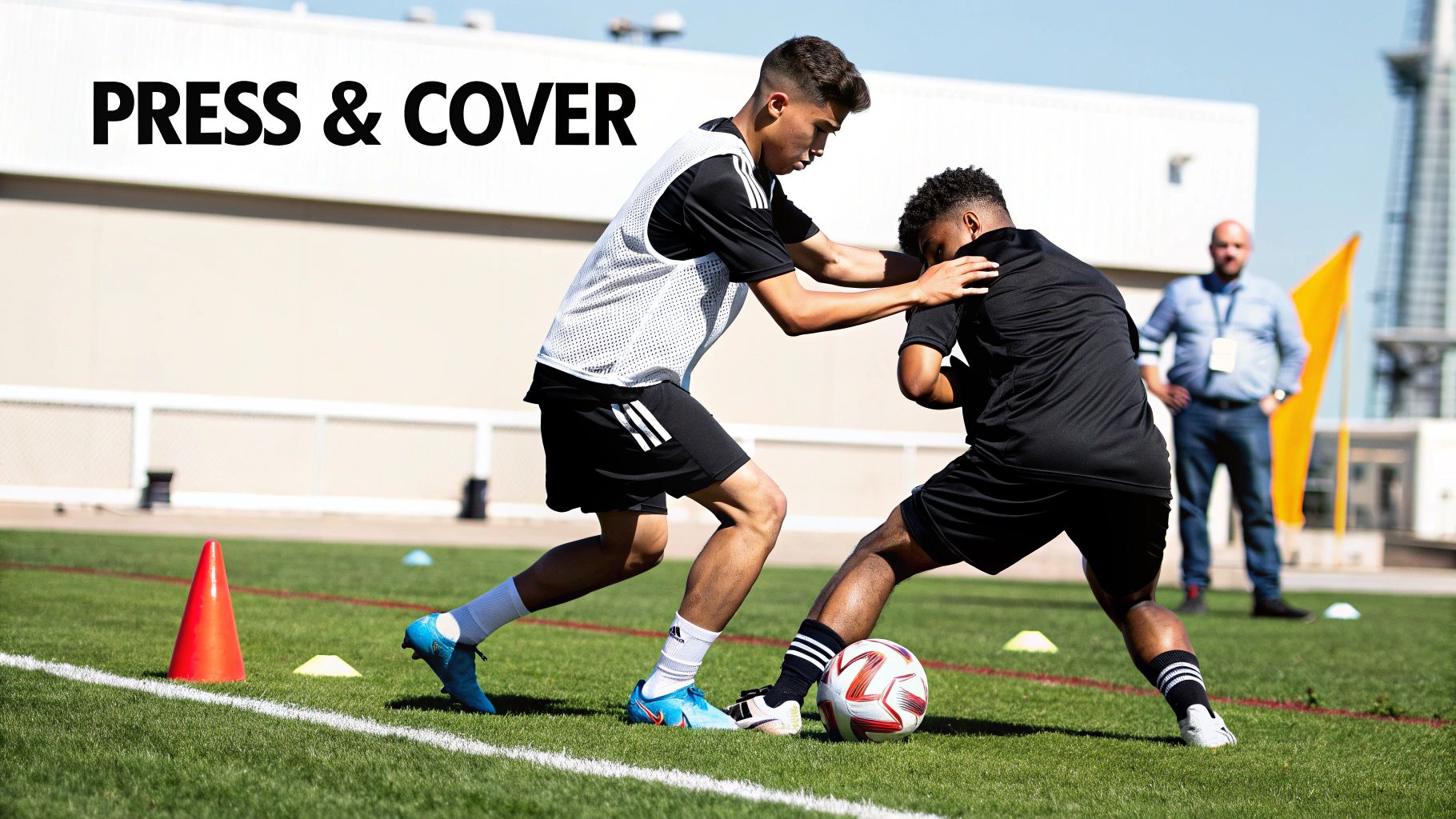
Individual brilliance is vital, but modern defending is built on partnerships and coordinated movement. The Pressure and Cover drill moves beyond 1v1s to teach the fundamental relationship between the first and second defenders. This concept, popularised by legendary coaches like Arrigo Sacchi, is one of the most crucial defence football drills for developing an organised and intelligent backline.
Objective
The primary goal is for two defenders to work in tandem to dispossess two attackers. The "pressure" defender directly engages the ball carrier, while the "cover" defender provides support, anticipating the next pass or a dribble that beats the first defender. Success is defined by winning the ball back or forcing a backward pass.
Equipment
- Cones or markers to create a large grid (approx. 20x25 yards).
- One full-size goal with a goalkeeper.
- A supply of footballs.
Drill Execution
- Set up a rectangular grid in front of the goal.
- Two attackers start at the top of the grid, with two defenders positioned between them and the goal.
- The coach initiates the drill by passing a ball to one of the attackers, creating a 2v2 scenario.
- The nearest defender immediately applies pressure to the ball carrier, aiming to delay the attack and force a predictable action.
- The second defender takes up a cover position: deeper, at an angle, and close enough to support the pressuring defender or intercept a pass to the second attacker.
- The defenders must communicate to manage their roles and positioning as the attackers move the ball. The drill ends with a shot, a turnover, or the ball going out of play.
Coaching Cues
- "Who's pressure? Who's cover?": Constant, clear communication is essential. Defenders must verbally confirm their roles as the situation changes.
- "Cover the space, not the player": The covering defender should position themselves to cut off the most dangerous passing lane or space, not just mark the second attacker tightly.
- "Arched approach": The pressuring defender should arc their run to cut off one side, forcing the attacker into the path of the covering teammate.
Common Mistakes
- Both defenders pressing: A common error is for both defenders to be drawn to the ball, leaving the second attacker free in a dangerous area.
- Cover defender is too deep or flat: If the cover defender is on the same line as the pressuring player (flat) or too far away (deep), they cannot provide effective support.
- Silent defending: A lack of communication leads to confusion, with both players either pressing or neither doing so, making the defensive unit easy to break down.
3. Offside Trap Drill: Co-ordinating the High Line
Executing a successful offside trap is one of the most intellectually demanding and rewarding skills a defensive unit can master. It's an organised, collective action where the entire defensive line moves upfield in unison to catch an attacker in an offside position as a pass is played. Far from a simple gamble, it is a calculated risk that requires immense communication, timing, and trust, making it one of the most advanced defence football drills a coach can implement.
Objective
The primary objective is for the defensive unit to learn how to move as one, stepping up at the precise moment to leave an opponent offside. This drill builds cohesion, communication, and a shared understanding of tactical triggers, ultimately disrupting the opposition's attacking rhythm and winning back possession without a physical challenge.
Equipment
- Cones or markers to designate the defensive line's starting position and the offside line.
- One full-size goal with a goalkeeper.
- A supply of footballs.
- Bibs to distinguish attackers from defenders.
Drill Execution
- Set up a defensive back four (or back three/five) in front of the goal. Use a line of flat markers to give them a clear starting reference point.
- Position two or three attacking players in front of the defensive line.
- A coach or server stands with the balls in a midfield position, simulating a playmaker.
- The coach initiates play by looking up and preparing to pass. This is the visual cue for the defensive line to act.
- On the trigger (a designated leader’s call, like "Step!"), the entire defensive line steps forward together in a straight, organised line. The movement must be sharp and synchronised.
- The coach then plays a through-ball to one of the attackers, who should now be in an offside position.
- Reset and repeat, focusing on the timing, speed, and unity of the defensive line's movement.
Coaching Cues
- "All together now!": Reinforce that this is a collective action. One player moving late or early breaks the entire trap.
- "Head on a swivel": Defenders must constantly scan, checking the position of the ball, their teammates, and the attackers.
- "Listen for the trigger": A single, clear command from the designated leader (often a centre-back) is essential for synchronisation.
Common Mistakes
- A "jagged" line: If defenders are not in a straight line when they step, it creates pockets of space and plays attackers onside.
- Stepping too early or too late: Moving before the passer is ready to play the ball gives the attacker time to adjust their run. Moving too late means the attacker will already be in behind.
- Lack of communication: Silence is the enemy of the offside trap. The goalkeeper and the defensive leader must be in constant communication.
For a deeper understanding of the rule itself, you can learn more about the offside law in football.
4. The Aggressive Press: Forcing Errors and Regaining Possession
In the modern game, defending isn't just about sitting back; it's about proactively winning the ball high up the pitch. The Aggressive Press drill is designed to train a unit to hunt in packs, close down space, and force turnovers in the opponent's half. This is one of the most vital defence football drills for teams wanting to implement a high-intensity, front-foot style popularised by coaches like Jürgen Klopp and Pep Guardiola.
Objective
The primary goal is to train players to recognise pressing triggers and react collectively to close down the opposition, preventing them from playing out from the back and aiming to win possession in an advanced area of the pitch.
Equipment
- Cones or markers to define a playing area (e.g., half a pitch).
- One full-size goal with a goalkeeper.
- A set of bibs to distinguish two teams.
- A good supply of footballs.
Drill Execution
- Set up a game of 8v6 in one half of the pitch. The team of 8 (attackers) starts with their goalkeeper and aims to build play and score in a small gate or target zone at the halfway line.
- The team of 6 (defenders) is organised to defend the main goal. Their objective is to press the attacking team, win the ball back, and score in the full-size goal as quickly as possible.
- The drill starts with the goalkeeper passing to one of their defenders. This pass is the initial trigger for the pressing team.
- The defending team must work together to apply pressure, cut off passing lanes, and force a mistake or make a tackle.
- If the defending team wins the ball, they have a limited number of seconds (e.g., 8-10) to mount a counter-attack and shoot on goal.
Coaching Cues
- "Hunt as a pack": Reinforce that pressing is a collective action. One player presses the ball while others cover the nearest passing options.
- "Recognise the trigger": Define clear triggers, such as a pass to a full-back, a poor first touch, or a player receiving the ball with their back to goal.
- "Arched runs": Coach players to press using curved runs to block off passing lanes as they approach the player on the ball.
Common Mistakes
- Pressing alone: A single player pressing without support is easily bypassed, leaving gaps in the defensive structure.
- Ignoring cover shadows: Players fail to position themselves correctly to block passing lanes behind them while they press.
- Failing to transition: After winning the ball, teams can be slow to switch from a defensive to an attacking mindset, missing scoring opportunities.
5. Transition Defence Drill: Turning Chaos into Control
The modern game is defined by speed, and no moment is more critical than the split-second after possession is lost. The Transition Defence Drill trains players for this chaotic moment, emphasising the rapid switch from an attacking mindset to a structured defensive shape. This is one of the most vital defence football drills for any team looking to nullify devastating counter-attacks, a hallmark of organised units like those coached by Thomas Tuchel and Diego Simeone.
Objective
The primary goal is to train a team's collective reaction to losing the ball. Success involves immediately pressuring the ball, cutting off passing lanes, and recovering into a compact defensive formation to prevent the opposition from launching a successful counter-attack.
Equipment
- Cones or markers to define a large playing area (e.g., half a pitch).
- Two full-sized goals with goalkeepers.
- A supply of footballs.
- Different coloured bibs to create two teams (e.g., 7v7 or 8v8).
Drill Execution
- Set up a game of 7v7 plus goalkeepers on a half-pitch.
- The attacking team (Team A) is instructed to build an attack and try to score.
- The defending team (Team B) is coached to win the ball back.
- The key moment is the "turnover". The instant Team B wins possession, they must immediately launch a quick counter-attack towards the opposite goal.
- Team A's objective is to react instantly to losing the ball. Their first priority is immediate pressure on the ball carrier (counter-pressing), while other players recover their positions, get goal-side, and reorganise their defensive shape as quickly as possible.
- The drill is continuous, flowing from attack to defence and back again, mirroring a real game's rhythm.
Coaching Cues
- "Five-second fury!": Challenge the team that has just lost the ball to win it back or commit a tactical foul within five seconds.
- "Nearest player presses": The player closest to the ball upon turnover must apply immediate pressure to slow the counter-attack.
- "Recover towards the goal": Players not pressing must make recovery runs back towards their own goal, prioritising central areas.
Common Mistakes
- Ball-watching after turnover: Players stand still in disappointment after losing possession instead of reacting defensively.
- No immediate pressure: Allowing the new attacking team time and space on the ball to pick a forward pass.
- Individual recovery, not collective: Players run back in straight lines without communicating or re-establishing their team's compact shape.
6. Zonal Shift Drill: Mastering Collective Positioning
Moving from individual duels to collective organisation is a critical step in building a resilient defence. The Zonal Shift drill teaches players to defend spaces rather than just opponents, a concept popularised by legendary coaches like Arrigo Sacchi and perfected by top Italian teams. This exercise is one of the most intelligent defence football drills because it develops the communication, spatial awareness, and coordinated movement that defines an elite defensive unit.
Objective
The primary goal is for the defensive unit to move cohesively, shifting across the pitch in relation to the ball's position. This ensures they maintain a compact shape, deny passing lanes, and prevent attackers from exploiting gaps between defenders.
Equipment
- Cones or markers to create a large grid (approx. 40x30 yards) and to mark out specific zones.
- A supply of footballs.
- Optional: Different coloured bibs for attackers and defenders.
Drill Execution
- Set up a grid representing a section of the pitch (e.g., the area just outside the penalty box) and divide it into four or six equal zones using cones.
- Position a back four (or a defensive midfield and backline) within these zones.
- A group of attacking players (or coaches) are positioned outside the grid and are instructed to pass the ball amongst themselves. They are not trying to score initially.
- As the ball moves from side to side, the defensive unit must shift together, moving into the correct zonal positions to cover the most dangerous areas.
- The focus is on maintaining correct distances between each other, communicating shifts, and ensuring the defensive block moves as one.
Coaching Cues
- "Move on the travel": Begin shifting as the ball is passed, not after it has arrived. This anticipation is key to staying ahead of the attack.
- "Head on a swivel": Constantly scan the pitch to be aware of the ball, your teammates' positions, and any off-the-ball runs from opponents.
- "String between you": Imagine you are all connected by a piece of string. If one player moves, everyone else must adjust to maintain the team’s shape and compactness.
Common Mistakes
- Ball-watching: Defenders focus solely on the ball and forget to check their shoulders for runners, leaving dangerous gaps behind them.
- Leaving gaps between units: The distance between defenders becomes too large, allowing attackers to receive passes in dangerous pockets of space.
- Silent defending: A lack of communication leads to confusion, with two defenders marking one player or leaving another completely free. Encourage constant, clear instructions.
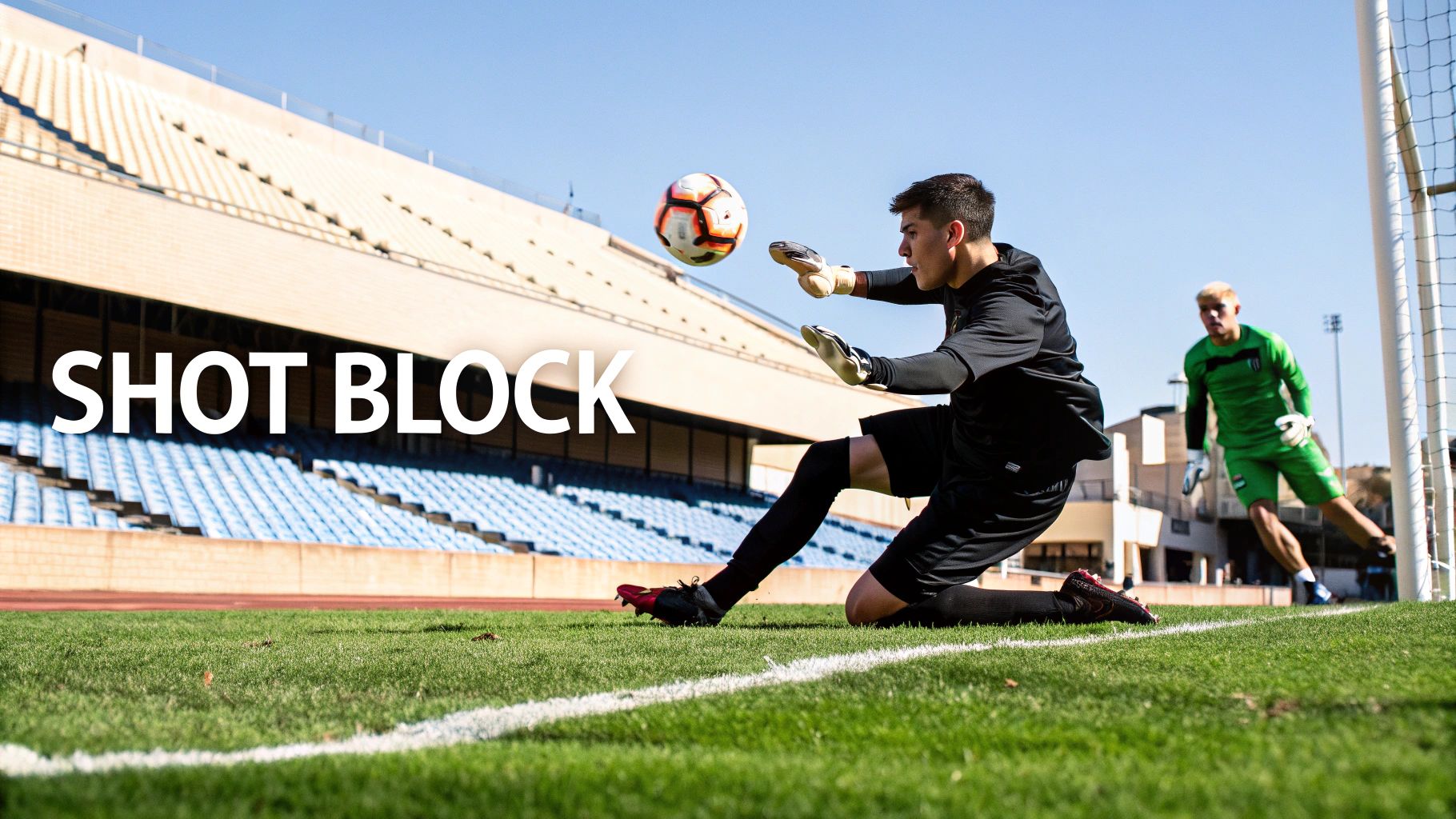
7. Sliding and Blocking Drill: The Art of Last-Ditch Defending
In critical moments, when an attacker is about to shoot, a well-timed slide tackle or block can be the difference between conceding a goal and keeping a clean sheet. This drill focuses on the high-risk, high-reward techniques of desperation defending. It’s one of the most crucial defence football drills for teaching players how to intervene safely and effectively when all other defensive options are exhausted, turning potential goals into heroic defensive plays.
Objective
The primary aim is to teach defenders the correct, safe techniques for executing slide tackles and body blocks to prevent shots on goal. Success is measured by a clean interception, a successful block, or forcing a mishit from the attacker without committing a foul.
Equipment
- A full-size goal with a goalkeeper.
- Cones or markers to designate starting positions.
- A good supply of footballs.
- Optional: Mannequins to act as passive attackers for initial technique work.
Drill Execution
- Set up the drill on the edge of the penalty area, roughly 18-20 yards from goal.
- An attacker starts with the ball, facing a defender who is positioned slightly to the side and a few yards away, creating an angle towards the goal.
- On the coach's signal, the attacker takes a touch forward and prepares to shoot.
- The defender must react, close the remaining space, and execute either a slide tackle to dispossess the attacker or a block to stop the shot.
- The defender should focus on sliding with the outside leg to sweep the ball away or making their body "big and wide" for the block.
- Rotate players after each attempt, ensuring everyone practises both attacking and defensive roles.
Coaching Cues
- "Get low and long": For blocks, encourage a low centre of gravity. For slides, instruct players to cover the ground by extending their body.
- "Slide across, not through": Emphasise sliding parallel to the attacker's path to take the ball, not the player. This is key to avoiding fouls and injuries.
- "Arms in, be brave": When blocking, tuck arms into the body to avoid giving away a penalty for handball and to protect against the impact of the shot.
Common Mistakes
- Two-footed tackles: A dangerous and illegal challenge that must be coached out immediately. Always lead with one foot.
- Sliding from behind: Poor timing or positioning can lead to sliding from a trailing position, which almost always results in a foul.
- Turning away from the shot: A natural instinct is to turn away when blocking, but this reduces the blocking surface and effectiveness. Players must be coached to face the ball.
8. Back Four Shape and Communication Drill
While individual brilliance is vital, a defence is only as strong as its collective organisation. The Back Four Shape and Communication Drill moves beyond one-on-one battles to focus on the synchronised movement, spacing, and vocal coordination of the entire defensive line. This is one of the most fundamental defence football drills for developing a disciplined, impenetrable unit that operates as a single entity, much like the cohesive backlines seen under elite coaches.
Objective
The primary goal is to train the back four (or back three/five) to maintain its compact shape, adjust its position relative to the ball, and communicate effectively to manage space and threats. Success is measured by how well the unit shifts, slides, and supports each other without leaving dangerous gaps for attackers to exploit.
Equipment
- Cones or markers to delineate the playing area (e.g., half a pitch).
- One full-sized goal with a goalkeeper.
- A supply of footballs.
- Training bibs to distinguish the defensive unit.
Drill Execution
- Set up on half a pitch with a back four and a goalkeeper in position.
- The coach (or a server) starts with the ball in various positions in the midfield (central, wide left, wide right). The defenders do not try to win the ball.
- As the coach moves the ball, the back four must shift across the pitch as a unit, maintaining their "shape on a string" and keeping appropriate distances between each other.
- The nearest defender applies "token" pressure to the ball, while the other three provide cover and balance, tucking in to protect the central areas.
- The goalkeeper communicates constantly, organising the line from behind. The coach should call out specific scenarios, like "drop," "squeeze up," or "shift right."
Coaching Cues
- "Keep it on a string": Encourage defenders to visualise a rope connecting them, ensuring they all move together and maintain their spacing.
- "Head on a swivel": Remind players to constantly scan to be aware of the ball, their teammates, and any opposition runners.
- "Loud, clear, and early": Communication must be proactive, not reactive. Use simple commands like "step," "hold," "man on," and "cover."
Common Mistakes
- A jagged line: Defenders moving at different speeds or times, creating gaps for through balls. The line must remain as flat as possible when appropriate.
- Ball-watching: Focusing solely on the ball and losing track of opposition movement in behind or in the channels.
- Silent defending: A lack of communication leads to uncertainty, duplication of roles, or leaving dangerous players unmarked. For more on building a cohesive defensive unit, explore our detailed guide on the Back Four Shape and Communication Drill.
8-Point Defence Drill Comparison
| Drill | Complexity | Resources | Expected Outcomes | Ideal Use Cases | Key Advantages |
|---|---|---|---|---|---|
| 1. 1v1 Gauntlet | Low | Minimal | Better close-marking & tackling | Youth development, individual skills | Builds confidence, easy to set up |
| 2. Pressure & Cover | Medium | Low | Improved partner communication | Developing CB/FB pairings | Teaches core principles of support |
| 3. Offside Trap | High | Medium | Coordinated line movement, timing | Advanced teams, high-line tactics | Disrupts attacks, forces turnovers |
| 4. Aggressive Press | High | Medium | Forced errors, high possession | High-energy systems, match prep | Creates chances in attacking third |
| 5. Transition Defence | High | High | Faster recovery, fewer counters | Counter-attack prevention | Drills real-game chaos, builds fitness |
| 6. Zonal Shift | Medium | Low | Better compactness & positioning | Organising team shape, system work | Maintains structure, denies space |
| 7. Sliding & Blocking | Medium | Low | Safer technique, fewer fouls | Individual technique sessions | Prevents goals in desperate situations |
| 8. Back Four Shape | High | Medium | Cohesive unit, consistent spacing | Tactical sessions, pre-season work | Builds foundation of the entire defence |
From Drills to Dominance: Integrating Defence into Your Team's DNA
Building a truly resilient defensive unit is a journey, not a destination. The eight defence football drills in this guide—from mastering the 1v1 duel to orchestrating the collective symphony of the back four—provide a complete blueprint. However, the true test lies not in the isolated execution of these exercises, but in their seamless integration into your team's identity. These drills aren't just weekly tasks to be ticked off; they are the building blocks of a defensive philosophy that wins matches.
The journey from practice to on-pitch dominance requires transforming theoretical knowledge into instinctive reactions under pressure. The concepts of pressure, cover, balance, and compactness must transcend the training ground and become the unspoken language that unites your players when possession is lost. By consistently reinforcing these principles, you cultivate a collective mindset where every player, regardless of their position, understands their defensive responsibility.
Key Takeaways for Building a Defensive Fortress
To ensure these principles stick, focus on the overarching themes that connect all the drills we've explored:
- Communication is Non-Negotiable: As highlighted in the Back Four Shape and Offside Trap drills, silent defending is failed defending. Encourage loud, clear, and concise instructions like "step," "drop," "squeeze," and "man on" to become part of your team's audible heartbeat.
- Context is King: A drill is only as good as its application. Always connect the exercise back to a specific match scenario. When practising the Pressure and Cover Drill, ask your players: "Where on the pitch would this happen? What's the trigger to press?"
- Progression Over Perfection: Start with the basics, like the individual technique in the Sliding and Blocking Drill, and gradually increase the complexity. Introduce attackers, add conditions, and move towards game-realistic situations. This layered approach builds confidence and competence simultaneously.
- Celebrate Defensive Victories: A goal-saving block or a perfectly timed interception deserves the same level of praise as a 30-yard goal. Fostering a culture where players take immense pride in a clean sheet is paramount. Make defending a celebrated art form within your squad.
Your Actionable Next Steps as a Coach
Reading about these defence football drills is the first step; implementation is what separates good teams from great ones. Here is your roadmap:
- Audit Your Defence: Start by identifying your team's specific weaknesses from recent matches. Are you vulnerable to counter-attacks (Transition Defence Drill)? Do you struggle to maintain a compact shape (Zonal Shift Drill)? Let your analysis guide your session planning.
- Create Themed Sessions: Dedicate entire training sessions to a single defensive theme. For example, a "Pressing Masterclass" week could involve the Aggressive Press drill on Tuesday, integrated into small-sided games on Thursday.
- Use Video for Reinforcement: Record your training sessions and matches. Visual feedback is incredibly powerful. Show your players clips of them successfully executing a press or maintaining their shape. Likewise, use clips to constructively highlight areas for improvement.
Ultimately, the goal is to cultivate a squad of eleven defenders on the pitch—players who understand that the moment possession is lost, a switch must be flicked. It's about creating an organised, intelligent, and aggressive unit that works in unison to deny space, frustrate opponents, and protect the goal. By committing to the consistent practice of these drills, you are forging the foundation upon which every future victory will be built.
To execute these drills effectively, your players need equipment that supports their performance and protects them during intense training. From durable training bibs and agility cones to high-quality shin guards and boots, having the right gear is essential for creating a professional and safe training environment. Explore the extensive collection at SoccerWares to find everything you need to transform your training sessions and equip your defensive warriors for success. Visit SoccerWares today to gear up your team.