

Effective training is the bedrock of any successful player or team, and the right drills are the tools that build champions. Moving beyond simple kickabouts, structured practice hones specific skills, embeds tactical understanding, and forges the physical resilience needed to dominate a 90-minute match. This guide provides a comprehensive roundup of 10 fundamental yet powerful drills in soccer, organised to elevate every aspect of your game. We will break down each exercise, from the required setup and step-by-step execution to the crucial coaching cues that make the real difference between just going through the motions and achieving genuine improvement.
Whether you are a budding youth player, a seasoned amateur, or a coach planning your next session, these drills offer a blueprint for tangible progress. This listicle is designed to be a practical resource, giving you the specific, actionable insights needed to implement these exercises effectively. We will explore everything from possession-based Rondos and high-intensity shuttle runs to complex transition plays and specialised set-piece routines. The goal is to provide a clear pathway to enhancing on-pitch intelligence, technical proficiency, and peak physical condition.
While dedicated practice is paramount, optimising your body's recovery and energy levels is equally vital for consistent gains. Understanding the best supplements for athletes to boost performance can complement rigorous training, helping to maximise your physical output and endurance. By combining intelligent drills with a holistic approach to fitness, you create the ideal environment for development. Prepare to transform your training sessions and unlock new levels of performance on the pitch.
1. Rondo (Possession Circle)
A cornerstone of modern football philosophy, the Rondo is a dynamic possession drill that has revolutionised training sessions worldwide. Popularised by legends like Johan Cruyff and Pep Guardiola at clubs such as Barcelona and Manchester City, it’s a deceptively simple yet profoundly effective exercise. At its core, a group of players forms a circle or square, aiming to keep possession of the ball while one or two defenders in the middle try to win it back. This drill is celebrated for its ability to teach multiple skills simultaneously in a game-realistic scenario.
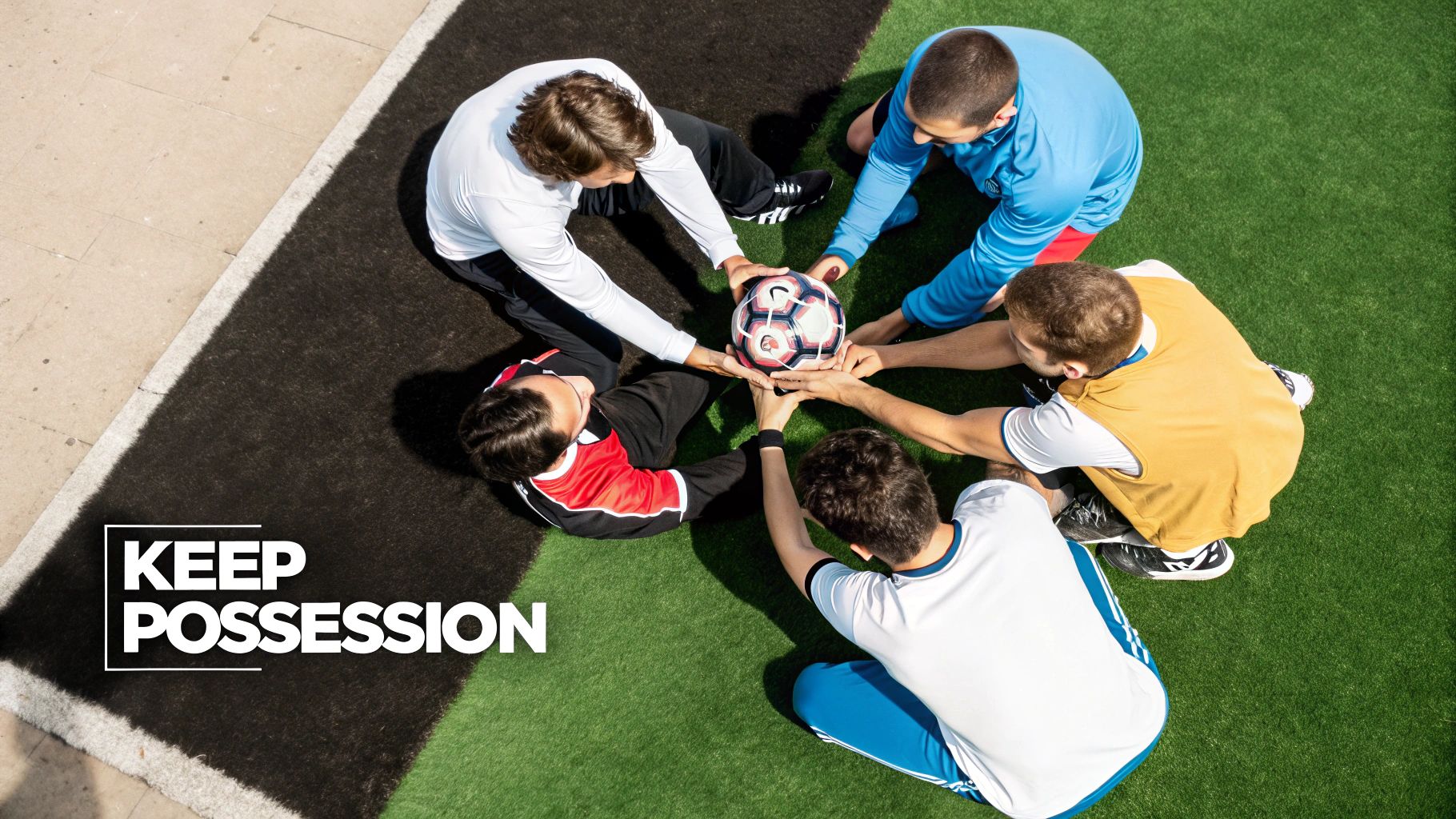
Players on the outside must use quick, one or two-touch passes, sharp movement, and constant spatial awareness to deny the defenders an interception. It’s one of the most efficient drills in soccer for developing a player's first touch, decision-making under pressure, and the crucial ability to play in tight spaces. The Rondo is not just about passing; it’s about communication, anticipation, and understanding teammates' movements, forming the building blocks of a fluid, possession-based style of play.
How to Implement the Rondo
Setting up a Rondo is straightforward, requiring minimal equipment – just a few cones and a ball. You can easily adapt it for any age or ability level by adjusting the rules.
- Area Size: Start with a larger area (e.g., 10x10 metres) to give attackers more time and space. As players improve, gradually shrink the playing area to increase the difficulty and pressure.
- Touch Limitations: Begin with unlimited touches for younger or less experienced players. Progress to two-touch, and eventually, one-touch passing to accelerate decision-making and technical precision.
- Player Numbers: A classic setup is 5v2 (five attackers vs. two defenders), but this can be adjusted. A 4v1 is great for beginners, while a 6v2 or 8v2 challenges players to find more complex passing lanes.
By consistently incorporating Rondos into training, coaches can cultivate a team that is comfortable on the ball, intelligent in its movement, and resilient under defensive pressure. To explore more variations and enhance your team's ball retention, discover a range of specialised possession drills for soccer on soccerwares.com.
2. High-Intensity Interval Training (HIIT) Shuttle Runs
A staple of modern athletic conditioning, HIIT Shuttle Runs are designed to replicate the explosive, stop-start nature of a real football match. This physical conditioning drill involves players performing intense sprints between marked lines or cones, followed by brief, active recovery periods. Popularised by sports science research and adopted by elite conditioning coaches worldwide, this method is a scientifically-backed way to build match-specific fitness. It simultaneously develops a player's aerobic and anaerobic capacity, acceleration, deceleration, and agility.
This drill is fundamental because it trains the body to recover quickly between high-intensity efforts, just like a midfielder tracking back after a forward run. The success of athletes like Cristiano Ronaldo, known for his incredible physical condition, is partly built on this type of training. These are some of the most effective drills in soccer for pushing a player's physical limits and ensuring they can maintain a high performance level for the full 90 minutes. It builds the engine that powers every other skill on the pitch.
How to Implement HIIT Shuttle Runs
Setting up shuttle runs requires only cones to mark distances. The key is to carefully manage work-to-rest ratios to maximise physiological benefits while minimising injury risk.
- Area Size: Set up cones at various distances, such as 5, 10, and 20 metres. The specific distances can be adjusted to focus on different aspects of fitness, like short-burst acceleration or longer sprints.
- Work-to-Rest Ratio: A common starting point is a 1:2 or 1:3 work-to-rest ratio. For example, a 15-second sprint could be followed by a 30-45 second active recovery (jogging or walking). As fitness improves, this can be progressed to a 1:1 ratio.
- Intensity and Volume: Players should aim to perform sprints at 90-100% of their maximum effort. Begin with a lower number of sets (e.g., 2 sets of 4 reps) and gradually increase the volume as the team adapts to the physical demands.
By integrating HIIT shuttle runs into a training programme, particularly during pre-season or specific conditioning blocks, coaches can dramatically improve their team's physical resilience and output. For a deeper look into building game-winning endurance, you can learn more about how to improve stamina in football on soccerwares.com.
3. 1v1 Attacking and Defending Drill
The 1v1 duel is the fundamental building block of any football match, and this drill isolates that moment to sharpen both offensive and defensive instincts. In a small, designated area, one attacker is pitted directly against one defender. The attacker's goal is to beat the defender and score, while the defender aims to dispossess them or prevent the shot. This exercise is crucial for developing individual brilliance, tactical awareness, and resilience in one-on-one situations. It is a staple in modern youth academies and was a key component of coaching philosophies from Arsène Wenger to Thomas Tuchel, who used it to develop fearless attackers and resolute defenders.

This scenario forces attackers to use clever dribbling, changes of pace, and feints to create space, directly improving their confidence on the ball. Simultaneously, defenders learn proper body positioning, tackling technique, and how to read an opponent's movements. Because of its intensity and direct competition, this is one of the most effective drills in soccer for simulating the high-pressure moments that decide matches. It teaches players how to win their individual battles, a skill that translates across the entire pitch.
How to Implement the 1v1 Drill
Setting up this drill requires a small grid, a goal, and a group of players ready to compete. The key is to create a realistic game-like challenge that is both demanding and rewarding.
- Define Clear Objectives: Before starting, establish what success looks like. For the attacker, it could be scoring in a small goal or dribbling past a designated end line. For the defender, it could be winning the ball and dribbling out of the area or simply stopping the attack within a time limit (e.g., 10 seconds).
- Vary the Area: Adjust the grid size to focus on different skills. A wider area encourages attackers to use their speed and dribbling ability, while a narrower, tighter space forces defenders to be compact and precise with their tackling.
- Regular Rotation: Keep the drill fast-paced by rotating attackers and defenders frequently. This ensures high intensity and gives every player a chance to experience both roles.
- Add Constraints: To increase the difficulty, introduce rules like a two-touch limit for the attacker or forcing them to use their weaker foot. This challenges players to adapt and think more quickly under pressure.
By focusing on these individual confrontations, coaches can build players who are not only technically proficient but also mentally tough. To further strengthen your team's ability to win the ball back, explore these specialised defensive soccer drills on soccerwares.com.
4. Pressing Triggers and Compactness Drill
A tactical masterclass in coordinated defence, the pressing triggers and compactness drill is fundamental to the modern high-intensity game. Popularised by visionary coaches like Jürgen Klopp and Ralf Rangnick, this exercise teaches a team to hunt as a pack, forcing turnovers in dangerous areas. The drill focuses on establishing clear cues (triggers) for when to press collectively, such as a poor touch, a pass into a specific zone, or a player receiving the ball with their back to goal. It is about turning defence into a potent attacking weapon.
This is one of the most vital tactical drills in soccer for developing a proactive and organised defensive unit. Players learn to maintain a compact shape, closing down space between lines and shifting as a single entity to suffocate the opposition. Systems like Liverpool's famous "Gegenpressing" are built upon the principles honed in these sessions. The goal is not just to win the ball, but to do so quickly and efficiently, creating immediate counter-attacking opportunities.
How to Implement a Pressing Drill
Setting up this drill requires a clear tactical objective and excellent communication from the coach. The focus is on collective action rather than individual brilliance.
- Define Clear Triggers: Before starting, clearly define the triggers for the press. This could be a pass to a full-back, a slow pass across the backline, or a player receiving the ball under pressure. Ensure every player understands these cues.
- Practise Compactness: Begin with a shadow play exercise where the defensive team shifts and maintains its compact shape as the ball is moved around by a non-resisting attacking team. This builds the foundational understanding of positioning.
- Increase Complexity: Start in a small-sided game format (e.g., 6v6 plus goalkeepers). As the team's understanding grows, progress to larger areas and more players, making the scenario more game-realistic. Constantly reinforce the principles of pressure, cover, and balance.
By integrating this drill, coaches can develop a defensively intelligent and physically relentless team, capable of dominating opponents both with and without the ball.
5. Small-Sided Games (SSG) / Possession-Based Matches
A fundamental tool in modern coaching, Small-Sided Games (SSGs) are reduced-format matches that amplify the intensity and demands of a full-scale game. By playing on smaller pitches with fewer players (e.g., 3v3, 4v4, 5v5), SSGs place individuals in realistic game situations more frequently. This methodology, central to philosophies like Tactical Periodisation developed by Vitor Frade and popularised by coaches like Pep Guardiola, ensures that physical, technical, and tactical training elements are combined. Every player gets more touches on the ball, makes more decisions, and performs more game-relevant actions per minute than in a traditional 11v11 match.
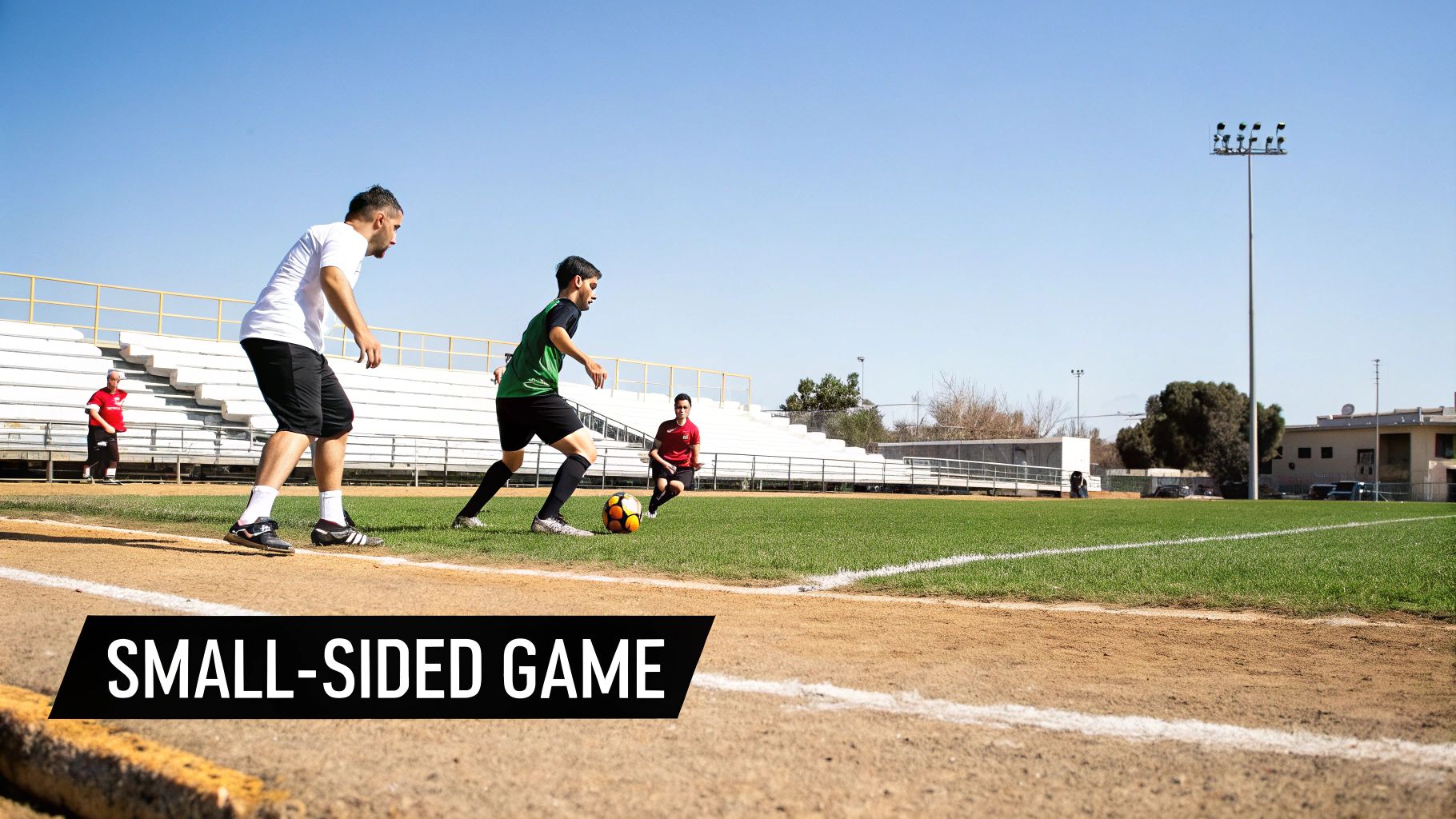
The primary benefit of SSGs is their incredible versatility and efficiency. They are not just a chaotic kick-about; they are highly structured drills in soccer designed to overload specific principles of play. A coach can manipulate the rules, pitch size, and player numbers to focus on anything from high-pressing and defensive transitions to quick combination play in the final third. This makes SSGs an indispensable part of developing intelligent, adaptable players who can execute complex tactical instructions under the physical and mental stress of a real match.
How to Implement Small-Sided Games
The beauty of SSGs lies in their adaptability. By adjusting a few key variables, coaches can create countless scenarios tailored to their session objectives.
- Pitch Dimensions: The size of the playing area directly influences the game's nature. A long, narrow pitch encourages vertical play and runs in behind, while a wide, short pitch promotes switching the point of attack and patient build-up play.
- Rule Modifications: Introduce specific constraints to target desired outcomes. For example, implement a touch limit (e.g., three-touch maximum) to speed up play or award double points for a goal scored immediately after a successful tackle to incentivise quick transitions.
- Player Numbers & Overloads: Use balanced numbers like 4v4 for general play, or create numerical advantages (e.g., 5v4) to coach attacking overloads or defensive organisation. Adding neutral "joker" players who play for the team in possession can also help maintain flow and focus on ball retention.
By integrating well-designed SSGs, coaches can move beyond isolated drills and train players within the complex, dynamic environment of the game itself, fostering a deeper tactical understanding and superior decision-making.
6. Crossing and Heading Accuracy Drill
A classic yet indispensable part of offensive strategy, the crossing and heading accuracy drill focuses on perfecting the art of scoring from wide areas. This exercise is fundamental for developing the synergy between wingers and strikers, turning wide play into a reliable source of goals. It has been a hallmark of many successful teams, particularly in English football, with sides like West Ham United and Stoke City historically building their attacks around aerial dominance. The drill systematically trains players to deliver precise crosses and for attackers to execute powerful, well-timed headers on goal.
This drill is one of the most effective drills in soccer for simulating a crucial match-day scenario: creating and finishing chances from the flanks. It refines a winger's ability to assess the situation and choose the right type of delivery – whether it’s a floated ball to the back post, a driven cross into the six-yard box, or an early, whipped-in ball. Simultaneously, it hones a striker's movement, timing, and heading technique, teaching them how to attack the ball aggressively and direct it with accuracy. The focus on repetition builds the muscle memory and understanding required for success under pressure.
How to Implement the Crossing and Heading Drill
This drill requires a goal, a supply of balls, and cones to mark crossing positions. It can be adapted to focus on specific attacking patterns and player abilities.
- Vary Delivery Points: Set up cones at different spots along the wing and at varied depths. Have players practise crossing from the by-line, from deep, and from half-spaces to replicate different in-game situations.
- Introduce Defenders: Start with unopposed headers to build confidence and refine technique. Gradually introduce a passive defender, then an active one, to force attackers to fight for space and improve their timing against opposition.
- Rotate Heading Techniques: Coach attackers to practise different types of headers. Focus on near-post flick-ons, powerful far-post finishes, and brave diving headers to create a versatile and unpredictable aerial threat.
By consistently working on this drill, coaches can develop a potent attacking weapon, making their team a constant threat from wide positions and set-pieces.
7. Transition Attack and Defence Drill
Modern football is defined by moments of transition, and this drill is engineered to master them. The Transition Attack and Defence Drill simulates the chaotic, high-stakes scenarios that occur the instant possession is lost or won. Coaches like Mauricio Pochettino and Diego Simeone have built formidable teams on the back of rapid, organised transitions, turning a defensive action into a goal-scoring opportunity in seconds. This exercise forces players to switch their mindset instantly, developing game awareness, speed of play, and tactical discipline.
This is one of the most physically and mentally demanding drills in soccer, as it replicates the highest intensity moments of a match. When the attacking team loses the ball, they must immediately press to win it back, while the defending team must quickly reorganise to launch a counter-attack. It hones players' ability to read the game, make split-second decisions, and cover ground efficiently, ensuring the team is never vulnerable after losing possession and always dangerous after winning it.
How to Implement the Transition Drill
This drill can be set up in various ways, often using a small-sided game format on a condensed pitch with goals at each end. The key is creating clear moments where possession changes hands.
- Game Setup: A common format is a 4v4 plus goalkeepers, played in an area from one 18-yard box to the other. This ensures frequent turnovers and transition opportunities.
- Triggering Transitions: The coach can start the drill by playing a ball to one team to begin their attack. The moment the other team wins the ball or the goalkeeper makes a save, the transition phase begins. The team that just lost possession must react defensively immediately.
- Coaching Cues: Emphasise the "5-second rule" for the team that loses the ball: attempt to win it back within five seconds. For the team that wins it, encourage a quick, forward pass to exploit the disorganised opposition. Provide adequate recovery time between repetitions to maintain high intensity.
8. Progressive Ball Circulation and Buildup Play Drill
A cornerstone of modern, possession-based football, this drill is designed to teach teams how to patiently and methodically build an attack from their defensive third. Popularised by tactical visionaries like Pep Guardiola, it focuses on creating numerical superiority and finding passing lanes to progress the ball through the lines of defence, midfield, and attack. It is an advanced tactical exercise that moves beyond basic passing into the realm of positional play and coordinated team movement.
This drill ingrains the principles of patient circulation, teaching defenders and midfielders how to draw opponents out of position before exploiting the space created. It’s one of the most effective drills in soccer for developing a team’s tactical intelligence, positional discipline, and the ability to control the game's tempo. Success in this drill translates directly to match day, creating a team that is comfortable building from the back and resilient against high-pressing opponents.
How to Implement the Buildup Play Drill
Setting up this drill requires a larger space, typically half a pitch, and is tailored to your team's formation. You can start without opposition and gradually add defenders to increase the realism and challenge.
- Initial Setup: Arrange your defenders and midfielders in their game-day positions. The aim is to move the ball from the goalkeeper to a target in the attacking third using a structured sequence of passes.
- Introduce Opposition: Start with passive defenders who can only press specific zones. As your team becomes more proficient, progress to active defenders who provide realistic pressure, forcing players to make quicker decisions. A common setup is an 8v6 in favour of the attacking team.
- Define Success: Clearly outline the objectives. Success could be defined as completing a certain number of passes, breaking the midfield line, or successfully delivering the ball to a designated target player or zone in the final third.
By mastering this buildup play, a team develops a cohesive identity, moving as a single, intelligent unit. It fosters communication and an understanding of spacing and timing, which are crucial for dominating possession and creating scoring opportunities.
9. Agility Ladder and Cone Dribbling Circuits
A staple in youth academies and professional pre-season training, agility ladder and cone dribbling circuits are fundamental for developing a player's technical foundation. These drills are designed to enhance footwork, balance, coordination, and close-ball control through a series of structured patterns. Popularised by conditioning specialists and technical skills coaches, this training method isolates and refines the micro-movements essential for sharp, explosive dribbling and quick changes of direction on the pitch. It forces players to be precise, quick-footed, and mentally engaged.
The core principle is to master movement patterns without the ball first, using an agility ladder, before integrating the football with cone circuits. This sequential approach builds muscle memory and ensures that players can maintain technique while dribbling. These are some of the most versatile drills in soccer, as they directly improve a player's ability to navigate tight spaces, beat defenders in one-on-one situations, and accelerate away from pressure. It’s about making complex footwork second nature, allowing players to focus on the game around them rather than the ball at their feet.
How to Implement Agility and Dribbling Circuits
Setting up these circuits requires basic equipment like an agility ladder and a set of cones or markers, making them accessible for any training environment. The key is to start with quality of movement before adding speed.
- Pattern Progression: Begin with simple ladder patterns like one-foot or two-feet in each square. Progress to more complex movements such as the Ickey Shuffle or lateral hops. Once mastered, replicate these rhythms while dribbling through a cone slalom.
- Focus on Quality: Emphasise keeping the head up to scan the surroundings, using soft touches to keep the ball close, and maintaining a low centre of gravity for balance and explosive power.
- Add Variations: Challenge players by requiring them to use their weaker foot only, or to use different parts of the foot (sole, outside, inside). Combining multiple ladder patterns and cone layouts into a single, longer circuit can test endurance and concentration.
- Introduce Competition: Time players as they complete the circuit to create a competitive and high-intensity environment, encouraging them to push their speed while maintaining technical control.
10. Set-Piece (Free Kick and Corner Kick) Specialisation Drill
In a game often decided by fine margins, set-piece specialisation is a critical training component that can transform dead-ball situations into match-winning opportunities. This drill moves beyond casual practice and focuses on the systematic execution of free kicks and corner kicks, involving both offensive patterns and defensive organisation. By dedicating specific time to these scenarios, teams can develop the cohesion and precision needed to exploit these crucial moments, a strategy heavily influenced by data-driven coaching and the structured preparation of top international teams.
Effective set-piece routines require every player to understand their specific role, from the taker's delivery to the runners' movements and the defenders' marking assignments. It’s one of the most strategic drills in soccer, teaching players to read cues, anticipate plays, and execute with accuracy under pressure. Teams renowned for their set-piece prowess, like Germany for their meticulous organisation or various Premier League clubs for their innovative corner kick variations, demonstrate how dedicated practice in this area directly translates to goals scored and points won.
How to Implement Set-Piece Specialisation
Implementing this drill requires a full-pitch setup with goals, balls, and cones or mannequins to simulate opponents. The key is repetition and role clarity.
- Assign Clear Roles: Designate primary and secondary takers for corners and free kicks from various angles. Assign specific roles for attackers: one player may target the near post, another may block a key defender, and another might lurk at the edge of the box for rebounds.
- Practise Variations: Develop two to three core routines for each situation (e.g., an in-swinging corner, a short corner, a far-post delivery). Run through each variation repeatedly until the timing and movements are synchronised. Use mannequins to represent the opposition's defensive shape.
- Defensive Organisation: Simultaneously, practise your defensive setup against set-pieces. Organise your zonal and man-marking systems, ensuring players know who to mark, which zones to cover, and how to set up an effective wall for free kicks.
By consistently drilling these scenarios, coaches can instil a deep tactical understanding and confidence in their squad, turning set-pieces from a hopeful chance into a calculated threat.
Comparison of 10 Soccer Drills
| Drill | Implementation complexity 🔄 | Resource requirements ⚡ | Expected outcomes ⭐ / 📊 | Ideal use cases | Key advantages 💡 |
|---|---|---|---|---|---|
| Rondo (Possession Circle) | 🔄🔄 (low–medium) | Low — small area, minimal equipment ⚡ | High ⭐⭐⭐ — possession, decision-making 📊 | Technical warm-ups, possession work | 💡 High touch volume; vary space/touches |
| HIIT Shuttle Runs | 🔄🔄 (medium) | Low equipment, requires timing/monitoring ⚡⚡ | Very high ⭐⭐⭐ — cardio, speed & VO2 improvement 📊 | Pre-season conditioning, fitness blocks | 💡 Time-efficient; increase intensity gradually |
| 1v1 Attacking and Defending Drill | 🔄🔄 (low–medium) | Low — cones, small area, rotation of players ⚡ | High ⭐⭐ — dribbling, defending under pressure 📊 | Individual skill development, duel practice | 💡 Rotate roles; set clear success criteria |
| Pressing Triggers & Compactness Drill | 🔄🔄🔄 (high) | High — coach instruction, video, repeated reps ⚡ | High ⭐⭐⭐ — team pressing, quicker recoveries 📊 | Team tactical sessions, defensive organisation | 💡 Define triggers; use video and gradual load |
| Small-Sided Games (SSG) | 🔄🔄 (medium) | Moderate — space, players, flexible rules ⚡⚡ | Very high ⭐⭐⭐ — decision-making, match-like reps 📊 | Tactical integration, situational practice | 💡 Adapt rules to target specific behaviours |
| Crossing & Heading Accuracy Drill | 🔄🔄 (low–medium) | Moderate — space, multiple players, balls ⚡ | High ⭐⭐ — set-piece finishing, aerial dominance 📊 | Set-piece work, finishing practice | 💡 Vary crossing depth/pace; add defensive pressure |
| Transition Attack & Defence Drill | 🔄🔄🔄 (high) | Moderate — full-team numbers, recovery management ⚡⚡ | High ⭐⭐⭐ — transition speed, tactical awareness 📊 | Phase-of-play training, conditioning with purpose | 💡 Control intensity; clearly define transition moments |
| Progressive Ball Circulation & Buildup | 🔄🔄 (medium) | Low–moderate — positional setup, coach guidance ⚡ | High ⭐⭐ — structured buildup, passing patterns 📊 | Buildup play, positional organisation drills | 💡 Start without pressure, then add defenders |
| Agility Ladder & Cone Dribbling | 🔄 (low) | Low — ladders/cones, small space ⚡ | Moderate ⭐⭐ — footwork, close control 📊 | Individual technical sessions, youth development | 💡 Emphasise technique before speed; vary patterns |
| Set-Piece (Free/Corners) Specialisation | 🔄🔄 (medium) | Moderate — players, coaching, video analysis ⚡ | High ⭐⭐⭐ — increased scoring from dead balls 📊 | Match preparation, specialist routines | 💡 Practice multiple variations; track conversion rates |
Integrating These Drills for Maximum Impact
The journey from the training ground to match day triumph is paved with purposeful practice. We have explored a comprehensive suite of drills in soccer, from the foundational Rondo to the intricate Set-Piece Specialisation Drill. Each one is a crucial component in a player's or team's developmental toolkit, targeting specific facets of the game, including technical skill, tactical intelligence, and physical conditioning. However, the true art of coaching and self-improvement lies not in the isolated execution of these exercises, but in their intelligent and integrated application.
A random assortment of drills, no matter how well-executed, will only yield fragmented progress. The key is to view this list not as a rigid menu, but as a collection of ingredients to create a balanced, dynamic, and challenging training regimen that addresses specific weaknesses and enhances existing strengths. Think of it as building a pyramid: fundamental ball mastery from agility circuits and 1v1 duels forms the base, upon which tactical concepts like pressing triggers and progressive buildup play are layered.
Weaving the Threads: Creating a Cohesive Training Plan
To truly elevate performance, consider how these drills complement one another. A session might begin with Agility Ladder and Cone Dribbling Circuits to activate players' footwork and sharpen their close control. This can naturally progress into a high-tempo Rondo, demanding sharp passing and movement in tight spaces, reinforcing the technical skills just warmed up.
From there, you could introduce the Transition Attack and Defence Drill, forcing players to apply their passing and dribbling skills under the pressure of a sudden change in possession. This tactical element can then be scaled up into a Small-Sided Game, where all the individual components, from defending to shooting, are brought together in a competitive, match-like environment. This layered approach ensures that skills are not just learned in a vacuum but are continuously tested and refined in increasingly complex scenarios.
The Philosophy of Purposeful Practice
The most significant takeaway is the importance of purposeful practice. Every cone placed, every pass made, and every run tracked should have a clear objective tied to in-game performance. Ask yourself why you are doing a particular drill.
- Are you aiming to improve defensive shape? The Pressing Triggers and Compactness Drill is your focus.
- Is the final ball into the box lacking quality? Dedicate time to the Crossing and Heading Accuracy Drill.
- Are your players' fitness levels dropping in the final 20 minutes? Integrate High-Intensity Interval Training Shuttle Runs to build that essential endurance.
Key Insight: True development in football does not come from simply going through the motions. It comes from understanding the 'why' behind every drill and focusing intently on the specific technical or tactical outcome you want to achieve during each repetition.
This deliberate approach transforms training from a simple physical exertion into a deep, cognitive learning experience. It encourages players to think critically about their decisions on the pitch, leading to smarter, more effective play when it truly matters. By consistently applying these principles and thoughtfully combining the drills in soccer outlined in this guide, you create a powerful framework for continuous improvement. The result is not just a collection of skilled individuals, but a cohesive, intelligent, and formidable team.
Ready to turn these drills into results? The right equipment makes all the difference in executing training sessions effectively. Explore the professional-grade cones, agility ladders, goals, and cutting-edge GPS trackers at SoccerWares to equip yourself for success. Visit SoccerWares to find everything you need to elevate your training to the next level.