

Football agility ladder drills are the secret weapon for developing the rapid, razor-sharp footwork that lets you dominate on the pitch. These drills are all about boosting your neuromuscular coordination and foot speed, giving you the ability to make explosive changes of direction and keep the ball under control in the tightest of spaces.
Why Top Players Swear By Agility Ladder Training
Ever watch a top-tier footballer and wonder how they seem to dance past defenders with such quick feet? It’s not just about being fast; it's about elite body control and coordination, skills they’ve spent countless hours sharpening. A huge part of that on-pitch magic is a finely-tuned nervous system, and that's exactly what consistent football agility ladder drills build.
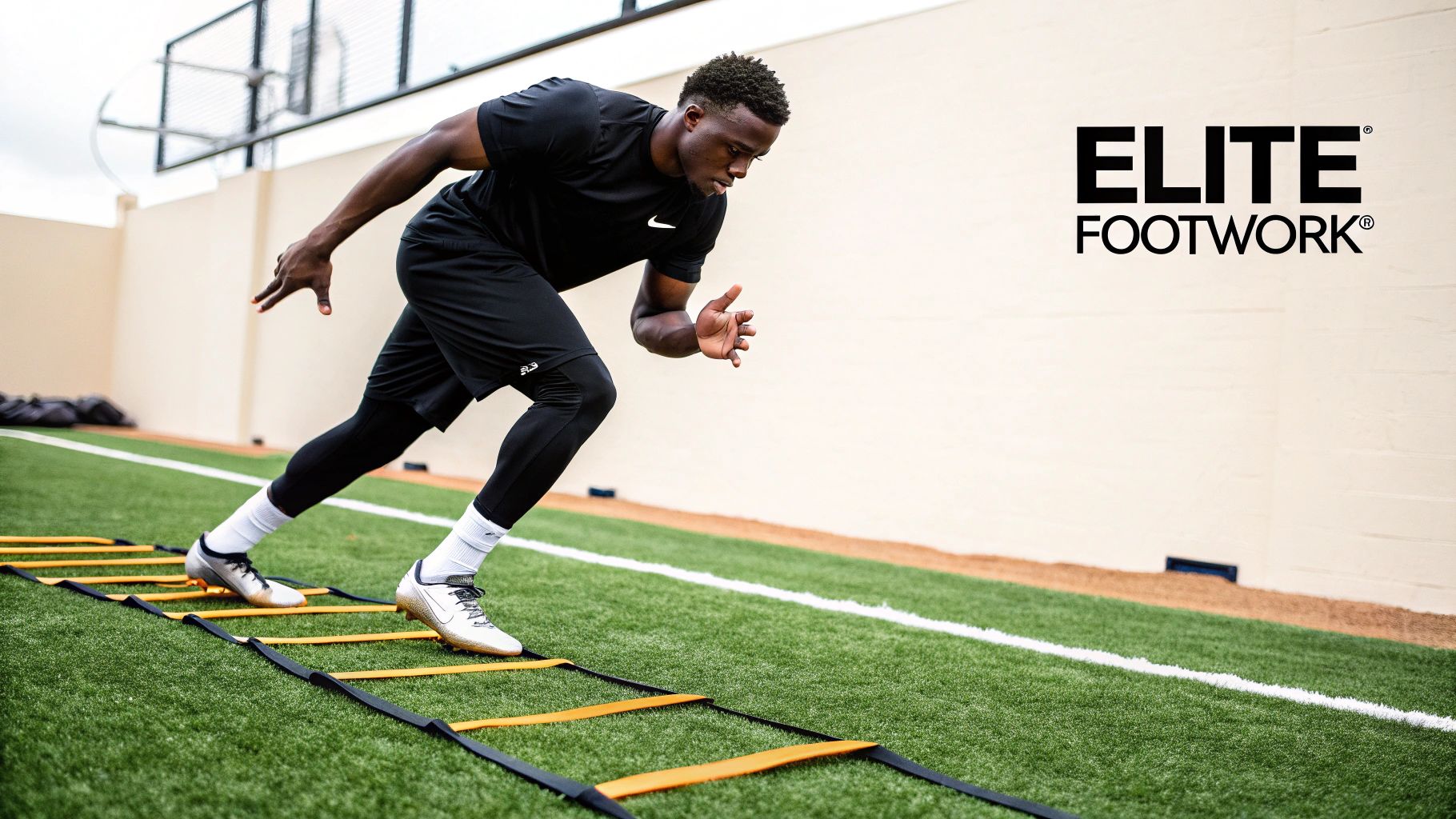
What I love about these simple-looking drills is how directly they translate into game-winning moves. They’re less about building raw power and more about forging a faster, stronger connection between your brain and your feet.
Forging Elite Neuromuscular Connections
At its core, agility ladder training is all about programming your body for football. Every single step, hop, and shuffle through the rungs strengthens the neural pathways that control quick, precise movements. It's how you build the muscle memory that becomes pure instinct in a match.
Think about a winger hitting a sharp cutback to leave a fullback for dead. That explosive change of direction is only possible if their brain can instantly tell their feet exactly where to go. Ladder drills build that exact response, one repetition at a time.
Enhancing On-Pitch Performance
When you start weaving ladder work into your training, the benefits show up where it matters most—in those critical moments on the pitch. Players who stick with it almost always see massive improvements in a few key areas:
- Foot Speed: Absolutely essential for dribbling in tight spots, reacting to a loose ball, or throwing in a last-ditch tackle.
- Body Control and Balance: Ladder drills force you to keep a low centre of gravity and stay on the balls of your feet. This is vital for staying upright in a challenge or sidestepping a defender.
- Coordination: By getting your arms and legs working in sync, you develop a more powerful and efficient running style, which is the foundation of true athleticism. For a deeper look, check out our guide on how to increase speed.
The real value of the ladder isn't just making your feet faster; it's about teaching your body to move efficiently and react instinctively. It's the foundation upon which true game agility is built.
To get started, a decent piece of kit like the SoccerWares Agility Ladder is a must. It provides the consistent spacing needed to build good habits and is tough enough to handle proper training sessions. It’s a tool every player who’s serious about building elite movement patterns should have in their bag. And for players looking to maximise their recovery and performance, exploring the science-backed sauna benefits for athletes can also be a game-changer for staying at the top of your game.
Preparing For A High-Intensity Ladder Session
Thinking about jumping straight into explosive football agility ladder drills without a proper warm-up? Don't. It's a sure-fire way to pull something and get absolutely nothing out of your session. To nail those rapid, precise movements the ladder demands, your body has to be primed and ready to fire.
A targeted warm-up isn't just about getting a bit warmer; it’s about waking up the right muscles and switching on your nervous system for the work ahead.
A Practical 10-Minute Protocol
A solid, football-specific warm-up should take about 10 minutes. The key is progression—start gentle and build the intensity so you’re ready for the high-energy stuff.
First, get the blood flowing with a few minutes of light jogging. This isn't a 5k run; it's just about raising your heart rate and loosening up your joints. From there, it's straight into dynamic stretches that actually mimic the movements you'll make on the pitch.
- Leg Swings: Do them forward-and-back and then side-to-side. This is brilliant for opening up your hips and waking up your hamstrings.
- Hip Circles: Get those hips rotating, both clockwise and anti-clockwise. Think about improving that crucial mobility for quick turns.
- Torso Twists: Gently rotate your upper body. This engages your core and gets your spine ready for action.
These movements focus on the muscles you'll rely on most: your glutes, hamstrings, and core. Nailing this part is vital for generating power, staying stable, and keeping injuries at bay. For any player serious about protecting their joints, understanding how to prevent ACL injuries is a must, and a proper warm-up is your first line of defence.
Your warm-up isn't a chore to get through; it's the first and most important part of your training. It sets the tone for your performance and dramatically cuts your risk of getting hurt.
Final Activation Phase
To finish off, you need to dial in your coordination and get that explosive pop. This is where activation exercises come in, getting your nervous system ready for the fast-twitch movements the ladder drills demand.
Spend the last couple of minutes on light, snappy plyometric-style movements. Things like ankle hops (sometimes called pogos), short skips, and low-intensity A-skips are perfect here. This final stage ensures you're physically sharp, mentally focused, and ready to squeeze every last drop of benefit out of your session.
Alright, you've warmed up and you're ready to go. Now for the good stuff. This is your playbook for the essential football agility ladder drills that build truly elite footwork. We're not just moving feet for the sake of it; each drill is designed to mimic the exact, explosive movements you'll need on the pitch.
We'll walk through ten core drills, starting with the basics and building up to more complex patterns. For each one, I’ll explain why it matters for a footballer, how to do it right, and the common mistakes I see players make all the time. Nailing the technique now is everything—sloppy repetitions just reinforce bad habits.
Before you even step up to the ladder, a quick warm-up is non-negotiable. It gets the blood flowing, wakes up the muscles, and primes your body for the sharp movements ahead.
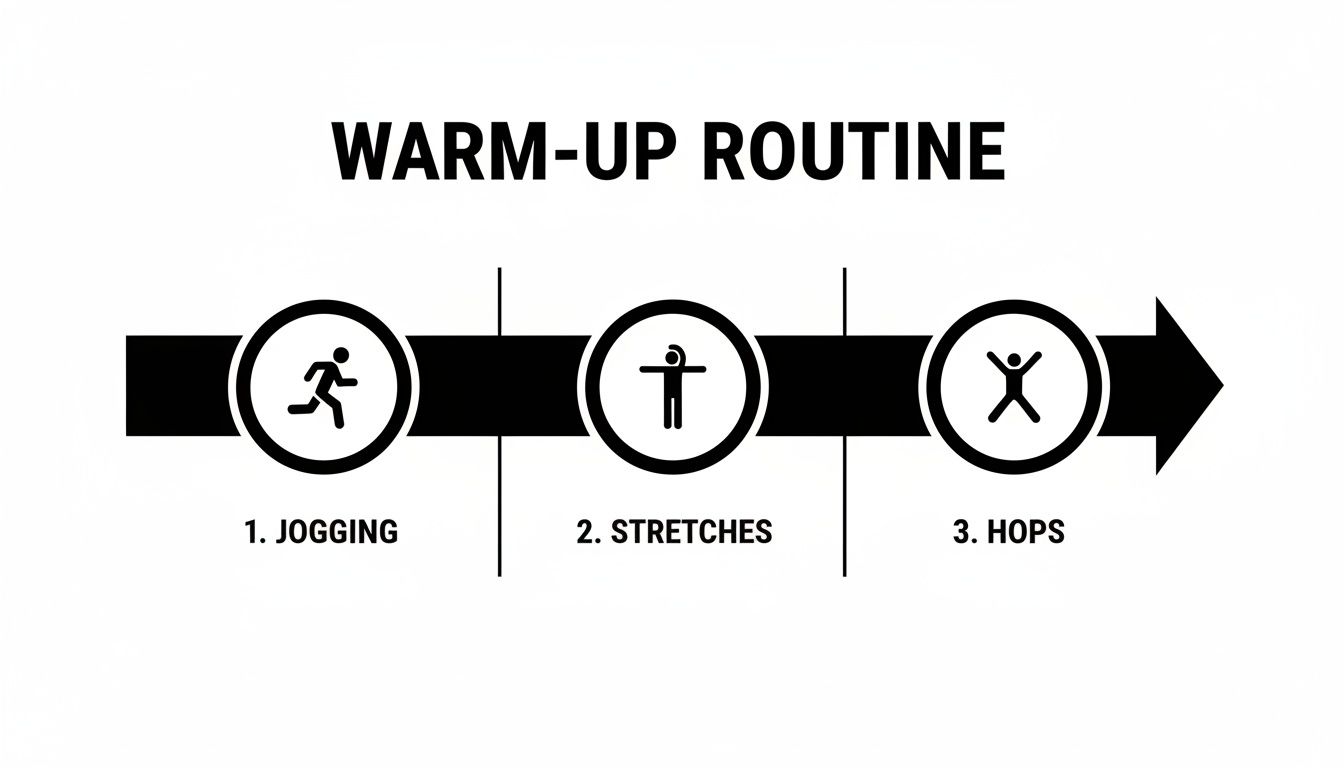
Think of it as a simple progression: light jogging to raise your heart rate, dynamic stretches to mobilise your joints, and a few hops to get your nervous system firing.
1. The Linear Run (One Foot In)
This is ground zero for anyone new to the ladder. It’s the simplest drill but builds the rhythm and coordination you'll need for everything else.
- Why it helps: It develops your basic foot speed and encourages a high knee drive, which is the foundation for acceleration.
- How to do it: Jog forwards, placing just one foot inside each square. Stay light on the balls of your feet and pump your arms in time with your legs.
- Coaching cue: "Knees up, arms pumping." A simple phrase to keep your form clean and stop you from just shuffling.
- Common mistake: Staring down at your feet. Get your head up and eyes forward, just like in a match. Trust your feet to find the squares.
2. The Linear Hopscotch (Two Feet In)
Once the one-foot run feels comfortable, it's time to up the tempo. Getting two feet in each square demands much quicker steps and better coordination.
- Why it helps: This is a massive boost for your foot speed and cadence. It’s perfect for improving those tiny, rapid adjustments you make with the ball at your feet.
- How to do it: It's the same forward motion, but you'll place both feet inside each square before moving to the next. Think a quick "right-left" in one box, then "right-left" in the next.
- Coaching cue: "Quick feet, light taps." Imagine the ground is hot. You want your feet to pop straight back up.
- Common mistake: Slapping the ground with heavy feet. This kills your speed and rhythm. Stay on the balls of your feet the entire time.
3. The Lateral Stepper
Football is rarely played in a straight line. This drill gets you moving sideways, which is crucial for defending, shadowing an opponent, or creating space.
- Why it helps: Builds lateral quickness and hip mobility. This is the exact movement a fullback uses to contain a winger or a midfielder uses to shut down space.
- How to do it: Stand sideways to the ladder. Lead with your inside foot, stepping into the first square, and have your other foot follow. Repeat this pattern all the way down.
- Coaching cue: "Stay low, push off." Keep a low, athletic stance and use your outside leg to drive you powerfully into the next square.
- Common mistake: Crossing your feet over. Your feet should never cross. One follows the other, otherwise you’ll trip, lose balance, and slow right down.
Remember, the point isn't just to get through the pattern. It's about performing it with quality movement that translates to the pitch—staying balanced, head up, and moving with purpose.
4. The In-Out Shuffle
A classic for a reason. This drill combines forward and sideways movement, teaching your body to shift direction efficiently. It's a real step up in coordination.
- Why it helps: It sharpens your ability to change direction from a narrow to a wide stance, which is vital for dribbling past defenders.
- How to do it: Start with your feet outside the first square. Step one foot in, then the other ("in-in"). Immediately step both feet back out ("out-out"). Repeat this "in-in, out-out" sequence down the ladder.
- Coaching cue: "Rhythm is key." Find a steady beat for your "in-in, out-out" and stick to it.
- Common mistake: Forgetting your arms. Keep them active and driving in sync with your legs. They generate momentum and help you stay balanced.
For players just getting started, these fundamental movements are pure gold. If you're building a foundation from scratch, you can find more great ideas in our guide to beginner soccer drills.
5. The Ickey Shuffle
Named after an American football player, this drill is fantastic for developing the hip rotation and footwork needed to evade a tackle or make a sharp cut.
- Why it helps: Boosts your hip dexterity and multi-directional speed. It trains you to plant your foot and change direction in a flash.
- How to do it: Stand to one side. Step into a square with your inside foot, then your outside foot follows. Then, step your inside foot out to the other side. Your trail foot now becomes the lead foot as you repeat the "in, in, out" pattern.
- Coaching cue: "Swivel your hips." The movement needs to be fluid. Let your hips rotate to make the transition into the next square smooth and fast.
- Common mistake: Being flat-footed. You have to be on the balls of your feet to make these quick, rotational movements happen.
6. The Ali Shuffle
Just like the legendary boxer it's named after, this drill is all about lightning-fast feet and staying balanced while you switch your stance.
- Why it helps: Develops incredible foot speed. It’s vital for the quick feints and body fakes you need in one-on-one situations.
- Execution: Stand with one foot inside a square, the other outside. In a quick shuffling motion, switch their positions. Progress down the ladder, doing one shuffle per square.
- Coaching cue: "Float like a butterfly." Stay light and bouncy. The movement should be a continuous, fluid rhythm, not a series of jerky steps.
- Common mistake: Leaning too far forward or back. Keep your core tight and posture upright to stay balanced.
7. The Slalom (Weave)
The Slalom feels like you're dribbling through a line of cones or defenders. It demands precise foot placement and excellent body control.
- Why it helps: This translates directly to close-control dribbling. It improves your ability to make tight turns and keep the ball glued to your feet while weaving through players.
- How to do it: Start beside the ladder. Step your lead foot into the first square, then bring your trail foot around the outside of that rung. Your lead foot then steps into the next square as the trail foot goes around the outside again. You're weaving in and out.
- Coaching cue: "Lead with your hips." Your hips and shoulders should turn slightly ahead of your feet to guide them through the pattern smoothly.
- Common mistake: Taking huge, looping steps with the outside foot. Keep everything tight and efficient to stay quick.
And there's science to back this up. While the research wasn't on footballers, a study on badminton players found that a structured ladder programme led to a 9% improvement in speed. Their sprint times dropped to 7.47 seconds compared to a control group average of 8.21 seconds. It shows how these drills create real, measurable improvements. You can read the full research about these speed improvements yourself.
8. The Carioca
Also known as the grapevine, the Carioca is essential for developing hip rotation while moving sideways—a pattern you see defenders use constantly.
- Why it helps: Improves agility and coordination when moving laterally. It's perfect for a defender who needs to turn and run with a winger without losing sight of the ball.
- How to do it: Move sideways. The pattern is "front, behind, front." Step your lead foot into a square, then cross your trail foot behind it into the next. Your lead foot then steps out, and your trail foot crosses in front into the next square.
- Coaching cue: "Twist your torso." Actively rotate your upper body and hips to drive the movement.
- Common mistake: Just stepping without rotating. The real benefit comes from that dynamic hip and torso twist.
9. Two In Two Out Forward Shuffle
This is a more advanced take on the standard "In-Out" shuffle. It requires a higher level of coordination and foot speed, making it a great progression once you've mastered the basics.
- Why it helps: Builds advanced coordination and the ability to accelerate and decelerate quickly. It mimics the stutter-step movements used to unbalance a defender.
- How to do it: Stand on one side of the ladder. Step two feet into a square ("in-in"), then two feet out to the same side ("out-out"), before moving forward to repeat at the next square.
- Coaching cue: "Punch the ground." Your steps should be quick, sharp, and purposeful.
- Common mistake: Losing the rhythm. It's a complex pattern, so start slow to get the footwork right before you try to add speed.
10. Creating Your Own Circuit
The real magic happens when you start combining these drills and adding a ball. Don't just work the ladder in isolation—make it part of a bigger circuit.
- Progression and Variation: Once a drill feels too easy, mix it up. Try it backwards, add a football to dribble through the pattern, or place some SoccerWares training cones at the end to sprint towards.
-
Example Circuit:
- Perform the Ickey Shuffle through the ladder.
- Immediately explode into a 10-metre sprint to a cone.
- Perform a sharp turn as you receive a pass from a partner.
- Dribble back to the start at pace.
This kind of circuit bridges the gap between raw footwork and on-pitch performance, ensuring the skills you're building on the ladder actually show up on match day.
How To Integrate Ladder Drills Into Your Training Week
Knowing the best football agility ladder drills is only half the battle. If you just throw them in whenever, or worse, when you’re already tired, you’ll never see the explosive results you're after. The secret lies in smart, consistent integration.
It’s a classic mistake to think more is better. I see players all the time grinding out repetitions on the ladder until they're completely gassed. That’s not the point. Agility work is all about teaching your nervous system to fire quicker, which demands sharp, high-quality movements—not long, draining sessions.
Quality Over Quantity, Always
The whole point of ladder work is to build speed and precision, not endurance. The moment your form starts breaking down from fatigue, you begin reinforcing sloppy movement patterns. That’s the exact opposite of what we’re trying to achieve.
Short, focused bursts are far more effective. A good session should feel intense but brief, leaving you feeling sharp, not exhausted. This high-intensity, low-volume approach is what forges faster connections between your brain and your feet.
The purpose of the agility ladder is to refine your movement, not to test your stamina. Treat it like a skill session—focus on perfect execution for every single repetition.
Top sports conditioning coaches agree. Most pros recommend using the ladder for less than five minutes per session, just once or twice a week. This measured approach treats ladder drills for what they are: a vital tool for warm-ups and neuromuscular development, but just one piece of the overall athletic puzzle. You can read more on this training philosophy from some of the best in the business.
Where Does It Fit in Your Week?
So, when’s the best time to do your ladder work? The sweet spot is right after your dynamic warm-up but before any heavy technical or physical training. Your body is primed, your nervous system is firing, but you haven’t built up any fatigue yet.
Slotting it in here guarantees you can perform every drill with maximum speed and perfect form. The one place you should never put it is at the end of a session when your legs feel like lead and your focus has gone.
Sample Weekly Agility Ladder Training Schedule
To give you a clearer picture, here’s how you could structure your training week to include ladder drills effectively. This schedule prioritises performing them when you’re fresh to get the maximum benefit for your speed and coordination.
| Day | Training Focus | Agility Ladder Integration | Duration & Intensity |
|---|---|---|---|
| Monday | Rest / Active Recovery | None | N/A |
| Tuesday | Technical Skills & Passing | Post Warm-Up | 5 Mins / High Intensity |
| Wednesday | Strength & Conditioning | None | N/A |
| Thursday | Tactical Shape & Small-Sided Games | Post Warm-Up | 5 Mins / High Intensity |
| Friday | Rest / Light Session | None | N/A |
| Saturday | Match Day | Pre-Match Warm-Up (Light) | 2-3 Mins / Low Intensity |
| Sunday | Rest / Active Recovery | None | N/A |
As you can see, the main sessions are early in the week on non-strength days, with a very light, short burst just to prime the muscles before a match.
How to Keep Progressing
To keep making gains, you have to keep challenging yourself. Once a drill becomes so easy you can do it perfectly without thinking, it’s time to level up.
Here are a few ways to progress:
- Increase Speed: This is the most obvious one. Push yourself to move through the patterns as fast as you can while keeping your technique flawless.
- Add Complexity: Time to move on to more advanced drills that really test your coordination, like the Carioca or the Ickey Shuffle.
- Introduce a Ball: This is the real game-changer. Try dribbling through a simple ladder pattern. It’s one of the best ways to connect your footwork directly to your on-pitch skills.
Moving Beyond The Ladder For True Game Agility
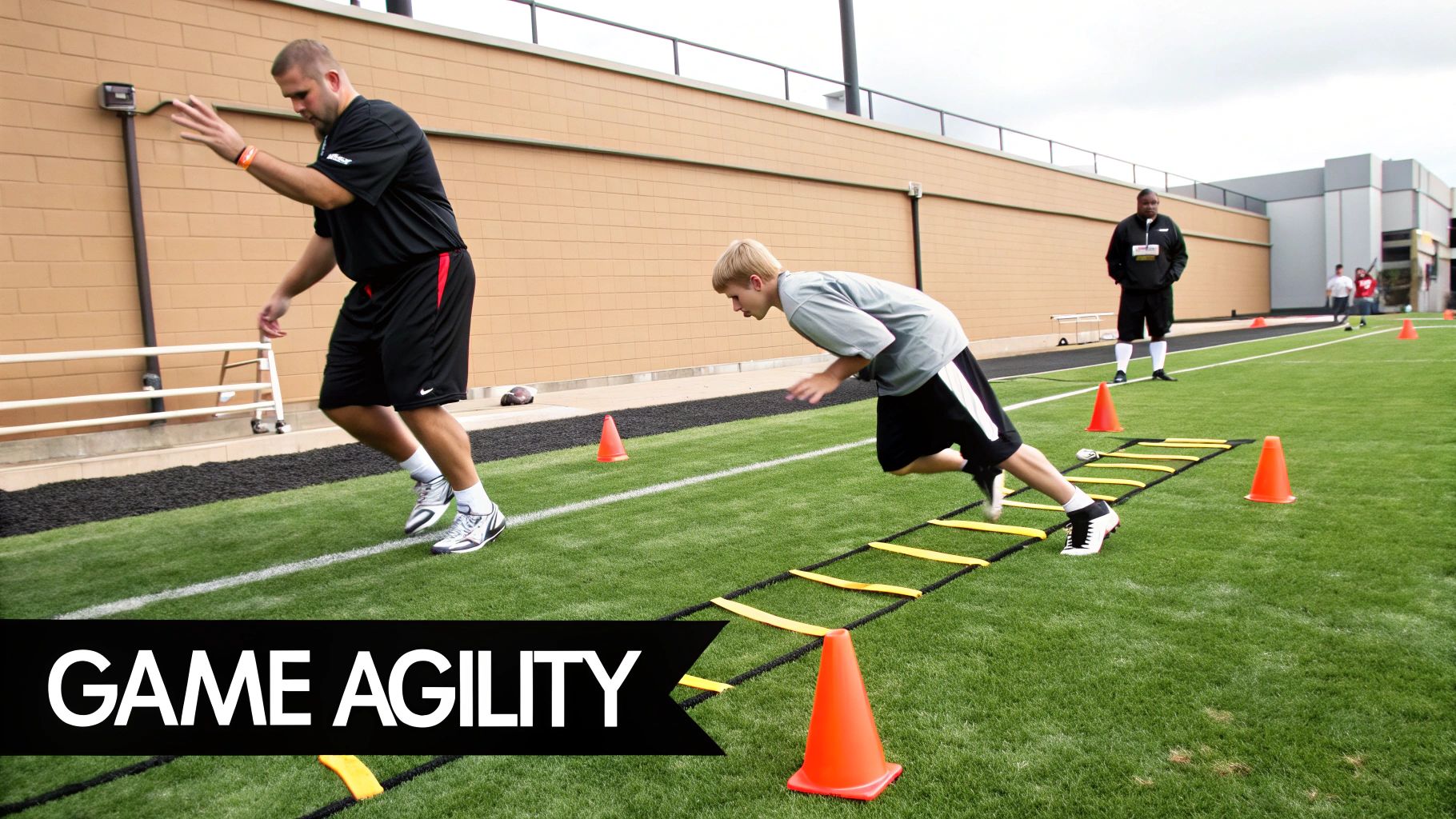
Look, the agility ladder is a brilliant bit of kit. It’s fantastic for drilling foot patterns and building that muscle memory for quick, sharp movements. But let's be honest about its limits.
True match-day agility isn't about running through a perfect, pre-planned sequence. It's about reacting to chaos. It's the sudden sidestep to beat a lunging defender, the split-second change of direction to meet a through ball, or the sharp check-back into space.
That's the gap. Ladder drills are predictable. You know exactly what's coming next. This is great for coordination but doesn't train your brain to perceive, decide, and explode into action based on an unpredictable trigger.
Building Reactive, Game-Ready Skills
So, how do we bridge that gap from rehearsed drills to real-game reactions? Simple. You have to add an unpredictable element to your training.
You need to force your brain and body to connect. The goal is to train your instincts, not just your feet. It's about seeing something, processing it in a heartbeat, and making your move. That’s when the ladder work really starts to pay off.
Here are a few simple but incredibly effective ways to do it:
- Cone Drills with Commands: Forget just weaving through cones. Set up different coloured cones and get a coach or teammate to shout a colour. Your job is to react and sprint to the correct one instantly.
- Small-Sided Games: This is probably the best agility training there is. A 4v4 or 5v5 game is pure chaos. It’s a constant storm of triggers forcing you to adjust, turn, and accelerate.
- Rebounder Drills: Using a tool like a rebounder is a game-changer. The ball flies back at you at different speeds and angles, forcing you to adjust your body shape and first touch on the fly.
The agility ladder builds the alphabet of movement. Reactive drills teach you how to form words and sentences on the pitch, creating fluid, intelligent, and unpredictable play.
The Role Of Strength and Functional Training
Finally, let's talk about the engine. All the quick feet and fast decisions in the world mean nothing without the raw power to execute the move. Explosive strength is the foundation of game-changing agility.
This is non-negotiable for serious players. To really make your ladder work count, you need to get stronger. And I don’t just mean lifting weights—it’s about understanding functional fitness training, which focuses on movements that translate directly to the pitch.
Think squats for driving power, deadlifts for stability, and plyometric jumps for that explosive first step. If you want to add more variety, our guide on using football training poles has some great ideas.
When you combine ladder footwork, reactive drills, and a solid strength programme, you're not just getting faster. You’re building unstoppable, game-winning agility from the ground up.
Your Top Agility Ladder Questions Answered
Even with a solid set of drills, a few practical questions always pop up. Over the years, I've heard the same queries from players and coaches just starting to weave football agility ladder drills into their training. Let's clear up some of that confusion.
Think of this as your go-to guide for sidestepping the common hurdles that can trip up your progress.
How Often Should I Be Doing Ladder Drills?
For the best results without burning out, aim for two to three sessions a week. The golden rule here is to hit the ladder right after your dynamic warm-up. This is when your muscles are fired up and your brain is switched on.
Whatever you do, don't leave them until the end of a long, gruelling session. Your form will be sloppy, and you'll just be practising bad habits. Keep it short and sharp—5-10 minutes of focused, high-quality work is worth far more than a tired, drawn-out workout.
Will Ladder Drills Genuinely Make Me a Faster Player?
Yes, but it's crucial to understand how. Ladders are incredible for sharpening your foot speed, coordination, and the quick-fire muscle responses that give you that explosive burst over the first few metres. They build the foundation for acceleration.
But to improve your top-end sprint speed over longer distances, you need more in your toolkit. Ladder work must be combined with strength training (like squats and lunges), plyometrics (box jumps are great for this), and proper sprinting drills. The ladder is a vital piece of the speed puzzle, not the whole picture.
The agility ladder hones your footwork and quickness, directly boosting your initial burst of speed. For top-end velocity, this must be paired with a dedicated strength and power programme.
What Are the Most Common Mistakes Players Make?
The three biggest errors I see time and time again are players staring down at their feet, letting their arms hang loose, and running with a stiff, upright posture. These habits don't just kill your performance; they build bad muscle memory.
- Keep your head up: You wouldn't stare at the ground in a match, so don't do it in training. Scan ahead.
- Stay on the balls of your feet: Be light, springy, and ready to react. No clomping feet.
- Drive your arms: Your arms power your legs. Use them to create momentum and keep your balance.
Always, always prioritise clean, precise movements over raw speed, especially when you're learning a new drill. The pace will come naturally once your technique is dialled in.
Can I Do These Drills Without an Actual Ladder?
Absolutely. If you don't have one, get creative. You can use chalk on a patio, lay out cones, or even use the pitch markings as your guide. The main thing is to keep the spacing between your markers consistent.
That said, a purpose-built ladder is always the better choice. It gives you perfect, consistent spacing every single time, it's built to last, and you can take it anywhere. This consistency makes your training far more effective and helps you lock in the right movement patterns much faster.
Ready to build elite footwork and transform your game? The SoccerWares Agility Ladder is engineered for durability and perfect spacing, giving you the professional-grade tool you need to sharpen your speed and coordination. Check out our full range of training essentials today.