

You know the session. One player wants to rattle shots from the edge of the box, the keeper wants a few volleys at chest height, and everyone leaves feeling busy. Then match day arrives, a clear chance opens up, and the finish is rushed. Or the goalkeeper gets set half a second late and palms a save into danger.
That's the problem with most football goal training. It looks active, but it doesn't build repeatable actions under pressure.
Useful goal training has to join three things that too often get split apart. Clean technique. Real decision-making. Safe, suitable equipment that lets you train properly without cutting corners. If one piece is missing, players end up rehearsing habits they can't rely on when the moment matters.
Why Structured Football Goal Training Makes the Difference
A missed chance rarely comes from one big flaw. More often, the routine is messy. The first touch is fine, the body shape is nearly right, but the finish gets snatched because the player hasn't trained the whole action in a disciplined way.
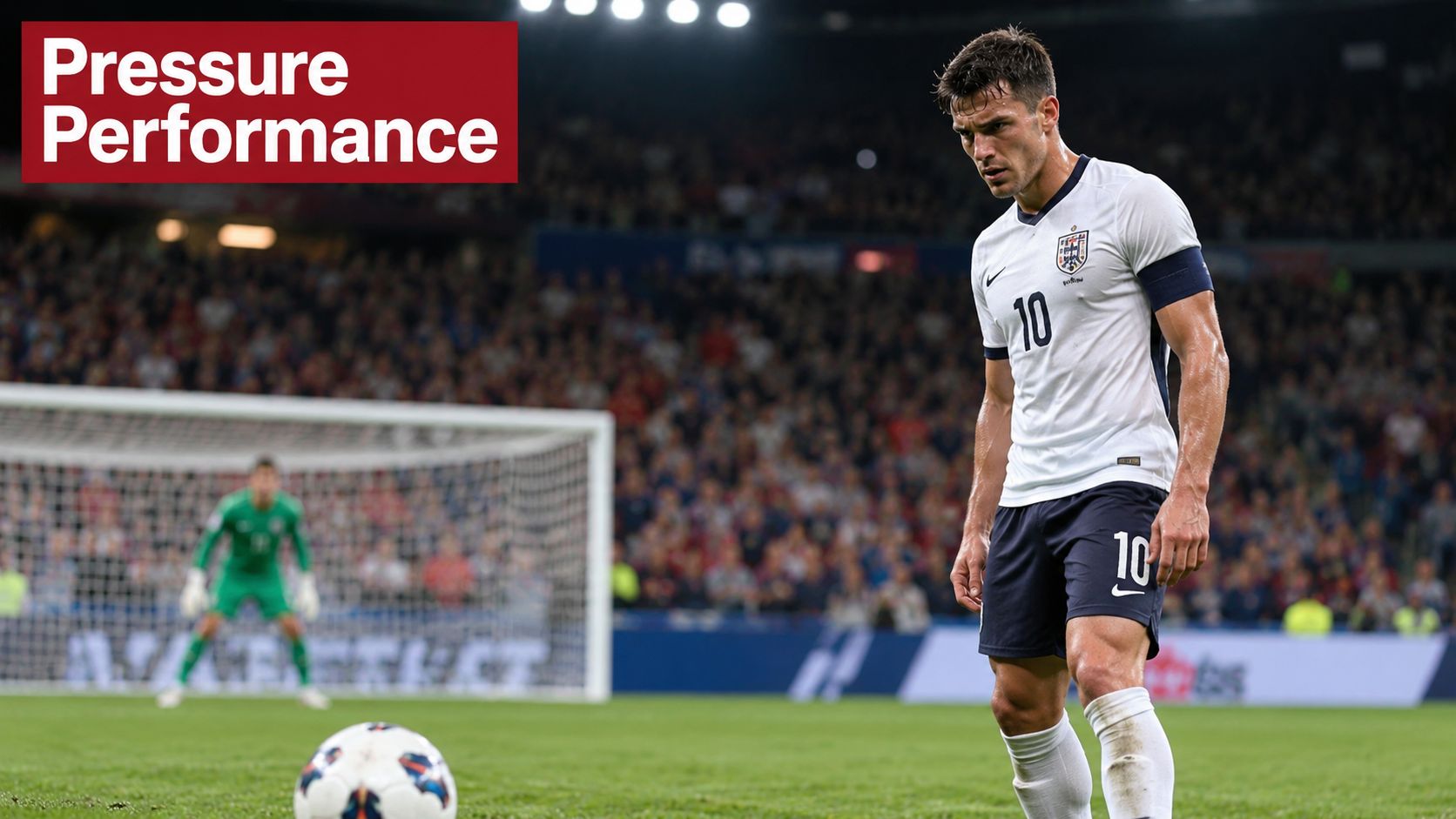
Penalty work shows this clearly. UK guidance from the British Association of Sport and Exercise Sciences says anxiety is a major cause of failure in shootouts, and it highlights a sharp difference in outcomes. Players who take less than one second to place the ball score about 58% of penalties, while those who take longer score about 80% according to the BASES expert statement on psychological preparation for football penalty shootouts. That isn't a lesson about walking slowly for the sake of it. It's a lesson about having a repeatable process instead of rushing into the strike.
What repetition gets wrong
A lot of players think more shots automatically means better finishing. It doesn't. If every rep is taken from the same spot, with no cue, no target, and no pressure, you're only grooving comfort.
BASES guidance points coaches towards target-focused practice, pre-shot routines, and controlled-pressure scenarios so players can hit each corner consistently and feel more in control under stress. That's the bit many sessions miss. They train striking, but not execution.
Practical rule: If the player can't tell you the target, the trigger, and the finish type before the shot, the rep probably isn't specific enough.
What structured sessions actually change
Structured football goal training gives you a tighter link between training and match moments:
- Clearer shot selection so players stop hitting hopeful efforts just because the ball sat up nicely
- Better pre-kick habits so penalties, one-on-ones, and late chances don't become panic actions
- More useful feedback because misses can be traced to body shape, touch, timing, or decision
- Calmer goalkeepers because they face shots with purpose rather than random service
That's why good sessions usually look less chaotic than bad ones. They aren't softer. They're sharper. Every finish has a reason, and every save attempt asks a real question.
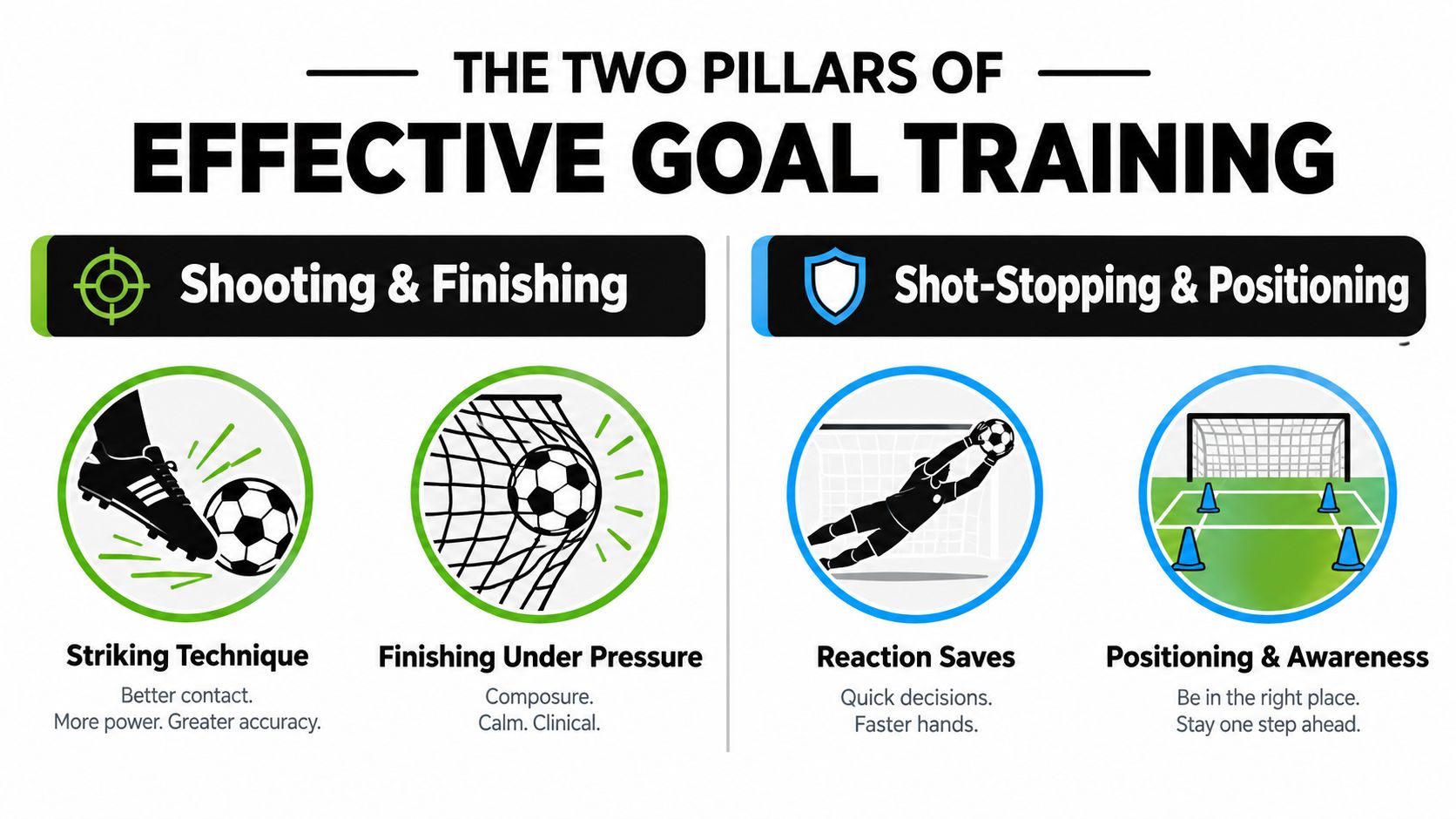
The Two Pillars of Effective Goal Training
Most football goal training is biased from the start. It either turns into finishing practice for outfield players, with the keeper serving as a prop, or it becomes a goalkeeper session where attackers just feed shots. Both approaches leave something on the table.
The better model has two pillars that push each other upwards. Attackers need to learn where and when to finish. Goalkeepers need to read cues, set early, and deal with repeat explosive actions without letting technique fall apart.
Shooting and finishing
For attackers, the job isn't just hitting the target. It's choosing a finish that fits the picture. Near-post whip, far-corner pass, early strike, cut-back finish, first-time redirection. Training should reflect that variety.
A strong field-based study with elite youth players found that structured decision support matters in penalties. Player self-selection produced an 88% goal rate, coach selection produced about 82%, and a random algorithm produced only around 70% in the Leeds Beckett validation study on penalty decision support. That matters because many players still hear generic advice to “just hit it hard”. Placement choice and reading the goalkeeper are often the difference.
Shot-stopping and positioning
Goalkeeper work needs proper respect in the weekly plan because the load can be deceptive. A UK doctoral study found that a ~12±2 minute pre-match shooting block produced 36 dives, roughly one dive every 20 seconds, making it the most intense period in a goalkeeper's weekly load. In the same research, goalkeepers averaged only one dive about every nine minutes in match-play, according to the University of Leeds and White Rose doctoral research on goalkeeper training load.
That same study reported that during a ~79-minute goalkeeping training session, players performed about 51 dives, ~34 high-speed changes of direction, ~14 high jumps, ~19 medium jumps, and ~70 explosive efforts. So no, matches alone don't give keepers enough repetitions of the key actions.
Better shooters sharpen keepers. Better keepers force shooters to pick corners, disguise intent, and stay composed.
Why the two-pillar model works
| Focus | Weak training version | Useful training version |
|---|---|---|
| Attackers | Repeated unopposed shots | Specific target zones and decision cues |
| Goalkeepers | Endless random serving | Dense, organised blocks with footwork and recovery |
| Team effect | One side develops, the other stagnates | Both roles improve together |
If a session raises the standard for only one side of the duel, it isn't complete.
Shooting Drills That Actually Improve Finishing
Most bad shooting practice has the same flaw. Too many shots, too little intention. If you want football goal training to carry into matches, each drill needs a target, a trigger, and a progression.
For more ideas on building session variety around end product, SoccerWares has a useful guide to soccer shooting drills. The key is still the same. Don't collect touches. Collect meaningful finishes.
Target-zone finishing
Set visible targets in the corners or mark strike zones with cones if you don't have attachments. The player starts central, receives a simple lay-off, and must finish into a called zone with controlled technique.
If you want a quick visual aid, 2-Pack Football Goal Target Nets – Precision Shooting Training Aids for Accuracy Practice can fit this drill because they use adjustable straps and Velcro loops to attach to most standard-size goals, and the cut-out zones give players a clear placement reference.
Use this drill well by keeping the coaching tight:
- Call the corner late: Make the player react after the first movement, not before the setup.
- Alternate feet: Don't let the weaker side disappear from the session.
- Track misses by pattern: High and wide, dragged across goal, straight at the keeper. Each type tells you something different.
Common mistake: players try to “pick corners” by leaning back and opening the body too much. The result is usually a floated miss.
First-touch finish under movement
This is the drill that exposes whether a player can arrive onto the ball in balance. Start with a short movement around a cone, then receive from an angle and finish off the first touch. Add passive pressure once the technique holds up.
A useful progression looks like this:
- Unopposed receive and shoot
- Passive chaser from behind
- Live recovering defender
- Keeper starts slightly off line to change the picture
A first touch that kills the next action isn't a good first touch. In finishing drills, the touch should prepare the strike, not just control the ball.
Power or placement decision drill
This one matters because matches don't present the same finish every time. Set the keeper in different starting positions. Sometimes deeper, sometimes cheating near post, sometimes slow to set. The shooter must read the picture and choose.
Coach the decision, not only the outcome:
- If the keeper sets early and covers space well, favour placement.
- If the keeper is moving or unsighted, strike early with conviction.
- If the angle tightens, don't force the spectacular finish. Reset or pick the safer side.
What doesn't work is turning every rep into a blast across goal. That trains one answer to every question. Matches don't ask one question.
Goalkeeper Training Blocks Built for Match Intensity
Goalkeeper sessions go wrong when coaches chase volume instead of quality. Keepers end up battered by endless serves, their set position gets lazy, and every dive after that becomes practice in poor mechanics.
The smarter approach is to train in short blocks that reflect the explosive nature of the role. Keep the work dense, recover properly, then go again.
A simple block structure
Start with footwork and handling before any heavy dive work. The body needs to be awake, but the keeper also needs visual focus and clean movement patterns.
A practical goalkeeper block can include:
- Set and hold work: Quick adjustment steps, balanced stance, hands ready
- Low diving series: Repeated saves from varied angles with controlled recoveries
- Rebound actions: First save, get up, react again
- Distribution after the save: Catch or secure, then play out quickly and accurately
If you want a solo or paired tool for rebounds, Professional Soccer Rebounder – Durable Training Equipment for All Skill Levels is relevant here because it uses galvanised steel pipe, a weather-resistant PE net, adjustable angles, and includes 4 ground stakes for stability. That makes it workable for reflex saves, first touch returns, and controlled service in gardens or training pitches.
Managing intensity without overloading
Goalkeeper training has to respect cumulative impact. Repeated dives and changes of direction tax joints and concentration quickly, especially for young players. If the keeper's feet stop organising the body before the shot, the block has gone on too long.
For kit choices around the role itself, the SoccerWares guide to youth goalkeeper gloves is a useful reference for parents and coaches sorting practical equipment.
Watch for these errors:
- Too many static starts: Keepers need adjustment steps, not mannequin saves.
- No recovery demand: A save isn't finished until the keeper can get up and act again.
- Poor service quality: Wild shooting teaches chaos, not reading.
- No mental reset: Keepers rush the next rep after an error and stack mistakes.
The best goalkeeper blocks feel sharp, not endless. Once footwork and hands go sloppy, the session should change or stop.
Distribution matters as well. A modern keeper isn't only there to save. Build in throws, passes, and quick restart decisions so the session mirrors the role, not an old stereotype of shot-stopping only.
Putting It All Together a Complete Training Session Plan
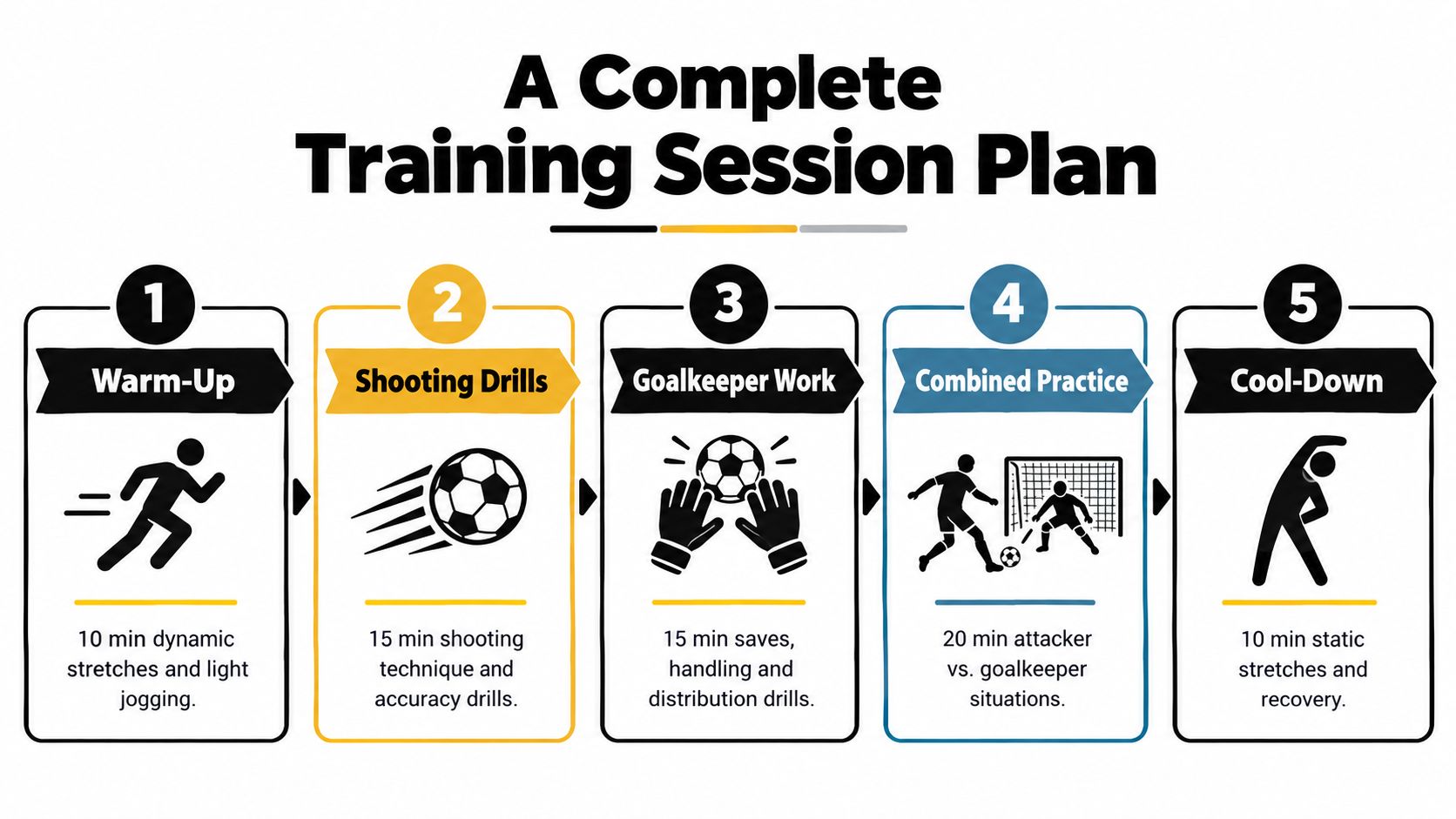
Attackers and keepers improve faster when they train in the same reality. That means one coherent session where the warm-up connects to finishing, the finishing connects to pressure, and the pressure connects to decisions.
A useful starting point is a proper activation sequence, especially if players are heading into strikes, dives, and repeated accelerations. SoccerWares has a solid reference for soccer warm-up drills that fit this kind of session.
A practical session flow
Use one goal if space is tight, or split across two areas if you have more room. Keep coaching points brief so the players are moving, not standing around listening.
-
Activation phase
Dynamic movement, turning, short passing, and a few clean striking actions. Include goalkeeper footwork early so they aren't diving cold. -
Technical finishing phase
Run target-zone and first-touch finishing with clear scoring conditions. Rotate servers, shooters, and ball collectors. -
Goalkeeper block
Pull keepers into a short concentrated section while outfield players work receiving patterns or finishing prep nearby. -
Combined practice
Set up attacker versus goalkeeper scenarios. Cut-backs, through balls, angle finishes, rebounds. -
Cool-down and review
Light movement, reset the area, then give one technical takeaway each.
Adjustments that keep it realistic
If you're training on a worn surface or a shared community pitch, build around the conditions instead of pretending they don't matter. Ball speed, footing, and bounce change the whole session. A practical seasonal sports fields maintenance guide is worth reading if you manage school or grassroots space, because surface condition affects both safety and the quality of finishing work.
A few coaching adjustments make the session easier to run:
- Limited players: Reduce lines and use a rebounder or wall pass to keep reps flowing.
- Indoor space: Focus on shorter finishing distances, body shape, and reaction saves.
- Mixed ages: Scale target size and service quality before scaling pressure.
- Few footballs: Use one active ball and one recovery role so stoppages don't kill rhythm.
The best session plan isn't the fanciest one. It's the one players can repeat weekly without losing purpose.
Safe Goals Proper Anchoring and Equipment Choices
You can design a brilliant football goal training session and still get the basics badly wrong if the goal itself isn't safe. Too many home setups, school spaces, and grassroots sessions cut corners.
Safe goals aren't an admin detail. They are part of good coaching.
Anchoring is not optional
The Football Association's guidance says that portable and permanently installed goalposts of any size must always be securely anchored to the ground or have a weighted back bar on both match pitches and practice fields. That's stated directly in the FA goalpost safety guidelines.
UK guidance aimed at practical safety also makes clear that freestanding goals must be securely anchored, portable goals can overturn if assembled incorrectly, and inspections should happen at least weekly, every time a moveable goal is moved, and again whenever socketed goals are re-installed according to this UK goal safety and standards guide. The same guidance highlights the ban on metal cup hooks and the need to avoid homemade or altered goals.
If a goal can move, tip, wobble, or lift, training stops until that's fixed.
Choosing the right size for the player
Wrong-sized goals distort training. Small players start launching high because the frame is too big for the exercise. Older players get lazy with placement because the target is too forgiving.
Here are the FA-recommended dimensions for youth formats in the UK from the FA recommended pitch and goal sizes document:
| Age group | Recommended goal size |
|---|---|
| U7/U8 and U9/U10 | 3.66 by 1.83 metres |
| U11/U12 | 4.88 by 2.13 metres |
| U13/U14 | 6.40 by 2.13 metres |
For senior football, the full-size 11-a-side goal is 7.32 by 2.44 metres in the FA guidance notes on goalpost safety.
If you're sorting smaller setups for younger players, the SoccerWares article on football nets for kids helps frame the practical side of age, space, and home use.
Compliance matters in ordinary settings too
The published safety guidance also states that football goals should be procured, installed, maintained, stored and inspected in line with BS 8461:2005 in the routine football goal inspection document used in UK guidance. That applies just as much to a training area as a match pitch.
Good training starts before the first ball is struck. Stable frame. Correct size. Proper inspection. No shortcuts.
Your Next Steps for Consistent Goal Training
Most players don't need a more complicated plan. They need a plan they'll repeat. Good football goal training is built on simple habits done properly, week after week.
If consistency is the part you struggle with, a broader fitness read like this stop skipping workouts guide can help you tighten the routine side of training. The same principle applies here. Short, focused sessions beat the occasional all-out marathon.
A practical checklist
- Choose the right goal size: Match the frame to the age group and the space you have.
- Check anchoring before every session: Don't assume last week's setup is still safe.
- Rotate drills with purpose: One target drill, one movement finish, one pressure-based exercise is enough for a strong session.
- Track what misses look like: Don't just count goals. Note whether the problem is body shape, touch, rushed decision, or poor placement.
- Include both sides of the duel: A shooter-only session misses half the picture.
- Keep the routine repeatable: If setup takes too long or needs too much equipment, you won't stick with it.
A lot of progress comes from clearing out wasted reps. Train the finish you're likely to need. Train the save the keeper is likely to face. Use equipment that fits the player and the space. Then repeat often enough that the routine holds when the match gets tense.
That's what separates random practice from useful football goal training.
SoccerWares carries football training gear that fits this kind of work, including rebounders, goals, training accessories, and fan-inspired kit for players and supporters who live around the game. If you're setting up smarter finishing sessions, safer home practice, or a more complete goalkeeper block, have a look at SoccerWares and build around equipment you'll use regularly.