

Staying on the pitch and out of the physio room comes down to a smart, proactive strategy. It’s not about luck; it’s about combining proper warm-ups, consistent strength work, and intelligent recovery. The goal is simple: prepare your body for the unique demands of the game by strengthening the areas that take the most punishment, like your hamstrings, knees, and ankles.
Understanding the Risks of the Beautiful Game
Football is a game of explosive movements and physical battles, which means injuries are, unfortunately, part of the package. For every player, from Sunday league heroes to seasoned professionals, the first step to staying healthy is understanding why injuries happen in the first place.
It's about shifting your mindset from just treating injuries after they happen to actively preventing them before they start. Think of it this way: intelligent preparation is your best defence against frustrating spells on the sidelines.
The most common setbacks are often those nagging muscle strains, painful ligament sprains, and bruises from collisions. Unsurprisingly, the high-risk areas are the joints and muscles that do most of the work: the knees, ankles, and hamstrings. They're constantly under stress from sprinting, cutting, and tackling. While we're focusing on football here, many of the foundational strategies are universal. For a broader look, you can find some great general principles for preventing athletic injuries that apply across different sports.
The Reality of Football Injuries
Statistics from the professional game paint a very clear picture. The sheer intensity of a match day dramatically increases the chances of getting hurt.
Research from English professional football shows that injury rates are almost four times higher during matches (24.29 per 1000 hours) than in training (6.84 per 1000 hours). This stat alone shows you just how demanding competitive play really is.
This data really drives home why preparing your body to handle that match-day intensity is completely non-negotiable.
So, what are the most common culprits? It's all about the muscles.
To put the risks into perspective, let's break down the key numbers. The data highlights just how predictable many football injuries are, which is good news—it means we can target our prevention efforts effectively.
Key Football Injury Statistics at a Glance
| Statistic | Finding | Prevention Focus |
|---|---|---|
| Thigh Injuries | Account for 31.7% of all cases. | Hamstring and quad strengthening is crucial. |
| Muscle Strains | Make up 41.2% of total injuries. | Proper warm-ups, mobility, and load management. |
| Hamstring Strains | Involved in nearly 40% of all muscle strains. | Eccentric exercises (like Nordics) and flexibility. |
| Match vs. Training | Injury risk is 4x higher in matches. | Prepare the body for peak intensity through smart training. |
These figures tell a clear story: your leg muscles, especially your hamstrings, are in the firing line. Smart, consistent training is the best way to keep them protected.
The infographic below gives a great visual breakdown of the primary injury hotspots, showing exactly where players are most vulnerable.
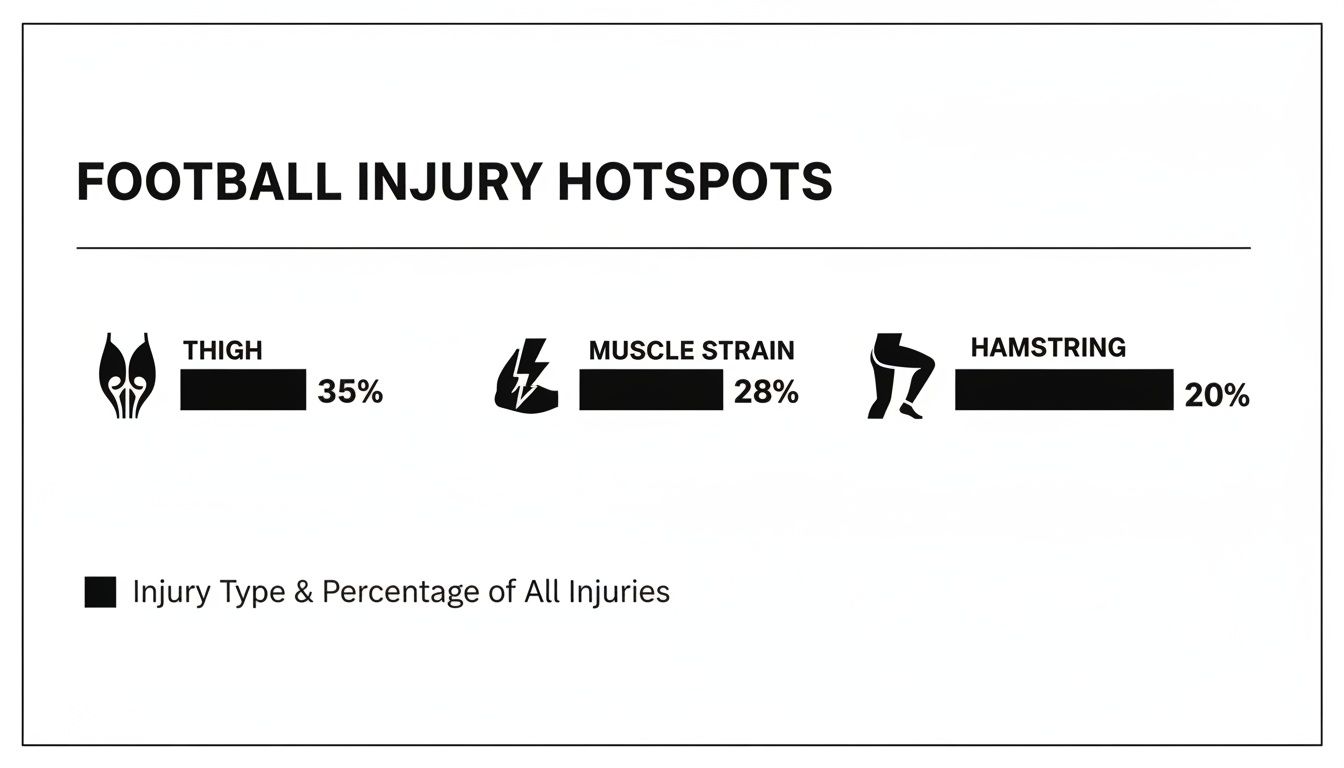
As you can see, it all comes back to the thigh muscles. This reinforces the absolute need for targeted strength and flexibility work. Ligament damage, especially to the knee, is another massive risk factor in a sport filled with quick pivots and heavy tackles. For more specific advice on that, check out our guide on how to prevent ACL injuries.
By understanding these common threats, you can start building a smarter, more resilient approach to your game. It all starts with getting the fundamentals right.
Mastering Your Pre-Match and Post-Match Routines
Injury prevention in football isn't just about what happens during the 90 minutes. It starts long before the first whistle and carries on well after the last. Think of your pre-match and post-match routines as the bookends for your performance—they set your body up for success and then help it recover properly. Many players are still stuck on outdated advice, but building a smart, modern routine can make a world of difference.
Let's be honest, the days of holding a few lazy static stretches before kick-off are long gone. Football is an explosive, dynamic game, and your warm-up needs to mirror that. The goal isn't just to "get warm"; it's to prime your muscles, joints, and nervous system for the exact demands of a match—sprinting, jumping, tackling, and sudden changes of direction.
This is all about dynamic movements. You need to take your body through a full range of motion, wake up those key muscle groups, and improve your mobility. A proper warm-up doesn't just lower your injury risk; it genuinely makes you a better player from the first minute.
Building an Actionable Pre-Match Sequence
A good warm-up should be a ramp-up, gradually increasing in intensity from general movement to football-specific actions. You're systematically waking the body up. It’s basically a rehearsal for the match itself.
Here’s a simple, effective sequence that works every time:
- Light Cardio (5 minutes): Start with a gentle jog around the pitch. This raises your heart rate and gets blood flowing to your muscles. You're just getting the engine started.
-
Dynamic Stretches (5-7 minutes): Now it’s time to mobilise your joints and activate the key players. This is the real core of your pre-match prep.
- Leg Swings (Forward and Sideways): Loosens up the hamstrings, quads, and hip flexors.
- Hip Circles and Gates: Opens up the hip joint, which is absolutely crucial for agility and dodging those annoying groin strains.
- Walking Lunges with a Twist: Fires up your core, glutes, and quads while adding a bit of rotation.
- High Knees and Butt Kicks: Gets your fast-twitch muscle fibres ready for sprinting.
- Light Plyometrics and Drills (3-5 minutes): Finish with short, sharp bursts of explosive movement. Think short sprints, small hurdles, or quick feet drills to get your nervous system ready for the game’s intensity.
This whole routine only takes 15-20 minutes, but it means your body is fully prepared, slashing the odds of a cold muscle tear or strain early in the game. It's as fundamental as choosing the right gear, and on that note, we've got a full breakdown of the best shin pads for football in our detailed guide.
The Overlooked Importance of the Cool-Down
The final whistle blows, but your job isn't done. That 10-15 minute window right after a match or tough training session is golden for recovery. Skipping the cool-down is one of the biggest mistakes players make, and it leads directly to more muscle soreness and a slower bounce-back to full fitness.
A cool-down helps your body transition from all-out effort back to rest. It gently lowers your heart rate, helps flush out metabolic junk like lactic acid from your muscles, and kicks off the repair process.
The whole point of a cool-down is to kickstart recovery. Just 10 minutes of dedicated effort can dramatically reduce next-day soreness (DOMS) and get you ready for your next session. It's a cornerstone of consistent performance.
Your post-match routine should be simple enough that you'll actually stick to it:
- Light Jogging (3-5 minutes): A slow jog helps bring your heart rate down gradually and aids in clearing waste products from your muscles.
- Targeted Static Stretching (5-7 minutes): Now is the time for static holds. Focus on the major muscle groups you’ve just hammered: hamstrings, quads, glutes, calves, and hip flexors. Hold each stretch for 20-30 seconds.
- Foam Rolling: If you have one, spending a few minutes with a foam roller can be brilliant for releasing muscle tightness and improving blood flow.
Making these routines a habit is easier when you have a dedicated space. A high-quality indoor training mat from SoccerWares gives you a clean, comfortable surface for all your pre-match mobility and post-match stretching. And to take recovery a step further, consider incorporating sports massage therapy into your wider plan to help with muscle repair and prevent chronic tightness.
Building a Body Built for Football
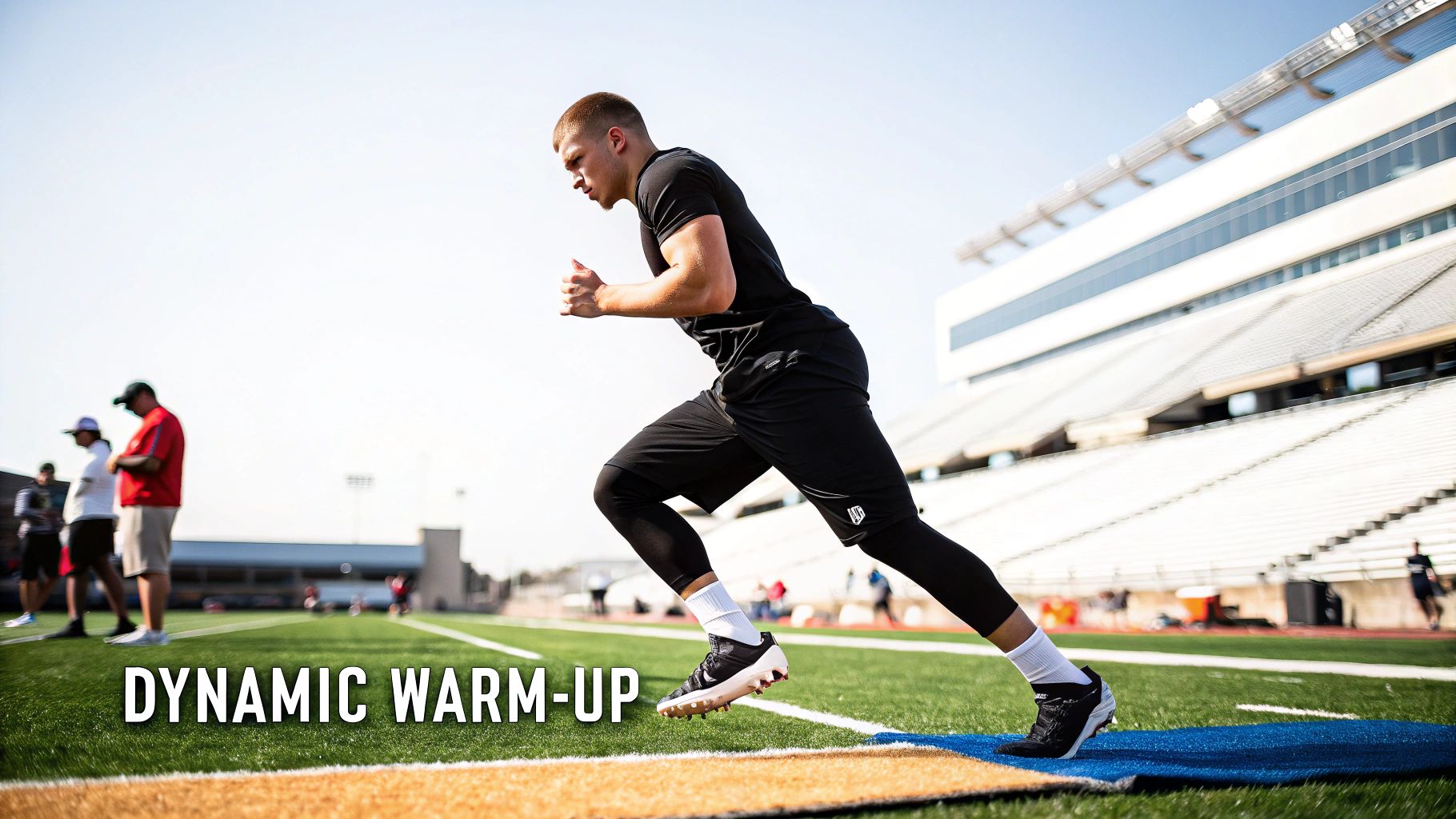
Real resilience on the football pitch isn't just about what you do in the 90 minutes. It's built long before you even lace up your boots. While a solid warm-up and cool-down are crucial on match day, the true foundation of an injury-proof body is laid in the gym and during your dedicated training sessions. This is where you forge the strength to ride a heavy tackle and the mobility to move like a well-oiled machine.
We're not talking about generic, "beach muscle" gym routines here. This is about conditioning that has a direct, measurable impact on your performance and, more importantly, keeps you safe. It’s about building a body that isn't just strong, but strong in the specific ways football demands—balancing raw power with fluid, functional movement.
The Foundation: Targeted Strength Conditioning
Strength work for football is all about functional power. It's the kind that protects your joints from impact and lets you explode past a defender. Your training has to mirror the extreme forces your body goes through in a real game.
And the difference between training and a match is massive. One eye-opening study on men's international football found that match injury rates were 31.8 per 1000 hours. That absolutely dwarfs the training rate of just 3.8 per 1000 hours. This huge gap, highlighted in this detailed football injury research, shows just how vital it is to close that physical gap with smart conditioning.
To get your body match-ready, your programme needs to stand on two pillars:
- Foundational Compound Lifts: These are your big, multi-joint exercises that build all-over strength. Think squats, deadlifts, and lunges. They’re non-negotiable for strengthening your entire lower body and core—the engine room for any footballer.
- Football-Specific Movements: These drills directly target common problem areas. The most famous is the Nordic hamstring curl, a simple-looking exercise proven to dramatically cut the risk of hamstring strains, one of the most frustrating and common injuries in the sport.
Think of your strength work as body armour. Every rep of a squat or a Nordic curl adds another layer of protection, making your muscles and ligaments better equipped to handle the explosive sprints, sudden stops, and physical battles of a 90-minute match.
It’s also crucial to mix in plyometrics—explosive moves like box jumps and broad jumps. These train your muscles to generate maximum force in minimum time, which is exactly what you need when leaping for a header or bursting away from your marker. A simple piece of kit like a SoccerWares rebounder isn’t just for passing drills; it's a great tool for reactive plyometric work that builds that explosive power and strengthens the connective tissues around your joints.
Unlocking Performance With Functional Mobility
Strength without mobility is like having a Ferrari engine in a car with a locked steering wheel. All that power is useless if you can't control it effectively and safely. Mobility is your ability to move through a full and stable range of motion, and it's an absolute game-changer for staying off the treatment table.
The two areas that take a real beating in football are your hips and ankles. If your hips are tight, you're setting yourself up for groin strains and lower back pain. Stiff ankles? That's a huge risk factor for sprains and nasty knee injuries.
Key Mobility Drills For Footballers
To keep these crucial areas moving freely, you need to weave these drills into your routine. They're perfect for your warm-up or on active recovery days.
- Hip Mobility: Drills like the '90/90 stretch' and 'Cossack squats' are fantastic for opening up the hip capsule. This directly translates to more fluid changes of direction and takes a huge amount of strain off your adductors (groin muscles).
- Ankle Mobility: Ankle dorsiflexion—your ability to pull your toes up towards your shin—is vital. Simple exercises like 'wall ankle mobilisations' or using a resistance band can seriously improve this range of motion, helping to prevent sprains when you land awkwardly or plant your foot to shoot.
By combining a smart strength programme with dedicated mobility work, you build a body that’s genuinely prepared for the unique demands of the beautiful game. For more specific ideas, our guide to soccer fitness workouts has plenty of routines to get you started. This two-pronged approach ensures you’re not just fit to play, but built to last an entire season.
How to Train Smarter, Not Just Harder
One of the biggest culprits behind non-contact injuries isn’t a bad tackle or an awkward fall. It’s something quieter and far more common: poor load management. The term 'training load' is just a simple way of describing the total physical stress you put your body through. When you get it wrong, you’re on a fast track to the sidelines.
Most of these injuries happen when players suddenly ramp up their training intensity or volume without giving their body a chance to adapt. Think of it like this: you wouldn't try to run a full marathon tomorrow after only a few short jogs. Your body would almost certainly break down.
The exact same thing happens in football. A sudden spike in sprints, longer training sessions, or more frequent matches without a gradual build-up is a clear invitation for muscle strains, tendonitis, and burnout.
The Art of Planning Your Training
This is where a concept called periodisation comes into play. It’s the art of planning your training in deliberate cycles, mixing up the intensity and volume. Instead of going flat-out at 100% all the time, you strategically switch between hard, moderate, and light weeks.
This approach gives your body the time it needs to properly adapt, recover, and ultimately get stronger. It’s a smarter way to build fitness that’s based on a simple truth: real improvements happen during rest, not just during work.
Here’s a rough idea of how periodisation works across a typical football season:
- Pre-Season: The focus here is on gradually increasing how much and how hard you train to build a solid fitness base.
- In-Season: The goal shifts to maintaining that fitness while managing fatigue. This means lighter sessions are scheduled around match days to make sure you’re fresh for kick-off.
- Off-Season: This is all about active recovery. You’ll do lower-intensity work to let your body fully repair before the whole cycle kicks off again.
This planned approach helps you peak at the right times and avoids the dangerous territory of overtraining, where your body is constantly playing catch-up and becomes incredibly vulnerable to injury.
Using Technology to Your Advantage
In the past, managing training load was mostly guesswork. It relied on a coach's eye or how tired a player felt. But today, technology gives us objective, data-driven insights that remove that guesswork. This is where modern tools become a genuine game-changer.
Modern wearable technology gives you the power to see exactly what your body is doing. It transforms abstract feelings of fatigue into concrete numbers, allowing you and your coach to make truly informed decisions about your training and recovery.
A SoccerWares GPS tracker, for example, gives you precise data on the metrics that actually matter. You can see your total distance covered, the number of sprints you make, your max speed, and the overall intensity of a session. It’s a massive leap forward in monitoring your load with real accuracy.
With this data, you can spot the red flags of overtraining before they become a real problem. Has your weekly load spiked too quickly? Are your intensity levels consistently higher than planned? This information lets you pull back, adjust your training, and prioritise recovery right when it’s needed most.
Understanding this data is key, and you can learn more about how to use wearable football sensors for injury prevention in our detailed guide.
Manual vs. Tech-Based Load Management
It's one thing to feel tired, but another to see the data proving you're in the red zone. This table breaks down the old-school approach versus what’s possible with today’s tech.
| Aspect | Manual Tracking (e.g., RPE Scale) | GPS Tracker (e.g., SoccerWares Tracker) |
|---|---|---|
| Objectivity | Subjective; based on how a player feels (can be unreliable) | Objective; based on concrete data (distance, speed, sprints) |
| Accuracy | Varies day-to-day and can be influenced by mood or mindset | Highly accurate and consistent, providing reliable metrics every session |
| Early Warning | Relies on noticing physical signs of fatigue, which is often too late | Can identify sudden spikes in load before symptoms appear |
| Player Insight | Limited to personal perception of effort | Provides detailed performance breakdowns and progress tracking |
| Coach's Role | Relies on observation and player feedback | Can make data-driven decisions to adjust team and individual plans |
While listening to your body will always be important, supplementing that feeling with hard data from a GPS tracker gives you a complete picture, helping prevent injuries before they happen.
By combining the timeless principle of periodisation with modern data, you can finally train smarter, not just harder. It’s all about making sure every minute on the pitch is productive, pushing you towards peak performance without tipping you over the edge into injury.
Tailoring Prevention for Your Age and Position
Not all football injuries are created equal, and neither are the players who get them. The physical battering a centre-back takes is worlds away from the explosive demands on a winger. Likewise, a 30-year-old veteran needs a completely different game plan to a 16-year-old still growing into their body.
Any decent advice on preventing football injuries has to be personal. A one-size-fits-all approach is a recipe for disaster.
Think of it like this: a brand-new sports car and a classic family saloon both need looking after, but you wouldn’t use the same oil, the same parts, or drive them in the same way. The same logic applies to footballers. Your age and your role on the pitch are the two biggest factors that should shape your prevention strategy.
Get this right, and you're already playing smarter.
Adjusting Your Approach Through the Ages
A player's body changes. The stresses it can handle, how quickly it recovers, and its weak spots all evolve over a career. What works for a youth player can be totally wrong for a seasoned pro managing years of wear and tear.
-
Youth Players (Under 18): It's all about managing growth. Young players are notorious for picking up growth-related niggles like Osgood-Schlatter or Sever's disease, where bones are growing faster than the muscles and tendons can keep up. The focus here should be on mastering fundamental movements, building a solid base of strength without crazy heavy lifting, and making sure they get enough rest.
-
Peak Years (19-28): This is when players are at their physical peak but also pushing their bodies to the absolute limit, week in, week out. It’s prime time for those sudden soft-tissue injuries—think hamstring pings and groin strains—caused by the sheer intensity of the game. Prevention is all about consistent strength work, disciplined recovery, and smart load management.
-
Veteran Players (29+): As you get older, your body naturally loses a bit of its spring and takes longer to bounce back. The risk of those same old injuries coming back to haunt you goes up, and chronic problems from years of overuse start to surface. For veterans, the priority shifts to mobility, dedicating serious time to recovery, and tweaking training to stay sharp without overloading the body.
The stats from the professional game back this up. Research showed that while players aged 26-30 suffered the most injuries overall in the 2021/22 Premier League season, players over 30 averaged a worrying 2.5 recurring injuries each. You can see the full breakdown and explore more football injury insights here.
Position-Specific Injury Risks and Prevention
Where you play on the pitch dictates how you move, and that directly influences your biggest injury risks. Fine-tuning your conditioning to match those demands is a massive win for staying fit all season.
Defenders, midfielders, and forwards all have unique physical blueprints. A centre-back’s training should focus on stability for duels, while a striker's must prepare their hamstrings for explosive sprints. Matching your prevention to your position is non-negotiable.
Here’s a quick look at how different positions should think about their injury prevention:
-
Defenders: Your game is built on physical challenges, winning headers, and standing your ground. That puts a huge amount of strain on your core, lower back, and knees. Your focus should be on building rock-solid core stability, strengthening your quads and glutes for tackling power, and drilling safe landing mechanics from jumps. And, of course, a sturdy pair of shin guards from a brand like SoccerWares is a must to protect against the inevitable clattering.
-
Midfielders: You’re the engine room. You cover the most ground, making endless box-to-box runs and sharp changes of direction. This leaves you vulnerable to groin strains, ankle sprains, and general overuse issues. Your training should zero in on hip mobility, ankle stability drills, and building the endurance needed to stay strong and avoid those fatigue-related mistakes late in a match.
-
Forwards and Wingers: Your game is all about explosive power—sudden sprints, aggressive cuts, and powerful shots. This puts your hamstrings, hip flexors, and adductors under constant fire. Make eccentric hamstring exercises like Nordic curls your best friend, use plyometrics to build that explosive power, and dedicate time to mobility work to keep your hips and groin feeling loose and ready to go.
Winning the Game Off the Pitch
All that hard work on the training ground can be undone in an instant by poor habits off it. Some of the most powerful ways to prevent football injuries have nothing to do with drills or sprints. They’re all about two things players often ignore: what you eat and how you recover.
Think of it this way: what you eat isn’t just fuel to get you through 90 minutes. It’s the raw material your body uses for everything—repairing muscles, restocking energy, and fighting off inflammation. Getting this right isn't just a good idea; it's a non-negotiable part of building a resilient body.
Fuel Your Body for Resilience
Your approach to nutrition doesn't need to be complicated, but it has to be consistent. The goal is to give your body the right building blocks at the right time, especially around training and matches. A well-fed muscle is a much less vulnerable muscle.
Three things are absolutely critical here:
- Carbohydrates: These are your main source of energy. If you don't get enough quality carbs (think oats, brown rice, potatoes), your muscles won't have the glycogen stores needed to perform at high intensity. That leads to fatigue, and fatigue leads to injuries.
- Protein: This is the cornerstone of muscle repair. A tough session literally creates tiny tears in your muscle fibres. Protein provides the amino acids needed to rebuild them stronger, which is vital for stopping those annoying recurring strains.
- Hydration: Being dehydrated is a fast track to muscle cramps, a drop in performance, and a much higher risk of injury. Even a small dip in your hydration levels can have a massive impact.
Making hydration a simple, constant habit is key. Always having a high-quality SoccerWares stainless steel water bottle with you—at training, at your desk, or in the car—removes any excuse. It’s a simple trick, but it ensures you’re constantly topping up throughout the day.
The Ultimate Performance Enhancer: Sleep
If nutrition provides the building materials, then quality sleep is when the construction crew actually shows up to do the work. It is, without a doubt, your single most powerful recovery tool. You can get everything else spot on, but if you don't sleep enough, your body simply can't repair itself properly.
During deep sleep, your body releases growth hormone, which is essential for repairing damaged muscle tissue. Skimping on sleep directly sabotages your body's natural recovery cycle, leaving you more susceptible to injury.
You should be aiming for 7-9 hours of quality, uninterrupted sleep every night. This is when your hormones regulate, your tissues are repaired, and your mind gets the rest it needs to stay sharp and make good decisions on the pitch.
Alongside sleep, don't forget active recovery. A foam roller is a fantastic tool for working through tightness in your major muscle groups, improving blood flow and keeping you mobile. By mastering these off-pitch habits, you give yourself the best possible chance of staying on it.
Your Questions on Football Injury Prevention Answered
We’ve covered a lot of ground, but there are always a few specific questions that pop up time and time again. This is where we tackle those common queries to clear up any lingering doubts.
Getting these details right can be the difference between a season on the pitch and a frustrating spell on the sidelines. Let's dive in.
How Often Should I Strength Train During the Season?
This is a classic, and the answer is all about finding that sweet spot. During the competitive season, your goal isn’t to build maximum strength anymore—it’s about maintaining it while managing the fatigue from matches and training. Go too hard in the gym, and you'll turn up on match day with heavy legs.
For most players, two strength sessions per week is the sweet spot. These need to be timed smartly, never on the day before or the day after a match. This is enough to keep you powerful and resilient without wrecking your recovery.
What Are the Best Stretches for Footballers?
The best stretch depends entirely on when you’re doing it. Think of your stretching routine in two distinct parts to get the most benefit and avoid doing more harm than good.
- Before Training/Matches (Dynamic): Your pre-match routine should be all about movement-based stretches that get the body ready for action. Think leg swings, hip circles, and walking lunges. These wake up the muscles and improve mobility without switching them off.
- After Training/Matches (Static): Now is the time for holding stretches. Focus on the big muscle groups you’ve just hammered—hamstrings, quads, glutes, and calves. Hold each stretch for 20-30 seconds. This helps lengthen the muscle fibres and kicks off the recovery process.
A huge mistake we see is players doing long, static stretches right before a game. This can actually reduce your muscle power and explosiveness for a short time. Always save those deep holds for your cool-down.
Should I Still Train if I Feel a Minor Twinge?
This is a tough one, but the smart answer is almost always no. Pushing through pain is a recipe for turning a small problem into a big one. That little muscle tweak can easily become a full-blown tear if you don’t give it the respect it deserves.
You have to learn to listen to your body. If you feel a sharp or unusual pain, that's a clear signal to stop, rest, and figure out what's going on. It is far, far better to miss one training session than to be forced out of the game for six weeks.
At SoccerWares, we believe that staying on the pitch is the ultimate win. From high-tech GPS trackers that help you manage your training load to premium protective gear, we have the essentials you need to play smarter and safer. Explore our full collection of training equipment at https://soccerwares.com and build your resilience today.