

Saturday morning starts with the familiar scramble. A coach drags a bag of flat cones from a hatchback, checks a register, searches for the key to the equipment cupboard and tries to inflate a deflated size-4 ball, while a parent asks whether their child will get a shot.
Without a clear aim, finishing practice quickly becomes “shoot at the keeper” chaos. Players crowd the six-yard box, collect off-target balls and wait longer than they work. Football practice targets change that session dynamic. They give players a visible destination, give coaches a way to count successful actions and turn vague technique into a measurable outcome.
The right target isn't always a net with holes. It might be a cone gate, a marked zone, a mannequin or a teammate moving into space. This guide matches the target to the player's age, available space and session objective, using FA target-game principles instead of treating every target as an isolated shooting aid.
Why Football Practice Targets Matter on the Training Pitch
A target creates a coaching reference that everyone can see. Rather than telling a player to “finish better”, the coach can ask for a low shot into the far-side zone, a pass through a gate with the correct weight or a first touch away from pressure. The instruction becomes specific because the target defines success.
That matters in a busy grassroots session. A visible target keeps players spread out, reduces aimless shooting and lets the next player prepare while the ball is recovered. It also helps a coach spot the fault. If the ball consistently misses to the left, the conversation can focus on body shape, planting foot and contact point, rather than repeating “keep your head up”.
Targets turn repetition into feedback
Repetition only helps when the action has a clear purpose. A player who strikes twenty balls at an unoccupied goal may practise power, but may not practise placement, scanning or choosing between a shot and a pass. Add a target zone and the player has to control the direction of the finish.
The FA's infrastructure planning guidance identifies a strategic target for every team playing competitive football to access a floodlit 3G artificial grass pitch at least once a week for training. The same FA-linked commission material notes that an average artificial grass pitch is used 69 hours per week and occupied 73% of the time, which shows why clubs, schools and community programmes need equipment that makes shared training space work harder.
Practical rule: If a target doesn't change the player's decision, technique or feedback, it may only be decoration.
Targets also help clubs communicate what happened at training. A coach can record successful attempts, compare outcomes between conditions and share useful moments with parents. For clubs documenting fixtures or community activity, an organised pitch event content collection can sit alongside the practical session notes.
Use target work with movement tools rather than treating it as a standalone finishing block. A short sequence combining turning, acceleration and a final pass through a gate can be more representative of football than a queue of stationary shooters, which is why agility equipment for UK football training can complement a target-led setup.
What a Target Actually Is in a Football Session
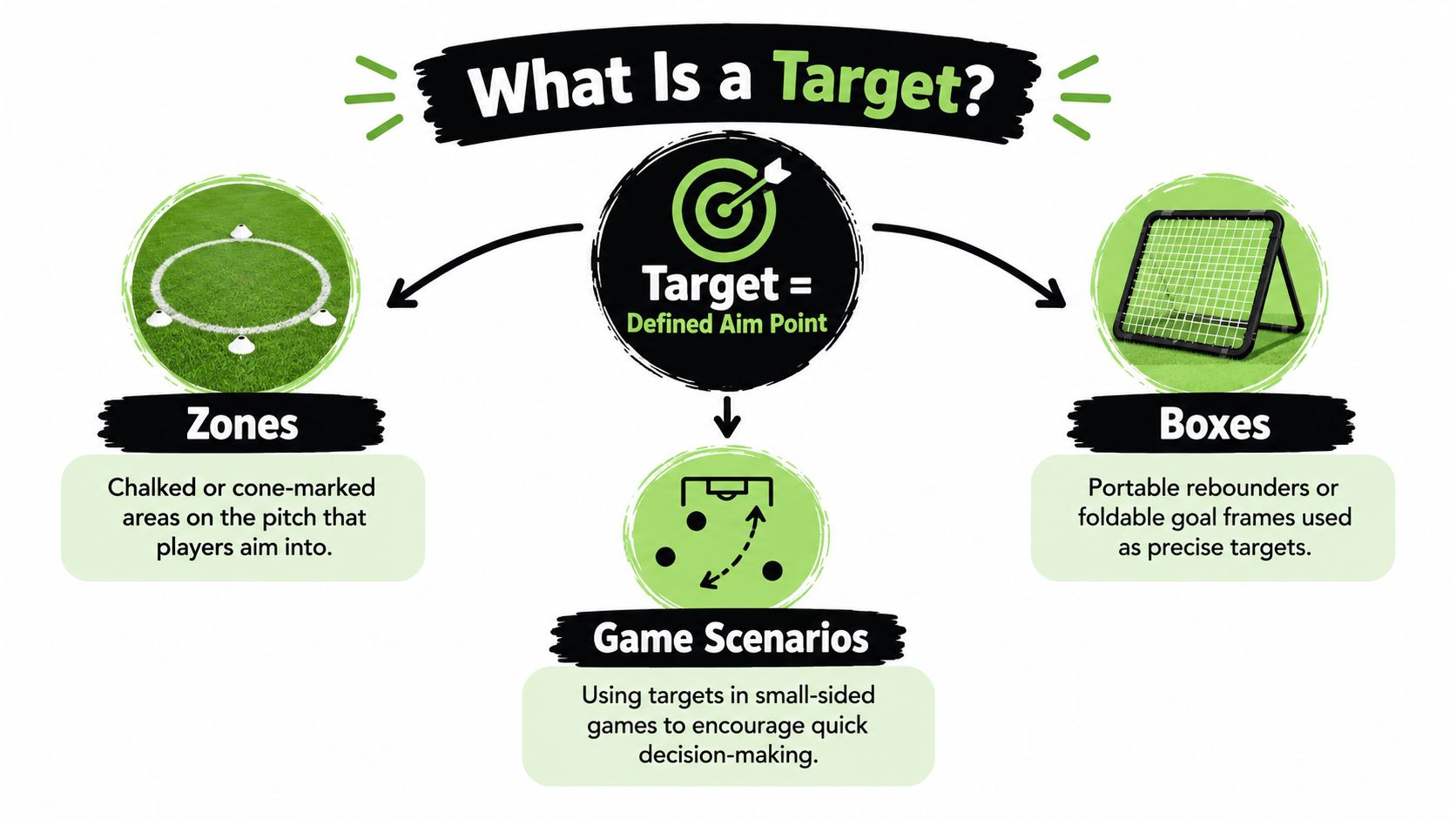
In FA coaching language, a target is a defined aim point. It can be a player, a zone or a box, and the practice should connect that target to an outcome, a scoring system and an opposition challenge. That broader definition is useful because it stops grassroots coaches buying a product before deciding what the session needs.
Zones give players a destination
A zone is an area marked with cones, flat discs or pitch lines. In a finishing exercise, the corners of the goal can become scoring zones. In a possession game, a wide channel can be the target that rewards a switch of play.
Zones work well when the coach wants players to recognise space. The target is deliberately larger and less precise than a small hole, so the player can focus on timing, body orientation and the choice to play forward.
Boxes make accuracy visible
A box might be chalked on the ground, built from cones or created by a small portable goal. It gives the player a clear boundary. A passing box can test whether the ball arrives at a teammate's preferred foot, while a shooting box can reward a finish that avoids the goalkeeper's central position.
The FA's practice design guidance for target games recommends identifying the outcome first, then selecting the target and deciding whether the game is directional or multi-directional. The scoring system should also be agreed before play begins, including what the possession team must do to score and how many points an action receives.
Gates test weight and direction
Two cones facing each other form a gate target. Make the gate wide enough for the group's ability, then ask players to pass through it with a particular foot, receive beyond it or use it as the exit point after a turn.
A gate doesn't return the ball, so it demands more organisation than a rebounder. That limitation is useful. Players must move to collect, scan before receiving and support the next action. For a practical equipment overview, see this guide to cones for football training.
Players create moving targets
A teammate can be the target for a pass, a bounce pass or a run behind a defensive line. A mannequin can represent a defender, while a live opponent adds pressure and changes the answer. Target games become more than accuracy drills. The target tells players where success is possible, but the opposition decides whether that option remains available.
The Four Main Types of Football Practice Targets
Four tool families cover most grassroots target sessions: cones, rebounders, target nets and mannequins. They overlap, but they don't train the same action and they shouldn't be selected as interchangeable products.
Cones
Cones are the most flexible choice for passing gates, turning zones and small-sided scoring areas. Run a “gate collector” game where a player receives from a server, turns away from a passive defender and scores by passing through a gate. The drill trains first touch, disguise and pass weight, not shooting power.
The trade-off is obvious. A cone has no ball return and can't show whether a shot would have beaten a goalkeeper. It also moves when struck, so the coach must reset the area regularly.
Rebounders
A rebounder gives the ball back with a different angle and speed, making it useful for first touch, volleys, reactions and goalkeeper work. On a narrow 9 to 12-yard pitch strip, one player passes into the rebounder, adjusts to the return and plays into a marked space. The quality measure is not whether the ball comes back, but whether the player controls it into the next action.
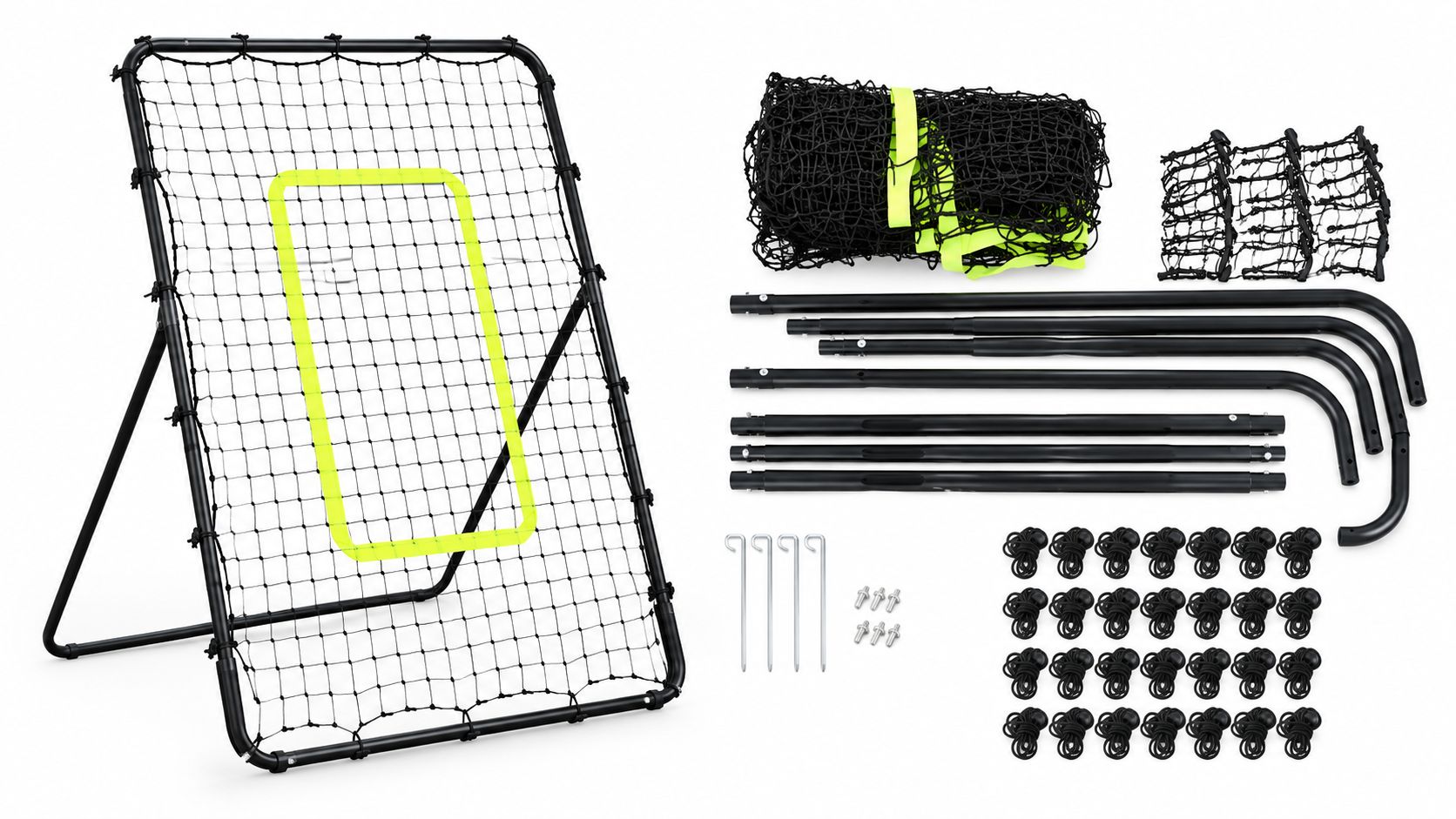
A compact angled board can suit solo work, while an adjustable net offers more varied returns. The Professional Soccer Rebounder, Durable Training Equipment for All Skill Levels uses a galvanised steel frame, a weather-resistant PE net and an adjustable angle. Its listed dimensions are 140 x 90 x 80 cm, with a listed weight of 3.5 kg, ground stakes and bungee cord buckles included.
Target nets
Target nets are designed for defined shooting areas, such as the top corner or lower side pocket. In a “three-zone finish” exercise, the attacker receives from an angle, checks the goalkeeper's position and aims for the called zone. The coach can count placement attempts rather than praising every shot that reaches the goal.
Their limitation is that they can narrow the session too far. If players always know the target before receiving, they may stop scanning and execute a rehearsed strike.
For guidance on choosing and using a rebounder alongside other equipment, this soccer rebounder goal guide is a useful reference.
Mannequins
Mannequins provide a defender-shaped reference for wall passes, curved runs, free-kicks and blocking lines. In an “around the defender” drill, the passer plays into a forward, runs beyond a mannequin and receives the return on the other side. The mannequin gives the movement a realistic line without introducing a full tackle.
Inflatable or spring-back dummies are easy to move, but they don't create genuine defensive pressure. Players still need live opposition later in the session.
| Target type | Primary skill trained | Example drill | Typical cost | Best for |
|---|---|---|---|---|
| Cones | Passing, turning and space awareness | Gate collector | Qualitative budget option | Clubs needing flexible layouts |
| Rebounders | First touch, ball return and reactions | Pass, adjust and play | Qualitative mid-to-higher equipment option | Solo work and compact stations |
| Target nets | Shooting placement | Three-zone finish | Qualitative specialist equipment option | Goal-based accuracy practice |
| Mannequins | Runs, wall passes and set-piece movement | Defender screen | Qualitative specialist equipment option | Pattern play and dead-ball work |
Size, Material and Goal Fit Considerations
A target should match the goal, surface and player. UK retailers list target sheets for several goal dimensions, from 5ft x 4ft with five holes through to 24ft x 8ft with twenty holes, with intermediate options including 8ft x 6ft with eight holes, 12ft x 6ft with fourteen holes and 16ft x 7ft with fourteen holes. These choices show why a target sheet isn't a universal accessory. Its openings must make sense against the goal mouth and the players using it. See the UK target-sheet size range before ordering.
Material affects how the target behaves as much as its measurements. PVC is light and practical for portable zones, while steel frames tend to resist repeated impact and remain steadier on a 3G surface. On grass, pegged bases can work well when the ground accepts them. A weighted base is more suitable where pegging is restricted or the wind is unreliable.
Match the target to the surface
Foam-edged or softer equipment is preferable indoors, especially where players may fall against it or where rigid uprights could damage a sports hall. On hard astroturf, a spring-loaded mannequin can bounce unpredictably, so a stable base or a softer dummy may create a safer, more controlled station.
A UK winter also exposes weak stitching, untreated metal and poor netting. Look for weather-resistant materials, but still dry equipment before storage. Water left inside folded nets or around frame joints will shorten their useful life.
| Target type | Recommended size | Best for goal size | Surface | Material |
|---|---|---|---|---|
| Flat cone zones | Small, low-profile markers | Any goal, especially small-sided | Grass, 3G, indoor | Flexible PVC or rubber |
| Compact rebounder | Small portable frame | Youth or small-sided goals | Grass, 3G, indoor with clearance | Steel frame with PE net, or soft rebound surface |
| Target sheet | Scaled to the goal | Match the exact goal dimensions | Grass or 3G | Reinforced netting or sheet material |
| Mannequin | Youth or adult height selected for the drill | Small-sided to full-size goals | Grass or 3G | Inflatable PVC, foam or spring-back construction |
Don't ignore height. A target that sits too high turns a technique exercise into a power contest, especially for younger players. Indoors, check the ceiling and lighting before using lofted returns or high crosses. The best setup leaves enough room for the ball to travel safely and for players to move around the equipment without collisions.
Matching Targets to Age, Space and Skill Level
Age gives you a starting point, not a complete buying rule. The Premier League's EPPP framework separates development phases into Foundation U9 to U11, Youth Development U12 to U16 and Professional Development U17 to U23, which supports changing the practice emphasis as players mature. The target should follow the skill and decision being trained, rather than a label on the packaging.
For younger groups, flat discs and low rebounders keep the equipment visible without turning the activity into an obstacle course. A small-sided goal with broad scoring zones gives players a realistic chance of success while they learn to receive, carry and finish. Parents and coaches can find further ideas in this guide to football nets for kids.
Use space as a design constraint
A tight 20m x 20m cage favours stackable discs, short passing gates and compact rebounders. There isn't enough room for long run-ups, several full-size goals or wide mannequin channels. Set one target and rotate the decision around it, such as receive and pass, receive and turn, or receive and finish.
A full pitch allows multiple target zones and longer approaches. Players can attack one target, scan for another and react to a defender. That extra space only helps if the coach maintains clear channels and recovery routes.
FIFA guidance points towards daily 5 to 10-minute activation and development sessions lasting under 20 minutes for young players, with high-value, multi-dimensional exercises. A target can make those short blocks purposeful, but it shouldn't be used to justify endless striking repetitions.
Let success decide the difficulty
Ask three questions before making a purchase:
- Can the player see the target? Colour, contrast and height matter in poor weather and indoor light.
- Does the target create the intended decision? A tiny hole may test accuracy, but not scanning or combination play.
- Is the target challenging without becoming random? If every attempt misses, reduce the difficulty. If every attempt succeeds without thought, make the zone smaller or add pressure.
The most useful target is the one that exposes a correctable problem. A child who struggles with a small opening may need a larger zone and better body position first. An advanced player who never misses a broad target needs movement, opposition or a choice between several targets.
Using Targets for Set Pieces and Game Outcomes
Set-piece work deserves more than a few corner shots at an empty goal. In the 2025-26 Premier League season, set pieces accounted for 27.4% of all goals, the second-highest share in the competition's 34-season history, compared with 20.6% the season before, according to The Analyst's set-piece data. The practical lesson is that a target should rehearse a match outcome under pressure, not only reward a clean strike.
Build the target around the moment
For a corner routine, mark a far-post zone and a near-post channel. A 1m x 1m patch can give the taker a precise delivery area, while a cone gate can represent the first movement or the short-corner option. The players must decide whether to attack the near post, recycle possession or play short when the defence blocks the first route.
Mannequins can represent a defensive wall in a free-kick rehearsal. The taker aims over or around the wall, but the rest of the group must also practise the second ball, the defensive clearance and the next pass. A target net makes the intended finish visible, yet the coach should still add a goalkeeper or a recovery defender when appropriate.
Rebounders have a different role. Place one near the edge of the box to simulate an awkward clearance, then ask the next player to control, shoot or move the ball wide. The rebound is deliberately less predictable than a static target, so the player has to adjust quickly.
A target should force an answer. The player should have to pass, shoot or recycle, not simply strike at a marked hole.
That approach follows the FA's target-game framework, where a target can represent a zone, box or player and the scoring rules define the behaviour. A corner target is useful when it improves the routine. It becomes a distraction when players chase the patch and ignore the movement around it.
Buying Checklist and Common Mistakes to Avoid
Start with the session, then buy the equipment. A target that doesn't fit the goal, surface or storage space will spend more time in the shed than on the pitch.
Check these details first
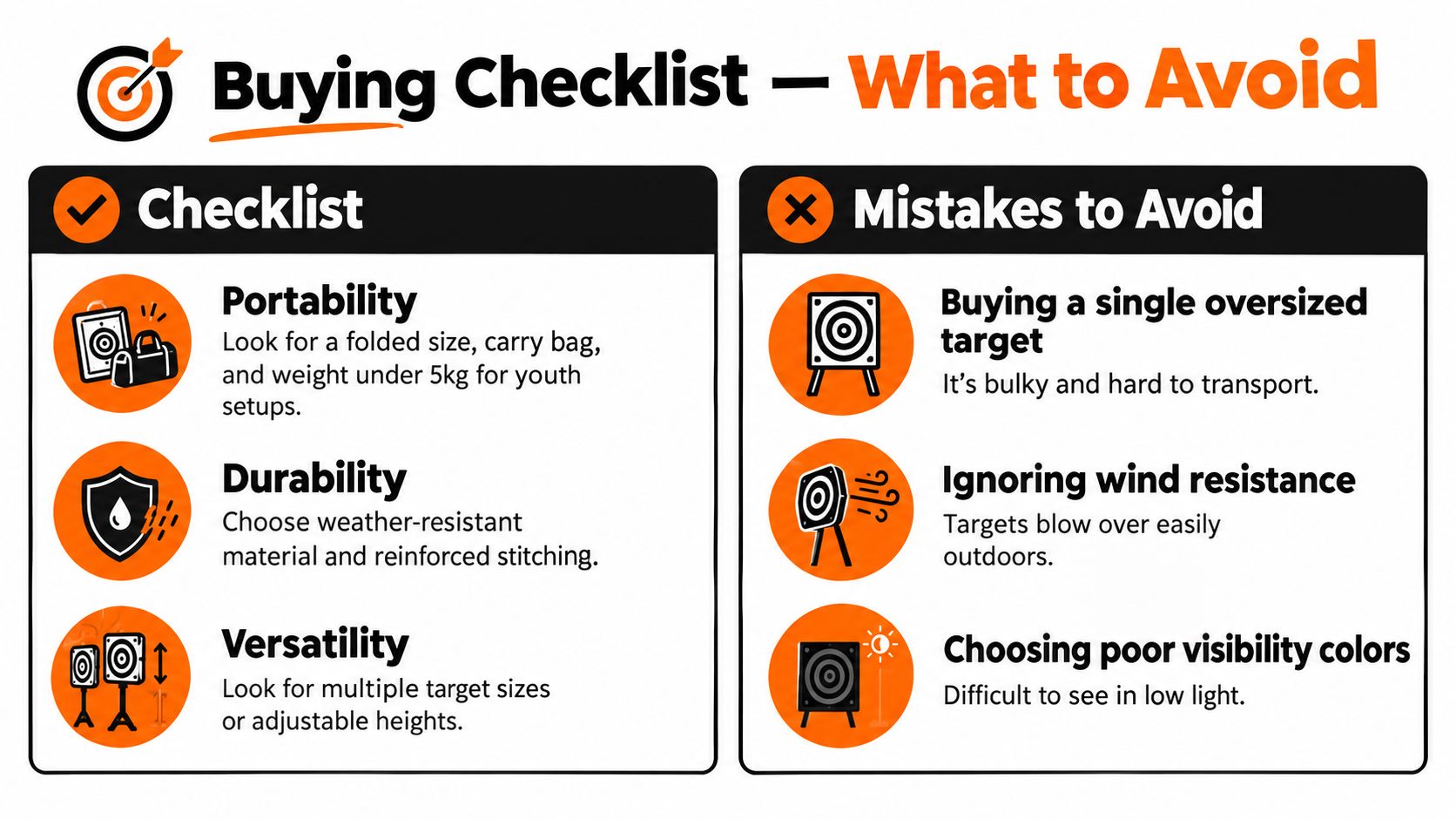
- Portability: Check the folded size, carry bag and handling weight. A youth setup benefits from equipment under 5 kg, provided the frame remains stable.
- Weather resistance: Look for treated nets, protected stitching and corrosion-resistant frames. Store wet equipment only after it has dried.
- Indoor safety: Choose soft-edged cones and avoid rigid uprights where players could fall into them or where ceiling height is limited.
- Versatility: Adjustable rebound angles, several target zones or interchangeable layouts usually offer more session value than a single fixed opening.
- Base stability: On grass, use suitable pegs. On 3G or hard surfaces, choose a base designed for stability without damaging the pitch.
A common mistake is buying a full-size rebounder for a small-sided goal. The target may dominate the area, leave no room for movement and make the drill harder to organise. Another is using a spring rebounder on hard astroturf, where the return can become too sharp for young players.
Coaches also overbuy. One rebounder combined with cones can cover first touch, passing, turning and reaction work. Add target nets or mannequins when the session outcome requires them, not because a larger equipment bag looks more complete.
Quick fit check: Does it match the goal, suit the surface, challenge the age group and fit your storage space? If any answer is no, keep looking.
Building Targets Into a Weekly Training Plan
A target works best as a session multiplier, not as a warm-up extra. Use one equipment choice to connect the technical block with the game that follows.
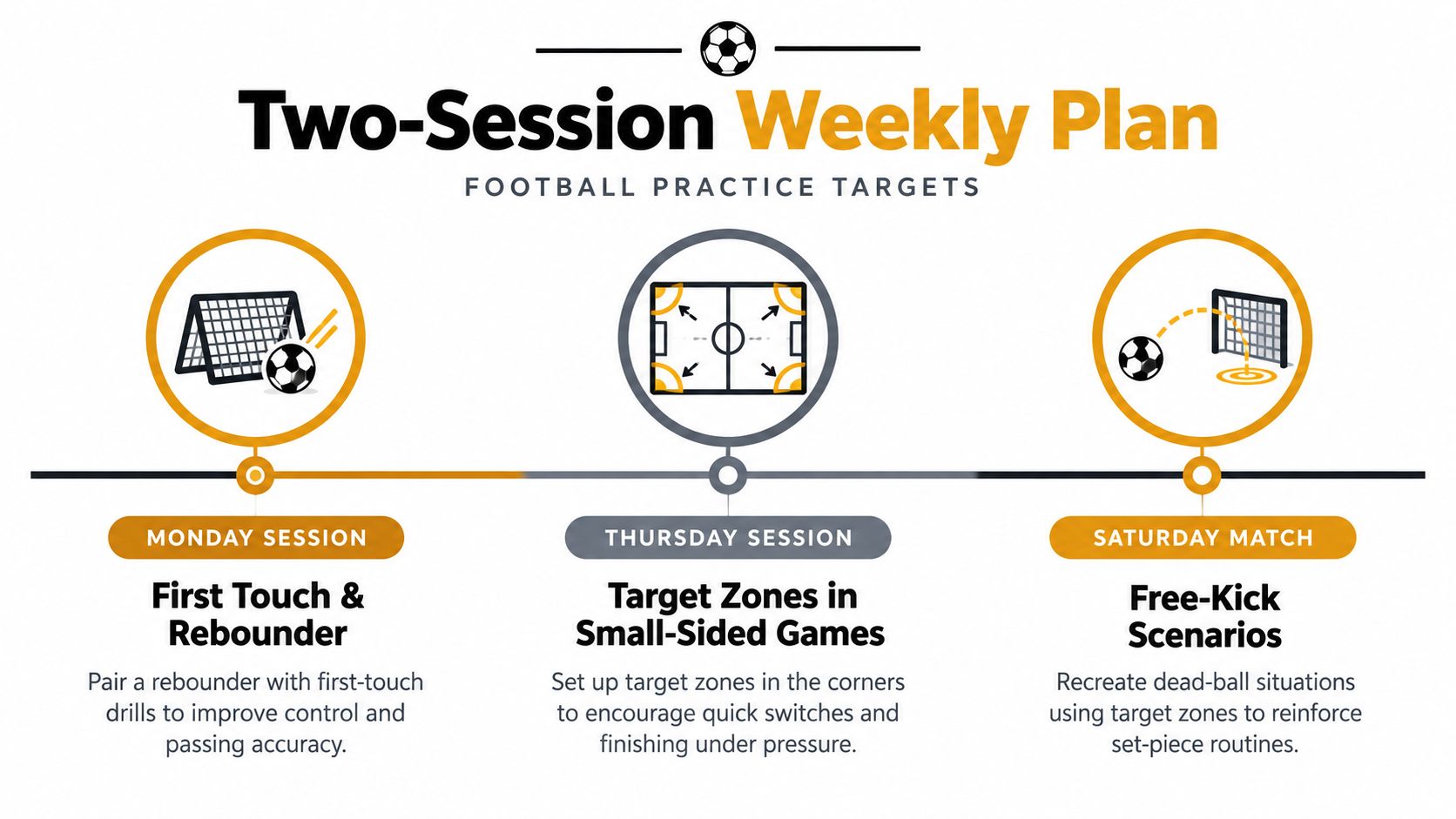
On the first training day, pair a rebounder with first-touch work. Players pass, adjust their feet and play into a supporting space rather than stopping after the return. On the next session, place target zones inside the goal during a small-sided game, rewarding switches, cutbacks or finishes into the selected areas.
For a later match-preparation block, use mannequins and a target net to rehearse free-kick and corner scenarios. The players should recognise the picture, make the delivery decision and react to the second phase. FIFA's short-session guidance supports keeping these development blocks brief and focused, while the EPPP phase structure reminds coaches to adapt the demand to the player group.
Use this video as a visual prompt for organising a target-led practice:
Write the outcome on the session plan before setting out the equipment. Then choose the smallest, safest target that gives players a realistic chance to succeed while still making them think.
SoccerWares offers training essentials including rebounders, goals, indoor training mats, GPS trackers and related football equipment for players, parents and clubs. Visit SoccerWares to compare practical training options and choose equipment that fits your pitch, players and target-led session plan.