

A well-structured football preseason training plan is your secret weapon for a successful season. It’s all about building your fitness, strength, and sharpness over 6-8 weeks so you hit your peak right when that first whistle blows. Think of it as a blueprint to avoid burnout and give you a clear roadmap to smash your performance goals.
Laying The Foundation For a Dominant Season
The first match of the season might feel a long way off, but the groundwork for victory starts now. A dedicated preseason is what separates the players who hit the ground running from those who spend the first few games just trying to catch up. It is a calculated period of preparation, designed to build a rock-solid physical and technical base that will carry you through the whole campaign.
This is not about running yourself into the ground from day one. Not at all. A smart preseason is built on the principle of periodisation—intelligently breaking down your training into distinct phases. Each phase has a specific focus, allowing your body to adapt, get stronger, and sidestep those frustrating early-season injuries.
The Core Principles of Preseason Success
It helps to think of your preseason as a multi-stage project. You would not build a house without a blueprint, right? The same goes for training. The first few weeks are all about laying the foundation, then you start building the framework, and finally, you add the finishing touches.
The key ingredients for an effective plan are pretty straightforward:
- Setting Goals: What do you actually want to achieve? Is it improving your stamina to cover more ground? Adding that explosive burst of power to your sprints? Or finally mastering your weaker foot? Be specific.
- Fitness Testing: You have to know your starting point. Simple tests like a timed 5k, a vertical jump, or the classic yo-yo test give you real, measurable data to track your progress against.
- Progressive Overload: This just means gradually making your training harder—whether that’s more intensity, longer sessions, or more frequent workouts. It is how you consistently challenge your body and force it to improve.
- Recovery and Nutrition: Training breaks your muscles down; proper rest and fuel build them back stronger. This is completely non-negotiable.
This timeline gives you a good idea of how a typical preseason flows, moving from general fitness work to more football-specific sharpness.
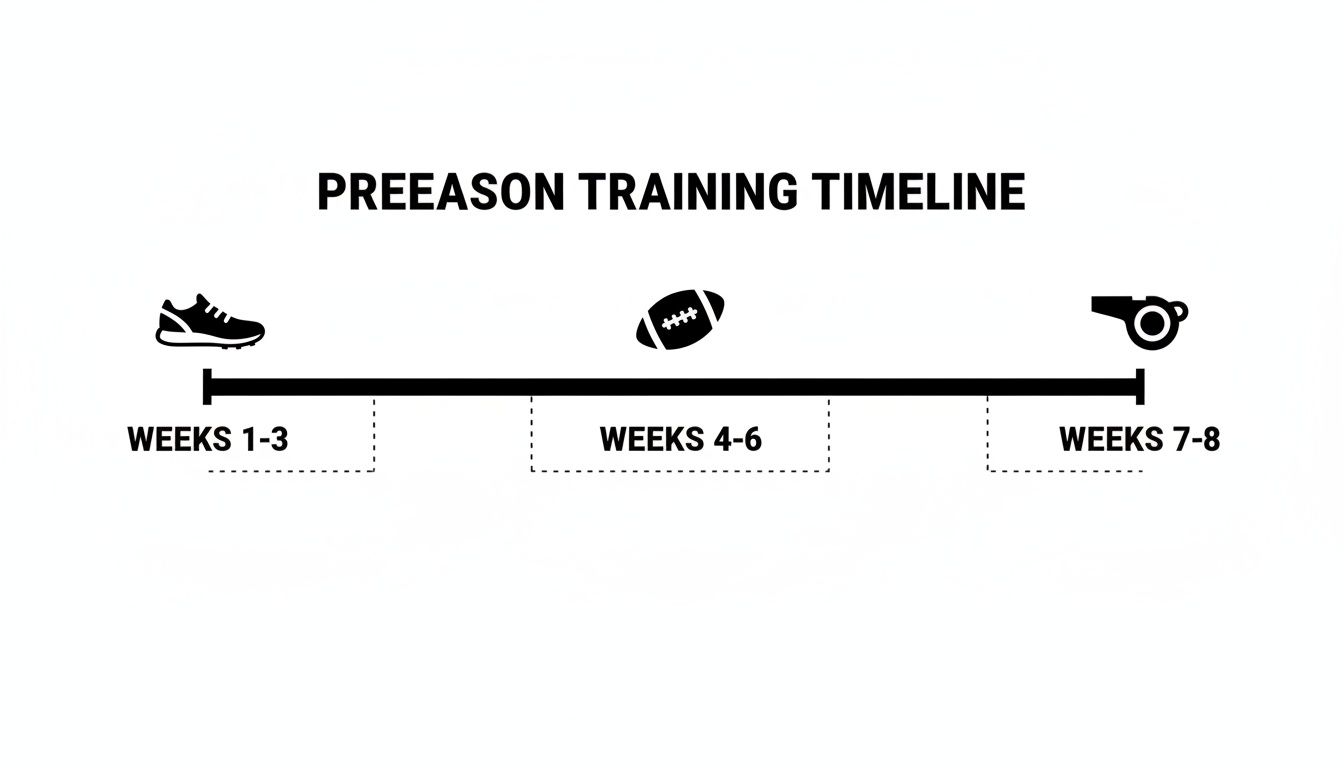
As you can see, it starts with conditioning (the running shoe), shifts into technical skill work (the football), and finishes with tactical readiness for match day (the whistle).
To give you a clearer picture, here is how the focus typically shifts week by week.
Sample 6-Week Preseason Periodisation Focus
| Week | Primary Fitness Focus | Technical & Tactical Goal | Intensity Level |
|---|---|---|---|
| 1-2 | Aerobic Base Building (Endurance) | First Touch & Ball Familiarity | Moderate |
| 3-4 | Anaerobic Fitness (HIIT, Sprints) | Passing Drills & Small-Sided Games | High |
| 5-6 | Speed, Agility & Power | Tactical Shape & Set Pieces | Peak/Tapering |
This structure ensures you are building a solid fitness foundation before layering on the high-intensity, match-specific work, getting you ready to perform from the very first kick-off.
Learning From The Professionals
Pro clubs treat preseason with military-like precision. In the UK, most Premier League teams are back at it by mid-June, dedicating a solid 6-8 weeks to get match-fit before the season kicks off in August. It is intense.
One recent preseason saw a top-flight club cram 28 training sessions into a 5-week period. They hammered high-intensity interval training (HIIT), boosting their players' VO2 max by 12% on average. This brutal schedule included double sessions on 65% of days, with some players clocking up to 10km in endurance runs daily. The result? Their injury rates dropped by 18% compared to the previous season.
The takeaway is crystal clear: a high-volume, scientifically planned preseason directly leads to better performance stats and fewer players on the treatment table once the season starts.
Setting Personal and Realistic Goals
Your preseason plan has to be about you. A centre-back's needs are worlds apart from a winger's. Your goals should reflect your position on the pitch, your current fitness, and what you personally want to achieve this season.
Start by asking yourself a few honest questions:
- What were my biggest weaknesses last season?
- What physical attributes does my position demand most?
- Do I need more stamina, raw speed, strength, or agility?
Once you have your answers, you can set proper SMART goals (Specific, Measurable, Achievable, Relevant, and Time-bound). So, instead of a vague goal like "get faster," aim for something like, "improve my 20-metre sprint time by 0.2 seconds in the next 6 weeks." This gives you a clear target and helps you build every training session with a real purpose.
Of course, having the right kit is the final piece of the puzzle. From supportive boots to a durable stainless steel water bottle from SoccerWares to stay hydrated during those tough sessions, the right gear supports your goals and helps you perform at your best.
Building Your Engine With Strength And Conditioning
A powerful engine is the heart of any successful team, and in football, your body is that engine. Forget just wandering around the gym; your preseason strength and conditioning programme needs to be as specific and tactical as your on-pitch drills.
This is the phase where you forge a resilient, powerful, and durable physique—one that can handle the relentless demands of a 90-minute match, week after week. It is about building the physical armour you will need for the season ahead.
The goal is not just to get stronger in a general sense. We are talking about building functional strength that translates directly to the pitch. Think explosive power to beat a defender, core stability to shield the ball, and the muscular endurance to make that lung-busting recovery run in the final minutes.
The Pillars Of Football-Specific Strength
A well-rounded football strength programme really comes down to three key areas. If you neglect any one of them, you are leaving a massive gap in your physical prep, making you more vulnerable to fatigue and injury.
- Explosive Power: This is your ability to generate maximum force in the shortest time. Think jumping for a header, bursting past a fullback, or putting in a powerful tackle.
- Core Stability: Your core is the foundation for pretty much every athletic movement. A strong and stable core improves your balance, lets you transfer power efficiently, and helps you win those 50/50 physical battles.
- Muscular Endurance: This is what keeps your muscles firing at a high intensity late in the game. It is the difference between making a crucial block in the 89th minute or watching the striker run past you.
To build these attributes, your training needs to be built around compound exercises—the big lifts that recruit multiple muscle groups at once and mimic the dynamic movements you make in a match.
Designing Your Workout Programme
Your training has to be structured and progressive. Just turning up and doing the same old routine will not cut it. Your football preseason training plan needs a clear focus on progressive overload, which simply means gradually increasing the weight, reps, or intensity to keep challenging your body to adapt.
Here are some absolute cornerstone exercises for any footballer's preseason plan:
- Lower Body Power: Squats (barbell or goblet) and Deadlifts are non-negotiable for building the foundational strength needed for sprinting, jumping, and shooting. Lunges and split squats are also brilliant for sorting out your single-leg strength and stability.
- Upper Body Strength: Football might be a lower-body dominant sport, but upper body strength is crucial for shielding the ball and holding off opponents. Make sure to include exercises like bench presses, overhead presses, and pull-ups.
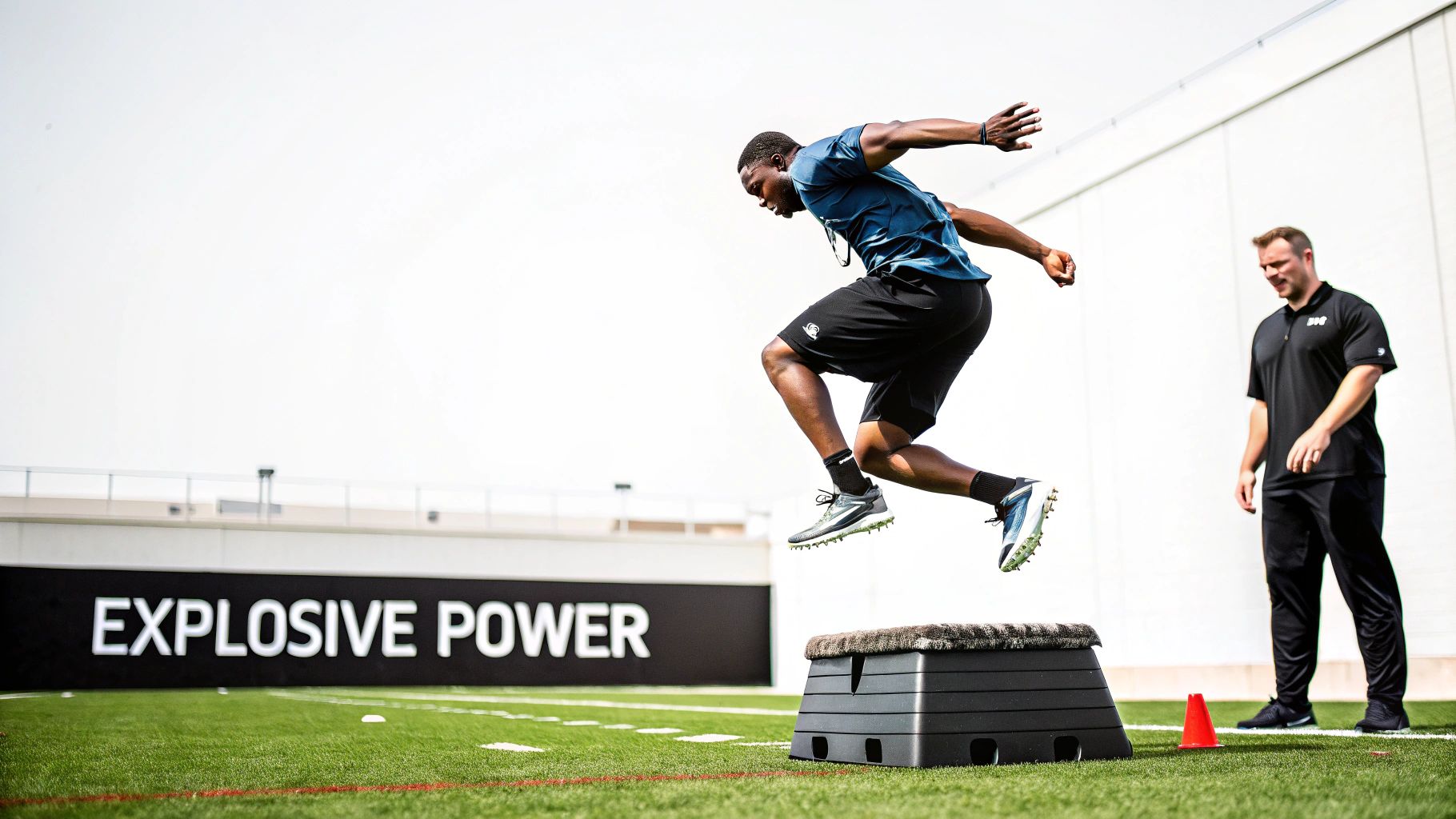
- Plyometrics: These drills train your muscles to produce force rapidly. Box jumps, broad jumps, and squat jumps are perfect for developing that explosive first step that leaves defenders for dead.
A key insight from sports science is that hamstring injuries—one of the most common setbacks in football—are often caused by a strength imbalance between the quads and hamstrings. Prioritising hamstring-focused work like Romanian Deadlifts (RDLs) and Nordic Curls is one of the smartest injury prevention tactics you can adopt.
For a deeper dive into structuring your sessions, our guide on soccer fitness workouts provides detailed routines you can slot directly into your preseason schedule.
Injury Prevention Through Smart Training
A preseason plan is useless if you get injured before the first whistle. Good strength and conditioning is your first line of defence against common football injuries like hamstring strains, groin pulls, and even ACL tears.
Proper form is everything. It is far better to lift a lighter weight with perfect technique than to compromise your form just to lift heavier. This ensures you are hitting the right muscles and not putting unnecessary stress on your joints and ligaments.
Training At Home With The Right Gear
You do not need a state-of-the-art gym to build a professional-level physique. With just a few key pieces of equipment, you can create a highly effective training setup right at home.
- An indoor training mat from SoccerWares gives you a comfortable and stable surface for all your core work, from planks and Russian twists to leg raises.
- A rebounder is not just for passing drills. It is a fantastic tool for developing reactive strength and coordination, simulating the unpredictable nature of receiving a pass under pressure.
- Resistance bands are incredibly versatile. Use them for warm-up activation exercises, add resistance to bodyweight movements, or help with mobility work.
By combining bodyweight exercises with some basic kit, you can effectively hit every key area of your strength and conditioning plan from home. You will turn up for the new season powerful, resilient, and ready to dominate.
Sharpening Your Skills With Technical Drills
Being physically dominant is a massive advantage, but let's be honest, football is a game of skill. All the strength and endurance in the world will not save you if your first touch is poor or your final pass goes astray. This is where your preseason training shifts gears—from building the engine to fine-tuning it. We are bridging the gap between being fit and being football-fit.
Technical drills are where you sharpen the tools you will use every second you’re on the pitch. It is the dedicated, repetitive graft on core skills—passing, receiving, dribbling, shooting—that builds the muscle memory needed to pull things off flawlessly under pressure. Setting aside specific time for this refinement during preseason ensures your technique keeps pace with your improving physical condition.
Core Drills For Individual Improvement
Even when training alone, you can make huge strides in your technical ability. These drills do not need much kit but demand maximum concentration, making them perfect for any player serious about their development.
- First Touch Mastery: The wall drill is a classic for a reason. Just pass the ball against a solid wall and work on controlling the rebound with different parts of your foot. Focus on a clean first touch that sets you up for your next move, whether it is a pass, a shot, or a dribble.
- Dribbling in Tight Spaces: Set up a small square or a line of cones. The goal is simple: keep the ball as close to your feet as possible, using both the inside and outside of your boots. This is essential for developing the close control needed to navigate a crowded midfield.
- Shooting Precision: Forget about blasting it for a while and focus on technique. Set up a target in the goal and practise striking the ball cleanly, aiming for the corners. Work on different finishes—driven shots, curled efforts, and placed side-foot finishes.
The secret to effective solo training is purpose. Do not just go through the motions. Every pass against the wall and every touch around a cone should be done with match-day intensity and focus.
If you are looking to expand your solo and team-based sessions, our comprehensive list of coaching drills for soccer offers dozens of ideas to keep your training fresh and challenging.
Enhancing Drills With The Right Equipment
While solo work is invaluable, adding specific training aids can really elevate your sessions. A high-quality rebounder, for example, is a game-changer for working on receiving and returning passes at pace. It simulates the speed of a real match far better than a simple brick wall ever could.
This is not just theory; professional clubs rely heavily on this stuff. A recent Premier League preseason report revealed that UK clubs covered an average of 1.8 million kilometres in training and friendlies combined. One club’s specific focus, which included 12% more possession drills, directly correlated to a 9% possession advantage in their opening league matches. Another team used rebounders and GPS tech to track 25% higher acceleration metrics, showing how targeted training directly improves on-pitch performance.
Integrating Tactical Awareness
Technical skill is nothing without tactical intelligence. It is not enough to have a great first touch; you need to know what you’re doing with the ball before it even arrives. This is all about positional awareness.
During your drills, constantly scan your surroundings—even if you’re training alone. Get into the habit of checking over your shoulder before receiving the ball. This practice builds the mental map of the pitch that separates the good players from the great ones. As you refine your skills, incorporating practical drills to improve reaction time will make a huge difference come match day.
This is where modern tools like the soccer GPS trackers available at SoccerWares provide incredible feedback. By analysing your heat maps and sprint speeds, you can see if your physical output actually aligns with what your team needs tactically. Are you making the right runs? Are you covering the necessary ground for your position? This data-driven feedback lets you train smarter, ensuring your hard work on the training pitch translates directly to effective, intelligent play during a match.
Your Weekly Preseason Training Schedule
Alright, we have covered the individual building blocks—strength, conditioning, and ball work. Now it is time to put it all together into a smart weekly plan that actually works. A proper football preseason training plan is not just a random list of drills; it’s a carefully balanced schedule that mixes hard work with smart recovery, so you keep making progress without burning out.
The real secret is understanding how different sessions affect your body. You would not smash a heavy leg day in the gym the day before you are meant to be doing explosive sprints, would you? It’s all about layering your training logically to work hard, recover properly, and hit the pitch ready for the next challenge.
Here, I will lay out some flexible templates you can tweak for your own situation, whether you are a youth player finding your feet, a committed amateur, or a semi-pro with much higher demands.
Structuring Your Training Week
How your week looks will really depend on your level and how much time you can realistically commit. A semi-pro player might be hitting two-a-days a couple of times a week. An amateur juggling a full-time job, on the other hand, needs to get the absolute most out of four or five quality sessions.
But no matter your level, the core principles do not change:
- Balance Hard and Easy Days: Alternate high-intensity days (think HIIT or plyometrics) with lower-intensity work like technical drills or a good mobility session. This gives your body the chance to adapt and get stronger.
- Skills Come First: Always do your most technical drills, the ones that need sharp focus and coordination, when you are fresh. That means at the start of a session or on a day you are not feeling fatigued.
- Listen to Your Body: These templates are a guide, not a strict set of rules. If you are feeling wrecked, an active recovery day will do you far more good than forcing a tough session and risking an injury.
Remember, consistency is king. It is way better to complete four solid sessions every week for six weeks than to go all-out for one week and then crash.
Sample Amateur Player's Training Week (Phase 2)
For an amateur player balancing training with work or studies, making every session count is vital. This schedule is designed to tick all the boxes over four dedicated sessions a week, with plenty of time built in for recovery.
Here’s a look at what a balanced week could be during the middle part of your preseason:
| Day | Morning Session | Afternoon/Evening Session |
|---|---|---|
| Monday | Rest | Strength & Power: Full-body gym session (Squats, Bench, Core) |
| Tuesday | Active Recovery: Light jog, foam roll | Rest |
| Wednesday | Rest | Technical & Agility: Cone drills, first touch, 1v1s |
| Thursday | Rest | Conditioning (HIIT): Hill sprints or interval runs |
| Friday | Complete Rest | Complete Rest |
| Saturday | Skill Integration: Shooting/passing | Light team session or small-sided game |
| Sunday | Complete Rest | Complete Rest |
Even in preseason friendlies or competitive drills, you need to protect yourself. Getting a preventable knock can set you back weeks. A solid pair of shin guards from SoccerWares is a non-negotiable part of your kit to avoid those painful impact injuries.
Adapting The Plan For Semi-Professional Players
When you are playing at a semi-pro level, the training volume and intensity jump up a notch. The schedule usually becomes a blend of your own individual work and structured team sessions, with a heavier focus on tactics as the first match gets closer.
Double-session days become the norm, often pairing a physical session in the morning with on-the-pitch work in the evening.
A typical semi-pro week might look more like this:
- Monday: Morning strength session, evening technical passing drills.
- Tuesday: High-intensity conditioning (e.g., repeated sprint work with the team).
- Wednesday: Tactical session focusing on team shape and pressing triggers.
- Thursday: Morning power work (plyometrics), evening finishing drills.
- Friday: Active recovery and team video analysis.
- Saturday: Preseason friendly match.
- Sunday: Complete rest and recovery.
This ramped-up schedule means your body's ability to handle the load is critical. A strong aerobic base is essential, and our guide on how to build stamina for football offers specific drills you can weave into your conditioning days.
With this much intensity, recovery is not just a good idea—it is a vital part of the training cycle itself. By planning your week with care, you ensure every session pushes you one step closer to being stronger, sharper, and more resilient when that first whistle blows.
Mastering Recovery And Nutrition
 Putting in the hard yards on the pitch is only half the battle. How you recover is what determines whether all that effort actually translates into real gains. This is the off-the-pitch work that’s just as crucial as any sprint drill or gym session.
Get this part right, and you will adapt, grow stronger, and show up to the next session ready to go again. Elite players know recovery is not passive—it’s an active process. Neglecting it is the fastest way to hit a wall, burn out, or pick up a silly injury that derails your whole preseason.
Active Recovery And Fuelling Your Body
What you do in the hour after a tough session can make a massive difference to how you feel the next day. A proper cool-down is not optional; it helps bring your heart rate down gradually and can seriously reduce muscle soreness.
Your post-training recovery toolkit should include a few non-negotiables:
- Proper Cool-Downs: A 10-minute light jog followed by static stretching is perfect for flushing lactic acid from your muscles.
- Foam Rolling: Get familiar with your foam roller. Targeting key areas like your quads, hamstrings, and calves helps release muscle tightness and improves your mobility.
- Quality Sleep: This is non-negotiable. Aim for 7-9 hours a night. Sleep is when your body does most of its heavy lifting—repairing tissue and building muscle.
Nutrition is the fuel that powers everything. Forget complicated diets; just stick to simple, effective principles. Focus on lean protein to repair muscle, complex carbohydrates to restock your energy stores, and plenty of veg for those essential vitamins and minerals.
A simple post-training meal like grilled chicken with sweet potato and broccoli ticks all the boxes. It gives your body exactly what it needs to rebuild efficiently. Good recovery is just as vital as the training itself, and there are plenty of proven strategies on how to recover faster from workouts that can keep you on track.
Proactive Injury Prevention And Load Management
Staying injury-free is all about being smart and listening to your body. Pushing through sharp pain is almost never a good idea, especially during the intense build-up of preseason. You have to learn the difference between the normal ache of hard work and the early warning signs of an injury.
Managing your training load is the cornerstone of staying healthy. That means balancing high-intensity days with proper rest and lower-intensity sessions. It is not just theory; data from the English Football League shows that well-structured preseasons have cut soft-tissue injuries by 22% across top squads. Teams that got their workload balance right saw huge drops in common problems like hamstring strains.
One of the biggest mistakes players make is doing too much, too soon. A sudden spike in training volume or intensity is a common recipe for disaster. Progressive overload has to be gradual.
To manage your load properly, a soccer GPS tracker from the SoccerWares range can be a game-changer. These devices give you hard data on your total distance covered, sprint distance, and overall intensity, helping you and your coach make smart decisions to avoid overtraining. For a deeper dive, check out our guide on how to prevent ACL injuries—it’s a must-read for any serious player.
Finally, hydration. It is fundamental. Being even slightly dehydrated can lead to fatigue, cramps, and a serious drop in performance. Keeping a club-branded water bottle from SoccerWares with you all day is a simple but effective visual reminder to keep drinking, ensuring you’re always topped up for whatever training throws at you.
Your Preseason Questions Answered
Diving into preseason always throws up a few questions. Getting it right can literally make or break your season, so it is only natural to want to nail down the best approach. Let's tackle some of the most common queries I hear from players trying to build their football preseason training plan.
How Long Should A Football Preseason Last?
The sweet spot is usually between six to eight weeks. This gives you enough time for a steady, structured build-up of both your fitness and technical skills without cutting corners. Trust me, rushing your preseason is the fastest way to pick up a niggle before a ball is even kicked in a real match.
Think of it in phases. The first few weeks (1-3) are all about laying the foundations – building your aerobic base and getting some general strength work in. Then, from weeks 4-6, you start ramping things up with more football-specific work like high-intensity interval training and small-sided games. The last week or two is for tapering down the volume, making sure you hit that first game of the season feeling sharp and explosive, not heavy-legged.
What Is The Most Important Part Of Preseason Training?
If I had to pick just one thing, it is injury prevention through smart workload management. A great preseason is not about being the fittest player on day one; it is about being available for selection on match day one. Simple as that.
This means you have to listen to your body, follow a structured plan, and treat recovery—sleep, nutrition, and hydration—with the same importance as your training sessions. A smart, progressive approach will always beat a brutal, all-out one.
The ultimate goal is availability. You can’t make an impact from the treatment table. Smart load management is what keeps you on the pitch when it matters most.
Can I Do Preseason Training By Myself?
Absolutely. While the tactical side of things obviously needs your teammates, you can get the vast majority of your physical and technical prep done on your own. Your strength programme, conditioning runs, and ball-work drills are all perfect for solo sessions.
The key to making solo training work is discipline and having the right equipment. You do not need a pro setup, but investing in a few key bits of gear like a rebounder for passing and first-touch drills, some cones for agility work, and a decent indoor mat for core exercises can make a massive difference. Following a plan, like the ones we have outlined, gives you the structure you need to stay focused.
Should I Play Matches During Preseason?
Yes, but you need to be strategic about it. Friendlies are vital for building match fitness, but they should come in the later stages of your preseason – usually the final two or three weeks. They’re your chance to test your fitness under pressure and get back in sync with your team’s tactics.
A common mistake is playing too many intense games too early, which just leads to burnout or injury. Your training should build you up to handle the demands of a full 90 minutes. Start by playing 45 minutes in the first friendly, then maybe 60 or 70 in the next one, letting your body adapt gradually.
At SoccerWares, we provide the training essentials you need to make your preseason a success. From GPS trackers to monitor your load to high-quality rebounders for solo drills, we have the gear to support your ambition. Explore our full collection at https://soccerwares.com.