

Picture the classic dugout scene: a manager, marker in hand, frantically sketching out a game-winning play. That is the magic of a football tactics board. It’s the essential tool that turns a coach's complex vision into simple, clear instructions players can actually use on the pitch.
Think of it as the bridge between the strategy in your head and the execution that wins matches.
From Chalk Dust to Digital Touchscreens
A football tactics board is much more than a piece of kit; it's the main communication canvas for the sport. For decades, it was just a simple chalkboard in a dusty changing room, but its job has always been the same: to make abstract ideas visible.
Today, this vital tool has come a long way from those humble beginnings. You’ll now find everything from portable magnetic folders a coach can slip into their bag to interactive digital apps on a tablet.
This guide will walk you through how this timeless coaching aid has evolved. We'll show you how the right board becomes your team’s strategic hub, turning complex formations and set-piece routines into simple visual instructions that players can understand and act on instantly. This evolution mirrors how the game itself has become more analytical. To see how deep this goes, check out our article on how technology in football is shaping modern strategies.
Why Every Coach Needs a Tactics Board
It doesn't matter if you're a Sunday league volunteer, a parent helping your child’s team, or an aspiring analyst—getting to grips with these tools is the first step towards tactical mastery. Their real value lies in providing instant, visual feedback that the whole squad can see and understand together.
A well-used board can:
- Clarify Roles and Responsibilities: Show players exactly where they need to be, whether it’s defending a corner or launching a rapid counter-attack.
- Explain Complex Movements: Break down tricky patterns, like attacking rotations or a coordinated high press, into simple, digestible steps.
- Make In-Game Adjustments: Quickly sketch out a change in formation or a new defensive shape during a half-time talk, making sure everyone is on the same page.
- Boost Player Engagement: Involve players in the conversation. Letting them move the markers and contribute ideas creates a much stronger team understanding.
Choosing the Right Tactics Board for Your Needs
Picking the perfect football tactics board is a lot like a player choosing a new pair of boots. It really comes down to your personal style, where you'll be using it, and what you’re trying to achieve on the pitch. The sheer number of options can feel overwhelming, but it gets much clearer once you break them down by type.
Each one has its own strengths, designed for different coaching moments. From the classic changing room wall-hanger to the slick app on your tablet, the right tool is the one that helps you get your vision across to your players. Let's walk through the most common types so you can find your perfect match.
Traditional Magnetic Boards
The old-school magnetic board is a coaching icon for a reason. You’ll usually find these wall-mounted in a changing room or manager's office, giving you a big, clear overview of the pitch. Coaches love them for their durability and classic feel—there’s just something satisfying about physically moving the chunky magnets around to show formations and runs.
Their biggest advantage is being a stable, central point for team talks. The downside? Their size makes them impractical for carrying down to the pitch or taking to away games. They’re really best for pre-match briefings and post-match dissections.
Portable and Roll-Up Boards
For the coach who is always on the go, portable folder and roll-up football tactics boards are an absolute lifesaver. They’re lightweight, compact, and designed to be thrown into a coaching bag right next to the cones and bibs. You get the same core function as the big boards, just in a format built for the real world of grassroots football.
- Folder Boards: These are usually A4 or A3 and often come in a zipped case with small magnetic markers and a dry-erase pen.
- Roll-Up Boards: Think bigger vinyl sheets that you can roll out on any flat surface. They give you a larger tactical canvas but are still simple to transport.
The image below shows how every tactical discussion starts with the coach's vision, whether it's for simple movements or a more complex strategy.
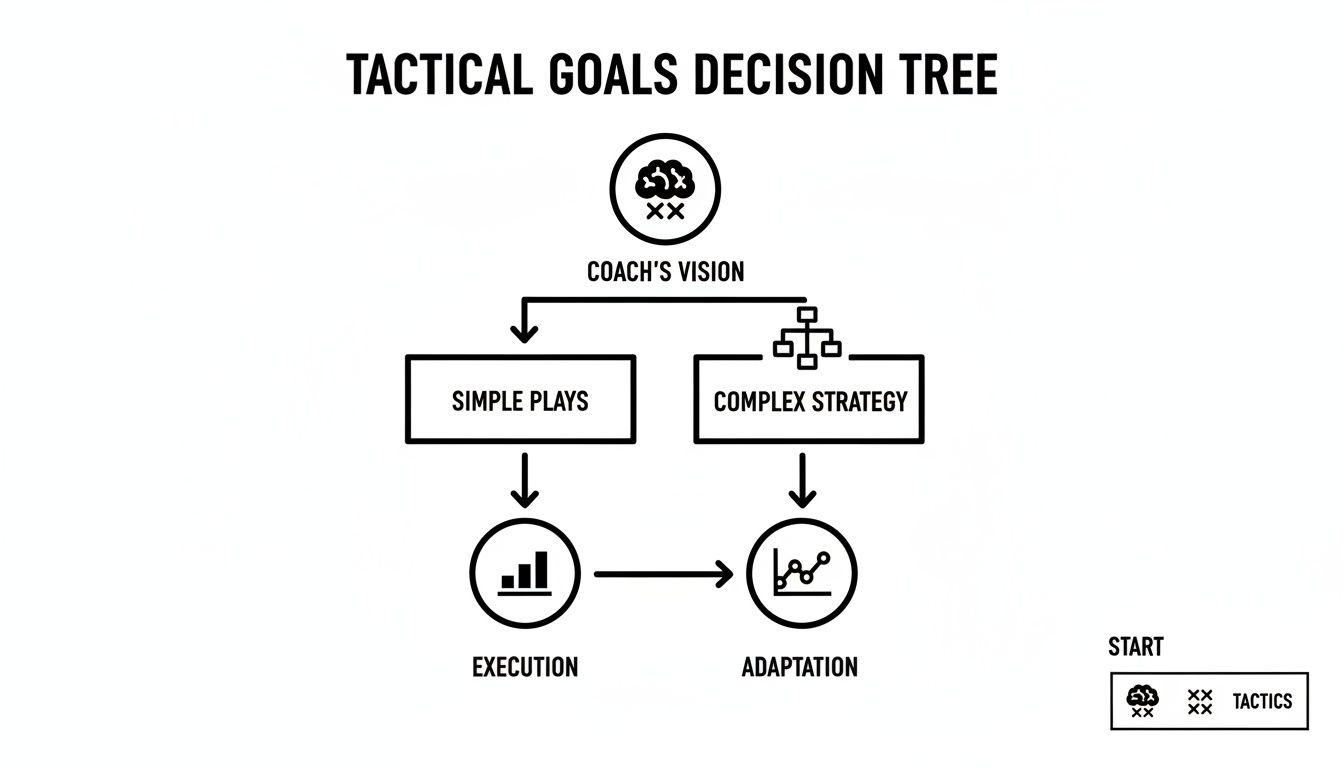
This really brings home the point that whether you're explaining basic positioning or intricate patterns of play, the goal is always clear execution and being able to adapt.
To help you weigh up the options, here’s a quick comparison of the most popular types of tactics boards out there. This should make it easier to see which one fits your coaching style and needs.
Comparing Football Tactics Board Types
| Board Type | Key Features | Best For | Pros | Cons |
|---|---|---|---|---|
| Traditional Magnetic | Large, wall-mounted, durable magnets, clear pitch view. | Pre/post-match talks in a dedicated changing room or office. | Very clear and stable; great for detailed team-wide discussions. | Not portable; limited to a single location. |
| Portable Folder | A4/A3 size, zipped case, lightweight, includes markers. | Pitch-side coaching, away games, grassroots coaches. | Highly portable and convenient; all-in-one solution. | Small surface area can feel cramped for complex tactics. |
| Roll-Up Board | Flexible vinyl sheet, larger than folders, rolls up for storage. | Coaches needing a large but transportable surface. | Good balance of size and portability; versatile. | Needs a flat surface to use; can be less rigid. |
| Dry-Erase Board | Whiteboard surface, free-form drawing, often magnetic too. | Brainstorming sessions, half-time adjustments, quick notes. | Extremely versatile and allows for fluid thinking. | Less structured than magnets; can get messy. |
| Digital App | Tablet/smartphone based, animation, session saving, video integration. | Advanced coaching, remote analysis, sharing plans with players. | Powerful features for detailed planning and sharing. | Can be costly; relies on battery and screen visibility. |
Each type has its place, and many experienced coaches end up using a combination—perhaps a large magnetic board in the clubhouse and a portable folder for match days. It’s all about having the right tool for the job at hand.
Dry-Erase Boards
The biggest selling point of a simple dry-erase board is its versatility. While many now come with magnetic features, a standalone whiteboard is brilliant for quick, free-form sketching and note-taking. You can instantly wipe away an idea and start again, which is perfect for dynamic brainstorming sessions or making rapid-fire half-time adjustments.
A tactics board isn't just for explaining a static formation; it's a dynamic canvas for solving problems as they emerge during a match. The ability to quickly erase and redraw is crucial for adapting to the flow of the game.
Their simplicity is their strength. They encourage fluid thinking without being restricted by fixed player pieces. For a better look at other essential coaching tools, our guide on football coaching equipment provides some excellent context.
Digital Tactics Board Apps
The modern take on the classic board comes in the form of digital apps for tablets and smartphones. These tools are seriously powerful. They let coaches create animated drills, save entire session plans, share tactics with players who aren't present, and even link video clips for in-depth analysis. It’s a huge leap in what a tactics board can do.
Of course, there are potential trade-offs. Some of the best apps have subscription costs, and you’re always at the mercy of your battery life and screen glare on a sunny day. Despite these hitches, for coaches at a higher level, their advanced features are becoming non-negotiable for managing and sharing complex tactical information effectively.
How Tactical Pioneers Shaped the Modern Game
Great tactics aren't just created on the spot; they’re visualised. Long before anyone dreamed of digital apps and high-tech video analysis, the legends of the game were using chalkboards and simple magnetic counters to orchestrate genius. The football tactics board has always been the physical space where a manager’s abstract ideas become a concrete, game-winning plan.
This link between vision and victory is a constant thread running right through football’s history. It’s a powerful reminder that every successful strategy, no matter how intricate it looks on the pitch, often starts with a few simple shapes on a board. This tool is what turns "what if" scenarios into clear, actionable instructions the whole team can get behind.
The core idea has never really changed: use a board to create clarity, solve tactical puzzles, and ensure every single player understands their role. That's the bedrock of good coaching.
Chapman and the Birth of the WM Formation
One of the best-known examples of this comes from Arsenal’s Herbert Chapman. Back in the 1920s, a major offside rule change in 1925—reducing the number of defenders needed to play someone onside from three to two—unleashed tactical chaos. Teams piled forward, leading to incredibly high-scoring games that left defences completely exposed. Chapman, Arsenal’s forward-thinking manager, saw the problem and turned to his chalkboard for an answer.
He took the traditional 2-3-5 formation and pulled two forwards back into deeper roles, creating the legendary 3-2-2-3 shape that looked like a ‘WM’ on his board. This adjustment, sketched out during training at Highbury, wasn't just a minor tweak; it created a perfect balance between attack and defence that other teams couldn't handle. The result? An era of dominance, as Arsenal won five First Division titles and two FA Cups between 1931 and 1938. You can find more insights on this tactical revolution and its huge impact on the game.
This historical masterstroke is proof of how a simple board can solve complex problems on the pitch, a lesson that’s just as relevant for coaches today.
The Board as a Coach’s Canvas
The legacy of innovators like Chapman lives on in every dugout and changing room. The tactics board, whether it’s a simple dry-erase version or a slick digital app, remains the coach’s most essential canvas. It’s where managers translate their understanding of space, opposition weaknesses, and player strengths into a picture everyone can understand.
The coach's eye isn’t just tactical. The art of coaching is the art of lining up players, and the board is where that art begins. It allows a manager to see how the pieces best fit together.
Ultimately, the board serves to empower players. When a manager can clearly show why a certain run needs to be made or why a defensive shift is so crucial, it builds trust and buy-in. It transforms players from just following orders to becoming active participants in the team's strategic identity—a tradition started by the game's earliest pioneers.
Putting Theory into Practice on Your Board
A football tactics board is only as good as the ideas you put on it. It’s one thing to have a formation in your head, but a great coach uses the board to make complex, abstract concepts feel concrete and achievable for every single player in the squad.
This is the tool that transforms a theoretical game plan into a set of clear, actionable instructions. It’s where you can visually demonstrate the specific movements, triggers, and responsibilities that will define how your team plays on match day.
Visualising Key Tactical Concepts
To really bring your sessions to life, you need to be diagramming specific scenarios. Don't just stick the magnets in a 4-4-2 formation and call it a day; show how that shape adapts and shifts when you win or lose the ball. This approach helps players finally understand the 'why' behind their movements.
Here are a few practical examples you can map out:
- The High-Pressing Trap: Use arrows to show your forwards how to angle their runs, forcing an opposition defender towards the touchline. Then, place your midfield magnets in the exact spots to anticipate that forced pass. It creates a powerful visual cue for the entire team to press as one unit.
- Zonal Marking for Corners: Instead of assigning confusing one-to-one markers, divide the penalty box into zones on your board. Place a magnetic counter in each zone and explain that it's their job to attack any ball that enters their area. This clarifies responsibility and stops players from being dragged all over the place.
- Attacking Rotations: Show how your winger, full-back, and central midfielder can interchange positions to create overloads down the flank. Draw the fluid movement patterns to illustrate how one player’s run opens up space for another, turning a static attack into a properly dynamic threat.
Lessons from a Master Tactician
Legendary managers often used their boards for simple but devastatingly effective adjustments. Think of Sir Alex Ferguson's masterful use of the 4-4-2 at Manchester United—a cornerstone of British football history, meticulously planned on tactics boards that became synonymous with his dugout.
He was famous for using half-time breaks to make small but crucial tweaks, scribbling instructions for his wide players or twin strikers that so often turned frustrating draws into vital wins. Across the 1990s alone, this clear, direct approach helped United win five league titles and maintain a league win rate of over 65%.
This highlights a key principle: the board's greatest strength is often in its simplicity, especially when the pressure is on.
The most effective tactical instructions are the ones that can be understood in seconds. Your board should cut through the noise, not add to it, giving players one or two clear ideas to focus on when they step back onto the pitch.
Of course, putting theory into practice requires a continuous feedback loop. Understanding how to apply performance profiling can offer brilliant insights into how effective your plans actually are. By linking what you draw on the board to what you see in training, you can constantly refine your approach. For more ideas on bridging this gap, check out our guide on effective pass and move football drills that bring your diagrams to life.
Integrating Technology with Your Tactical Planning
Welcome to the digital dugout. The old-school magnetic board still has its charm and place, but the modern game moves too fast for tactics to stand still. Today's football tactics boards are no longer just static diagrams; they're becoming data-rich hubs that connect your strategy to what's actually happening on the pitch.
This isn't just about swapping a physical board for an app—it's about making your tactical planning smarter, faster, and more responsive. The best digital tools can now sync directly with player performance data, creating a powerful feedback loop between your instructions and on-field actions.

From Data Points to Decisive Plays
One of the biggest leaps forward is importing data from GPS trackers. Instead of just guessing about a player's positioning or work rate, you can overlay real heat maps and running stats onto your virtual pitch. This lets you visually pinpoint gaps in your formation, show a player exactly where they needed to be, and have a data-backed conversation about their performance. You can learn more about the role of football GPS tracking in modern coaching to see how this works.
Then there's video analysis. This is a complete game-changer. By layering video clips of key match moments onto your digital board, you can:
- Break down an opponent's defensive shape frame by frame.
- Review your team’s pressing triggers and see if they were timed correctly.
- Analyse set-piece effectiveness by showing players exactly how a routine worked (or didn't).
When you combine hard data with clear video evidence, tactical talks become far more engaging and impossible to argue with.
Conte's Title-Winning Masterstroke
This blend of tech-driven insight and crystal-clear instruction was famously demonstrated by Antonio Conte during Chelsea’s 2016-17 title-winning season. We all remember his frantic gestures on the touchline, but those were just the final output of some serious data analysis.
After a rough patch, Conte boldly ditched the common 4-2-3-1 for a 3-4-3 system mid-season. This wasn't a gut feeling; it was a decision born from analysing his team's defensive frailties. The result? An incredible 11-game winning streak without conceding a single goal. Chelsea stormed to the Premier League title with 93 points and 30 wins, leaving rivals in the dust. His switch was so influential that by the next season, 22% of Premier League teams had tried a back-three, a huge jump from under 5% before.
The modern coach's challenge is to translate complex data into simple, actionable instructions. Technology provides the information, but the tactics board remains the essential tool for communicating it clearly.
To take your planning even further, digging into how providers like Opta player stats analyse performance can offer deeper insights. Conte’s success proves it: combining smart data with clear visual instruction isn't just a trend; it's a powerful, modern coaching philosophy that gets results.
Common Questions About Football Tactics Boards
To help you land on the perfect board, we’ve tackled some of the most common questions we hear from coaches, players, and parents. Think of this as the practical advice you'd get from a fellow coach on the touchline—straightforward answers to real-world problems.
What Is the Best Type of Tactics Board for a Youth Coach?
For most youth coaches, a portable magnetic folder or a simple roll-up board is the way to go. You can’t beat them for practicality. They're durable enough to be thrown in the car boot, easy to carry to away games, and you don’t have to worry about a tablet screen getting soaked in a downpour.
Look for a double-sided board if you can. They usually offer the best value, giving you a full pitch on one side and a half-pitch on the other. It's perfect for quickly switching between explaining a full-team shape and zoning in on a corner routine. While digital apps have their place, they can be a major distraction for younger players and are pretty useless on a wet and windy Sunday morning.
How Can I Clean and Maintain My Tactics Board?
A little bit of care goes a long way and will keep your board in good condition for seasons to come. How you look after it really depends on the type you have.
- For Dry-Erase Boards: Stick to high-quality, non-permanent markers and, crucially, wipe it clean right after your session. This stops the ink from "ghosting" and leaving faint, permanent marks. For a proper deep clean, a dedicated whiteboard spray and a soft microfibre cloth will do the trick.
- For Magnetic Boards: The biggest battle here is losing the small magnetic pieces. Get a small, sealable bag to store them in—it’s a lifesaver. Give the surface a wipe with a slightly damp cloth every now and then to get rid of any dirt and dust.
- For Roll-Up Boards: Here’s a simple but brilliant tip: always roll them with the printed side facing outwards. This stops the surface from cracking and creasing over time, which keeps your pitch markings clear and legible.
Whatever board you have, never use abrasive cleaners or rough cloths. They’ll scratch the surface in a heartbeat.
Are Digital Tactics Board Apps Worth the Subscription Cost?
This is the big question. Whether a digital app is 'worth it' really comes down to your level of coaching and what you need to achieve. For semi-pro set-ups, academies, and serious analysts, they’re often an essential tool that provides a real competitive edge.
Digital apps let you create animated drills, share detailed session plans with players before they even arrive at the training ground, and import video clips for analysis. It’s a level of detail a physical board just can’t compete with.
But for most grassroots coaches, many of the premium features are probably overkill. In that case, a free or low-cost app will likely do everything you need for basic diagramming. Our advice? Always try a free trial version first. It’s the only way to know if the features and workflow actually suit your coaching style before you commit to a subscription.
How Can a Player Benefit from Using a Tactics Board?
Tactics boards aren't just for the manager. For any ambitious player, having a small, personal board at home is a fantastic way to deepen their understanding of the game.
It’s a form of active learning that’s far more powerful than just watching a match on TV. A player can use it to map out their positioning from the last game, trace the movements of a top professional in their position, or visualise runs and defensive duties before the next match. It helps turn abstract instructions from a coach into something they can see and understand.
At SoccerWares, we believe the right tools can elevate your game, whether you're a coach masterminding a title-winning strategy or a player sharpening your tactical awareness. From training ground essentials to the latest fan gear, we have everything you need to live and breathe the beautiful game. Explore our full collection at https://soccerwares.com.