

Before you can execute fancy drills or complex tactics, you need to get the basics right. Your core training gear is the foundation of your game – it keeps you safe, comfortable, and ready to perform. Think of it as the chassis of a car; without a solid frame, all the high-tech engine parts are useless.
Getting these fundamentals sorted isn’t just about looking the part. It's about preventing injuries and making sure nothing holds you back on the pitch. Let's break down the absolute essentials every player needs in their kit bag.
Your Core Training Gear Checklist
Here’s a quick rundown of the must-have items we're about to cover. Each piece plays a crucial role in your training, so getting the right fit and features is non-negotiable.
| Gear Item | Why It's Essential | Key Feature to Consider |
|---|---|---|
| Football Boots | Your connection to the pitch, affecting grip, speed, and ball control. | Stud type that matches your most common playing surface (FG, AG, or SG). |
| Shin Guards | Non-negotiable protection against tackles, kicks, and impacts. | A balance of a hard outer shell and a comfortable padded interior. |
| Training Wear | Keeps you dry, cool, and focused by managing sweat and body temperature. | Moisture-wicking fabric that pulls sweat away from your skin. |
This table covers the bare minimum. Master these three, and you have built a solid foundation for your entire football journey.
The Right Football Boots for the Job
Your boots are probably the most important bit of kit you will ever buy. They are your direct link to the ground, dictating everything from your first touch to your top speed. Picking the right pair isn't a one-size-fits-all deal; it comes down to one simple question: where are you playing?
- Firm Ground (FG) Boots: These are the all-rounders, the boots you see most often. They have moulded studs designed for brilliant grip on natural grass pitches that are dry or just a little damp.
- Artificial Ground (AG) Boots: Made specifically for those modern 3G or 4G pitches. The studs are shorter and often hollowed out to give you better traction on the synthetic turf and reduce the strain on your knees and ankles.
- Soft Ground (SG) Boots: When the heavens open and the pitch turns to mud, these are your best friends. They use longer, screw-in studs (often with metal tips) that dig deep into the turf to stop you from slipping and sliding all over the place.
Wearing the wrong boots doesn't just mess with your performance; it's a fast track to blisters, discomfort, or even a nasty injury. Make sure they fit snugly but are not painfully tight.
Essential Protection with Shin Guards
Shin guards are not optional. They are mandatory in official matches for a very good reason. They are your first and only line of defence against stray boots and crunching tackles, drastically cutting your risk of bruises, cuts, or even a fracture.
A well-fitted shin guard should cover the majority of the area between your ankle and your knee, but it should not get in the way of your movement. It’s that one simple bit of kit that could save you from weeks on the sidelines.
Look for a pair with a tough outer shell to take the impact and a soft, padded lining for comfort. Some players prefer the slip-in style held in place by a compression sleeve, while others like the extra security of an attached ankle guard. It really boils down to personal preference—do you value maximum mobility or all-out protection?
Performance-Ready Training Wear
The days of training in a heavy old cotton t-shirt are long gone. Modern training gear is engineered with clever moisture-wicking fabrics that actively pull sweat away from your skin. This keeps you dry, cool, and comfortable, letting you stay focused and perform at your peak for much longer.
This kind of performance apparel is a huge part of the UK football scene. In fact, the entire UK football market was valued at USD 422.23 million in 2024, and a massive slice of that is dedicated to high-performance training kit.
When you are building out your training wardrobe, think about layers—a good base layer, a training top, and a lightweight jacket will have you covered for almost any weather. For a deeper look at putting together the perfect collection of gear, check out our full guide on creating your ideal football training kit. And if you're sorting out gear for a whole team, looking into custom screen printing services is a great way to get that professional, unified look.
Selecting Gear for Your Age and Ambition
Not all football gear is created equal. What's right for a seasoned semi-pro is complete overkill for a six-year-old just getting to grips with kicking a ball. Choosing the right equipment is all about matching it to a player's age, their physical development, and, just as importantly, their ambition on the pitch. Get this right, and the gear actively helps them improve and keeps them safe.
If you’re a parent stepping into this world for the first time, the sheer number of options can feel a bit overwhelming. But the best place to start is always with age-appropriateness. The goal is not to buy the priciest kit on the shelf, but the most suitable. This simple approach avoids a lot of frustration and makes sure a young player’s first steps in the game are positive ones.
This visual guide breaks down the essential kit choices you'll make as a player moves from starting out to serious competition.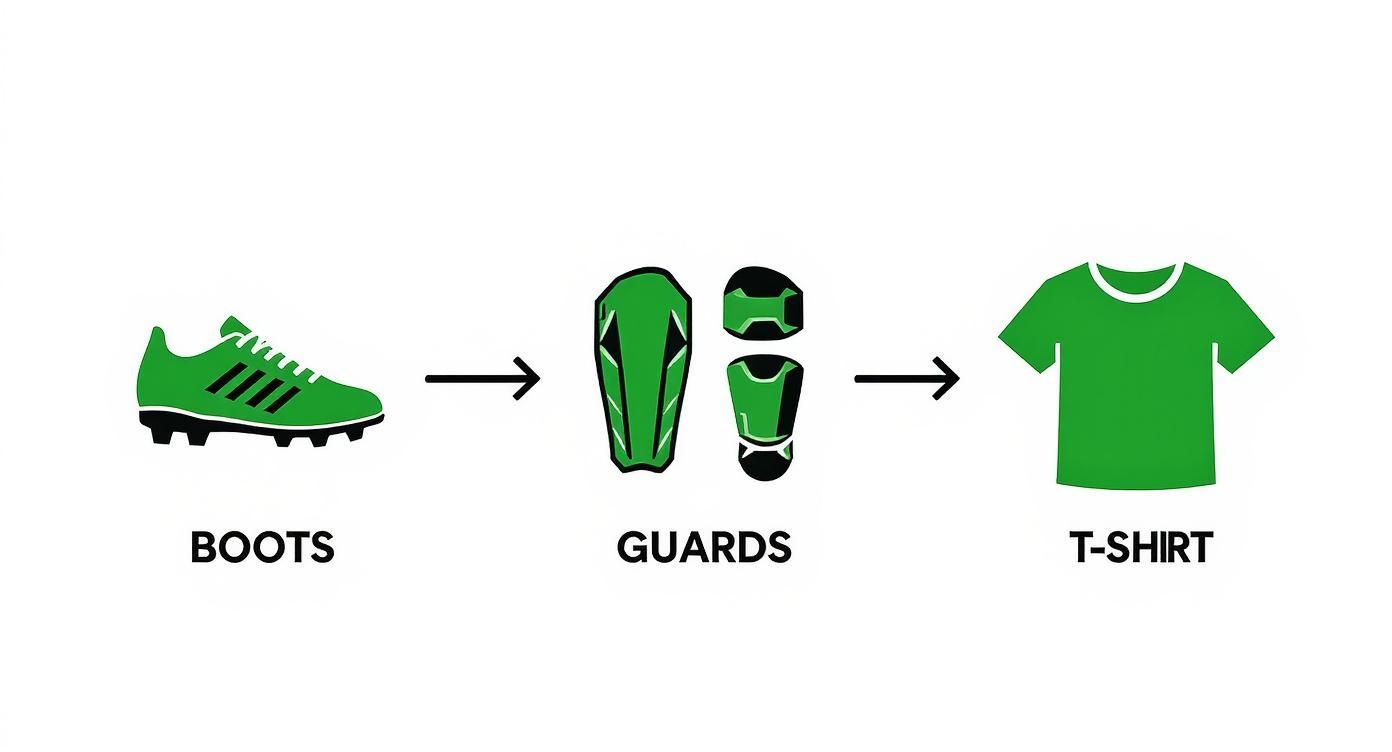
The main takeaway? While the core items—boots, guards, and kit—stay the same, the features you will want to prioritise will shift as a player grows and gets better.
Gearing Up for Youth Football
For the youngest players, everything should revolve around three things: safety, comfort, and fun. The gear has to fit properly. If it’s clumsy or uncomfortable, it will get in the way of their movement and, trust me, they will quickly lose interest in the game.
One of the most common things parents get confused about is the football itself. Ball size is tied directly to age for a really important reason: a smaller, lighter ball is far easier for little feet to control and kick. This is absolutely vital for building the right technique without putting strain on developing muscles.
- Size 3 Ball: This is the one for players aged 8 and under. It's light enough for them to build confidence when passing and shooting.
- Size 4 Ball: Used by players aged 9 to 13. This ball acts as a bridge, helping them get used to more weight and a larger size as they get bigger and stronger.
- Size 5 Ball: The full-size, standard ball for everyone aged 14 and up. It's the same one used in every professional match you see on TV.
Shin guards are another absolute non-negotiable. For kids, look for shin pads that come with built-in ankle protection and are easy for them to put on themselves. The fit needs to be snug, covering most of the shin bone without stopping them from bending their ankle properly.
Advancing to Competitive Play
As a player’s drive and skill level increase, their training gear needs to keep up. The focus starts to shift away from basic comfort and safety and more towards features that can give them a real performance edge on the pitch. This is where you start weighing up rugged durability against lightweight, specialised design.
For a player in a youth academy or a competitive Sunday league team, boots become a much more technical decision. They might go for boots made from lighter synthetic materials for a closer feel of the ball, or a pair with a specific stud pattern designed for explosive speed. The upfront cost might be higher, but the difference in performance is something you can actually feel.
This is the stage where it’s smart to invest in quality. High-performance boots that correctly support your feet and match your playing style can make a real difference, whereas you can often save money on items like training tops or shorts without a drop in performance.
In the same way, an advanced player might swap out their bulky ankle-protecting shin guards for minimalist, carbon fibre ones that slip into a compression sleeve. These offer incredible protection without the bulk, giving them total freedom of movement. It is all about finding those small advantages that add up to a bigger impact in a match.
Ultimately, the best gear is the stuff that feels like a natural extension of the player, letting them forget about what they're wearing and focus entirely on the game.
Sharpening Your Skills with Solo Training Aids
Team practice is where you build tactics and chemistry, no doubt about it. But the real, game-changing improvements? Those often happen when you are putting in the work on your own. That extra dedication is what separates the good players from the great ones, and it’s where solo training gear becomes your best mate.
Think of this gear as a tireless training partner, ready whenever you are to help you grind out the reps and gain that crucial edge. These tools are all about isolating specific skills and letting you get hundreds of touches in the time it might take to get a handful in a crowded team drill.
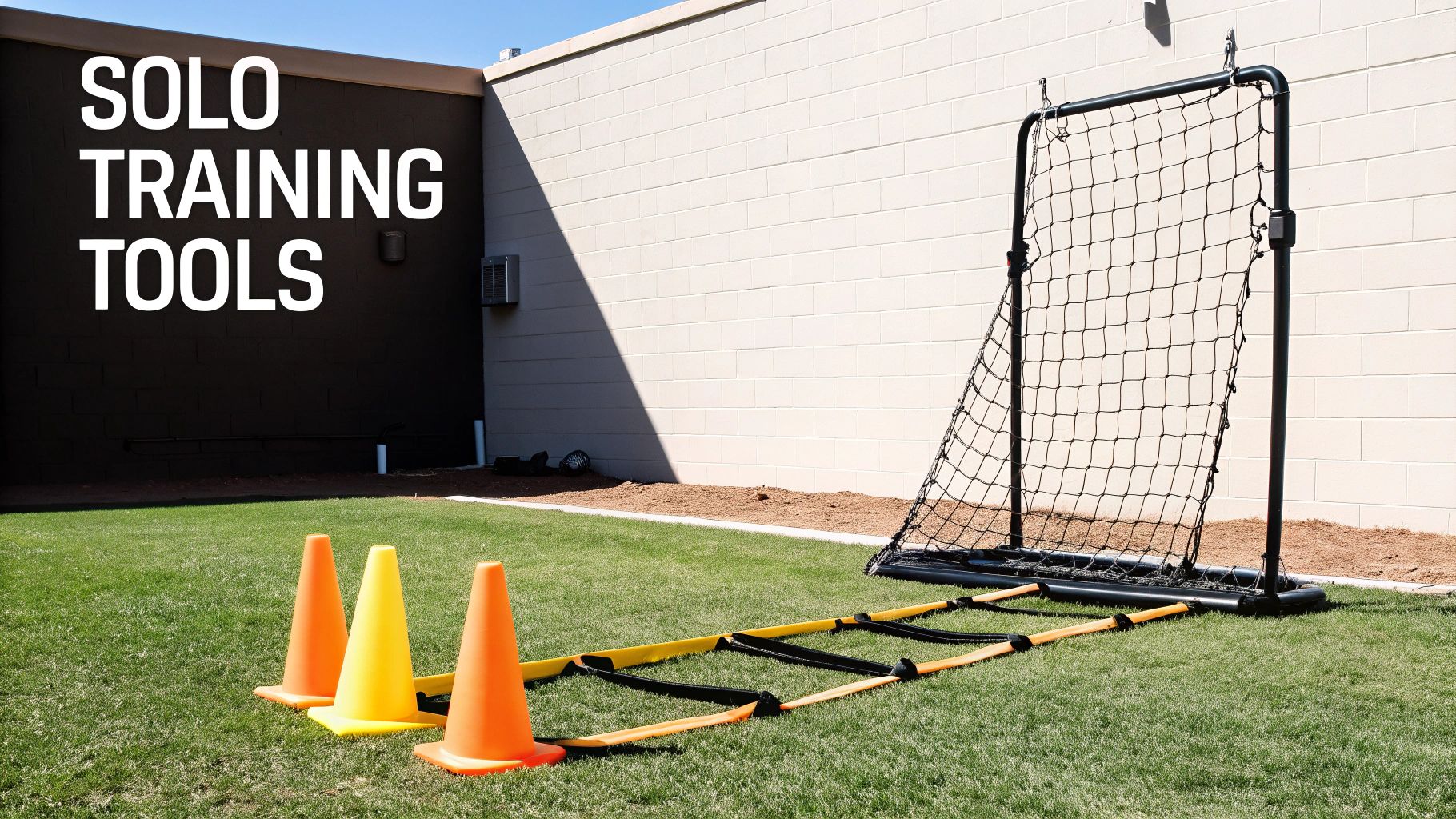
Master Your Touch with a Football Rebounder
If there's one piece of kit that can transform your game, it's a football rebounder. It's the secret to developing that silky first touch and crisp, one-touch passing that catches the eye. It's basically a netted wall that pings the ball back at different speeds and angles, forcing you to react, adjust, and control it instantly.
This is not just about stopping a dead ball. A good rebounder session helps you perfect the real-deal skills:
- Receiving on the half-turn: An absolute must for any midfielder. Practice taking the ball with your body already open to play forward.
- One-touch passing: Get into the habit of returning the ball cleanly and accurately first-time, speeding up your entire game.
- Volleys and half-volleys: Chip the ball into the net and work on controlling it as it loops back to you in the air.
Consistent work with a rebounder builds that all-important muscle memory, making your touch in a match feel completely natural.
Boost Speed and Agility with Cones and Ladders
A brilliant first touch is one thing, but it’s not much use if you do not have the speed and agility to make something happen with it. This is where the classics come in: training cones and agility ladders. They are the absolute foundation for improving your footwork, balance, and that explosive burst of pace.
An agility ladder isn't just about moving your feet quickly; it's about teaching your brain to send faster signals to your muscles. It rewires your neuromuscular pathways, leading to quicker, more efficient movements on the pitch.
These simple bits of gear open up a world of drills. You can set up cones to weave through at pace, mimicking how you'd dribble through a packed defence. An agility ladder is perfect for those quick-feet exercises that sharpen your coordination and let you change direction in a flash. It’s this kind of training that gives you that extra yard to beat a defender or make a last-ditch recovery tackle.
Sharpen Your Finishing with Portable Goals
At the end of the day, it's all about putting the ball in the back of the net. Having a portable goal turns any patch of grass into your own personal shooting gallery. Instead of just wellying it against a fence, a proper goal gives you a realistic target, helping you fine-tune both your accuracy and power.
You can set up all sorts of scenarios to work on specific shots:
- Precision finishing: Pop some cones down as "defenders" and practise curling the ball around them into the far corner.
- Shooting under pressure: Dribble towards the goal at full tilt before getting a shot away quickly, just like you would in a game.
- Free-kick practice: Focus on hitting specific spots in the goal to build dead-ball confidence and accuracy.
By combining these different aids, you can build a complete solo workout that hits every part of your game. Put in the hours with this gear, and you will absolutely see the results on match day.
How Tech Is Revolutionising Player Development
Data is the modern footballer's secret weapon. Gone are the days of relying purely on a coach's eye; we are now in an era where everything from your work rate in midfield to the spin on your free-kick can be measured. What was once exclusive tech for elite clubs with monster budgets is now genuinely accessible to any player serious about improving their game.
This is not about collecting numbers for the sake of it. It’s about getting a much deeper, honest look at your own performance. Using technology in your training gives you concrete, unbiased feedback that helps you train smarter, sidestep injuries, and track your progress with incredible precision.
Unpacking Your Performance with GPS Trackers
You have probably seen professional players wearing what looks like a sports bra under their shirts. That’s a wearable GPS tracker, and it's one of the most powerful bits of kit you can get your hands on today. These devices are so much more than glorified step counters; they capture a huge amount of data about your physical output during a training session or a match.
Just sync the tracker to its app, and you get an instant breakdown of key performance stats. This data paints a crystal-clear picture of your physical contribution, helping you spot patterns and pinpoint exactly where you need to improve.
A few of the most valuable insights include:
- Total Distance Covered: See exactly how much ground you are covering. It’s a brilliant indicator of your overall work rate and endurance.
- Sprint Speed: Track your maximum speed to see if your agility and power training is actually paying off. You can monitor your top speeds over weeks and months.
- Heat Maps: This is a visual map of where you spent most of your time on the pitch. It's fantastic for checking your positional discipline—are you drifting out of position or are you properly controlling your zone?
This kind of data helps you train with real purpose. For instance, if your heat map shows you’re less active in the final 20 minutes, you know to focus on stamina. If your sprint count is low, it’s a clear signal to add more explosive drills to your routine.
This tech also plays a massive role in preventing burnout and injury. By keeping an eye on your physical load over time, you can tell when you’re pushing too hard and might need a rest day. It's a common practice used in top UK academies to keep their players in peak condition.
The Rise of Smart Footballs and Analytics
Beyond tracking your body, the tech is now being built right into the equipment. Smart footballs, for example, have sensors inside that give you immediate feedback on every single kick. They can measure things like shot power, spin rate, and strike point, sending all that info straight to your phone.
This lets you analyse your technique in a way that was pretty much impossible without seriously expensive lab equipment. If you’re trying to master a knuckleball free-kick, a smart ball can tell you exactly how little spin you managed to generate. This instant feedback loop makes the learning process so much faster.
The UK, in particular, has seen a huge uptake in this kind of advanced training gear, driven by the incredibly high standards of leagues like the Premier League. The demand for precision-engineered, tech-heavy training equipment is booming, with things like AI-driven performance analytics and GPS vests becoming standard issue. If you want to dive deeper into how these advancements are shaping the game, you can explore the future of football training technology in our detailed article.
This trend is a big part of Europe's growing football equipment market, where the UK is a major player. It’s clear that using data is no longer a luxury; it’s becoming an essential part of player development at every single level.
Here’s a quick rundown of some of the most common tech you’ll see out on the training ground today.
Comparing Modern Football Training Tech
This table breaks down some of the most popular training technologies, explaining what they do and who they're really for. Think of it as a cheat sheet for picking the right gear to level up your game.
| Technology Type | What It Tracks | Best Suited For |
|---|---|---|
| GPS Vests/Trackers | Distance, sprint speed, heat maps, work rate, acceleration/deceleration. | Players wanting to improve fitness, endurance, and positional awareness. Great for teams and serious individuals. |
| Smart Footballs | Shot power, spin rate, strike location, pass speed, and flight trajectory. | Players focused on refining their kicking technique, especially for set-pieces and shooting. |
| AI Tracking Cameras | Player positioning, team shape, ball movement, and creates automatic highlights. | Coaches and teams for tactical analysis, and players creating recruitment highlight reels. |
| Smart Shin Guards | Touches, pass/shot count, time on the ball, and balance between feet. | Midfielders and technical players looking for detailed on-ball statistics. |
Ultimately, whether you are a Sunday league hero or an aspiring pro, there's a piece of tech out there that can give you an edge. The key is figuring out what part of your game you want to improve and choosing the tool that gives you the right feedback to make it happen.
Keeping Your Gear in Peak Condition
Splashing out on quality football gear is the easy part. Making it last? That's what really counts. Proper maintenance isn’t just about looking smart; it’s about making sure your kit performs the way it’s supposed to, session after session. A little bit of care goes a very long way in protecting your investment and making sure your gear is always ready for action.
Think of gear maintenance as part of your training routine—a cool-down for your equipment. Just like you stretch after a match to prevent injuries, cleaning your boots stops them from cracking and losing their shape. It's a simple discipline, but it is one that guarantees longevity and peak performance from every item in your bag.
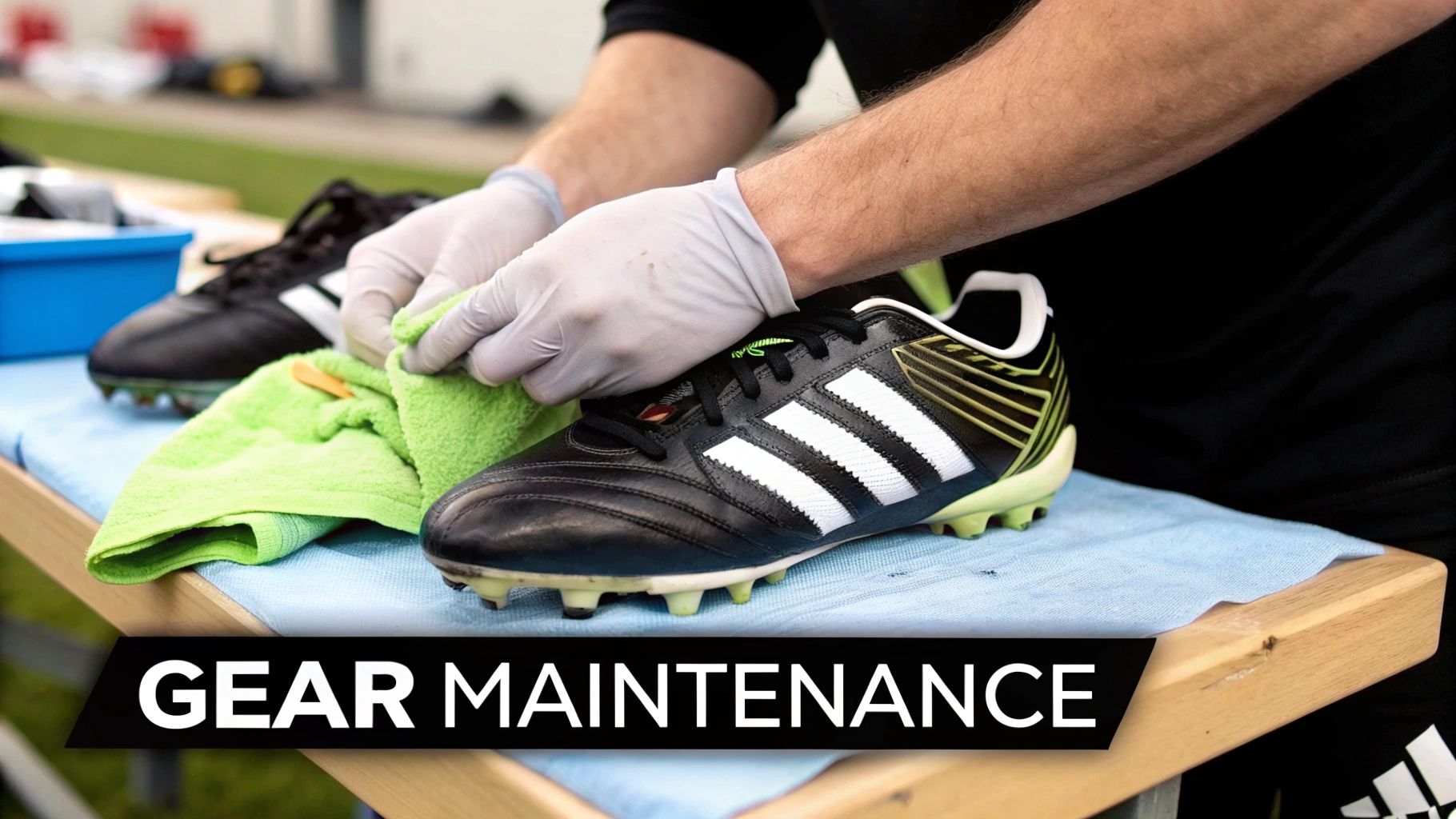
The Essential Boot Cleaning Ritual
Your football boots take the biggest beating, so they need the most love. Leaving them caked in mud is a recipe for disaster. When the mud dries, it sucks the moisture out of the material, leading to cracks and stiffness that can completely ruin the fit and feel. A consistent cleaning routine is absolutely non-negotiable.
Here’s a simple, effective process to follow after every single match or training session:
- Knock off the big stuff: As soon as you step off the pitch, bang the soles of your boots together. Get the worst of the mud and grass off right away.
- Scrub the soles: Grab a stiff brush (an old toothbrush is perfect for this) and some lukewarm water to get all the grime out of the studs and grooves.
- Wipe the uppers: Use a damp cloth to gently wipe down the upper part of the boot. Steer clear of harsh soaps or detergents—they can damage modern synthetic materials and strip the natural oils from leather.
- Dry them properly: Stuff your boots with old newspaper. This works wonders by absorbing moisture from the inside out and helping them keep their shape. Never, ever stick them on a radiator or use a hairdryer. Direct heat makes the material brittle and will ruin them.
Caring for Your Technical Training Wear
Modern training wear is packed with technology—special fabrics engineered to pull sweat away from your skin and keep you comfortable. The quickest way to destroy all that tech? Throwing it in a hot wash with fabric softener. The chemicals in fabric softener clog up the tiny pores in technical fibres, which means they trap moisture instead of letting it escape.
To keep your performance gear in top nick, just follow these simple rules:
- Wash in cold water: A cool, gentle cycle is all you need to protect those delicate fibres.
- Use a sports detergent: These are made specifically to tackle sweat and bacteria without harming the fabric.
- Never use fabric softener: This is the golden rule. It completely reverses the fabric's ability to manage sweat.
- Air dry when possible: Hang your kit up to dry instead of chucking it in the tumble dryer. The intense heat can shrink the material and weaken the elastic fibres over time.
A well-maintained kit does not just perform better; it lasts significantly longer. Proper washing can extend the life of your training wear by an entire season or more, saving you money and ensuring you get the most out of your gear.
Goalkeeper Gloves and Footballs
Do not forget about your specialised kit. For keepers, the grip on their gloves is everything. After a match, give the latex palms a gentle wash with lukewarm water to get rid of any dirt, which can dry out the latex and destroy its tackiness. Let them air dry naturally, well away from direct sunlight.
Even the football itself needs a bit of looking after. Store your balls in a cool, dry place and check the pressure regularly. A properly inflated ball does not just fly truer; it also puts less stress on its stitching, helping it last longer. Taking these small steps ensures every single piece of your gear is primed for performance when you need it most.
Got Questions About Gear? We've Got Answers
Stepping into the world of football gear can feel a bit overwhelming. Whether you're a parent kitting out your child for their first season or a player looking to upgrade, questions are bound to pop up. Getting straight-up, practical answers is the key to spending your money wisely.
Think of this as your go-to guide for those nagging queries. From knowing when to finally retire your favourite boots to figuring out if all that fancy tech is actually worth it, we’ll clear things up.
When Should I Bin My Old Football Boots?
This is the big one, and there is no single right answer. How long your boots last really depends on how often you play, what they're made of, and the pitches you are playing on. A player training three or four times a week will burn through boots way faster than a casual Sunday league player.
But there are a few dead giveaways that it is time for a new pair.
Watch out for these tell-tale signs:
- The Sole Is Peeling Off: If the soleplate is starting to separate from the upper, it's game over. The boot's structure is compromised, and you are risking an injury.
- Studs Are Worn to Nubs: Once your studs are rounded off and short, you lose your grip. It's that simple. This drastically increases your chances of slipping, especially on a wet pitch.
- They Feel Baggy and Loose: If the material has gone soft and your foot is sliding around inside during sharp turns, the boot is not giving you the support you need. Time to go.
Remember, using the wrong boots for the surface is the quickest way to kill them. Wearing firm ground (FG) boots on an artificial (AG) pitch will shred your studs in no time and will likely void the warranty.
If I Can Only Splurge on One Thing, What Should It Be?
While every piece of kit has its place, your football boots are without a doubt the most critical investment you will make. They are the only thing that connects you directly to the pitch and influences every single move—sprinting, turning, shooting, the lot.
A cheap or badly fitting pair of boots can be a nightmare, leading to everything from blisters to more serious foot injuries. On the flip side, a quality pair that fits you perfectly and is designed for your playing surface gives you the comfort and confidence to play your best. You can get by with a basic training top, but never, ever skimp on your footwear.
Are GPS Trackers and Other Tech Actually Necessary?
Honestly? No, they're not essential. Especially not for young players or anyone just starting out. The most important thing is mastering the basics with simple gear—a good ball, some cones, maybe a rebounder. Solid technique and a good football brain are what make a great player, not fancy gadgets.
That said, for dedicated players looking for that extra 1%, these tools can be incredible.
GPS trackers give you cold, hard data on your performance. They show you your work rate, top speed, and distance covered, turning guesswork into a science. This helps you train smarter, manage your fitness, and avoid burnout.
Think of tech as a performance booster, not a foundation. Build the core skills first. Once you are ready to really dig into the details and fine-tune your game, then it is time to bring in the technology. Beyond just gear, remember that smart recovery, like having high protein snacks for post-workout recovery, is just as vital for keeping you at the top of your game.
How Do I Know Which Size Football to Buy?
This one is crucial for development, especially for kids. Using the right size ball ensures it is not too heavy or bouncy, which can mess up how a player learns to kick and control it. It’s all about building the right habits from the start.
Thankfully, The FA's guidelines are super simple and are all based on age:
- Size 3: The perfect starter ball for players aged 8 and under.
- Size 4: The next step up, for players aged 9 to 13.
- Size 5: The standard, full-size ball used by everyone aged 14 and up.
Stick to these recommendations. It gives every player the best shot at developing their skills properly and safely.
Ready to gear up for success? At SoccerWares, we offer a curated selection of high-performance football training gear, from rebounders to GPS trackers, designed to help you reach your full potential on the pitch. Explore our collection and find the perfect equipment to elevate your game.