

Choosing the right size for your goalkeeper gloves is not just about comfort—it is a critical factor that directly impacts your performance, control, and confidence on the pitch. An improper fit can be the difference between a spectacular save and a costly mistake. This complete guide will make sure you find the perfect pair to command your penalty area.
Why the Right Glove Size Is a Goalkeeper's Secret Weapon
Think of your goalkeeper gloves like a surgeon's – precision is everything. They are the most important tool you have, the final barrier between the ball and the back of the net. When the fit is perfect, the glove becomes a natural extension of your hand, letting you focus completely on the game.
When your gloves fit correctly, you gain a massive advantage. The latex palm lies flat against your skin, maximising the surface area for grip and control, whether you are catching, punching, or throwing. This snug connection gives you a much better "feel" for the ball, which is essential for making clean catches and confident decisions under pressure.
The Problem with a Poor Fit
An ill-fitting glove creates immediate problems that can undermine your entire game. It is not something you can just 'play through'; it actively works against you. Understanding these issues shows why taking a moment to measure correctly is so important.
- Gloves That Are Too Large: If your gloves are too big, you will get that annoying bunching of material in the palm. This kills your sensitivity and feel for the ball, often leading to fumbles and clumsy handling. The fingers of the glove can also twist during a save, which seriously increases the risk of injury.
- Gloves That Are Too Tight: On the other hand, a glove that is too snug will restrict blood flow and hand movement. This makes it tough to form a proper catching shape and often leads to the seams splitting under constant strain. Tight gloves are not just uncomfortable; they can slow down your reaction time.
A well-fitted glove is the foundation of a goalkeeper's confidence. When you trust your equipment, you can commit fully to every action, from a routine collection to a last-ditch diving save. This mental edge is just as important as the physical benefits.
Ultimately, the right size enhances your natural ability. It lets you perform without distraction, knowing your gear is working with you, not against you. From shot-stopping to ball handling, a perfect fit is fundamental. Of course, great handling also comes from practice, which is why incorporating specific football goalkeeper drills into your training is essential for building muscle memory.
This guide will walk you through every step, ensuring you select a pair that truly feels like a second skin.
How to Measure Your Hand for Goalkeeper Gloves
Finding the right glove size is not guesswork. It all starts with a simple measurement you can do at home in about two minutes. Getting this right is probably the single most important step in making sure your new gloves feel like a second skin, not a clumsy accessory.
All you need is a soft or flexible tape measure. If you do not have one handy, a piece of string and a ruler will do the job just as well. The trick is to measure the right part of your hand to get an accurate starting point.
The Step-by-Step Measurement Process
Just follow these simple steps to get your core hand measurement. It is a good idea to measure both hands, as one is often slightly bigger than the other. Always go with the measurement from your larger hand to ensure a comfortable fit that will not feel tight during a match.
- Measure Your Palm Circumference: Wrap the tape measure around the widest part of your palm. This is usually right across your knuckles, just below where your fingers start. Make sure you do not include your thumb in this measurement.
- Record the Measurement: Jot down the number in both centimetres (cm) and inches (in). Having both makes it easier to cross-reference different brand size charts, which can sometimes vary slightly.
- Add Room for Comfort: This is the key step that a lot of keepers miss. Once you have your palm measurement, add about one inch (or 2.5 cm) to that number. This extra bit of room accounts for the glove's padding and structure, stopping the fit from being too restrictive.
So, for example, if your palm measures 8 inches around, your final measurement for sizing is 9 inches. This is the number you will use to find your recommended size on a chart.
This image shows exactly why that perfect fit is so important. A tiny difference between too big, just right, or too tight can completely change your control and confidence.
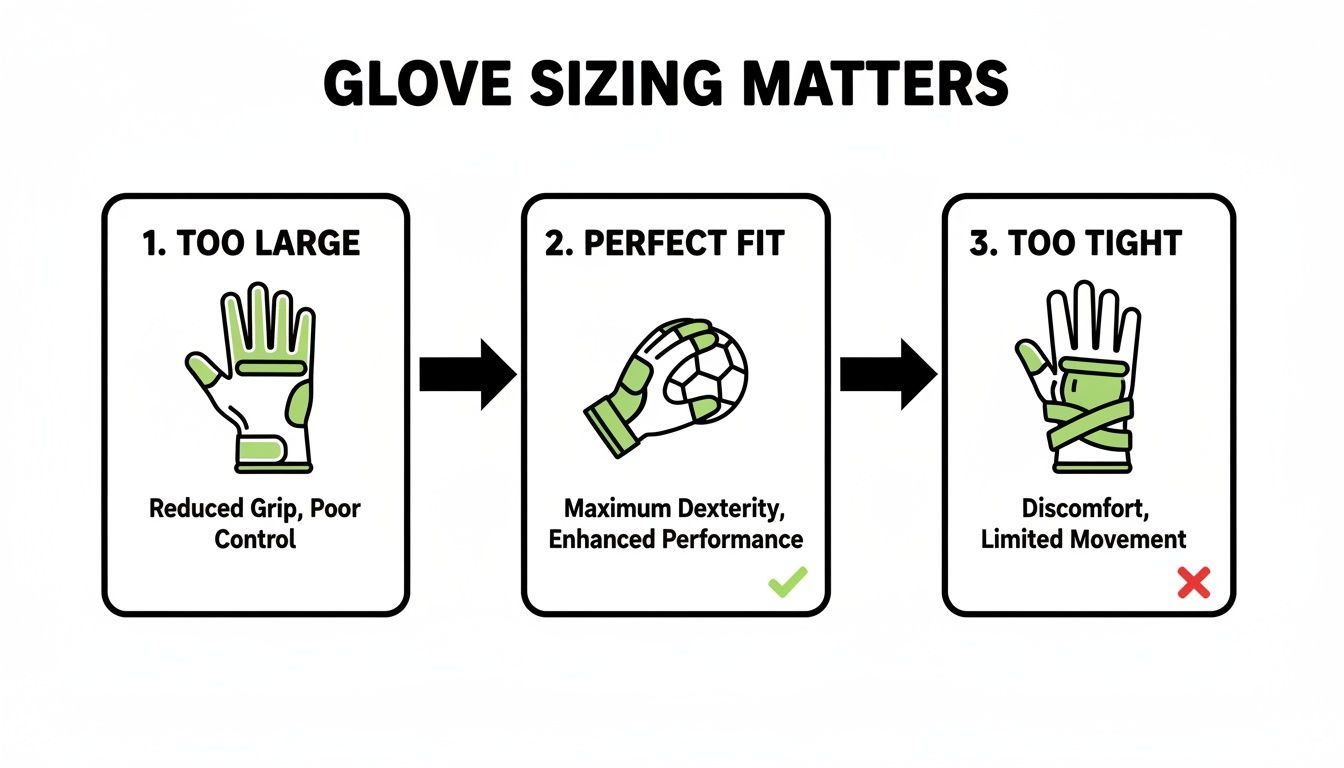
As you can see, the 'perfect fit' gives you the best possible contact with the ball. Baggy or tight gloves just get in the way.
Converting Your Measurement into a Glove Size
Okay, now that you have your final measurement, you can use a size chart to find your perfect glove. This simple conversion takes the guesswork out of it and points you straight to the right size when you are browsing the collection here at SoccerWares.
Data from retailers across the UK shows that most adult keepers fall between sizes 8 and 11—roughly 78–85% of all adult glove sales are in this range. For a more detailed fit, some keepers also measure their finger length, but for most, the palm circumference is all you need. If you want to dive deeper, you can discover more about goalkeeping size guidance on prodirectsport.com.
Pro Tip: If you find your measurement lands right between two sizes, always go for the larger one. A glove that is a little too big is far easier to play in than one that is too tight and cramps your hands.
Here is a standard goalkeeper glove size chart to help you out. Find your adjusted palm measurement (that is your initial measurement + 1 inch) in the columns below to see your recommended UK/US glove size. This is your most reliable starting point.
Goalkeeper Glove Size Chart
Use this chart to convert your palm circumference measurement into its corresponding glove size. Remember to add 1 inch to your measurement before finding your size.
| Palm Circumference (cm) | Palm Circumference (in) | Recommended Glove Size (UK/US) |
|---|---|---|
| 15.2 | 6" | Size 6 |
| 17.8 | 7" | Size 7 |
| 20.3 | 8" | Size 8 |
| 22.9 | 9" | Size 9 |
| 25.4 | 10" | Size 10 |
| 27.9 | 11" | Size 11 |
| 30.5 | 12" | Size 12 |
Now that you have your size, you are ready to start looking at the different types of glove cuts, which we will cover in the next section.
Understanding Goalkeeper Glove Cuts and Their Fit
Got your hand measurement? Great. But that is only half the story. The next piece of the puzzle is the glove’s ‘cut’, and honestly, it is the one thing most people overlook. Yet, it completely changes how a glove feels on your hand.
Think of it like buying a pair of jeans—two pairs can have the same waist size, but a skinny fit feels worlds apart from a relaxed fit. The same goes for gloves. A size 9 in a tight Negative Cut will feel much snugger than a size 9 in a classic Flat Palm.
The cut is all about how the palm's latex is stitched to the backhand. This simple difference dictates the glove's tightness, how flexible it is, and how much of that grippy latex actually makes contact with the ball. Getting this right is crucial for finding a glove that suits your hand shape and your playing style.
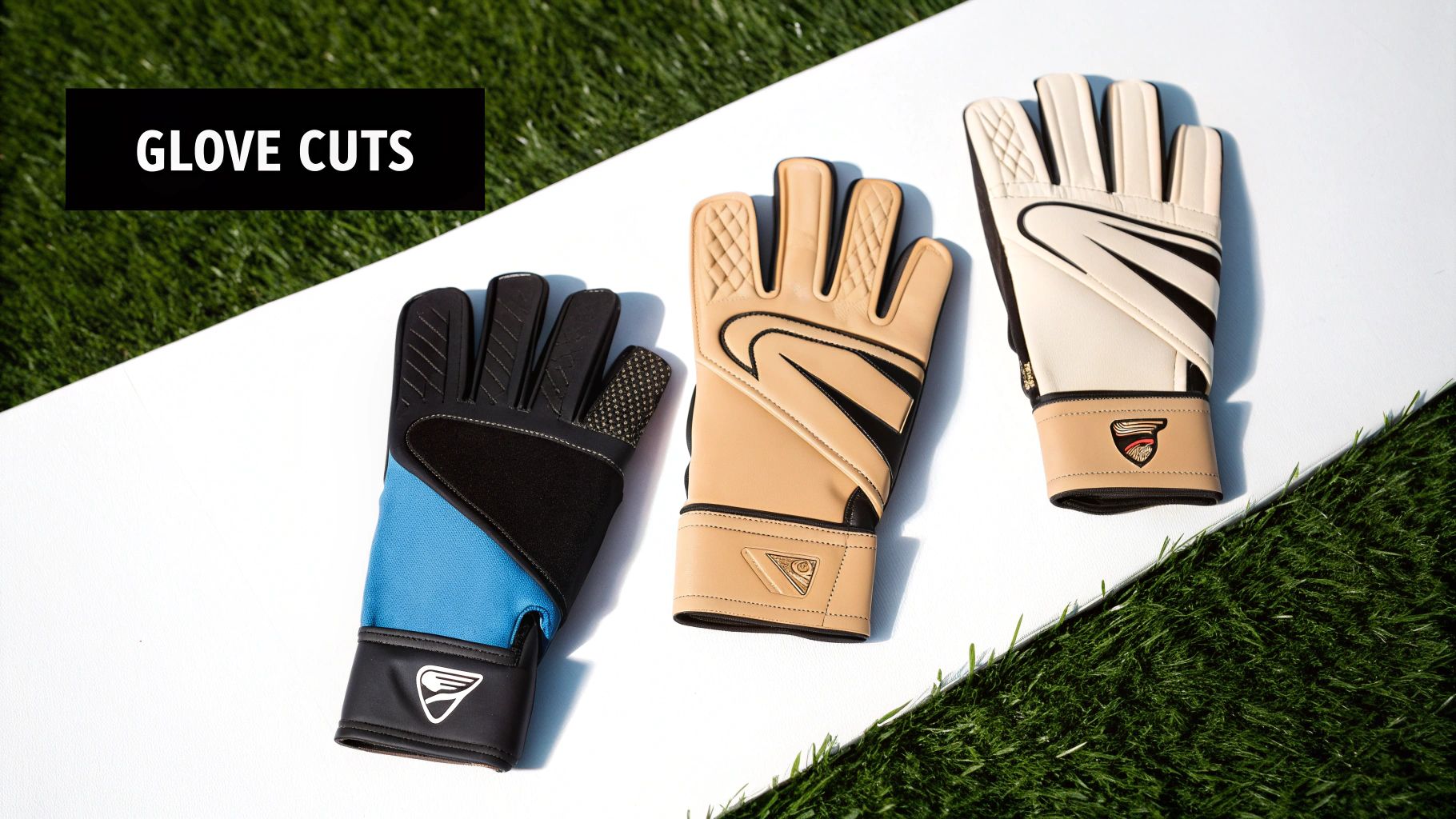
Let's break down the most common cuts so you know exactly what you are looking for.
The Negative Cut: A Second-Skin Feel
The Negative Cut gets its name from its inwardly stitched seams. This design pulls the material in, creating a super-tight, streamlined fit around your fingers. It is a huge favourite among professional keepers who want an exceptional, pure feel for the ball.
Because the seams are on the inside, there is absolutely no wasted material. It is the closest you will get to a true 'second-skin' sensation.
- Best for: Goalkeepers with more slender hands.
- Key benefit: Unmatched ball feel and a precise, snug fit.
- Consideration: Because it is so form-fitting, it is a bit less forgiving when you are trying to stop a rocket of a shot compared to more padded cuts.
The Roll Finger Cut: Maximising Latex Contact
The Roll Finger Cut is easily one of the most popular choices out there, hitting that sweet spot between comfort and grip. In this design, the palm latex wraps—or 'rolls'—all the way around the fingers, connecting directly to the backhand.
This clever construction gives you a much larger latex-to-ball contact area, which can be a real confidence booster when you are plucking crosses out of the air or smothering powerful shots. It generally feels a bit looser and more cushioned than a Negative Cut.
The Roll Finger Cut is often seen as a brilliant all-rounder. It provides the comfort many keepers crave while maximising the surface area that helps you securely hold onto the ball, making it a reliable choice for various conditions.
The Flat Palm Cut: The Traditional Choice
The Flat Palm Cut is the original, classic glove design. You can spot it a mile off by its single piece of flat latex for the palm and its gussets (the material between the fingers) stitched to the outside. This gives the fingers a distinctly boxier shape.
This old-school construction results in a looser, more spacious fit. While modern designs have improved its performance, it offers that traditional, roomy feel some keepers still swear by.
- Best for: Keepers who prefer more room inside their gloves or those with wider hands.
- Key benefit: A comfortable, non-restrictive fit and good breathability.
- Consideration: It provides less direct contact with the ball compared to the snugger Negative and Roll Finger cuts.
The Hybrid Cut: The Best of Both Worlds
Just as the name suggests, a Hybrid Cut cherry-picks elements from two or more different cuts to create a unique fit and feel. This lets glove designers get really specific about performance benefits.
A common example is a glove that combines a Negative Cut on the middle fingers (for a tight feel) with a Roll Finger Cut on the outer fingers (for better grip when catching). This level of customisation means you can find a glove that is perfectly tuned to your personal preferences.
Exploring the diverse range of goalkeeper gloves available at SoccerWares is a great way to see how different hybrid designs work in practice. The possibilities are vast, offering a tailored experience that can really elevate your game.
Youth and Junior Goalkeeper Sizing Made Simple
Trying to find the right glove size for a young, growing keeper can feel like a real headache for parents and coaches. It is not like sizing up an adult; a kid's hands are changing all the time, which makes guessing based on age a bit of a gamble.
While using their age and height is a decent starting point, the only way to get it right is to actually measure their hand. It takes a couple of minutes, but that small step guarantees the glove fits perfectly from day one, which is a massive deal for a young player’s confidence and development.
A common trap is buying oversized gloves for them to 'grow into'. It might seem like you are saving a few quid, but it can seriously hold them back. Baggy, ill-fitting gloves make it harder for a young keeper to feel and handle the ball, which can knock their confidence and even be unsafe.
The Ideal Fit for Young Keepers
The perfect fit for a youth player is not the same snug fit an adult keeper might look for. You are aiming for about half an inch (around 1-2 cm) of space at their fingertips. This gives them just enough room for comfort and movement without the glove feeling clumsy or slow to react.
That little bit of space is crucial. It acts as a buffer to help absorb the shock of a shot while letting their fingers flex and spread naturally. A glove that is too tight restricts movement and feels uncomfortable, while one that is too big makes catching feel awkward and uncertain.
A well-fitting pair of gloves is a young keeper's best friend. It gives them the confidence to attack the ball, knowing their equipment will support them. This builds a positive foundation for their skills to grow.
Age and Height as a Starting Guide
Even though measuring is king, age and height charts can give you a useful ballpark figure to start with. Here in the UK, junior goalkeeper sizing tends to follow a fairly clear pattern. Youth gloves usually run from sizes 4 to 7, covering kids from about 7 to 14 years old.
For example, a common UK guideline might suggest:
- Size 4 for ages 7–9
- Size 5 for ages 9–10
- Size 6 for ages 10–12
We have found that return rates can drop by 15–25% when parents use a measurement chart instead of just going by age. It just goes to show how much it helps.
But remember, this is just a guide. Every kid's hands are different. You could have two ten-year-olds on the same team with completely different hand sizes, so that final check with a tape measure is the most important step in this goalkeeper gloves size guide.
Why the Right Fit Is So Important for Development
Young keepers are still getting the hang of the basics, like catching and handling. The gear they use plays a huge part in how quickly they learn. Youth gloves are often designed with softer latex palms to give them a better grip on the lighter, less powerful shots they typically face.
For that tech to work properly, the glove has to fit. A good fit ensures the latex makes as much contact with the ball as possible. This helps them build the muscle memory and technique they need to become a reliable shot-stopper.
When you pair great-fitting gloves with the right gear, like a complete junior goalkeeper kit, it helps them feel like a pro and play their best. At the end of the day, getting the size right is not just about comfort—it is about setting them up for success.
Getting Your Head Around Brand Variations and International Sizes
Anyone who has bought a pair of football boots knows the feeling. A size 9 in one brand fits like a glove, while the same size in another feels completely different. Well, goalkeeper gloves are exactly the same. It is not a mistake—it is just that every brand has its own way of making things, from the materials they use to their design philosophy.
That is why just measuring your hand once is not the whole story. You absolutely have to check the specific size chart for the brand you are buying. On every single product page here at SoccerWares, we include the official brand chart to take the guesswork out of it and save you the hassle of a return.
These small differences can feel massive depending on the glove's cut. For example, a brand known for its tight-fitting Negative Cut gloves might feel a size smaller than another brand’s roomier Flat Palm glove, even if they are both labelled as a size 10.
Understanding UK, US, and EU Sizing
To add another layer of fun, you will also run into different international sizing systems. The good news is that UK and US glove sizes are pretty much identical—a UK 9 is a US 9. European (EU) sizing, however, plays by slightly different rules.
With top European brands becoming more popular in the UK, keepers are seeing EU sizes more often. One of the main things you will notice is that EU sizing often ditches the half-sizes common in the UK, jumping straight from one full size to the next. This has definitely caught a few people out.
This shift has caused a noticeable change in how keepers pick their gloves. As EU sizing took hold, UK players found their usual half-sizes had vanished. In fact, it has led to a 20–30% rise in sizing questions to UK retailers. To help clear things up, suppliers now provide conversion tables showing that an EU size 9 is roughly a UK 8.5, while an EU 10 is closer to a UK 9.5. You can discover more insights about these EU regulation changes on hazchemsafety.com.
Your International Size Conversion Chart
To help you switch between sizes without any stress, this simple conversion chart is your best friend. Use it to quickly see how your UK/US size lines up with its EU equivalent, so you can order the right fit every time.
| UK / US Size | EU Size |
|---|---|
| 4 | 4 |
| 5 | 5 |
| 6 | 6 |
| 7 | 7 |
| 8 | 8 |
| 8.5 | 9 |
| 9 | 9.5 |
| 9.5 | 10 |
| 10 | 10.5 |
| 10.5 | 11 |
| 11 | 11.5 |
| 12 | 12 |
Remember: This chart is a solid guide, but the glove’s cut is still king. Always have a quick read of the product description for any notes on whether a model fits true-to-size, or if the brand suggests going a size up or down.
By keeping these brand and international differences in mind, you can shop for your next pair of gloves with confidence. It is this little bit of extra knowledge that turns a good fit into a perfect one.
Checking the Fit and Caring for Your New Gloves
The postman has been, and your new gloves have finally arrived. The temptation to rip open the packaging and head straight to the pitch is real, I get it. But hold on a second. Taking a couple of minutes to check the fit now will make all the difference when you are facing a last-minute penalty.
Think of it this way: a glove should feel like an extension of your hand, not some clunky accessory you are fighting against. A perfect fit breeds confidence, and confidence is everything for a keeper. Let's make sure you have nailed it.
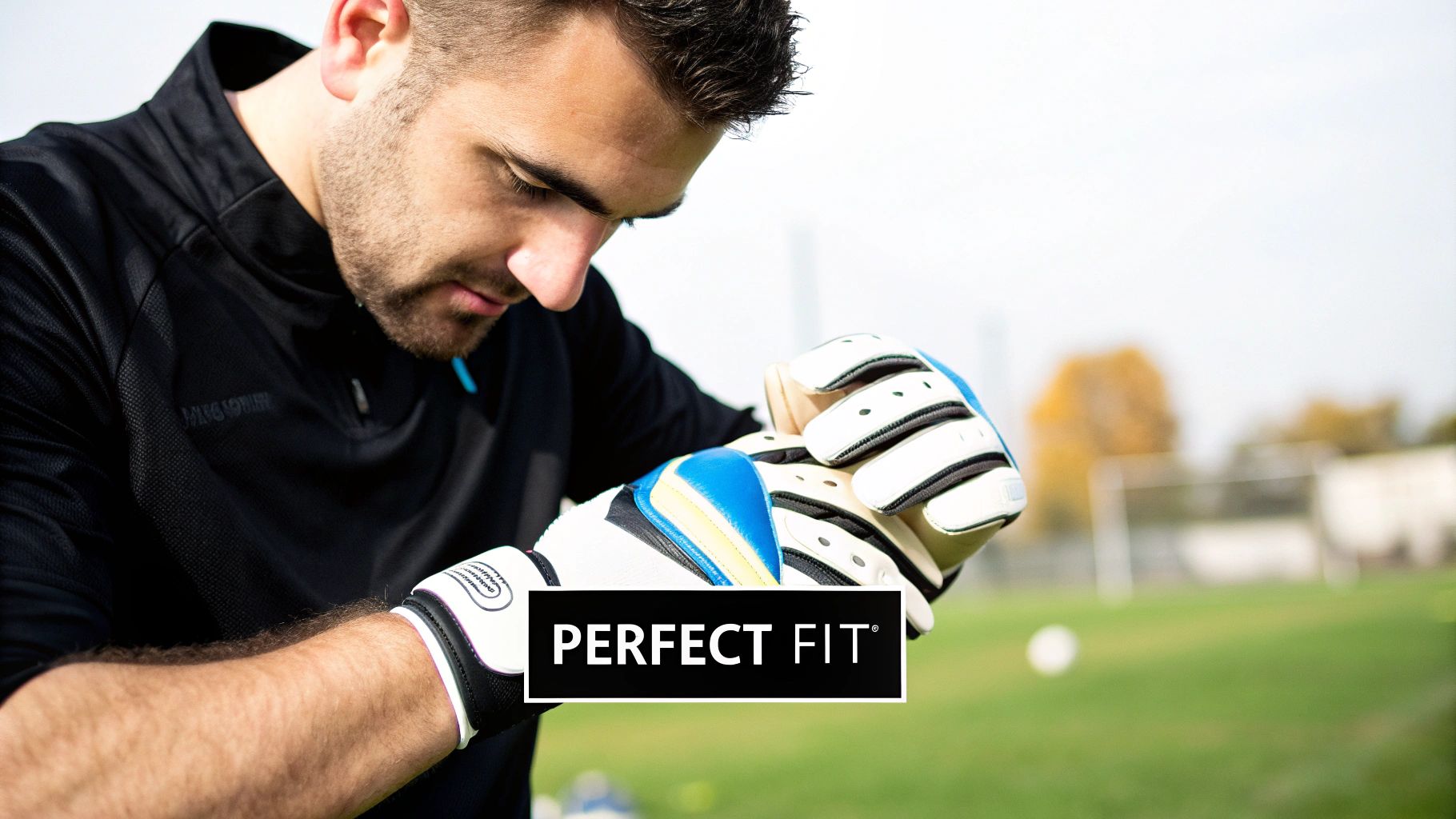
The Perfect Fit Checklist
Run through these three quick checks. If you can give a thumbs-up to all of them, you are good to go.
- Finger Space: You are looking for about a half-inch of space (that is roughly 1-2 cm) between your fingertips and the end of the glove. This little gap is your shock absorber—it stops your fingers from jamming into the tips when you pull off a world-class save.
- Palm Fit: The palm of the glove should sit flat and smooth against your own palm. If you see any baggy spots or wrinkles, the glove is probably too big. That slop will kill your feel for the ball.
- Wrist Security: Do up the wrist strap. It needs to feel snug and supportive, but not like a tourniquet. You should be able to flex your wrist without any trouble.
Caring for Your Gloves to Maintain Performance
Okay, so the fit is spot on. Step one, complete. Now for step two: looking after them. A little bit of care from day one protects your investment and keeps that crucial grip in prime condition for longer.
Straight out of the packet, new gloves are coated with chemicals from the factory. This can make the latex feel slick and almost useless. A quick pre-wash is not just a suggestion; it is essential to "wake up" the grip.
Your gloves are the most important tool in your kit bag. A simple care routine not only preserves the latex but ensures they are ready to perform at their best every single time you step onto the pitch.
Your Glove Care Routine
Get into this habit after every single game or training session. If you do not, the latex will dry out, go brittle, and lose its grip way faster than you would think.
- Pre-Wash Before First Use: Give your new gloves a gentle bath in lukewarm water. No soap needed. This simple step washes off the manufacturing residue and gets the latex ready for action.
- Wash After Every Match: A quick rinse in lukewarm water is all it takes to get the mud and sweat off. Never use harsh detergents, and do not scrub the palms—you will tear the delicate latex.
- Dry Naturally: Squeeze out the extra water (do not wring them!) and hang them up to air-dry. Keep them well away from direct sunlight or radiators. Heat is the number one enemy of latex.
Follow this simple advice, and your gloves will stay in top form. But if you have run through the checklist and something just does not feel right, do not sweat it. We are here to help you find the perfect pair from our collection of goalkeeper gloves at SoccerWares, and our straightforward returns policy makes it easy.
Common Questions About Goalkeeper Glove Sizing
Even after measuring your hands and getting your head around the different cuts, you might still have a few questions buzzing around. That is totally normal. Nailing the fit is a bit of an art, and a few common queries pop up time and again as keepers try to lock in their choice.
Think of this as the final check before you commit to your new pair. We will cover the quick-fire questions that almost everyone asks after taking their measurements.
Should My Fingers Touch the End of the Gloves?
This is probably the number one question we get, and the answer is a firm no. You should always aim for a little bit of breathing room at the top.
The sweet spot is a gap of about a quarter to a half-inch (around 1-2 cm). This space is there for two very important reasons: first, it stops your fingers from smashing into the tips of the gloves during a powerful save, which really hurts and can cause injuries. Second, it lets your hand flex and move naturally without feeling constricted, giving you way better control and comfort.
What if My Measurement Is Between Two Sizes?
Ah, the classic dilemma. Landing right between two sizes is super common. When you are stuck in the middle, the best advice is almost always to choose the larger size.
A glove that is slightly too big is much easier to manage than one that's too tight. A cramped fit can restrict your hands, mess with blood circulation, and put a ton of strain on the seams, causing them to wear out way too fast. A slightly larger glove gives your hands room to breathe, especially when you remember how different cuts can change the feel. For example, a Negative Cut in your exact size will feel a lot snugger than a Flat Palm in the same size.
When in doubt, size up. It gives you a much safer margin for comfort and performance, ensuring your gloves are working with you, not against you.
Do I Need Different Sizes for Training and Match Gloves?
Your glove size should stay the same, whether you are buying a pair for muddy training sessions or a cup final. Your hands do not change size, so your core number should not either.
That said, some keepers do like a different feel for their training gear. It is pretty common for a player to pick a more durable, and maybe slightly looser-fitting, model for the grind of daily practice. This might mean choosing a glove with a Flat Palm or Roll Finger cut for training, while saving a snugger Negative Cut pair for that perfect ball-feel on match day. The size number stays the same, but the cut you choose can tweak the fit for the occasion.
At SoccerWares, we are all about helping every goalkeeper find the perfect gear to step up their game. From fan apparel to elite training essentials, we have got you covered.
Explore our full collection and gear up for greatness at https://soccerwares.com.