

Struggling to find the back of the net consistently? We've all been there. The good news is that becoming a clinical finisher isn't about some secret trick. It’s about building your shot from the ground up, focusing on three key areas: your technical form, your mental focus, and how you practise. This guide will give you the exact blueprint to do just that.
The Blueprint for Pinpoint Shooting Accuracy
Every player dreams of being the one the team can count on to score when it matters. But that kind of ice-cold precision doesn't just happen. It's built, session by session, through deliberate and structured work. Think of it like building a house – if the foundations are weak, the whole thing will eventually come crashing down.
The journey starts by realising that shooting is a full-body movement. It’s not just a hopeful swing of the leg. It’s a chain of events: your approach to the ball, where you plant your standing foot, the strike itself, and the follow-through. Get these fundamentals right, and you build the muscle memory for instinctive, repeatable accuracy.
Deconstructing Elite Performance
The pros make it look effortless, don't they? But that "effortless" finish is the result of thousands of hours of purposeful practice. At the top level, the margins are razor-thin. In a recent Premier League season, shooting accuracy hit a record 49.9%, with Manchester City leading the pack at an incredible 57.3%. This shows that the best don't just shoot a lot; they shoot with lethal precision.
This blueprint is designed to help you build those same consistent habits by breaking down the essential pillars that support every great shot.
- Technical Form: This is your foundation. It’s all about the physical mechanics of striking the ball cleanly and on target, time after time.
- Mental Focus: This covers your composure, decision-making under pressure, and visualisation. It’s about having the belief to execute when the chance comes.
- Intelligent Practice: This is about moving beyond mindlessly kicking a ball against a wall. It’s about using drills that actually feel like real game situations.
To help you get a clearer picture of what this looks like, here’s a breakdown of the core pillars that elite strikers master.
Core Pillars of Shooting Accuracy
A summary of the foundational components required to develop elite shooting accuracy in football.
| Pillar | Key Focus | Why It Matters for Goal Scoring |
|---|---|---|
| Technical Form | Body positioning, foot placement, follow-through. | A clean, repeatable technique is the bedrock of consistency. Without it, you're just guessing. |
| Mental Focus | Composure, decision-making, visualisation. | The best chances often come under pressure. A calm mind makes the right choice and executes cleanly. |
| Intelligent Practice | Game-like scenarios, variable drills, feedback. | Practising how you play ensures your skills transfer from the training ground to a match day. |
Mastering these pillars creates a complete system for improvement.
Of course, achieving pinpoint accuracy isn't just about what you do on the pitch; it's a holistic approach that includes looking after your body. Check out some of the best athlete recovery tools to make sure you're supporting your training regimen properly.
Ready to get started? A great way to begin refining your technique on your own is with a rebounder. Take a look at our guide on using a https://soccerwares.com/blogs/our-blogs/football-rebound-wall – it’s the perfect tool for getting in those crucial reps.
Mastering the Mechanics of a Perfect Shot
A great shot is never an accident. It's the end result of a finely tuned process where every part of your body works in perfect sync. Getting these mechanics right is the absolute foundation for improving your shooting accuracy. It’s all about building a consistent, repeatable motion that you can fall back on, even when the pressure is on in the final minutes of a match.
We're going to break down the key physical components, piece by piece, from the moment you approach the ball right through to that perfect follow-through. Once you nail these individual elements, you’ll be striking the ball with a confidence that brings both power and precision.
Think of it as a simple blueprint: good form leads to sharper focus, which is then hardwired into your brain through dedicated practice.
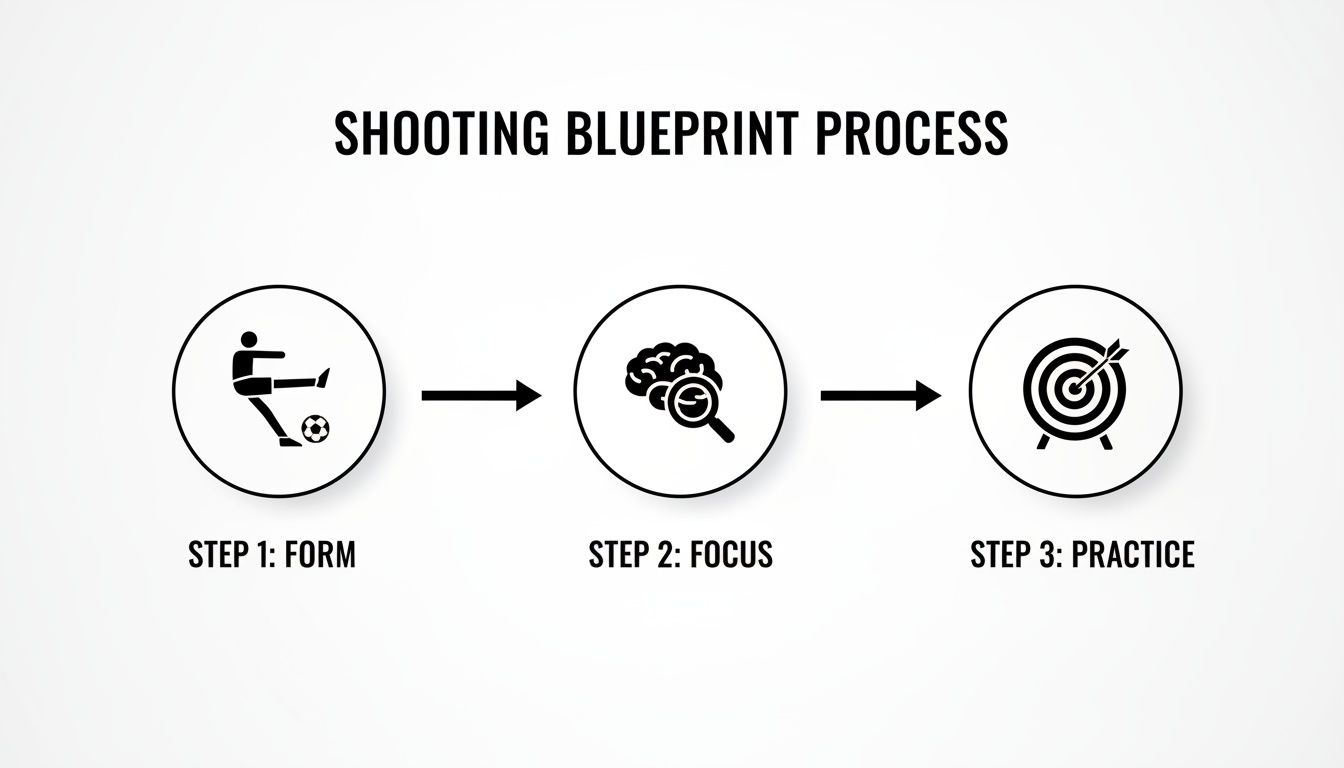
This whole sequence starts before you even think about kicking the ball.
Your Approach and Plant Foot
Everything begins with your run-up. It's what dictates the power and angle you can generate. A slight, curved approach is almost always better than running straight at the ball, as this angle naturally opens up your hips to strike it cleanly.
Your non-kicking foot, the plant foot, is your anchor. It’s the source of your balance, stability, and aiming direction. Get this wrong, and the rest of the shot falls apart.
- Placement is Crucial: Aim to plant your foot roughly shoulder-width away from the side of the ball. If you're too close, you'll feel cramped and snatch at the shot. Too far, and you’ll be overstretching, which kills your power.
- Aim with Your Toes: Your plant foot's toes should point directly where you want the ball to go. Your hips and shoulders will naturally follow that line, effectively aiming your entire body for you.
- Balance and Stability: Keep a slight bend in the knee of your plant leg. This creates a solid, stable base and helps absorb the force of the kick, keeping you balanced from start to finish.
The Strike and Body Position
Now for the main event: making contact. The secret here is generating force through a firm, controlled motion. A floppy ankle is the absolute enemy of a powerful, accurate shot.
To get that crisp, clean strike, you need to lock your ankle. Pull your toes up towards your shin, then point them down and slightly inwards just as you connect. This creates a solid, flat surface that transfers maximum power into the ball.
Your body position is just as vital for keeping the shot low and on target. Leaning back is probably the most common mistake I see, and it's a guaranteed way to send the ball sailing over the crossbar. Instead, get your chest and head right over the ball as you strike it. This downward momentum helps drive the shot forward, keeping it low and accurate.
The Follow-Through
The shot doesn't stop the second the ball leaves your foot. The follow-through is an often-neglected but absolutely critical part of the mechanic. It ensures you complete the entire range of motion, which is key to maximising both your power and your accuracy.
Let your kicking leg swing through the ball towards your target. A great mental cue is to imagine your foot is trying to land exactly where you want the ball to go. This simple thought helps guide the ball's trajectory and maintains your balance long after the strike.
Building this muscle memory is everything. Using simple bits of kit like SoccerWares Training Cones can help you create specific drills to repeat these perfect mechanics over and over, until they become pure second nature.
Progressive Drills to Sharpen Your Aim
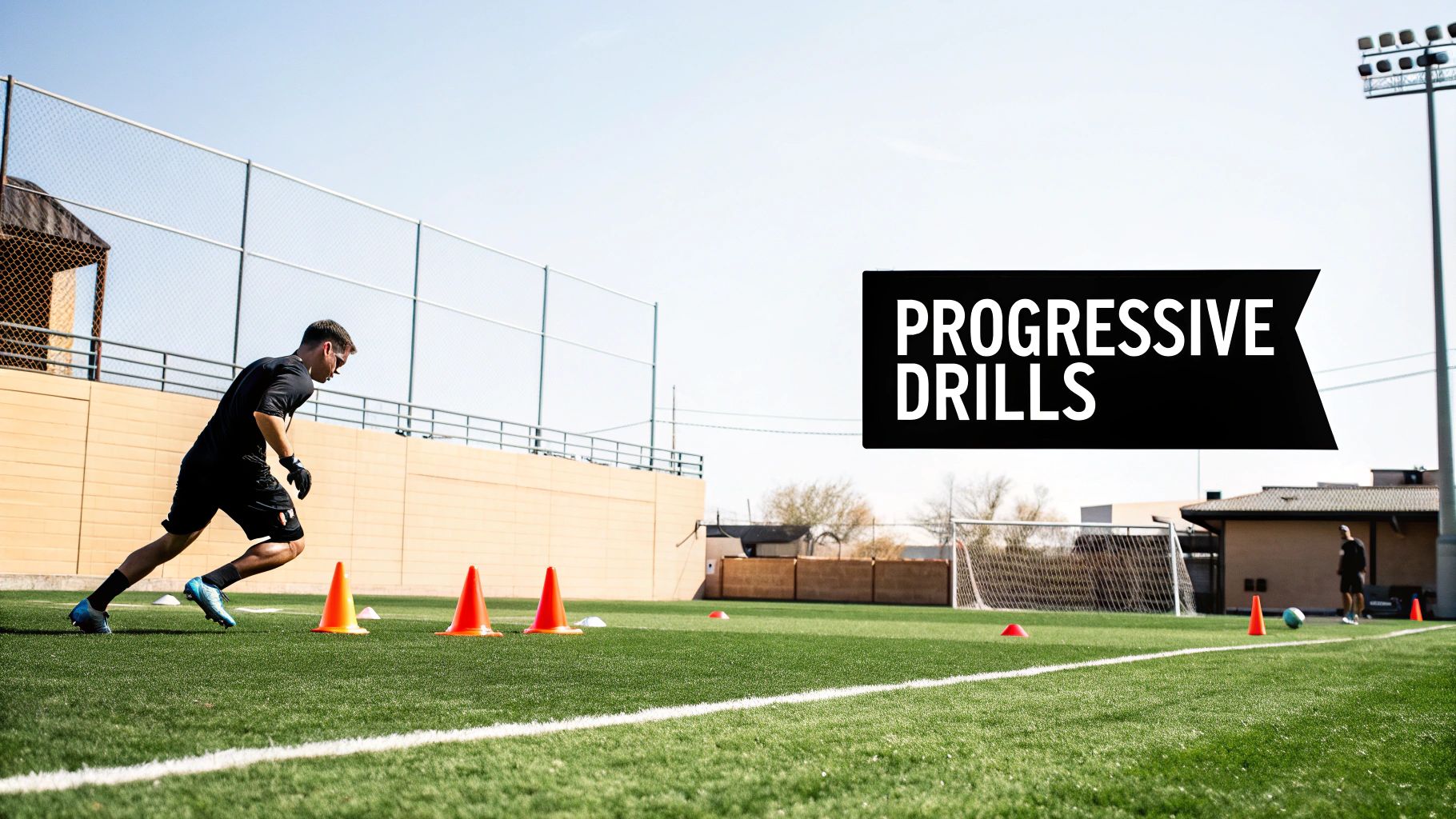
Knowing the theory behind a perfect shot is one thing, but actually delivering it time and again on the pitch? That's what separates the good from the great. Improving your shooting accuracy isn't just about endless repetition; it's about progressive overload. You have to start simple, build that crucial muscle memory, and then layer on complexity to mirror what you’ll actually face in a match.
This approach is your roadmap. It builds a rock-solid foundation before throwing you into the chaos of game-day pressure. Each drill builds on the last, taking you from a quiet, controlled practice to the split-second decisions needed to be a clinical finisher.
Start with Stationary Ball Drills
Before you can score on the run, you need to master the art of striking a dead ball. This is where you strip everything back and focus purely on technique, with no distractions. All that matters here is clean contact and finding your spot.
Set up a few balls just outside the penalty area. The task is simple: hit each ball, aiming for a specific corner of the goal. Forget about power for now. The real goal is locking in your form—the plant foot, the ankle lock, the follow-through. A great way to do this is to aim for the bottom-left corner ten times, then switch to the bottom-right.
By focusing on one target zone at a time, you're not just kicking a ball; you're programming your body to understand the exact mechanics needed to send it there. This deliberate practice is the bedrock of accuracy.
To raise the stakes, a SoccerWares Portable Goal with specific target zones gives you instant visual feedback. It turns a simple practice into a real, measurable challenge.
Advance to One-Touch Finishing
Let’s be honest, you rarely get time in a match to take a touch and set yourself up perfectly. That’s why one-touch finishing is such a deadly skill. This drill brings in movement and timing, forcing you to connect cleanly with a moving ball.
You’ll need a partner or a rebounder for this one.
- With a Partner: Ask them to stand to the side of the goal and play passes across your body. Your job is to meet the ball first-time and guide it towards the far post.
- On Your Own: A SoccerWares Rebounder is an incredible training partner here. You can fire passes into it from different angles and speeds, forcing you to constantly adjust your body shape to get a clean shot away.
This drill is brilliant for sharpening your reactions. It teaches you to get your body into the right position before the ball even arrives.
Incorporate Dribbling and Movement
Time to put it all together. This drill simulates breaking away from a defender and having to finish on the move. The challenge is maintaining close control while running at pace, taking that crucial preparatory touch, and then finding the corner.
Set up a cone about 25 yards out. Dribble from the cone towards the box, push the ball slightly ahead to set up the shot, and then strike it. The key here is to keep your head up to see the keeper’s position while still feeling the ball at your feet. For more ideas, our guide on coaching drills for football has some great exercises.
Add Defensive Pressure
This is the final test—replicating the chaos of a real game. Staying accurate when a defender is breathing down your neck is what truly defines a top striker. This drill introduces a defender to close you down, forcing you into quicker decisions and awkward shots.
Start with a teammate acting as a passive defender, just a body to get in your way. As you get more comfortable, ask them to ramp up the pressure, trying to block the shot or make a tackle. This will force you to shield the ball, be creative, and get a shot off in a tiny window. It’s the ultimate test of all the skills you’ve just worked on.
Common Shooting Mistakes and How to Fix Them
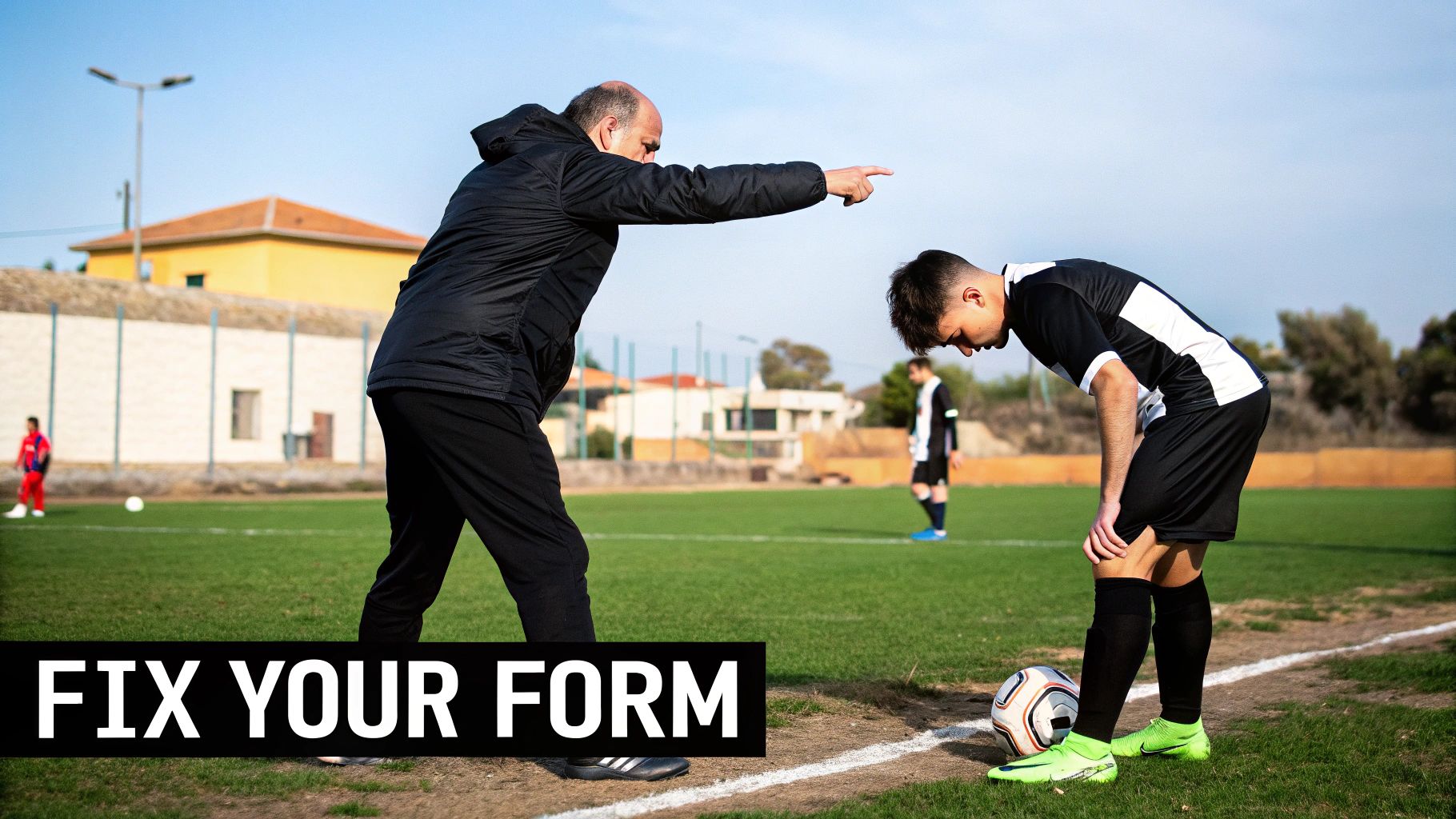
Even the best players can fall into bad habits that wreck their shooting accuracy. Spotting and stamping out these common faults is a massive step towards becoming a clinical finisher. Think of this section as your personal troubleshooting guide—it's here to help you diagnose the small errors in your technique that lead to big misses on match day.
Mastering how to improve shooting accuracy often comes down to honest self-correction. Once you understand why a shot flew wide or sailed over the bar, you can make instant adjustments. Let's break down the most frequent mistakes and give you some simple, effective fixes to get you back on target.
The Dreaded Sky Shot: Leaning Back
This is probably the most common mistake you’ll see at every level of the game. A player makes a sweet connection with the ball, only to watch it balloon harmlessly over the crossbar. The culprit is almost always the same: leaning back at the moment of impact.
When your body weight is behind the ball, you’re creating natural lift. Your body acts like a ramp; angle it backwards, and the ball has nowhere to go but up.
- The Fix: It’s simple in theory but needs practice to become a habit. You have to get your chest and head directly over the ball as you strike it. This posture forces your momentum to drive the ball forwards and downwards, keeping it low and on target. A great mental cue is to try and get your nose over your knee as you make contact.
The Floppy Ankle Problem
Ever hit a shot that feels weak or spongy, lacking that satisfying "ping" off your boot? That’s a classic symptom of a ‘floppy’ ankle. If your ankle is relaxed and unlocked, it just absorbs the impact of the shot, robbing it of both power and direction.
A firm ankle is non-negotiable for a crisp, powerful strike. It should act like a solid club, transferring every bit of your energy directly into the ball.
The Fix: Just before you shoot, consciously lock your ankle. You can do this by pointing your toes down and slightly inwards, making the joint as rigid as possible. Get used to this feeling by striking a ball against a wall, focusing only on keeping that firm ankle through the entire motion until it’s second nature.
Incorrect Plant Foot Placement
Your non-kicking foot is the rudder for your shot—it governs your balance, power, and direction. Placing it wrong is like trying to fire a cannon from a wobbly boat; the result will be unpredictable and often miles off target.
Two common errors pop up here: placing the foot too close to the ball, which cramps your swing, or planting it too far away, which forces you to stretch and lose all your power.
- The Fix: Aim to place your plant foot roughly a shoulder's width beside the ball, with your toes pointing directly at your target. This gives you a stable base and aligns your entire body with where you want the shot to go. A great way to build this habit is by using agility equipment. Working with SoccerWares Agility Ladders sharpens your footwork, making you more nimble and precise in how you set your feet before every single shot.
Developing a Scorer's Mindset Under Pressure
Perfect technique and endless drills will get you far, but they won’t score the winner in the 90th minute if your head isn't in the game. Figuring out how to improve shooting accuracy in football is as much a mental challenge as it is a physical one.
The best strikers have a unique brand of mental toughness. It allows them to stay ice-cold and execute when the pressure is boiling over.
This mental fortitude isn't something you're born with. It's a skill you can train, just like your first touch. It’s all about building composure, making smarter decisions when your legs are tired, and trusting your ability when the moment finally arrives. The first step is learning to quiet the noise and focus on the one thing that matters: putting the ball in the back of the net.
Building Composure in Front of Goal
Panic is the enemy of precision. We’ve all been there. A golden opportunity opens up, your heart rate spikes, and your instincts scream, "just hit it!" This almost always leads to a snatched shot that flies over the bar. Clinical finishers, however, have learned to slow the game down in their own minds.
To build this composure, you need to deliberately practise under simulated pressure. Instead of just shooting at an empty net, add some consequences. Tell yourself you can't finish training until you've slotted five consecutive shots into the bottom corner. This small shift adds a layer of mental pressure, training your brain to perform when there’s something on the line.
Visualisation: The Pro's Secret Weapon Before a match, or even during a quiet moment in training, close your eyes and mentally rehearse a successful shot. Picture the entire sequence in vivid detail—the pass coming to you, your first touch, the run-up, the clean connection with the ball, and the sight of the net bulging. This isn't just daydreaming; studies have shown that visualisation activates the same neural pathways as actually performing the action, building genuine confidence and muscle memory.
Developing Game Intelligence and Decision-Making
A true scorer’s mindset goes beyond just being calm; it’s about making split-second tactical decisions. Is this the moment for a thunderous strike, or is a placed, side-foot finish the smarter play? This is what coaches mean when they talk about game intelligence.
Start actively analysing the goalkeeper's positioning during your drills. Make it a habit.
- Is the keeper creeping off their line? This could be the perfect time for a cheeky chip.
- Are they favouring one side of the goal? Aim for the space they've left open at the far post.
- Is a defender rushing out to block you? A quick, low shot is often more effective than trying to blast it through them.
By consciously making these reads in practice, you're wiring your brain to spot these opportunities instinctively during a match. This is what transforms you from someone who just shoots into a calculated finisher who consistently makes the right choice to beat the keeper.
Tracking Your Progress for Measurable Improvement
How do you really know if all that hard work on the training ground is paying off? The answer is simple: data. Tracking your performance stops you from just guessing and turns your practice into a proper strategy, giving you cold, hard proof that you're getting better.
And you don't need a load of fancy gear to get started. The simplest methods are often the best. Keeping a dedicated logbook or even just a note on your phone is a powerful first step. By writing things down, you can set realistic goals, spot those annoying recurring mistakes, and keep yourself motivated.
Simple Metrics for Sharper Shooting
First off, create specific target zones in the goal. You can use cones, markers, or even just mental targets. This forces you to track not just if you hit the target, but where you hit it. This one small change instantly sharpens your focus during practice.
After each session, jot down a few basic stats. It only takes a minute.
- Shots on Target: The total number of shots that would have made the keeper work.
- Total Shots Taken: A simple count of every single attempt you made.
- Accuracy Percentage: A quick calculation – (Shots on Target ÷ Total Shots) x 100.
- Target Zone Success: Make a note of how often you hit specific spots, like the bottom-left corner versus the top-right. This is gold for finding your strengths and weaknesses.
This data-driven approach is key to understanding how to improve shooting accuracy in football because it shows you patterns you'd definitely miss otherwise.
Using Technology to Your Advantage
While a pen and paper work wonders, modern tech can give you a much deeper layer of insight. Some of the latest gear provides instant feedback you just can't get with the naked eye. For a closer look, you can check out our detailed review of smart footballs to see how they measure things like shot speed and spin.
By putting numbers to your practice, you create a feedback loop. You see the stats, tweak your technique, and then watch the stats improve. This process doesn't just build skill—it builds an unshakable confidence in your ability.
If you're really serious about finding out where you stand and what to work on, you might look into more advanced methods like custom performance testing. These assessments offer a personalised breakdown of your game, making sure every drill you do is aimed at turning you into a more clinical finisher.
Burning Questions on Shooting Accuracy Answered
To wrap things up, let's tackle some of the most common questions players have when they get serious about hitting the back of the net more often. Getting these right can clear up a lot of confusion and keep you focused on what really works.
Here are the queries we hear all the time from players determined to become more clinical finishers.
How Long Does It Take to See Real Improvement?
This is the big one, and the honest answer is: it depends. But with consistent, focused practice, you will see results. Stick to 2-3 dedicated sessions per week that target specific mechanics and drills, and most players start to feel a real difference in their accuracy and confidence within 4-6 weeks.
The key isn't just blasting balls at a goal for hours. It’s about quality over quantity. Every single shot you take in training needs to have a purpose.
Should I Focus on Power or Accuracy First?
Accuracy. Always, always accuracy. Power without direction is just wasted energy that sends the ball into the car park. It’s a classic mistake to try and leather the ball before you can actually guide it.
First, master the technique for an accurate shot. Concentrate on your body shape, that locked ankle we talked about, and a clean follow-through. This builds a reliable, repeatable foundation. Power will come naturally as your technique becomes more efficient and you start striking the centre of the ball cleanly, time after time.
What Is the Best Way to Practise Shooting Alone?
Solo practice is fantastic for sharpening your skills without any distractions. One of the best methods is simply using a wall or a proper rebounder, which is brilliant for working on your first touch and shooting in one fluid motion.
A simple solo drill? Set up targets inside the goal with cones. Aim for the bottom-left corner ten times, then switch to the top-right. This kind of focused repetition is what builds muscle memory for precision, turning a basic solo session into a seriously productive one.
Also, don't underestimate your phone. Propping it up to film yourself can give you priceless feedback on your form.
Do My Football Boots Really Affect My Shooting?
While your technique is easily the most critical factor, the right boots can play a supporting role. Some of the newer boot designs feature a really clean striking zone, which can give you a more consistent contact surface on the ball.
However, the single most important thing is a snug, comfortable fit that lets you feel the ball properly. No bit of kit will ever make up for poor fundamentals. Master your technique first, and think of your boots as a tool to complement your skill, not create it.
At SoccerWares, we're passionate about helping players at every level find their edge. From top-tier rebounders to precision training markers, our gear is designed to support your journey to becoming a more clinical finisher. Explore our full range of training essentials at https://soccerwares.com and start turning that hard work into goals.