
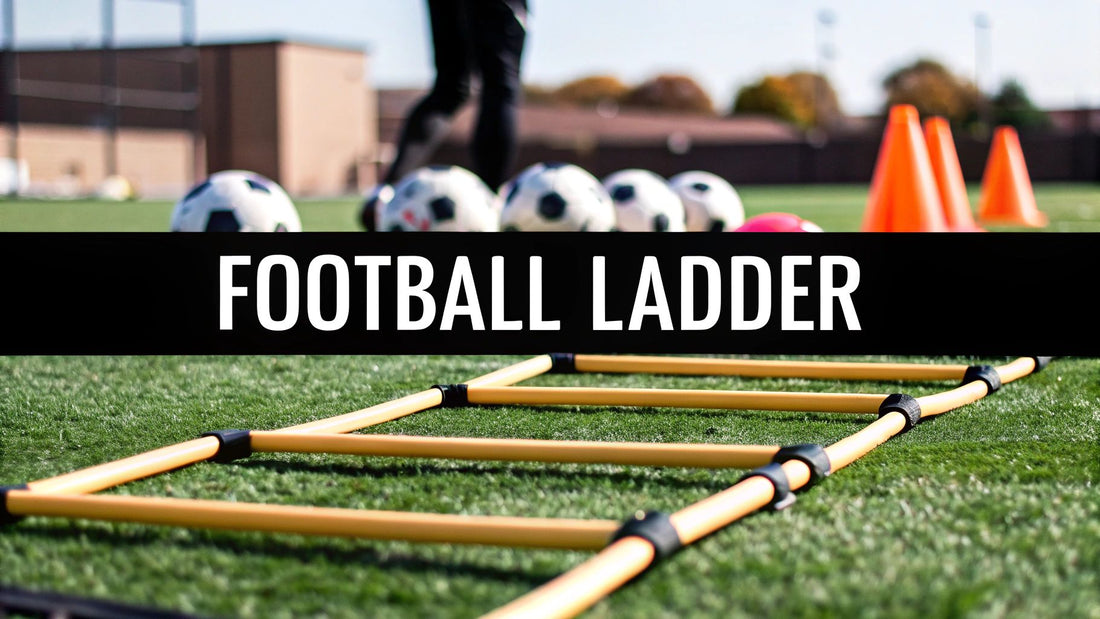
A ladder for football is a deceptively simple piece of kit. It is just two long straps connected by flat rungs, laid out on the grass. But think of it as a cheat sheet for your feet—it’s designed to teach them the rapid, precise, and explosive movements that are absolutely essential on the pitch.
Why a Ladder for Football Is Your Secret Weapon
An agility ladder might not look like much, but its impact on a player's performance is massive. It’s not just about running through squares as fast as you can; it’s about fundamentally rewiring the connection between your brain and your feet.
This process is all about improving what experts call neuromuscular efficiency. In simple terms, you're training your body to fire the right muscles in a split-second, controlled sequence. The constant repetition builds muscle memory, letting your feet move almost instinctively without you having to consciously think about every single step.
Translating Drills to Game-Day Dominance
Picture a chaotic midfield. An opponent makes a clumsy tackle, and the ball pops loose. The player who reacts first—taking that quick, balanced step to snatch the ball and explode away—wins the moment. That’s exactly what ladder training prepares you for. It isn’t about rehearsing a specific play, but about building the athletic foundation to execute any play faster and more efficiently than the opposition.
An agility ladder is like learning the alphabet of movement. Once you master the letters (the individual steps and patterns), you can form words (like dodging a tackle) and then build entire sentences (dribbling past multiple defenders).
The benefits aren’t just physical, either. Consistent ladder work sharpens your mental focus and concentration. Each drill demands your full attention to avoid tripping, forcing you to stay present and precise—a skill that’s invaluable during high-pressure moments in a match.
Core Benefits of Agility Ladder Training
To really understand why a ladder for football is a non-negotiable for any serious player, let's break down the main advantages. The table below shows how this simple piece of equipment translates directly into on-pitch success.
| Benefit Area | Description of Improvement | On-Pitch Application |
|---|---|---|
| Agility | Enhances your ability to accelerate, decelerate, and change direction swiftly without losing balance or speed. | Evading a defender's challenge, quickly tracking back to defend, or making sharp cuts to find open space. |
| Footwork & Speed | Develops rapid foot strikes and a shorter ground contact time, leading to explosive first steps and overall quickness. | Beating an opponent to a loose ball, accelerating past the backline, or making rapid adjustments to control a pass. |
| Coordination | Improves the synergy between your mind, eyes, and feet, allowing for more fluid and controlled body movements. | Dribbling at high speed, maintaining balance while shooting under pressure, or executing complex skill moves. |
| Injury Prevention | Strengthens key joints, ligaments, and tendons in the lower body, improving stability and reducing the risk of common injuries. | Landing safely after a jump, stabilising your knee during a sharp turn, or absorbing the impact of a tackle. |
Ultimately, it’s about making your body smarter, stronger, and quicker. Every drill you complete on the ladder is another step towards becoming a more dominant and resilient player on the field.
How to Choose the Right Football Ladder
Picking the right agility ladder isn't just about grabbing the longest or cheapest one you can find. The ladder you choose has a direct impact on how effective your training is, so it pays to understand the differences, whether you're a Sunday league hopeful or a seasoned pro.
Your first big decision comes down to fixed-rung vs. adjustable-rung ladders.
Fixed-rung models are brilliant for beginners and youth players. The rungs are stitched in place, so the spacing is always consistent. This is a massive help for building foundational muscle memory and quick-foot coordination without any fuss during setup.
Adjustable-rung ladders, on the other hand, are the go-to for more experienced athletes. Being able to slide the rungs closer together or further apart lets you completely customise the challenge. You can shrink the gaps for lightning-fast, high-frequency footwork, or widen them to work on longer, more explosive strides.
Materials and Durability Matter
The build quality of a football ladder is just as important as whether the rungs move. A good quality ladder will have tough nylon straps that can take a beating on grass, turf, or even concrete without fraying. Cheaper versions often use materials that will stretch or snap after a few hard sessions.
But the most critical part? The rungs themselves. For safety and performance, always go for flat plastic rungs.
- Flat rungs sit flush with the ground, which drastically cuts the risk of tripping or rolling an ankle if you catch one by mistake.
- Round rungs can move and roll under your boots, creating a horribly unstable surface that’s just an injury waiting to happen.
Think of it like choosing your boots; the right fit and material make all the difference. A well-made ladder with flat rungs and durable nylon straps is a proper long-term investment in your safety and your development.
This decision tree gives you a simple way to think about what you want to achieve with your ladder training.
As the graphic shows, whether you’re aiming for quicker reactions off the mark, sharper turns to wrong-foot a defender, or pure explosive speed, the ladder is a tool that can help you get there.
Finding the Perfect Length
Ladder length is another key factor to consider. It’s tempting to think that longer is always better, but it really depends on what you will be using it for.
Shorter ladders, usually around 4-5 metres, are perfect for younger players or for drills that focus on short, sharp, explosive movements. They're also much easier to pack up and carry to the park.
Longer ladders of 8-10 metres are better for more advanced players or full team sessions. They give you the space to string together more complex patterns and run drills with multiple players at once without constantly having to reset.
Whether you're after a simple ladder for the back garden or a professional-grade one for your club, you can check out our collection of premium football ladders to find the right fit for your goals.
Getting Started with Foundational Ladder Drills
Got your ladder? Great. Now it’s time to turn that piece of kit into a tool for building serious speed and coordination. The secret isn't learning dozens of complicated drills; it's about mastering a few core movements that teach your feet the patterns needed to dominate on the pitch.
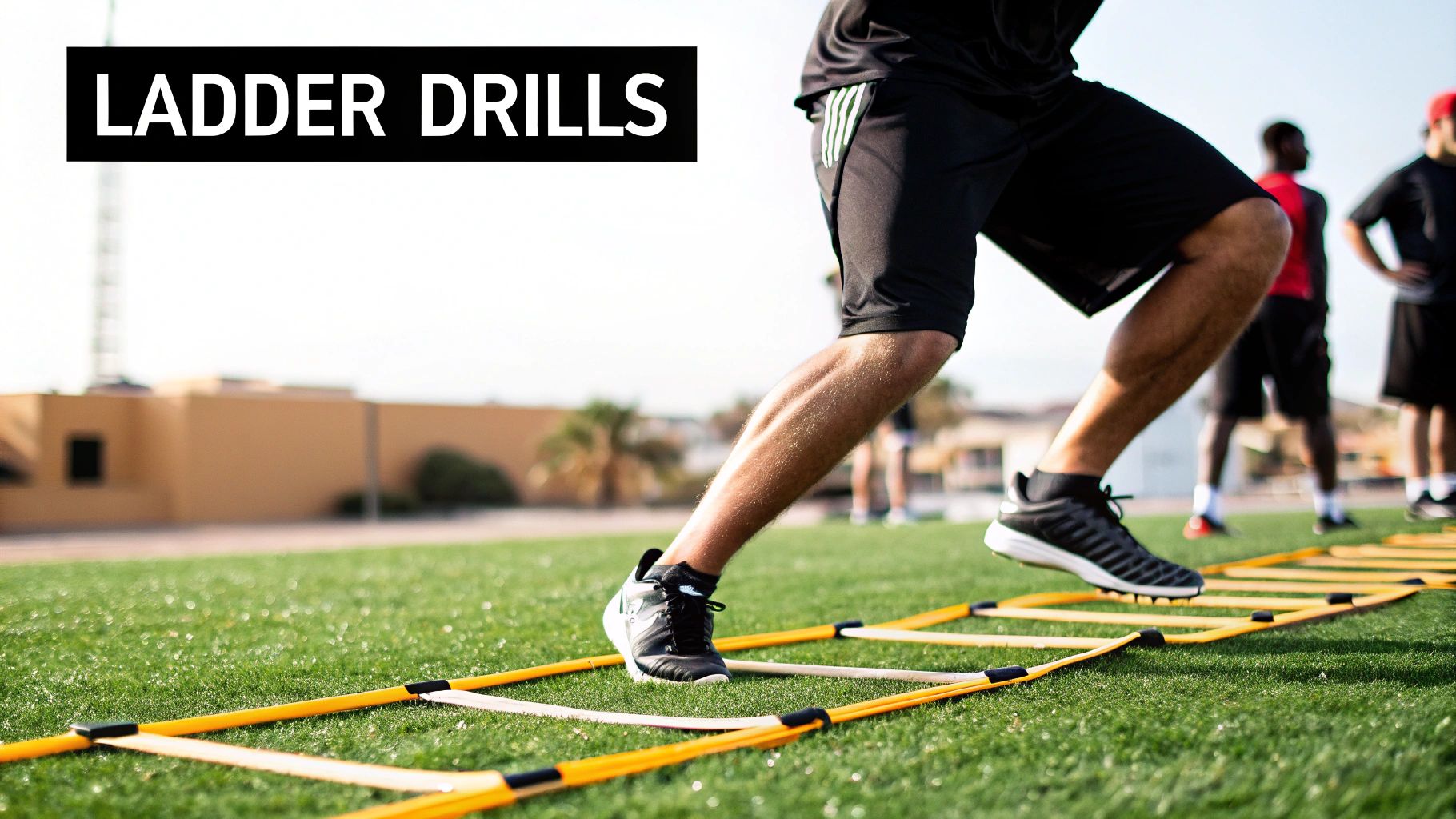
We're going to break down some of the most effective drills to get you started. One golden rule before we begin: focus on quality over speed at first. Crisp, clean footwork is far more valuable than rushing through with sloppy form. Speed will come naturally once the patterns are locked in.
The Linear Run
This is the bread and butter of ladder drills and the perfect place to start. It builds the basic rhythm and foot-eye coordination that all other exercises are built upon.
- How to do it: Face the ladder and simply run forwards, making sure to place one foot in each square. The key is to stay light on the balls of your feet and drive your knees up.
- On-pitch advantage: Think about sprinting onto a through ball or tracking back to defend. This drill directly improves your straight-line acceleration and cleans up your running form.
- Common mistake: Leaning too far back or letting your heels smack the ground. You want to stay on your toes with a slight forward lean, ready to explode.
The Lateral Stepper
Every footballer needs to be quick side-to-side, and this drill is essential for building that lateral agility.
- How to do it: Stand sideways to the ladder. Step into the first square with your lead foot, and then bring your trail foot to join it. Keep repeating this "step-together" pattern down the ladder. Both feet must touch inside each square before you move to the next.
- On-pitch advantage: This is the exact footwork you use for defensive jockeying. It lets you stay in front of an attacker without crossing your feet and losing your balance. Absolutely vital for full-backs and midfielders.
- Common mistake: Crossing your feet over. The whole point is to keep a wide, stable base, just as you would when defending a tricky winger.
The key to effective ladder training isn't just speed; it's precision. Each step is a repetition that trains your brain to fire your muscles in the correct sequence. Slow down, get it right, and the speed will follow naturally.
The Ickey Shuffle
Named after the famous American football player Elbert "Ickey" Woods, this is a classic for a reason. It's a cornerstone drill for building dynamic, multi-directional footwork.
- Start: Stand just to one side of the ladder.
- Step In: Step into the first square with your inside foot, followed immediately by your outside foot.
- Step Out: Pop your inside foot out of the square, placing it on the other side of the ladder.
- Repeat: Your outside foot follows, landing next to it, and you’re perfectly set up to repeat the pattern into the next square.
That quick three-step rhythm (in-in-out) is incredible for developing coordination and balance while on the move.
- On-pitch advantage: The Ickey Shuffle is a direct translation of the footwork needed to evade tackles. It teaches you to rapidly shift your body weight and change direction, leaving defenders flat-footed.
- Common mistake: Looking down at your feet! In a match, you’d get tackled instantly. Keep your eyes up and chest forward the entire time. Use your arms to drive momentum and keep your balance, just as you would when running. It’s a crucial habit to build.
Advancing Your Drills for Peak Performance
Once you have nailed the basic footwork patterns, the real fun begins. It's time to start layering in challenges that actually feel like a proper football match, moving beyond simple repetition. The goal is no longer just about having fast feet; it's about developing a fast football brain.
This is all about simulating game-day pressure. Just going through the motions faster isn't going to cut it. You need to train your body to execute perfect technique while your mind is already thinking about the next pass, tackle, or run. That's what separates good players from truly great ones.
Introducing the Football
The most obvious—and effective—way to level up your ladder drills is to bring a football into the mix. This completely changes the dynamic, forcing you to keep your coordination and balance while staying in control of the ball.
Here are a few ways to add the ball to your training:
- Dribbling Alongside: Try a lateral shuffle through the ladder while dribbling a ball on the outside. This is brilliant for training you to keep your head up and use your peripheral vision to control the ball.
- Receive and Pass: Get a partner or a rebounder set up at the end of the ladder. As you pop out of the final rung, receive a pass, kill it with a perfect first touch, and play the ball straight back.
- Weaving Drills: This one demands real precision. Weave the ball in and out of the ladder rungs as you move through, forcing you into tight, close-control dribbling at pace.
These drills are designed to build that crucial link between moving your feet into position and then immediately performing a technical action with the ball. To really build that explosive power, you can also mix in some plyometric exercises which will seriously boost your agility and raw speed off the mark.
Adding Cognitive Challenges
Elite footballers react; they don’t just move. By adding cognitive challenges to your drills, you're forcing your brain to think and adapt on the fly, which is essential for developing real on-pitch intelligence.
Adding a cognitive load to your ladder drills bridges the gap between training ground exercises and actual match performance. You are conditioning your brain to make smart, quick decisions under physical stress.
A simple way to do this is with coloured cones. As you're running through a drill, have a coach or teammate hold up a cone. Your job is to react instantly by sprinting to the matching cone placed at the end of the ladder. This is a fantastic way to sharpen your reaction time and decision-making.
This level of preparation is vital. For example, when Preston North End went through the inaugural 1888-89 Football League season unbeaten, they became "The Invincibles" not just through skill, but through superior conditioning that let them think and react quicker than anyone else.
Building a Complete Agility Training Circuit
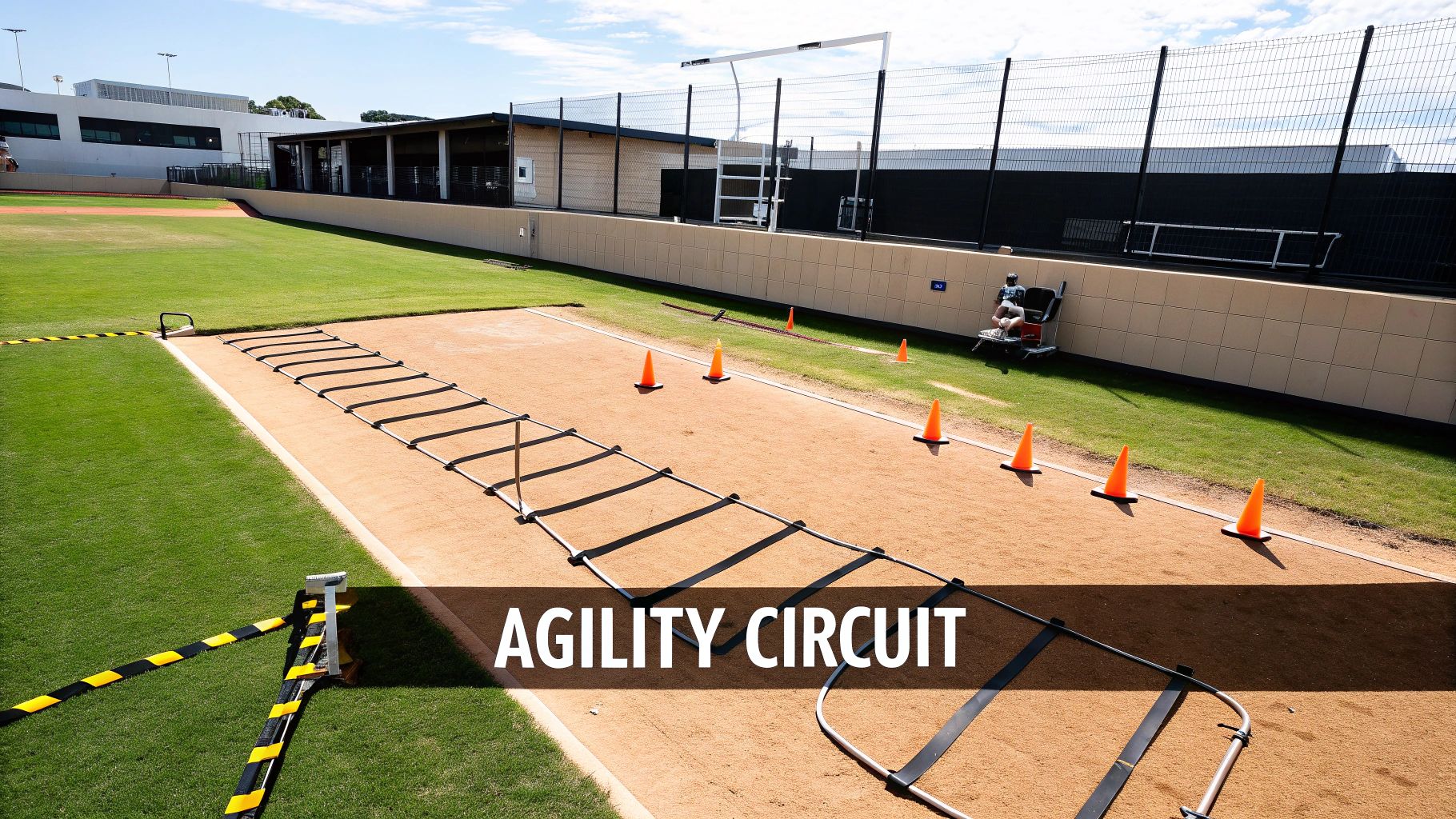
An agility ladder is a fantastic bit of kit on its own, but its real power is unlocked when you make it the centrepiece of a full training circuit. Football isn't played in straight lines. It’s a chaotic mix of sprinting, braking, turning sharply, and reacting in a split second. By building a circuit, you start to replicate that organised chaos.
The goal here is to move past isolated footwork drills and create scenarios that feel like a real match. This means pulling in different pieces of equipment to challenge your agility, technical skill, and decision-making all at once. It’s about making your training as game-realistic as possible.
Combining Ladders with Other Equipment
Think of the ladder as your starting block. Once you nail a footwork pattern, what happens next? In a game, you don't just stop. You explode into a sprint, change direction, or bring a ball under control. This is where adding other gear becomes so important.
-
Ladders and Cones: Set up a series of cones in a zig-zag pattern about five metres from the end of your ladder. After flying through a drill, burst out of the final rung and weave through the cones. This combination is brilliant for mimicking a run where you beat a defender and then have to swerve to avoid another.
-
Ladders and Rebounders: Pop a rebounder a few metres from the ladder’s exit. As soon as you finish your footwork, have a partner fizz a pass into you to control and play back against the rebounder. This is excellent for training your first touch and passing accuracy while your heart is pounding and you're breathing heavily—a classic match-day scenario.
Measuring and Optimising Performance
Modern technology can take your circuit training to the next level. Using a GPS tracker during these drills gives you incredible data on your actual performance. You can measure your peak speed, see how explosive your acceleration is, and track your total distance covered. This provides hard numbers to track your improvement over time.
This kind of objective feedback tells you if you’re keeping the intensity high throughout the session or if your performance is dropping off. It turns a standard drill into a proper, measurable test of your physical output.
Integrating various training tools transforms a simple agility ladder drill into a comprehensive, match-specific simulation. You're not just training your feet anymore; you're training to become a more complete footballer.
The English football pyramid demands this kind of competitive sharpness. Reading FC's Championship record of 106 points in the 2005-06 season highlights the brutal consistency needed to succeed. Such achievements are built on optimised training that prepares players for relentless campaigns.
Building these circuits is a powerful way to get your body and mind ready for the game's unpredictable nature. For more ideas on what to include, check out our guide on the football training equipment every coach needs.
Common Questions About Football Ladders
Even with a solid grasp of the benefits and drills, it's normal to have a few practical questions before committing to ladder training. Getting these details right is key to using this fantastic tool safely and effectively.
Let's tackle some of the most common queries we hear from players, parents, and coaches, with clear, to-the-point answers.
How Often Should I Use an Agility Ladder?
For the best results, you should aim to weave ladder drills into your training schedule about 2-3 times per week. They’re brilliant as part of a dynamic warm-up to get your nervous system firing before a match, or as the main event in a dedicated speed and agility session.
Think quality, not quantity. Keep your sessions short but sharp—around 10-15 minutes is the sweet spot. This ensures every single step is crisp and explosive. Remember, you're training for neuromuscular precision, not just running yourself into the ground. Once fatigue sets in, form gets sloppy, and that's when bad habits can creep in.
The point of ladder work is to teach your feet to be quick, precise, and automatic. A few minutes of focused, high-quality work is far more valuable than a long session where you're just going through the motions.
What Is the Right Age to Start Ladder Training?
Young players can start having fun with agility ladders from as early as age 6 or 7. At this stage, it’s all about play. The goal is to develop basic coordination and learn fundamental movements through games and playful activities, not intense drills.
As athletes get older and hit their teens, the training can become more structured and targeted. Drills can be designed to specifically improve athletic speed, footwork for tight spaces, and the complex movements needed to excel in football. This natural progression means the ladder remains a relevant and challenging tool throughout a player's development journey.
Can I Use a Football Ladder on Any Surface?
Yes. One of the best things about a football ladder is its versatility. You can roll it out on almost any flat surface, which makes it perfect for training all year round, regardless of the weather.
- Grass and Artificial Turf: This is where ladders feel most at home, as it’s the surface you play on.
- Indoor Gym Floors: Works perfectly on wood or rubberised floors, letting you get a session in when it's raining outside.
- Pavement or Concrete: While not ideal for drills that involve diving or changing direction at full speed, you can certainly use a ladder on hard surfaces for basic footwork patterns.
A quick safety tip for indoor use: make sure the floor isn't too slick. If you find the ladder sliding around during intense drills, just place a couple of small weights on the ends or ask a teammate to hold it steady.
Ready to unlock your full potential on the pitch? The right equipment makes all the difference. Explore the premium training gear at SoccerWares and find the perfect agility ladder and other essentials to take your game to the next level.