

A child needs a new hoodie, the weather has turned properly British, and you're standing in a checkout queue with two Manchester United options open on your phone. One says 9–10, the other says YL, and your ten-year-old has grown so quickly that last month's jumper already looks borrowed. The crest is easy to choose. The size is where the trouble starts.
A Manchester United hoodie for youth should be warm enough for school, comfortable enough for the sofa, and durable enough for mud, toast crumbs and weekly washing. The right purchase depends less on the newest badge or launch colour and more on fit, fabric, construction and intended use. Start by identifying the hoodie type, measure the child properly, then choose deliberate growth room without buying something they'll swim in.
Why Buying a Man Utd Youth Hoodie Feels Harder Than It Should
Youth clothing labels aren't standardised enough to trust on their own. One retailer may use an age band, another a lettered junior size, and another may place children's, juniors' and small adult garments close together. The official Manchester United UK store itself presents children's fashion as a broad category containing hoodies, shirts, shorts, socks and other fanwear, so a quick search can turn into a comparison of several different cuts rather than one simple size choice. The club's UK kids' fashion range reflects how wide that junior merchandise ecosystem has become.
The label is only a starting point. A child who is tall and narrow may need a different choice from a shorter child with a broader chest, even when both are the same age. A hoodie intended for a school layer also needs a different fit from one worn over a football shirt at a cold match.
The three checks that prevent most mistakes
- Identify the garment first. Is it a soft pullover for everyday wear, a zip-up for layering, or a training-style piece with a closer cut? Don't compare the size label until you know what the hoodie is designed to do.
- Measure the child, not an old label. Chest and height give you more useful information than an age printed on a product page. Measure in light clothing, with the child standing naturally.
- Add room with a purpose. A little extra space makes sense for school layering and a growing child. Excess fabric at the shoulders, sleeves and hem doesn't create useful longevity. It creates a hoodie that catches on everything and gets abandoned.
Practical rule: Choose the size that accommodates the child's measurements and the layer underneath, not the size that sounds safest because it's older.
The UK store describes its kids' hoodies for both relaxed wear and training, including use at home and on the pitch. That everyday and training positioning is useful because it confirms the central buying question: where will this hoodie be worn? Once you answer that, the size label becomes much easier to interpret.
Official Inspired and Replica Youth Hoodies Explained
A red hoodie can look like Manchester United gear without being official merchandise. That distinction matters when you are paying for club identity, checking construction, or choosing a layer for school, training, and cold matchdays. Official, inspired, and replica describe different products, not interchangeable labels.
An official hoodie is licensed Manchester United merchandise with approved club branding. The UK range includes children's styles such as the Kids MUFC Overhead Hoodie Grey, listed at £42, and the Kids Z.N.E. Full-Zip Hoodie Purple, which appears at £20 and £16 during sale cycles. The official hoodie category also shows reductions of 30%, 60% and 70%, depending on the product and retail cycle. Check the actual product page before treating a sale price as permanent.
An inspired hoodie uses Manchester United's general colour palette or football heritage without claiming to be licensed club merchandise. It suits a child who wants a red football-style layer for casual wear and does not need the exact current club design. Read the description carefully. If the seller does not call the item official, assume the crest, badge, or design is not authorised.
A replica or training hoodie sits closer to performance football clothing. It is a sensible choice for a child heading to training or matchdays, especially if they prefer a lighter, closer-fitting layer. That cut may be awkward over a school shirt or bulky jumper, so do not buy it for winter layering unless the product description supports that use.
| Category | Typical Price | Badge Type | Best For |
|---|---|---|---|
| Official | Varies by model and sale cycle | Licensed Manchester United branding | Supporters who want recognised club merchandise |
| Inspired | Varies by retailer and design | Football-inspired branding or references | Casual wear and flexible styling |
| Replica or training | Varies by model and retailer | Performance-focused club or football branding | Training, matchdays and active use |
The Manchester United x adidas youth listing calls the garment a juniors' football hoodie and refers to the club's red, white and black tricolour on the adidas Badge of Sport. That product description demonstrates the product detail parents should expect, including the garment's football positioning and club connection.
My recommendation is simple. Buy official when the badge and licensed identity matter. Choose inspired for a flexible everyday layer. Choose replica or training only when the child will move in it. Do not pay for performance features that will sit unused, and do not mistake a club-coloured hoodie for official merchandise.
How to Read a Manchester United Youth Size Chart
Ignore the age label until you've checked chest and height. Those measurements tell you whether the hoodie will sit properly now, while the garment description tells you whether its cut allows room for another layer.
Measure in two minutes
Measure height barefoot, with the child standing against a wall and looking straight ahead. Mark the top of the head lightly, then measure from the floor to the mark. Don't let the child stand on tiptoe or slump, because either mistake can push you towards the wrong band.
For chest, place the tape around the fullest part of the chest, keeping it level and comfortably close to the body. The child should breathe normally. Don't pull the tape tight, and don't measure over a thick jumper. The purpose is to establish the body measurement before you account for the hoodie's shape.
| Age | Chest | Height |
|---|---|---|
| Younger children | Check the retailer's current centimetre chart | Check the retailer's current height band |
| Primary-school sizes | Match the child's chest and height to the product chart | Prioritise the stated height range |
| Older children and juniors | Compare the chart with the garment's fit description | Check whether the size bridges into adult sizing |
| Lettered youth sizes | Never assume YS, YM or YL means the same thing across brands | Use measurements rather than the letter alone |
This is deliberately less tidy than a universal chart because there isn't one reliable system across every Manchester United hoodie seller. Product pages can use overlapping age and junior labels, while fit descriptions such as standard, loose or oversized change how much usable room the child gets. The official product listing for the MU Youth MUFC Overhead Hoodie Burgundy is a useful reminder to check the individual garment page rather than relying on a general search result. Review the product-specific sizing information before ordering.
Growth room needs a limit
If the child is between sizes, decide what the hoodie must accommodate. A school hoodie worn over a T-shirt can have modest extra room. A winter layer worn over a football shirt may need more space across the chest and arms. Look for a shoulder seam that sits near the shoulder, sleeves that reach the wrist without covering the hand, and a hem that doesn't hang so low that it restricts movement.
Wash care matters too. Cotton-rich fabrics may change shape if washed aggressively, so a size that is already tight leaves no useful margin. Check the brand's own chart every time because Nike, adidas and club-store cuts can differ even when the age label looks similar. For a broader visual reference, compare the garment with this hoodie sizing chart, then return to the specific Manchester United product page for the final decision.
Cotton Polyester and the Blends That Actually Matter
Fabric choice decides whether a youth hoodie becomes the reliable one by the front door or the one that feels wrong after its first wash. The useful question isn't whether cotton or polyester is universally better. It's whether the fabric suits the child's routine.
A 100% cotton hoodie usually feels soft and breathable against the skin. The official Manchester United juniors' range includes a hoodie listed as 100% cotton, a clear specification rather than vague wording such as “premium feel”. That official material listing gives parents something concrete to assess, although the care label still determines how to wash it.
Cotton-rich fleece is my default for school, weekends and watching football. A brushed inner feels warmer, while French terry gives a lighter, less bulky layer. The trade-off is that cotton needs sensible washing and can be less forgiving of high heat than a synthetic performance knit.
Choose the construction before the colour
- Cotton-rich fleece: Best for everyday warmth and comfort. Look for a smooth outer face, a soft inner and cuffs that recover after stretching.
- French terry: Useful for milder days or children who dislike heavy fleece. It gives a more breathable feel and works well under a coat.
- Poly-cotton blend: A practical compromise for school weeks and matchdays. Polyester can help the garment dry faster and hold its shape, while cotton keeps the next-to-skin feel more comfortable.
- Technical polyester knit: Choose this for genuine training use, not because the label sounds advanced. It can feel light and dry quickly, but some children dislike the synthetic feel and it may hold odour if it isn't washed promptly.
UK listings show both 100% cotton French terry and cotton-poly constructions such as 60% cotton and 40% polyester, giving buyers a real choice between comfort-focused and durability-focused fabrics. This material comparison is more useful than guessing from photographs.
Don't obsess over fabric weight while ignoring the seams. Ribbed cuffs, a secure hem, reinforced pocket corners and clean double stitching usually matter more to a child's day-to-day experience than a marketing phrase about premium fabric. For a practical quality reference, use these apparel quality standards when comparing construction details.
My short rule is simple: cotton-rich for the playground, a blend for relentless school use, and technical knit only when the child trains in it.
Care Instructions That Survive a British Wash Cycle
A children's hoodie rarely gets the gentle treatment shown in a product photograph. It meets grass, ketchup, wet pavements and the inside of a football bag. The best care routine is simple enough to follow on a busy evening.
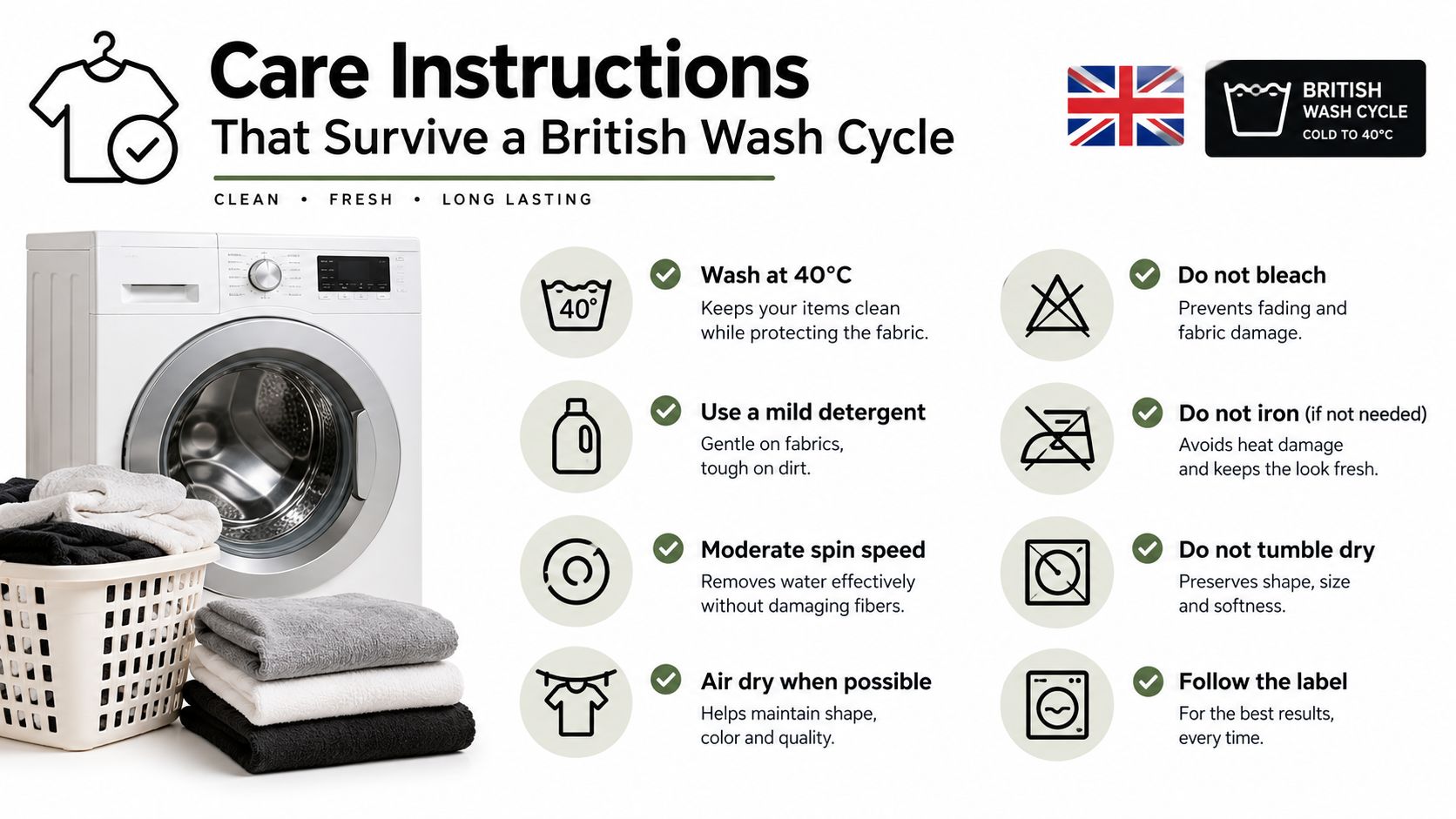
Wash at 30°C when the care label allows it. Turn printed and embroidered hoodies inside out before washing, use a non-bio detergent if that suits your household, and keep fabric softener away from technical finishes and printed areas. Softener can leave a coating that affects the feel of performance fabrics and may reduce the clean definition of logos over time.
Treat the stain, not the whole garment
Grass needs prompt attention before it dries into the fibres. Mud should dry first, then be brushed away before washing. Ketchup and food stains respond better to a small amount of suitable detergent worked gently into the mark than to repeated hot washes.
Tumble drying is the shortcut most likely to punish a cotton hoodie. Use a low setting only when the care label permits it, and air-dry when you want to protect the fit and printed details. While the hoodie is damp, reshape the cuffs, hood and hem by hand rather than pulling them once dry.
Never iron directly over a print. Place a cloth between the iron and the garment if ironing is allowed, and follow the care label for embroidered sections. The safest routine is covered in this guide to how to wash hoodies.
Print this list and keep it near the washing machine:
- Before washing: Turn the hoodie inside out and check pockets.
- Detergent: Use a suitable non-bio detergent and skip fabric softener.
- Temperature: Select 30°C when permitted by the care label.
- Drying: Air-dry where possible, away from direct heat.
- Finishing: Reshape cuffs and the hood while damp.
- Ironing: Never place heat directly on printed branding.
Matching Hoodie Type to Age and Use Case
A child's routine matters more than the club badge. The same Manchester United hoodie can be a sensible buy for a matchgoing teenager and a poor choice for a younger child who needs quick changes, easy layering and freedom to climb.
Toddlers, roughly 2–4, generally get more use from a lightweight cotton-rich zip-up. A full opening makes dressing easier, and a relaxed shape leaves room for a base layer without creating a bulky neckline. Check the hood and trims carefully. UK children's clothing is subject to cord and drawstring requirements under BS EN 14682, with restrictions designed to reduce strangulation and entrapment risks. The children's clothing safety guidance explains why safer designs often use shaped hoods, ribbed cuffs and elasticated hems instead of adjustable cords.
Primary-school children need hard-wearing simplicity
Children in early primary school usually get the most value from a classic pullover. Pick a cotton-rich construction with a roomy but controlled fit, a useful kangaroo pocket and cuffs that don't immediately lose their shape. It should survive school, the playground and a matchday without needing special treatment.
For children in later primary and early secondary school, ask whether the hoodie is mainly for everyday wear or active football. A training-style cut can work well for movement, but it may feel too close across a base layer. A standard pullover is usually more forgiving for school and travel.
Teenagers often care more about silhouette and styling. An official training hoodie may appeal to a teenager who wants a football-specific look, while an inspired streetwear design can work better with everyday clothing. Don't buy a technical piece because it looks more serious. If it spends most of its life on a bedroom chair, a comfortable casual layer was the smarter choice.
For children heading to football trials, practical clothing advice matters more than a fashionable badge. This expert advice on tryout attire is useful because it keeps attention on movement, comfort and suitability for the activity.
Buy for the child's actual week, not the launch calendar.
A hoodie for training should allow arm movement and work over the child's football kit. A hoodie for school should layer under a coat and tolerate repeated washing. A gift hoodie should prioritise forgiving fit and easy care. This children's soccer apparel guide can help when the hoodie is part of a wider football clothing choice.
Quick Checklist Before You Click Buy
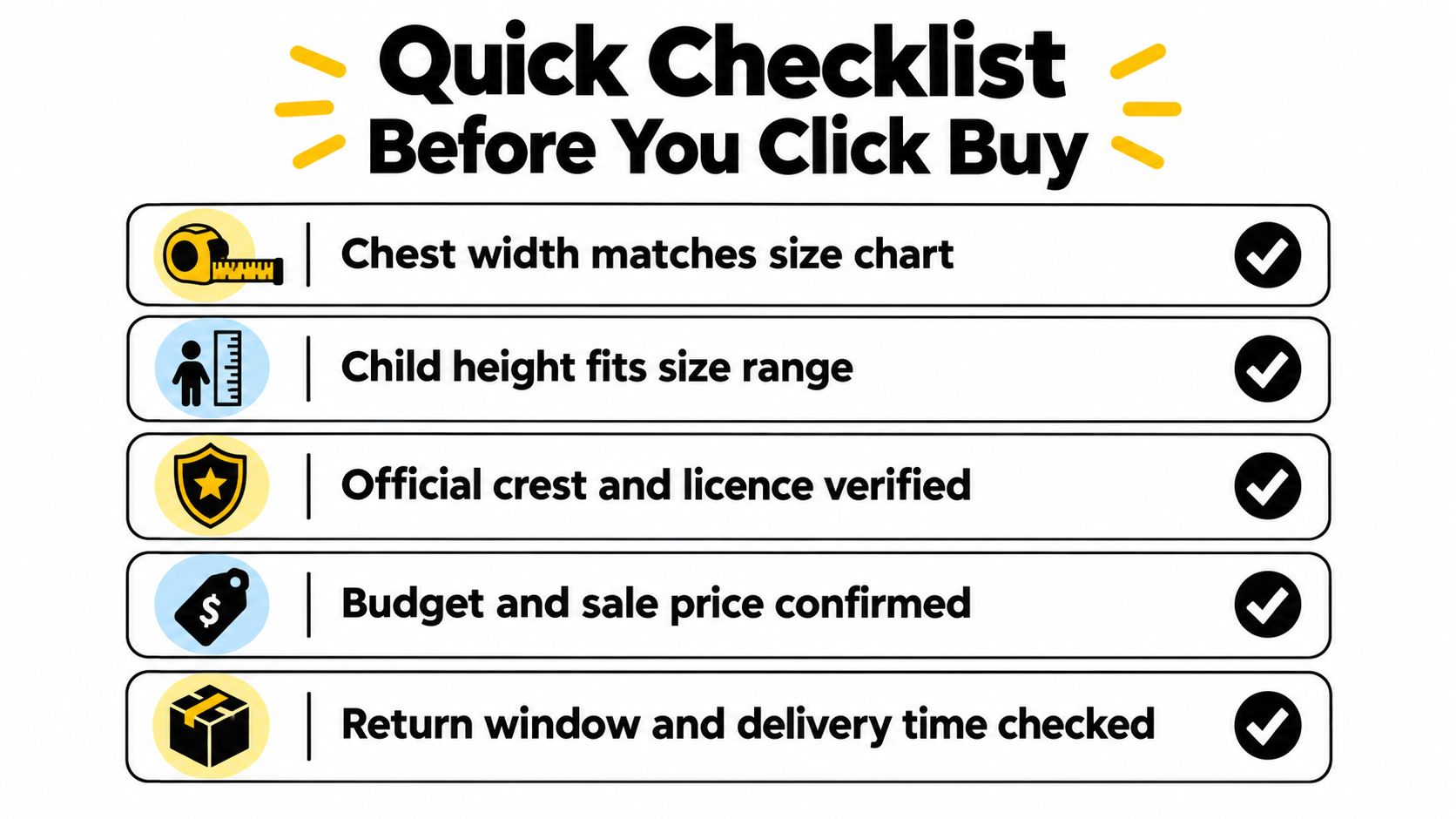
A child can outgrow the idea of a hoodie before the parcel arrives, so make the fit decision first. Check chest and height, then confirm the cut, fabric, care instructions and return terms. A sale label is never a reason to guess the size.
The parent's pre-checkout list
- Measure first: Compare the child's current chest and height with the specific Manchester United hoodie chart, not just the age label.
- Check the cut: Decide whether standard, loose, oversized or training fit leaves enough room for the layer underneath.
- Allow sensible room: Choose growth space without accepting dropped shoulders, sleeves that cover the hands or a body that hangs awkwardly.
- Verify the category: Confirm whether the listing is official, inspired or training-focused before comparing it with another style.
- Inspect the branding: Look for a clear club description, consistent crest presentation and product details that avoid unsupported licensing claims.
- Read the fabric line: Choose cotton-rich, cotton-poly or technical fabric according to how often the child will wear and wash it.
- Scan the care label: Check the permitted wash temperature, drying instructions and any restrictions that could make regular care inconvenient.
- Check the stress points: Inspect cuffs, hem, hood, pocket corners and visible stitching in the product photographs.
- Review the sale terms: Confirm the live price, delivery details and return window before payment. Prices on the official store move with the sale cycle, so check the current product page rather than an old screenshot or search result. Use the current official category
- Think about use: School, home, training and matchdays may call for different levels of warmth, movement and durability.
For a gift, ask the parent for the child's latest height and chest measurement instead of guessing from age. If that is impossible, choose a forgiving casual cut, avoid a close-fitting training style and confirm that returns are allowed. Keep the packaging and tags until the recipient has tried it on.
A useful final test is simple: will the child wear this hoodie for the purpose you had in mind? The chest and height should match, the shoulders should sit sensibly, and the care routine should fit your household. If the purchase only works after the garment somehow changes shape in the wash, choose another size or style.
SoccerWares offers football-inspired hoodies, supporter apparel and children's training essentials, giving families another place to compare club-style layers with practical kit. Visit SoccerWares to browse options for matchdays, everyday wear and football gifts.