

Effective passing and moving drills in football are what separate good teams from great ones. It’s the engine room of any successful strategy, turning simple possession into a genuine threat. The idea is simple: pass the ball, then immediately move into a better position. This coordinated dance creates space, pulls defences apart, and ultimately, wins matches.
The Secret to Dominating Modern Football
Let's be honest, keeping the ball without a purpose is just a glorified game of keep-away. The real magic happens when you master the relationship between the pass and the movement that follows. This synergy fuels today’s fast-paced game, transforming a group of individuals into a slick, cohesive unit. Forget static, predictable football; the modern game is all about fluid, intelligent motion.
Top-tier teams live by this principle to dismantle even the most organised backlines. When a player passes and then moves, they create a quick numerical advantage—an 'overload'—in a specific part of the pitch. This forces defenders to make split-second decisions, which inevitably creates gaps for teammates to exploit. A simple one-two pass is the classic example, instantly taking a defender out of the game and putting your team on the front foot.
Why Passing and Moving is Non-Negotiable
Mastering this core skill goes way beyond just creating chances. It’s about levelling up your team's collective football IQ and building the kind of habits that win you points on a rainy Tuesday night in Stoke.
- Creates Unpredictability: A team that moves smartly off the ball is a nightmare to defend against. Constant rotation and clever runs keep the opposition guessing, stopping them from ever settling into their defensive shape.
- Improves Team Chemistry: To move in sync, players need communication and anticipation. Running these drills repeatedly builds an on-field telepathy where players just know where their teammates are going to be.
- Dictates Game Tempo: A team that passes and moves with precision controls the entire flow of the match. You can speed things up for a lightning-fast counter-attack or slow it down to keep possession and patiently probe for an opening.
The philosophy is straightforward: the ball moves, you move. If a player stands still after passing, they’ve taken themselves out of the play, making life much easier for the opposition.
This isn't just for midfielders. The concept applies to every player on the pitch, from a centre-back building from the back to a striker peeling off a defender in the box. And it’s not about running for the sake of it; it’s about intelligent running. It’s knowing when to make a supporting run, when to drift into an open pocket of space, and how to time your movement to arrive just as the ball does. The drills we're about to cover are designed to burn these habits into your players' minds, turning them from bystanders into game-changers.
Building Your Foundation with Core Drills
Before your team can play intricate tiki-taka football, you have to nail the absolute basics. This section gets straight to the point, breaking down the essential passing and moving drills football coaches swear by to build the muscle memory every top player needs. These drills are the bedrock of intelligent, instinctive play.
We'll walk through classics like the 'Pass and Follow', the 'One-Two Wall Pass', and the ever-popular 'Rondo'. This is more than just a list of setups; we'll dig into the details that matter—body shape before receiving a pass, judging the weight of the ball, and that explosive first step after you've played it. Think of these not as warm-ups, but as the fundamental building blocks for creating players who make smart decisions under pressure.
This simple diagram breaks down the core sequence of any effective attack.
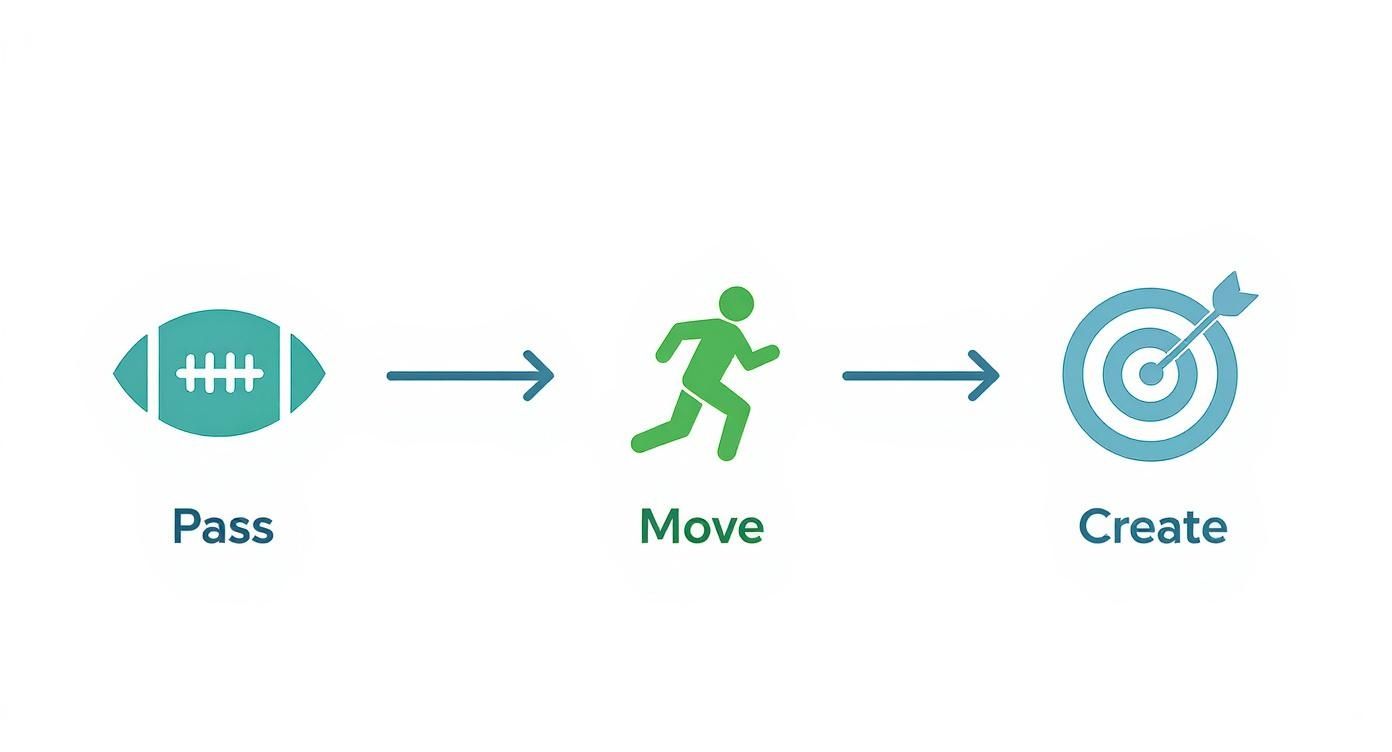
It’s that seamless flow from a crisp pass into an intelligent run that unlocks defences and creates golden goal-scoring chances.
To truly master passing and moving, players need to internalise a few key ideas. These aren't just one-off tips; they are principles that should underpin every drill and every touch of the ball.
Core Principles of Effective Passing and Moving
| Principle | Description | Key Coaching Cue |
|---|---|---|
| Move After Passing | The most common mistake is "ball watching". Players must immediately move into a new space after releasing the ball to offer a new passing option or pull a defender away. | "Don't be a statue! Pass and go." |
| Open Body Shape | Receiving the ball side-on allows a player to see more of the pitch, assess their options quicker, and play their next pass with their first touch. | "Check your shoulder! See the picture before you get the ball." |
| Pass to Feet vs. Space | Players must learn to read the situation. A pass to feet is for a stationary teammate, while a pass into space leads a running player towards goal. | "Read the run! Pass where they're going, not where they are." |
| Communication | Simple shouts like "man on," "turn," or "one-two" are vital. Verbal and non-verbal cues (like pointing) create understanding and speed up play. | "Talk to each other! Be loud and be clear." |
Consistently reinforcing these principles will turn robotic drills into fluid, game-realistic habits.
The Classic Pass and Follow Drill
This is the quintessential drill for stamping out the bad habit of standing still after making a pass. It’s incredibly simple to set up but brutally effective at building the instinct to move.
- Setup: Get four to six players to form a circle, roughly 10-15 yards across. One player kicks things off with the ball.
- Execution: The player with the ball passes to anyone in the circle and immediately sprints to take the spot of the person they just passed to. The receiver takes a touch to control, picks their next target, and the cycle continues.
The real goal here is automation. You want the movement after a pass to become so second-nature that players don't even have to think about it. It’s all about creating a 'pass-and-sprint' mindset.
Of course, all these dynamic movements require a solid physical base. Mastering fundamental lower-body exercises like the bodyweight squat is crucial for building the power needed for explosive sprints.
Mastering the One-Two Wall Pass
The one-two, or the give-and-go, is one of the most devastating tools for breaking down a stubborn defensive line. This drill isolates that exact movement, honing the timing, pass weight, and explosive run needed to pull it off on match day.
- Setup: Players get into pairs. One player (the passer) stands about 10 yards away from the other (the 'wall').
- Execution: The passer plays a firm ball into the wall player’s feet. The moment the pass leaves their foot, the passer sprints forward into open space. The wall player must play a first-time return pass into the path of their sprinting partner.
A few key things to watch for as a coach:
- Weight of the Pass: The first pass needs to be firm enough for a one-touch return but not so powerful it’s uncontrollable.
- The Return Ball: The wall player should aim for the space ahead of the runner, not directly at them. Lead them with the pass.
- Timing the Run: That sprint has to be explosive. The passer needs to time it perfectly to meet the return ball at full speed.
This level of co-ordination is what separates good teams from great ones. The impact of passing efficiency is huge. In UK collegiate football, for instance, since 2008, the UK Wildcats have had 11 different quarterbacks start more than one game. However, only four managed to start 20 or more career games, and just four maintained a winning record as a starter. It’s a stark reminder that team success hinges on the consistency developed through this kind of drill work.
The Rondo Possession Game
You can't have a list of essential passing drills without mentioning the Rondo. Made famous by Pep Guardiola's Barcelona, this possession game is a masterclass in improving technique, awareness, and decision-making under intense pressure.
- Setup: Mark out a small grid (a 10x10 yard square works well). You'll have five attackers on the outside and two defenders in the middle—a classic 5v2.
- Execution: The attackers' job is simple: keep the ball. They pass it around the grid while the two defenders frantically try to win it back. If a defender intercepts the ball or forces a mistake, they swap places with the attacker who lost possession.
The beauty of the Rondo lies in how many skills it teaches at once. Players naturally learn to open their body to see the pitch, play passes with the right pace, and create good supporting angles for their teammates. For younger players, you might find our guide on beginner soccer drills helpful for breaking these concepts down even further.
Ultimately, the constant pressure forces quick thinking and reinforces the main lesson of all passing and moving drills football: keep the ball, and keep moving.
Developing Tactical Intelligence with Advanced Drills
Once your players have the basics down, the real fun begins. It's time to move beyond just how to pass and start focusing on why and when. This is where technical skill transforms into tactical intelligence.
Advanced passing and moving drills football sessions need to challenge your players' brains, not just their feet. They should be forced to make game-like decisions under pressure, turning the training pitch into a dress rehearsal for match day. The drills that follow are all about simulating those complex scenarios—teaching players to read the game, anticipate runs, and unlock defences with clever combinations.
The Third Man Run Drill
The third man run is a classic for a reason. Top teams use it constantly to slice through organised defences. The idea is simple but devastatingly effective: a player makes a run to receive a pass from a teammate who has just received the ball from someone else. It’s a quick, triangular movement that often leaves defenders flat-footed because they’re busy watching the first pass.
-
Drill Setup: Set up a channel with cones, roughly 20 yards wide and 30 yards long. Have three attacking players start at one end, with two defenders positioned a bit further down the channel.
-
Execution: Player 1 passes to Player 2. As that ball travels, Player 3 needs to time their run perfectly to sprint past the defenders. Player 2 then plays a first-time pass into the path of Player 3, who is now clean through.
-
Coaching Cues: Everything hinges on the timing of Player 3’s run. They have to explode into their sprint just as the first pass is being played. I always tell Player 2 to receive with an open body shape so they can see the run developing and play the through ball in one touch.
To make it harder, throw in another defender for a 3v3 scenario. This forces the attackers to be even sharper with their timing and the weight of their passes.
This drill is brilliant because it forces players to think two steps ahead. They aren't just reacting to the ball; they're anticipating the next phase of play and creating chances through synchronised movement.
Combination Play in the Final Third
Breaking down a team that sits deep requires something special. It demands quick, intricate passing and clever movement in tight spaces. This drill is all about rehearsing those sharp combinations around the penalty area—wall passes, overlaps, and third-man runs—that can pry open a defence for a clear shot on goal.
By practising these patterns over and over in a confined space, players build an almost telepathic understanding of each other's movements. This is how you build the chemistry needed to pull off these moves at match speed.
The idea of creating space through intelligent passing isn't new, of course. For a bit of perspective, look at the stats from UK collegiate football. Back in the 1998 season, the Kentucky Wildcats averaged an incredible 412.2 passing yards per game over 11 games, racking up 4,534 passing yards in total. This wasn't an accident; it was a direct result of a strategic focus on passing drills and receiver mobility, built on a record 574 pass attempts that season. You can read more about these historical team statistics at UK Athletics.
Possession vs Counter-Attack Game
I absolutely love this game because it teaches two massive tactical concepts at the same time. You’ll have one team focused on patient possession play, while the other is drilled to defend as a compact unit and launch lightning-fast counters the second they win the ball.
-
Setup: Mark out a rectangular pitch, say 40x30 yards, with a small goal at each end. Split your players into two teams, maybe a 6v4. The team with six is your possession team; the team of four is the counter-attacking side.
-
Rules for Possession Team: They have to complete a certain number of passes—let’s say 8-10—before they can even think about scoring. This forces patient ball circulation, constant movement to create angles, and a real emphasis on quality passing.
-
Rules for Counter-Attack Team: The moment they win the ball, a clock starts. They have a tight window, maybe 8-10 seconds, to get a shot off in the opposite goal. This drill hammers home the need to be direct, decisive, and clinical on the break.
This drill is fantastic for instilling tactical discipline. The possession team learns to cherish the ball and avoid risky passes that could get them caught out. At the same time, the counter-attacking team learns how to defend as a unit and, crucially, to recognise those trigger moments to spring forward with purpose and speed.
Keeping an eye on player output in a drill this intense can give you some amazing insights. Understanding player load, sprint distances, and high-intensity efforts is key to managing fatigue. For a closer look at the metrics that really matter, have a look at our guide on how to read football GPS data.
Using Small-Sided Games to Make Skills Stick
Drills are great for building muscle memory, but the real test comes when those skills have to hold up in the chaos of a match. That’s where small-sided games (SSGs) come in. They’re the perfect bridge between a structured practice and a full-blown game, creating an environment where passing and moving become second nature.
SSGs are fantastic because they automatically crank up player engagement and the number of touches everyone gets. In a smaller space with fewer players, there’s simply nowhere to hide. This intensity forces quicker thinking, sharper passes, and smarter movement off the ball. It’s all about creating a learning environment that’s fluid, fun, and directly translates to the challenges of a full-sized pitch.
The secret to a great SSG isn't just about throwing out some bibs and a ball. It’s about designing games with clever rules that steer players toward the right habits without you needing to blow the whistle every thirty seconds.
Designing Effective Small-Sided Games
To really get the most out of your SSGs, you’ve got to be intentional. Think about the specific behaviours you want to see. Are you trying to encourage quick one-twos? Switching the point of attack? Better support for the player on the ball? Tailor the game to force those outcomes.
Here are a few constraints I love to use:
- Touch Limits: A mandatory two-touch or even one-touch rule is brilliant. It forces players to think ahead, scan for their next pass before the ball even arrives, and play quickly.
- Passing Conditions: Try requiring a team to make a certain number of passes—say, five—before they’re allowed to shoot. This builds patience and rewards good possession.
- Movement Requirements: A simple but effective rule is that a player can't pass back to the person who just passed to them. This one simple tweak forces constant movement and the creation of new passing angles.
By setting these parameters, you shift from being a director to a facilitator. The game itself becomes the teacher, and players learn by doing.
Example SSG: The End Zone Possession Game
This is one of my absolute go-to passing and moving drills football coaches can easily adapt for any age group. It’s superb for teaching players how to move with purpose to break down a defensive line.
- The Setup: Mark out a rectangular pitch, roughly 30x20 yards, with a five-yard "end zone" at each end. Split your squad into two teams for a 4v4 or 5v5.
- The Objective: The goal here isn't to score in a net. Instead, a team scores a point by passing to a teammate who makes a run into the opposition's end zone.
- Key Rules: The player receiving the ball in the end zone can't just be standing there waiting. They have to time their run to meet the pass. This immediately kills stationary play and rewards dynamic movement.
This game is a fantastic real-world simulation of trying to break down a compact defence. Players quickly learn that just passing side-to-side gets them nowhere. They’re forced to use clever combinations, third-man runs, and perfectly weighted through balls to get any success.
The emphasis on timed runs into a specific area directly mimics the movements needed to create goal-scoring opportunities in a real match. It’s about passing with a purpose, not just for the sake of keeping the ball.
The importance of a high-volume, high-efficiency passing game can't be overstated. In the US high school football scene, teams have built dynasties on this philosophy. Lone Oak High School, for example, hit a remarkable passing average of 396.7 yards per game during their 2007 season, coming from 535 pass attempts. That level of output shows a deep commitment to passing and moving as a core strategy. You can explore more high school football team records on the KHSAA website.
The 4v4 Plus 3 Neutrals Game
Another brilliant SSG for developing possession-based skills is the 4v4+3 game. This drill creates a constant overload for the team with the ball, making it easier for them to find passing options and encouraging slick, fluid circulation.
- The Setup: Use a square grid, around 25x25 yards. Play 4v4, but add three "neutral" players (usually in a different colour bib) who play for whichever team is in possession.
- The Game: When a team has the ball, they are effectively playing 7v4. This huge numerical advantage should make keeping possession much easier. The focus is all on quick passes, constant movement to create triangles, and using the neutral players to switch the play.
This game is fantastic for teaching players to recognise and exploit a numerical advantage. It hammers home the importance of finding the "free" player and moving the ball before the defence can shift across and shut down the space. It’s fast, engaging, and puts all the core principles of passing and moving into a game-realistic context.
Common Passing and Moving Mistakes to Avoid
Even the most talented players can fall into bad habits that kill effective team play. Spotting and fixing these common slip-ups is one of the most important jobs a coach has, because it’s often these little details that unlock a team’s true potential on match day.
Think of this section as your troubleshooting guide. We're going to break down the most frequent mistakes that undermine good passing and moving drills in football and give you some simple, actionable ways to fix them.
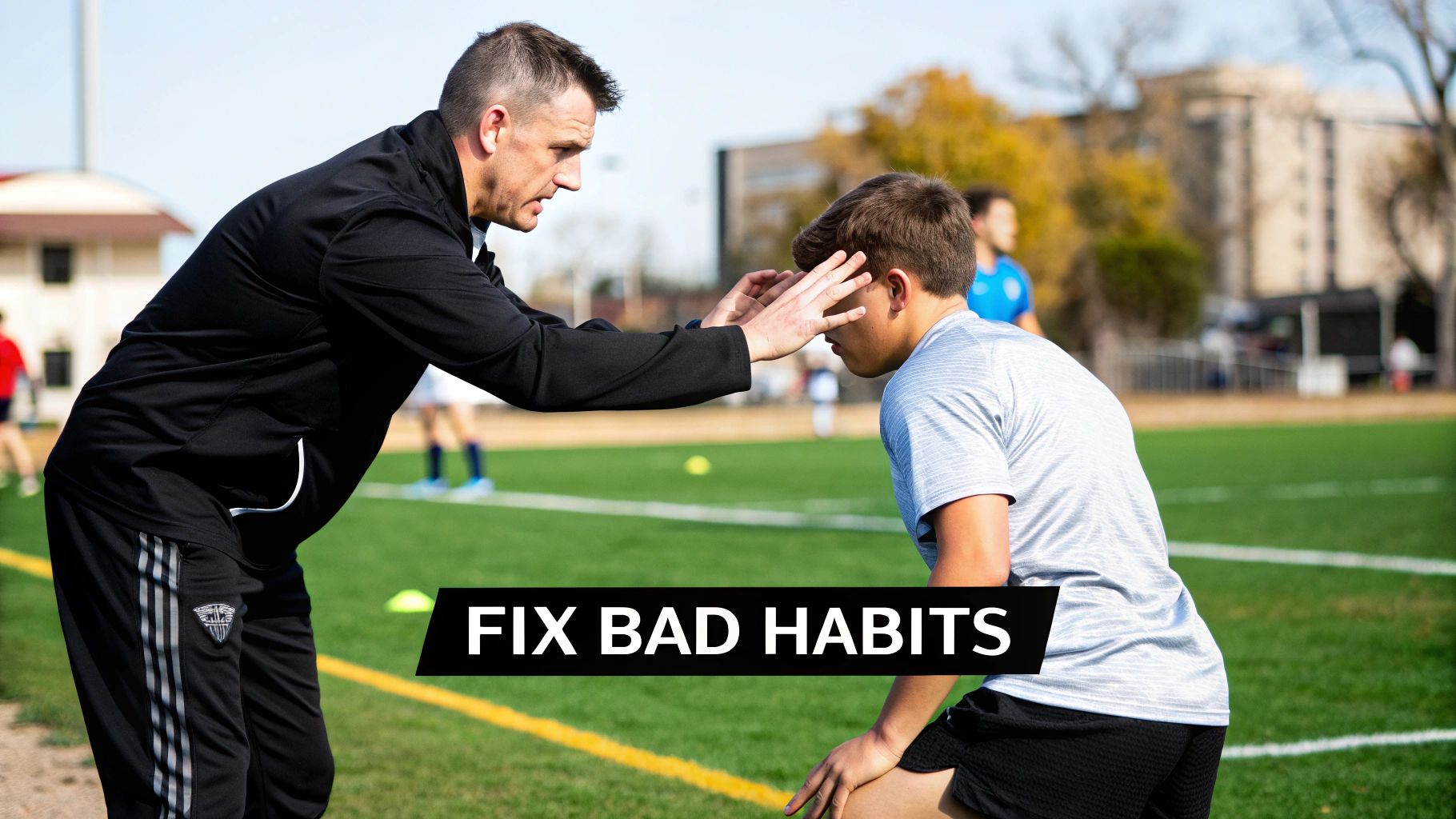
Admiring the Pass
This is, without a doubt, the most common and damaging habit in youth football. A player makes a pass—often a really good one—and then just stops for a split second to watch it. They become a spectator in their own game.
That tiny hesitation is a killer. In that moment, the player takes themselves out of the play, offers no support for their teammate, and gives the opposition a free pass to get organised again. It all comes down to a lack of ingrained discipline; the "pass and move" mindset just hasn't become a reflex yet.
- The Fix: The 'Pass and Follow' drill is the perfect antidote. The rule is dead simple: after you pass the ball, you must immediately sprint to the cone or the position of the player you passed to. It forces the physical act of moving after every single pass until it becomes second nature.
Passing Directly to Feet in Congested Areas
Another classic error is passing straight to a teammate's feet when they're swarmed by defenders. The intention is good, but it’s a pass that invites immediate pressure and usually ends with the ball being lost. The receiver has zero time or space to get their head up and make their next move.
This mistake screams a lack of game awareness. The passer is only focused on completing the pass, not on what happens next. They aren't reading the pressure around their teammate.
A pass should be a key that unlocks the next action, not a problem for your teammate to solve. Passing into space allows the receiver to run onto the ball, maintaining the team's momentum and keeping the defence on the back foot.
Poor Timing of Supporting Runs
Movement is only useful if it's timed correctly. It happens all the time: a player makes a run way too early and either ends up offside or closes down the very space they were trying to create. On the flip side, a run that comes too late means the passing window has slammed shut.
This is all about a lack of synchronisation between the player on the ball and the runners off it. It’s a deeper understanding of anticipation, reading triggers, and developing that unspoken on-pitch chemistry.
- Corrective Action: Get your players doing the 'Third Man Run' drill. This exercise is brilliant because it specifically trains players to time their sprint based on the trigger of the first pass in a sequence, not the second. It builds that instinct to anticipate each other's moves, ensuring the runner arrives in the space at the exact moment the ball does. Getting this timing right is an absolute game-changer for breaking down stubborn defences.
Gear Up for Success with the Right Equipment
Having the right equipment isn't just about looking professional; it's the foundation for running a sharp, high-tempo training session. You can have the most brilliant passing and moving drills football plan in the world, but without the right gear, it can quickly fall apart.
Good kit lets you set up drills with precision, keep players engaged, and make the most of every second on the pitch. It removes the little frustrations that kill momentum and lets you focus on what actually matters: coaching.
The Non-Negotiables for High-Impact Drills
There are a few items that are absolutely essential for running the drills in this guide. They create the structure and visual cues players need to understand their roles and execute movements at pace.
-
High-Visibility Marker Cones: A coach's best friend. Use them to lay out grids for Rondos, create passing channels, or mark the start and end points for a 'Third Man Run'. Brightly coloured cones mean players can see their targets and boundaries in a split second, which is crucial for keeping a drill flowing.
-
Durable Training Footballs: You need plenty of them. Nothing kills the energy of a session faster than everyone standing around waiting for a single ball to be fetched. Having a bag of properly inflated, quality footballs ready to go allows you to restart drills instantly, meaning more touches and more repetition for every player.
-
Lightweight Training Bibs: Absolutely essential for any drill that involves opposition, like a small-sided game or our 'Possession vs Counter-Attack' drill. Bibs cut out the confusion, letting players instantly recognise teammates and opponents. This speeds up decision-making and better replicates the quick thinking needed on match day.
The right gear isn't an expense; it's an investment in your team's development. Quality equipment withstands countless sessions and directly contributes to a more organised, professional, and productive training environment.
Take Your Sessions to the Next Level
Once you've got the basics sorted, a few other pieces of kit can really elevate your training. These tools add new layers to your drills or give players a way to work on their skills on their own.
A football rebounder, for instance, is a fantastic tool for solo practice. It’s perfect for working on wall passes and first-touch control when a partner isn't available.
To make sure you're fully prepared to run any passing drill with precision, you need the right tools for the job. Having a well-stocked kitbag means you can adapt on the fly and keep your sessions engaging.
| Equipment | Primary Use in Drills | Recommended SoccerWares Link |
|---|---|---|
| Marker Cones & Discs | Setting up grids, gates, and boundaries for drills like Rondos and passing channels. | Shop Cones & Markers |
| Training Footballs | Ensuring high-repetition drills with minimal downtime. Essential for all passing work. | Shop Footballs |
| Training Bibs | Differentiating teams in small-sided games and possession vs defence drills. | Shop Training Bibs |
| Football Rebounder | Solo practice for wall passes, first-touch control, and receiving skills. | Shop Rebounders |
| Agility Ladders | Warm-ups and footwork drills to improve co-ordination before passing sessions. | Shop Speed & Agility Gear |
Building out your coaching toolkit is a continuous process, but starting with these essentials will put you in a great position. For a more detailed breakdown of everything a coach might need, check out our comprehensive guide on essential football coaching equipment to build your perfect kit.
Common Questions on Passing and Moving
Even with the best drills laid out, there are always a few questions that pop up on the training ground. Let's tackle some of the most common ones I hear from players and coaches. Getting these details right is what separates a good training session from a great one.
How Often Should My Team Practise These Drills?
Passing and moving shouldn't be a "topic" you cover once a month. It needs to be woven into the fabric of every single training session. It's that fundamental to the modern game.
I always recommend dedicating 15-20 minutes of your warm-up to a drill like a Rondo or a simple 'Pass and Follow'. From there, make sure you're reinforcing those same principles throughout your main session and small-sided games. Consistency is what turns conscious actions into match-day instinct.
What Is the Single Most Important Part of Moving Off the Ball?
You can talk about the angle of the run or the explosive speed, and both are vital. But the single most critical element is timing.
If you move too early, you just drag a defender with you and kill the space for everyone else. Move too late, and the passing window slams shut before you even get there. The magic happens when your movement is perfectly synchronised with the player on the ball, almost like you're anticipating their next move before they've made it.
The ultimate goal is simple: to be arriving in the space at the exact moment the ball does. This requires a deep understanding between teammates, built through countless hours of practice.
How Can Players Improve Their On-Field Awareness?
Awareness isn't some mystical talent; it's a skill you can train, just like a first touch or a cross-field pass. The secret is getting players to constantly scan the pitch. A quick glance over each shoulder before receiving the ball has to become an unbreakable habit.
This "shoulder check" gives them a mental snapshot of everything: where the space is, where teammates are, and where the danger is coming from. This is why drills that force players under pressure, like Rondos and possession games, are so brilliant. They literally force players to think two steps ahead just to survive.
Are These Drills Okay for Younger Players?
Absolutely. You can easily adapt any of the drills in this guide for your youth teams.
For the youngest age groups, keep it simple. Start with something like 'Pass and Follow' in a circle with no defenders at all. The entire focus should be on two things: the quality of the pass and the simple act of moving immediately after. As they get the hang of it, you can introduce a passive defender or add a few more players to build complexity, but always keep it fun.
Here at SoccerWares, we know that running a top-tier session depends on having the right gear. From high-visibility cones that stand out on a winter's night to durable footballs that can withstand a full season of training, we’ve got you covered. Elevate your team’s performance by exploring our full range of training essentials.