

The kit order looked straightforward until the coach sent the spreadsheet. Some players needed match shirts, others needed training tops, parents wanted names and numbers, and the youngest children might outgrow everything before the season ends. A low checkout price can quickly become expensive once cracked prints, replacement shirts, changed squad numbers and unwanted personalised garments enter the calculation.
That's the challenge with personalized team apparel. The right purchase isn't just the garment with the brightest mock-up or the lowest unit cost. It's the combination of a suitable base fabric, decoration that survives matchday use, sizing that allows for real movement, and a plan for what happens when the player changes size or leaves the squad.
The UK market gives clubs room to build a serious merchandise range. A 2024 commercial estimate valued the UK custom-apparel market at USD 112.10 million, with a projection of USD 205.27 million by 2032, equivalent to a forecast compound annual growth rate of 7.86%. London accounted for 35% of UK market share, while Manchester, Birmingham and Glasgow were identified as important emerging centres, according to Credence Research's UK custom-apparel market estimate. Treat those figures as an industry forecast rather than an official government measurement, but they indicate that personalisation has moved beyond a niche service.
Choosing the Right Base Garments
A club kit manager usually starts with the visible decisions, colour, crest, sponsor and player names. The more important decision comes earlier: choosing a blank garment that suits the job. Decoration can't rescue a shirt that traps heat, restricts movement, loses its shape or fails after repeated washing.
A Saturday match shirt has different requirements from a training top. A supporter hoodie has a different job again. Treating them as interchangeable creates problems that only appear after the first muddy fixture.
Match shirts and training layers
For matchday, prioritise a lightweight performance shirt with enough stretch for sprinting, turning and challenging for the ball. Polyester is common in this category because it can support moisture management and dries more quickly than a heavy natural-fibre garment. Mesh panels can help in warm conditions, but their placement matters. A large decorated area over a breathable panel may reduce the benefit of the fabric.
Training tops need to tolerate more contact with equipment, benches, grass and repeated laundering. A slightly more substantial polyester construction can make sense for regular drills, especially where players wear the same top through much of the week. Look closely at the collar, cuffs, side seams and underarm panels. These areas experience constant pulling and friction, so a smart graphic on a weak construction still produces a short-lived product.
For younger squads, comfort and fit deserve more attention than a professional-looking cut. An U10 player may need room for movement, a base layer and growth, while an adult first-team shirt may be deliberately close to the body. Don't order solely from the player's age. Compare the supplier's actual garment measurements with a shirt that already fits the child.
Hoodies, jackets and supporter pieces
A heavyweight hoodie works well for travel, warm-ups and spectators in cold stands. It needs a stable surface for a crest or sponsor, but thick fabric can make large heat transfers feel rigid. Embroidery may suit a chest badge, provided the backing and stitch density don't make the garment uncomfortable.
Supporter clothing should be designed for ordinary life, not only matchday. A cotton or cotton-blend T-shirt may be comfortable in the stands and useful off the pitch, while a training jacket offers more protection during travel. Drinkware and bags extend the club identity beyond clothing, but they should be treated as separate product categories with their own care requirements.
Parents looking for practical ways to identify children's football belongings may also find this guide to football jerseys and bags for children useful. The principle is the same for a club order: personalisation should make an item easier to use, not make an unsuitable item harder to replace.
Practical rule: Choose the garment for its main physical use first. Add the name, number and crest only after the fabric, cut and construction have passed that test.
Comparing Print and Embroidery Methods
A design can look perfect on a digital proof and still be wrong for a wet away fixture. Decoration changes how a garment stretches, breathes, dries and behaves in the wash, so the method must match both the fabric and the location of the design.
Sublimation is usually the strongest choice for full-colour polyester football shirts. The design becomes part of the fabric rather than sitting as a separate thick layer on top. That keeps the shirt flexible and breathable, and it avoids the cracking associated with a rigid surface transfer. It works best on suitable light-coloured polyester and is less flexible when a club needs a design on cotton or a dark base.
Screen printing can provide a clean, economical finish for repeat orders, particularly on cotton T-shirts, hoodies and simple supporter graphics. It handles bold blocks of colour well, but a heavy print can feel less comfortable on a performance shirt. Fine detail, gradients and very small runs may also make the setup less practical.
Direct-to-film, often called DTF, transfers a printed graphic onto the garment with adhesive. It can handle detailed artwork and mixed fabric types, making it useful for names, sponsor marks and fanwear. The trade-off is a surface layer that may feel warmer or less flexible than sublimation. Adhesion depends on correct pressing, fabric compatibility and care.
Heat-pressed vinyl remains useful for simple names and numbers, especially where a club needs a clear, single-colour finish. It's easy to understand and can work well when applied properly. Cheap or poorly applied vinyl is where problems start, with lifting edges, cracking across stretch zones and peeling around sharp corners.
Embroidery gives a raised, premium appearance and suits club crests on hoodies, jackets, polos and staffwear. It's not usually the first choice for a lightweight match shirt. Dense stitching can add weight, reduce stretch and create an uncomfortable backing against the skin.
Decoration Method Performance Matrix
| Method | Best Fabric | Durability | Ideal Use Case |
|---|---|---|---|
| Sublimation | Light-coloured polyester | Strong when the garment and process are compatible | Full-colour match shirts and all-over designs |
| Screen printing | Cotton and cotton blends | Good for simple, well-cured graphics | Supporter T-shirts, hoodies and repeat club designs |
| Direct-to-film | Polyester, cotton and blends subject to testing | Variable, strongly dependent on pressing and care | Detailed logos, sponsor marks and small-run fanwear |
| Embroidery | Hoodies, jackets, polos and stable fabrics | Strong on suitable heavyweight garments | Club crests and staff or supporter outerwear |
| Heat-pressed vinyl | Smooth polyester and cotton surfaces | Suitable for simple designs, but vulnerable to poor application | Names, numbers and single-colour lettering |
Ask the supplier to test the actual decoration on the actual garment. Nottingham Trent University's Clothing Longevity Protocol recommends combining physical-performance testing, colour-fastness testing, repeated care-label wash cycles and wearer trials. Its framework can include trials of up to 200 hours, while repeated washing tests have been used for up to 50 cycles, as described in the Nottingham Trent University clothing longevity protocol.
Evaluating Fabric Quality and Durability
A cheap shirt with premium printing is still a poor kit decision. The blank garment controls comfort, shape retention, colour stability and how well the decoration performs after a season of mud, sweat and washing.
Start with the fibre label. Under the UK textile labelling guidance, garments placed on the UK market must state their fibre composition using recognised fibre names. Personalisation doesn't replace that information, and a printed label or crest must not obscure it.
Read beyond cotton versus polyester
Polyester is often a sensible base for activewear, but fibre content alone doesn't prove quality. Check whether the fabric has a moisture-management finish, whether the surface feels stable and whether the garment recovers after stretching. Cotton can be comfortable for supporter wear, but it may hold moisture and require more care around shrinking and print damage.
Mixed-fibre garments need clear descriptions. Where no single fibre accounts for at least 85% of the garment by weight, the constituent fibres must be listed in descending order with percentages for the relevant fibres. The Darlington Trading Standards guidance on fibre composition gives the example “cotton 80%, polyester 15%, nylon 5%”. Small decorative material accounting for 7% or less is excluded from the fibre-content indication.
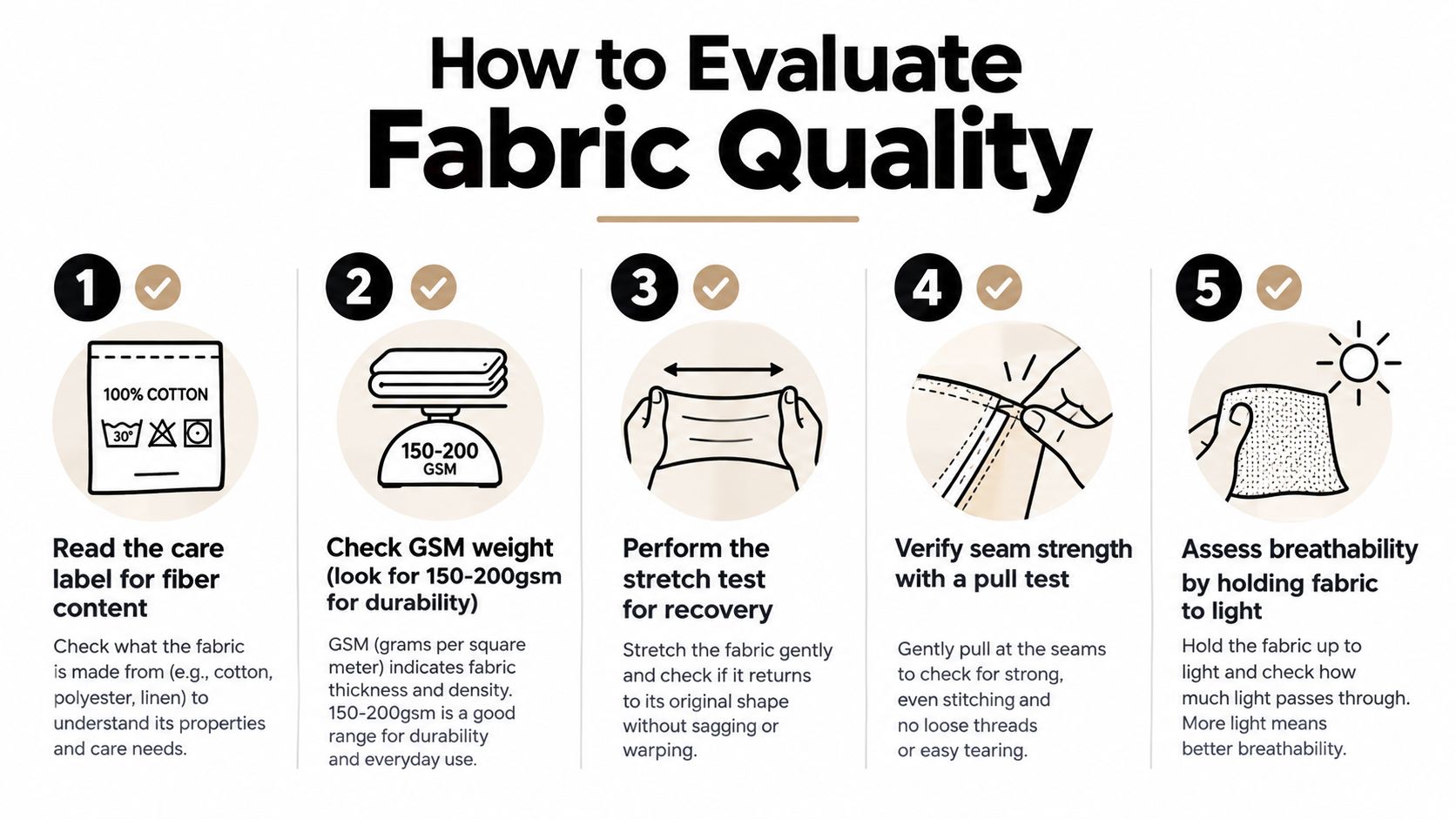
The commonly used GSM measure can help compare fabric weights, but don't use it as a standalone quality verdict. A heavier shirt isn't automatically more breathable or more suitable for sprinting. Assess the whole garment instead:
- Check the care label: Confirm the fibre content, washing temperature and drying instructions before approving a bulk order.
- Stretch the fabric: Pull across the chest and sleeves, then watch how quickly it returns to shape. Poor recovery can create sagging panels and distorted numbers.
- Inspect the seams: Look for secure stitching around the shoulders, collar, side panels and cuffs. A gentle pull test can reveal weak construction before players do.
- Hold it to the light: This can help you spot uneven knitting or unusually open areas, but remember that mesh zones may be intentional.
- Test decorated samples: A print can behave differently from the blank fabric, so inspect adhesion, cracking, colour change and distortion after washing.
UK and EU textile criteria commonly use ISO colour-fastness methods, with level 3–4 identified as a minimum benchmark for washing-related colour change and staining in the supplied durability guidance. Ask for the test method and conditions, not just a supplier's statement that a garment is “wash resistant”.
For a more structured supplier conversation, use SoccerWares' apparel quality standards guide alongside your own sample checklist. The useful question isn't whether a shirt looks good on delivery day. It's whether the shirt, seams, colours and decoration still look acceptable after realistic use.
Managing Costs and Player Turnover
A youth player may outgrow a shirt before the season ends, leave the squad or receive a different number next year. Permanent names and numbers then turn a usable garment into stock that is difficult to reassign. The cheaper order at checkout can become the more expensive choice after replacement shirts, redecoration and unused kit are included.
Families already feel the pressure of compulsory branded clothing. Among parents reporting an increase in compulsory branded items, 79% said uniforms became more expensive, while 4% said they became cheaper, according to the UK Parent, Pupil and Learner Voice Omnibus Surveys. A 2025 UK Parliament debate cited average compulsory branded schoolwear, including sportswear, of £92.45 across 548 schools and 520,000 pupils. That context supports a club policy that limits personalisation where it adds little matchday value.
Make personalisation replaceable
A replaceable system protects the base garment and gives the club more options when players move between squads:
- Removable patches: Velcro name panels let the club change player details without discarding the shirt. Check that the attachment stays secure during contact and washing.
- Interchangeable numbers: A shared set of numbers can serve different squads if the fixing method holds and match regulations permit it.
- Loan shirts: The club owns the core kit and lends it to players. This reduces family expense and makes collection, inspection and reassignment easier.
- Reusable blanks: Keep the crest and club colours permanent, then add names only where identification or competition rules require them.
Calculate cost per season, not just the initial invoice. Include replacement garments, redecoration, delivery, collection, storage and the likelihood that a child will outgrow the shirt. A slightly dearer blank with replaceable decoration can cost less over its useful life than a cheaper shirt that cannot be reassigned.
A club shop can also raise funds without adding another personalised garment to every player's order.
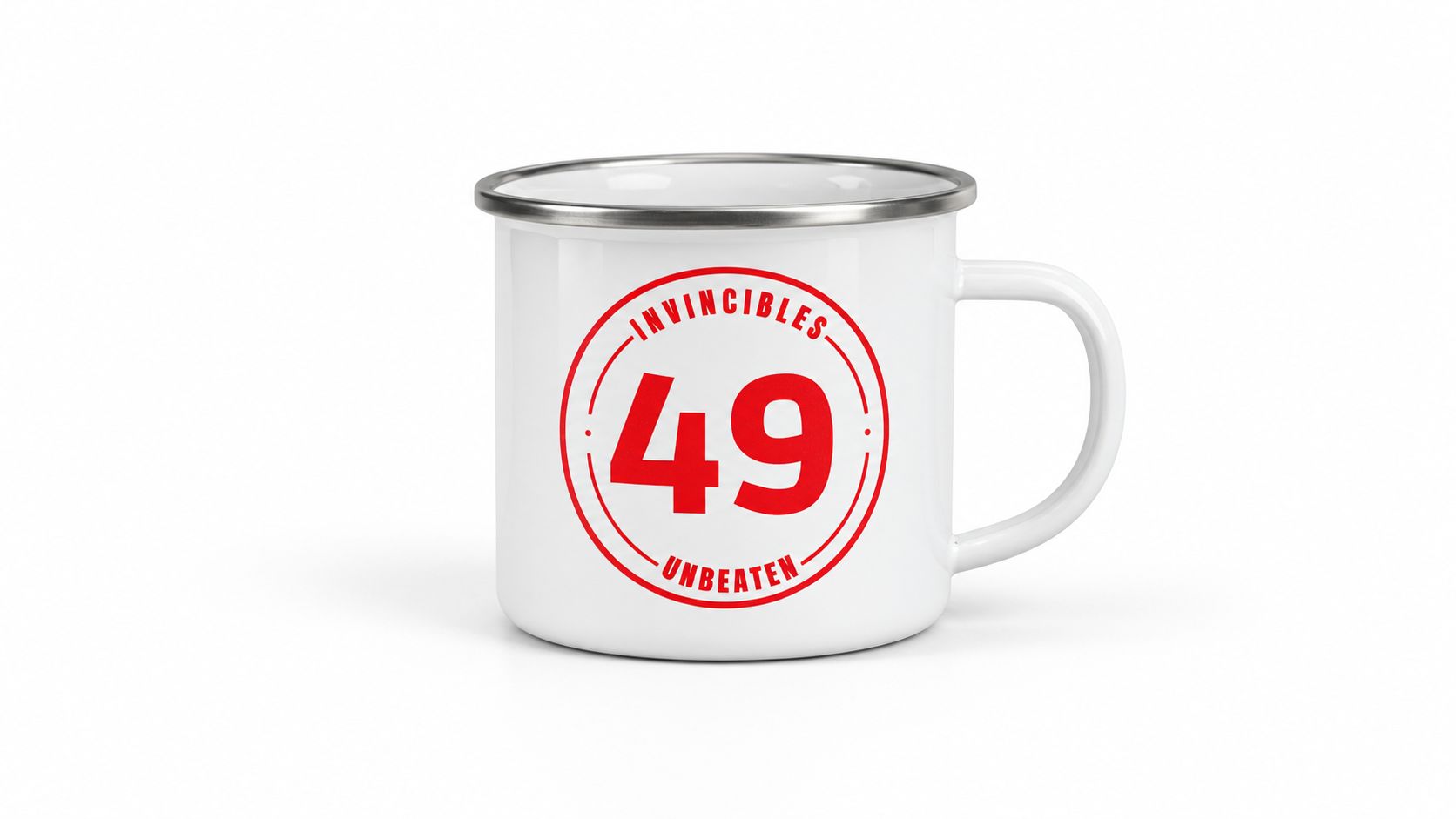
For fundraising or travel merchandise, the Arsenal 49 Unbeaten Enamel Mug is a separate, non-kit item that suits a club-shop range better than another garment. Low-commitment supporter merchandise can generate income while leaving playing kit focused on fit, rotation and reuse.
Navigating Sizing, Proofs, and Timelines
Most order failures happen between the spreadsheet and production. One child's “age 10” shirt may fit like another supplier's “age 8”, while a digital proof can hide a misspelt surname, an incorrectly placed sponsor or a colour that changes on the actual fabric.
Use garment measurements, not age labels alone. Measure a shirt that already fits, compare chest width and length with the supplier's chart, and record the result in a shared sheet. Parents who need a refresher can use these tips for measuring yourself, then submit measurements through one controlled club process rather than sending conflicting messages to the supplier.
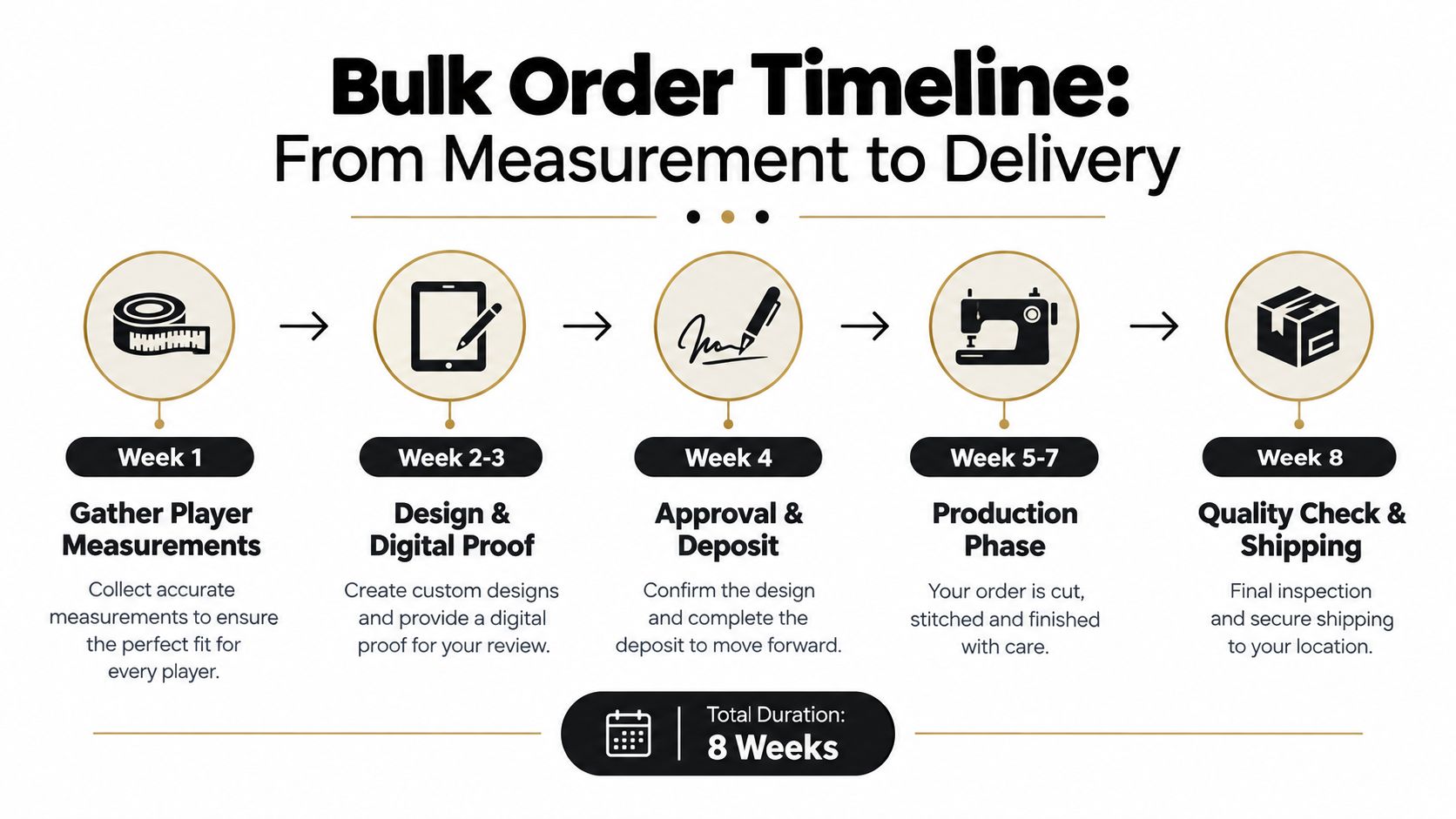
Build approvals around decisions
An organised timeline separates fit, artwork and production approval. Gather measurements first, then confirm the size range and decoration positions. Review names letter by letter, check squad numbers against the official list and inspect the crest at its intended physical size.
The proof should show more than a flat front view. Ask for placement on sleeves, back panels and shorts where relevant. Confirm whether the artwork is intended for sublimation, vinyl, DTF, screen printing or embroidery, because the same file can produce different visual results.
Intellectual property needs the same early attention. A club can use its own badge, colours and original supporter artwork, but official club crests, league marks, broadcaster branding and protected sponsor designs may require permission. Don't assume that a design is safe because it appears on social media or because a supplier can technically print it.
Use a physical strike-off where colour, fabric or decoration is critical. It gives the coach and kit manager something tangible to assess before the entire order is committed.
A final approval should be written and dated. Include the size list, spelling, numbers, artwork version, garment colour, decoration method and delivery address. For hoodie orders, check the supplier's hoodie sizing chart separately from shirt sizing, because a relaxed outer layer won't fit like a close-cut match top.
Care Instructions and End-of-Life Planning
Personalisation creates extra failure points. Heat transfers can crack or peel, embroidered elements can distort the fabric and dark colours can migrate or fade when the wrong wash process is used.
Give parents one care sheet with every order. The instructions should match the decoration method and the fabric, not a generic “wash as normal” message.
- Turn garments inside out: This reduces direct abrasion against prints and embroidered surfaces.
- Use the recommended temperature: Hotter washing isn't automatically cleaner and can accelerate colour change or adhesive failure.
- Avoid direct ironing: Keep the iron away from printed areas unless the decorator has provided a specific method.
- Choose careful drying: High heat can affect shape, elastane recovery and decoration. Follow the care label rather than guessing.
- Treat mud promptly: Brush off dried soil before washing and avoid aggressive scrubbing across names, numbers or badges.
The guide to washing hoodies is useful for supporter layers, but match shirts and decorated training tops still need their own label-based instructions. Keep a spare sample from the production batch if the club wants to test a new detergent or process.
End-of-life planning should start before the order. UK Government estimates put annual textile waste at approximately 1.8 million tonnes, while parliamentary evidence reports that around 300,000 tonnes of clothing enter household bins each year. Of that municipal clothing waste, approximately 20% is landfilled and 80% incinerated, according to the UK Resources and Waste Strategy monitoring report.
Create a club take-back box, repair torn seams, replace worn decoration where practical and separate garments that can be donated from those that are no longer safe to wear. For youth teams, removable names and numbers make reuse far easier when a player changes squad or size.
Strategies for Bulk Orders and Fundraising
A well-run club order starts with demand, not stock. For match kit, collect confirmed player requirements before production. For supporter merchandise, open a pre-order window, publish the size chart clearly and order only what families and supporters have selected. That approach reduces the risk of boxes of unsold hoodies sitting in a committee member's garage.
Consider a simple seasonal sequence. The first campaign covers essential shirts and training tops. A later winter campaign offers a warm hoodie or jacket for parents, alumni and supporters. A separate club-shop range can include drinkware and bags, giving people a lower-commitment way to show their colours without buying another full outfit.
Turn merchandise into a club process
A useful fundraiser needs clear ownership. One person should manage artwork, another should reconcile names and numbers, and someone else should coordinate collection. Keep the order form restricted to approved products and use one final spreadsheet for production.
Packaging can also build identity. Group player kits by squad, label each bag with the player's name and provide a care card. For supporters, make the product description honest about fabric, decoration and washing. Trust matters more than an ambitious claim about performance.
The UK's personalisation opportunity is broader than football-specific demand. An Accenture survey of 2,159 consumers across Germany, Sweden, the UK and the United States included 539 UK respondents. The UK chart reported 85% interest in personalised fashion products, while overall interest reached 84% and rose to 94% among high-spending fashion enthusiasts, according to Accenture's fashion personalisation research. The same research found average spending of €500 among consumers interested in personalisation compared with €340 among those not interested, and identified colour as the most popular customisation option. It also found that only 17% of 70 reviewed global fashion brands and retailers offered colour customisation.
That supports a practical club strategy: make colour, identity and personal relevance easy, but don't force permanent personalisation onto every essential garment. For further product ideas that can support a club shop, see SoccerWares' club merchandise ideas. SoccerWares offers football fan apparel, drinkware and training essentials, so a club can consider matchwear decisions separately from supporter and gifting products.
A sustainable order is one the club can still explain at the end of the season: who used it, how it was cared for, whether it can be reassigned and where it goes next.
SoccerWares brings together football apparel, drinkware and training essentials for supporters, parents and players who want practical products with a clear club connection. Visit SoccerWares to compare suitable merchandise and training options, then choose personalisation that fits your budget, matchday demands and end-of-season reuse plan.