

In modern football, controlling the ball means controlling the game. From the fluid, almost hypnotic, passing of top European clubs to the relentless pressure-and-possess style seen in the Premier League, the best teams are built on a foundation of superior ball retention. Achieving this level of dominance isn't a happy accident; it’s forged on the training ground through deliberate, repetitive, and intelligent practice. This is where a focused regimen of possession soccer drills becomes a team's most valuable asset.
This comprehensive guide moves beyond simply "keeping the ball." It provides a complete toolkit of 12 elite drills designed to elevate your team’s technical skill, tactical intelligence, and on-field chemistry. We will break down everything from foundational rondos that sharpen first touch and awareness to complex, game-realistic scenarios that teach players how to maintain possession under intense pressure. You will gain actionable insights and a clear blueprint for transforming how your players value and utilise the football.
For each drill, we provide everything a coach needs:
- Step-by-step setup instructions and clear objectives.
- Key coaching points to emphasise during the session.
- Progressions and variations to challenge players of all skill levels.
- Common mistakes to watch for and correct.
Whether you're coaching a youth team learning the fundamentals or an advanced squad looking to refine its tactical approach, this collection of possession soccer drills will provide the structure needed to dominate the midfield, create more scoring opportunities, and ultimately control the rhythm of every match. Let's get started.
1. Rondo (Possession Circle)
The Rondo is the cornerstone of possession-based football, celebrated by legendary coaches like Johan Cruyff and Pep Guardiola. It is a simple yet profoundly effective drill where a group of attacking players forms a circle and aims to keep possession away from one or more defenders positioned in the centre. This fundamental exercise is a staple in training sessions from grassroots clubs to elite teams like Manchester City and Liverpool.
At its core, the Rondo sharpens essential skills under pressure. Players on the outside must demonstrate excellent first-touch control, precise passing, and constant spatial awareness to succeed. The tight space forces quick thinking and decision-making, simulating the high-pressure scenarios encountered in a real match. It’s a versatile tool that can be easily adapted, making it one of the most valuable possession soccer drills for any coach's toolkit.
Key Objectives and Setup
The primary goal is for the attackers to complete a target number of consecutive passes while the defenders try to intercept the ball. If a defender wins possession or forces an error, they swap places with the attacker who lost the ball.
- Setup: Mark out a circle or square with cones (approximately 8-10 yards in diameter).
- Players: Start with a 5v2 setup (five attackers, two defenders). This numerical advantage helps build confidence.
- Execution: Attackers stay on the outside of the area, passing the ball to keep it away from the two defenders inside.
Actionable Coaching Tips
To maximise the effectiveness of your Rondo sessions, focus on these key details:
- Enforce Touch Limits: Begin with unlimited touches for younger players, then progress to two-touch or one-touch only. This restriction forces quicker ball movement and improved first touch.
- Rotate Defenders: Keep the intensity high by rotating defenders every 60-90 seconds, regardless of whether they win the ball. This ensures every player experiences both sides of the drill.
- Focus on Body Shape: Coach attackers to receive the ball with an "open" body shape, allowing them to see multiple passing options and play forwards more easily.
- Emphasise Communication: Encourage players to call for the ball and provide information to teammates, creating a more dynamic and organised possession game.
For a deeper dive into foundational training exercises, explore our guide on coaching drills for soccer to complement your session planning.
2. Keep Away (Possession Isolation)
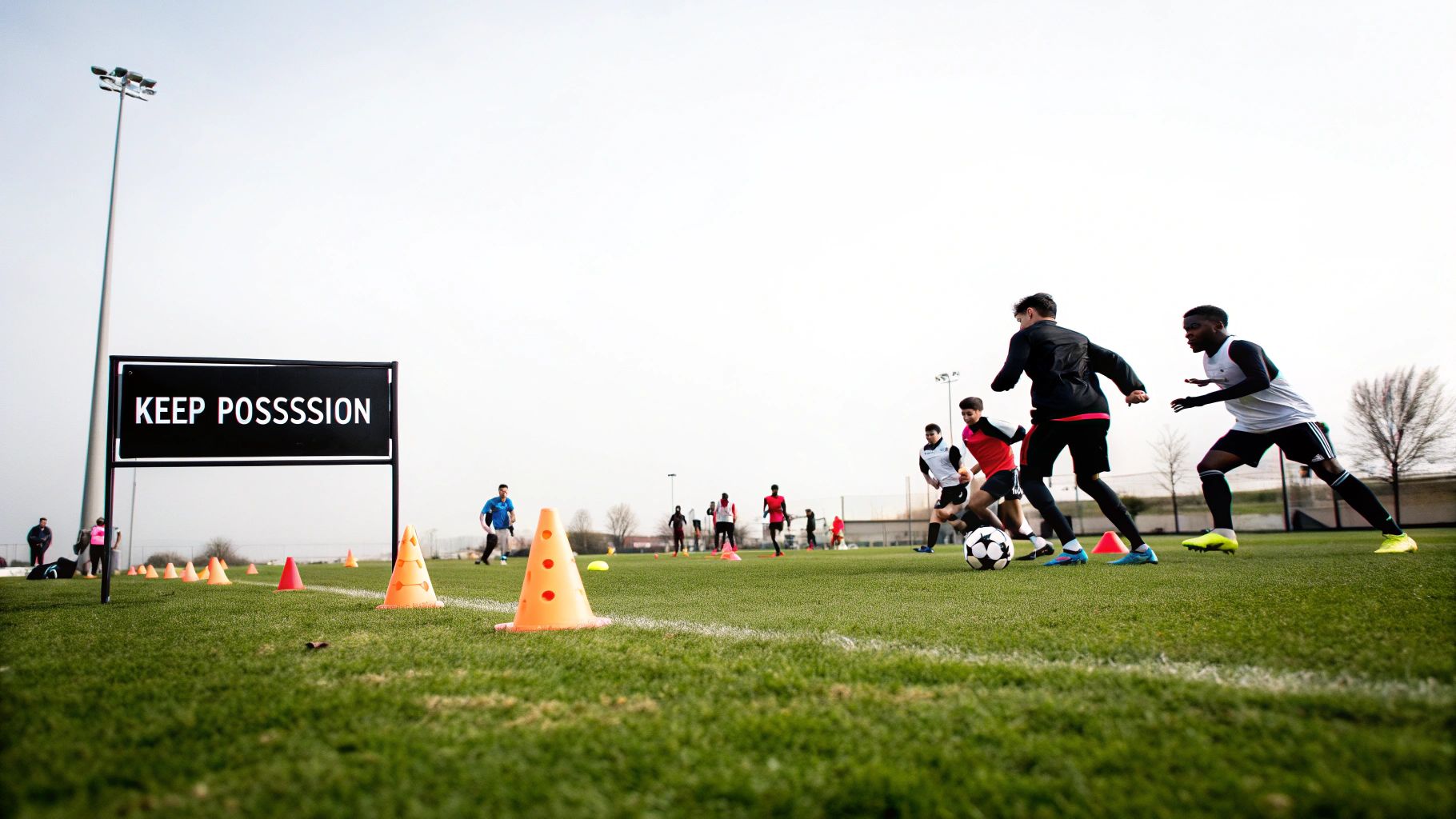
Keep Away, also known as Possession Isolation, elevates the basic Rondo by creating a more game-realistic, competitive environment. In this drill, two teams compete in a defined area with the sole objective of maintaining possession for as long as possible or completing a set number of passes. The team without the ball must press aggressively and work cohesively to win it back, simulating the intense transitions that define modern football.
This drill is a staple for developing decision-making under pressure, improving ball retention, and sharpening the transition from defence to attack. Top-tier teams like Liverpool, under Jürgen Klopp, use variations of Keep Away to hone their famous gegenpressing philosophy, while Chelsea has employed it to master quick ball circulation. It is one of the most effective possession soccer drills for teaching players how to value the ball while simultaneously learning how to win it back with urgency.
Key Objectives and Setup
The primary goal is for the team in possession to string together passes, while the defending team works to disrupt play and force a turnover. The drill focuses on team shape, movement off the ball, and quick transitions upon losing or winning possession.
- Setup: Use training cones to mark out a rectangular grid (e.g., 20x30 yards). The size can be adjusted to change the difficulty.
- Players: A 6v3 or 8v4 setup works well, creating a numerical advantage for the attacking team.
- Execution: One team starts with the ball and tries to keep it. The defending team presses to intercept. When the defenders win the ball, they become the attacking team and must quickly secure possession.
Actionable Coaching Tips
To get the most out of your Keep Away sessions, focus on these tactical elements:
- Set Pass Targets: Challenge the possession team to complete 8-10 consecutive passes before they can "score" a point. This encourages patience and purpose.
- Shrink the Space: As players become more proficient, reduce the size of the playing area. A smaller grid increases the intensity of the press and demands a faster speed of play.
- Reward Defensive Actions: Award points to the defending team for successful tackles or interceptions that lead to them keeping possession. This motivates a high-intensity press.
- Coach Transition Moments: Emphasise the first 3-5 seconds after a turnover. The team that lost the ball should immediately counter-press, while the team that won it should secure the first pass to safety.
3. Possession with a Neutral Player
Introducing a neutral player is a brilliant tactical layer to add to standard possession games, popularised by coaches like Pep Guardiola to teach the principles of tiki-taka. In this drill, one or more neutral players (often called "jokers" or "floaters") always play for the team in possession. This creates a constant numerical advantage for the attacking side, encouraging intelligent movement and combination play.
This setup forces players to recognise and exploit numerical superiority, a key concept in modern football. The constant support from the neutral player helps build confidence in possession and develops a deeper understanding of angles, spacing, and positional rotation. It’s a fantastic way to train players to think one step ahead, making it one of the most effective possession soccer drills for developing tactical intelligence.
Key Objectives and Setup
The objective is for the team in possession, aided by the neutral player, to maintain the ball and connect passes, while the defending team works to win it back. The neutral player’s role is to offer a constant passing outlet and help create overloads.
- Setup: Create a rectangular grid (e.g., 20x30 yards) using cones.
- Players: A 4v4+1 setup is a great starting point (four attackers, four defenders, one neutral player). The neutral player should wear a distinct colour bib.
- Execution: The team with the ball works with the neutral player to create a 5v4 advantage. If the defending team wins the ball, they immediately transition to become the attacking team, utilising the neutral player.
Actionable Coaching Tips
To elevate the quality of this drill, concentrate on these tactical elements:
- Movement of the Neutral: Coach the neutral player to constantly move into space, either between lines or in wide areas, to offer the best possible passing option.
- Exploit the Overload: Encourage the attacking team to be patient and find the "third man". The extra player should facilitate quick, triangular passing patterns.
- Quick Transitions: Emphasise the speed of transition. The moment possession is lost, players must react instantly to defend, and the new attacking team must immediately look to use the neutral player.
- Enforce Touch Limits: Progress the drill by limiting players to two touches, or even one touch for the neutral player, to increase the speed of thought and execution.
4. Passing Lane Possession Drill
The Passing Lane Possession Drill moves beyond simple ball retention, teaching players why and where to pass. This exercise forces teams to think strategically about ball progression, focusing on moving the ball through specific channels or zones to break down an opponent's defensive structure. It’s a sophisticated drill used by top-tier clubs like Arsenal and Liverpool to develop intelligent midfielders and forwards who can slice through organised defences.
At its core, this drill develops a team's ability to transition between different passing styles, from short, patient build-up play to sharp, line-breaking passes. It challenges players to recognise passing lanes as they open and close, requiring exceptional spatial awareness and precise execution under pressure. As one of the more tactical possession soccer drills, it bridges the gap between technical practice and match-day application, training players to see the bigger picture.
Key Objectives and Setup
The primary objective is to maintain possession while successfully playing the ball through designated lanes or zones to a teammate. This teaches players to move the ball with purpose, rather than just keeping it for the sake of it.
- Setup: Create a rectangular grid (e.g., 30x20 yards) and divide it into three vertical lanes using cones or markers.
- Players: A common setup is 6v3 or 8v4, with the attacking team aiming to keep possession.
- Execution: The attacking team scores a point by successfully passing the ball from an outside lane, through the central lane, to a player in the opposite outside lane.
Actionable Coaching Tips
To elevate the effectiveness of this drill, focus on these critical coaching points:
- Define the Lanes Clearly: Use flat markers or different coloured cones to ensure the passing lanes are clearly visible to all players. This visual cue is essential for understanding the drill's objective.
- Start Without Pressure: Begin with a passive defence or no defenders at all to allow attackers to understand the passing patterns and movements required. Gradually introduce defenders to increase the challenge.
- Emphasise Pass Quality: The focus should be on the quality, weight, and timing of the pass, not just the number of completions. Reward passes that are sharp, accurate, and break lines effectively.
- Encourage Player Rotation: Ensure players rotate through different lanes and positions. This helps them understand the passing options and movements available from various areas of the pitch.
To build the foundational skills needed for this drill, explore our detailed guide on passing and moving drills for soccer, which can help prepare your players for more complex exercises.
5. Triangle Possession Drill
The Triangle Possession Drill is a technical exercise that teaches players the geometric principles underpinning modern possession football. Popularised by Barcelona during their tiki-taka era, this drill focuses on creating and maintaining triangular shapes to provide constant passing options for the player on the ball. It ingrains the habits of intelligent movement, precise passing, and creating angles to dominate possession.
At its heart, this drill moves beyond simple keep-away and into a more structured form of ball retention. It forces players to think two or three steps ahead, constantly adjusting their position to support teammates and maintain the team's shape. For coaches looking to implement a sophisticated, patient build-up style, the triangle possession drill is one of the most fundamental possession soccer drills to master.
Key Objectives and Setup
The primary objective is for players to move the ball quickly and efficiently by constantly forming triangles around the ball carrier. This drill develops spatial awareness, communication, and the quality of the first touch, as players must receive and pass in fluid motions.
- Setup: Place three cones in a triangle, approximately 8-10 yards apart.
- Players: Start with three attackers and one defender (3v1). The attackers position themselves at each cone.
- Execution: The three attackers pass the ball amongst themselves, aiming to keep possession away from the defender. The players are encouraged to move off their cone after passing to create new angles and reform the triangle.
Actionable Coaching Tips
To get the most out of this foundational drill, focus on the details of player movement and technique:
- Introduce Movement Gradually: Begin with players staying at their cones to master the basic passing pattern. Then, progress to requiring the passer to move to an open cone or space immediately after releasing the ball.
- Emphasise First Touch Direction: Coach players to take their first touch away from pressure and into space, setting up their next pass. A good first touch is the key to maintaining the drill's tempo.
- Use Visual Cues: Initially, use different coloured cones to define the triangle's points. This helps younger players visualise their positioning and understand the geometric concept.
- Promote 'One-Two' Combinations: Encourage quick give-and-go passes (one-twos) to unbalance the defender and reinforce the importance of movement after passing.
6. Directional Possession Drill
While keeping the ball is important, possession without purpose is ineffective. The Directional Possession Drill bridges the gap between patient build-up and incisive attacking play, teaching teams to move the ball with intent towards a specific target. It forces players to think beyond simply maintaining possession and start identifying moments to break lines and progress up the pitch, a hallmark of tactically sophisticated teams like Manchester City and Liverpool.
This exercise elevates basic keep-away by adding a clear objective, simulating the real-game challenge of transitioning from midfield dominance to creating scoring opportunities. It develops purposeful passing, intelligent movement, and the timing of forward runs. By embedding a clear goal into the exercise, it becomes one of the most effective possession soccer drills for teaching teams how to turn control of the ball into tangible attacking threats.
Key Objectives and Setup
The primary objective is for the possession team to work the ball from a starting zone into a designated end zone, while the defending team aims to win possession and prevent this progression. This creates a more game-realistic possession scenario.
- Setup: Mark out a rectangular area (e.g., 30x20 yards) with a 5-yard end zone at each end.
- Players: A 6v4 or 7v5 setup works well, creating a numerical advantage for the possession team to encourage success.
- Execution: The possession team starts with the ball and scores a point by successfully passing to a teammate inside the opposition's end zone. Defenders aim to win the ball and can score by dribbling into the opposite end zone.
Actionable Coaching Tips
To get the most value from this drill, focus on coaching purposeful and progressive play:
- Reward Forward Play: Award bonus points for passes that split defenders or for quick combinations that lead to entering the end zone. This encourages positive, forward-thinking actions.
- Emphasise Player Rotations: Coach players to interchange positions and make runs that create space for others. A static shape makes it easy for defenders to block passing lanes.
- Focus on Timing: Teach players to recognise the right moment to play a forward pass. It’s not about forcing risky balls, but about patience and exploiting openings when they appear.
- Change the End-Zone Target: Instead of just a pass into the zone, require a player to dribble into it, or place mini-goals in the zone to transition into shooting.
7. Possession with Supporting Play
This is an advanced drill that elevates simple possession into a coordinated tactical exercise, focusing on intelligent off-the-ball movement and creating constant passing angles. Unlike basic keep-away games, this drill teaches players to think two or three steps ahead, ensuring the player on the ball always has multiple viable options for support. It is the tactical bedrock of elite teams like Manchester City under Pep Guardiola, where players move cohesively to maintain possession and unbalance the opposition.
At its core, "Possession with Supporting Play" develops a collective understanding of space, timing, and communication. The goal isn't just to keep the ball, but to do so with purpose by creating a dynamic support structure around the ball carrier. This is one of the most effective possession soccer drills for teaching players how to dominate a game through superior positioning and tactical awareness, transitioning them from individual skill to collective intelligence.
Key Objectives and Setup
The primary objective is to maintain possession by ensuring the player with the ball always has at least two clear passing options: a safe option and a forward option. The drill trains players to constantly adjust their position in relation to the ball, their teammates, and the defenders.
- Setup: Mark out a rectangular area (e.g., 20x15 yards). The size can be adjusted based on the number of players and skill level.
- Players: Start with a 6v2 or 7v3 setup. The attackers aim to keep possession, while defenders work to win the ball back.
- Execution: Attackers must focus on creating triangles and diamonds around the ball. The ball carrier's primary job is to find a pass, while teammates must move intelligently to become an option.
Actionable Coaching Tips
To get the most out of this drill, focus on the tactical details that foster collective understanding:
- Coach Specific Movements: Teach players to "check their shoulder" before receiving and to move into new spaces immediately after passing. Emphasise "third-man runs" and creating passing lanes.
- Use Visual Cues: Freeze the play and point out good and bad support positions. Ask players "Where could you have moved to help?" to improve their decision-making.
- Emphasise Communication: Players must communicate both verbally ("man on," "time") and non-verbally (gesturing, eye contact) to show where they want the ball.
- Rotate Positions: Ensure players experience different roles within the possession structure. This develops tactical versatility and an appreciation for the movement required in all areas of the pitch.
8. Possession Endurance Drill
The Possession Endurance Drill merges technical possession play with high-intensity physical conditioning, creating an essential exercise for teams that play a high-tempo, press-and-possess style. Popularised by the training philosophies of clubs like Barcelona and adapted by high-energy teams such as Liverpool, this drill trains players to maintain technical precision and tactical discipline even when physically fatigued. It simulates the demands of late-game scenarios where physical and mental resilience are paramount.
At its core, this drill challenges players to keep the ball for extended periods, combining cardiovascular load with constant decision-making. By pushing physical limits while demanding sharp passing, intelligent movement, and good communication, it builds the specific type of fitness required for possession-based football. This makes it one of the most effective possession soccer drills for developing a team that can dominate the ball from the first minute to the last.
Key Objectives and Setup
The primary goal is for teams to maintain possession under continuous pressure for prolonged intervals, building both physical endurance and mental concentration. The focus is on quality retention over a long duration rather than a set number of passes.
- Setup: Create a large grid (e.g., 40x30 yards), adjusting based on the number of players.
- Players: Use a format like 8v8 or 10v10 with two neutral players to ensure the possession team has a numerical advantage, encouraging success.
- Execution: One team aims to keep possession for a set time (e.g., 4-5 minutes) before switching roles. The defending team presses aggressively to win the ball.
Actionable Coaching Tips
To maximise the effectiveness of this demanding drill, focus on managing player workload and maintaining technical standards:
- Monitor Intensity Levels: Use GPS trackers to monitor player workload and ensure they are working within the desired physical zone. This prevents over-exertion and optimises fitness gains.
- Schedule Hydration Breaks: Keep intensity high but provide short, scheduled water breaks between intervals (e.g., every 5 minutes) to aid recovery and maintain performance.
- Emphasise Quality Under Fatigue: Constantly reinforce the importance of a sharp first touch, accurate passing, and intelligent body shape, even as players tire.
- Rotate Neutral Players: Ensure neutral players are swapped out regularly, as their role is often the most physically and mentally demanding in continuous play.
9. Positional Possession Drill
The Positional Possession Drill bridges the gap between abstract possession exercises and real match application. Popularised by tactical visionaries like Pep Guardiola, this drill requires players to maintain possession while adhering to positions relative to their actual roles in a team's formation. This isn't just about keeping the ball; it's about keeping it with purpose and structure, mirroring the organised patterns seen in top clubs like Manchester City and Arsenal.
This exercise forces players to think about role-specific passing angles, movement, and responsibilities. By creating a framework that reflects the team's tactical shape, it develops a collective understanding of how to build play from the back, progress through midfield, and create chances. It is one of the most intelligent possession soccer drills for teaching players not just what to do, but why they are doing it within the team's system.
Key Objectives and Setup
The primary goal is for players to circulate the ball effectively while maintaining their designated positions, understanding how to create and exploit space as a cohesive unit. The focus is on intelligent movement and passing that respects the team's formation.
- Setup: Use cones to mark out a large grid, subdivided into zones representing different positions on the pitch (e.g., centre-back zones, midfield zones).
- Players: Arrange players in their match-day positions within the zones, for example, a 4-3-3 shape against a few defenders.
- Execution: The possessing team must pass the ball between zones, focusing on creating triangles and finding passing lanes. Defenders press to try and win the ball back.
Actionable Coaching Tips
To elevate the tactical understanding gained from this drill, concentrate on these details:
- Define Clear Zones: Use different coloured cones to clearly delineate each player's primary area of operation. This provides a strong visual cue for maintaining structure.
- Emphasise Role-Specific Actions: Coach defenders on their passing range, midfielders on receiving on the half-turn, and forwards on their movement to create space.
- Introduce Progressions: Initially, restrict players to their zones. Then, allow limited movement, such as a midfielder dropping into a defender's zone to receive the ball, to teach fluid rotations.
- Focus on Body Shape and Scanning: Insist that players constantly scan their surroundings and receive the ball with an open body shape, preparing their next action before the ball arrives.
This drill is physically demanding, so ensure your players are conditioned. For tips on building endurance, check out our guide on how to improve stamina in football for comprehensive fitness strategies.
10. Possession Under Pressure (Press Resistance)
In modern football, where high-intensity pressing systems like Jürgen Klopp’s "gegenpressing" dominate, training players to be press-resistant is non-negotiable. This drill is specifically designed to simulate the chaos of a coordinated press, forcing the possession team to maintain control and make smart, quick decisions under extreme duress. It moves beyond simple possession and teaches players how to protect the ball and find solutions when opponents close them down aggressively.
The essence of this drill is to develop composure, technical security, and rapid cognitive processing. By recreating the high-stakes moments of a real match, players learn to trust their first touch and play their way out of trouble rather than panicking. It's a cornerstone of the philosophy at elite clubs like Liverpool and Manchester City, making it one of the most relevant possession soccer drills for teams aiming to play a modern, progressive style.
Key Objectives and Setup
The goal is for the attacking team to keep the ball while the defending team applies a coordinated, high-intensity press. The focus is less on pass count and more on the quality of decision-making and execution under pressure.
- Setup: Create a rectangular grid (approx. 20x25 yards). The size can be adjusted to change the difficulty.
- Players: A 6v3 or 8v4 setup works well, creating a numerical advantage for the possession team but giving defenders enough numbers to press effectively.
- Execution: The possession team aims to keep the ball. The defenders work together to press the ball carrier aggressively, aiming to force a turnover within the grid.
Actionable Coaching Tips
To safely and effectively implement press resistance training, consider these points:
- Start with Controlled Intensity: Begin with defenders pressing at 70% intensity before escalating. This allows attackers to adapt without being overwhelmed.
- Emphasise Quick Execution: Coach players to take one or two touches at most. The solution to pressure is not dwelling on the ball but moving it quickly and intelligently.
- Vary Pressing Triggers: Instruct defenders to press on specific cues, like a poor touch or a sideways pass. This teaches attackers to recognise and avoid these dangerous moments.
- Focus on Body Shape and Scanning: Players must receive the ball with an open body shape, having already scanned the area to know their next move before the ball arrives. This is crucial for evading pressure.
11. End Zone Possession Game
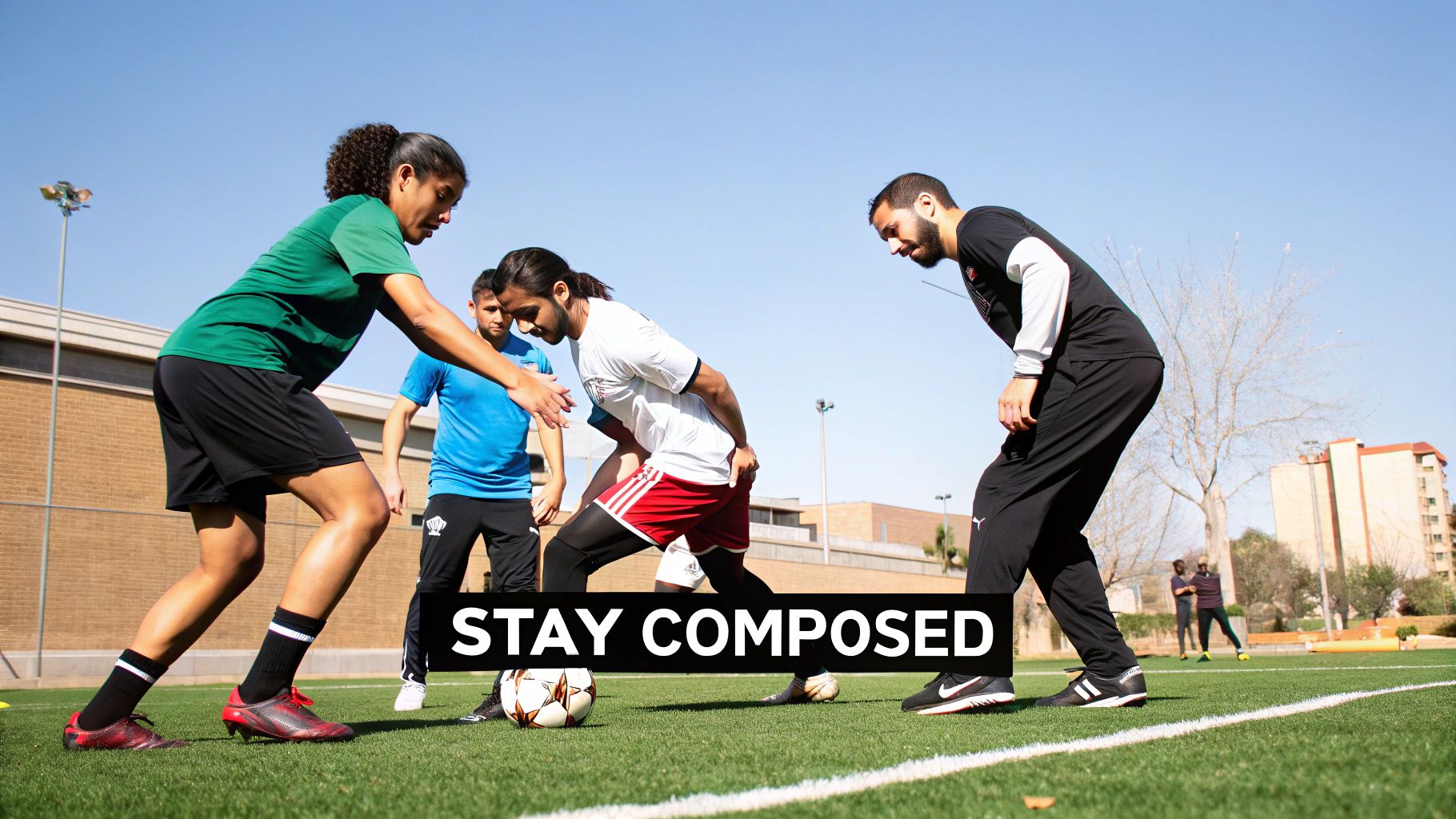
The End Zone Possession Game is a dynamic drill that directly translates possession into goal-scoring opportunities without using traditional goals. It forces teams to not only keep the ball but to do so with a clear purpose: penetrating the opponent’s final third. This exercise is excellent for teaching players how to progress the ball up the pitch and rewards effective build-up play.
This drill shifts the focus from simple passing to purposeful, forward-thinking possession. It challenges players to recognise moments to break lines and make decisive runs into a high-value area, mirroring the attacking phase of a real match. By creating a clear objective beyond just keeping the ball, it makes for one of the most game-realistic possession soccer drills available.
Key Objectives and Setup
The primary objective is for the attacking team to maintain possession and score a point by successfully dribbling the ball into, or completing a pass to a teammate inside, the opposition's designated end zone.
- Setup: Create a rectangular pitch (approx. 40x30 yards) with a 5-yard deep end zone at each end, marked with cones.
- Players: Play 6v6 or 8v8, with teams organised in their respective formations. A neutral "floater" can be added to create an overload for the attacking team.
- Execution: Teams attempt to work the ball from one end of the pitch to the other. A point is scored when a player receives a pass under control inside the opponent's end zone.
Actionable Coaching Tips
To get the most out of this drill, concentrate on these coaching points:
- Reward Forward Passes: Encourage players to look for vertical or diagonal passes that break the opponent’s lines. Praise bravery on the ball.
- Emphasise Movement: Coach players without the ball to make intelligent runs into the end zone, timing their movement to arrive as the pass is played.
- Introduce Touch Limits: Start with unlimited touches, then progress to a two-touch or three-touch maximum to increase the tempo and challenge players' decision-making.
- Coach Defensive Principles: Remind the defending team to stay compact, shift as a unit, and deny penetrating passes into their end zone.
12. 4-Goal Possession Game
The 4-Goal Possession Game is a highly effective drill that teaches players to combine ball retention with quick changes in the point of attack. By placing four small goals in the corners of a grid, it forces the team in possession to constantly scan the field and switch play to exploit open space. This is a favourite of coaches looking to develop players who are not only comfortable on the ball but also tactically aware.
This drill is excellent for developing peripheral vision, decision-making, and the ability to execute long-range passes under pressure. It moves beyond simple 'keep ball' and introduces the strategic element of attacking multiple targets, forcing defenders to cover more ground and creating gaps to exploit.
Key Objectives and Setup
The primary goal is to maintain possession and score by passing the ball through any of the four mini-goals. This encourages the attacking team to switch play and find the path of least resistance.
- Setup: Create a square or rectangular grid (e.g., 40x30 yards). Place four small pop-up goals or cone goals, one in each corner.
- Players: Use a 6v6 or 8v8 format. This ensures a competitive game with enough space for switching play.
- Execution: Both teams compete to score in any of the four goals. After a goal is scored, possession is turned over to the other team.
Actionable Coaching Tips
To get the most out of this game, focus on the following details:
- Encourage Switching Play: Explicitly reward long, diagonal passes that switch the point of attack and lead to a goal. This reinforces the core objective of the drill.
- Promote Quick Transitions: After scoring, the team must quickly transition to a defensive shape to prevent the opposition from launching a fast counter-attack.
- Demand Head-Up Play: Coach players to constantly scan the field to identify which of the four goals is the best attacking option at any given moment.
- Adjust Grid Size: Make the grid larger to encourage longer passes and more running, or smaller to focus on quick, intricate combination play around the goals.
Building Your Possession-Based Identity
Mastering possession is a journey, not a destination. Throughout this guide, we have explored a diverse range of possession soccer drills, from the foundational Rondo to the complex Positional Possession exercises. The journey from simply keeping the ball to truly dominating a match through intelligent movement, sharp passing, and cohesive team play is built block by block in training sessions. Each drill serves a unique purpose, but they all contribute to the same overarching goal: creating a team that is comfortable, confident, and creative with the ball at its feet.
The key is to see these drills not as isolated activities but as interconnected components of a larger tactical philosophy. Think of them as a toolkit. The Rondo forges quick decision-making in tight spaces. Keep Away drills instil a relentless desire to maintain the ball. Directional Possession games introduce the crucial concept of purpose, teaching players not just to keep the ball, but to progress it towards a target. By weaving these drills together, you cultivate a possession-based identity that becomes second nature to your players on match day.
From Drills to Dominance: A Practical Framework
Implementing these possession soccer drills effectively requires a strategic, layered approach. It's not about running through every drill in a single week; it's about building a curriculum that progresses logically.
- Foundation First: Always start with the fundamentals. A team that cannot execute a basic 5v2 Rondo with confidence and quality will struggle with more complex games. Dedicate consistent time to these foundational exercises to sharpen first touch, body shape, and communication.
- Layer the Complexity: Once the basics are solid, begin adding tactical elements. Introduce neutral players to create overloads, add target goals or end zones to encourage purposeful play, and gradually shrink the playing area to increase the pressure and demand quicker thinking.
- Context is King: The most effective coaching connects the training ground to the pitch. Constantly ask your players, "Where would you see this situation in a game?" By linking a Positional Possession drill to building out from the back, or a Press Resistance exercise to escaping a high press, you give the training context and meaning.
Coaching Insight: Remember that the ultimate aim of possession is not just to have the ball, but to use it to unbalance the opposition and create scoring opportunities. Your coaching cues should always reinforce this end goal. Encourage bravery on the ball, reward forward-thinking passes, and celebrate intelligent movement that breaks defensive lines.
Beyond the Cones: Cultivating a Possession Mindset
Ultimately, a true possession-based style is about more than just technique; it's a collective mindset. It requires patience, trust, and a shared understanding among all players. It means the centre-back must be as comfortable receiving the ball under pressure as the attacking midfielder. It demands that players without the ball work just as hard, constantly creating angles and options for their teammates.
The possession soccer drills outlined in this article are your blueprint for instilling this mindset. They create an environment where players are constantly making decisions, communicating, and working together towards a common objective. By committing to this training methodology, you are not just teaching players how to pass and move; you are empowering them with the tactical intelligence and technical security to control the rhythm of any game, turning your team into a formidable, ball-dominant force.
To execute these drills with precision and get the most out of every session, having the right equipment is essential. From high-visibility marker cones and durable training bibs to advanced GPS trackers that monitor player load, SoccerWares provides the professional-grade gear needed to elevate your training. Equip your squad for success by exploring our extensive collection of training essentials at SoccerWares.