

Forget the old-school image of a coach just barking orders from the sidelines. The modern coach's role has expanded far beyond simple instruction. Today, a great coach is a tactician, a teacher, a mentor, and a manager all rolled into one, blending the art of motivation with the science of peak performance.
What Does a Modern Sports Coach Actually Do?
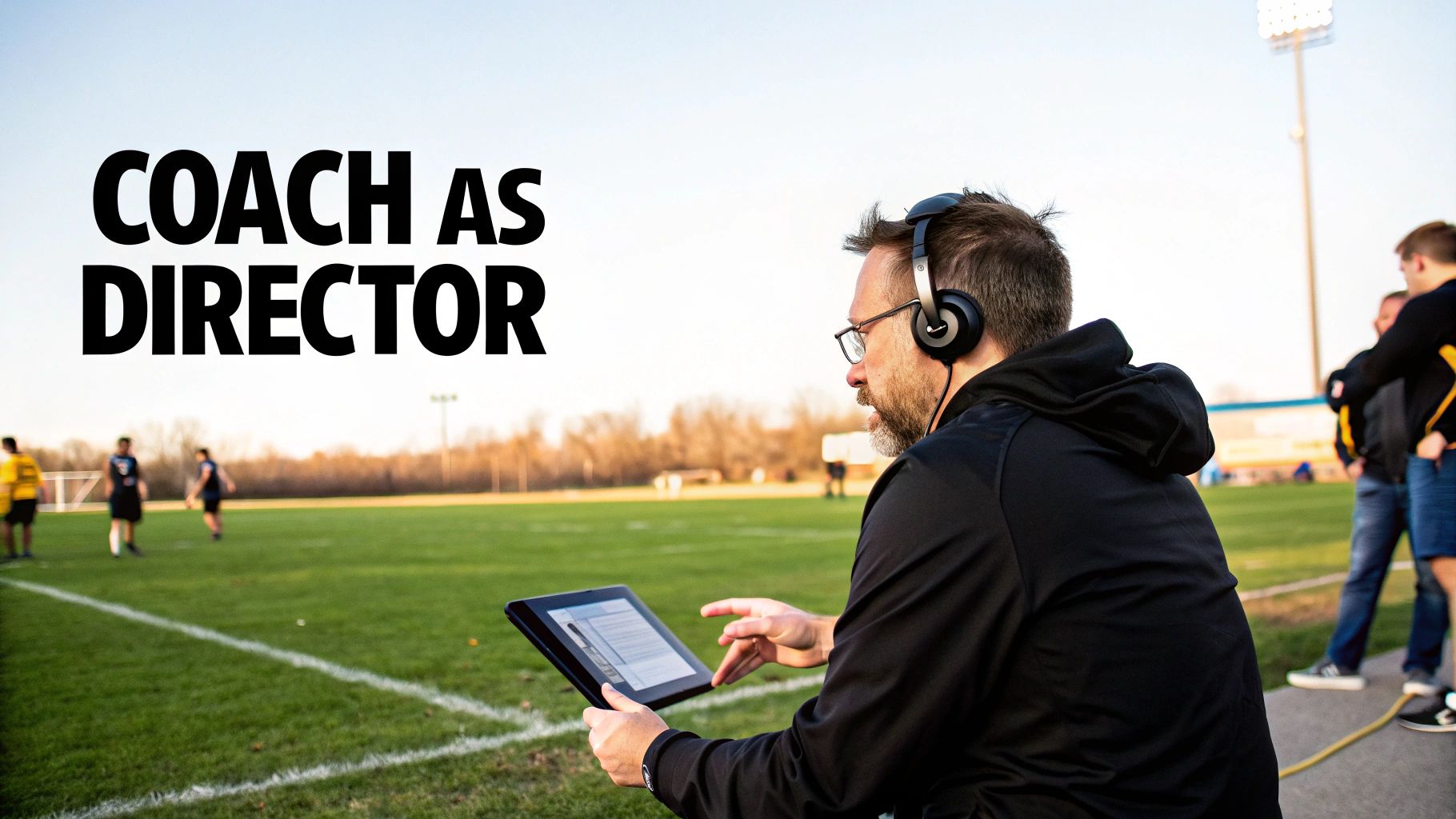
Think of a successful football manager less like a PE teacher and more like a film director. They are in charge of the entire production. The game plan is the script, the players are the actors, and the entire support staff—from physios to data analysts—are the crew. The coach’s job is to pull all these pieces together to create a winning performance on match day.
This director analogy captures the sheer breadth of a modern coach's responsibilities. It’s no longer enough just to know your X's and O's or how to set up a 4-4-2. A coach must now manage different personalities, make sense of complex performance data, and look after the holistic well-being of their athletes.
To give you a clearer picture, let's break down these core duties into a simple table.
The Modern Coach at a Glance
| Core Role | Primary Focus | Example in Football |
|---|---|---|
| The Tactician | Devising game plans, formations, and in-game strategies. | Setting up a high press to counter a team that plays out from the back, or designing specific set-piece routines. |
| The Teacher (Pedagogue) | Developing player skills, technique, and football intelligence. | Running drills to improve a striker's finishing or using video analysis to teach a defender better positioning. |
| The Mentor | Supporting player welfare, building trust, and fostering mental resilience. | Helping a young player manage the pressure of breaking into the first team or providing support during a challenging personal time. |
| The Leader | Establishing a strong team culture, setting standards, and motivating players. | Creating a 'never-say-die' attitude within the squad or defining the team's core values, like hard work and respect. |
As you can see, the job description is extensive. An effective coach has to switch between these roles seamlessly, adapting to whatever the team or an individual player needs at that moment.
The Coach as a Multifaceted Leader
The contemporary coaching role is built on several key pillars, each demanding a different skill set. It’s a constant balancing act.
These core functions include:
- Tactical and Strategic Planning: This is the chess match. It involves designing formations, drilling set-piece plays, and making crucial in-game adjustments to outsmart the opposition.
- Skill Development and Pedagogy: Here, the coach is a teacher. Their job is to improve an athlete's technical ability and game intelligence through carefully designed drills and constructive, targeted feedback.
- Mentorship and Player Welfare: This is about the person, not just the player. It means building genuine trust, supporting athletes through their personal and professional challenges, and nurturing a positive, resilient mindset.
- Leadership and Culture Building: This is the foundation. It involves setting the team's values, demanding high standards of behaviour, and inspiring the entire squad to work together for a common goal.
Beyond just physical training, a massive part of a modern coach's role is supporting the mental health of their athletes. This focus on psychological well-being is no longer a 'nice-to-have'; it's essential for sustained performance. Resources on Unlocking Performance with Sports Mental Health Strategies offer brilliant insights into this growing responsibility. This holistic approach ensures athletes are ready not just physically, but mentally for the intense pressures of competition.
The Seven Pillars of Effective Coaching
Forget the simple labels of ‘tactician’ or ‘mentor’. A modern coach's job is built on seven distinct pillars. Each one is a core responsibility that drives both individual player growth and the team's collective success. Mastering these turns a good coach into a great one.
Think of it like building a house. You cannot just have strong walls and forget the foundation. A coach might be a tactical genius, but if they neglect player welfare, the whole structure can collapse. Likewise, a great motivator will get nowhere if their players lack the basic technical skills to execute the game plan.
Tactical and Technical Mastery
This is what most people see on match day, but it’s actually two different skills working together.
Tactical development is the ‘why’. It’s the grand plan, the formations, and the in-game chess moves designed to outwit the opposition. For example, a coach might decide to deploy a high press to stop a team that loves to play out from the back. That is a tactical choice.
On the other hand, technical skill enhancement is the ‘how’. It’s all about improving a player's fundamental abilities—perfecting their passing accuracy, sharpening their shooting technique, or drilling their defensive stance. This is where you get hands-on with equipment like cones, agility ladders, and rebounders from SoccerWares.com to build that crucial muscle memory. A coach’s ability to teach these fine details is what makes the overall strategy work on the pitch.
Physical and Psychological Preparation
A top team is made of athletes who are as tough mentally as they are physically. The coach is central to developing both.
-
Physical Conditioning: This is about managing fitness, strength, speed, and stamina. A coach collaborates with specialists to build training plans that ensure players peak for big games while keeping injuries at bay. Using data from GPS trackers, for instance, can tell a coach exactly when a player is in the red zone and needs a rest.
-
Psychological Preparation: Football is a mind game. A great coach builds mental resilience, teaching players how to handle pressure, shake off mistakes, and stay focused during make-or-break moments. It’s about fostering an environment of trust and confidence where players are not afraid to fail.
Mentorship, Leadership, and Development
The final three pillars reach beyond the pitch and into the human side of the game. Holistic player welfare and mentorship is about remembering your players are people first. It means offering guidance on life, building genuine relationships, and supporting them as individuals. A coach acting as a true mentor helps a young player navigate the tough moments in their career and beyond.
A coach's most profound impact often comes not from a specific tactic, but from their ability to build a culture where every player feels valued, supported, and driven to improve for the collective good.
This blends perfectly into leadership and culture building, where the coach defines the team’s identity. They set the standards, embody the values, and create a shared purpose that unites everyone. Finally, there's continuous professional development. The best coaches never stop learning. They’re constantly studying new tactics, exploring new technology, and understanding new psychological approaches to stay ahead and give their players the very best.
Exploring the Different Coaching Roles in a Team
Not every coach carries the same whistle or clipboard. A modern football team, especially at the professional level, runs less like a one-person show and more like a specialist surgical team.
The Head Coach is the lead surgeon, setting the overall vision and making the critical calls. But they lean heavily on a team of experts, each with a distinct role, to ensure every player performs at their peak. Think of it as a puzzle—every coaching role is a vital piece, and the team only reaches its full potential when they all fit together perfectly.
The Specialised Coaching Staff
In any high-performing club, you will find a few key roles working in harmony. The structure is built to cover everything, from the big-picture strategy right down to an individual player’s first touch.
- The Head Coach (or Manager): This is the architect of the team. They define the playing philosophy, make the major tactical decisions, and steer the entire squad. Ultimately, they are the one responsible for the results.
- The Assistant Coach: The Head Coach's right-hand person. They are deeply involved in planning and running daily training sessions, often acting as the bridge between the manager and the players. Their job is to turn the manager's vision into drills and actions on the pitch.
- The Technical Coach: This is the skills specialist. This coach is laser-focused on honing specific abilities, like a striker’s finishing, a defender’s tackling technique, or a midfielder’s passing range. They provide that crucial one-on-one feedback to perfect technique.
This infographic breaks down the core pillars of coaching into the tactical, technical, and mental domains, which are often shared among these specialist roles.
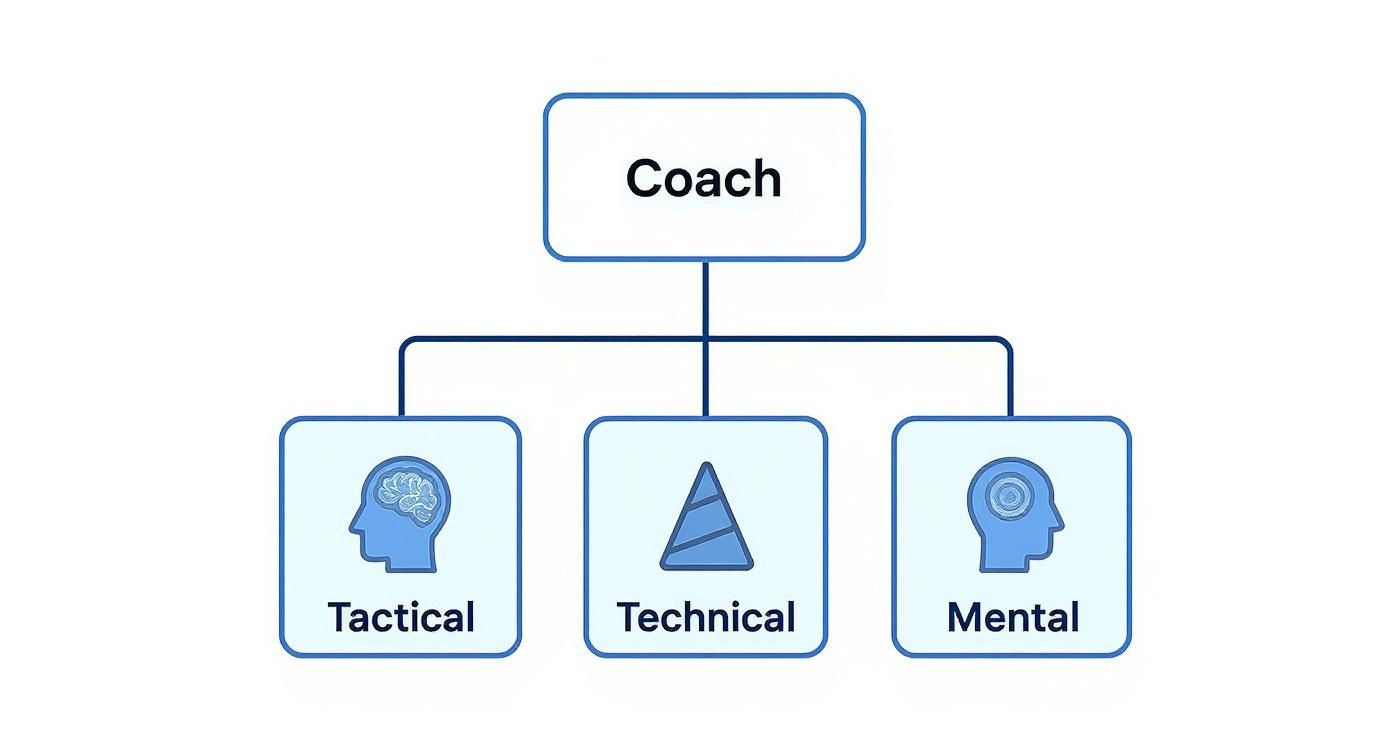
The diagram drives home how a coach has to master strategy (the tactical side), execution (the technical skills), and mindset (the mental game). This is a huge reason why a team of specialists has become so valuable.
The Performance and Analytical Experts
Beyond the traditional tracksuited staff, modern teams are powered by data and sports science.
- Strength and Conditioning Coach: Think of them as the team’s engine builder. They design fitness programmes to improve players' speed, strength, and stamina while working tirelessly to prevent injuries. Their work ensures athletes are physically ready for the demands of a long season.
- Performance Analyst: This is the data detective. Their role involves poring over match footage and performance data from tools like GPS trackers to spot tactical patterns—both in their own team and the opposition. They provide the hard evidence that shapes the Head Coach’s biggest decisions.
This growing specialisation has led to a boom in coaching roles. The total number of sports coaches, instructors, and officials in the UK has been on a steady rise, showing how professional the entire sector has become.
This expansion highlights a huge demand for qualified people at all levels of sport. You can explore more data on UK coaching employment trends on Statista.com to see how these roles have evolved. It’s a clear sign that coaching is a serious career path that demands constant learning and adaptation.
Integrating Data and Technology into Coaching

Not so long ago, a coach's essential tools were a whistle, a clipboard, and a well-honed gut instinct. While intuition still counts for a lot, today's top coaches are also part data analyst, turning raw numbers into a genuine competitive advantage.
This is not about replacing experience with spreadsheets. It’s about backing up what you see with hard evidence. Technology provides a window into what the naked eye can easily miss, uncovering subtle patterns in training, recovery, and opponent analysis that can be the difference between a win and a loss.
From Metrics to Match-Winning Decisions
The biggest leap forward has been in how we monitor player performance and welfare. Tools that were once the exclusive domain of elite, big-budget clubs are now finding their way to all levels of the game, giving coaches incredible insights.
A couple of key technologies have reshaped the modern coaching role:
-
GPS Performance Trackers: You have probably seen players wearing specialised vests with a small pod between their shoulder blades. These devices track everything from total distance covered and top sprint speed to the number of accelerations and decelerations. This data is invaluable for managing training loads, preventing burnout, and spotting the early signs of fatigue that often lead to soft-tissue injuries.
-
Video Analysis Software: This is a coach's best friend for breaking down performances. You can deconstruct your own team's tactics or pick apart an opponent's set-piece routines. By tagging key moments in a match, a coach can instantly create a playlist of a striker's runs or show a defender exactly where their positioning went wrong, offering crystal-clear visual feedback.
This kind of data unlocks highly personalised coaching. Instead of a one-size-fits-all training plan, you can tailor drills and recovery sessions to what an individual player actually needs, based on real numbers.
Picture this: Your winger's GPS data shows they covered 11 km in the last match, but their number of high-intensity sprints was unusually low. That single insight could spark a specific training drill focused on explosive power, directly addressing a gap you spotted with technology.
The Coach as a Data Interpreter
Of course, having all this data is one thing; knowing what to do with it is another game entirely. A huge part of the modern coaching role is translating complex information into simple, actionable instructions that players can understand and apply.
Bombarding a player with endless statistics will only overwhelm them. The coach must be the filter, picking out the one or two key points that will make a real difference.
To see just how far this is going, it is worth understanding how some are integrating AI to scale coaching, which highlights the move towards smarter, more automated analysis.
At the end of the day, the goal is simple: make smarter decisions. It could be adjusting Tuesday's training session based on the weekend's exertion levels or showing a forward video clips of a keeper's tendencies before a penalty shootout. By embracing technology, coaches add a powerful layer of objectivity to their hard-earned expertise. If you want to delve deeper, our guide on how technology in football is changing the game is a great next step.
How Coaching Changes From Grassroots to Elite Levels
The journey from the local park to a professional stadium changes everything for a coach. What works for a team of seven-year-olds will not work in a Premier League dressing room. The pressures, the priorities, and the entire purpose of coaching shift dramatically as you move up the ladder.
It’s a transition from simply sparking a passion to demanding outright perfection.
Grassroots Coaching: All About Fun and Fundamentals
At the grassroots level, a coach wears many hats, but the most important one is that of an educator and motivator. The real win is not a trophy at the end of the season; it’s seeing the same children turn up again next year, still enthusiastic about football.
Success is measured in smiles and returning players, not by where you finish in the league table.
In youth football, the job is all about creating a safe, fun, and positive space where children can fall in love with the game. The focus is squarely on participation and getting the basics right.
- Teaching the Basics: Forget complex tactical setups. We are talking about core skills like dribbling, passing, and teamwork, all taught through fun, game-based drills.
- Building Confidence: Coaches celebrate effort, not just results. This helps young players build self-esteem and learn to bounce back from mistakes without any fear of failure.
- Fostering a Love for Sport: The number one goal is making sure the children have a brilliant time, encouraging them to stay active and involved in sports for the long haul.
A grassroots coach's greatest victory is not a championship title. It's seeing a child fall in love with football, learn a new skill, and understand what it means to be part of a team.
This role is the absolute backbone of community sport in the UK. Around 3.1 million adults have coached in the past year, and the vast majority—about 68%—are working at these grassroots levels. While more coaches are now entering structured academy pathways, it is these volunteers who keep the game alive.
Elite Coaching: The Hunt for Peak Performance
As you climb into the elite game, the entire dynamic flips on its head. Mentorship and player well-being are still part of the job, of course, but the overriding priority becomes squeezing every last drop of performance out of the team to win.
Football is now a high-stakes profession, and winning is the only metric that truly matters.
Coaching at this level is a different beast entirely:
- Advanced Tactical Systems: You’re implementing complex strategies, analysing opponents in forensic detail, and making game-changing adjustments on the fly.
- Managing High-Pressure Environments: This means handling intense media scrutiny, managing big player egos, and making ruthless selection decisions that can make or break a season.
- Data-Driven Decisions: Every decision is backed by data. Coaches use detailed analytics from GPS trackers and video analysis to fine-tune every single aspect of individual and team performance.
Technology is not just for the pros anymore. At SoccerWares.com, we believe accessible tech can give players at all levels a massive boost, offering a range of equipment to help develop the next generation.
Answering Your Questions About Sports Coaching
Let's wrap things up by tackling a few of the most common questions people have about coaching. Think of this as a quick-fire round to clear up any lingering thoughts you might have about the profession.
What Qualifications Do You Need to Be a Sports Coach in the UK?
In the UK, the path to becoming a qualified coach is usually set by the sport’s National Governing Body (NGB). For football, that means The FA. The journey typically starts with an introductory course and can go all the way up to elite-level badges like the UEFA A Licence.
However, regardless of the sport, two things are absolutely non-negotiable: safeguarding and first aid qualifications. This is especially true when you are responsible for young athletes. For a more detailed look at the football coaching ladder, our guide on how you can become a football coach breaks down every step you will need to take.
How Do Coaching Roles Differ Between Team and Individual Sports?
The core job changes massively. In a team sport like football, the coach is a master of group dynamics. Their world revolves around building a cohesive unit, getting 11 players to work as one, and implementing complex tactical systems that the entire squad understands. The focus is always on the collective.
Now, contrast that with an individual sport like tennis or athletics. The coach’s role becomes intensely personal. It’s all about one-on-one technical refinement, mental preparation, and mapping out a single athlete's career path. The relationship is much more direct and focused.
What Qualities Make a Truly Great Sports Coach?
Look beyond the clipboard and the tactical diagrams. The best coaches are exceptional communicators, leaders, and, most importantly, mentors. They have a high degree of empathy, which allows them to connect with their players on a human level and build genuine, lasting trust.
The most impactful coaches inspire belief. They can explain complex ideas simply, adapt their methods to suit their players, and cultivate an environment where athletes are motivated to improve continuously.
It’s this ability to nurture both the person and the player that separates a good coach from a truly great one.
At SoccerWares, we provide the gear that supports every coaching role, from grassroots to the elite level. Explore our full range of training equipment and fan apparel at https://soccerwares.com.