

A size 4 soccer ball is the standard youth match between junior and full-size play: it typically measures 25–26 inches around, weighs 350–390 g, and suits most players aged 8–12. For parents and coaches, the practical takeaway is simple: it is smaller and lighter than a size 5, so young players can control first touches, pass with cleaner technique, and strike the ball without over-swinging.
How We Evaluated Size 4 Soccer Balls
When we review youth footballs, we do not start with branding or marketing claims. We start with fit for the player. For this guide, we looked at whether each ball matches accepted size 4 dimensions, how it feels off the foot for 8–12-year-olds, how well it keeps air, how quickly the cover scuffs on common surfaces, and whether the construction suits training, matches, or casual use.
We also weigh the buying questions parents and coaches ask: Is it durable enough for three sessions a week? Does it feel too firm for younger players? Will it hold up on artificial turf? Does it meet league expectations if the ball is meant for weekend matches?
In our experience, a youth ball gets ruled out quickly if it misses the official size range, feels overly heavy at normal pressure, loses inflation too fast, or has a hard casing that makes repeated striking unpleasant for younger players. We consider surface suitability essential, since a ball that is fine on grass can wear down much faster on abrasive turf or concrete. That is why the best choice is not always the most expensive one; it is the one that fits the player, the surface, and the amount of weekly use.
What Defines a Size 4 Soccer Ball?
A size 4 ball has a clear place in the game’s equipment standards. The accepted range is 63.5–66 cm in circumference and 350–390 g in weight, which puts it below a regulation size 5 in both diameter and mass. The usual age band is 8–12 years, a range reflected in major retail and coaching size guides such as DICK'S Sporting Goods and SELECT's ball size chart. The FA also publishes the formal dimensions in Law 2 of the game.
That difference from a size 5 is not cosmetic. A size 4 is roughly 4–6 cm smaller in circumference and about 60–100 g lighter than the adult ball. In practice, that means less effort to move the ball cleanly, better repeatability in passing drills, and less fatigue during sessions with lots of touches.
Size 4 vs Size 5 at a Glance
| Ball size | Circumference | Weight | Typical player age |
|---|---|---|---|
| Size 4 | 63.5–66 cm (25–26 in) | 350–390 g | 8–12 years |
| Size 5 | 68–70 cm | 410–450 g | 13+ years |
Why Those Measurements Matter
For younger players, a lighter and slightly smaller ball changes the mechanics of almost every action. On first touch, it is easier to cushion the ball instead of having it bounce away. On passes, players can use the inside of the foot and keep their hips and plant foot in better positions rather than muscling the ball forward. On shots, they are more likely to strike through the center of the ball instead of toe-poking or snatching at it.
I notice this most in mixed-age training: once a child is given the right ball size, the session usually becomes less about surviving the weight of the ball and more about actual technique. That is the point of size 4. It sits in the middle ground where the ball still feels game-like, but not so demanding that it encourages rushed mechanics.
If you want the bigger picture on transitions between youth ball sizes, our breakdown of different soccer ball sizes and age groups is a helpful next step.
Size 4 Soccer Ball vs Size 5: Which One Should You Use?
If the player is in the 8–12 range, size 4 is usually the right choice. If the player is 13 or older, size 5 is the standard match size. That sounds straightforward, but the confusion usually comes from stronger 11- or 12-year-olds who seem capable of kicking a full-size ball.
Ability to kick a bigger ball is not the same as benefiting from it. A child may be able to launch a size 5 downfield, but repeated work with a heavier ball often changes how they receive, pass, and shoot. We see this most often in long sessions: first touches get heavier, passes turn into toe-pokes, and shots come with too much body swing because the player is trying to create force instead of clean contact.
Use size 4 when the goal is youth development, high-rep training, and age-appropriate match play. Use size 5 when league rules require it or when the player has moved into the age band where full-size match standards apply. Adults can absolutely kick around with a size 4 for technical work or small-space drills, but it is not the normal match ball for adult football.
A simple rule works for most families and coaches: choose the ball size for the player’s age group first, then choose materials and build quality second.
Why the Right Ball Size Is So Important for Young Players
Using the correct ball size is primarily a technique issue first and a safety issue second. Coaching bodies and equipment guides consistently size youth balls by age because the ball changes how a player learns core movements: first touch, dribbling, passing shape, and striking mechanics. A size 4 sits in the development window where players are moving beyond basic familiarity and into more structured repetition, which is why major sizing guidance links it to the 8–12 range rather than treating it as a minor variation of a size 5 DICK'S guide.
The technique benefit is easy to see in training. With an age-appropriate ball, players can keep the ball closer, set their plant foot more naturally, and strike through passes without throwing their whole body into the action. In our experience, confidence grows fastest, not because the ball is easier in a vague sense, but because the player gets clearer feedback from each touch. Good habits are easier to repeat when the equipment is not fighting them.
Safety matters too, but it should be discussed carefully. Rather than leaning on unsupported injury numbers, it is more accurate to say that youth equipment standards and coaching guidance are designed to reduce unnecessary strain and manage exposure appropriately. For example, the U.S. Soccer Federation’s Recognize to Recover heading guidance limits heading for younger age groups and structures when and how heading is introduced. That does not mean a size 4 ball is a medical guarantee; it means age-appropriate equipment and coaching are part of safer development.
What Goes Wrong With the Wrong Ball Size
When a child trains regularly with a ball that is too big or too heavy, the problems usually show up in recognizable ways:
- Heavier first touch: the ball rebounds farther, so the player spends more time chasing than controlling.
- Poorer passing form: instead of striking through the middle with the inside of the foot, the player compensates with extra body movement.
- Toe-poking: children often jab at the ball because they cannot comfortably shape the foot around it.
- Over-swinging: the leg action gets exaggerated to generate force, which can flatten technique.
- Reluctance to strike cleanly: some players become hesitant, especially on volleys or firmer passes, because the contact does not feel manageable.
I have seen this most clearly in shooting drills: give a younger player the wrong ball and they often stop focusing on placement altogether. Give them the correct one and the conversation shifts back to body shape, contact point, and where they want the ball to go. That is why ball size matters so much at this stage.
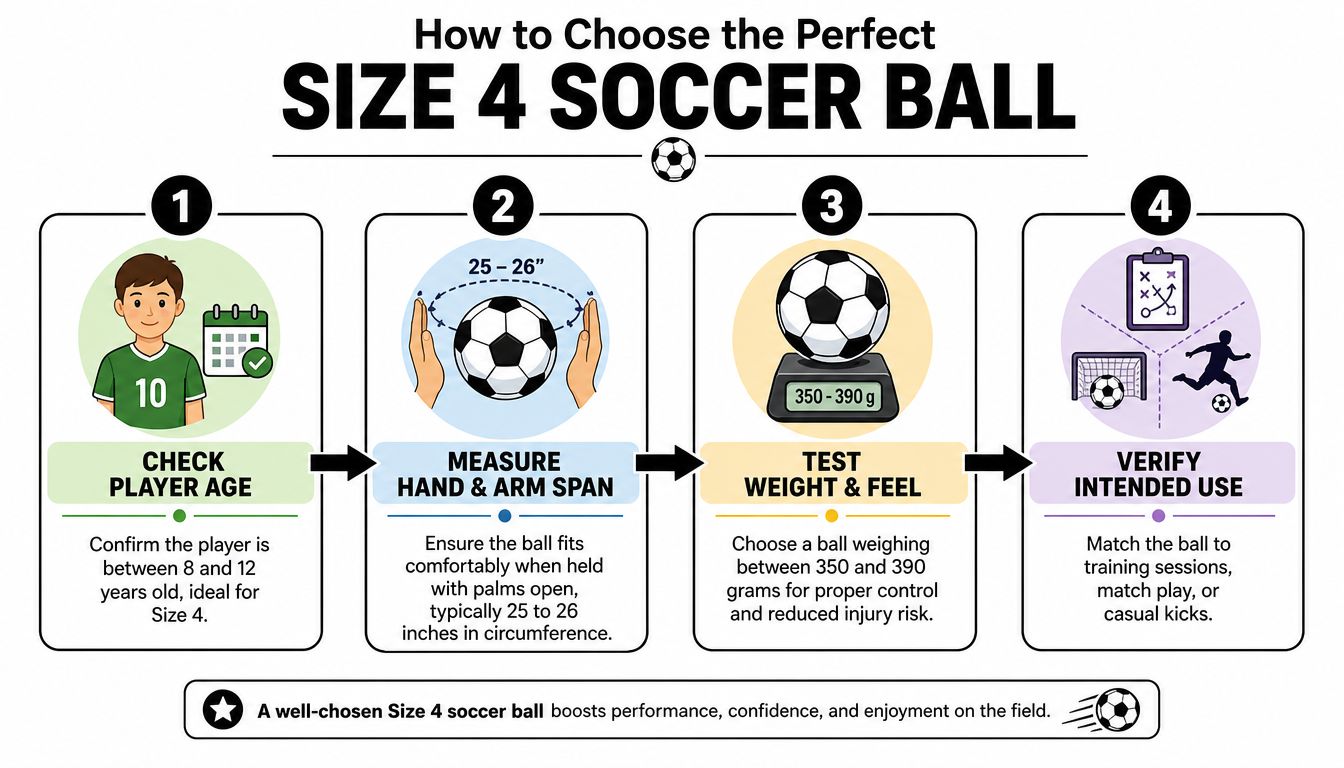
How to Choose the Perfect Size 4 Soccer Ball
Once you know size 4 is the right fit, the better buying question is not “Which one is best?” but “Best for what?” Parents usually care about durability and value. Coaches usually care about consistency, air retention, and whether the ball behaves similarly across a whole bag of training balls. The right choice depends on five things: use, surface, frequency, budget, and whether the ball needs to meet match standards.
Start With the Actual Use Case
- Training only: Choose durability first. A TPU cover and machine-stitched construction usually make the most sense for repeated sessions.
- Weekend matches: Prioritize touch, flight, and league compliance. A PU cover or higher-grade match-style finish is often worth it.
- Backyard or school use: Go for value and resilience over premium feel, especially if the ball may see rough surfaces.
- Club team use: Check whether the league or coach expects specific standards, especially for match balls.
Match the Ball to the Surface
The same ball will not wear the same way everywhere. On natural grass, a softer cover can make sense because abrasion is lower. On artificial turf, especially older rough turf, tougher outer materials tend to last longer. On hard playgrounds or concrete, even a good ball can deteriorate quickly, so it often makes more sense to keep a separate casual-use ball.
From what we have tested over time, this is where buyers make the most expensive mistake: using a premium match-style ball as an everyday school or garden ball. It feels great on day one, then ages fast in the wrong environment.
Think About Weekly Volume
A child playing once a week does not need the same ball as a player in two team sessions plus a match. If the ball will be used heavily, put inflation retention and cover durability above minor differences in feel. If it is mostly for matches, touch and consistency matter more.
Material and Panel Choices, Tied to Real Scenarios
Our complete size 4 football guide goes deeper on construction, but the short version is this:
- TPU casing: Best for frequent training, PE lessons, and club ball bags. It is tougher and usually more affordable.
- PU casing: Best for match use and advanced technical sessions where touch matters more.
- Machine-stitched panels: Strong value choice for regular use and team training.
- Thermally bonded panels: Better for premium match feel and lower water uptake, usually at a higher price.
Best Fit by Situation
| Situation | What to buy | Why |
|---|---|---|
| School training | Durable TPU, machine-stitched | Handles frequent use and mixed conditions |
| Club training | Mid-range TPU or blended cover | Balances feel, durability, and cost |
| Weekend matches | Softer PU or match-style ball | Better touch and more consistent flight |
| Backyard use | Budget training ball | Better value when wear and tear are higher |
Budget Tiers That Make Sense
- Budget: Best for casual play, school sessions, and younger players who mainly need repetition.
- Mid-range: Usually the smartest buy for most families; the jump in feel and durability is often worth it.
- Premium: Most useful when the ball must meet match expectations or closely mimic game-day performance.
Do You Need League Standards?
If the ball is for formal matches, check league rules before buying. Not every size 4 sold at retail is intended as a match ball. Some are clearly built as training models, which is fine for practice but not always ideal for organized fixtures. When parents ask us for one-ball-does-everything advice, the safest answer is usually a strong mid-range training ball unless the team specifically needs match certification.
Drills to Master the Size 4 Ball
Alright, you've got the perfect size 4 ball. Now for the fun part: putting it to work. This isn't just about kicking a ball around; it's the ideal tool for building the fundamental skills that separate good players from great ones.
Repetition with an age-appropriate ball is everything. It builds the muscle memory and confidence a young player needs to thrive on the pitch. A few simple but effective drills designed for the 8-12 age group focus on the core abilities of dribbling, first touch, and shooting.
Close Control Weaving
This is the bread and butter of ball mastery. It’s all about teaching a player to keep the ball glued to their feet while moving, an essential skill for navigating a crowded midfield.
How to set it up:
- Place five to seven cones in a straight line, roughly one metre apart.
- The player starts at the first cone, dribbling and weaving in and out until they reach the end.
- The goal is to use both feet, taking lots of small, quick touches.
- Once at the last cone, they turn and weave their way back to the start.
The key coaching point? Encourage them to get their head up! They need to learn to "feel" the ball with their feet rather than staring down at it. This is how game awareness starts.
The size 4 ball is perfect for this. Its smaller size lets young players use the inside and outside of their boots with far more precision than they could with a big, clumsy size 5.
First Touch Passing Gates
A great first touch buys you time and space. It's the difference between controlling the game and chasing it. This drill is brilliant for training a player to receive a pass and move the ball into a useful position with a single touch.
How to set it up:
- Create several small "gates" by placing two cones about a metre apart. Scatter them around your training area.
- Players get into pairs, with one acting as the server.
- The receiving player's job is to control the pass and guide it through a nearby gate, all in one fluid motion—their first touch.
This drill forces players to think ahead and scan their options before the ball even arrives. It's a fantastic exercise for building control, awareness, and decision-making all at once. For more ideas, check out our guide on essential coaching drills for soccer, and if you want more age-specific warm-weather session ideas, this roundup on Vanta Sports's site is a useful companion resource.
Finishing Zones for Accuracy
Every young player loves to smash the ball as hard as they can. But real goalscorers know that placement trumps power every time. This drill shifts the focus from raw power to deadly accuracy.
How to set it up:
- Use cones to mark off "zones" in the bottom and top corners of the goal. These are the high-value targets.
- Players shoot from just outside the penalty area.
- Award points for hitting one of the zones. This gamifies the drill and encourages them to aim instead of just blasting it.
A size 4 ball is a huge help here. It allows players to generate enough power and swerve to hit their targets without over-exerting themselves, letting them concentrate purely on their technique.
Caring for Your Football to Make It Last
A good football is an investment, not just in the gear but in a player’s development. Ensuring it stays in top condition means it will perform consistently week in, week out, all season long. Looking after your size 4 soccer ball is pretty straightforward, but it makes a massive difference to its longevity and playability.
Just a few simple maintenance steps will protect your purchase and give your young player that reliable, true feel every time they step onto the pitch.
Correct Inflation Is Key
The single most important part of ball care is getting the air pressure right. An under-inflated ball feels heavy and sluggish—it won't fly properly off the foot. On the other hand, over-inflation makes it hard, overly bouncy, and risks putting too much strain on the stitching.
For a size 4 ball, you’re aiming for a sweet spot between 6 and 8 PSI (pounds per square inch). Always double-check the manufacturer's recommendation, which is usually printed right next to the valve. Pro tip: before you insert the pump needle, moisten it with a drop of water or glycerine. This helps it slide in smoothly and prevents damage to the valve that could cause a frustrating slow leak.
A well-inflated ball isn’t just about performance—it’s also about safety. It absorbs the impact of a powerful strike correctly, protecting both the player's foot and the ball's internal structure from unnecessary stress.
Cleaning and Storage Advice
After a muddy Sunday league game, it’s all too easy to chuck the ball in the boot of the car and forget about it. However, taking a minute to clean it can prevent the outer casing from drying out, becoming brittle, and eventually cracking.
Just follow these simple steps:
- Wipe it down: Grab a damp cloth and gently clean off the mud and grass. Steer clear of harsh cleaning chemicals or abrasive scourers that could damage the surface.
- Dry it properly: Pat the ball dry with a clean towel. Never leave it to bake in direct sunlight or next to a hot radiator, as extreme heat can ruin the material.
- Store it smartly: Find a cool, dry spot for your football. Extreme temperatures—like inside a hot car in summer or a freezing shed in winter—can damage the bladder and cause the ball to lose its shape.
Stick to this routine, and your size 4 football will be in prime condition, ready for the next training session or big match.
Got Questions About Size 4 Balls?
What age uses a size 4 soccer ball?
For most players, size 4 is the correct ball from about 8 to 12 years old. Some brands or clubs may label the transition slightly differently, such as U10 to U12 or U10 to U13, but 8–12 is the standard range used in most sizing guides.
Which ball is bigger, size 4 or size 5?
Size 5 is bigger. A size 5 ball is generally 68–70 cm in circumference and 410–450 g in weight, while size 4 is 63.5–66 cm and 350–390 g. That makes size 5 both larger around and heavier to strike.
Can adults play with a size 4 soccer ball?
Yes, adults can use a size 4 ball for technical drills, tight-space work, or casual kickabouts. It is not the standard adult match ball, though. For full games and regulation adult play, size 5 is the normal choice.
Is size 4 better than size 5 for 10- or 11-year-olds?
Usually, yes. Even if a strong 10- or 11-year-old can kick a size 5, a size 4 is generally better for cleaner first touches, passing form, and repeated striking during training.
At SoccerWares, we provide a wide range of high-quality footballs and training gear to support players at every stage of their development. Explore our collection today to find the perfect equipment for your team.
| Feature | Best For | Pros | Cons |
|---|---|---|---|
| TPU Casing | Training, regular practice | Highly durable, affordable | Firmer feel, less responsive |
| PU Casing | Matches, advanced training | Soft touch, great feel, responsive | More expensive, less durable |
| Machine-Stitched Panels | All-round use, training | Classic feel, consistent flight, good value | Can absorb water over time |
| Thermally Bonded Panels | Match play, wet conditions | Nearly seamless, low water uptake | Higher price point |