

A size 4 soccer ball is the official football for young players aged 8 to 12. Think of it as the crucial stepping stone between the smaller, introductory balls and the full-size one adults use. It’s cleverly designed with a smaller circumference and lighter weight, helping developing players master the fundamentals without having to wrestle a ball that’s too big for them. It is the perfect tool for building both skill and confidence.
What Defines a Size 4 Soccer Ball?
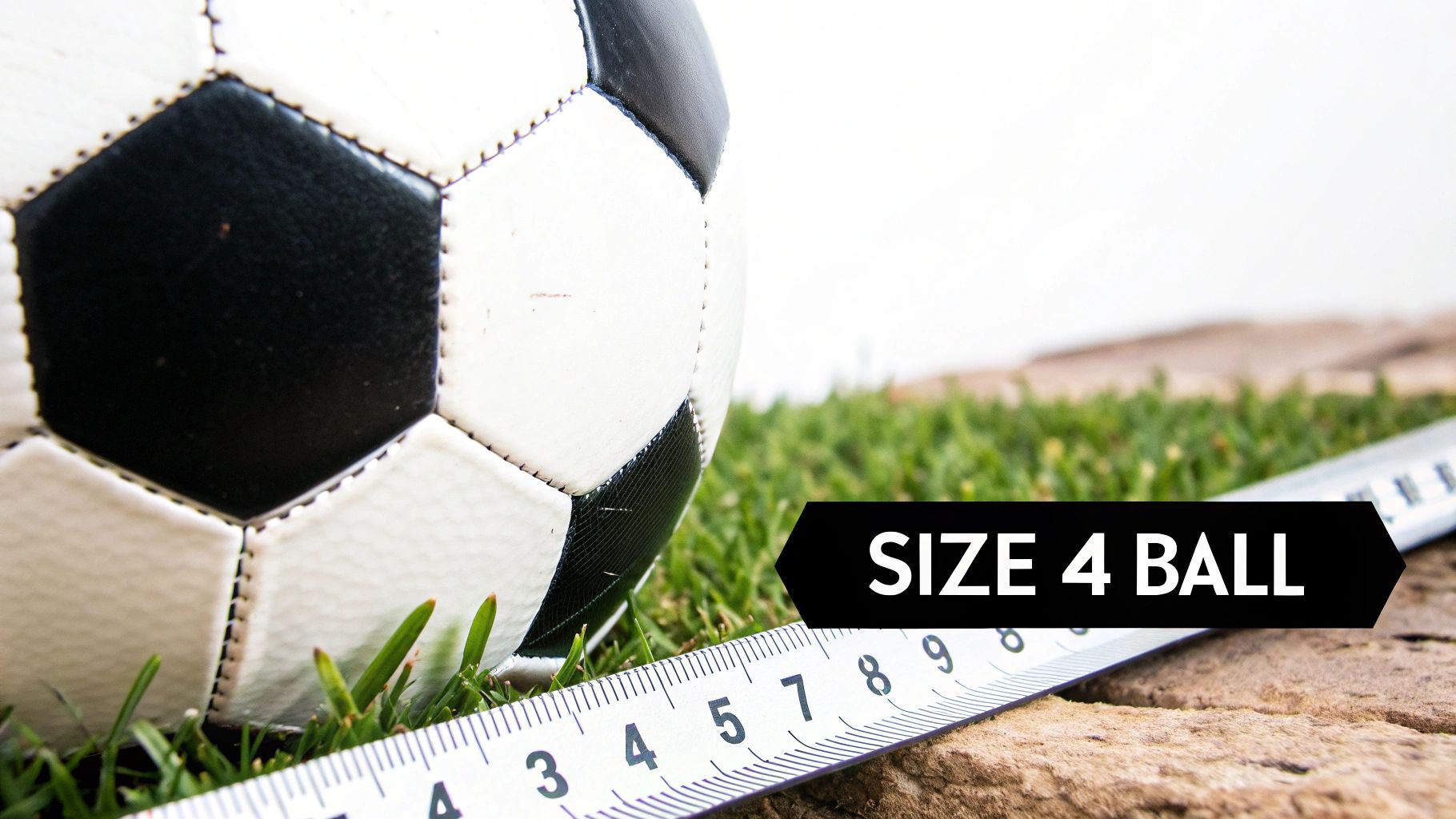
Choosing the right football is one of the most important decisions for a young athlete's development. It’s like a musician learning an instrument—you wouldn’t hand a small child a full-sized guitar. In the same way, a size 4 ball is perfectly scaled to give young players the best possible chance to succeed.
These specifications are not just random numbers; they’re carefully chosen to match the physical abilities of players in the 8-12 age group. This ensures the ball is manageable, encourages correct form, and lowers the risk of strain or injury.
Official Dimensions and Weight
The Football Association (FA) sets clear standards for ball sizes to maintain consistency in youth leagues across the UK. According to their guidelines, a size 4 soccer ball must have a circumference of 25 to 26 inches (63.5 to 66 cm) and weigh between 350 and 390 grams. These precise measurements are key to creating a predictable and fair playing experience for everyone on the pitch. You can see the detailed ball specifications directly on The FA's website.
This makes it noticeably lighter and smaller than the adult size 5 ball, which is exactly why it’s so effective for training young footballers.
The Developmental Sweet Spot
The size 4 ball hits a developmental sweet spot. It’s for players who have outgrown the little size 3 but aren’t quite physically ready for a full-size 5. It feels like a "real" football but is light enough to allow for:
- Better Ball Control: Players can get their feet around the ball more easily, which vastly improves their dribbling and first touch.
- Refined Passing Technique: The reduced weight helps them generate enough power for crisp passes without having to swing their leg wildly and compromise their form.
- Confident Shooting: Youngsters can practise shooting with proper technique, focusing on accuracy instead of just trying to hoof a heavy ball towards the goal.
By matching the equipment to the player, the size 4 ball removes physical barriers and allows skill to become the primary focus of development.
This deliberate sizing is fundamental to building a solid foundation of skills that will serve them well as they grow. For a complete comparison, you might be interested in our detailed breakdown of different soccer ball sizes and age groups.
Why the Right Ball Size Is So Important for Young Players
Using the correct football is about much more than just following the rules. It's the bedrock of proper skill development, helps build confidence, and, most importantly, keeps young players safe on the pitch. The real-world impact of an age-appropriate ball cannot be overstated, especially for children whose bodies and techniques are still growing.
A size 4 soccer ball is designed to work with a young player's body, not against it. Asking a nine-year-old to train with a full-size 5 ball is like telling a child to learn handwriting with a massive, clumsy marker pen. It’s frustrating, awkward, and just encourages the development of bad habits. The right ball changes everything.
Building Real Technique and Confidence
When a player can actually get the ball under their control, their entire approach to the game transforms. The lighter weight and smaller circumference of a size 4 ball mean children can execute skills with the correct form, building muscle memory that will stick with them for years to come.
- Passing: Players can snap crisp, accurate passes without having to swing their entire body, which is a common cause of poor form.
- Dribbling: Keeping the ball close becomes an achievable skill instead of a constant battle, letting them lift their head and focus on movement.
- Shooting: They can strike the ball cleanly, focusing on placement rather than just trying to hoof a heavy object towards the goal.
This sense of control is an incredible confidence booster. When a young player sees they can make the ball do what they want, their love for the game skyrockets. It makes them want to practise more and stay involved in the sport.
It's All About Safety
Skill is one thing, but safety is paramount. Using a ball that’s too heavy puts unnecessary strain on a child’s growing joints, ligaments, and muscles. Kicking or heading an oversized ball repeatedly can lead to pain and seriously increase the risk of injury.
In fact, the connection between equipment size and safety is clear. Injury reports have shown that young players using size 4 balls suffer up to 12% fewer injuries than similar groups using adult-sized size 5 balls. It’s a statistic that highlights how crucial the right size is at the grassroots level. You can read up on more grassroots football safety facts on The Fact File.
"Giving a young player the right size ball is the first and most important piece of coaching advice I can offer. It's not just about the rules; it’s about respect for their physical development and setting them up for a long, healthy relationship with the game." - Experienced Youth Coach
At the end of the day, a size 4 football isn’t just a scaled-down adult ball. It's a specialised piece of kit designed to nurture talent, build self-esteem, and protect young players while they fall in love with the beautiful game.
How to Choose the Perfect Size 4 Soccer Ball
So, you’ve figured out a size 4 ball is right for your 8 to 12-year-old. Great! But now you’re faced with a wall of options. It's easy to feel a bit lost.
The key is to look beyond just the size. A few other features make a huge difference in performance, durability, and ultimately, whether you're getting good value for your money. Think of it as the first critical step towards building skill and keeping young players safe on the pitch.
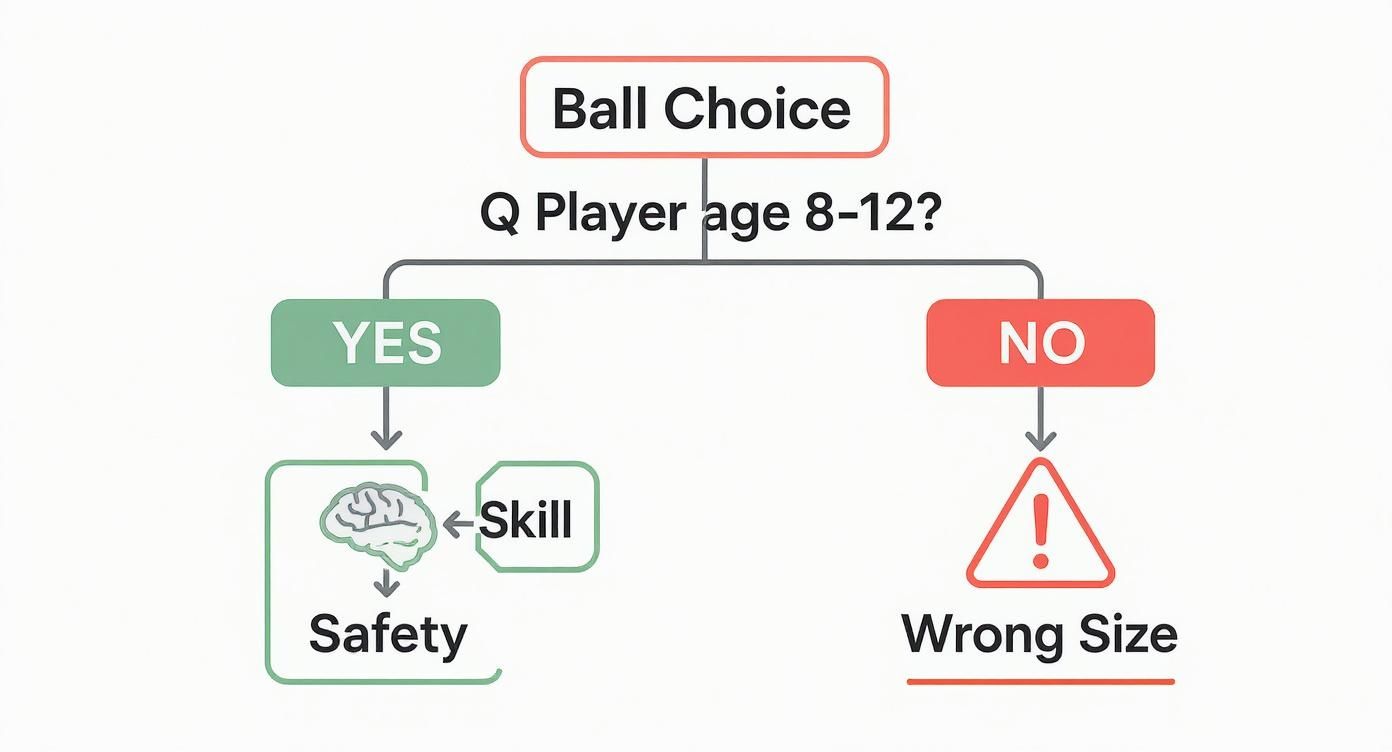
As you can see, getting the size right for the player's age is the foundation. It’s what unlocks better technique and helps reduce the risk of injury.
What’s the Ball Made Of?
The material of the outer shell, or casing, is probably the biggest factor affecting how a ball feels, how long it lasts, and how much it costs. It's like choosing tyres for a car—some are built for everyday driving, while others are designed for high-performance racing.
Here’s a quick rundown:
- TPU (Thermoplastic Polyurethane): This is your workhorse material. You’ll find it on most training balls because it’s tough, scuff-resistant, and can take a beating on grass or artificial turf. A brilliant, budget-friendly choice for practice.
- PU (Polyurethane): A definite step up. PU is softer and gives a much better touch and feel. This is what most quality match balls are made from. That responsive feel is exactly what you want on game day.
If you want to delve into the finer details, our complete size 4 football guide breaks down all the materials and construction details.
What About the Panels?
How the ball's panels are pieced together matters more than you’d think. The number and shape of the panels influence how the ball flies through the air.
The classic football design has 32 hexagonal and pentagonal panels stitched together. It's a timeless design for a reason—it provides a true, stable flight path. More modern balls often have fewer, larger panels that are thermally bonded (glued with heat) instead of stitched. This creates a smoother surface, which helps keep water out and can even improve aerodynamics.
For a young player just starting to master the fundamentals, a machine-stitched 32-panel ball is a fantastic choice. It offers the reliable, predictable performance needed to build skills with confidence.
Size 4 Ball Feature Comparison
To help you decide, here’s a simple breakdown of common materials and construction. Consider what you need the ball for and your budget.
| Feature | Best For | Pros | Cons |
|---|---|---|---|
| TPU Casing | Training, regular practice | Highly durable, affordable | Firmer feel, less responsive |
| PU Casing | Matches, advanced training | Soft touch, great feel, responsive | More expensive, less durable |
| Machine-Stitched Panels | All-round use, training | Classic feel, consistent flight, good value | Can absorb water over time |
| Thermally Bonded Panels | Match play, wet conditions | Nearly seamless, low water uptake | Higher price point |
This table should give you a clearer idea of which features align best with your player's needs, whether for relentless training sessions or the big weekend match.
Match Ball vs. Training Ball
This one’s pretty straightforward and comes down to its primary use.
- Training Balls: These are built to last. Designed for durability and thousands of touches, they usually have a tougher TPU cover to withstand session after session.
- Match Balls: These are all about performance. They use premium PU materials for that softer touch and predictable flight that players love on game day.
Many clubs now get custom club-branded balls from SoccerWares for their youth teams. It gives the children a real professional-grade experience and builds a massive amount of team pride right from the start.
Drills to Master the Size 4 Ball
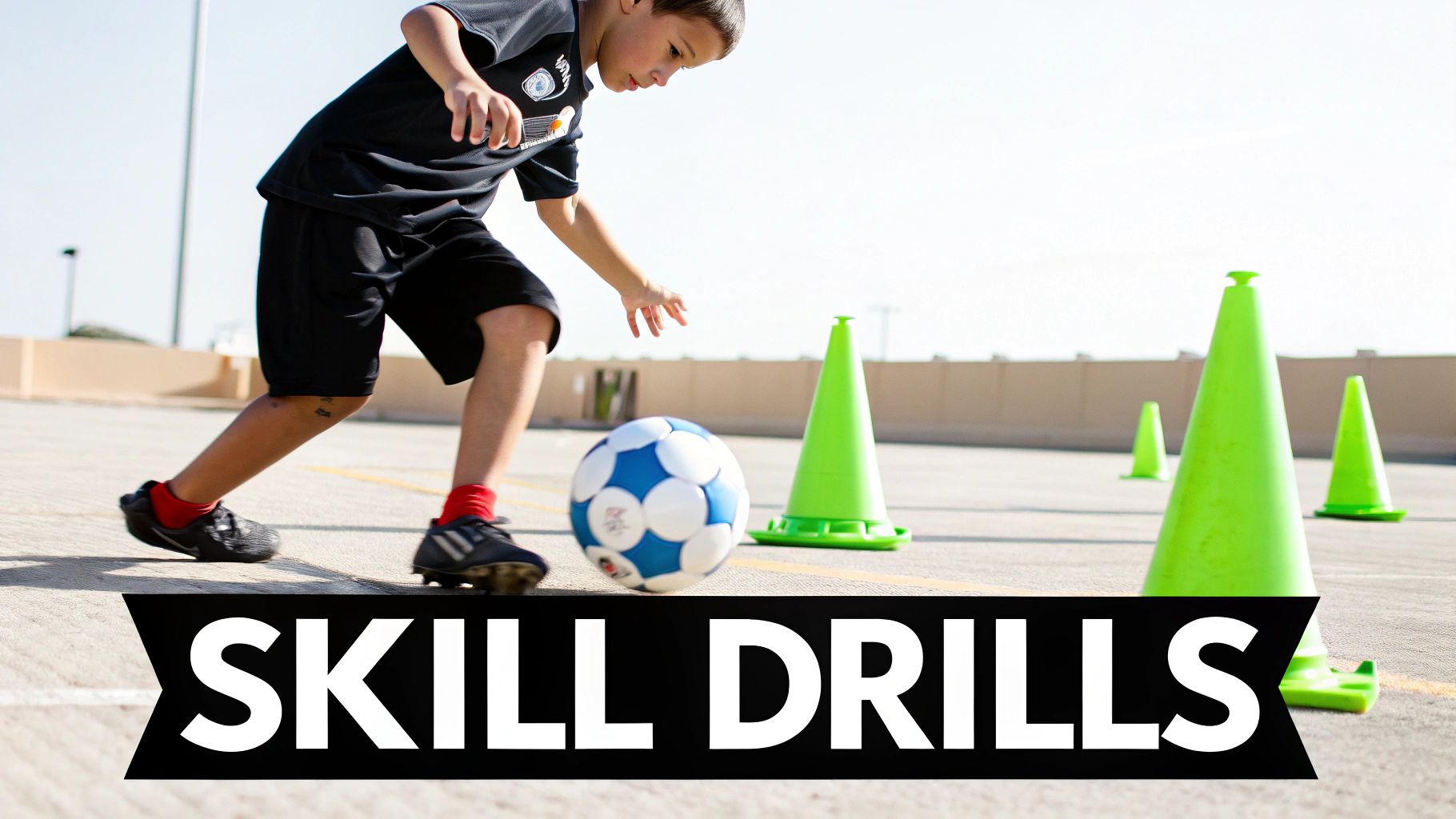
Alright, you've got the perfect size 4 ball. Now for the fun part: putting it to work. This isn't just about kicking a ball around; it's the ideal tool for building the fundamental skills that separate good players from great ones.
Repetition with an age-appropriate ball is everything. It builds the muscle memory and confidence a young player needs to thrive on the pitch. Here are a few simple but incredibly effective drills designed for the 8-12 age group, focusing on the core abilities of dribbling, first touch, and shooting.
Close Control Weaving
This is the bread and butter of ball mastery. It’s all about teaching a player to keep the ball glued to their feet while moving—a non-negotiable skill for navigating a crowded midfield.
How to set it up:
- Place five to seven cones in a straight line, roughly one metre apart.
- The player starts at the first cone, dribbling and weaving in and out until they reach the end.
- The goal is to use both feet, taking lots of small, quick touches.
- Once at the last cone, they turn and weave their way back to the start.
The key coaching point? Encourage them to get their head up! They need to learn to "feel" the ball with their feet rather than staring down at it. This is how game awareness starts.
The size 4 ball is perfect for this. Its smaller size lets young players use the inside and outside of their boots with far more precision than they could with a big, clumsy size 5.
First Touch Passing Gates
A great first touch buys you time and space. It's the difference between controlling the game and chasing it. This drill is brilliant for training a player to receive a pass and move the ball into a useful position with a single touch.
How to set it up:
- Create several small "gates" by placing two cones about a metre apart. Scatter them around your training area.
- Players get into pairs, with one acting as the server.
- The receiving player's job is to control the pass and guide it through a nearby gate, all in one fluid motion—their first touch.
This drill forces players to think ahead and scan their options before the ball even arrives. It's a fantastic exercise for building control, awareness, and decision-making all at once. For more ideas, check out our guide on essential coaching drills for soccer, which can be tweaked for any age.
Finishing Zones for Accuracy
Every young player loves to smash the ball as hard as they can. But real goalscorers know that placement trumps power every time. This drill shifts the focus from raw power to deadly accuracy.
How to set it up:
- Use cones to mark off "zones" in the bottom and top corners of the goal. These are the high-value targets.
- Players shoot from just outside the penalty area.
- Award points for hitting one of the zones. This gamifies the drill and encourages them to aim instead of just blasting it.
A size 4 ball is a huge help here. It allows players to generate enough power and swerve to hit their targets without over-exerting themselves, letting them concentrate purely on their technique.
Caring for Your Football to Make It Last
A good football is an investment, not just in the gear but in a player’s development. Ensuring it stays in top condition means it will perform consistently week in, week out, all season long. Looking after your size 4 soccer ball is pretty straightforward, but it makes a massive difference to its longevity and playability.
Just a few simple maintenance steps will protect your purchase and give your young player that reliable, true feel every time they step onto the pitch.
Correct Inflation Is Key
The single most important part of ball care is getting the air pressure right. An under-inflated ball feels heavy and sluggish—it won't fly properly off the foot. On the other hand, over-inflation makes it hard, overly bouncy, and risks putting too much strain on the stitching.
For a size 4 ball, you’re aiming for a sweet spot between 6 and 8 PSI (pounds per square inch). Always double-check the manufacturer's recommendation, which is usually printed right next to the valve. Pro tip: before you insert the pump needle, moisten it with a drop of water or glycerine. This helps it slide in smoothly and prevents damage to the valve that could cause a frustrating slow leak.
A well-inflated ball isn’t just about performance—it’s also about safety. It absorbs the impact of a powerful strike correctly, protecting both the player's foot and the ball's internal structure from unnecessary stress.
Cleaning and Storage Advice
After a muddy Sunday league game, it’s all too easy to chuck the ball in the boot of the car and forget about it. However, taking a minute to clean it can prevent the outer casing from drying out, becoming brittle, and eventually cracking.
Just follow these simple steps:
- Wipe it down: Grab a damp cloth and gently clean off the mud and grass. Steer clear of harsh cleaning chemicals or abrasive scourers that could damage the surface.
- Dry it properly: Pat the ball dry with a clean towel. Never leave it to bake in direct sunlight or next to a hot radiator, as extreme heat can ruin the material.
- Store it smartly: Find a cool, dry spot for your football. Extreme temperatures—like inside a hot car in summer or a freezing shed in winter—can damage the bladder and cause the ball to lose its shape.
Stick to this routine, and your size 4 football will be in prime condition, ready for the next training session or big match.
Got Questions About Size 4 Balls?
To wrap things up, let's tackle a few of the most common questions from parents and coaches. Getting these details right from the start means you can choose the right ball with confidence and help your young player get the most out of every session.
Can My 7-Year-Old Use a Size 4 Ball?
While it might seem like a small jump, it’s best to stick with the recommended sizes for their age. A size 3 ball is officially the right fit for players under eight because it's that little bit lighter and smaller.
This makes a huge difference in helping them handle the ball and kick correctly without having to force it. Using the right size early on prevents bad habits from forming and builds a much stronger foundation for their skills down the road.
What Is the Difference Between a Training and a Match Ball?
The main differences come down to durability and the ball's materials. Match balls are built for performance—they often use softer, higher-grade PU materials for a better feel on the foot and a truer flight through the air.
Training balls, on the other hand, are the workhorses. They’re typically made from tough TPU designed to withstand constant use on all sorts of surfaces. A durable training ball is always the more cost-effective choice for relentless practice sessions.
A good rule of thumb is to train with a durable ball and save the premium match ball for game days. This approach offers the best of both worlds in terms of performance and value.
How Do I Know If the Ball Is Inflated Correctly?
Most size 4 balls have the recommended pressure printed right next to the valve, which is usually between 6 and 8 PSI (pounds per square inch). If you don't have a pressure gauge handy, there's a quick and easy test you can do.
Just press into the ball firmly with both thumbs. It should give way by about half an inch. If it feels as hard as a rock, it’s over-inflated, and if it’s soft and squishy, it needs more air. It is as simple as that.
At SoccerWares, we provide a wide range of high-quality footballs and training gear to support players at every stage of their development. Explore our collection today to find the perfect equipment for your team.