

Defender drills aren't just about running through cones. They're about creating game-realistic situations that forge the physical and mental skills every defender needs to dominate at the back. It’s this blend of smart practice and repetition that turns a good defender into a great one.
Building the Foundation of a Modern Defender
Before we touch a ball, it’s crucial to understand what it means to be a defender in today's game. The role has evolved far beyond crunching tackles and last-ditch clearances.
Modern elite defenders are often the first line of attack, the organisers of the team's shape, and sharp tactical thinkers. They combine raw physical power with a clever football brain, making them the rock on which successful teams are built. This all starts with a few core principles.
The Defender's Mindset
Great defending starts between the ears. It's about being proactive, not just reactive. To truly command a backline, there are three mental traits you simply cannot do without:
- Anticipation: This is the art of reading the game a step or two ahead of everyone else. It’s about spotting a passing lane before the midfielder has looked up, or seeing a striker’s run before they’ve even thought about accelerating.
- Composure: Panic is a defender's worst enemy. Staying calm when a winger is running at you allows for clear, simple decisions. Do you clear it? Play a simple pass to your midfielder? Or just shield the ball out of play? A cool head always wins.
- Communication: A quiet defence is a weak defence. Period. Constant, clear, and concise instructions to your teammates about marking, cover, and potential threats will prevent countless mistakes before they happen.
Core Physical Attributes
A sharp mind is vital, but it needs the physical tools to back it up. The modern game demands that defenders are complete athletes.
You need agility to handle tricky wingers, core strength to muscle strikers off the ball, and that explosive burst of speed for recovery runs. Improving your pace is a constant battle, and you can get a head start by checking out our detailed guide on how to increase your speed.
The path to the top is brutal. UK football academy stats reveal that while 97% of top-tier players aged 21-26 don't get Premier League minutes, the ones who stand out are often those who excel in key defensive stats like recoveries and duels. With 98% of 16-year-old scholars falling out of the top five tiers by 18, intelligent, dedicated training isn't just an advantage—it's essential for that rare breakthrough. (Source: The Athlete Academy UK).
Essential Drills for Individual Defensive Mastery
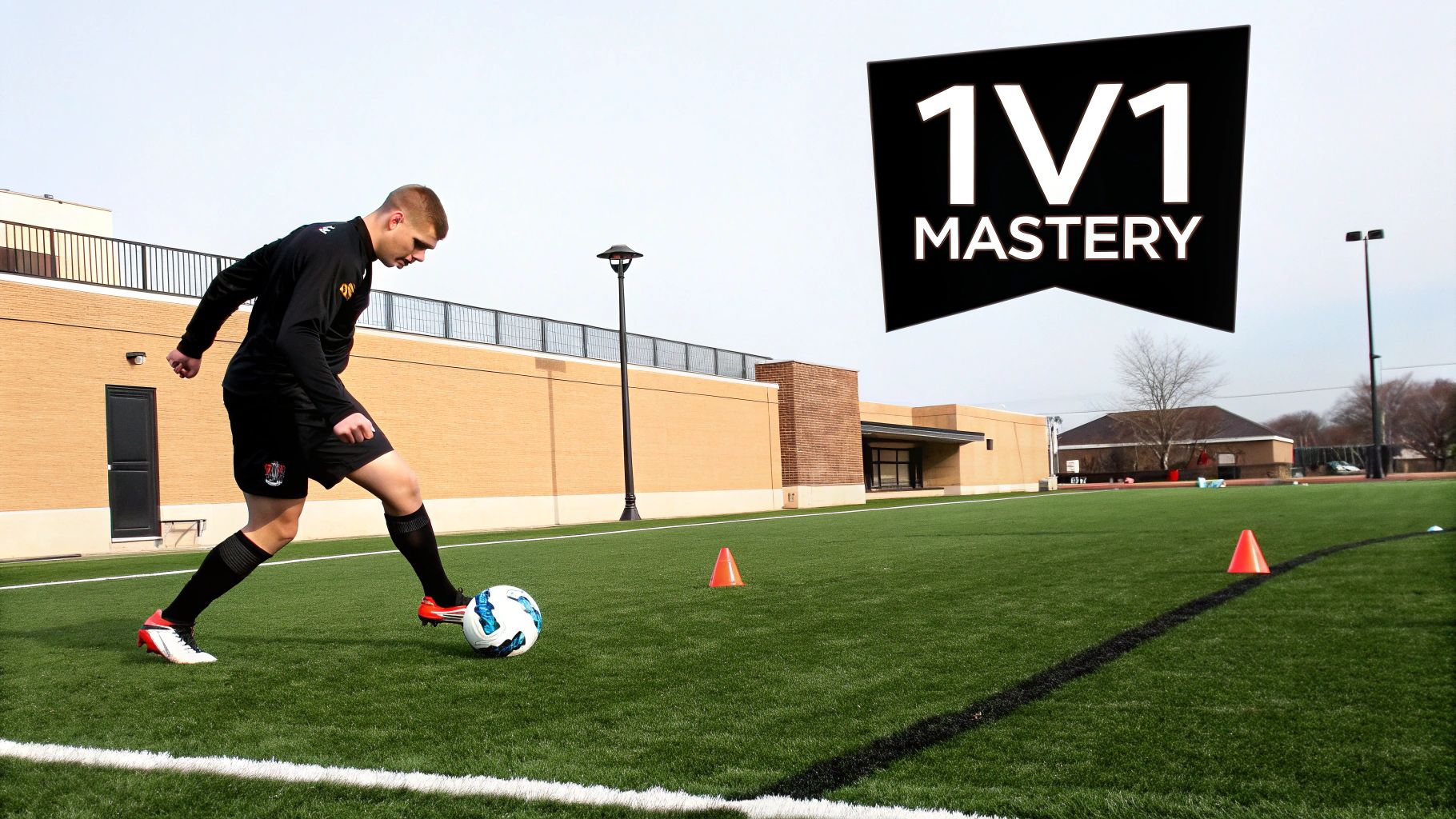
Alright, with the right mindset locked in, it’s time to get our boots dirty. Individual defensive skill isn't magic; it's built brick-by-brick through focused, deliberate practice. These drills are designed to sharpen the exact movements that turn an average defender into a dominant one.
This is about more than just running through cones. The idea is to recreate those split-second moments in a match that decide whether you win the ball or give away a chance. From your body shape to the timing of a tackle, this is where excellence is forged.
Dominating the 1v1 Battle
The one-on-one duel is the ultimate test for any defender. Winning these individual battles consistently is non-negotiable, and it’s not about blind aggression. It's about control, patience, and smart footwork.
Your main goal is to dictate where the attacker can go. You want to force them into crowded areas or onto their weaker foot—anywhere but towards your goal. This all starts with your body position long before you think about making a tackle.
The Jockeying Drill
This is the absolute foundation of 1v1 defending. It teaches you how to keep a safe distance, stay light on your feet, and steer an attacker exactly where you want them to go without lunging in.
- Setup: An attacker starts with the ball about 20 yards from goal. You, the defender, stand five yards in front of them.
- Action: The attacker dribbles towards you, trying to get past. Your job is not to win the ball straight away. Instead, you'll jockey backwards and sideways, keeping a low centre of gravity.
- Objective: Force the attacker wide. Keep your body between them and the goal at all times. The real focus here is on your footwork and body shape. A slightly side-on stance is critical. Never plant your feet or face the attacker square-on; you'll be beaten every time.
A classic mistake young defenders make is "diving in." Patience is your best friend. By staying on your feet and controlling the space, you pressure the attacker into making a mistake, which gives you a much better chance to win the ball cleanly.
Sharpening Game Intelligence for Interceptions
Great defenders don't just react; they anticipate. Reading the game to cut out a pass is just as important as making a last-ditch tackle because it stops an attack before it even starts. This skill comes from constantly scanning the pitch and recognising attacking patterns.
Good interception drills train your brain to see the play developing and your body to explode into the space to cut out the pass. This is how you can turn defence into attack in a single movement.
The "Read and React" Interception Drill
You can do this drill with a partner or, if you're training solo, a rebounder is a brilliant tool. It sharpens your ability to judge the weight of a pass and move decisively to get there first.
- Setup: Place two cones about 10 yards apart to make a "gate." Stand right in the middle. Your partner (or rebounder) should be 15 yards in front of you with a ball.
- Action: Your partner pings a firm pass towards one of the cones. Your job is to read its direction and speed, then sprint to intercept it before it goes through the gate.
- Progression: Want to make it more realistic? Add a second attacker who makes a run behind the gate. Now you have to make a split-second decision: intercept the pass or drop off to mark the runner. This adds that crucial in-game decision-making element.
Using one of the best football rebound walls is a fantastic way to drill this on your own. Our guide can help you pick the right one for effective training.
Mastering the Art of the Tackle
Tackling should be your last resort, but when you have to do it, it needs to be precise, well-timed, and safe. A perfectly timed tackle can save a game. A poorly timed one can lead to a yellow card or a penalty.
The Block and Slide Tackle Technique Drill
This drill isolates the technique for both types of tackles, focusing on doing them safely and effectively.
- Block Tackle: Have a partner dribble slowly towards you. The second they take a slightly heavy touch, step in firmly. Plant your non-kicking foot beside the ball and use the inside of your other foot to block it and win possession. The key is to use your body as a shield.
- Slide Tackle (Controlled): Start this one at a walking pace to perfect the form. Have a partner dribble across your path, not directly at you. Practise sliding to hook the ball away. You should lead with the leg furthest from the attacker to sweep the ball, tucking your other leg underneath you for stability and to avoid injuring yourself or them. Remember, the aim is to win the ball cleanly, not to take out the player.
How to Progress from Solo Drills to Team Scenarios
Individual brilliance is a fantastic starting point, but defending is a team sport. The best defenders don't just win their personal duels; they make the entire unit stronger. This section is all about bridging that gap—taking your solo work and scaling it up to handle the coordinated chaos of a real match.
It’s time to add teammates and replicate the pressure of game day. The first step is simple: move from isolated 1v1s to partnered drills. This immediately introduces the most crucial element of team defending: communication. Working with a teammate forces you to talk, cover for each other, and start making decisions together.
Introducing a Partner for 2v1 and 2v2 Drills
Adding just one other player changes everything. Suddenly, it's not just about stopping your opponent. It's about trust, positioning relative to your partner, and knowing when to press the ball and when to drop off and provide cover. This is where the real art of defending begins.
- The 2v1 "Overload" Drill: Set up a lone defender facing two attackers about 25 yards from goal. The attackers' job is to score; the defender's job is simply to delay them for as long as possible. This drill is brilliant for forcing you to perfect your jockeying and body shape to cut off passing lanes. You learn to show attackers into less dangerous areas until your imaginary help arrives.
- The 2v2 "Cover and Balance" Drill: This is a classic for a reason—it builds partnerships. Two defenders face two attackers. The key here is the relationship between the two defenders. One defender presses the player with the ball, while the other provides cover, staying ready to intercept a pass or challenge the second attacker. Constant communication—"I've got ball!", "Cover inside!"—is completely non-negotiable.
The core principle is simple but absolutely vital. The nearest defender applies pressure to the ball, while the covering defender positions themselves to see both the ball and the other attacker. This "pressure-cover" relationship is the foundation of every successful defensive partnership.
Replicating Match Pressure with Small-Sided Games
Once you're comfortable working with a partner, small-sided games are the ultimate test. They perfectly replicate the intensity, tight spaces, and rapid-fire decision-making of a real match. Using portable goals and cones means you can create these dynamic training environments anywhere.
A simple 4v4 game in a tight grid forces defenders to communicate constantly, hold a cohesive line, and decide as a group when to press high or drop back. These aren't just casual kickabouts; they are intense tactical exercises.
This is also where managing your physical output becomes critical. Training loads in UK football academies show huge variation by age and position. For instance, U15/U16 centre-backs face a staggering 164% coefficient of variation in their training loads outside of academy sessions. For aspiring defenders looking to manage this, tools like SoccerWares' soccer GPS trackers can help you monitor just how intense these small-sided games are, just like the pros do.
Given that only a tiny 0.5% of players entering academies at U9-U11 will ever sign a professional contract, optimising every single session is key. To go deeper on this, you can read more about other top-tier soccer drills for defence.
Finally, don't forget the last piece of the puzzle: transitioning from defence to attack. Winning the ball back is only half the job. In these small-sided games, the second your unit wins possession, the focus must shift instantly. Look for that first forward pass to launch a counter-attack. A good defence doesn't just stop goals; it starts them.
Creating Your Ultimate Defender Training Session
Having a list of drills is a great start, but the real magic happens when you structure them into a smart, challenging session. A well-planned workout is what separates random practice from purposeful improvement, ensuring every minute on the pitch pushes you forward.
It’s about turning individual exercises into a complete programme. To help you do that, here are two session plans: one for the solo defender grinding to perfect their technique, and another for a small group learning to work as a unit.
The Solo Defender Sharpening Session
When it’s just you, the goal is simple: high-volume, quality repetitions. This 45-minute session is all about sharpening your individual mechanics with minimal gear.
- Dynamic Warm-Up (10 minutes): Get moving with light jogging, leg swings, and hip mobility work. Finish with some quick-feet ladder drills to really switch on your nervous system. Never skip a proper warm-up; it’s your best defence against injury.
- 1v1 Jockeying Footwork (10 minutes): A few cones are all you need. Get into your defensive stance and practise moving backwards and sideways. The key is to stay low and balanced, keeping every movement sharp and controlled.
- Rebounder Interception Drill (15 minutes): This is where a tool like a high-quality rebounder from SoccerWares becomes your best training partner. Use it to fire passes at different angles. Your job is to read the ball's path, explode to intercept it, and secure your first touch.
- Cool-Down (10 minutes): Wind down with static stretching, holding each stretch for at least 30 seconds. Give extra attention to your hamstrings, quads, and groin – they’ve earned it.
Think of your development as a clear pathway. You start by mastering your own skills before you can think about slotting into more complex team scenarios.
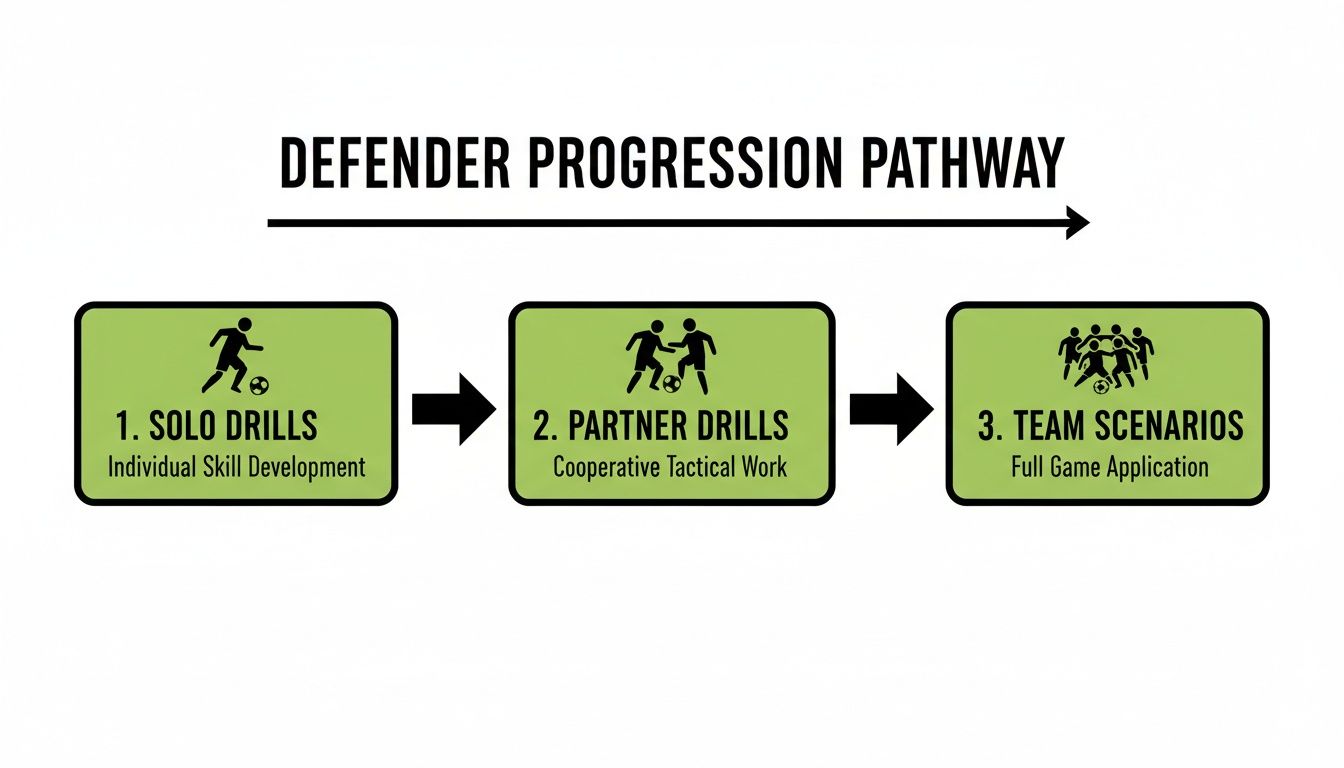
The takeaway is simple but crucial: mastery starts with you. Only after you’ve nailed the solo techniques can you become a truly effective partner in a defensive unit.
The Small Group Tactical Session
Once you bring teammates into the mix, the focus shifts to communication, positioning, and coordination. This 60-minute session for 2-4 players is designed to build the understanding you need to operate as a solid unit.
- Dynamic Warm-Up with a Ball (10 minutes): Start with passing patterns or a game of piggy-in-the-middle. This gets everyone moving, talking, and switched on from the first minute.
- 2v2 "Pressure and Cover" Drill (20 minutes): Mark out a small pitch with portable goals. The entire focus here is on the relationship between the two defenders. One player presses the attacker with the ball, while the other provides cover. Constant, clear communication is the non-negotiable goal here.
- Clearing Under Pressure (15 minutes): Have one player serve crosses into the box. The two defenders have to work together to clear the danger, practising headers and volleys while organising who attacks the ball and who covers the space.
- Cool-Down and Debrief (15 minutes): Finish up with some static stretches and, just as importantly, a quick chat. What went well? What still needs work? This feedback loop is where real tactical growth happens.
Defender Drill Session Planner
To make things even easier, here's a simple planner. Use it to build a balanced training session that targets your specific development goals. Just pick a goal, choose a few drills, and get to work.
| Development Goal | Recommended Drills | Solo Training Tool | Repetitions/Duration |
|---|---|---|---|
| Improve 1v1 Defending | 1v1 Jockeying, Side-On Defending Drill | Cones, Agility Ladder | 10-15 minutes |
| Master Tackling Technique | Slide Tackle Practice, Block Tackle Drill | Mannequin or friend | 20 tackles per type |
| Boost Interception Speed | Rebounder Interception, Anticipation Drill | Rebounder Net | 15 minutes |
| Enhance Aerial Ability | Heading for Clearance, Rebounder Volleys | Rebounder, Footballs | 25-30 headers |
| Build Defensive Unit Cohesion | 2v2 Pressure and Cover, Zonal Defending | Cones, Portable Goals | 20-25 minutes |
This isn't just about ticking boxes; it's about building a session with a purpose. Mix and match to keep things fresh and target your weaknesses until they become strengths.
A well-structured training session is like a roadmap for your development. It ensures you don’t just work hard, but you work smart, targeting specific weaknesses and turning them into strengths, one drill at a time.
The Modern Defender's Toolkit
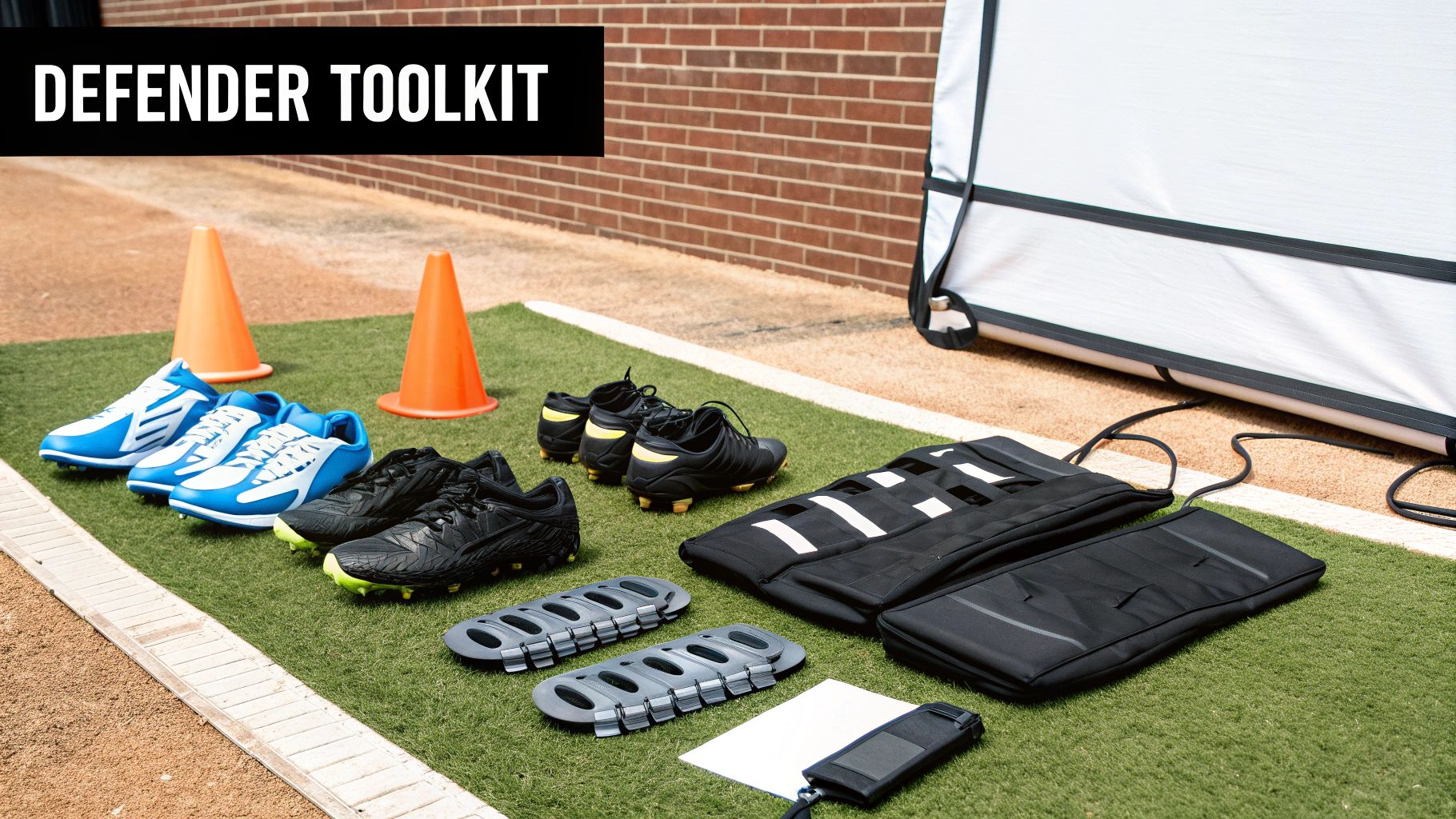 In today's fast-paced game, talent alone won't cut it. The right equipment is no longer a luxury for a defender; it’s a fundamental part of their development. Using the correct tools makes your training sessions more efficient, more realistic, and—crucially—measurable. It’s what turns raw potential into consistent on-pitch performance.
Think of it this way: a simple brick wall can return a pass, but it can't replicate the wicked spin, pace, and sheer unpredictability of a cross fizzed in by a tricky winger. This is where a high-quality rebounder makes a real difference. It forces you to adjust your body shape and technique in a split second, just as you would in the heat of a match. It’s an investment in realistic repetition.
Essential Gear for Serious Defenders
Beyond a decent pair of boots and a ball, certain pieces of kit are non-negotiable for anyone serious about levelling up their defensive game. They provide safety, crank up the quality of your drills, and deliver invaluable data on your performance.
Here are the key items you'll want in your bag:
- Durable Shin Guards: These are your first line of defence against injury during intense tackling and blocking drills. Never compromise on protection.
- Agility Cones and Ladders: You can't be a top defender without sharp footwork. These are essential for honing the quick-feet movements needed for jockeying and changing direction at speed.
- A Quality Rebounder: This is the ultimate solo training partner for practising clearances, first-touch control under pressure, and reacting to unpredictable bounces.
For those looking to get even more advanced, integrating something like a Football Simulator Hire can offer an immersive way to sharpen your decision-making in simulated match scenarios, bridging the gap between the training ground and game day.
The Power of Performance Data
The biggest leap forward in modern training has come from data. There’s a reason top academies are obsessed with it—it completely removes the guesswork. This is where soccer GPS trackers come into play, letting you monitor your output just like the pros.
Data from English Premier League academies shows just how physically demanding the modern game is, even for young defenders. Post-EPPP, training drills for full-backs saw a huge 20-25% increase in deceleration loads. U16 players were covering massive high-speed running distances in match simulations. Tools like GPS trackers are vital for managing this intensity and preventing burnout. In fact, proper load monitoring can cut injury risk by 15-20%.
By tracking metrics like sprint distance, accelerations, and overall intensity, you can ensure every one of your soccer defender drills pushes you to the right limit without risking overtraining.
This isn't just about owning gear; it’s about making smart investments in your football journey. You can learn more about how to pick the right tech in our guide to wearable football sensors in 2025.
Got Questions About Defender Drills? We've Got Answers
Even with a solid training plan, questions always pop up. Getting these sorted helps you fine-tune your approach, push past plateaus, and make sure the hard graft on the training pitch shows up on match day.
Here are some of the most common questions we hear from defenders looking to sharpen their game. Think of it as your go-to guide for training smarter, not just harder.
How Often Should I Practise These Soccer Defender Drills?
When you're starting out, consistency beats intensity every time. Aim for two or three focused sessions a week, each lasting about 45 to 60 minutes.
The goal is quality over quantity. It's far better to do a drill correctly ten times than to rush through it fifty times with bad form. On your off-days, you can always do some light technical work—keepie-uppies or wall passes—just to keep your touch sharp. Using a GPS tracker is a great way to monitor your weekly load, ensuring you're pushing yourself without risking burnout.
What Is the Single Most Important Skill for a Defender?
A last-ditch slide tackle looks amazing on the highlight reel, but ask any top-level coach and they’ll tell you the same thing: positioning and game intelligence are paramount. A defender who can read the game properly snuffs out danger before it even starts, often without needing to make a challenge.
The best defenders make the game look easy because they're always in the right place at the right time. Drills that force you to constantly scan, anticipate an attacker's next move, and hold your team's defensive shape are where the real magic happens. They build the football brain that turns a good defender into a great one.
Can I Improve My Defending by Myself?
Absolutely. So many of the core defensive skills can be sharpened on your own. You can perfect your jockeying footwork in the garden, practise heading technique against a wall, and work on your first touch and clearances without needing a teammate.
This is where investing in a tool like a soccer rebounder becomes a genuine game-changer. It lets you work on clearances, interceptions, and volleys with a realistic pace and unpredictable returns, mimicking the chaos of a real match. While you’ll eventually need partners for tactical drills, building that strong individual foundation is the perfect place to start.
At SoccerWares, we provide the high-quality gear you need to elevate every training session. From performance GPS trackers to durable rebounders, find the tools to build your defensive mastery. Explore our full range of training equipment today!