

It's a common misconception that every professional football pitch is exactly the same size. The truth is, governing bodies like FIFA and The FA actually set a range of acceptable dimensions, which is why the pitch at Old Trafford might feel different from the one at Anfield. This flexibility allows for fair play while accommodating stadiums of all shapes and sizes.
Decoding Official Football Pitch Dimensions
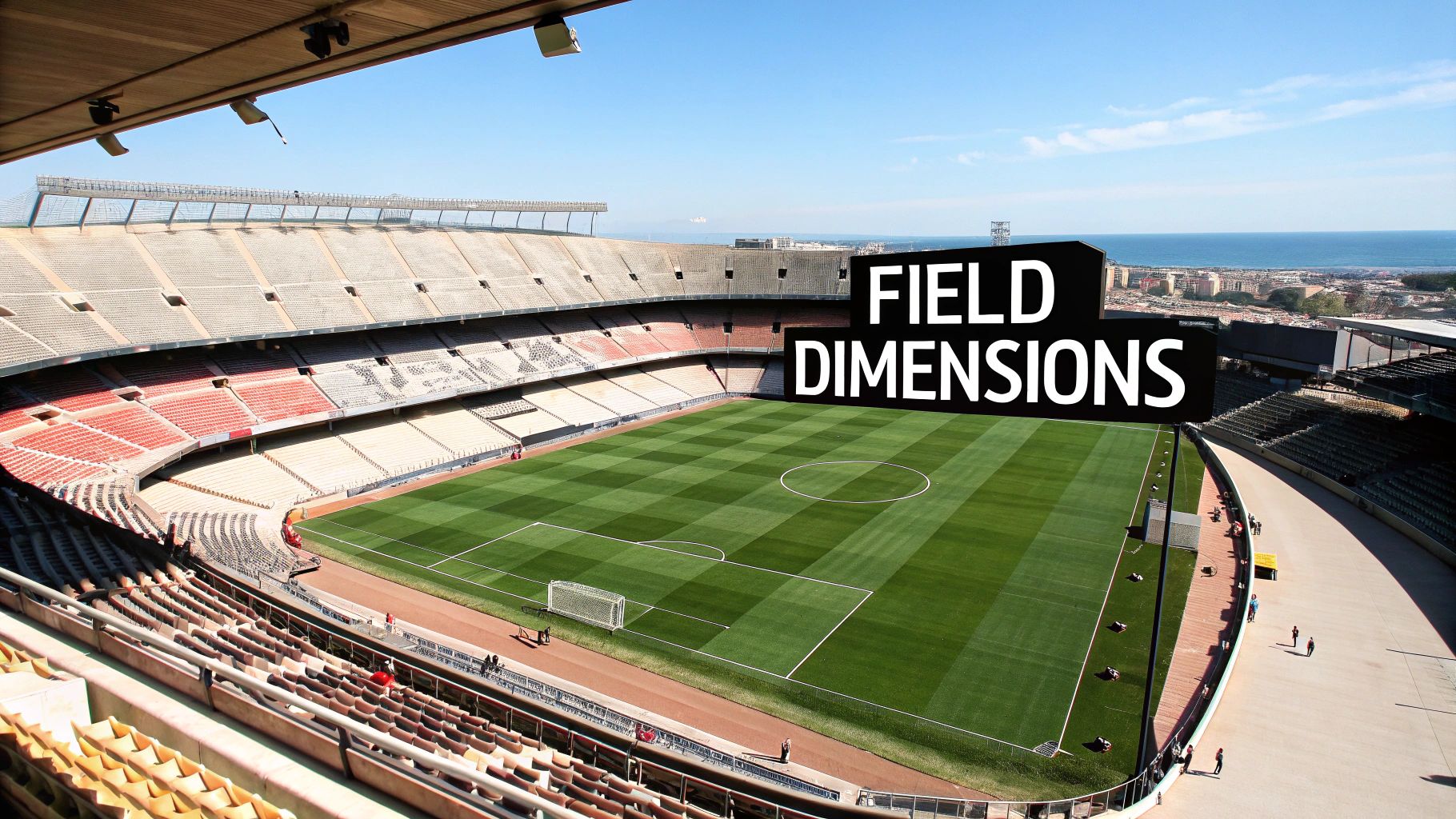
First, a quick bit of terminology. When you're watching a match, the playing area inside the white lines is officially called the pitch. People often use the word 'field' to describe the entire grass surface, including the runoff areas, but for the purists, 'pitch' is the correct term for where the action happens.
These dimensions are all laid out in the official Laws of the Game, a rulebook managed by the International Football Association Board (IFAB). The guidelines give a minimum and maximum for both length and width, which creates consistency but still allows for the unique character of older, historic stadiums.
FIFA and FA Regulations
Both FIFA (the global authority) and The Football Association (The FA) in England sing from pretty much the same hymn sheet for standard 11-a-side football. For any senior match, the pitch dimensions have to fall within a specific range, whether you're measuring in metres or yards.
Here’s a quick-reference table to show you the permitted wiggle room for a standard adult pitch.
Official 11-a-Side Football Pitch Dimensions (FIFA & FA)
| Dimension | Minimum | Maximum |
|---|---|---|
| Length (Goal Line to Goal Line) | 90 metres (100 yards) | 120 metres (130 yards) |
| Width (Touchline to Touchline) | 45 metres (50 yards) | 90 metres (100 yards) |
As you can see, there's quite a bit of variation allowed, especially in the width.
However, when it comes to international matches, the rules get a bit tighter. This is to make sure the playing field is as level as possible for teams visiting from all over the world.
For international fixtures, the pitch length must be between 100–110 metres (110–120 yards), and the width must be between 64–75 metres (70–80 yards).
This stricter range stops one country from gaining an unfair home advantage by playing on an unusually massive or ridiculously narrow pitch.
So, Why Does This Flexibility Exist?
This range in football pitch size is mostly down to history. Many of the most iconic stadiums, especially in the UK, were built over a century ago in cramped city neighbourhoods where space was a luxury. If every club had been forced to adopt one rigid size, it would have meant tearing down historic grounds, which was never going to happen.
This flexibility also adds a subtle tactical layer to the game. A team with a wide, long home pitch might build their style around wingers stretching the opposition's defence. On the flip side, a club with a tighter, narrower pitch might favour a more direct, compact game. It's all part of the unique challenge of playing home and away, and it keeps the game dynamic.
How the Modern Football Pitch Evolved
The perfectly manicured pitch we see today wasn't designed overnight. It's the result of well over a century of tweaks and changes, born from a time when the dimensions of a football field were all over the place. To really get a feel for the modern football field size, we have to go back to 19th-century Britain, where the game was a chaotic, disorganised affair played on pitches of every imaginable shape and size.
Just picture it: one field could be nearly twice as long as another, or so wide that "home advantage" had less to do with tactics and more with pure geography. That was the reality of early football. There were no universal rules, meaning the pitch at one school could be completely different from its rival just down the road.
The Birth of Standardisation
The big turning point came in 1863 with the creation of The Football Association (The FA) in London. This new governing body had a massive job on its hands: writing a single set of rules that everyone could agree on to bring some order to the beautiful game. A huge part of that mission was defining the playing area itself.
Initially, The FA set some very generous maximums for pitch size. In fact, the history of football field size in the UK is deeply tied to these early efforts. The FA originally laid down a maximum length of 200 yards (about 183 metres) and a width of 100 yards (roughly 91 metres). But even then, these early dimensions were vague and allowed for massive variations—a world away from today’s precise regulations. You can find more insights into these early dimensions over at The PFSA.
This first step was crucial, but the pitch was still missing many of the features we now take for granted. The game was evolving fast, and the rules—and the field markings—had to keep up to make sure things were fair.
The modern pitch wasn't simply designed; it evolved piece by piece. Each new marking, from the penalty area to the centre circle, was a direct response to a new rule or a problem that needed solving on the field.
Adding the Lines That Define the Game
As football became more strategic, it was obvious that clear boundaries and zones were needed. Key markings were introduced over decades, each adding a new layer to how the game was played.
- The Halfway Line: This simple line split the pitch into two equal halves, a basic requirement for organised play and essential for offside rules.
- The Penalty Area: Brought in later in the 19th century, this box completely changed the game. It defined where the goalkeeper could handle the ball and created a specific zone for awarding the game-changing penalty kick.
- The Centre Circle: This marking ensures opponents are a fair distance away during kick-off, helping each half get off to a clean start.
These additions weren't just about painting lines on grass; they were about creating a standard arena for skill, strategy, and fair competition. From the sprawling, irregular fields of the early 1800s to the structured pitches of today, the evolution of the football field tells the story of how a chaotic pastime became the world’s most organised sport. This journey ensured that a match played in Manchester would follow the exact same spatial rules as one played anywhere else on the globe.
A Breakdown of Every Pitch Marking
Every white line on a football pitch tells a story. They’re more than just boundaries; they turn a patch of grass into a tactical arena, dictating the flow of play, enforcing the rules, and carving out the zones where matches are won and lost. Understanding what they all mean is the key to appreciating the real strategy behind every pass, tackle, and shot.
It’s easy to take these markings for granted, but they’ve come a long way. The game wasn’t always so organised, and the journey from chaotic lines to a globally recognised standard was a long one. This infographic shows just how much things have changed over the years.
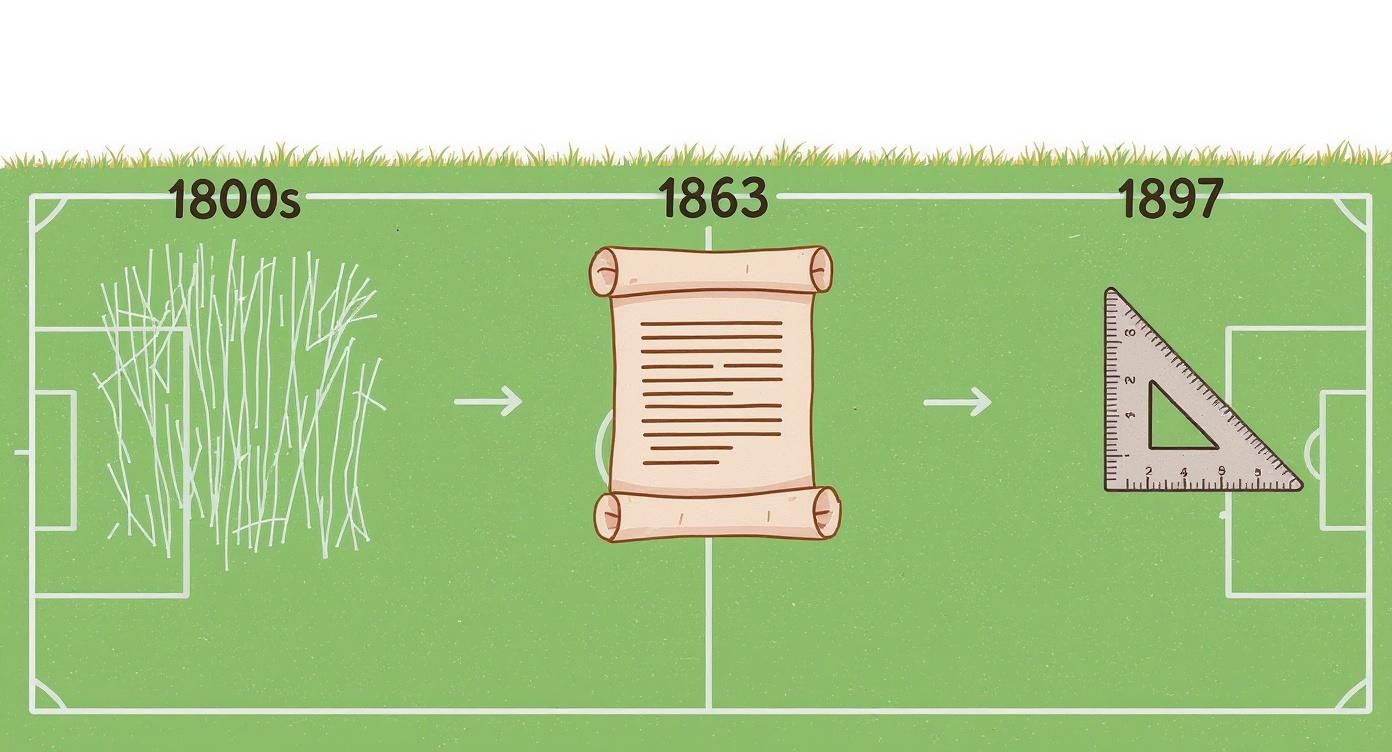
As you can see, the formation of The FA in 1863 and some crucial rule updates in 1897 were massive milestones. They brought much-needed structure to the game, moving it away from its messy origins and towards the organised sport we know today.
The Outlines of the Playing Area
First up, the most fundamental markings are the lines framing the entire pitch. They establish the legal playing area and are the ultimate judge of whether the ball is in or out of play.
- Touchlines: These are the two long lines running down each side of the pitch. When the ball crosses one completely, it’s out, and play restarts with a throw-in. Simple as that.
- Goal Lines: These are the two shorter lines at each end of the field. If an attacker kicks the ball over the goal line (and not into the goal!), it’s a goal kick. If a defender does it, the attacking team gets a corner kick.
The goal itself sits bang in the middle of each goal line. While the overall football pitch size affects how long these lines are, their job stays the same on every pitch. If you want to get into the nitty-gritty of goal specifications, have a look at our guide on full-size football goal dimensions.
The Central Zone
The middle of the park is all about starting and restarting the game fairly. These markings ensure everything is orderly during kick-offs.
The halfway line does exactly what it says on the tin—it splits the pitch into two identical halves. It's also vital for the offside rule, as a player can't be offside in their own half of the field.
Right in the middle of that line is the centre mark, a small spot where the ball is placed for kick-off. Around it is the centre circle, which has a radius of 9.15 metres (10 yards). When a game starts, only the two players taking the kick-off can be inside this circle. Everyone else has to wait outside until the ball is touched.
The All-Important Penalty and Goal Areas
Let’s be honest, the boxes at each end of the pitch are where most of the drama happens. These areas come with special rules that can completely change the course of a match.
The bigger of the two is the penalty area, often just called the "18-yard box". It stretches 16.5 metres (18 yards) out from the goal line and is 40.3 metres (44 yards) wide.
Inside this box, the defending goalkeeper can legally use their hands. More importantly, if a defender commits a direct free-kick foul here, the attacking team is awarded a penalty kick.
Nestled inside the penalty area is the smaller goal area, or the "6-yard box". This extends 5.5 metres (6 yards) from the goal line and spans 18.32 metres (20 yards) in width. All goal kicks must be taken from somewhere inside this little box.
The penalty mark (or spot) is 11 metres (12 yards) directly out from the centre of the goal. This is where the ball is placed for a penalty. You'll also see the penalty arc at the top of the box; it's a curved line with a radius of 9.15 metres (10 yards) from the penalty spot. During a penalty kick, every player apart from the taker and the keeper must stay behind this arc and outside the penalty area.
Finally, each of the four corners has a corner arc with a radius of 1 metre (1 yard). When taking a corner kick, the ball has to be placed inside this little quadrant.
How Pitch Size Shapes Team Tactics
Pitch dimensions are far more than just lines on a patch of grass. Think of them as the silent twelfth player on the field, capable of dictating the entire rhythm and strategy of a match. The specific football pitch size a team calls home can give them a serious tactical edge, forcing visitors to adapt or get picked apart. A few metres here or there can completely change the game.
It’s a bit like a dance floor. A huge, open floor gives dancers space for grand, sweeping movements. A small, crowded one forces them into tight, quick steps. Football is no different; the size of the pitch directly shapes the tactical choreography of both teams.
The Advantage of Expansive Pitches
Wider, longer pitches are a paradise for teams that thrive on possession and technical wizardry. All that extra space is a strategic weapon, giving skilled players more room to breathe and making it a nightmare for defensive teams to stay compact and organised.
These larger surfaces are tailor-made for a certain style of play:
- Wing Play is King: Big pitches let speedy wingers stretch the opposition's defence thin, creating gaps in the backline for attackers to pour into.
- Possession-Based Football: Teams like Manchester City or Arsenal, famous for their patient build-up, use the full width of their home grounds to move the ball and drag defenders out of position.
- Technical Superiority Shines: More space means more time on the ball. This is where technically gifted players come alive, able to pick out a killer pass or dribble past a defender with ease.
On a massive pitch, a defending team has to cover an incredible amount of ground, which inevitably leads to fatigue and opens up channels for the attacking side to exploit. It becomes a game of endurance and spatial awareness.
A larger pitch forces defenders into a horrible choice: stay narrow to protect the goal and concede the flanks, or stretch to cover the wings and risk leaving gaping holes through the middle.
The Dynamics of Narrower Pitches
On the flip side, a tighter, more compact pitch can completely neutralise a possession-hungry team and favour a more direct, physical style of football. With less space to work with, the game often becomes faster, more frantic, and congested in the middle of the park.
Statistically, the size of football pitches in the UK has always influenced playing styles and home advantage. While old rules allowed for much bigger fields, modern professional pitches are more standardised. According to Premier League data, teams on smaller pitches log more tackles and interceptions simply because there’s less space, which ramps up the match tempo. You can find more insights on football pitch dimensions in the UK.
This compression of space creates a totally different kind of tactical battle:
- Direct and Vertical Play: Teams are encouraged to get the ball forward quickly, as there's little room for intricate passing triangles. Long balls and fast transitions become deadly weapons.
- Intense Pressing: With less ground to cover, it's far easier for teams to press high up the pitch, forcing mistakes and winning the ball back in dangerous areas.
- Physicality and Duels: The congested nature of the game leads to more one-on-one battles, favouring teams that are strong in the tackle and excel at winning second balls.
Clubs with smaller home pitches often build their identity around this high-energy, aggressive approach. They turn their ground into an intimidating fortress where opponents have no time to think, let alone breathe. It’s a perfect example of how football pitch size isn’t just a measurement—it’s a core part of a team's tactical DNA.
Pitch Dimensions for Youth and Small-Sided Football
For a young player just starting out, a full-sized pitch can feel like a vast, empty ocean. It’s intimidating, exhausting, and can quickly drain the fun out of the game. That’s exactly why The Football Association (FA) champions a scaled-down approach, creating a football pitch size perfectly suited to smaller legs and developing skills.
The philosophy is brilliantly simple: shrink the pitch to fit the player. Smaller pitches mean more touches on the ball for every child, more chances to dribble, pass, and shoot, and way less time spent chasing a distant ball. This builds confidence, encourages creativity, and fosters a genuine love for the sport from the very first whistle.
The Logic Behind Scaled-Down Football
Think of it like learning to ride a bike. You wouldn't put a five-year-old on an adult-sized racing bike; you’d give them a smaller one with stabilisers. Youth football follows the same logic. By scaling the game down, we create an environment where children can succeed and develop fundamental skills without being totally overwhelmed.
This progressive model ensures that as players grow physically and improve technically, the game grows with them. It’s a structured pathway that gradually introduces tactical concepts like spacing and positioning, preparing them for the move to a full 11-a-side pitch when the time is right. This thoughtful progression is a key reason why understanding that not all soccer fields are the same size is so crucial for player development.
The core idea of small-sided games is to maximise engagement and fun. When a young player gets 50-100% more ball touches in a match, their skill acquisition accelerates dramatically, and their enjoyment of the game soars.
The FA Recommended Youth Football Pitch Sizes
To ensure consistency and create the best possible learning environment, The FA provides clear guidelines for pitch dimensions, goal sizes, and team formats for different age groups. These recommendations are pretty much the gold standard for youth football in the UK.
Of course, a smaller pitch also needs smaller goals. Using full-size goals on a 5v5 pitch would make scoring far too easy and take the focus away from skilful build-up play. You can find the perfect equipment, like our Youth Football Goals, to match these specific requirements and complete your setup.
Here’s a clear breakdown of the official FA guidelines.
The FA Recommended Youth Football Pitch Sizes
| Age Group | Format | Recommended Pitch Size (Yards) | Recommended Goal Size (Feet) |
|---|---|---|---|
| Under 7s & 8s | 5-a-side | 40 x 30 | 12 x 6 |
| Under 9s & 10s | 7-a-side | 60 x 40 | 12 x 6 |
| Under 11s & 12s | 9-a-side | 80 x 50 | 16 x 7 |
As you can see, the pitch dimensions and goal sizes increase systematically as players get older. The U7s start on a compact 40x30 yard pitch, which is just over a quarter of a full-size adult field. This small area ensures they are always involved in the action. By the time they reach the U12s, the 80x50 yard pitch introduces more space, challenging them to think more tactically about passing and movement before they eventually graduate to the full 11-a-side game.
A Practical Guide to Marking Out a Football Pitch
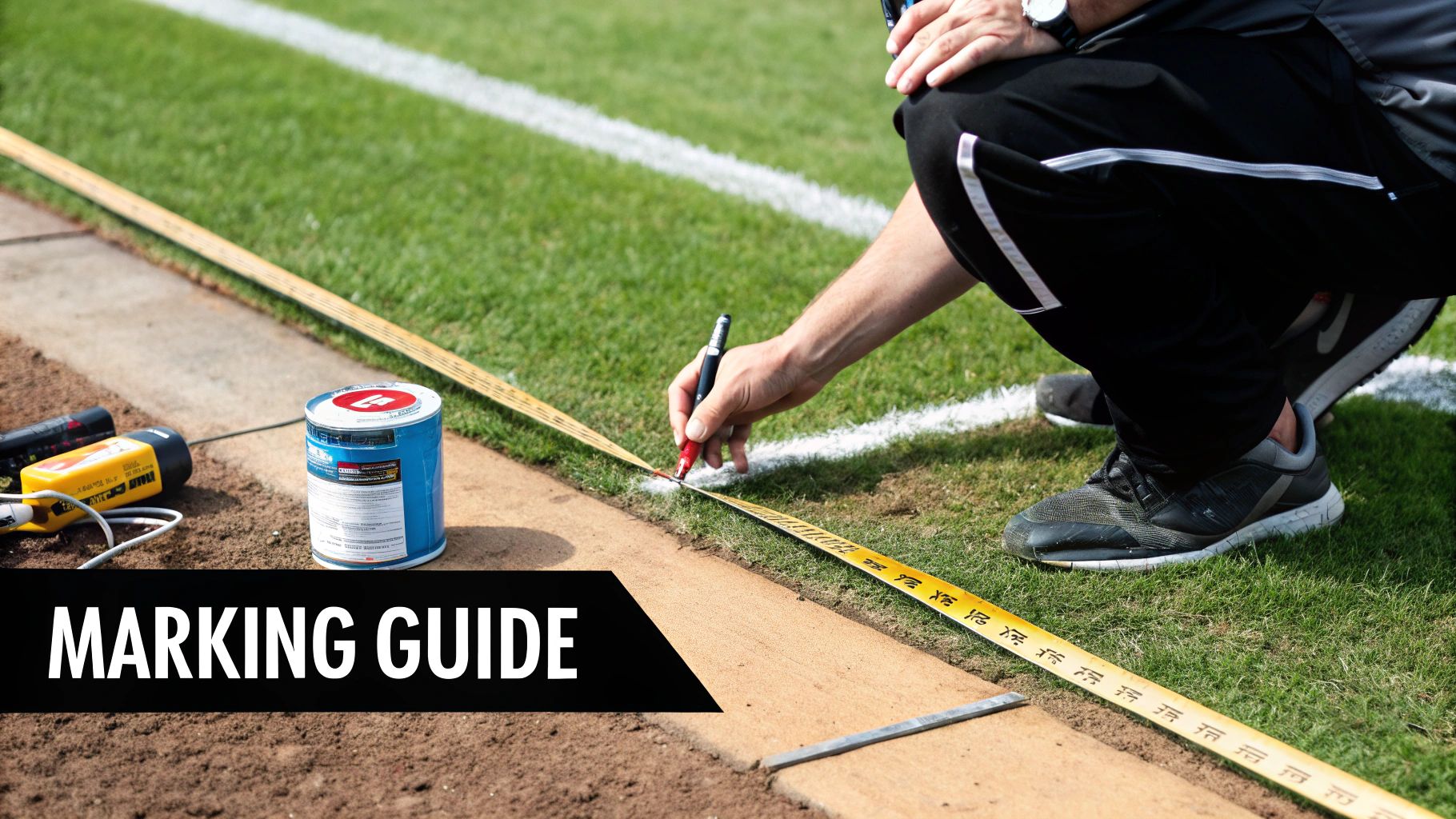
Turning a patch of grass into a proper pitch can feel like a huge job. But with the right approach, it’s a totally manageable project. This guide breaks the process down, moving from the theory of football pitch size to the practical steps you need to get it done, whether you’re a groundskeeper, coach, or dedicated club volunteer.
The first, and most important, step is to get your baseline perfectly straight. This will be one of your touchlines, and every single measurement you make from here on out will depend on it. Use a long measuring tape and some stakes to pull a string line taut between your two future corner flags. This line is your foundation—get it right, and everything else follows.
Creating Perfect Right Angles
Once the baseline is set, the next challenge is creating perfect 90-degree corners. Mess this up, and you’ll end up with a wonky trapezoid instead of a neat rectangle. The easiest and most reliable way to nail this is with the classic 3-4-5 triangle method, a trick builders and groundskeepers have used for centuries.
It’s simpler than it sounds. Here’s how it works:
- Measure 3 Units: From a corner stake, measure 3 metres along your baseline string and make a small mark.
- Measure 4 Units: From that same corner stake, measure 4 metres roughly where you think the goal line should go.
- Find the 5-Unit Point: Now, the magic. Measure exactly 5 metres from your 3-metre mark on the baseline over to the 4-metre line. The point where they meet is a perfect right angle. Pop a stake in the ground right there.
Do this for all four corners, and you'll have a perfectly squared-off pitch. Once the corners are staked, you can run string lines for all four boundaries and get ready to paint. To make this even easier, our complete Pitch Marking Kits give you all the essential tools you need to get started without any of the guesswork.
A common mistake is rushing the corners. Taking an extra 10 minutes to get the 3-4-5 method spot-on will save you hours of headaches later. It’s the difference between a professional-looking field and an amateur one.
Marking the Key Areas
With your main rectangle defined, you can start adding the internal lines. Measure inwards from the goal lines and touchlines to mark out the penalty areas, goal areas, and the halfway line.
For the centre circle, plant a stake in the exact middle of the pitch, tie on a rope cut to a 9.15-metre radius, and walk it around with your line marker to trace the perfect circle. You'll do the same for the corner arcs, but this time using a much shorter 1-metre radius from each corner flag.
Precision is your best friend here, so always double-check your measurements before the paint comes out. For a more detailed breakdown of every line and box, check out our complete guide on soccer pitch dimensions. It's a great resource to have open while you're out on the field.
Using high-quality, weather-resistant paint and a decent line marker will make sure your lines are crisp, clear, and last through a few rainy matches. Follow these steps, and you’ll be able to confidently transform any space into a pitch you can be proud of.
A Few Lingering Questions About Pitch Sizes
Even after you get the basics down, a few common questions always seem to pop up about football pitch dimensions. Let's clear up some of the most frequent ones to give you a complete picture of how pitches are measured and why you see so many variations.
Here are the quick answers you’re looking for.
Are All Premier League Pitches the Same Size?
It's a common myth that every pitch in England's top flight is identical. While it's true that most clubs have settled on a standard size of 105 metres by 68 metres (that's about 115 x 74 yards) for consistency, this is more of a strong recommendation than a hard-and-fast rule.
The FA’s regulations still allow for a bit of wiggle room. This means some grounds, especially older, more compact stadiums, might have slightly different dimensions. While the differences are usually minor these days, a slightly narrower pitch can still subtly change how a match plays out.
Why Do We Use Both Metres and Yards?
The dual-measurement system can feel a bit confusing, but it’s really just tradition bumping up against modern regulations. Officially, FIFA's Laws of the Game use the metric system, making metres the global standard. But in British football culture, imperial measurements are just part of the language.
You’ll always hear commentators and fans call it the "18-yard box," never the "16.5-metre box." They're the same thing, but the old-school term has stuck. For a quick mental conversion, just remember that one metre is roughly 1.09 yards.
How Different Are Indoor Pitches?
Indoor football is a completely different beast, and its pitches are built to match. Unlike the regulated world of outdoor football, there's no single, universal standard for indoor or 5-a-side pitch sizes. The dimensions can vary massively from one venue to the next, often just depending on how much space was available in the building.
As a general rule, an indoor pitch is much smaller, usually somewhere around 30-40 metres long and 20-30 metres wide. There are a few other key differences you'll notice straight away:
- Walled Perimeters: Many indoor pitches have walls or rebound boards, which means the ball almost never goes out of play.
- Smaller Goals: The goals are tiny compared to their outdoor cousins, which makes sense with fewer players and less space.
- Different Surfaces: Forget grass. You’ll be playing on artificial turf or a hard court surface.
All these changes come together to create a much faster, more intense, and technically demanding version of the beautiful game.
Whether you're marking out a professional pitch or just setting up for a Sunday league game, having the right gear is crucial. At SoccerWares, we've got everything from goals to marking cones to help you create the perfect playing field. Check out our full collection at https://soccerwares.com.