

To become properly fit for football, your workouts need to be built around four things: endurance, speed, agility, and functional strength. The best training plans combine high-intensity interval running—the kind that feels like a real match—with drills that sharpen your changes of direction and build powerful, game-ready movements.
It's all about training smarter, not just harder, for the unique demands of the pitch.
Why Generic Fitness Won’t Cut It on the Pitch
Have you ever spent hours plodding away on a treadmill or lifting heavy in the gym, only to feel a yard off the pace during a match? You’re not alone. Many players fall into the trap of thinking general fitness is enough to command a game, but the reality is far more specific.
A standard gym routine simply doesn't prepare your body for the beautiful chaos of a 90-minute match.
Football isn't a marathon, and it's not a pure sprint either. It’s an unpredictable mix of short bursts, sudden stops, sharp turns, jumps, and moments where you have to dig deep and keep going. A generic plan might make you fitter in a straight line, but it fails to build resilience for these game-winning actions. This is where dedicated soccer fitness workouts change everything.
The Unique Physical Demands of Football
To truly make a difference on the pitch, your training has to mirror the physical challenges you'll actually face. The modern game is incredibly fast and more physically demanding than ever—and that’s not just an opinion. The data backs it up.
Take the English Premier League, for instance. Analysis shows that the amount of high-speed running players have to do has shot up in recent seasons. Midfielders and full-backs, in particular, are covering more ground at higher speeds than ever before. Elite clubs now use GPS tracking to ensure their training drills replicate these intense match-day sprints, ditching the old-school long, slow runs for sharp, data-driven work. You can read more about these high-intensity running trends here.
This tells a crucial story for players at every level: your fitness must be functional. Building a big engine is only half the job; you need to be able to use that power in short, explosive, and often unexpected ways.
The goal of a soccer-specific workout isn't just to make you tired. It's to make you resilient to the type of fatigue you feel in a match, so you're just as sharp in the 90th minute as you are at kick-off.
The Four Pillars of Soccer Fitness
To build a training plan that actually works, we need to focus on four core areas that translate directly to how you play. If you neglect any one of these, you’re leaving a weakness in your game for opponents to exploit.
- Endurance: Not just jogging, but the ability to repeat high-intensity sprints throughout an entire match.
- Speed: That raw acceleration to beat a defender or make a recovery tackle.
- Agility: The power to slam on the brakes, turn on a sixpence, and explode in a new direction without losing your balance.
- Functional Strength: The real-world power needed to win a 50/50 tackle, shield the ball from a defender, or leather a shot into the top corner.
By building your workouts around these four pillars, you stop doing generic conditioning and start creating a body that’s genuinely ready for football. You start training with purpose.
Building the Engine Room with Endurance Drills
Your ability to impact a match often boils down to what you have left in the tank during those final ten minutes. While others are gasping for air, a well-built engine room lets you make that late, lung-bursting run or a crucial recovery tackle. This is where endurance training, specifically designed for football, becomes your greatest asset.
But forget those endless, monotonous jogs around the park. The stop-start nature of football demands a completely different kind of stamina. The most effective soccer fitness workouts for endurance are built around High-Intensity Interval Training (HIIT), because it perfectly mimics the rhythm of a game: short, explosive sprints followed by brief recovery periods.
Mastering High-Intensity Interval Training
HIIT is the absolute cornerstone of modern football conditioning. It trains your body to recover quickly between intense efforts, meaning you can sustain a high work rate for the full 90 minutes, not just the first half. The secret lies in tweaking your work-to-rest ratios to challenge both your anaerobic and aerobic systems.
Here are a couple of classic, brutally effective HIIT drills you can work into your routine:
-
Classic Interval Sprints: Mark out 40-50 metres. Sprint the distance at roughly 90% of your maximum speed, then immediately slow to a light jog or walk back to the start. That return trip is your recovery. Aim for 6-8 reps in a single set.
-
Pyramid Sprints: This one is a killer because it varies the distance, simulating the different types of runs you make in a real match. Set up cones at 20m, 40m, and 60m. Sprint to the first cone and back, jog for 30 seconds to recover, then sprint to the second cone and back. Keep going until you hit the furthest cone, then work your way back down.
When you’re just starting, focus on a 1:2 work-to-rest ratio. That means you rest for twice as long as you work—for instance, a 30-second sprint followed by 60 seconds of active recovery (jogging or walking). As you get fitter, you can push this towards a 1:1 ratio to crank up the difficulty and better replicate game intensity.
The real magic of HIIT isn't just the sprinting. It's about teaching your body to clear lactate and bring your heart rate down efficiently during those brief rests you get in a match. That’s what keeps you sharp when it matters most.
The Role of Steady-State Cardio
While HIIT is king for match-specific fitness, there’s still a place for traditional, steady-state cardio. A longer, slower run once a week—think 20-30 minutes at a conversational pace—is brilliant for building your aerobic base. This is the fundamental platform that all your high-intensity efforts are built on.
Think of it this way: your aerobic base is the size of your fuel tank. HIIT teaches you how to use that fuel efficiently, but steady-state cardio actually helps increase the tank's capacity. It's also a low-impact way to boost your cardiovascular health and aid recovery without hammering your joints.
Building Your Weekly Endurance Plan
Juggling these different training styles is key to maximising your gains while avoiding burnout. A well-structured week ensures you’re developing every part of your endurance without overtraining. Simple gear, like a few coloured cones or training bibs, can make organising your sessions much easier, especially if you're training with a group.
To put it all together, here’s a sample weekly structure you can adapt to your own needs.
Sample Weekly Endurance Training Plan
| Day | Focus | Workout Example | Duration/Sets | Intensity |
|---|---|---|---|---|
| Day 1 | HIIT Session | Interval Sprints (30s sprint, 60s jog recovery) | 2 sets of 6 reps | High |
| Day 2 | Active Recovery or Rest | Light stretching, foam rolling, or complete rest | 20 minutes | Very Low |
| Day 3 | HIIT Session | Suicide Runs (sprinting to multiple lines and back) | 4-6 repetitions | High |
| Day 4 | Active Recovery or Rest | Light walk or cycle | 20-30 minutes | Low |
| Day 5 | Steady-State Cardio | Continuous jog at a conversational pace | 25 minutes | Moderate |
| Day 6 | Match Day / Scrimmage | Putting your fitness to the test | 90 minutes | Max Effort |
| Day 7 | Rest | Full recovery day for muscle repair and growth | N/A | N/A |
This schedule gives you two high-intensity days to push your limits, one steady-state day to build your base, and plenty of recovery time built in.
For an even more detailed breakdown, check out our comprehensive guide on how to build stamina for football. Above all, listen to your body and adjust the plan based on how you feel. Consistency, not just intensity, is the true secret to building an engine that never quits.
Unlocking Explosive Speed and Agility
Endurance gets you through ninety minutes, but it’s your speed and agility that win the game. It’s the winger who explodes past a defender with a sharp change of pace or the centre-back reacting in a split second to cut out a dangerous through-ball. These moments aren’t just about being fast in a straight line.
They’re about explosive, multi-directional power. This is where many players get stuck. They might be quick over 30 metres but lack the sharp footwork needed to be truly dangerous. The real secret is blending raw speed work with drills that train your body to accelerate, slam on the brakes, and change direction on a dime.
Building Agility with Foundational Drills
Think of agility as your superpower on the pitch. It's what lets you react to the chaos of a match, staying balanced and ready to burst into space at any moment. The best part? You don't need a fancy gym to build it—just a bit of space and a few markers.
Weaving these drills into your soccer fitness workouts will make your movements sharper and way more efficient.
-
The T-Drill: A true classic for a reason. It nails forward sprints, lateral shuffles, and back-pedalling all in one go. Set up four cones in a 'T' shape. You sprint from the base to the top, shuffle left, shuffle all the way across to the right, shuffle back to the middle, and then back-pedal to the start. The key is to stay low and keep your feet buzzing.
-
Slalom Weave: Pop six to eight cones in a line, about a metre apart. Weave through them as fast as you can. Focus on taking tight turns and really planting your outside foot to power you in the new direction. This is exactly the kind of movement you need to dribble through a packed midfield.
To get the most out of these, having a decent set of durable marker cones makes life so much easier. You can create endless patterns to keep challenging your footwork.
Sharpening Footwork with Ladder Drills
Agility ladders are non-negotiable for any serious player. They force your feet to move with speed and precision in a tight space, which massively improves your coordination and how fast your brain can communicate with your feet.
Here are a couple of must-do ladder drills:
-
Ickey Shuffle: Stand to the side of the ladder. Step in with your lead foot, then your trail foot follows to the same square. Then, step out with the lead foot, followed by the trail foot. It's a rhythmic, side-to-side shuffle that builds incredible foot speed once you get the hang of it.
-
In-In-Out-Out: Another staple. Stand beside the ladder. Step into the first square with your inside foot, then your outside foot. Then step out with your inside foot, followed by your outside foot, moving forward to the next square. Keep it quick and consistent.
Investing in a quality agility ladder is one of the smartest things you can do for your training. It’s a brilliant tool for warm-ups or as part of a bigger speed circuit.
Developing Explosive Power with Plyometrics
While agility drills fine-tune your footwork, plyometrics build the raw, explosive power behind those movements. Think of these as your engine-builders for jumping, sprinting, and pure power.
True explosiveness isn't just about moving fast. It's about generating maximum force in the minimum amount of time. That's what plyometrics train your body to do.
Getting the form right is absolutely critical here to avoid injury.
-
Box Jumps: Find a sturdy box. Swing your arms back, bend your knees, and explode upwards, landing softly on both feet. Don't jump back down—step down and reset. Start with a low box and nail the soft landing before you even think about going higher.
-
Broad Jumps: From a standing start, swing your arms and launch yourself forward as far as you can. Land softly, absorbing the impact through your knees. This builds that horizontal power you need for that first explosive step to ghost past a defender.
The professional game is obsessed with data for a reason. In the UK, sport contributes £53.6 billion to the economy, and a huge part of that value is driven by player performance. Premier League players are tracked making more high-intensity runs than ever before, and that focus on elite conditioning has filtered all the way down to grassroots training. Read the full key findings on the value of UK sport here.
To get even deeper into building pure speed, our guide on how to increase your speed for soccer has extra drills and techniques to give you that edge. Combine these drills into a consistent plan, and you'll become a faster, more agile, and more dangerous player.
Developing Functional Strength for On-Pitch Battles
Forget beach muscles. Strength in football has very little to do with how much you can bench press and everything to do with functional, game-ready power. It’s what allows you to dominate a 50/50, shield the ball under intense pressure, and unleash a thunderous shot when the chance comes.
Many players get this wrong. They hit the gym and focus on isolated movements like bicep curls instead of building a body that moves powerfully as a single, coordinated unit. A well-designed strength circuit won't just make you stronger; it will make you more stable, more resilient to injury, and a far more formidable presence in any on-pitch battle.
The goal is to build an athletic physique that actually enhances your football skills, rather than hindering them with bulky, non-functional muscle.
Core Principles of Functional Strength
So, what is functional strength? It's your ability to generate force during dynamic, football-specific movements. It's the raw power behind winning a header, the stability when you go shoulder-to-shoulder with a winger, and the core control needed to stay on your feet after a heavy challenge.
Every single movement on the pitch, from a quick sprint to striking the ball, starts from your core and radiates outwards. To build this type of real-world strength, your training must be built around compound exercises that fire up multiple muscle groups at once.
- Squats: The undisputed king of lower-body exercises. They build explosive power in your quads, glutes, and hamstrings—the engine for sprinting and jumping.
- Lunges: Perfect for developing single-leg strength and stability, which translates directly to your running stride and your ability to cut and change direction on a dime.
- Deadlift Variations: Absolutely unbeatable for building a powerful posterior chain (hamstrings, glutes, and lower back). This is where almost all athletic power comes from.
These movements are the bedrock of any serious strength programme because they teach your body to work as an integrated system, just like it does during a match.
Building Your Full-Body Strength Circuit
A circuit-based approach is fantastic for footballers. It keeps your heart rate elevated, building that all-important muscular endurance right alongside pure strength. The idea is simple: move from one exercise to the next with minimal rest, complete a full round, then take a longer break.
Here are a couple of examples you can adapt based on where you're at.
Beginner Circuit (Bodyweight Only) Do each exercise for 45 seconds, then take 15 seconds of rest before starting the next one. Go for 3 full rounds.
- Bodyweight Squats
- Push-Ups (drop to your knees if you need to)
- Alternating Lunges
- Plank
- Glute Bridges
This simple circuit builds a solid foundation of strength and stability without needing a single piece of equipment.
Intermediate Circuit (With Basic Equipment) Again, perform each exercise for 45 seconds, with 15 seconds of rest in between. Aim for 4 rounds this time.
- Goblet Squats (using a kettlebell or dumbbell)
- Bent-Over Rows (with resistance bands or dumbbells)
- Walking Lunges
- Russian Twists
- Kettlebell Swings
This version introduces an external load to challenge your muscles further, which is key for promoting greater strength gains. To build a robust physique ready for on-pitch battles, supplementing your routine with targeted movements is a game-changer. You can find more ideas in resources like these 8 Essential Strength Training Exercises for Runners, which offer great compound movements that apply to any athlete.
The Importance of Core Strength
Your core is the crucial link between your upper and lower body. A strong, stable core is what allows you to transfer force efficiently, whether you're striking a ball clean or holding off a defender. Without it, you leak power and become far more susceptible to niggling injuries.
Think of your core as the chassis of a high-performance car. You can have the most powerful engine in the world, but without a strong and stable frame, all that power just goes to waste.
Make sure you're integrating core-specific exercises into your workouts to build that essential stability:
- Plank Variations: Don't just hold a standard plank forever. Try side planks to target your obliques and plank-to-push-ups to add a dynamic challenge.
- Dead Bugs: This is an excellent exercise for teaching core control and limb coordination without putting any stress on your lower back.
- Hanging Leg Raises: A more advanced move, but it builds incredible lower abdominal and hip flexor strength.
Pairing these circuits with simple but effective tools can make a massive difference. High-quality resistance bands are perfect for adding tension to your warm-ups and exercises like rows. Meanwhile, a good kettlebell from SoccerWares can open up a world of powerful, full-body movements like swings and goblet squats. By focusing on these functional exercises, you’ll build strength that truly matters on the pitch.
Creating Your Weekly Soccer Fitness Schedule
Knowing the right drills is one thing, but stringing them together into a coherent weekly schedule is where the magic really happens. A well-structured plan is your blueprint for combining endurance, speed, strength, and recovery into a powerful formula that pays off on match day. Without a plan, you're just guessing—risking overtraining, burnout, or injury by hammering one area while neglecting another.
This is your roadmap to taking control of your physical preparation. The key is to periodise your training, which is just a fancy way of saying you adjust the intensity and focus depending on where you are in the season. The demands of a gruelling pre-season are worlds away from what you need to stay sharp and fresh mid-season. It’s all about creating a smart, sustainable routine that builds you up, week after week.
Structuring Your Training Week
The ideal structure for your soccer fitness workouts really depends on your commitment level and where you're starting from. There’s no one-size-fits-all solution, but we can definitely build some solid templates.
The golden rule? Never schedule two high-intensity sessions back-to-back. Your body needs that downtime to repair and get stronger. Give it that respect.
Here are a couple of sample frameworks to get you going:
-
Beginner (2-3 Sessions/Week): The focus here is all about building a solid foundation without breaking your body. You'll mix a strength day with one or two conditioning days, making sure there's plenty of recovery in between.
- Day 1: Full-Body Strength Circuit
- Day 2: Rest
- Day 3: HIIT Endurance Drills
- Day 4: Rest
- Day 5: Agility & Speed Work (Ladders, T-Drill)
- Day 6 & 7: Rest or a light kickabout
-
Intermediate (3-4 Sessions/Week): At this point, you can handle a bit more volume and start separating your fitness components more distinctly.
- Day 1: Endurance (HIIT Sprints)
- Day 2: Full-Body Strength
- Day 3: Active Recovery (Light jog, stretching)
- Day 4: Speed & Agility Drills
- Day 5: Rest
- Day 6: Match Day
- Day 7: Rest
This tiered approach lets you progress steadily, building a resilient body that can handle whatever the game throws at you.
Pre-Season vs In-Season Training
Your training schedule must adapt to the rhythm of the football calendar. The punishing workload of pre-season is completely different from the fine-tuning required once matches start.
Pre-Season (4-6 weeks before the season): This is your grind time. The goal is to build a massive fitness base so you've got gas in the tank for the whole season. Volume and intensity are high, with a heavy focus on pushing your endurance and building functional strength. You’re looking at 4-5 tough sessions per week.
In-Season: As soon as the competitive matches kick off, everything changes. The focus shifts to performance and recovery. Your number one priority is arriving on Saturday feeling sharp and explosive, not with heavy legs from the gym. Fitness sessions become shorter, sharper, and are timed to give your body maximum recovery before a match.
This infographic breaks down the pillars of soccer strength that should underpin any good training schedule.
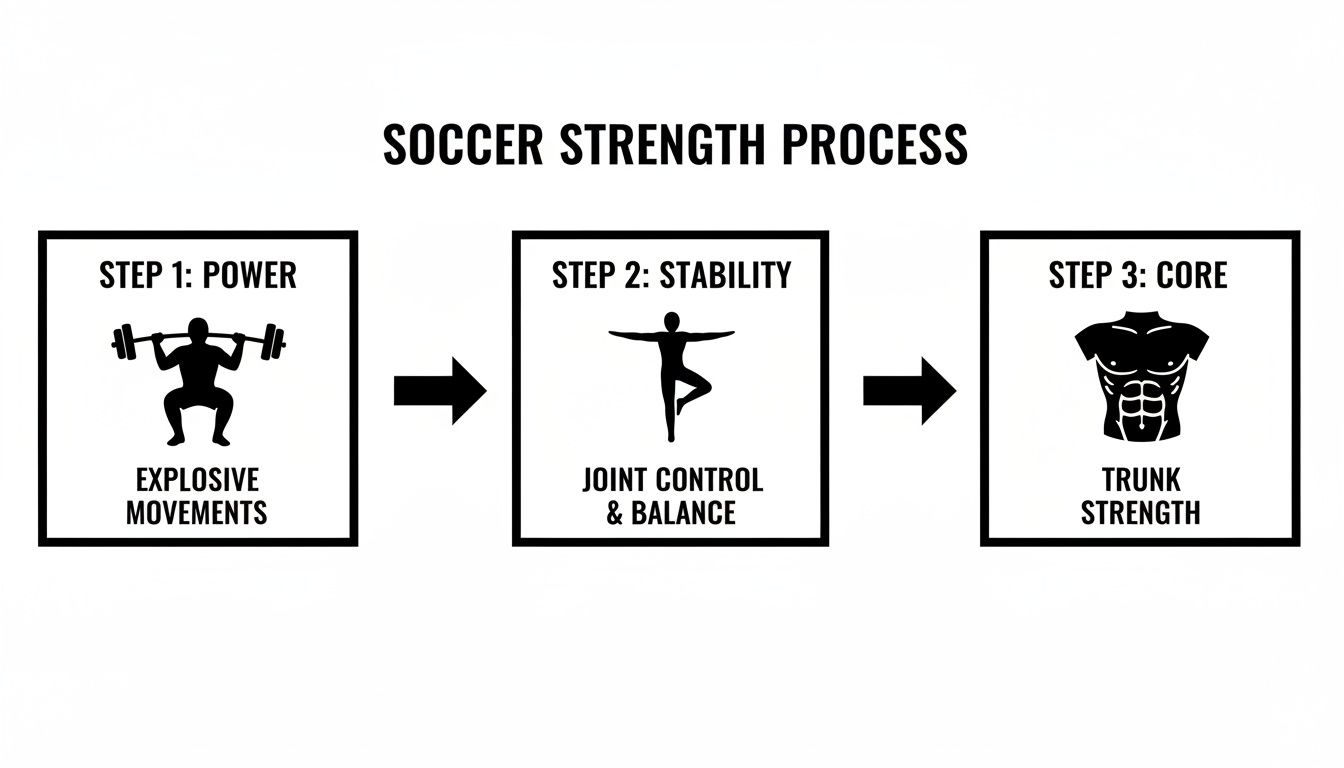
It’s a simple but powerful idea: true on-pitch strength is built by layering explosive power on a solid foundation of stability and core control.
Listening to Your Body and Adjusting
Look, no plan should be set in stone. The most important skill you can develop is learning to listen to your body. Fatigue, persistent muscle soreness, and a lack of motivation are all signs that you might need to dial it back or take an extra rest day.
This is where modern tools can be a real game-changer. For more advanced players, understanding performance metrics is crucial. If you're keen to go deeper, check out our guide on how to read football GPS data to see how the pros monitor their every move.
Your schedule is a guide, not a prison. The smartest athletes are the ones who know when to push hard and, just as importantly, when to back off. True fitness is a long-term project built on consistency, not a single heroic workout.
The desire for structured fitness is growing everywhere. Recent data from Sport England shows a record 63.7% of adults in England are meeting physical activity guidelines, a trend supported by the nation's 115,000+ sports facilities. This grassroots boom has fuelled a massive interest in proper soccer fitness workouts, as more players look to train like their heroes.
Use these templates as a starting point, but always listen to your body’s feedback. By doing that, you can build a personalised schedule that guarantees you arrive at every match in peak physical condition.
Answering Your Biggest Soccer Fitness Questions
When you start digging into soccer fitness workouts, a lot of questions pop up. How do I balance gym work with pitch sessions? What should I eat and when? How does my training change during the season? Getting these details right can be the difference-maker in your performance. Let’s tackle some of the most common queries.
One of the trickiest things to get right is the balance between strength training and technical work. The last thing you want is for your gym sessions to leave you feeling heavy-legged on match day. A simple rule is to avoid heavy leg days within 48 hours of a game or an intense pitch session. Do your tougher strength workouts earlier in the week so your muscles have plenty of time to recover.
When you're in the middle of the competitive season, the gym is for maintenance and power, not for building massive size. Your workouts should be shorter and more explosive. Think box jumps, kettlebell swings, and med ball slams instead of slow, grinding heavy lifts. This keeps your central nervous system firing on all cylinders without the muscle soreness that can kill your sharpness on the pitch.
Nailing Your Pre- and Post-Workout Nutrition
Honestly, what you eat around your training is just as important as the work you put in. The right fuel can push you through a tough session, while the wrong stuff can leave you hitting a wall halfway through.
- Before Training: Get a meal in that’s high in complex carbs about 2-3 hours before you start. This gives your body time to digest and provides that slow-release energy you need. A bowl of porridge, some wholewheat toast with a banana, or a simple chicken and rice dish are all solid choices.
- After Training: That 30-60 minute window after you finish is prime time for recovery. You need a hit of protein to start repairing your muscles and some simple carbs to top up your energy stores. A protein shake with a banana or even a glass of chocolate milk works perfectly.
Many players also ask about supplements specifically for soccer players. While real food should always be your foundation, understanding how certain supplements can aid performance and speed up recovery can give you that extra edge.
Adapting Your Fitness: In-Season vs Off-Season
Your training has to look completely different when you're playing matches every week compared to the off-season. Trying to keep up a pre-season workload all year round is just a recipe for burnout and injury.
The off-season is your time to build the engine—get stronger, improve your aerobic base, and build resilience. The in-season is all about fine-tuning that engine and arriving at every match feeling fresh and powerful.
During the off-season, you can really push the volume. This is the time for more frequent, intense gym sessions and gruelling conditioning drills to address any weaknesses.
Once the season kicks off, the entire focus shifts to recovery and being ready for match day. Your training volume naturally drops, and the intensity is carefully managed. A light, technical session the day before a game is far more valuable than a punishing fitness drill. The goal is simply to maintain the fitness you built, not chase PBs at the expense of your weekend performance.
At SoccerWares, we provide the high-quality training essentials you need to support every phase of your fitness journey. From agility ladders to GPS trackers, find the gear to elevate your game at https://soccerwares.com.