

You're probably here because you want a bottle that does two jobs at once. It needs to feel personal, whether that means a player's name, a club-inspired colour, or a gift that doesn't look generic. But it also has to survive real life: gym bags, commutes, training sessions, hand washing, the odd knock on a bench, and daily use that quickly exposes cheap customisation.
That's where a lot of buyers get stuck. A bottle can look brilliant in a product photo and still disappoint after a few weeks if the finish scuffs, the lid leaks, or the personalisation starts to look tired. With stainless steel water bottles personalized for fans, players, and gift buyers, the smart choice isn't only about style. It's about matching the personalisation method to how the bottle is going to be used.
In the UK, that matters more than ever. British consumers use approximately 14 billion plastic bottles each year, including about 7.7 billion water bottles, and only around 58% are recycled, leaving more than 3 billion plastic water bottles wasted annually according to this UK reusable bottle overview. That helps explain why reusable stainless steel bottles have become such a common pick for everyday carry, gifting, and team orders.
A standard 304 stainless steel bottle is described there as replacing about 167 single-use plastic bottles per year, and it's fully recyclable at end of life with a typical lifespan of 10 to 15 years. That long-life nature is a big part of why personalisation makes sense on steel. If you're adding a name, crest-inspired design, or team branding, you want it on a surface that's built to stay around.
Introduction to Personalised Stainless Steel Water Bottles
A familiar scene. You need a gift for a football fan who already owns the shirt, the scarf, and the mug. Or you're sorting kit for training and want each bottle clearly marked so nobody grabs the wrong one after drills. Or maybe you just want a bottle for work that nods to your club without looking childish at your desk.
That's exactly where personalised stainless steel bottles fit so well. They're practical enough for everyday use, but they still leave room for identity. A printed club-style graphic feels more expressive. An engraved name feels quieter and more premium. A powder-coated finish in a team-inspired colour can split the difference.
Why this category keeps growing
The UK reusable water bottle market was valued at USD 322.9 million in 2024 and is projected to reach USD 733.476 million by 2032, implying a 10.8% CAGR, according to this market reference. That same verified market summary notes that stainless steel and plastic were the largest material segments in 2024, which tells you stainless steel isn't a niche luxury choice. It's one of the main formats buyers already understand and trust.
For fans and teams, that matters because customisation usually works best on formats people already want to use daily. Stainless steel sits in that sweet spot. It feels more substantial than a giveaway bottle, but it's still practical enough for school runs, office desks, sideline use, and travel.
Practical rule: The most successful personalised bottle usually isn't the loudest design. It's the one the owner still wants to carry six months later.
What people often get wrong
Shoppers often begin with the artwork. They start with the name, logo, or colour, then think about bottle quality later. In practice, the better order is the reverse.
Check the steel first. Then the lid. Then the insulation. Then the personalisation method.
That order helps you avoid the classic mistake of buying a bottle that looks custom but behaves like a hassle. If the finish is delicate, the bottle is awkward to drink from, or the lid isn't suited to your routine, the personalisation won't rescue it.
What Makes Stainless Steel Ideal for Personalisation
Stainless steel works well for personalisation because it gives you a hard, stable surface to decorate without turning the bottle into something fragile. It's a well-built training ground wall. You can mark it, coat it, and use it hard without the whole structure becoming less dependable.
The steel itself matters
For food-contact safety and daily performance, UK listings commonly specify 18/8 or 18/10 stainless steel. One UK-facing source explains that 18/8 means roughly 18% chromium and 8% nickel, and that chromium improves corrosion resistance while nickel helps stabilise the alloy against wear and oxidation. The same source notes that this food-grade steel is approved for food contact and doesn't leach chemicals or affect taste, which is why it's so common in reusable drinkware for everyday use and insulated bottles in particular, as outlined in this engraving product reference.
If that sounds technical, the simple version is easy. Chromium helps the bottle resist rust and surface breakdown. Nickel helps the metal stay stable under repeated use. Together, they give you a bottle body that's better suited to daily refilling, washing, and carrying than cheaper-feeling alternatives.
Think in layers, like armour
Most good personalised steel bottles have a few layers working together:
- Inner steel wall keeps the drink in contact with food-grade metal
- Vacuum gap helps reduce heat transfer in insulated designs
- Outer steel wall adds structure and protects the inner chamber
- Powder coating or outer finish creates colour and gives personalisation methods something to work with
That outer layer is a big deal. It's why engraving can create contrast, and why certain printed designs look cleaner on some bottles than others.
Why steel handles names and logos so well
Plastic can flex. Some soft surfaces also mark and dull more quickly. Stainless steel feels different because the base material is firmer and the surface is usually smoother and more consistent. That gives decoration methods a more reliable canvas.
Independent UK product information also states that a standard stainless steel water bottle can be food safe and fully recyclable, and one UK bottle listing describes stainless steel as durable, odour resistant, reusable, and suitable for long-term use in this product example.
If you want a deeper look at the material itself, SoccerWares has a plain-English guide on whether stainless steel water bottles are safe.
A good bottle surface should accept personalisation without making you nervous to actually use it.
What this means when you shop
Before you even think about fonts or artwork, look for these signs:
| Quality check | Why it matters |
|---|---|
| 18/8 or 18/10 steel | A strong sign the bottle is built for food contact and repeat use |
| Powder-coated exterior | Usually gives better grip and stronger visual contrast for engraving |
| Double-wall construction | Better suited to long days out and regular carry |
| Simple, clean bottle shape | Easier to personalise well, especially with names and logos |
If the bottle body is strong and stable, the customisation has a far better chance of looking sharp for the long haul.
How Personalisation Methods Compare for Durability and Style
This is the part that trips up most buyers. They ask, “Which design looks best?” when the more useful question is, “How will this finish look after weeks of use?”
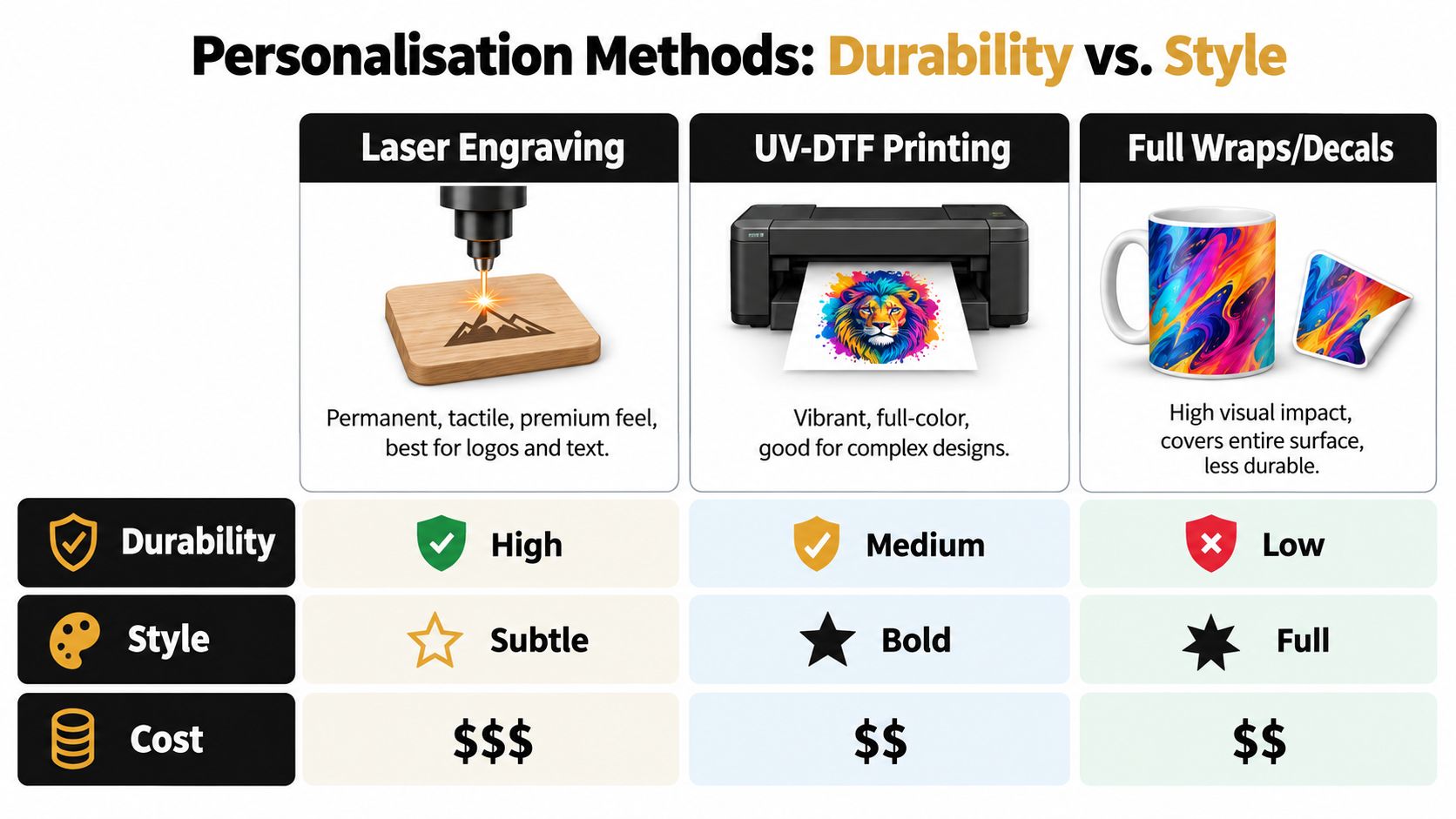
Three routes dominate stainless steel bottle personalisation: laser engraving, UV-DTF printing, and wraps or decals. All three can work. They just solve different problems.
Laser engraving
Laser engraving is usually the safest pick when durability matters most. UK suppliers describe it as a permanent marking method because it removes only the coating or a microscopic surface layer to expose the steel beneath, so the logo or name doesn't rub or wash off. Those same UK references note that this works especially well on powder-coated and double-wall insulated bottles because the contrast comes from revealing the bare metal rather than printing on top, as explained in this stainless steel bottle personalisation guide.
That's why engraved bottles tend to feel more “built in” than “added on”. The design becomes part of the surface story of the bottle, not a layer sitting above it.
Best for:
- Names
- Initials
- Clean logos
- Team issue bottles where long-term wear matters
Trade-off:
- You won't get bright multi-colour artwork
UV-DTF printing
UV-DTF printing is useful when your design needs colour, detail, or a more graphic look. It allows more visual expression than engraving, which makes it a strong fit for fan graphics, retro-inspired designs, and artwork that needs a fuller palette.
The trade-off is simple. Colour sits on the surface in a more decorative way, so it usually needs a bit more care. That doesn't mean it's flimsy. It means it isn't the same kind of “permanent mark” as engraving.
If you want a practical breakdown of decal placement and application on drinkware, Cobra DTF tumbler decal advice is a useful outside reference because it shows where edge lifting and handling issues can start if the artwork or application area isn't chosen carefully.
Full wraps and decals
Wraps are the boldest visual option. They can cover much more of the bottle and create a strong retail-style look. That's handy if the design itself is the main point, such as a supporter gift with club-inspired graphics.
But wraps also introduce more edges, more surface coverage, and more opportunity for visible wear over time. If the bottle is going in and out of bags, rubbing against keys, or getting heavy daily use, that matters.
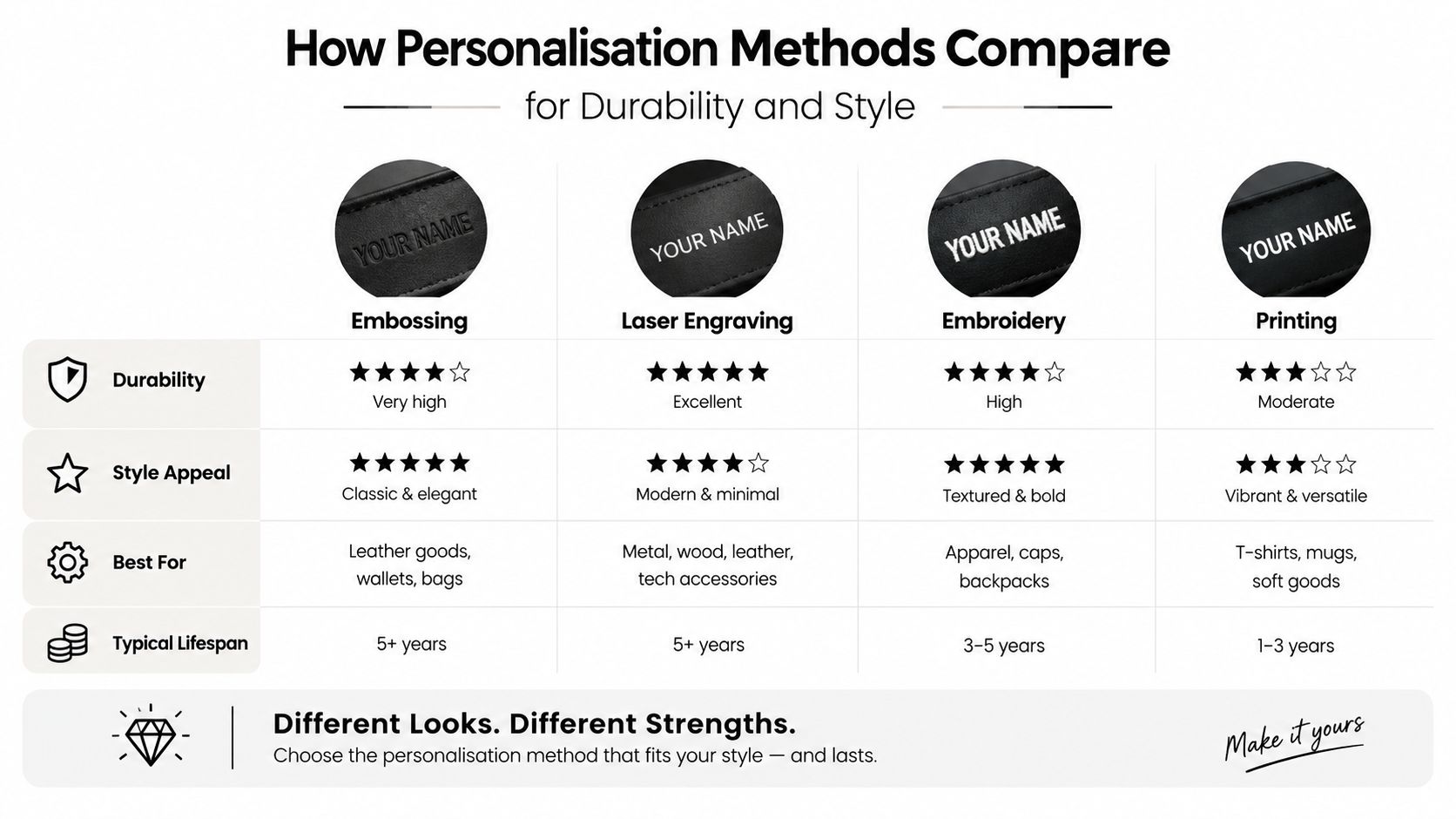
Personalisation Methods Compared
| Method | Best For | Durability | Colour Options |
|---|---|---|---|
| Laser engraving | Names, initials, simple logos, premium gifts | High | Limited, usually single-tone contrast |
| UV-DTF printing | Club-inspired graphics, detailed artwork, colourful designs | Medium | Strong full-colour potential |
| Full wraps or decals | Statement designs, fuller surface coverage, gift presentation | Lower | Broad visual freedom |
The feel in hand matters too
A bottle isn't a poster. You hold it, grip it, wash it, and chuck it into a bag.
- Engraving feels subtle and often slightly tactile
- UV-DTF feels more decorative and visually expressive
- Wraps feel most like applied artwork, which some buyers love and others find less premium
Quick test: If the bottle is for hard daily use, choose the method you'll worry about the least when it knocks into a zip, bench, or car cup holder.
A lot of buyers end up happiest by deciding one thing first. Do you care more about permanence or colour? If permanence wins, engraving usually takes it. If colour wins, printing or wraps make more sense.
Choosing the Right Size Lid and Insulation for Daily Use
A personalised bottle can still be wrong for your day. Plenty of people choose a design they love, then realise the bottle is too wide for a backpack pocket, too awkward to clean, or fitted with a lid that doesn't suit how they drink on the move.
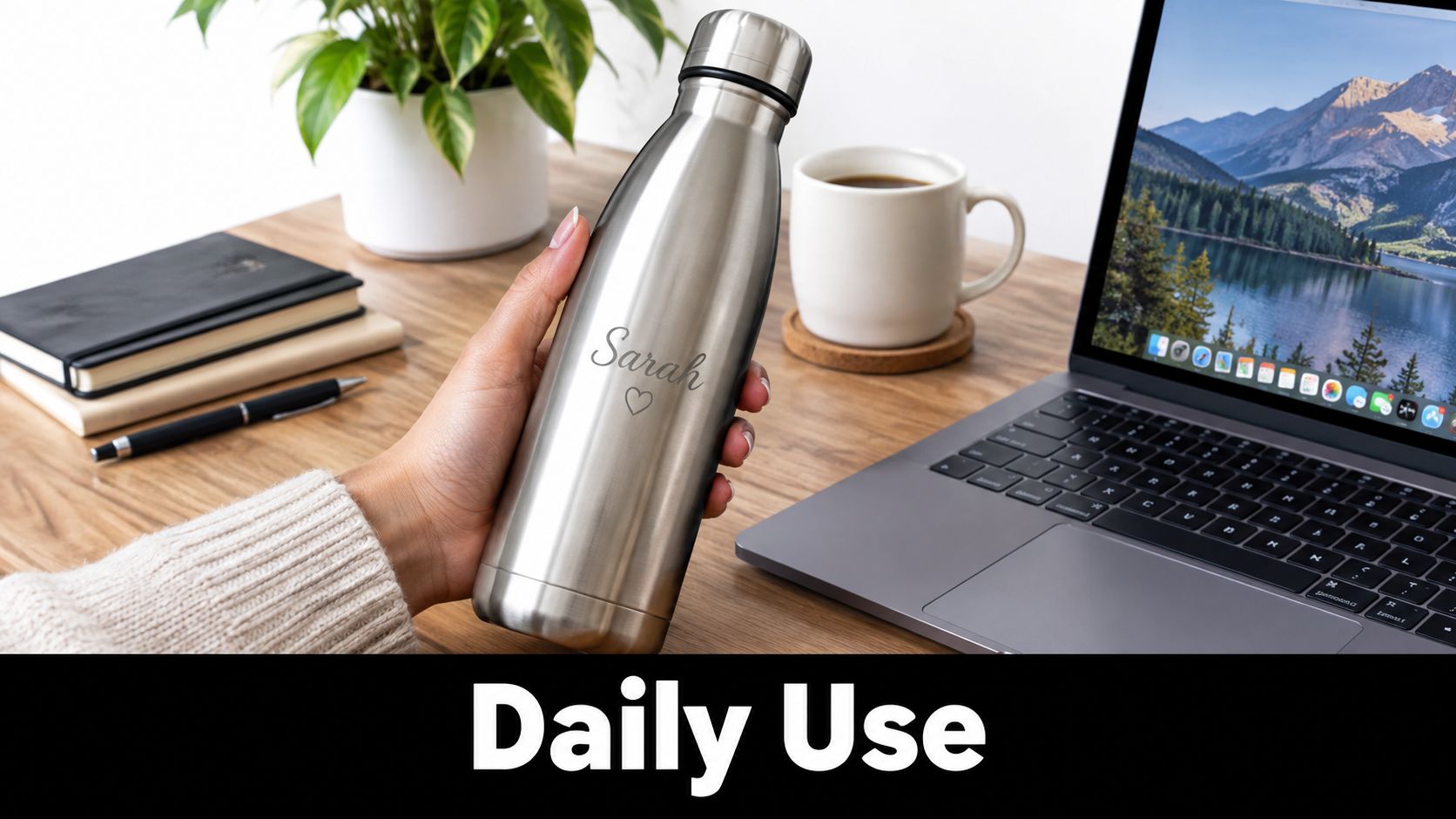
Start with the routine, not the bottle
Bottle size typically falls into a few everyday patterns:
- 500ml suits desks, school bags, and shorter trips
- 750ml is often the all-rounder for training, commuting, or weekend outings
- Larger 40oz travel formats suit long drives, long workdays, or anyone who hates constant refills
There isn't a universal best size. The useful question is how often you want to refill, and whether you're carrying the bottle by hand or stuffing it into a packed bag.
A slim 500ml bottle usually feels easier to live with in crowded spaces. A larger insulated bottle feels better for all-day use but can become noticeably heavier once filled.
Lid choice changes the experience
Recent UK testing highlights leak prevention, insulation, lid choice, and usability as the key decision drivers for reusable bottles, while many personalised listings focus mainly on names, logos, and appearance, as discussed in this UK buying guide.
That matches what most regular users find.
Screw lids
These are usually the safest bet for leak resistance. They're simple, dependable, and better for tossing into a kit bag.
Flip lids
These are handier when you're drinking often and don't want to fully unscrew the cap every time. They're popular for gyms and desks, but hinge areas can need more careful cleaning.
Straw lids
These work well for easy sipping while driving or working, though some people find them less appealing for quick deep drinks after exercise.
If you're comparing styles and capacities, SoccerWares has a useful overview of stainless steel water bottle options in the UK.
Why insulation still matters with personalisation
People sometimes treat insulation as a separate issue from customisation. It isn't. Bottle shape, wall construction, and outer coating all affect which decoration methods make sense.
A double-wall bottle with a powder-coated exterior is often an excellent base for engraving because you get that clean contrast without changing the bottle's structural performance. Good customisation should sit on top of the bottle's function, not fight it.
This short video gives a helpful visual look at the kind of everyday bottle features worth noticing before you order:
A simple way to match bottle to use
| Use case | What usually matters most |
|---|---|
| Commute | Slim shape, leak-proof lid, easy one-hand carry |
| Gym or training | Faster access lid, secure closure, easy refill |
| Desk and home | Comfortable sip experience, tidy look, stable base |
| All-day travel | Larger capacity, strong insulation, practical handle or grip |
Choose the bottle that fits your routine first. Then personalise it.
Real World Examples of Personalised Bottles for Fans and Teams
The easiest way to choose well is to look at real situations. The same bottle that works for a one-off gift often isn't the right answer for a full squad, and the team bottle that survives training might not feel special enough as a birthday present.
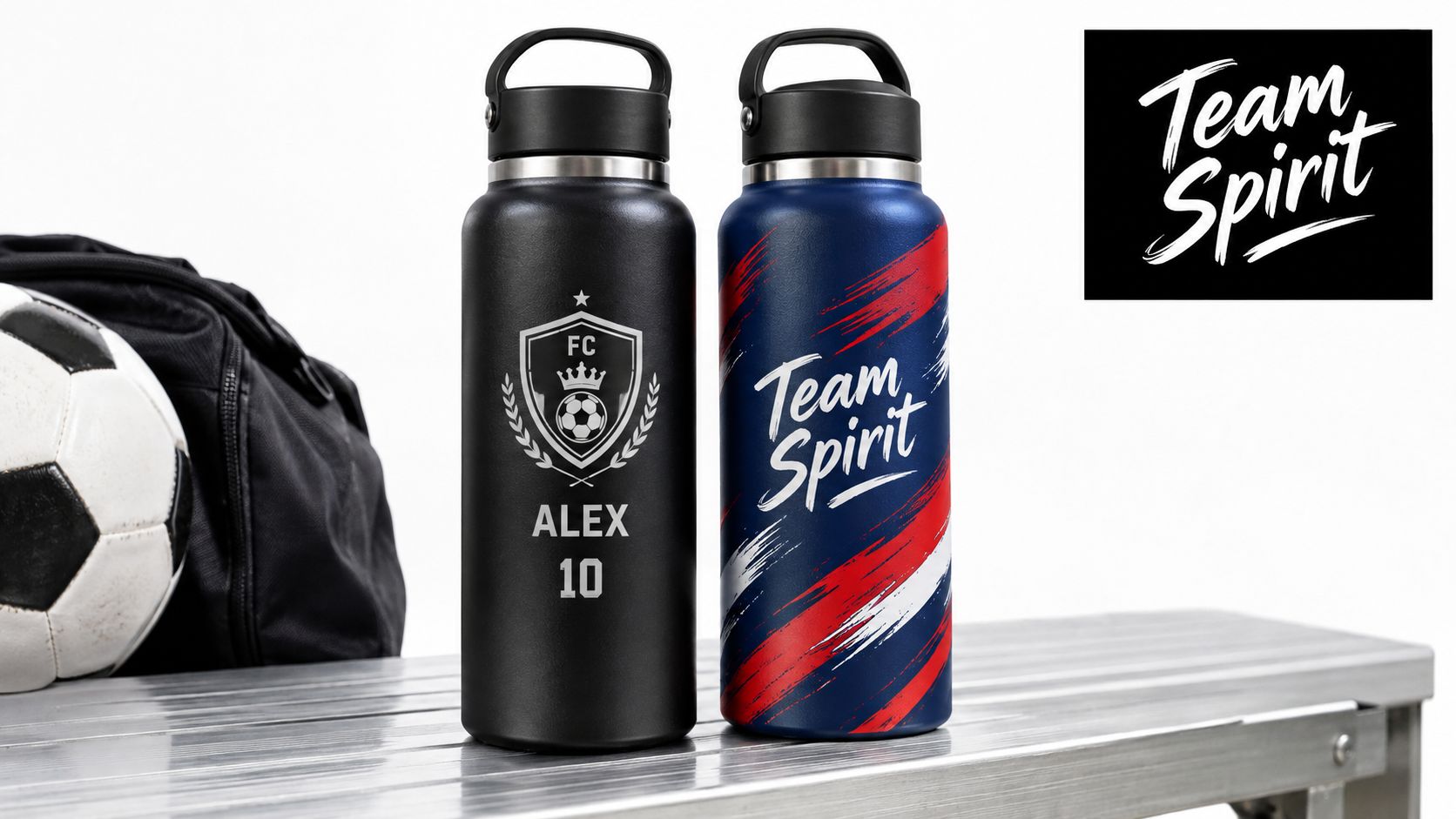
The fan gift
A supporter gift works best when it feels considered rather than overdone. An engraved name on a dark powder-coated bottle often lands well because it feels personal without drifting into novelty territory. Add a club-inspired colour palette and the result usually feels closer to premium merchandise than a generic promo item.
This is also where presentation matters. UK gifting research notes that packaging and presentation are important in food and drink gifting, and that many personalised bottle pages still leave practical questions unanswered around gift suitability, minimum orders, and turnaround time in this Mintel gifting market reference.
So if the bottle is a gift, ask more than “Can I add a name?” Also ask:
- Will the finish still look good after regular use?
- Does the lid feel substantial?
- Does the design choice suit a single recipient, not a bulk order look?
The team order
A squad order has different priorities. You want bottles that are easy to identify, hard to mix up, and able to handle repeated use. In that setting, laser engraving usually makes a lot of sense for player names or numbers because you're reducing the chances of visible wear from constant handling.
For club training groups and sports-focused use, stainless steel sports bottles are one practical reference point because they focus on durable drinkware formats rather than purely decorative gifting.
One more thing changes with team orders: consistency matters more than artistic range. A unified finish with clean names often looks sharper than trying to make every bottle highly individual.
Team bottles should be easy to spot, easy to use, and boring in the best possible way. Nobody wants to wonder whose bottle survived the wash and whose didn't.
The everyday carry bottle
This is the bottle for the office, school run, train commute, or daily errands. It doesn't need to shout. It needs to feel right in hand and survive routine use.
That's where a simple engraved monogram, short name, or clean printed graphic often works best. Bottles inspired by football culture can still feel subtle. A retro colour, a nod to a shirt era, or a pared-back crest style usually ages better than an overly busy design.
If you want to compare how premium engraved drinkware is approached in another market, this example of a personalized Yeti by Evright Industrial is useful as a reference for the kind of understated, engraving-led finish many buyers now prefer.
A note on related drinkware
Not every personalised steel drinkware item needs to be a tall bottle. A powder-coated insulated mug suits desk use. A lightweight tumbler can make more sense for cold drinks at home or on the move.
For example, a Bruised Banana inspired stainless steel tumbler in 20oz (600ml) with a reusable metal straw and lid suits people who want football nostalgia in a more casual format. That kind of product works when the owner values style and everyday sipping over maximum portability in a sports bag.
Caring for Your Personalised Bottle to Keep It Looking New
A good personalised bottle shouldn't feel high-maintenance, but a few habits make a big difference. Most surface damage happens through rough cleaning, trapped moisture around lids, or repeated abrasion in bags.
A care routine that actually works
Start simple:
- Wash soon after use. Don't leave drinks sitting for long periods, especially anything other than water.
- Use a soft brush or cloth. This protects both the steel and the personalised finish.
- Clean the lid separately. Seals and threads are where residue tends to hide.
- Dry with the lid off first. Let air circulate before sealing it back up.
Hand washing is often the safer choice for keeping personalised finishes looking fresh, especially for printed or applied designs. Engraving is more forgiving because the mark is superficial to the surface rather than a peelable top layer, but gentle care still helps preserve contrast and the surrounding coating.
What to avoid
- Harsh abrasives can dull coatings and scratch printed areas
- Metal scourers can leave visible marks
- Soaking lids indefinitely can shorten the life of seals
- Stuffing the bottle loosely with keys or hard items can wear down the exterior finish
If hygiene is your main concern, SoccerWares also has a practical article on water bottle hygiene.
Care shortcut: Treat the outside finish like the paint on a bike helmet. It's durable, but it lasts longer when you stop scrubbing it like a pan.
End-of-life value still matters
Independent UK product information states that stainless steel bottles can be fully recyclable at end of life, and stainless steel is widely valued for long-term reusability and odour resistance in daily use, as noted earlier in the article. That means the bottle has value beyond a single season, even after years of use.
Final Thoughts on Choosing Your Personalised Bottle
The strongest personalised bottle choices follow a simple order. First, choose a bottle with sound materials and construction. Then match the personalisation method to how the bottle will be used. After that, pick the size and lid that fit the owner's routine.
If you want the cleanest long-term result, engraving is usually the safest choice. It suits names, initials, and simple logos, and it works especially well on powder-coated stainless steel. If you want richer colour or more expressive fan graphics, printed options and wraps open up more design freedom, but they ask for a little more care.
For gifts, think about finish and presentation. For team orders, prioritise consistency and durability. For everyday use, don't underestimate lid choice and bottle shape. Those practical details decide whether the bottle becomes a daily companion or ends up forgotten in a cupboard.
The wider market also points in the same direction. One UK market report says the reusable water bottle market is projected to add more than USD 86.55 million by 2026 to 2031 in this forecast summary, while a UK-focused market analysis estimates that premium stainless steel vacuum-insulated bottles account for about 55 to 65% of retail value in the UK warm/cold water bottle market in this market analysis. Buyers clearly aren't treating stainless steel as a niche side option. They're choosing it as the main event.
The good news is that once you understand the trade-offs, the decision gets much easier. Pick the bottle for the life it's going to live, not just the photo you want it to look good in.
If you want football-inspired drinkware that balances everyday use with fan identity, SoccerWares offers stainless steel bottles, tumblers, mugs, and training-friendly gear built around club culture and practical use. It's a good place to browse styles that make sense as gifts, team kit additions, or daily carry without losing sight of finish, durability, and function.