

Wearable football sensors are small tracking devices that turn movement, workload, and recovery into usable football data. In practice, that means a player can see how hard they worked, a coach can spot fatigue before it becomes a problem, and a parent or academy can compare progress over time instead of relying on guesswork.
What has changed is who can use them. Systems once limited to elite clubs now reach serious amateurs, youth players, and grassroots teams as well as the professional game. Football teams started adopting GPS and accelerometer devices around 2007, and match use became mainstream after FIFA approved Electronic Performance and Tracking Systems following IFAB rule changes on player safety, as outlined in Duke’s history of EPTS regulations.
For years, only elite clubs with massive budgets could get their hands on this stuff. But things are changing, and fast. The latest devices are way more affordable and user-friendly, putting pro-level analytics in the hands of academy players, serious amateurs, and even passionate Sunday league teams.
These aren't just gadgets anymore; they're essential tools for anyone serious about improving. For a deeper look at this shift, check out our guide on the future of football training technology.
Think of it as having your own personal sports scientist on your shoulder, tracking every move. This data gives you an honest, objective look at your game that the naked eye just can't see. It finally answers those key questions:
- Are you overtraining or not pushing hard enough? Sensors measure your total workload, helping you strike that perfect balance between improvement and burnout.
- Is one side of your body doing all the work? The data can flag up subtle imbalances you’d never notice, which could lead to injuries down the road.
- Where are you really most effective on the pitch? Heatmaps reveal your true positional patterns, giving you and your coach solid evidence to refine your role.
When you start using this tech, you're not just crunching numbers. You're investing in a smarter, more sustainable way to play football. It gives players, parents, and coaches the power to make informed decisions that lead to real, visible improvements where it counts—on the pitch.
How We Evaluated Wearable Football Sensors
Key considerations when evaluating wearable football sensors include what the device tracks, whether it works for training or matches, how easy the app is to understand, how comfortable it is to wear, what the overall cost looks like after subscriptions, and whether it makes sense for pros, academies, or everyday players.
I tend to distrust football tech coverage that treats every sensor like it belongs to the same category, because a GPS vest for squad monitoring solves a very different problem from a boot-mounted tracker for an individual player. So the framework here separates systems by use case first, then by features. That makes it easier to decide whether you need live sideline data, post-session reports, or just a reliable football performance tracker that helps with weekly training.
We also weighted practicality heavily. A device can look impressive on a feature sheet and still be a poor fit if the app is clunky, the vest is uncomfortable, the reports are too analyst-heavy, or the subscription keeps key metrics locked away. In my view, the best system is not the one with the longest spec list; it is the one you will wear consistently and use to change decisions on the pitch or training ground.
Why Your Game Needs a Data Upgrade
Ever seen a Formula 1 car race without telemetry? Of course not. The driver and engineers would be completely in the dark about performance, fuel, and tyre wear. In today’s football, playing without performance data is a bit like that. You're guessing.
Wearable football sensors are the answer. They’re small, clever devices that track every sprint, turn, and kick, translating your hard work into insights you can use.
For years, only elite clubs with massive budgets could get their hands on this stuff. But things are changing, and fast. The latest devices are way more affordable and user-friendly, putting pro-level analytics in the hands of academy players, serious amateurs, and even passionate Sunday league teams.
These aren't just gadgets anymore; they're essential tools for anyone serious about improving. For a deeper look at this shift, check out our guide on the future of football training technology.
Think of it as having your own personal sports scientist on your shoulder, tracking every move. This data gives you an honest, objective look at your game that the naked eye just cannot see. It finally answers those important questions:
- Are you overtraining or not pushing hard enough? Sensors measure your total workload, helping you strike that perfect balance between improvement and burnout.
- Is one side of your body doing all the work? The data can flag up subtle imbalances you’d never notice, which could lead to injuries down the road.
- Where are you really most effective on the pitch? Heatmaps reveal your true positional patterns, giving you and your coach solid evidence to refine your role.
When you start using this tech, you're not just crunching numbers. You're investing in a smarter, more sustainable way to play football. It gives players, parents, and coaches the power to make informed decisions that lead to real, visible improvements where it counts—on the pitch.
How Do Wearable Football Sensors Actually Work?
Ever wondered what’s going on inside those little pods tucked between a player’s shoulder blades? It’s not just one piece of tech, but a tiny, coordinated team of specialists working together to paint a full picture of what’s happening on the pitch.

Think of it like this: your phone knows where you are thanks to its GPS. These sensors do the same, but on a much more detailed level. They use Global Navigation Satellite Systems (GNSS) to track a player’s every single step, which is how you get those cool heatmaps and see the total distance someone has covered in a match.
But football isn’t just about jogging around a field. It’s a game of explosive, split-second movements. That’s where the other bits of kit inside the pod come into their own.
The Brains Behind the Brawn
Knowing you ran 10 kilometres is one thing. Knowing how much of that was a flat-out sprint versus a slow jog back into position reveals deeper insight. Here the magic happens, with several sensors working in perfect sync.
- Accelerometers: These are the experts in explosive power. They measure how quickly you speed up and slow down, capturing every sprint, sharp turn, and jump.
- Gyroscopes: These track your body’s rotation and orientation. They are essential for analysing balance and agility, telling the story of how quickly you can twist to beat a defender or lunge into a tackle.
- Magnetometers: Think of this as a super-accurate digital compass. It provides a constant sense of direction, making sure the data from the other two sensors is correctly mapped to your actual movements on the pitch.
When you combine their data, you get a highly detailed profile of a player's physical output. It’s far more than just distance—it’s a complete story of their workload.
At its core, the technology translates every physical action into a data point. The combination of these points reveals patterns in performance, fatigue, and even potential injury risks that would otherwise be invisible.
From Raw Numbers to Smart Decisions
Of course, collecting millions of data points is only the first step. The power comes from AI algorithms that crunch all this information in real-time. These algorithms turn abstract numbers into metrics a coach or player can use, like sprint speed, player load, and fatigue levels.
This kind of advanced analysis is why adoption is rising throughout elite football. A recent sport-tech review notes that nearly four out of five professional sports organisations now maintain dedicated data-analysis staff for wearable outputs, showing how these systems are embedded in performance departments, and the same review links full-spectrum wearable monitoring with lower non-contact injury rates in team sport settings, as discussed in this 2024–2026 research summary.
For readers who want a consumer-facing example of how heart-rate and activity data are packaged in everyday wearables, DigiDevice's guide is a useful contrast to the more specialised football systems covered here.
Ultimately, these systems don't just tell you what you did. They give you the insights to understand how you can do it better next time. By checking out devices like the ones on SoccerWares, you can start to see how this technology turns raw effort into a genuine competitive edge.
What Can You Actually Track With These Things?
Before looking at metrics, it helps to know what players wear. In football and futbol, the most common setup at team level is a GPS or GNSS pod placed in a vest between the shoulder blades. That is the standard EPTS-style format used by clubs to measure distance, speed, accelerations, decelerations, and positional movement. Elite teams use it because it captures whole-body movement well and fits into training workflows, but it is less useful if you want detailed ball-contact or left-right foot data.
There are also boot- or foot-mounted trackers, chest-based heart-rate straps, and general-purpose wearables like smartwatches. Boot-mounted systems focus more on touches, kicking volume, foot balance, and technical repetition, which makes them attractive for individual development and younger players. Heart-rate straps are still one of the simplest ways to add physiological context to running data. Smartwatches can help with recovery, daily activity, and general fitness, though they are usually less football-specific and are often impractical during competitive play.
At the top end, clubs refer to approved match and training systems as EPTS. Under IFAB’s Laws of the Game, electronic performance and tracking systems are permitted when competition rules allow them and when safety requirements are met, which is why you so often see the familiar performance vest on pro players during training and warm-ups; IFAB summarises that framework in its Laws of the Game guidance.
If you want to get really technical about the GPS side of things, our complete guide to soccer GPS tracking systems is a great place to start.
Essential Football Metrics Tracked by Wearable Sensors
The table below ties the main metrics back to the device category that usually produces them. That distinction matters, because buyers often expect one device to do everything when most systems are strongest in one area.
| Metric Category | Specific Metric | Main Device Category | What It Measures | Why It Matters for Football |
|---|---|---|---|---|
| Physical | Total Distance | GPS vest pod / EPTS match vest | The overall ground covered during a session or match. | A key indicator of work rate and essential for managing weekly load to avoid burnout. |
| Max Speed | GPS vest pod / EPTS match vest | Your highest sprinting speed reached in a session. | A clear benchmark for your explosive power and sprinting progress. | |
| Accelerations & Decelerations | GPS vest pod with accelerometer | How quickly you can speed up and slow down. | Crucial for agility, changing direction, and identifying movement patterns linked to injury risk. | |
| Tactical | Heat Maps | GPS vest pod / EPTS match vest | A visual representation of where you spend time on the pitch. | Perfect for analysing positioning, tactical discipline, and your overall influence on the game. |
| Positional Discipline | GPS vest pod / team tracking platform | Compares your on-field movement to the coach’s intended tactical shape. | Ensures you're fulfilling your role and the team is working as a cohesive unit. | |
| Physiological | Heart Rate Zones | Heart-rate strap or integrated team system | The amount of time spent in different heart rate intensity zones. | Helps tailor training sessions to specific goals, like building endurance or focusing on recovery. |
| Player Load | EPTS vest with motion sensors | A combined score calculating the total stress on your body. | One of the best tools for managing fatigue and preventing overtraining injuries. | |
| Recovery Status | Heart-rate wearable / smartwatch ecosystem | A daily readiness score, often based on Heart Rate Variability (HRV). | Tells you when to push hard in training and when your body needs to rest and recover. | |
| Technical | Touches and Foot Balance | Boot- or foot-mounted tracker | Which foot is used, touch volume, and side-to-side technical output. | Useful for individual players trying to build weaker-foot use and monitor repetition quality. |
As you can see, we've moved way beyond simple step-counting. This is detailed, football-specific data that can give you a real edge.
| Metric Category | Specific Metric | What It Measures | Why It Matters for Football |
|---|---|---|---|
| Physical | Total Distance | The overall ground covered during a session or match. | A key indicator of work rate and essential for managing weekly load to avoid burnout. |
| Max Speed | Your highest sprinting speed reached in a session. | A clear benchmark for your explosive power and sprinting progress. | |
| Accelerations & Decelerations | How quickly you can speed up and slow down. | Crucial for agility, changing direction, and identifying movement patterns linked to injury risk. | |
| Tactical | Heat Maps | A visual representation of where you spend time on the pitch. | Perfect for analysing positioning, tactical discipline, and your overall influence on the game. |
| Positional Discipline | Compares your on-field movement to the coach’s intended tactical shape. | Ensures you're fulfilling your role and the team is working as a cohesive unit. | |
| Physiological | Heart Rate Zones | The amount of time spent in different heart rate intensity zones. | Helps tailor training sessions to specific goals, like building endurance or focusing on recovery. |
| Player Load | A combined score calculating the total stress on your body. | One of the best tools for managing fatigue and preventing overtraining injuries. | |
| Recovery Status | A daily readiness score, often based on Heart Rate Variability (HRV). | Tells you when to push hard in training and when your body needs to rest and recover. |
What Each Device Type Is Best At
For most team environments, the GPS vest remains the most useful all-round option because it gives coaches a shared picture of volume and intensity across the squad. If I were advising a club rather than an individual player, I would begin with the GPS vest, because training decisions are easier when everyone is measured in the same system.
For individuals, though, the answer can be different. A foot-mounted tracker may tell a more relevant story for a young player working on repetition, two-footedness, and ball work than a back-mounted pod that mostly reports running output. That is especially true for technical sessions where the quality of touches matters more than total distance covered.
Physical Output Metrics
This is the raw data of your effort and athleticism on the pitch. It’s all about putting a number on the physical work you do, from your endurance over 90 minutes to those short, sharp bursts of power.

- Total Distance: A classic for a reason. It shows your overall work rate and is vital for making sure you’re not overdoing it week after week, which is a fast track to burnout.
- Max Speed: Nothing beats the feeling of hitting a new top speed. It’s a straightforward, satisfying sign that your sprint training is paying off.
- Accelerations & Decelerations: These measures reveal how fast you can get to top speed and, just as crucial, how quickly you can stop. This data is gold for understanding agility and can even flag movement patterns that might lead to injuries down the line.
The proof is in the numbers. Clubs using this kind of data are seeing tangible results.
This shows it plain and simple: training based on sensor feedback is creating faster players and keeping them on the pitch with fewer injuries.
Tactical and Positional Insights
Beyond your fitness levels, these sensors give you a tactical map of your performance. They show you where you’re most effective on the pitch and whether you're sticking to the game plan your coach laid out.
Heat maps are a genuine game-changer for tactical analysis. They give you a crystal-clear visual of a player's positioning, offering undeniable proof of their discipline, work rate, and influence on the match.
Here are a couple of key tactical metrics:
- Heat Maps: These images show your hotspots on the pitch. They're perfect for refining your positioning and better understanding your tactical role in the team.
- Positional Discipline: Coaches can overlay a player’s actual movements onto the intended formation. It’s a brilliant way to see if everyone is on the same page and working together as a unit.
Physiological Responses
This category is all about what’s happening inside your body. It measures how you’re coping with the physical demands of the game, which is absolutely vital for optimising your recovery and making sure you’re always ready to perform at your peak.
- Heart Rate Zones: By tracking how long you spend in different heart rate zones, you can ensure your training is hitting its target, whether that’s building stamina or improving your recovery between sprints.
- Player Load: This is a clever one. It combines data from multiple sensors to give you a single score for the total stress placed on your body. It's one of the best ways to manage fatigue and stop overtraining injuries before they happen.
- Recovery Status: Using metrics like heart rate variability (HRV), the tech can give you a daily score on how ready your body is to perform. It helps you make the smart call on when to go all-out and when to prioritise a rest day.
Top Wearable Football Sensor Brands to Watch
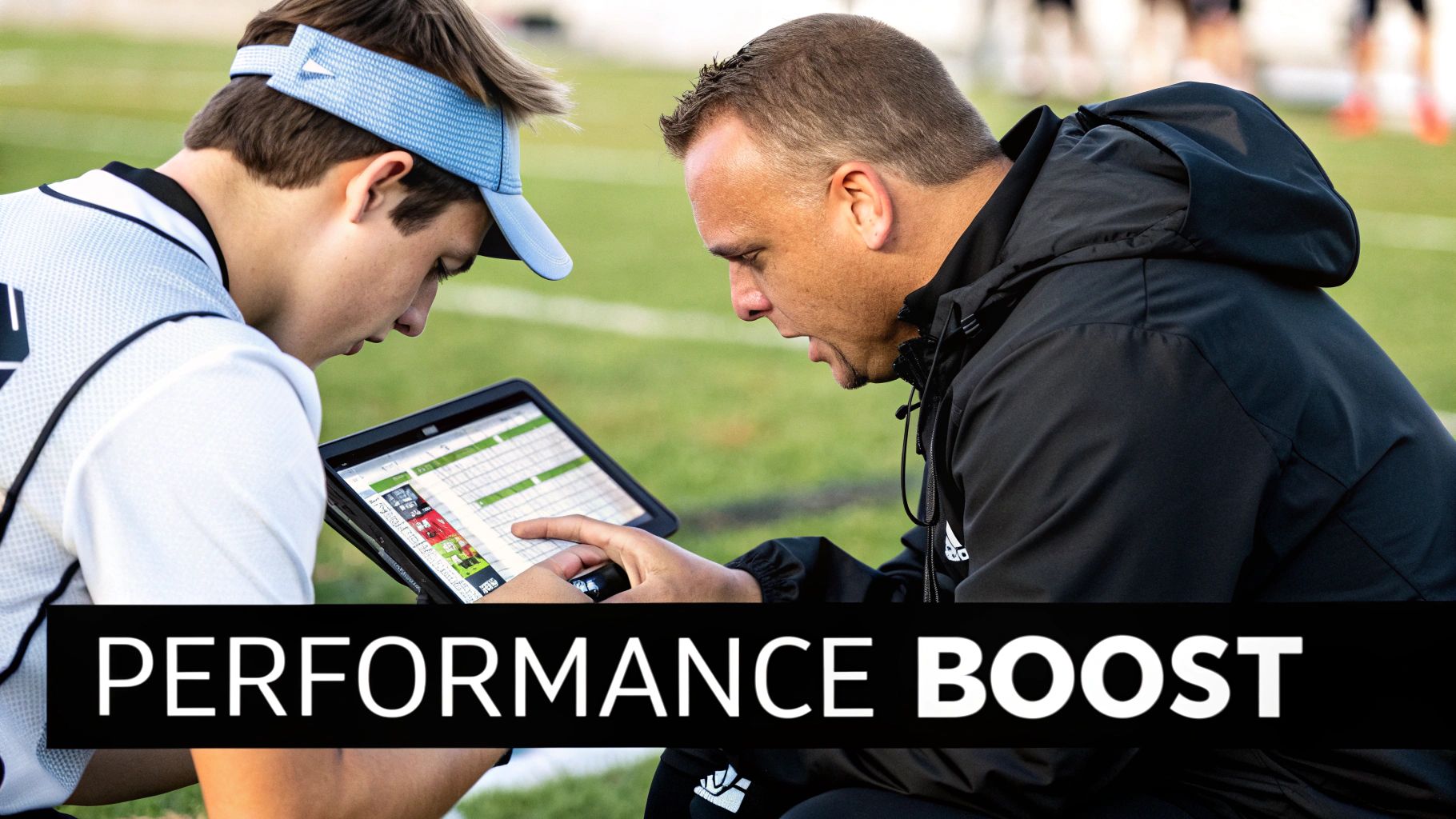
The most useful way to compare brands is by who they serve. Some systems are built for pro clubs and academies that have analysts, coaches, and sports-science staff reviewing squad data every day. Others are better for an individual player or parent who wants clearer feedback without needing to interpret a dense performance dashboard.
That split matters because elite futbol environments and amateur football do not buy for the same reasons. Professional teams care about squad-wide consistency, live monitoring, reporting, and integration into training-periodisation workflows. Amateur players and grassroots teams usually care more about cost, ease of setup, understandable feedback, and whether the data will lead to obvious action without an analyst sitting beside them.
I would not recommend a pro-only platform to most individuals just because it is used by top clubs. In editorial terms, the easiest product to admire is not always the easiest one to live with.
Quick Comparison by Use Case
| Brand / Type | Device Type | Best For | Likely Price Model | Standout Strength | Trade-off |
|---|---|---|---|---|---|
| Catapult | Vest-based GPS / EPTS ecosystem | Pro clubs, elite academies, performance departments | Premium team pricing, usually platform-led | Deep workload analysis and established pro workflow | Overkill and expensive for most individuals |
| STATSports | Vest-based GPS with live monitoring options | Clubs that want strong live session feedback | Premium hardware plus software/platform costs | Real-time metrics and strong team-session visibility | Best value appears when multiple players are tracked together |
| Playermaker / foot-mounted alternatives | Boot-mounted technical tracker | Serious individuals, youth players, parent buyers | Device purchase, often app/subscription layer | Technical insights around touches and foot use | Less suited to full-squad tactical and match-load analysis |
Pro Clubs and Academies: Catapult and STATSports
Catapult and STATSports dominate elite conversations because they fit the realities of high-level football. They are designed for squad monitoring, controlled training environments, and staff who need to compare players across sessions, not just celebrate one player’s top speed.
Catapult remains a benchmark choice for performance departments that want mature reporting and workload tools. Its strength is not just sensor hardware; it is the broader system around planning, reviewing, and sharing data. That is why it keeps showing up in elite settings.
STATSports is similarly entrenched because live monitoring is so valuable when coaches want immediate session feedback. If your staff wants to know during training whether players are hitting target intensity or drifting past safe load thresholds, that live view becomes a major practical advantage.
Serious Individual Players: Simpler Beats Bigger
For individual players, the decision changes. A solo player usually does not need the full complexity of a team EPTS stack. What matters more is whether the app explains the numbers clearly, whether sessions sync reliably, and whether the metrics line up with personal goals like speed, stamina, or technical repetition.
In my view, foot-mounted systems and player-focused platforms often make more sense here because they turn data into something a non-analyst can use. The use case is narrower and easier to understand, which helps explain the appeal to parents and developing players; see the Playermaker Smart GPS Soccer Tracker review for an example.
Grassroots and Youth Teams: Cost and Clarity Matter Most
Grassroots and youth teams rarely need the deepest possible dataset. They need a system players will wear, coaches will understand, and budgets can absorb. That often points toward simpler GPS trackers, entry-level player products, or a selective rollout where only key age groups or small units use the tech.
If I were choosing for a youth setup without dedicated analysis staff, I would lean toward the platform with the clearest app and the least friction in getting reports to coaches and parents. The best grassroots system is usually the one that gets used every week, not the one with the most elaborate white paper.
Putting Your Performance Data into Action
Let's be honest, collecting a mountain of numbers is one thing. Turning them into more goals and fewer injuries? That’s the real prize. The best wearable football sensors 2025 can flood you with data, but it’s how you actually use those insights that gives you a genuine edge on the pitch.

You bridge the gap between seeing your stats on a screen and feeling improvement in your game, translating raw data into smarter training, better recovery, and, ultimately, a stronger performance when it counts.
From Numbers to On-Pitch Improvements
Think of the data as a conversation with your body. It tells you stories you can’t see with the naked eye, shining a light on hidden strengths and potential weaknesses. The trick is to listen and then respond with a proper plan.
Here’s how different roles can turn that data into real, tangible results:
- For the Winger: Your sensor flags that your high-intensity sprints drop off sharply after the 60-minute mark. This isn't just about general fitness; it's a specific endurance issue. So, the action plan is simple: add interval sprints late into your training sessions to mimic that end-of-game fatigue. The result? You’re still explosive for the full 90 minutes.
- For the Coach: The weekly Player Load report shows two key midfielders are deep in the red zone before a massive cup match. Instead of a high-intensity tactical session, you pivot. You run a light, technical workout and spend more time on video analysis. This data-driven call helps prevent burnout and keeps your star players fresh for the big day.
- For the Physio: A player is coming back from a hamstring injury. The sensor data gives you objective milestones for their recovery. You can track their deceleration stats and any imbalances between their left and right legs. They only return to full-contact training when the numbers prove they are biomechanically sound, which massively reduces the risk of re-injury.
Setting Meaningful Performance Goals
Once you understand what the data is telling you, you can set specific, measurable goals. Vague aims like "get faster" suddenly become much more concrete: "increase max speed by 5% over the next six weeks" or "reduce the imbalance in left vs. right leg impacts to under 10%".
The goal isn't just to collect data, but to create a feedback loop. You train, you measure, you analyse, and you adapt. This continuous cycle is what drives consistent, long-term improvement.
There’s no denying the growth in this area. The UK's wearable technology market is set to explode, powered by IoT devices and faster networks like 5G that enable real-time data streaming. Further coverage examines the UK's expanding wearable tech market. This all means the tools for data-driven improvement are getting more powerful and easier to get your hands on every single season.
How to Choose the Right Football Sensor
The right sensor is the one that matches your actual decision-making needs, not the one with the most impressive spec sheet. Start with seven practical filters: tracking accuracy, live versus post-session feedback, comfort and rule compliance, app quality, ongoing subscription cost, sharing/reporting tools, and whether the device is suitable for matches, training, or both.
I think buyers often underrate the app and overrate raw hardware. A very accurate unit is still frustrating if the reports are slow, confusing, or impossible to share with a coach. For most non-professional users, the best buying question is not “What is the most advanced device?” but “What will I understand and act on every week?”
Accuracy and Tracking Quality
For GPS or GNSS-based systems, update frequency and signal quality matter because they shape how cleanly the device captures fast football movements. Higher-frequency tracking generally gives a better read on repeated sprints, changes of direction, and position data, especially compared with basic consumer wearables. If your priority is match-load monitoring or speed work, this should sit near the top of your checklist.
Live Feedback vs Post-Session Reports
Some systems are built for coaches who want live session data on the sideline. Others are mainly post-session tools that summarise what happened after training. Live feedback is more useful for team environments where staff can intervene immediately; post-session reporting is often enough for an individual player reviewing trends over time.
Comfort, Fit, and Match Compliance
The best data in the world is useless if players hate wearing the device. Vest-based pods need to feel stable and non-distracting, and boot-mounted trackers need to avoid interfering with touch or comfort. You should also confirm whether the device is permitted in your competition, because some products are perfect for training but not practical or approved for official matches.
App Quality and Reporting
A strong app should answer three questions quickly: what happened, why it matters, and what to do next. Good reporting tools also make sharing easier between player, coach, physio, and parent. In editorial terms, many products separate themselves more on reporting and presentation than on raw sensor claims.
Subscription Cost and Total Ownership
Many devices are not one-time purchases. The pod or tracker may be only the starting cost, with deeper analysis, cloud storage, team dashboards, or coaching features unlocked through a monthly or annual plan. Always compare the full first-year cost, not just the hardware price.
Team Use, Sharing, and Admin Load
If multiple players are using the system, you need to know how data is organised and shared. Can coaches compare sessions across the squad? Can parents access only their child’s reports? Can a club export useful summaries without extra admin time? These questions matter far more for academies and youth teams than they do for solo buyers.
Match Use or Training Only?
Some products shine in training but are less useful on match day, either because of rules, comfort, or data workflow. Others are designed around official competition use through approved EPTS setups. Make sure the device matches where you want to learn: training sessions, competitive matches, or both.
What Matters Most by Buyer Type
For pro and academy setups: prioritise reliable squad tracking, live feedback, reporting depth, integration with staff workflows, and competition compliance.
For amateurs, youth players, and parents: prioritise clarity, comfort, total cost, easy setup, and metrics that are simple to turn into action. A developing player usually benefits more from consistent, understandable feedback than from the deepest possible sports-science stack.
Best Fit by Scenario
- Pro club or academy: vest-based EPTS platform with live monitoring and strong reporting.
- Serious individual player: player-friendly GPS or foot-mounted system with a clear app and manageable subscription.
- Youth player with parent oversight: simple interface, durable hardware, and easy session summaries.
- Grassroots team: affordable shared system with low admin burden and straightforward coach reports.
- Recovery-focused buyer: platform that combines workload data with heart-rate or readiness context.
Frequently Asked Questions
What are the wearable devices in football?
The main wearable devices in football are GPS vest pods, EPTS match vests, boot- or foot-mounted trackers, heart-rate straps, and general fitness wearables like smartwatches. Each category measures different things, so the best choice depends on whether you care more about running load, recovery, or technical footwork.
Why do footballers wear catapult vests?
Footballers wear Catapult-style vests to hold a tracking pod high on the upper back, which is a stable position for measuring movement, speed, distance, and workload. The vest itself is not the sensor; it is the wearable harness that keeps the device secure during training or matches where regulations allow it.
Why do footballers wear smartwatches?
Footballers usually wear smartwatches away from competitive play to track recovery, sleep, heart rate, and general daily fitness habits. They are useful for lifestyle and readiness monitoring, but they are not usually the main tool for detailed on-pitch football analysis.
Are GPS football trackers allowed in official matches?
Yes, in many competitions they are allowed under EPTS rules, provided the devices meet safety and competition requirements. That does not mean every league handles them the same way, so players and coaches should always check local competition rules before match day.
Just how accurate are these things?
Modern football sensors are generally accurate enough to be very useful for trend tracking, workload management, and session comparison. The most important practical point is consistency: if you use the same device in the same environment over time, the trend data becomes much more useful than obsessing over tiny one-session variations.
Do I need a subscription to use a football sensor?
Often, yes. Many brands combine an upfront hardware purchase with a monthly or annual software plan for analytics, cloud storage, and advanced reporting. Before buying, check which features work without the subscription and which only become available once you pay ongoing fees.
At SoccerWares, we’ve hand-picked a selection of the latest football training gear to help you take your game to the next level. Check out our range of performance equipment and find the right tools to turn your data into dominance on the pitch.