

Before you even think about fancy passing drills or pressing triggers, getting your team organised is the first, and arguably most important, step to winning at 5-a-side. A solid formation gives everyone a clear job, helps you keep your shape, and provides a simple framework that everyone can understand.
For beginners, the key is simplicity and balance. The game is fast, so you need a setup that’s easy to remember and doesn’t leave you wide open at the back. This is why most new teams start with a few tried-and-tested systems.
Choosing Your Best 5-a-side Formation
An effective 5-a-side team starts with a balanced formation. For beginners, something like the 2-1-2 is perfect. It provides a solid defensive base, a crucial link player in the middle, and two dedicated attackers. This simple structure ensures everyone has a clear role, making it the ideal foundation for a team just learning to play together.
The Balanced 2-1-2 Formation
The 2-1-2 is pretty much the go-to starting point for any beginner 5-a-side team. Why? Because it creates natural triangles all over the pitch, which makes keeping the ball and finding a pass so much easier.
The roles are incredibly straightforward:
- Two Defenders: Their main job is to protect the goal. They need to stay compact, communicate, and ensure one of them doesn’t go wandering upfield at the same time as the other.
- One Midfielder: This player is the engine room. They link defence to attack, get forward to support the strikers, and work tirelessly to get back and help out the defenders. Stamina is key here.
- Two Attackers: Their job is to create chances, make runs in behind, and be the first line of defence by putting pressure on the opposition when they have the ball.
This diagram breaks down the three most common beginner formations, showing you exactly how they stack up.
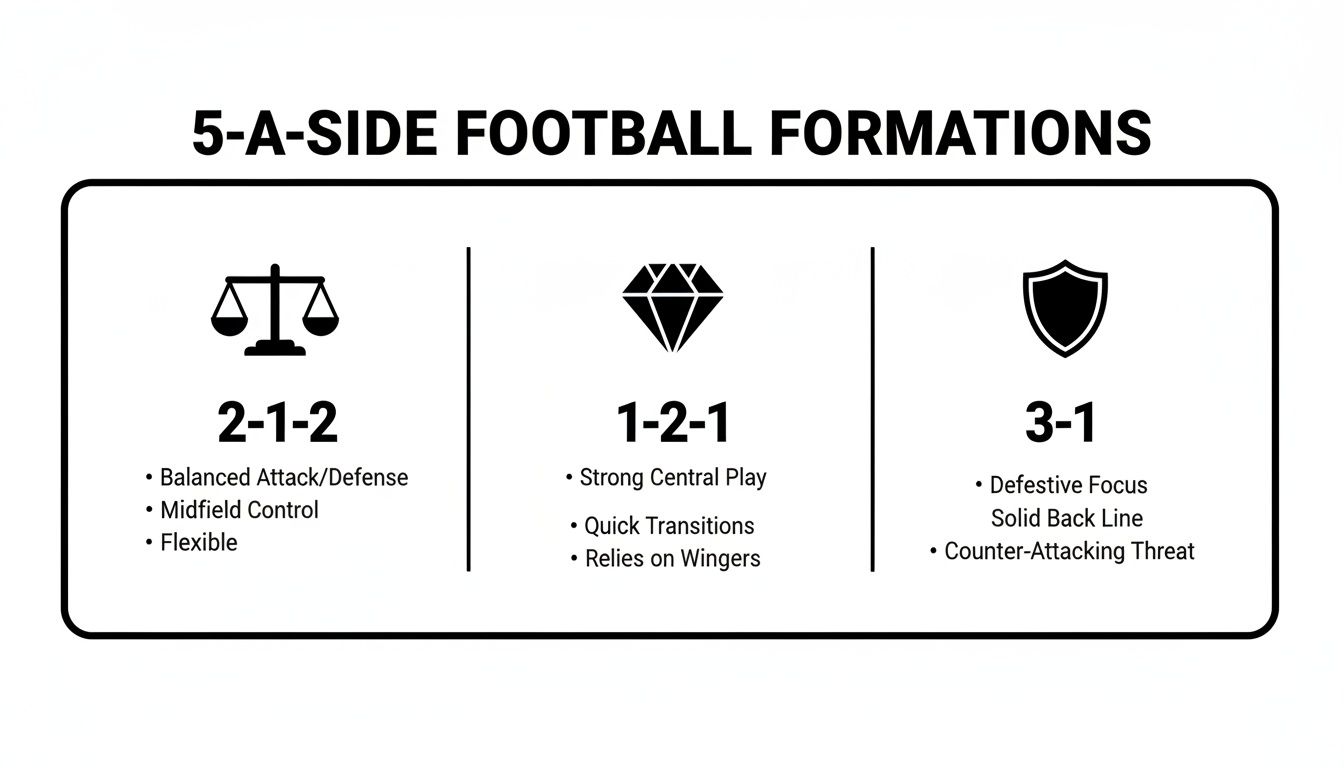
As you can see, each formation offers something a little different, from the all-round balance of the 2-1-2 to the pure defensive security of the 3-1.
Other Popular Beginner Formations
While the 2-1-2 is a fantastic place to start, there are a couple of other setups worth knowing about as your team gets more comfortable. These let you tweak your approach based on your players' strengths or the team you're facing. The size of the pitch can also make a difference; learn more in our guide to official soccer field sizes.
The key is to pick one formation and stick with it for a few games. Constant chopping and changing will only lead to confusion. Let players get comfortable in their roles before you try to get too clever.
The 1-2-1 'Diamond' is another brilliant choice. It really hinges on a versatile central midfielder who can attack and defend. If you have one player with a great engine and good all-round skills, this formation can work wonders.
On the other hand, the 3-1 is an unashamedly defensive setup. You pack the backline with three players to form a solid wall, leaving a single attacker up top to hold the ball up and wait for support. It’s perfect if you’re trying to protect a narrow lead or just frustrate a technically superior team.
To make things easier, here's a quick comparison of the three main systems.
Beginner-Friendly 5-a-side Formations Compared
| Formation | Main Strength | Potential Weakness | Best For |
|---|---|---|---|
| 2-1-2 (The Box) | Great balance between defence and attack. Creates simple passing angles. | Can leave the midfielder isolated if defenders don't step up. | New teams who want a simple, solid structure for everyone. |
| 1-2-1 (The Diamond) | Strong in the middle of the park, allows for quick transitions. | Relies heavily on two very fit wide players to cover the flanks. | Teams with one standout, energetic midfielder who can control the game. |
| 3-1 (The Wall) | Extremely solid defensively and very difficult to break down. | Can be very negative, leaving the lone striker isolated with little support. | Defending a lead or frustrating a more skilful opposition. |
Ultimately, the best formation is the one your players understand and can execute properly. Start with the 2-1-2, see how it feels, and don’t be afraid to try the Diamond or the Wall once everyone has found their feet.
Building a Solid Defensive Shape
They say goals win you a game, but a solid defence wins you the league. It's a cliché for a reason. For new teams, the first instinct is nearly always to chase the ball, which leaves massive gaps for the opposition to exploit. The best 5-a-side tactics for beginners are all about defending as a tight, organised unit.
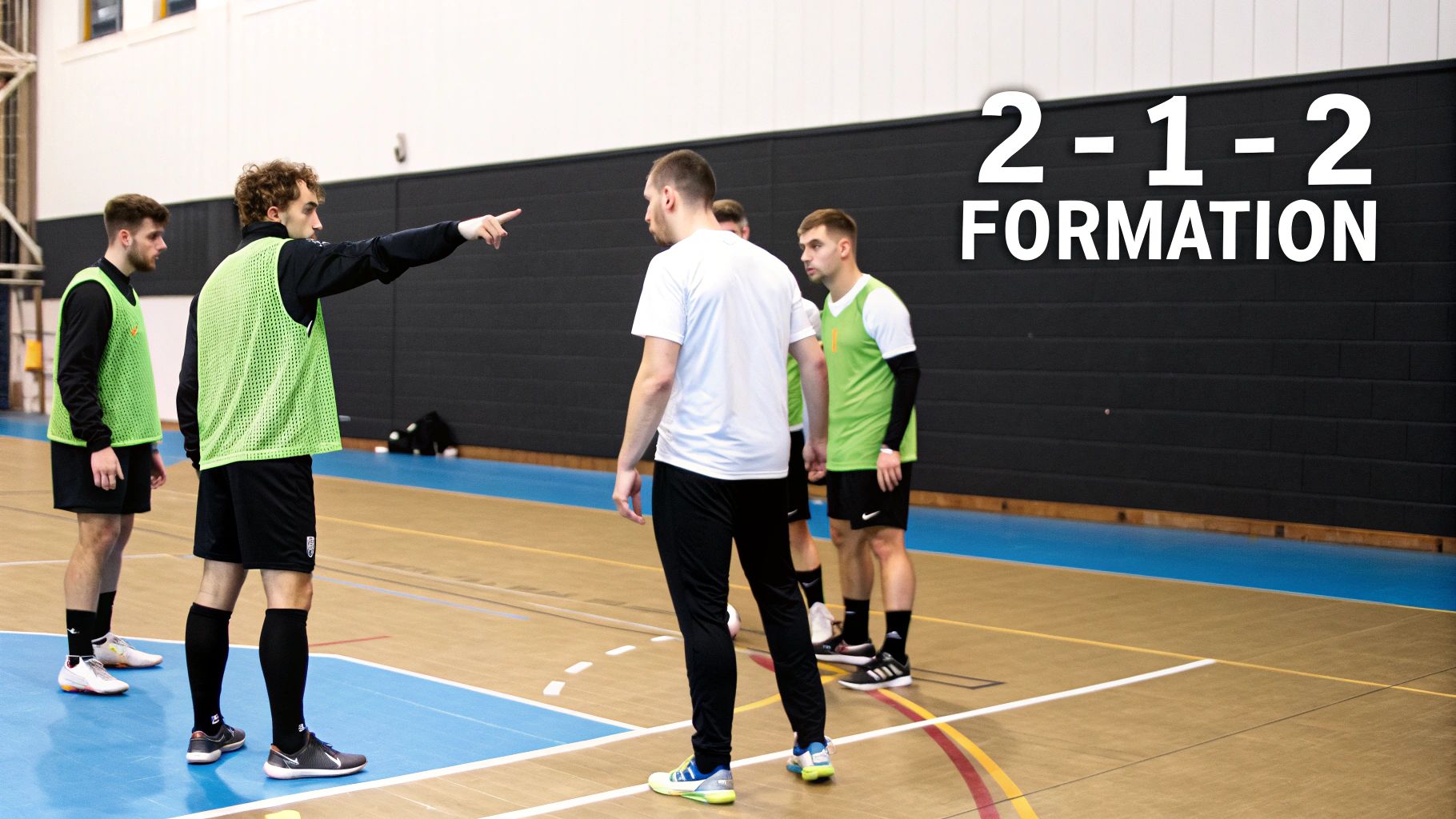
Rule number one is simple: stay compact. I tell my players to imagine their whole team is connected by invisible strings. When one person moves, everyone else must adjust to keep the distances between them roughly the same. This simple idea makes it incredibly difficult for attackers to find space or slide through-balls between your players.
Your main job is to protect the central areas right in front of your goal. Why? Because that’s where most goals are scored. So, force your opponents wide and show them the touchline. This cuts down their shooting angles and makes their next move far more predictable. Teamwork and communication suddenly become your most powerful tools.
Zonal Marking and Pressing Triggers
Instead of man-marking, where each defender frantically follows one attacker wherever they go, beginners should focus on zonal marking. It’s much simpler. Each player is responsible for defending a specific area of the pitch. If an attacker runs into your zone, you pick them up. If they run out, you pass them on to the next teammate and hold your position.
This system is brilliant because it stops your team from being dragged all over the pitch by clever movement. It guarantees you always have a solid defensive block, making you much harder to break down.
The goalkeeper is your most important defender. They can see the whole pitch and should be constantly talking, organising the players in front of them, and telling them where to be. A vocal keeper is a massive asset.
Deciding when to press the ball is another crucial skill. Don't just chase blindly. A smart team uses pressing triggers to hunt together, like a pack. A good trigger could be:
- A poor touch: The second an opponent miscontrols the ball, that's your signal to close them down quickly.
- A slow pass: If a pass is under-hit, the player receiving it is vulnerable. Go now!
- Facing their own goal: When an opponent turns their back to your goal, they can't see what's behind them. This is the perfect time to apply pressure and win the ball back high up the pitch.
The Goalkeeper's Role in Defence
Your goalkeeper isn't just there to stop shots; they are the director of your defence. From their position, they have the best view of the game and can organise the players in front of them. They should be constantly shouting instructions, pointing out unmarked runners, and telling players when to press or when to drop back.
Building this kind of defensive understanding takes time and practice. But a well-drilled defence provides the foundation for your entire game, giving your attackers the confidence to play with freedom. For more ideas on how to improve your team's structure, you can find some excellent soccer defence drills in our guide that are perfect for small-sided games.
Creating Chances with Smart Attacking Movement
Right, you've got your defensive shape locked down. Now for the fun part: breaking down the other team and scoring some goals. In 5-a-side, this rarely comes down to one player's mazy dribble. It's all about clever, coordinated movement that pulls defenders out of position and carves open golden opportunities.

The most important attacking principle is simple: make the pitch feel massive when you have the ball. When you were defending, the aim was to stay compact and small. Now, you flip that on its head. Get as wide as possible to stretch the opposition and create gaps in their defensive wall.
This doesn't happen by chance. It requires every single player to be constantly on the move, especially when they don't have the ball.
Moving Without the Ball
Even the best players in the world probably spend less than 5% of a match with the ball at their feet. The other 95%? That's all about movement. Creating space, offering passing options, and generally being a nuisance for defenders. For any beginner, understanding this is a huge step forward.
Standing still is the quickest way to make your team predictable and easy to defend against. Instead, focus on these simple but effective movements:
- Run into space: Always be scanning for the empty pockets on the pitch. If you make a run into a gap, one of two things will happen: you’ll receive the ball, or you’ll drag a defender with you. Both are good outcomes for your team.
- Show for the ball: Don't hide behind a defender. Move into a position where the player on the ball has a clear, simple passing lane to find you.
- Don't follow the ball: This is a classic beginner mistake. It’s natural to drift towards the action, but try moving away from it. This creates width and stretches the defence.
The most dangerous player on the pitch is often the one who has just passed the ball. Defenders can switch off for a split second. As soon as you release it, sprint into a new, dangerous position.
Simple Attacking Patterns
You don’t need a playbook thicker than a phone book to score goals. A couple of simple, well-drilled patterns can be unstoppable.
The most effective tactic for beginners is the classic give-and-go. You know the one. This one-two pass is absolutely deadly in the tight spaces of a 5-a-side pitch. A player passes to a teammate and immediately sprints into the space behind the defender, expecting the ball straight back. It’s quick, simple, and ridiculously effective.
Another key tactic is creating an overload. This just means getting more of your players onto one side of the pitch than the opposition has defenders. If you can create a 2-v-1 situation on the wing, you’ve got a massive advantage. This forces the lone defender into an impossible choice and often leads to a clear shot on goal.
Of course, mastering these movements takes practice. For some brilliant ideas on sharpening up your team’s chemistry, check out our guide on soccer drills for passing and moving.
Mastering the Moments of Transition
5-a-side is a game of rapid-fire moments where possession flips in an instant. How your team reacts during these split-second changes—what we call transitions—is often what decides the match. Getting this right is a cornerstone of any good 5-a-side tactical setup, especially for beginners.
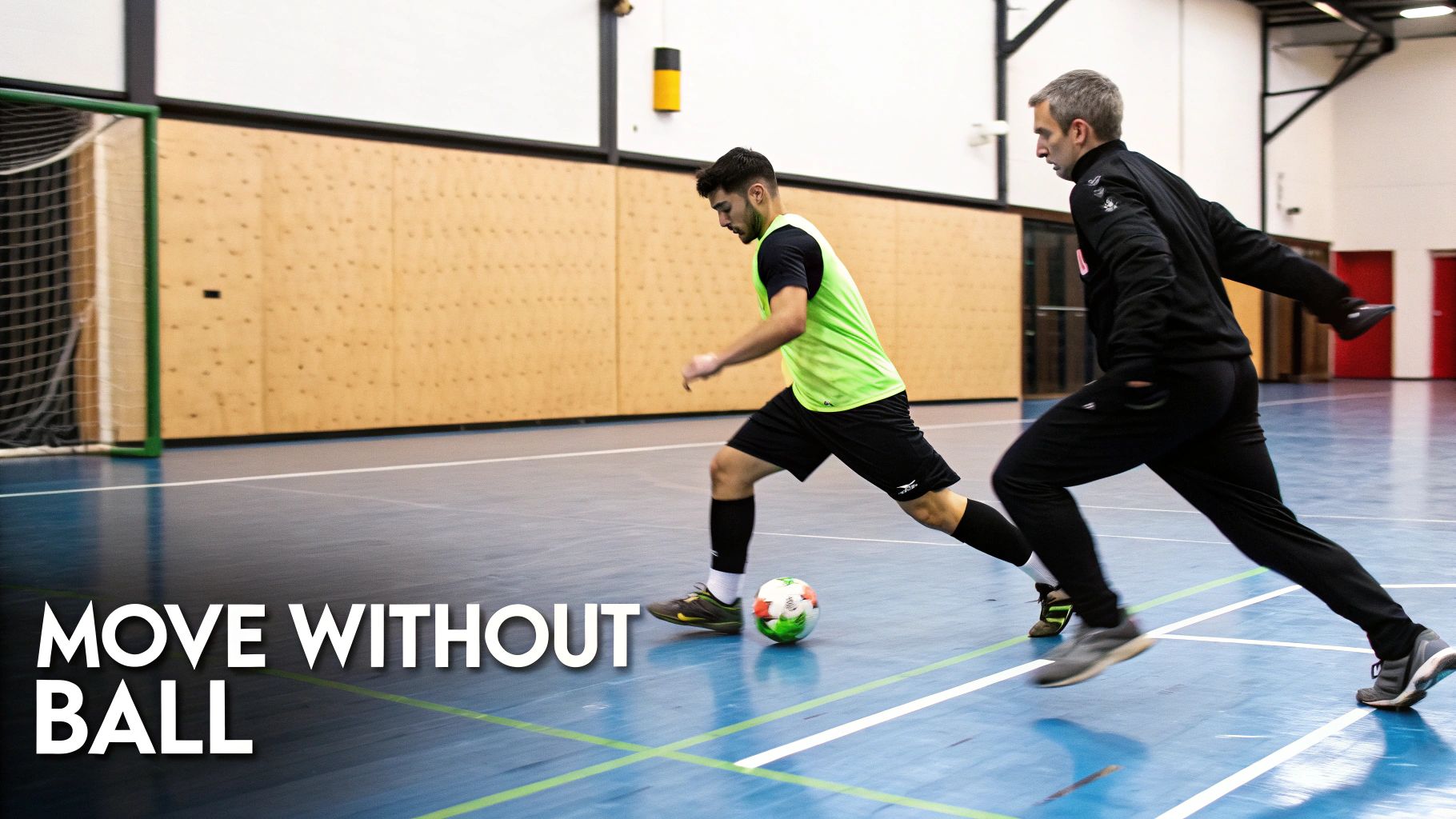
The game really boils down to two key transitional phases: shifting from defence to attack the second you win the ball, and snapping back from attack to defence the moment you lose it. Excelling at both will give your team a massive advantage and help you control the tempo of the game.
From Defence to Attack: The Counter
The second you win the ball back, the other team is often at its most vulnerable. Their players are probably pushed forward and out of their defensive shape, leaving huge gaps just waiting to be exploited. This is your golden opportunity to launch a killer counter-attack.
Your first thought should always be a positive one. Get your players to immediately look up and see if a quick, forward pass is on. Can you find a teammate already making a run into that empty space? This direct approach can bypass their entire team before they even have a chance to regroup.
A great counter-attack doesn't need to be complicated. I've seen games won with a simple pass into space for a quick teammate to latch onto. Speed of thought is just as important as speed of foot here.
From Attack to Defence: The 5-Second Rule
Losing the ball is frustrating, but your team's reaction is what truly matters. Instead of heads dropping or fingers pointing, you need an instant, collective response. This is where the '5-second rule' comes into play.
For the first five seconds after losing possession, the only goal is to win it back immediately. This is called a counter-press. The player closest to the ball must apply instant pressure, while their teammates swarm in behind to cut off the easy passing options.
This aggressive tactic often forces a mistake or a rushed pass, letting you steal the ball back high up the pitch. But here's the crucial part: if you can't win it back within those 5 seconds, the plan changes completely. Every player must forget the ball and sprint back into their defensive shape as quickly as possible.
This dual approach takes real discipline and a high level of fitness, which you can build up with dedicated soccer fitness workouts. Reacting quickly in both directions is the hallmark of a really well-coached team.
Simple Drills and Set Pieces to Practise
Knowing your formation is one thing, but making it work on the pitch is another challenge entirely. This is where the magic happens. A bit of focused practice, even just for an hour a week, helps build the muscle memory your team needs to make good decisions without having to think.
It doesn't have to be complicated. In fact, for beginners, it shouldn't be. The best drills are simple ones that hammer home one or two key ideas at a time. Let’s look at a few easy-to-run exercises and a couple of sneaky set pieces that can make a huge difference.
Fundamental Training Drills
The key to a good practice session is to mimic real game situations. These three drills are perfect for sharpening the absolute pillars of any decent 5-a-side team: passing, attacking, and keeping your defensive shape.
-
The 'Rondo' (or Piggy in the Middle): You've seen the pros do it, and for good reason. It’s the ultimate warm-up. Set up a small square with four attackers around the outside and stick one defender in the middle. The goal is simple: keep the ball away from the defender, ideally with just one or two touches.
- What it teaches: Quick thinking, sharp passing under pressure, and constantly moving to give your teammate an option.
-
2-v-1 Attacking Overloads: This one is brilliant for teaching attacking movement. Have one defender start near the goal with two attackers a bit further out. The attackers must combine to create a scoring chance. The defender’s job isn't necessarily to win the ball, but to delay the attack and force a bad shot.
- What it teaches: Encourages the classic give-and-go, decisive finishing, and using movement to pull the defender out of position.
-
Defensive Shape Shifting: Use four cones to mark out your team’s defensive formation (like a 2-1-1). Your players stand at their cones. The coach (or a spare player) simply moves the ball slowly from side to side across the pitch. The players must shuffle across together, ensuring the gaps between them stay consistent.
- What it teaches: This is all about compactness, communication, and getting players to understand they must move as a single unit, not as four individuals.
Beginner 5-a-side Practice Session Plan
Feeling overwhelmed? Don't be. You can run a brilliant, effective session in just 60 minutes. Here’s a simple template any parent or new coach can follow to get started. Just plug in the drills you want to focus on for that week.
| Activity | Duration (Minutes) | Key Focus |
|---|---|---|
| Warm-Up & Ball Familiarity | 10 | Getting muscles warm, basic dribbling, and passing in pairs. |
| Main Drill 1 (e.g., Rondo) | 15 | Passing under pressure, quick decision-making. |
| Main Drill 2 (e.g., 2-v-1s) | 15 | Attacking movement, finishing, creating overloads. |
| Small-Sided Game | 15 | Putting the drilled concepts into a real game scenario. |
| Cool-Down & Recap | 5 | Gentle stretching and briefly discussing what went well. |
The most important part is to keep it fun and focused. An hour of quality practice is worth more than two hours of simply messing about.
Simple Set Pieces to Surprise Opponents
In 5-a-side, a set piece is a golden opportunity. Most teams switch off for a second or two, and that's all you need. A well-rehearsed, simple routine can be the difference between winning and losing.
Don’t try to be too clever. Two simple routines that everyone understands are far more effective than five complicated ones that just cause confusion. The key is execution—everyone knows their job and does it fast.
Here are a couple of my favourites that are easy to learn:
- Corner Kick – The Near Post Flick: Player A takes the corner. Player B makes a sharp, aggressive run towards the near post, taking their defender with them. Player C hangs back towards the edge of the box. Instead of floating the ball in, Player A drills a low, hard pass to Player B, who just has to guide it first-time towards Player C for a shot.
- Kick-Off – The Instant Shot: This one is cheeky, but you'd be amazed how often it works. The whistle blows, one player taps the ball an inch forward to their teammate, who immediately unleashes a shot. The keeper is often chatting to their defender or not quite set. It’s a low-risk, high-reward play right from the start.
And remember, practice isn't just a team thing. Working on your own ball control and first touch is vital. For solo practice, using one of SoccerWares' indoor training mats is a great way to sharpen your skills at home so you're ready for game day.
Common Beginner Mistakes and How to Fix Them
Everyone has to start somewhere. Even the pros once looked completely lost on a pitch, and making mistakes is just part of the learning curve. The trick is to spot these common habits early and actively work on removing them from your game. Do that, and you'll see your team's performance jump up a level almost overnight.
One of the first and biggest hurdles is ‘ball watching’. It’s a totally natural instinct—the ball is the most important thing on the pitch, right? But when all five players are drawn to it like magnets, your team's shape completely collapses. This leaves massive, gaping holes for the opposition to stroll right through.
The fix sounds simple, but it takes real discipline: you have to trust your teammates. If the ball is over on the far side of the pitch, your job isn't to run towards it. It's to hold your position, cover your space, and keep your head on a swivel, constantly scanning for opposition players making runs into your zone.
Staying Spread Out and Being Patient
Another classic beginner mistake is bunching up. You'll see it all the time—players getting drawn towards the ball and ending up within a few feet of each other. This clogs up passing lanes and makes it ridiculously easy for one defender to mark two or even three attackers at once. It’s a recipe for disaster, often forcing players to dribble into trouble because they have nowhere to pass.
Remember, the aim in possession is to make the pitch as big as possible. When you don't have the ball, you make it small. If you find yourself within a few feet of a teammate, one of you is in the wrong position.
To solve this, players need to get into the habit of constantly adjusting their position to create width and depth. We’re not talking about huge sprints; sometimes just a few steps sideways is all it takes to open up a new passing angle. While running drills helps, being able to hold your ground and shift your balance effectively comes down to good physical conditioning. Learning how to build functional strength can make a huge difference to your stability and your ability to control your space on the pitch.
Ultimately, ironing out these errors boils down to two things: communication and tactical discipline. That’s what turns a group of five individuals into a proper, cohesive team.
Your 5-a-side Questions, Answered
Even the best game plan runs into questions on the pitch. Here are some quick-fire answers to the things I get asked most often by new 5-a-side teams.
Do We Need A Permanent Goalkeeper?
Not always. Look, having a dedicated keeper who actually wants to be there is brilliant, but it's a luxury for many casual teams.
A great approach is to rotate the role. We used to switch our keeper every 5-10 minutes. This keeps everyone fresh and, just as importantly, it gives every outfield player a taste of what it's like to be the last line of defence. It builds empathy and makes them work harder to protect the goal when they're back outfield.
What Is The Best Way To Handle Substitutions?
Fast and often. 5-a-side is an intense, lung-busting game, so you need to use a ‘rolling subs’ system where players can hop on and off freely.
Think short, sharp bursts. Aim for 2-3 minutes of high-intensity work, then a quick breather on the sidelines. This keeps the tempo of your whole team high and stops players from getting so tired they can't track a runner or make a simple pass.
How Should We Play Against A Stronger Team?
When you’re the underdog, forget trying to outplay them. Your new best friends are discipline and frustration.
The game plan is simple: get everyone behind the ball, stay compact, and clog up the middle of the pitch. Deny them space where it hurts most. Your job is to soak up pressure, force them into making a mistake, and then break quickly on the counter-attack. It's not about winning possession; it's about being patient and clinical when your one or two chances arrive.
Ready to put these tactics into action? Gear up with high-quality training essentials from SoccerWares. From premium shin guards to rebounders for solo practice, find everything you need to dominate the pitch at https://soccerwares.com.