

You're probably dealing with the usual mess right now. One coach wants names on the shirts, another parent has sent the wrong size twice, and the tournament date has already slipped into “order it this week or regret it later” territory. That's exactly why custom team jerseys need proper planning, not a quick click through a supplier's design tool.
Most clubs don't lose money on the jersey itself, they lose it on bad sizing, unclear artwork, weak print choices, and avoidable UK rules that nobody explained properly. If you order carefully, you get a kit that holds up. If you rush it, you get delays, refunds that aren't available, and shirts that look fine on a screen but fail on the pitch.
Why Custom Team Jerseys Deserve More Thought Than Most Clubs Give Them
I've seen the same scene more times than I can count. It's the night before a tournament, the coach is pinging the group chat for one missing medium, and someone's just realised the sponsor logo was sent as a blurry JPG. That's not a design problem, that's a planning problem, and it usually means somebody tried to treat custom team jerseys like a novelty order instead of club kit.
The market moved on a long time ago. In England, football jerseys became standardised from the 1890s, and fixed club colours from the 19th century have often lasted for more than 100 years. A Cambridge study of 81 clubs found they produced an average of 14.55 home jerseys each between 2001 and 2019, compared with 4.6 from 1905–1922, 4.85 from 1922–1939, and 10.2 from 1947–1965. That shift shows why modern kit buying is about seasonal turnover, not just basic matchwear, and it explains why the wrong decision now can haunt a club all season. Cambridge study on the evolution of the football jersey
Practical rule: order like a kit manager, not like a fan. If you wouldn't trust a rushed spreadsheet on match day, don't trust a rushed jersey order either.
This guide covers the decisions that matter before you open a design tool, fabrics, stitching, printing methods, artwork prep, player numbering, fit, UK return risk, and the durability trade-off that supplier sites gloss over. If you want a broader look at how clubs handle branded gear, the SoccerWares football club merchandise guide is a useful starting point, but the job here is more practical. You need a buying checklist that prevents avoidable mistakes, not another gallery of mockups.
The blunt answer is this. A careful order costs less than a rushed one because it avoids reprints, late changes, and complaints from players who can't wear what you ordered. The first decision isn't colour or font, it's whether you're buying something durable enough to survive actual football use.
Choosing the Right Fabric and Fit
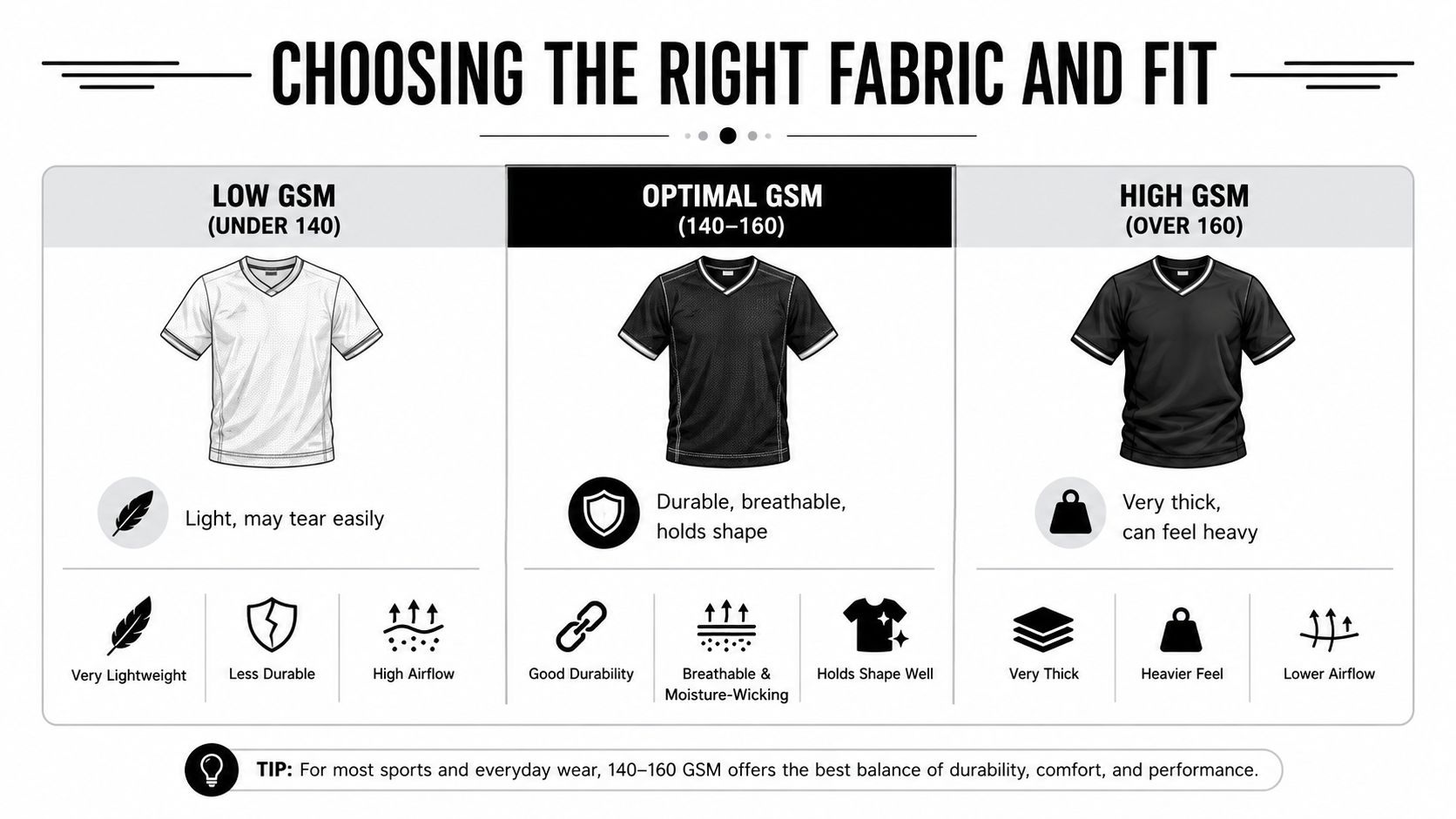
Start with GSM, because that's what tells you how the shirt will feel and wear. For match jerseys, the workable range is about 140 to 160 GSM. Lighter training jerseys sit around 120 to 140 GSM, while higher-end retail-style builds can move to 160 to 180 GSM, but those usually ask for higher MOQs and longer lead times. A light shirt sounds attractive until it twists, clings, or looks tired after a handful of washes. Alibaba's B2B jersey specifications guide
What to ask the supplier before they quote
Ask for the fabric weight first, then the stitching spec. For premium or semi-pro use, 10 to 12 SPI is the benchmark worth demanding, because higher SPI improves seam strength. Lower-cost 120 to 130 GSM heat-transfer builds can work for price-sensitive bulk orders, but they're less durable and usually show more print texture. If you want a jersey that still looks like a proper team shirt in month six, don't let anyone sell you only on the mockup.
Ask for the fabric blend too. For football, 100% polyester or a polyester-spandex blend with moisture-wicking treatment makes sense because it's built for sweat management and quick drying. Manufacturing guidance also points to colour-fastness of 4-5/5 for washing and 3-4/5 for rubbing, which matters if you don't want colour bleed on skin or shorts. Performance Team Sports on jersey materials and number sizing
Fit choice changes everything
Fit isn't a style detail, it changes who can wear the shirt comfortably. Slim fit looks sharper, but it narrows your margin for error on sizing. Classic fit is safer for mixed body types and youth-to-adult transitions. Relaxed fit gives the most comfort, but it can look too loose if your club wants a cleaner match-day profile.
If you need a reference point for the kind of product sizing ranges common in the UK, the SoccerWares Adidas football jerseys page shows how size ranges are usually presented for a club audience. The point is to compare actual garment measurements, not just label names. A classic-fit tee like the Goalkeeper Foul T-Shirt, After Review Westham No.19 Football Fan Tee also illustrates how width, length, and sleeve measurements change by size, which is exactly why you can't assume “large” means the same thing across suppliers.
My rule: lock GSM and stitch quality first, then argue about artwork. If the fabric's wrong, the rest doesn't matter.
For club orders, I'd rather see a shirt that feels slightly more substantial than one that feels paper-thin. A jersey that keeps its shape and washes cleanly is the one people wear again, and that's the whole point.
Picking the Best Printing Method for Your Kit
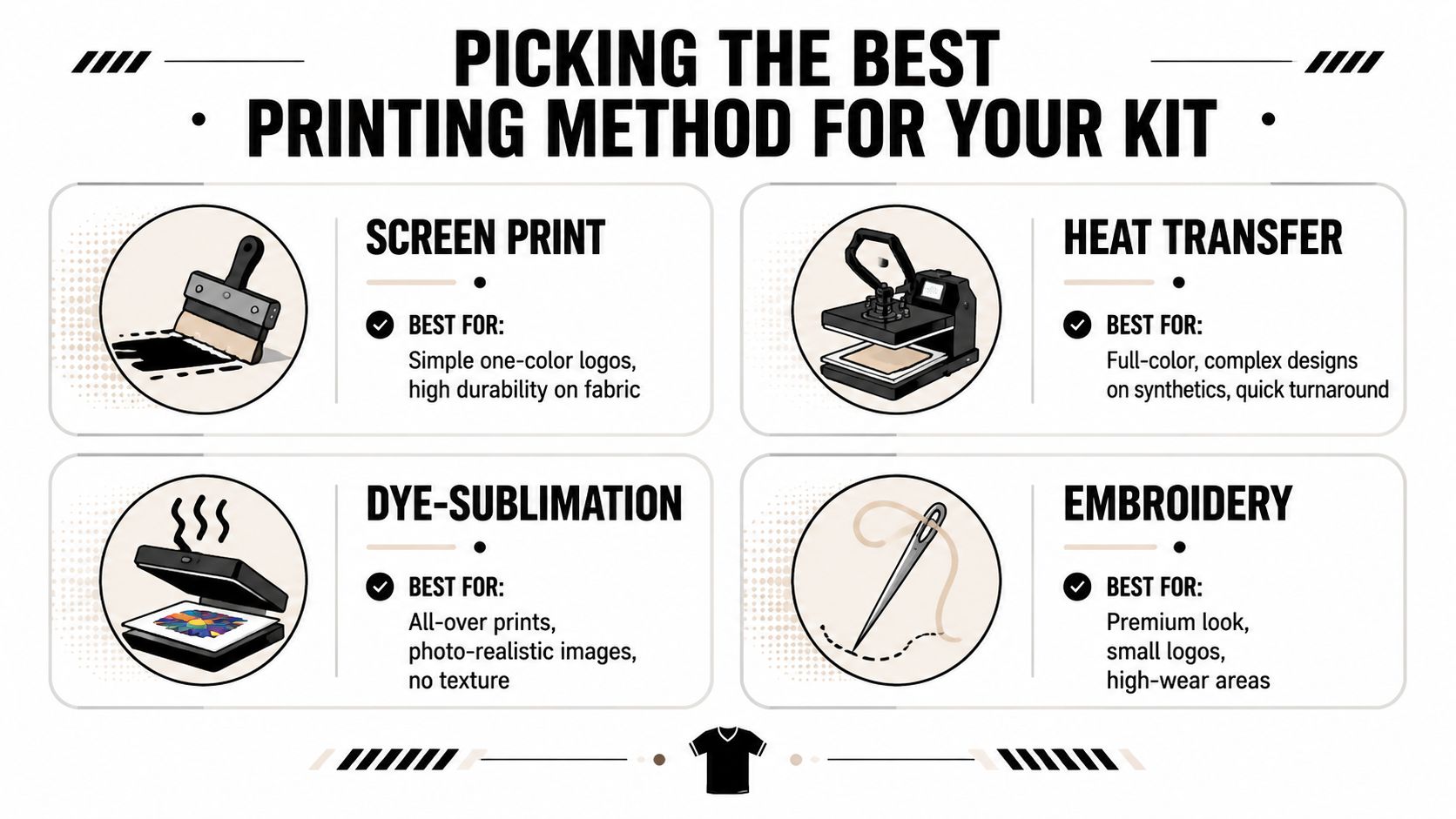
Not every decoration method belongs on a football shirt. Screen print is fine for simple, one-colour logos on cotton-rich training wear. Heat transfer keeps the upfront bill lower, but it usually ages worse and can show more texture on the surface. For serious match kits, dye-sublimation is the standard I'd back, because the design is fused into the fabric instead of sitting on top of it. Raccoon Transfers on printing on jersey
What each method does well
Screen print works when the design is simple and the garment base can take it. It's a sensible option for training tops and straightforward club logos, not busy match shirts with sponsor layers and multiple player identifiers.
Heat transfer is the budget-friendly path for quick runs and full-colour graphics, but it carries a real trade-off in durability. If the club expects the shirt to be worn, washed, and reused hard, that saving can disappear fast when the print starts looking tired.
Dye-sublimation is the method I'd choose for most match jerseys. One industry guide says fully sublimated jerseys can keep colours bright after 100 washes and typically last three to five seasons with proper care. That doesn't mean every sublimated shirt is magic, but it does mean the print itself is built into the garment rather than layered on top. Gear Team Apparel on custom jerseys vs standard team apparel
Embroidery has its place, but not across the whole shirt. It looks strong on small badges, chest crests, or high-wear areas where a premium finish matters. On lightweight performance jerseys, too much embroidery can add bulk and affect comfort, so keep it targeted.
Why I'd avoid cheap shortcuts on match kit
The hard truth is that a low-price transfer build can look fine on day one and weak by mid-season. If the shirt is only for a one-off event, that might be acceptable. If it's team kit, I'd rather spend a bit more on a build that won't crack, fade, or peel under regular use.
If you want a plain explanation of jersey fabric behaviour, More Sewing's jersey fabric advice is a decent background read before you sign off on materials. It's the kind of basic fabric literacy most club buyers should have before they approve a batch.
The safest production workflow is simple. Pick the GSM, confirm the SPI, then choose the print method that fits the shirt's actual job. Do that in the wrong order and you end up with a cheaper quote that costs more later.
Preparing Artwork, Logos and Player Numbers
Suppliers don't print “a logo”. They print files, placements, and measurements. If you send a fuzzy image, a random font, or a player list that changes three times after proofing, the order slows down. Good artwork prep is mostly about removing excuses for delay.
Get the file right the first time
Send vector artwork, not a screenshot pulled from WhatsApp. That means proper logo files, clean font outlines, and colour references that don't leave the supplier guessing. If your sponsor logo contains fine lines or thin text, it needs to be prepared for production, not just displayed on a phone screen.
The same logic applies to embroidery artwork. If you need fill patterns or digitised sport embroidery shapes, digitized team sport embroidery fills are an example of the sort of structured pattern library designers use when they're building repeatable stitch work. That's a useful reminder that production files need to be built for machines, not just for approval screenshots.
Treat numbers as a compliance issue, not decoration
For UK football shirts, numbers aren't optional styling. If a competition requires names or numbers, the team of the player must match on the front of all players' shirts. The back number must be between 1 and 99, and any front or shorts number must be unique within the team if used. For adult football in England, the FA kit guidance also expects shirt numbers to be clearly visible and in a contrasting colour to the shirt, with many competitions asking for 25 cm on the back and 10 cm on the front if front numbers are used. Football shirt numbering rules FA kit guidance and number visibility
That means you're not just choosing a font, you're choosing legibility under match conditions. Dark shirt, dark number, bad idea. Small number, bad idea. One colourway for every size without checking contrast, also a bad idea.
Don't stretch one file across every size
Artwork scaling should be checked per size. A master file that looks balanced on a medium shirt can sit wrong on an extra-large or bunch awkwardly on a youth cut. The print geometry changes with pattern size and fit, so the proof for one size isn't proof for all sizes.
Use this checklist before you send the file:
- Artwork file: Send vector format, not a low-resolution image.
- Text: Convert fonts to outlines so a missing typeface doesn't wreck the proof.
- Colours: Confirm exact club colours, not “close enough” guesses.
- Player list: Lock names and numbers in a spreadsheet before proofing.
- Scaling: Ask for size-by-size validation, especially for youth and oversize shirts.
Practical rule: once the proof is signed off, stop changing names. Every “small edit” costs time, and time is what teams never have enough of.
If you want a club-facing reference for numbering presentation, the SoccerWares footballers shirt numbers guide is useful context. The main point stays the same, artwork that's built cleanly saves production headaches that no one remembers until the deadline is close.
Sizing, Measuring and the UK Returns Reality
This is the part most jersey pages dodge. Parents assume they can swap a personalised shirt if it's wrong. In the UK, that's often not true.
Measure bodies, not guesses
Use chest width, shirt length, and sleeve measurement, not age bands alone. A youth player who's mid-growth might need one size up if the season spans several months, but you still need the actual body measurement first. If the club is ordering for a mixed squad, ask every player to measure once, then submit the same standard back to the supplier so the size call isn't made from memory.
Sample orders pay for themselves. If the kit is for a whole squad and the fit is unfamiliar, one sample in the club's most common size tells you more than ten mockups. It also gives you a chance to check whether the cut runs slim, classic, or relaxed before you commit the whole team.
Know what the UK refund rules really mean
In the UK, most distance sales come with a statutory 14-day cooling-off period, but made-to-order personalised goods are typically exempt from standard cancellation rights. That matters because a personalised shirt with a name and number on it is not treated like a regular off-the-shelf item in the same way. The Competition and Markets Authority and Citizens Advice both stress that personalised items can have different cancellation rules, so clubs need to read the correction policy before paying, not after delivery. Spized on personalised goods and UK cancellation rules
If you're spending club money, ask these questions before checkout:
- Fit policy: Can the club see a size chart with garment measurements, not just labels?
- Proofing: Does the supplier confirm names, numbers, and placement before print?
- Corrections: What happens if the proof has a spelling mistake?
- Personalisation: Does the policy explain the cancellation exemption in plain English?
Handle the hidden costs up front
The shirt price isn't the whole bill. Setup, artwork revisions, and split-size reorders all add friction even when the base price looks fine. That's why I'd rather approve a slightly slower, cleaner order than force a rushed one with no room for correction.
If the seller won't explain the return position on personalised kit, they're shifting the risk to you.
The club needs to know who owns the problem if a shirt doesn't fit. If that answer is fuzzy before you place the order, expect it to stay fuzzy after delivery too.
Cost, Bulk Ordering and Production Timelines
The cheapest-looking jersey is usually the most expensive one if you have to reorder it. Club budgets go wrong when people only compare unit price and ignore the way quantity, setup, and timing change the final invoice.
Why the quote changes when the order changes
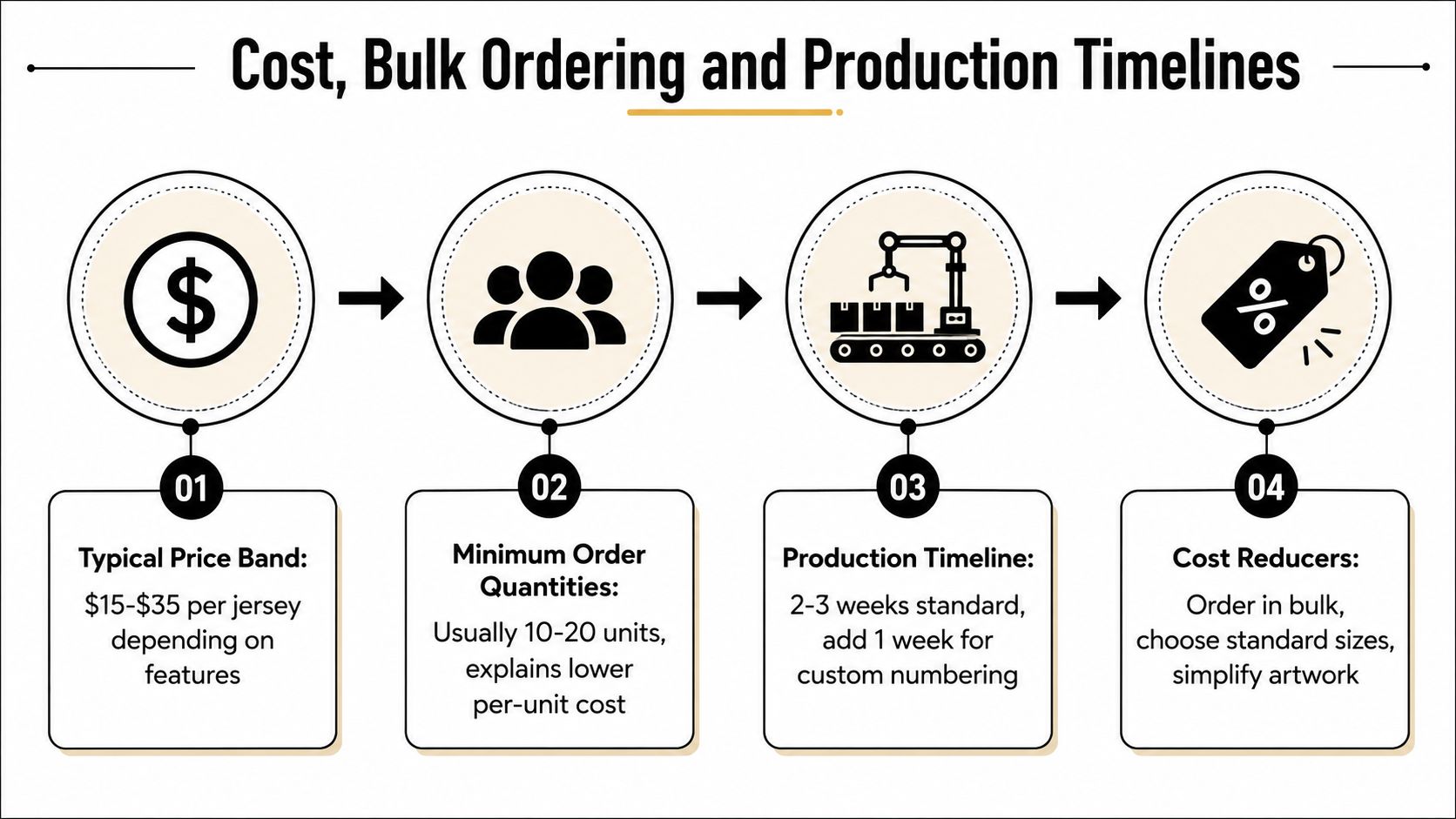
Minimum order quantities exist because setup has to be spread across the batch. That's why a bigger order usually cuts the per-unit cost. The practical rule is to order the full roster together if you can, then add a small buffer for replacements or growth rather than splitting into multiple tiny runs.
A realistic production flow looks like this. Artwork approval comes first, then sample production if needed, then the bulk run, then quality check, packing, and shipping. If you're ordering for a September kick-off, summer isn't “plenty of time”, it's the moment to stop dithering. Buffer time matters because size changes, artwork tweaks, and shipping delays all happen right when you'd rather they didn't.
Where hidden charges usually appear
These are the common ones that catch clubs out:
- Setup fees: Charged when the production process needs to be opened for your design.
- Screen or artwork charges: Added when the print method needs more prep than the quote made obvious.
- Revisions: Extra artwork changes can slow approval and add cost.
- Express shipping: Fine in an emergency, expensive when avoidable.
- Split sizes: Late add-ons in odd quantities usually cost more than the original batch.
For broader context on how clubs manage branded gear alongside other kit items, the SoccerWares custom team hoodies guide is a useful companion read. Jerseys and hoodies aren't the same purchase, but the budgeting mistake is the same, people underestimate how much the small stuff adds up.
The ordering schedule I'd trust
If I were placing a club order, I'd work backwards from match day and set an internal approval deadline well before the supplier's final cut-off. I'd also keep one person in charge of final sign-off, because committee-based approvals create avoidable delays.
For match kit, I'd never wait for “just one more size check” after the artwork has already been built. That's how you end up paying for urgent fixes that never needed to happen.
Care, Longevity and Common Questions
A good jersey should last the season without turning into an argument over washing. The main enemies are hot water, careless drying, and people ironing straight over print. If you avoid those, the shirt has a fighting chance.
Wash jerseys cold, keep them out of harsh heat, and don't use fabric softener if you want prints to hold up. Tumble drying is a bad habit on performance kit, and ironing directly onto decoration is asking for damage. Store match kits separately from training wear so the shirts you reserve for games don't get dragged into every muddy session.
The cheapest shirt isn't always the lowest-cost shirt. If a budget build fades early, cracks at the numbers, or gets replaced halfway through the year, the “saving” disappears fast. WRAP's UK-based research says extending the active life of clothing by just 9 months can reduce carbon, water, and waste impacts substantially, so durability isn't just a feel-good point, it's part of the real cost of ownership. WRAP's clothing life extension research
A few questions come up every season:
- What if a player leaves mid-season? Keep one or two spare shirts only if you expect squad churn, because reordering a single personalised shirt later is more awkward.
- What if you need extras? Order spares with the original batch in the most common sizes, not as a panic reorder.
- What if the delivery arrives damaged? Photograph it immediately and raise it before anyone starts issuing the shirts.
The simple rule is this. Treat the jersey as club equipment, not event merchandise. That mindset saves money, keeps players happier, and stops one avoidable mistake from becoming a whole-season problem.
If you want a club order handled with less guesswork, take a look at SoccerWares for team-branded apparel and training gear that sits alongside your jersey planning. Use the sizing discipline, artwork checks, and care rules above, then build your order around products that fit how your club plays and travels.