

A great drill for soccer isn't just about mindless repetition. It's about building skills that translate directly to the pitch—smart decision-making, keeping the ball close under pressure, and developing genuine tactical awareness.
Effective drills are designed to forge muscle memory and sharpen a player's core abilities. They are far more than just a warm-up; they are the foundation of on-field excellence.
Why Top Drills Are More Than Just Running Through Cones
Welcome to your new go-to resource for soccer drills that deliver tangible results. This guide is built for players and coaches who are ready to ditch pointless exercises and start implementing structured, high-impact training.
The best drills create scenarios that mirror the intensity and unpredictability of a real match. Instead of just running patterns, the goal is to develop players who can think on their feet, react to pressure, and solve problems creatively on the ball.
This isn't just theory; it's a philosophy gaining huge traction at every level of the game. Here in the UK, skill-focused drills have become a cornerstone of grassroots coaching. In fact, Football Association initiatives have demonstrated that this approach leads to significantly better engagement and development among young players.
Setting Up for Success
To get the most out of any session, you need two things: the right mindset and the right equipment. Before you even touch a ball, take a moment to visualise your goals for the training. Are you looking to build explosive speed, work on tight control in crowded spaces, or perhaps lock down your defensive positioning?
This mental preparation is just as important as the physical setup. Once you're focused, it's time to grab your essential gear. I never head to the pitch without:
- Training Cones: Absolutely essential for setting up boundaries, weaving through dribbling courses, and marking out player positions.
- Agility Ladders: Nothing beats a ladder for sharpening up your footwork, improving coordination, and building that quick-burst speed.
- Training Poles: These are incredibly versatile. You can use them for agility work or, my personal favourite, to simulate defenders and force players to keep their heads up. Our guide on using https://soccerwares.com/blogs/our-blogs/soccer-training-poles has some brilliant ideas to get you started.
Of course, to truly nail these drills, a solid physical foundation is non-negotiable. You can find some incredibly valuable general fitness advice from experienced pros, like these excellent fitness tips from a trainer, which will perfectly complement your on-pitch work.
Mastering Ball Control Under Pressure
Keeping the ball glued to your feet when a defender is breathing down your neck is a game-changing skill. Real ball control isn't about fancy flicks and tricks; it's about retaining possession when things get tight, creating an extra yard of space, and turning a defensive scramble into a quick counter-attack.
This section breaks down a fundamental drill for soccer that builds exactly this kind of unshakable control. We're moving beyond a simple cone weave to a dynamic dribbling drill that forces you to adapt, think, and react just like you would in a real one-on-one battle.
Before we dive in, remember that every great drill has three simple parts to get right: mindset, gear, and execution.
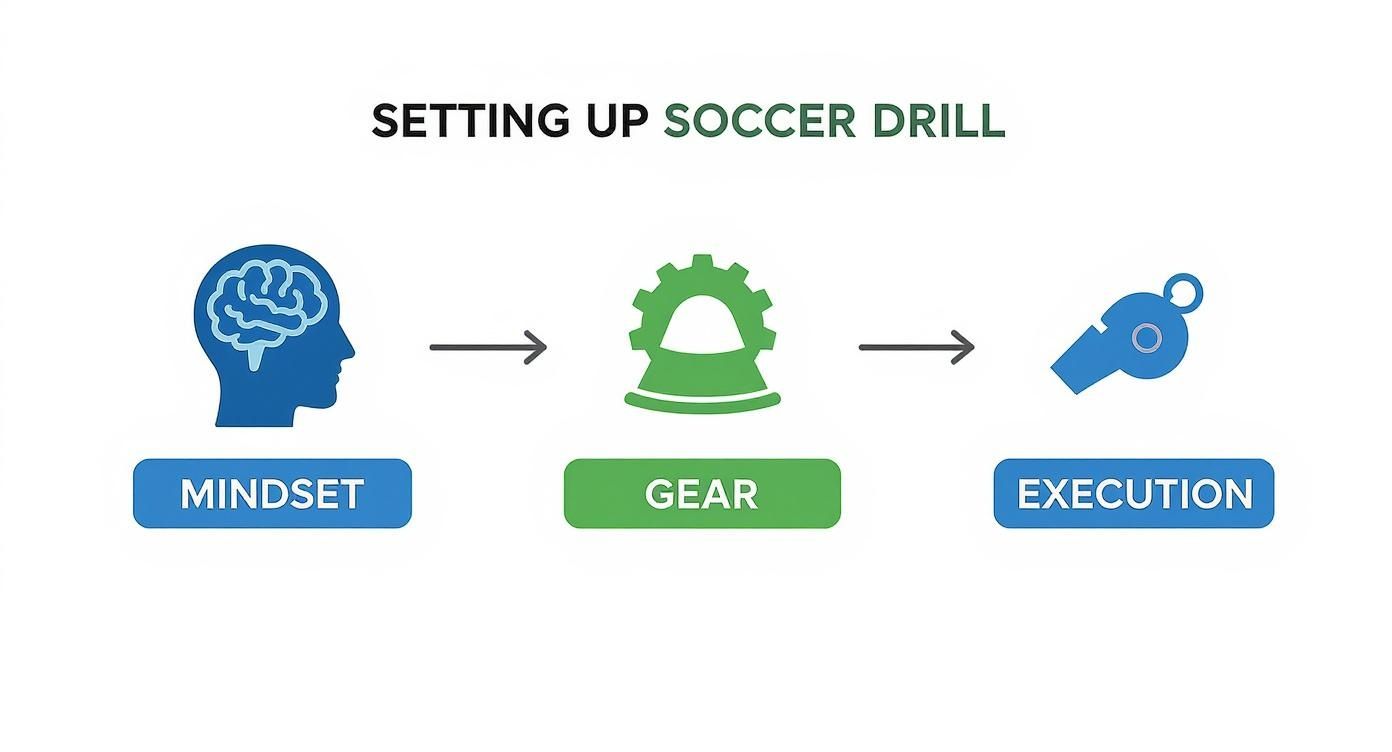
Get these three elements dialled in, and your practice sessions will become infinitely more productive.
The Pressure Gate Dribbling Drill
Think of this drill as learning to navigate a crowded midfield. It’s designed to force you onto both feet, demand sharp turns, and, most importantly, get your head up to spot the next gap.
Drill Setup
Grab a set of reliable training cones, a ball, and mark out a 15x15 metre grid. That’s all you need.
- Create the Box: Use four cones to mark the corners of your 15x15 metre square. This is your playing area.
- Set the Gates: Inside that square, scatter 5-6 pairs of cones to create small "gates." Make them about one metre wide and face them in different directions. This randomness is key – it stops you from just going through the motions.
How to Execute the Drill
The goal is simple: dribble through as many gates as you can in a set time. Let's start with 60 seconds.
Begin at a comfortable pace, focusing on keeping the ball close. As you pass through one gate, your eyes should already be scanning for the next one. This is the crucial part. It’s not just about dribbling; it's about decision-making under pressure, even if that pressure is just the ticking clock.
Key Coaching Point: Your first touch after going through a gate is everything. It needs to be a soft, controlled touch that immediately sets you up to accelerate toward the next target. A heavy touch here will kill your momentum and, in a real match, likely means you lose the ball.
Common Mistakes and Quick Fixes
Even with a simple cone drill, it's easy to develop bad habits. Be honest with yourself and watch out for these common slip-ups.
-
Mistake: Staring down at the ball. It’s a natural instinct, especially when you're concentrating, but it leaves you completely blind to the game around you.
-
Fix: Force yourself to take quick glances up between every couple of touches. At first, you’ll probably lose control of the ball more often. Stick with it. Your brain needs time to learn how to process the field while your feet do the work on autopilot.
-
Mistake: Pushing the ball too far ahead. This is an open invitation for a defender to step in and nick the ball. It screams "panic."
-
Fix: Concentrate on using the inside and outside of both feet for smaller, more frequent touches. Your aim should be to keep the ball within a single step's reach at all times. If you want to really hone that close control, check out our in-depth SenseBall review and drills for some excellent supplementary training.
Developing Precision Passing and First Touch
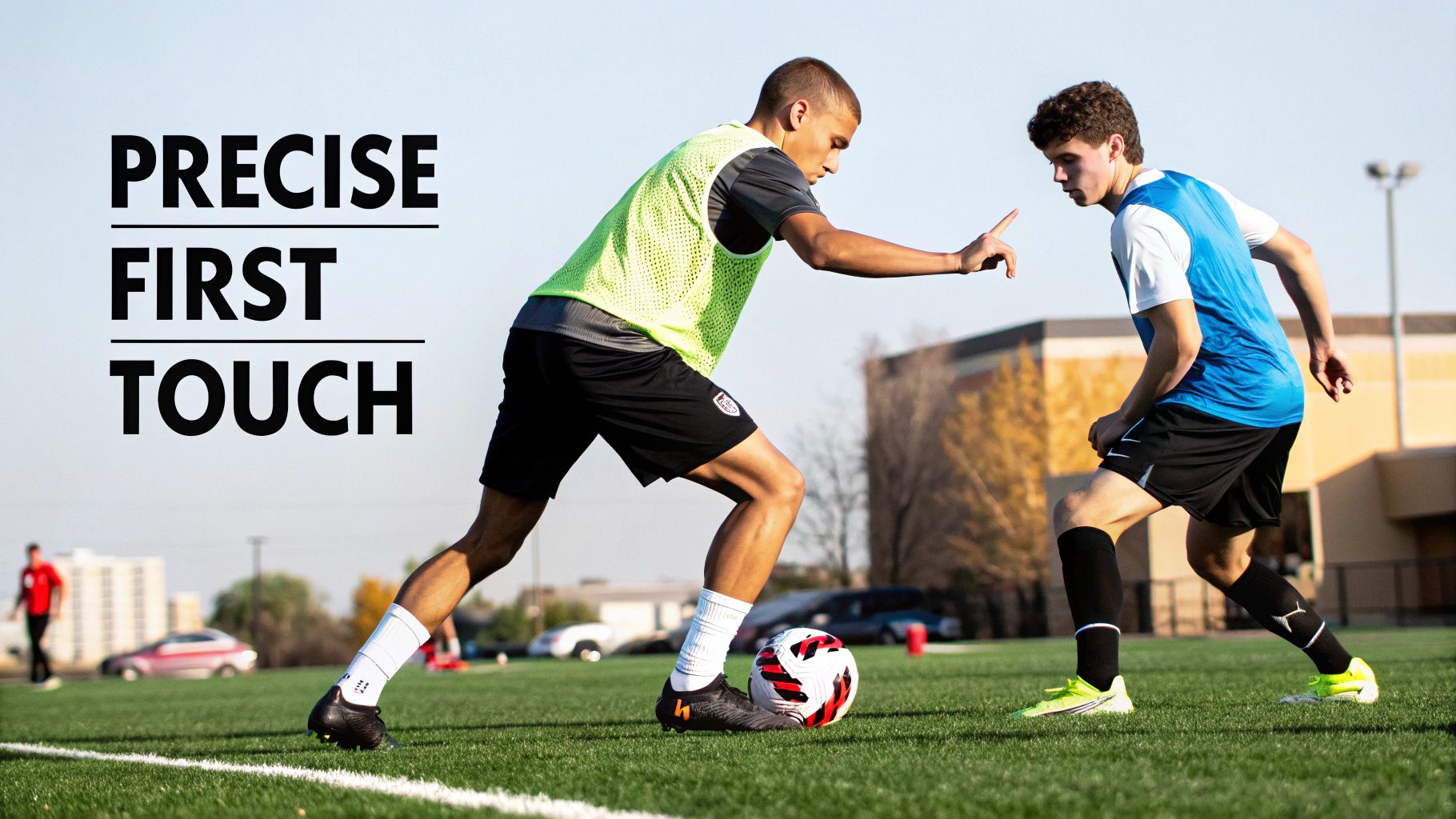
Great passing is the lifeblood of any team. It's the conversation that happens on the pitch, moving the ball with purpose to break down defences and create scoring opportunities. But a perfect pass is useless without a clean first touch to receive it.
This section is dedicated to a fundamental drill for soccer that refines both sides of this equation. We'll explore drills that sharpen passing accuracy, improve the weight of your pass, and develop a first touch that kills the ball dead. A controlled first touch gives you that extra split second needed to make your next move.
Ultimately, a crisp first touch is your ticket to dictating the play rather than just reacting to it. It immediately puts you on the front foot.
The Rondo Possession Drill
You’ve probably heard it called 'piggy in the middle'. The Rondo is one of the most effective and widely used drills in football, from grassroots all the way up to the professional level. It's brilliant because it looks simple but secretly teaches complex skills like spatial awareness, quick decision-making, and communication under pressure.
Drill Setup
- Mark the Area: Use cones to create a circle or square, roughly 10x10 metres. You can easily adjust the size based on the number of players and their skill level.
- Form the Group: You need a minimum of five players. Four players position themselves around the outside of the marked area, with one player (the defender) starting in the middle.
How to Execute the Drill
The players on the outside must keep possession of the ball by passing it amongst themselves, while the defender in the middle tries to intercept it. Simple. If the defender wins the ball or forces a mistake, the player who lost possession swaps places with them.
Key Coaching Point: The goal isn't just to keep the ball, but to do so with intelligence. Encourage players to receive the ball on their back foot—the foot furthest from the defender. This naturally opens up their body to see more of the pitch and makes their next pass quicker.
Progressing the Drill for a Greater Challenge
Once players get comfortable with the basic Rondo, it's time to introduce variations to ramp up the difficulty and keep them engaged. These progressions force players to think faster and execute their skills with more precision.
- One-Touch Passing: This is the classic progression. Limiting players to a single touch forces them to think ahead, anticipate the next pass, and perfect their first-time passing technique.
- Two-Touch Maximum: A slightly easier variation, this allows one touch to control and a second to pass. It’s excellent for focusing on the quality of that first touch, ensuring it sets up the pass perfectly.
- Receiving on the Half-Turn: Coach players to receive the ball with their body already angled to play forward. This small adjustment in body shape makes a huge difference in game situations, allowing for quicker transitions from defence to attack.
By mastering these elements, you'll see a massive improvement in how you and your team move the ball. For a deeper look into building on these foundations, our guide on the pass and move football drill offers some excellent additional exercises to incorporate into your sessions.
Becoming a Clinical Finisher In Front of Goal
Scoring goals is what the game is all about, but becoming a truly reliable finisher takes more than just brute force. It's a craft built on refined technique, ice-cool composure under pressure, and hours of repetition until the movement becomes pure muscle memory.
In this section, we'll walk through a structured approach to becoming a real threat in front of the net. We’ll start with the basics—static shooting practice to nail down your striking mechanics—before moving on to a dynamic drill that mimics the chaos and pressure of a real match.
This focus on structured training isn't just a modern trend; it has deep roots. By the 1920-21 season, with the expansion of the Football League, English clubs were already prioritising skill development through organised sessions. That practice has since evolved into the highly scientific discipline we see today. If you're interested in the backstory, you can learn more about the history of football in England.
Perfecting Your Striking Technique
Before you even think about adding movement or defenders, you must master the fundamentals of a clean strike. A simple, static shooting drill is the perfect place to start.
Set up a ball about 18-20 yards from the goal. Forget trying to blast it into the top corner for now. The entire focus here is on flawless mechanics.
- Plant Foot: Your non-kicking foot should land alongside the ball, pointing directly at your target. This is your anchor, providing both stability and direction.
- Body Shape: Lean forward, keeping your head and chest over the ball. It's a classic mistake to lean back, which almost always sends the ball sailing over the crossbar.
- Contact: You want to connect with the horizontal midline of the ball. Use the hard, bony part of your instep—right where your laces are.
- Follow-Through: Let your kicking leg swing through towards the target. You should naturally land on this foot to maintain your balance. This is crucial for transferring maximum power and accuracy into the shot.
The Dribble and Shoot Pressure Drill
Once that basic technique feels second nature, it's time to add movement and pressure to bring it closer to a real game scenario. This drill forces you to blend dribbling, quick thinking, and finishing all in one sequence.
Drill Setup
- Mark the Start: Place a cone 25-30 yards from the goal. This is where you'll begin.
- Add an Obstacle: Put a second cone (or a training mannequin if you have one) about 10 yards ahead of the first one. This acts as your "defender."
- Define the Zone: Use two more cones to create a "shooting gate" just outside the penalty area. The rule is simple: you must get your shot off before passing through this gate.
How to Execute the Drill
Start at the first cone and dribble at pace toward the "defender." As you approach, perform a skill move—a quick step-over or a body feint—to get past it. Explode into the space you've created and unleash your shot before you hit the shooting gate. The key here is to do everything at match speed.
Key Coaching Point: Don't slow down to take the shot. The best goalscorers can strike the ball cleanly while running at full tilt. Try to take a sharp preparatory touch right after you beat the defender; this will set the ball up perfectly for you to strike it in stride.
Here's a sample progression plan to guide a player from mastering the basics to executing complex, game-like finishing scenarios.
Shooting Drill Progression Plan
| Phase | Focus Area | Example Drill | Coaching Cue |
|---|---|---|---|
| 1: Foundation | Pure Technique | Static shooting (as described above) | "Head over the ball, follow through to the target." |
| 2: Movement | Shooting on the Move | Dribble & Shoot drill | "Don't slow down. Strike through it at pace." |
| 3: Game Pressure | Finishing Under Duress | 1v1 against a live defender | "Create a yard of space, get the shot off early." |
| 4: Scenarios | Varied Finishes | Crossing & Finishing drills | "Attack the ball, make clean contact." |
By following a structured plan like this, players build confidence and muscle memory layer by layer, ensuring their technique holds up when the pressure is on.
To make this drill for soccer even more efficient, think about using versatile gear. A quality rebounder from SoccerWares is fantastic for getting more reps in without chasing the ball, and our portable goals let you set up a dedicated shooting station almost anywhere.
Building a Resilient Defensive Mindset
A solid defence is the foundation of any successful team. It’s the backbone that gives your attackers the freedom to create magic up front. This section breaks down a crucial individual and small-group defending drill for soccer designed to make you a much tougher opponent to beat.
Forget dramatic slide tackles for a moment. Great defending is about intelligent positioning, patience, and dictating play. We’ll focus on the fundamentals: adopting the right defensive stance, timing your challenges, and jockeying attackers to control where they can go. A top defender funnels attackers into less dangerous areas, and that proactive mindset is exactly what we're building here.
The 1v1 Channel Defending Drill
This drill is brilliant because it simulates one of the most common scenarios in a match: an attacker trying to beat you down the line. It trains you to stay goal-side, force the attacker wide, and stop them from cutting inside for a shot.
Drill Setup
- Create the Channel: Grab some cones and mark out a long, narrow channel. Aim for about 10 metres wide and 20 metres long. This is your defensive turf.
- Position Players: One attacker starts with the ball at one end. The defender lines up about five metres in front of them, with a small goal at the opposite end of the channel.
How to Execute the Drill
The attacker’s job is to dribble past you and score. Your job is to stop them without giving away a foul. The real focus isn't on winning the ball immediately but on containing the threat and making life difficult for them.
Key Defensive Cue: Your body shape is everything. Get into a low, side-on stance—almost like a crab walk. This lets you move backwards and sideways quickly, matching the attacker's pace without getting turned inside out. Never face them square-on; it’s an open invitation for them to ghost past you.
Building Group Cohesion
Once you've got the hang of it individually, it's time to apply those skills in a small-group setting. Defending is rarely a solo mission. It relies on communication, trust, and holding a solid shape as a unit.
A simple way to progress this is by turning the 1v1 drill into a 2v2. This immediately introduces vital new concepts every defender needs to master:
- Cover and Balance: One defender pressures the player on the ball while the second provides cover, ready to intercept a pass or challenge the other attacker.
- Communication: Constant, clear talk is non-negotiable. Defenders have to shout instructions like "Step!", "Drop!", or "Show him wide!" Silence is a defence's worst enemy.
This small-sided drill for soccer really hammers home the psychological side of defending. It teaches patience and discipline, forcing you to wait for the perfect moment to make a clean tackle or step in for an interception. Master these principles, and you'll become more than just a tackler—you'll be a true defender who reads the game and organises the back line with confidence.
Putting It All Together In A Training Session
Individual drills are great, but the magic really happens when you string them together into a proper training session. This is where you see real, lasting development. A well-planned session makes every minute count, helping you build a balanced skillset instead of just working on things in isolation.
The secret is creating a logical flow. You want to warm the body up, switch on key skills, and then crank up the intensity to mimic the chaos of a real match. This approach stops training from feeling random and ensures each drill for soccer builds on the one before it.
A Sample 60-Minute Session Framework
A great session doesn't need to be complicated. In fact, some of the best ones follow a simple, repeatable framework that covers all the essentials, from getting loose to finishing with a game-realistic challenge.
Here’s a practical structure you can adapt for your own solo or team training:
- Dynamic Warm-Up (10 mins): Don't just go for a static stretch. Start with light jogging, leg swings, and dynamic movements. Then, get the feet firing with some agility ladder work to wake up the nervous system.
- Skill Focus (20 mins): Now, dedicate a solid block to one or two core skills. You could, for example, spend ten minutes on a Rondo drill to sharpen up your passing and decision-making, then immediately follow it with ten minutes on the Dribble and Shoot drill to work on finishing under pressure.
- Game Simulation (20 mins): This is where you bring everything together. A small-sided game like a 3v3 or 4v4 in a tight space is perfect. It naturally forces players to use their dribbling, passing, and defensive skills under the kind of pressure you'd face on match day.
- Cool-Down & Recovery (10 mins): Don't skip this bit! Finish up with some static stretching to improve flexibility and kick-start the recovery process. Your muscles will thank you tomorrow.
A smart approach to training doesn't end when the whistle blows. What you do off the pitch is just as important. Finding the best recovery tools for athletes can make a huge difference in performance and help you stay injury-free.
By structuring your practice this way, you guarantee a comprehensive workout that actually translates to better performance when it matters. Consistency is everything—stick to a framework like this, and you’ll turn practice into genuine progress.
Got Questions About Soccer Drills?
Here are some of the most common questions from coaches, parents, and players about setting up effective training sessions.
How Long Should a Soccer Training Session Be?
This is a big one, and the answer really depends on the age of your players.
For younger players (around 6-12 years old), keep things sharp and engaging. Aim for a focused 45-60 minute session. Any longer and you'll start to lose their attention. For older teens and adults, you can stretch it out to 75-90 minutes. That gives you enough time for a solid warm-up, skill work, game simulation, and a proper cool-down.
The golden rule? Quality over quantity. Every single drill needs a clear purpose; otherwise, you're just running players into the ground for no reason.
How Can I Adapt Drills for Different Ages?
Making drills work for different age groups is what separates good coaching from great coaching. It’s all about adjusting the challenge.
With younger children, the key is to simplify everything and make it fun. Use smaller playing areas, have fewer rules, and turn drills into games. A classic dribbling drill can easily become a game of tag where everyone has a ball.
For more advanced players, do the opposite: crank up the complexity. Throw in extra defenders to increase pressure, limit the number of touches they can take, or shrink the space they have to operate in. The goal is to force them into making quicker, smarter decisions.
What's the Best Way to Track Progress?
Seeing improvement is the ultimate motivator, but you need a simple way to measure it.
A low-tech approach that always works is a basic training journal. Just jot down your performance in any timed drills. How many passes did you complete in a minute? How fast did you run the agility ladder? Seeing those numbers improve over time is a huge boost.
Another great way is to use your phone. Video yourself doing a drill. You don't need fancy equipment. Then, a few weeks later, record it again and watch them side-by-side. The visual evidence of how much better your touch or movement has become is incredibly powerful.
Ready to put this all into practice? To run these drills properly, you need the right gear. Head over to SoccerWares to explore a complete range of high-quality training equipment, from cones and agility ladders to professional-grade rebounders. Find everything you need to perfect your skills.