

A player can be willing to attack a cross and still arrive underneath it, close their eyes or let the ball glance anywhere. The missing ingredient is usually not bravery. It's body control, timing, confidence and a repeatable contact point.
Good drills for heading in football build those qualities in the right order. Players should move from controlled contact to direction, then to crosses, defensive decisions, set pieces, pressure and only finally advanced actions such as diving headers. The seven drills below follow that pathway, but they aren't a compulsory ladder for every player. Coaches must adjust the service, volume and contact demands to age, experience, position and match exposure.
Supervise every session closely. Use an appropriate surface, keep players fresh enough to move well and stop when technique deteriorates. A tired player who starts turning away, closing their eyes or losing balance doesn't need more repetitions. They need a reset, easier service or a different activity.
1. The Basic Header Foundation Drill
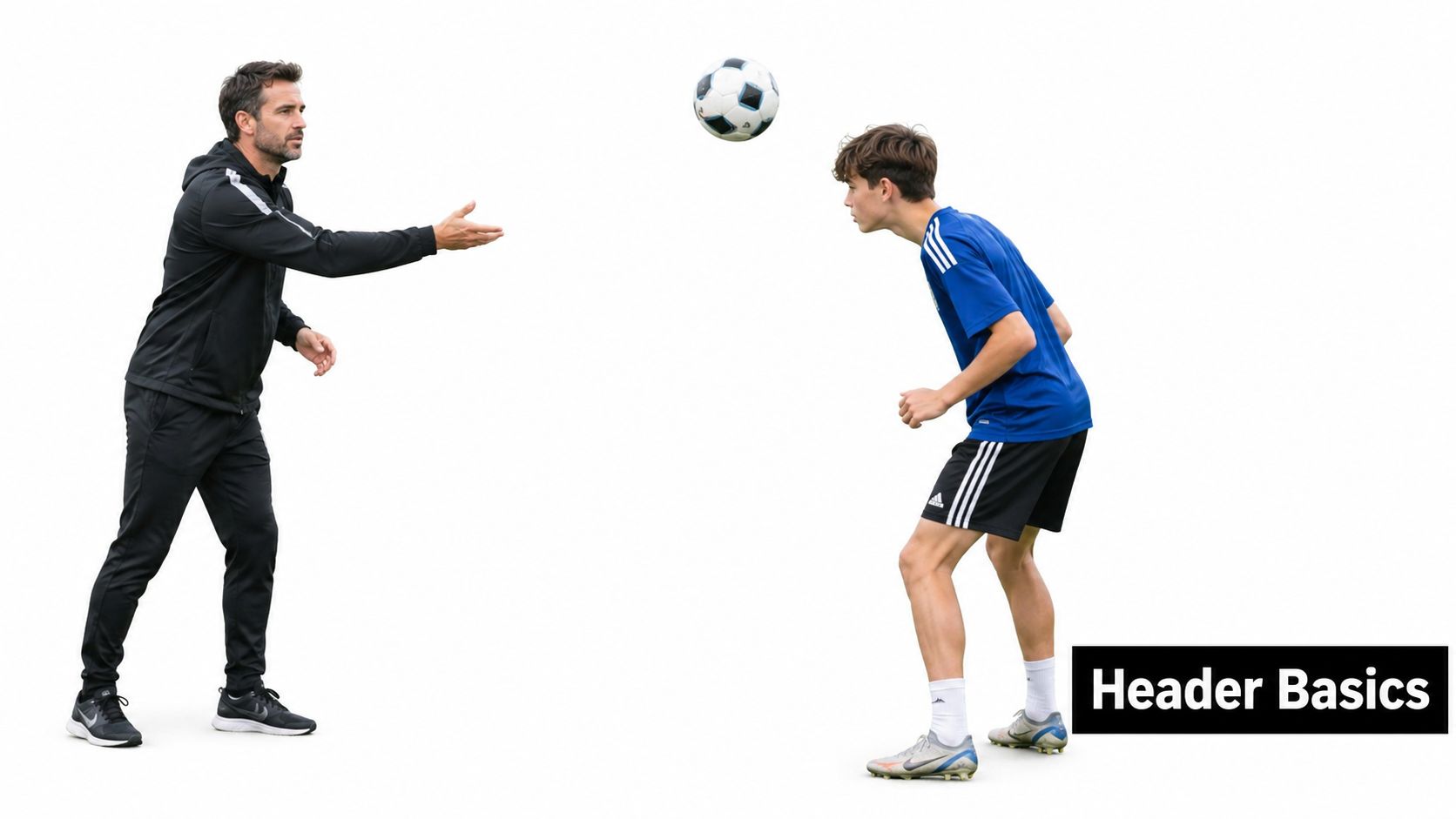
The first contact should feel predictable. Pair a player with a coach or partner at close range, facing one another, and begin with a gentle underarm delivery. The player sets their feet, watches the ball, meets it with the forehead and directs it back with a controlled movement from the trunk and neck.
Keep the distance short enough that the feeder can control every service. Start with low, comfortable throws before progressing towards chest-height deliveries. A partner can hold a cone or coloured target behind the feeder, giving the player a simple visual reference for direction without turning the exercise into a power contest.
Setup and coaching points
The forehead contact area sits between the eyebrows and hairline. Players should keep their eyes open through contact, hold the neck firm and use the body to guide the ball rather than snapping the head independently. A stable base matters. Feet that are too narrow make the player sway, while feet planted too rigidly prevent a small adjustment to the ball's flight.
Use a clear return target, such as the feeder's chest or a marked area on the ground. The player should learn to make a clean, purposeful contact, not just survive the delivery.
Practical rule: If the player can't control a gentle throw, don't increase the speed, height or distance of the service.
Begin with a small number of technically clean contacts and allow recovery between turns. The FA's professional guidance recommends thrown passes for technique work because they produce lower peak accelerations than ball strikes from longer passes, and it recommends monitoring heading activity in real time against each player's match exposure profile. The FA's professional football heading guidance provides the relevant framework.
Players and parents looking for a simple explanation of the mechanics can also use SoccerWares' football heading drills guide. The useful test is consistency. If the ball repeatedly reaches the intended target and the player's posture stays balanced, the exercise is ready to become more demanding. If not, reduce the service height and rebuild the contact.
2. The Directional Accuracy Header Drill
A clean header that travels nowhere useful isn't enough. This drill gives the player a decision and a destination, asking them to place the ball into a defined zone rather than merely return it to the feeder.
Mark large target areas in a goal or on the pitch. From a central position, serve gently from different angles and ask the player to direct the ball across the goal, towards a side zone or into a lower target. Keep the target generous at first. Accuracy develops when the player has time to recognise the delivery and organise their body, not when the coach makes the area impossibly small.
Turn contact into placement
Change the target after each short sequence so the player must look, adjust and direct. Coloured cones, bibs or target zones work well. A goalkeeper can make the exercise more realistic, but the goalkeeper shouldn't turn an early technical drill into a reflex competition. The player still needs to learn why the ball went high, wide or straight at the keeper.
A simple scoring system can add focus, but don't reward reckless force. A controlled header into a useful zone is a better outcome than a powerful contact that loses direction. Progress by varying the angle and height of the service, then by reducing the target area once the player's technique remains stable.
For goal-based work, 2-Pack Football Goal Target Nets, Precision Shooting Training Aids for Accuracy Practice can provide visible cut-out zones. The product snapshot describes reinforced nylon mesh, adjustable straps and Velcro loops, with two nets intended for attachment to standard goal frames. Use any target equipment as a visual aid, not as a reason to increase heading volume.
Mistake check
Watch the player's hips and shoulders. If the player turns the whole body away from the intended target, the head often follows and the ball drifts. Ask them to arrive side-on where appropriate, keep the forehead behind the ball and finish with the chest pointing towards the chosen zone.
The coach should also vary the delivery enough to prevent memorised movement. Once the player can direct a gentle ball, introduce a feeder who chooses the target late. The decision becomes more match-like, while the contact remains controlled.
3. The Crossed Ball Header Drill
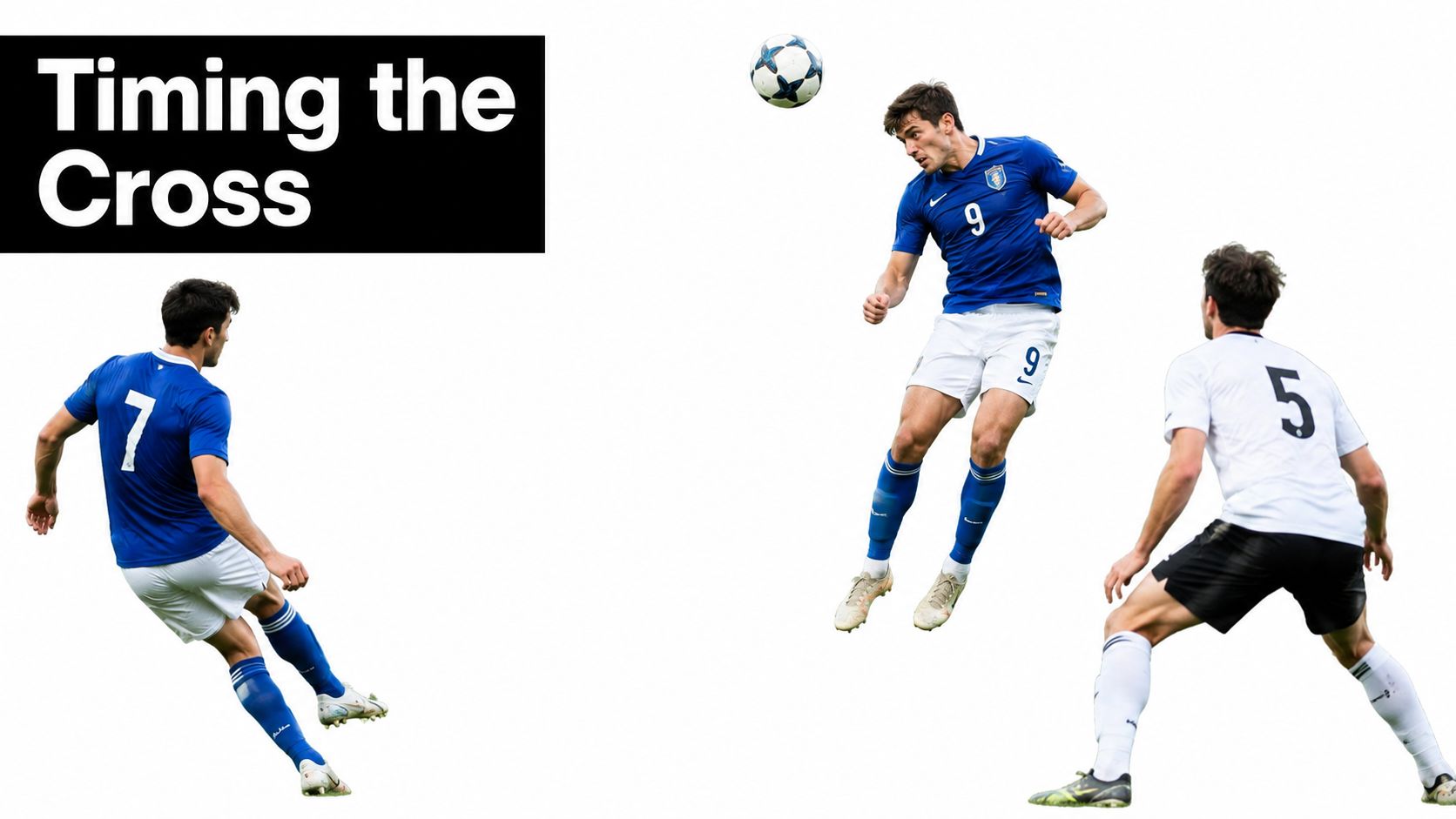
A winger delivers from the flank. The attacker starts outside the penalty area, checks their position, then makes a timed run towards a chosen zone. The feeder serves a cross with enough variety to make the player read the flight rather than run to a fixed spot and wait.
Static technique meets football. The attacker must judge when to move, protect the line of the run and adjust their stride as the ball travels. Begin without a defender. Mark a near-post, central and far-post lane with cones, then ask the player to attack one lane at a time.
Build the run before adding competition
The service should change in height, speed and depth, but not so dramatically that the player is guessing every time. A useful progression is a floated delivery to a set zone, followed by a faster cross in front of the runner, then a ball behind the first run that demands a second movement.
A Football Training Cone Set, 20 / 40 / 60 Pack Agility Disc Cones for Speed and Coordination Drills can mark starting points, defensive reference positions and the three attacking lanes. The snapshot describes PE cones in options of 20, 40 or 60 pieces, suitable for football sessions and change-of-direction work.
The common mistake is a late, straight run. The player sees the ball, then chases it, arriving with no separation or balance. Encourage an early movement that creates space, followed by a small adjustment near the contact point. The runner doesn't need to sprint at maximum speed. They need to arrive prepared.
The best cross-heading drill isn't the one with the fastest ball. It's the one that teaches the attacker to arrive balanced enough to choose the contact.
Add a passive defender once the run and service are reliable. The defender can screen a lane without jumping, then apply realistic pressure later. Keep the contact demands low and stop the sequence if players begin colliding or attacking the ball with poor body shape.
4. The Defensive Header Clearance Drill
Defensive heading has a different purpose. A centre-back facing their own goal isn't trying to guide the ball delicately into a scoring zone. They must recognise danger, communicate, meet the ball decisively and clear towards a safer area, usually away from the centre.
Set up a goalkeeper, one or two defenders and an attacker near the penalty area. The feeder serves from different angles, while the defender decides whether to attack the ball, hold position or allow the goalkeeper to claim it. Start with uncontested deliveries so the defender learns to clear high and wide rather than straight back into the danger area.
Teach the decision, not just the clearance
Use cones to identify safe wide channels. The defender should aim towards those channels and recover immediately after contact. A clearance that travels away from the centre but stays low may still invite a second attack, while a high, controlled defensive header can give teammates time to reorganise.
Communication needs to be part of the drill. The goalkeeper calls early, defenders identify runners and the nearest player takes responsibility. Rotate the defender's starting position so they deal with balls across the face of goal, deliveries behind them and service towards the front zone.
The SoccerWares soccer defence drills resource can sit alongside this work when coaches are building the wider defensive habits around positioning and recovery. Heading shouldn't be isolated from the decision that comes before and after contact.
A passive attacker can first occupy space, then compete for the ball once the defender's body position is reliable. Avoid turning every delivery into a wrestling match. Players need to learn when to attack the ball and when to protect their line, not jump at anything in the air.
5. The Set-Piece Heading Specialist Drill
Corners and free-kicks add a tactical layer that ordinary crossing drills don't provide. Players have starting positions, assigned zones, blocking movements, defensive responsibilities and a goalkeeper to manage. The header is only one part of the action.
Start with one attacking pattern and one defensive response. Place cones in the key zones and walk players through their movements before serving the ball. An attacker might begin away from the target area, bend their run across a marker and attack the delivery at a designated point. Defenders should practise tracking, holding a zone and communicating with the goalkeeper.
Rehearse patterns without chasing volume
The coach should value timing and spacing over repeated contact. Players can rehearse the run without a ball, then use a small number of controlled deliveries to test whether the movement creates a clean opportunity. A second attacker can provide a deliberate flick-on or screen, but the group must understand who is responsible for the first contact and who attacks the next zone.
Use different starting positions over time so players aren't locked into one role. A central defender may need to defend the near post in one scenario and attack the far zone in another. The goalkeeper should organise the defensive line and give clear information before the kick.
Set-piece work is also a good place for video review. Film the whole pattern, not only the header, and look for players arriving too early, standing behind opponents or moving into the same space. A pattern that looks clever on a tactics board fails if the delivery point and runner's timing don't match.
The FA's youth guidance provides a clear age boundary for this kind of work. Heading shouldn't be introduced in training for U7 to U11, while U12 heading, if introduced, is limited to one session per month with a maximum of five headers per session. The FA medical FAQs should inform the session plan, especially where match exposure already contributes to the player's total load.
6. The Contested Header Under Pressure Drill
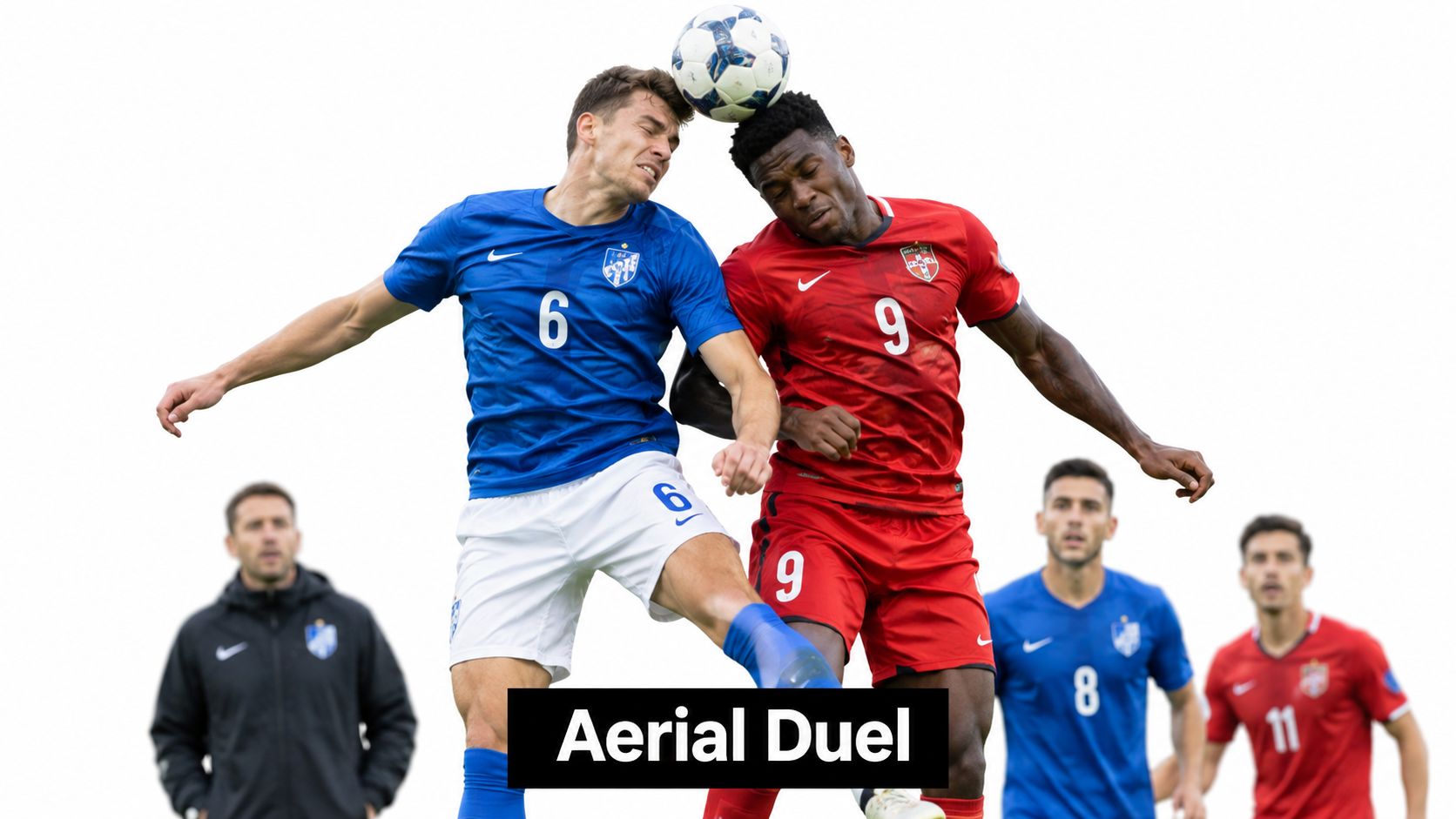
Use contested headers only after players can judge flight, create space and contact the ball reliably. The drill tests whether technique survives an opponent's movement, rather than rewarding collisions.
Set up one feeder, one attacker and one defender in a marked zone. Start with the defender as a passive visual obstacle. The attacker reads the delivery, uses legal body position to protect a route to the ball and attacks the highest controllable point. Rotate roles often, so players learn both the attacking and defending responsibilities. For defenders, connect the exercise to centre-back positioning, especially judging when to hold ground and when to challenge.
Add pressure in measured steps
Allow the defender to move into the zone only after the attacker shows consistent timing. Then permit an active contest at a controlled service speed. Set the boundaries first: no pushing from behind, no reckless movement beneath an airborne player and no challenge that threatens the head or landing space. The coach controls the delivery, watches the surrounding bodies and stops the repetition early when control disappears.
The coaching purpose is clean decision-making under pressure. Players should track the ball, keep the neck firm without excessive tension, use legal upper-body positioning and land with awareness of nearby feet and bodies. A successful repetition can mean leaving the ball, protecting space or clearing safely. Winning every duel is not the target.
This drill suits centre-forwards, centre-backs and full-backs, but position does not justify unlimited heading volume. The Nottingham Trent University football heading exposure analysis examined match heading across age groups and positions, showing why training should reflect a player's existing match exposure. Keep the contest block short, particularly when players already head frequently in competition.
Check for mistimed jumps, closed eyes, poor balance or contact made while falling. If any appears, return to passive pressure and slower service. End the heading portion while players are still making clear decisions, then review whether the contest improved timing and positioning rather than just adding impact.
7. The Diving Header and Risk Assessment Drill
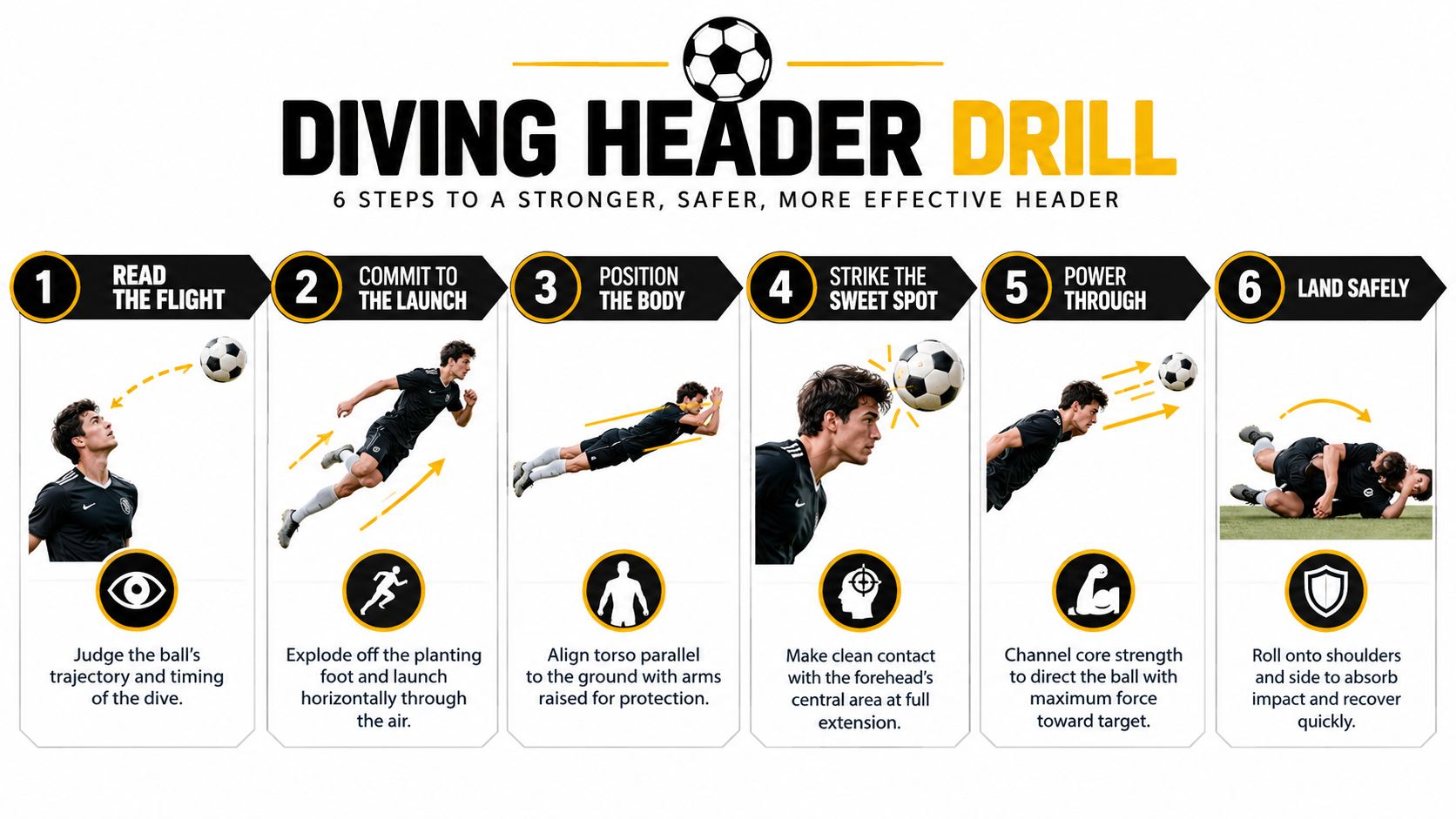
A diving header is an advanced option, not a badge of commitment. The player leaves the ground horizontally, so the technical demand includes the contact itself, take-off, arm position, landing and recovery. If any part of that chain is unreliable, the drill has become a poor risk trade-off.
Use an experienced player, a coach-controlled low delivery and a padded surface. First rehearse the landing without a ball. The player lowers the body, protects the upper body with appropriate arm positioning and learns to absorb the landing rather than brace stiffly. Only then should a ball be introduced at a low height and short distance.
Make the risk assessment part of the drill
Before every progression, check the surface, available space, service speed and player's readiness. Foam mats or suitable padded surfaces are appropriate for technical rehearsal, but they don't make poor decisions safe. The player must have enough strength, flexibility, spatial awareness and confidence to control the movement.
Start with a low ball that requires a small forward extension, not a full horizontal launch. Progress only when the player can connect with the forehead and land under control. A coach should never use a spectacular service to force commitment. The player needs to choose whether the action is available.
Core strength, lower-body control and landing practice support the movement, but they don't remove head-impact considerations. SoccerWares' injury prevention equipment resource may help coaches think about the wider equipment and environment around advanced training.
A diving header is successful only when the player reaches the ball and finishes the movement safely. Contact alone isn't success.
Don't use this drill with young beginners or players whose foundation technique is inconsistent. If a player has suspected concussion, the FA guidance says there should be no head-impact activities, including heading, during the structured return process. The FA concussion guidelines should take priority over any training plan.
Top 7 Heading Drills Comparison
| Drill | 🔄 Implementation complexity | 💡 Resource requirements | 📊 Expected outcomes | ⭐⚡ Key advantages | Ideal use cases |
|---|---|---|---|---|---|
| The Basic Header Foundation Drill | Low, simple close-range setup, coach-led corrections | Few footballs, cones/targets, 1 feeder or coach | Improved technique, neck control, muscle memory | Safe for beginners; quick technical feedback | Academy foundations, grassroots coaching, rehab |
| The Directional Accuracy Header Drill | Moderate, target setup and variable angles | Cones/targets, smaller goals, consistent feeders, optional tracking | Measurable placement accuracy, better decision-making | Trains precision and finish placement; progress is quantifiable | Striker finishing work, precision clinics, shooting practice |
| The Crossed Ball Header Drill | Moderate–High, coordinated runs and timed delivery | Multiple players/feeders, larger pitch area, varied balls | Enhanced timing, movement off the shoulder, power from runs | High transfer to match scenarios; develops explosiveness | Wing crossing integration, attacking pattern sessions, academy match prep |
| The Defensive Header Clearance Drill | Moderate, needs realistic pressure and positioning work | Attackers to simulate pressure, cones, goalkeeper involvement | Increased clearance distance, defensive composure, reduced second balls | Builds defensive resilience; improves distance and direction of clearances | Centre-back/full-back defensive drills, set-piece defence training |
| The Set-Piece Heading Specialist Drill | High, complex team organisation and rehearsed patterns | Full squad, set-piece servers, video analysis tools | Organised routines, higher conversion/defence rates from set plays | Tactical advantage via rehearsed patterns; repeatable team moves | Team set-piece sessions, match-specific planning, squad rehearsals |
| The Contested Header Under Pressure Drill | High, match-intensity, needs supervision and rules | Larger groups, protective gear optional, experienced coaches | Better aerial duel wins, mental toughness, match-readiness | Most match-realistic; builds competitive resilience | Elite academy prep, tournament warm-ups, physical duel training |
| The Diving Header and Risk Assessment Drill | High, advanced progression, strict safety protocols | Foam mats/padding, conditioning work, expert coaching | Extended reach finishing potential, higher physical demand | Enables unique finishes; distinguishes elite attackers | Specialist finishing clinics, experienced attackers, controlled practice only |
Turn Seven Drills into a Safer Progression
Players shouldn't complete all seven drills just because they appear in a list. Choose the next exercise based on the quality of the current one. A player who can make clean contact from a controlled throw but can't direct the ball should stay with the accuracy drill. A player who can place headers but mistimes crosses needs more work on movement and service, not more pressure.
Age policy comes first. The Scottish FA says heading shouldn't be introduced in training for ages 6 to 11. For ages 12 to 15, it remains a low-priority activity with strict limits, including one session per week and no more than five headers for 13-year-olds, while 14- and 15-year-olds can increase to 10 headers per session. The Scottish FA heading guidance gives coaches a practical reference for age-gated planning.
Adult and older-player sessions still need load control. Scottish FA adult guidance says repeated-heading exercises should take place no more than once a week, not on MD-1 or MD+1, with heading activity planned and monitored to reduce the overall burden. Parliamentary briefing material records guidance of a maximum of 10 higher-force headers per training week for professional and amateur players, and for Under-13s one session with a maximum of five headers each week. The UK heading exposure guidance summary reinforces that heading is a controlled-load element, not an unlimited repetition exercise.
A practical micro-session can stay simple:
- Foundation block: Use gentle, coach-controlled service and prioritise open eyes, firm neck position, balanced feet and clean forehead contact.
- Accuracy block: Add large target zones and ask players to direct the ball across or away from the central area.
- Crossing block: Use a low-volume series of wide deliveries, focusing on the timing of the run rather than maximum service speed.
- Position block: Finish with one brief application, such as a defensive clearance towards a wide channel or an attacking near-post movement.
Rest between blocks and inspect quality before continuing. The large UK match analysis found unintended head impacts during purposeful heading events were rare, with 31 recorded in total, under 1% of purposeful heading events, and an incidence of 1 per 971 match minutes in senior football and 1 per 1,852 match minutes in the foundation phase. The match heading exposure dataset offers useful context, but it doesn't remove the coach's responsibility to manage the training environment.
SoccerWares can be a relevant source for training essentials such as indoor training mats, goals, rebounders, training cones, high-visibility vests and protective equipment. The equipment should support a well-planned session, never justify adding more contact, speed or repetitions.
Reduce the service speed when players show discomfort, hesitation or fatigue. Stop the heading work when technique breaks down, and seek appropriate medical guidance after any suspected concussion rather than trying to coach through it.
SoccerWares offers football training essentials including goals, rebounders, indoor training mats, cones, high-visibility vests and protective equipment that can support controlled heading sessions. Visit SoccerWares to organise the equipment around your progression and keep technique, decision-making and player welfare at the centre of training.