

In modern football, a solid defence is the bedrock of every successful team. While attacking flair often grabs the headlines, championships are consistently built upon the principles of organisation, discipline, and tactical intelligence at the back. It's a craft meticulously honed on the training ground, where individual prowess is fused with collective understanding. This guide moves beyond generic advice to provide a comprehensive breakdown of essential soccer defence drills designed to forge a resilient and impenetrable unit.
Whether you're a coach planning your next session, a parent helping a young player, or an ambitious footballer determined to become a defensive stalwart, this blueprint offers the actionable insights you need. We've curated a collection of drills that cover the full spectrum of defensive responsibilities, from mastering 1v1 duels and perfecting body positioning to coordinating a high press and maintaining a disciplined backline under pressure.
This is not just a list; it's a practical toolkit. Each drill is presented with clear objectives, step-by-step instructions, and crucial coaching cues to maximise its effectiveness. We will explore exercises focused on individual technique, small-group coordination, and full-team tactical shape, giving you a structured approach to elevate defensive performance. By implementing these soccer defence drills, you can systematically build the awareness, communication, and cohesion required to shut down opponents and secure clean sheets. Let's dive into the exercises that transform a group of defenders into a formidable, organised force.
1. 4v4 Rondo (Possession in a Confined Space)
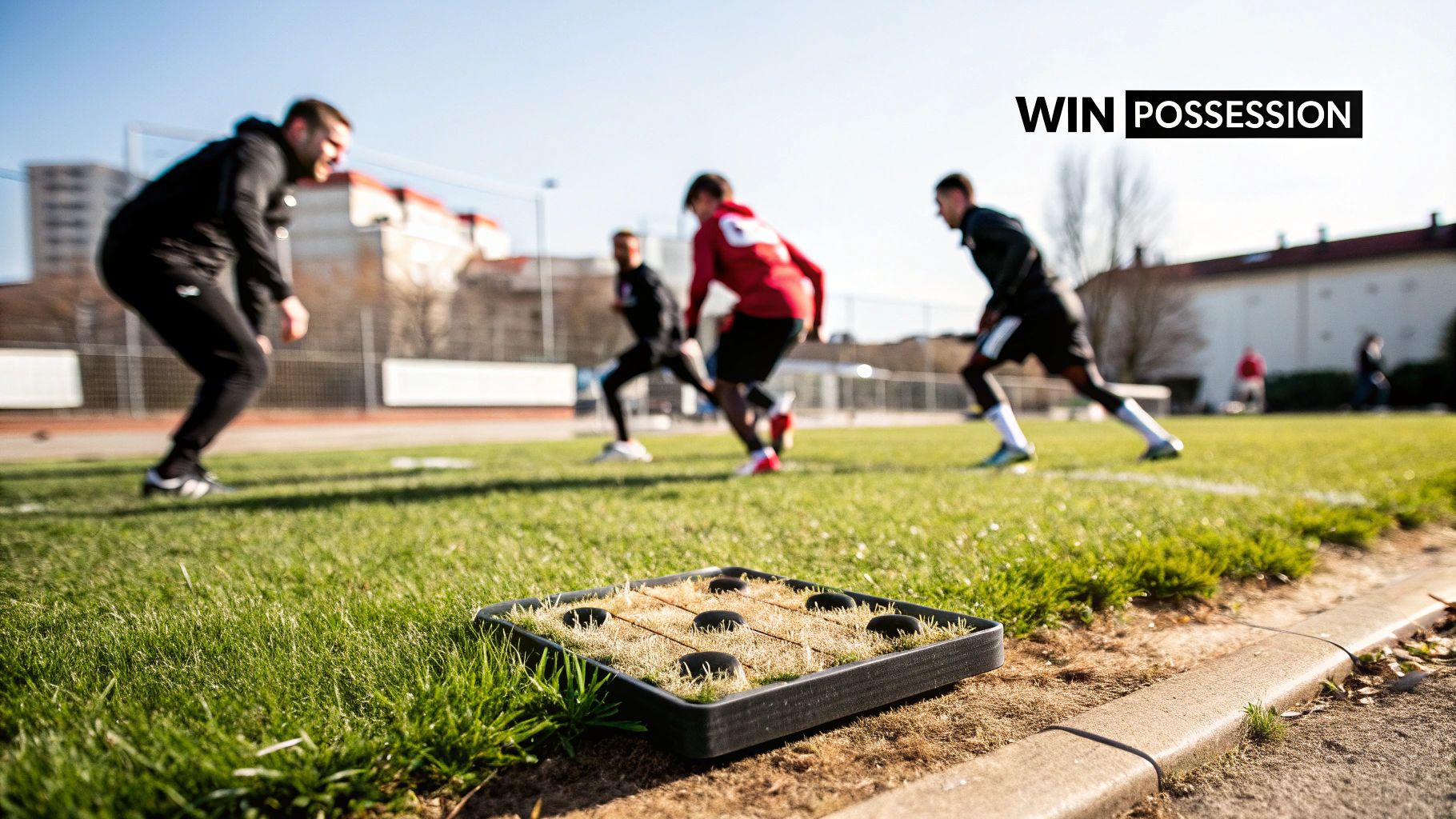
While often viewed as a possession-focused activity, the rondo is one of the most effective and foundational soccer defence drills for developing collective pressing, communication, and organised shape. It places four defenders in a high-intensity, confined space against four attackers, forcing them to work cohesively to win the ball back. This drill is a staple in the methodologies of elite managers like Pep Guardiola and Jürgen Klopp, who use it to instil the core principles of proactive, coordinated defending.
The beauty of the rondo lies in its simplicity and the immediate feedback it provides. Defenders quickly learn the importance of cutting off passing lanes, applying pressure on the ball carrier, and providing cover for their teammates. The tight 12x12 or 15x15-yard grid leaves no room for hesitation, demanding constant awareness and rapid decision-making.
Why It Works for Defence
This drill is crucial because it simulates the intense pressure of trying to regain possession in congested areas of the pitch, like the final third. It teaches defenders to hunt in a pack, communicating shifts in pressure and anticipating the attackers' next move. Players develop an intuitive understanding of when to press, when to drop, and how to position themselves to block passing options. For a deeper look into possession-based exercises, you can explore various possession drills for soccer that complement this defensive focus.
Actionable Coaching Tips
To maximise the defensive benefits of the 4v4 rondo, focus on these key coaching points:
- Pressure, Cover, Balance: Constantly reinforce the core defensive principle: one player presses the ball, the next two provide immediate cover, and the fourth maintains balance to cut off the switch of play.
- Communicate Clearly: Demand loud, specific calls. Defenders should be shouting "Press!", "Cover left!", or "Drop!" to stay organised.
- Body Shape is Key: Coach defenders to approach the attacker with a curved run to dictate their direction and a low, side-on body stance to be ready to tackle or intercept.
- Reward Defensive Wins: Implement a scoring system. For example, the defending team earns a point for winning the ball back in under five passes or for forcing a mistake. This fosters a competitive, aggressive mindset.
2. Back Four Defensive Shape Drill
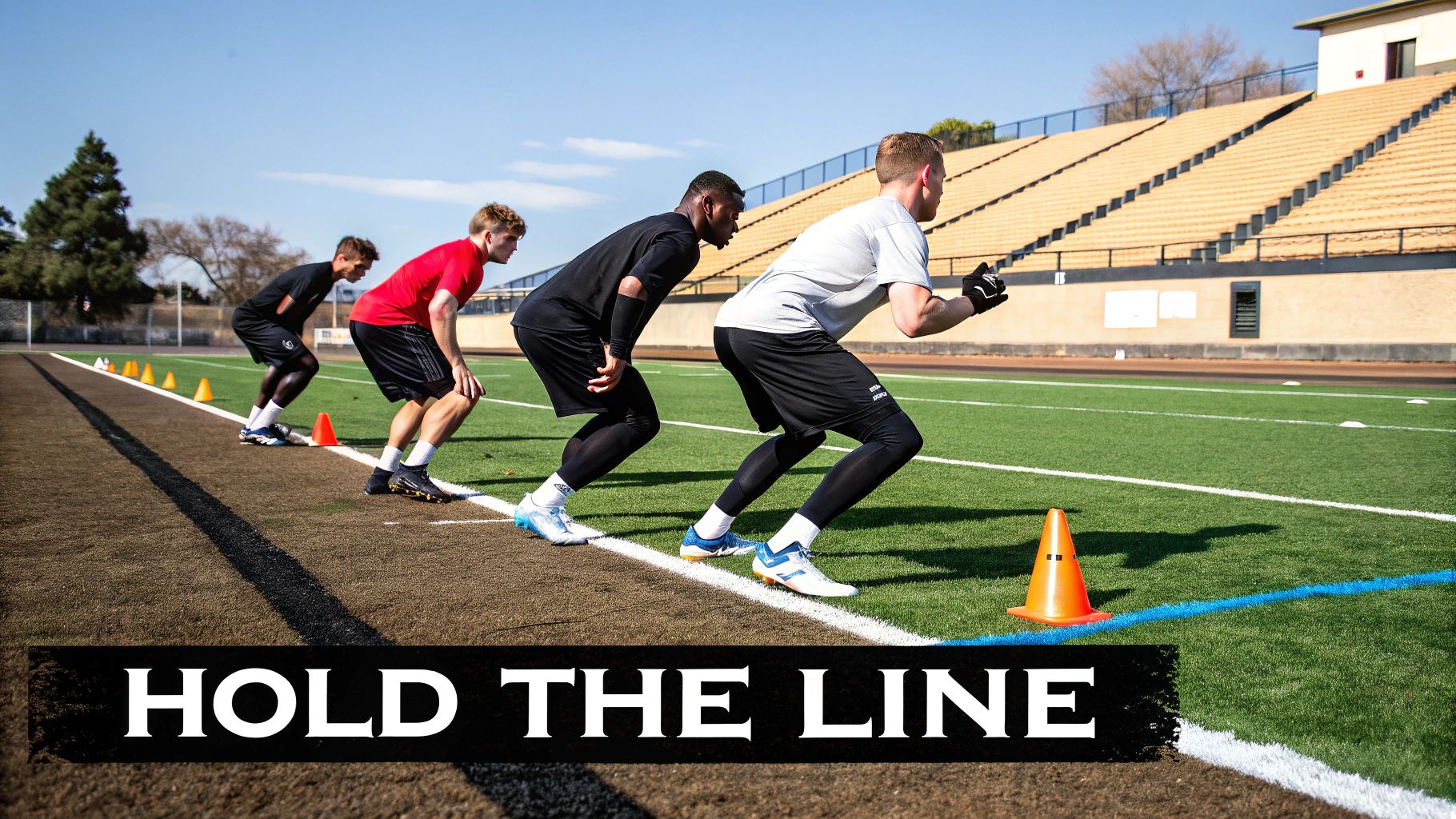
A cohesive back four is the bedrock of any organised defence, and this drill is specifically designed to forge that unity. It focuses on maintaining defensive line integrity, mastering offside awareness, and coordinating movement as a single, impenetrable unit. This is one of the most critical soccer defence drills for teaching a back line how to shift laterally, hold their shape, and communicate effectively to deny space and track runners.
This exercise moves beyond individual skills to focus on collective intelligence. Legendary managers like Sir Alex Ferguson and Arsène Wenger built their dynasties on the back of impeccably organised defences that moved in perfect sync. This drill replicates the scenarios a back four faces, forcing them to make synchronised decisions about when to drop, step up, or slide across the pitch.
Why It Works for Defence
This drill is fundamental because it isolates the back four and trains their collective movement patterns without the chaos of a full game. It builds the non-verbal understanding and vocal communication needed to operate the offside trap, pass on marking responsibilities, and maintain a compact shape. Success in this drill translates directly to fewer defensive breakdowns and a more confident, resilient back line during matches. For more insights into structured team defending, you can find a variety of defence football drills that build upon these principles.
Actionable Coaching Tips
To ensure your back four masters its shape and coordination, concentrate on these coaching points:
- Move as One Unit: Use a rope or training pole to physically connect the defenders, forcing them to maintain their spacing and move together. Emphasise that if one player moves, all must adjust their position accordingly.
- Constant Communication: Designate a vocal leader, typically a centre-back, to command the line. Demystify calls like "Step!", "Drop!", and "Slide!" so that the entire unit responds instantly and cohesively.
- Visual Cues: Use cones to mark offside lines and reference points for depth and width. This gives defenders a clear visual guide for their positioning relative to the ball and their teammates.
- Practise Triggers: Coach the back line to recognise specific triggers for their movements. For example, a pass back to a centre-back is the trigger to step up, while a forward-facing attacker with space is the trigger to drop.
3. Man-to-Man Marking Drill
A fundamental and demanding aspect of defending, the man-to-man marking drill isolates individual responsibility, forcing defenders to shadow specific opponents relentlessly. This exercise hones concentration, discipline, and the physical tenacity required to deny an attacker space, time, and passing options. It shifts the focus from zonal coverage to direct, personal accountability, making it one of the most effective soccer defence drills for developing resilient and aware defenders.
The intensity of this drill comes from the constant mental and physical engagement. Defenders learn to read their opponent’s movements, anticipate runs, and maintain close proximity without committing fouls. This approach has been a cornerstone for defensively robust teams like Diego Simeone's Atlético Madrid and was used to devastating effect in Chelsea's Champions League-winning campaign under Thomas Tuchel, where aggressive, organised man-marking dismantled opposition attacks.
Why It Works for Defence
This drill is critical because it simulates high-stakes defensive scenarios where a single lapse in concentration can lead to a goal. It teaches players to be accountable for their assigned attacker, developing crucial skills in tracking, jockeying, and timing tackles. Players learn to balance being "touch-tight" to their opponent with maintaining an awareness of the ball and the overall team shape, preventing them from being pulled completely out of position. This individual focus builds a strong foundation for a more complex, organised team defence.
Actionable Coaching Tips
To effectively coach the man-to-man marking drill, focus on these tactical details:
- Establish Clear Assignments: Before the drill starts, assign each defender a specific attacker to mark. This creates immediate clarity and responsibility.
- Body Positioning is Paramount: Coach defenders to position themselves "goal-side" of the attacker and on their shoulder. This stance allows them to see both the ball and their opponent, ready to intercept a pass or block a run.
- Dictate, Don't Follow: Encourage defenders to be proactive. Teach them to use their body to force the attacker towards the touchline or into less dangerous areas, rather than passively following them.
- Practise Recovery Runs: No defender wins every duel. Make it a rule that if a defender is beaten, their immediate reaction must be an explosive recovery run to get back between the attacker and the goal.
4. Pressing Triggers Drill (High Press Simulation)
One of the most tactically advanced soccer defence drills, the pressing triggers exercise moves beyond generic pressure and teaches players when and why to initiate a high-intensity press. It is designed to develop a collective understanding of specific moments in a match that signal an opportunity to win the ball back high up the pitch. This drill is central to the high-octane philosophies of managers like Jürgen Klopp, whose "gegenpressing" system at Liverpool was built on instant, coordinated reactions to losing possession.
The core idea is to train players to recognise triggers, such as a poor first touch, a slow pass, a player receiving the ball with their back to goal, or a pass to a weaker foot. By simulating these moments in a controlled environment, defenders learn to react as a synchronised unit rather than as individuals, making their press far more effective and difficult to play through.
Why It Works for Defence
This drill is critical for developing a modern, proactive defensive unit capable of dictating the tempo of a game without the ball. It transforms defending from a reactive action into an aggressive, attacking weapon. Teams like Manchester City and Arsenal excel at this, using pressing triggers to force turnovers in dangerous areas and launch immediate counter-attacks. It instils a shared intelligence and predatory mindset, ensuring the entire team knows the exact moment to close down space, cut off passing lanes, and swarm the opposition.
Actionable Coaching Tips
To effectively teach pressing triggers, coaches should focus on creating game-realistic scenarios and clear communication:
- Identify and Isolate Triggers: Start by focusing on one specific trigger per session. For example, the coach can shout "Back!" every time a player receives the ball with their back to the play, signalling the team to press immediately.
- Establish Clear Communication: Develop simple, loud verbal or non-verbal cues to initiate the press. This could be a designated player shouting "Go!" or a visual signal. This ensures the press is coordinated and not staggered.
- Create Numerical Advantages: Structure the drill so the pressing team has a numerical superiority (e.g., 5v3) once the trigger occurs. This builds confidence and rewards the aggressive movement, showing players the positive outcome of their press.
- Use Video for Reinforcement: Show players professional examples of both successful and unsuccessful presses. Analyse the body shape, speed of approach, and communication of elite teams to provide a clear blueprint for success.
5. Defensive Transition Drill (Possession to Defence)
This is one of the most critical soccer defence drills for the modern game, focusing on the chaotic moments immediately after possession is lost. The defensive transition drill trains players to instantly switch their mindset from attack to defence, closing down space, regaining a compact shape, and applying immediate pressure on the ball. It is the cornerstone of philosophies employed by elite managers like Pep Guardiola and Jürgen Klopp, whose teams are renowned for their ability to nullify counter-attacks at the source.
The drill is designed to replicate the high-stakes scenario of a turnover. Players start in an attacking phase and, upon losing the ball, must execute a rapid, coordinated recovery. This forces them to develop the mental agility and tactical discipline needed to reorganise under pressure, preventing the opposition from launching a dangerous attack. The focus is on immediate reaction, communication, and collective responsibility.
Why It Works for Defence
This drill is vital because it addresses the most vulnerable moment for any team: the transition. It teaches players to close the nearest passing lanes, with the closest player pressing the ball and others recovering into a compact, central shape. This proactive response can stifle a counter-attack before it even begins. Teams like Manchester City and Liverpool master this phase, ensuring their defensive structure is re-established within seconds of losing possession, a key reason for their sustained success.
Actionable Coaching Tips
To effectively coach the defensive transition, concentrate on these specific actions:
- Five-Second Rule: Challenge your team to either win the ball back or commit a tactical foul within five seconds of losing it. This instils a sense of urgency and aggressive intent.
- Prioritise the Presser: The player closest to the ball loss must press immediately and aggressively to delay the opposition's progress. Coach them to use a curved run to force the attacker in a predictable direction.
- Recovery Runs: Emphasise that players farther from the ball must make disciplined recovery runs back towards their own goal, prioritising central areas to protect the most dangerous space.
- Trigger-Based Scenarios: Create specific triggers for the transition. For example, the coach can shout "Turnover!" or have attacking players attempt a high-risk "killer pass" that is likely to be intercepted, initiating the defensive phase at game speed.
6. Channel Defence Drill (Wide Area Coverage)
Modern football is often won and lost in the wide areas, making this one of the most vital soccer defence drills for any organised backline. The Channel Defence Drill specifically targets the coordination required to shut down attacks in the channels – the crucial spaces between the full-back and centre-back. It forces defenders to manage wingers, prevent crosses, and maintain a compact defensive shape when the ball is moved out wide.
This drill replicates game-realistic scenarios where an attacker tries to exploit space behind the full-back. Elite tactical systems, like those employed by Pep Guardiola and Jürgen Klopp, rely heavily on their wide defenders being able to both press high and recover into these channels effectively. The drill isolates this specific phase of play, demanding clear communication and precise positioning to nullify the threat.
Why It Works for Defence
This exercise is critical for developing the partnership between a full-back and their nearest centre-back. It teaches them how to pass on responsibility, when the full-back should press aggressively, and when the centre-back needs to provide cover. Mastering this prevents attackers from getting in behind to deliver dangerous crosses or cutbacks. It builds the tactical intelligence needed to show attackers away from goal and force them into less threatening areas.
Actionable Coaching Tips
To effectively coach the Channel Defence Drill, concentrate on these key points:
- Communication is Non-Negotiable: Demand constant talk between the full-back and centre-back. Calls like "Show him outside!", "I've got cover!", or "Step!" are essential for synchronised movement.
- Define the Channels: Use cones or flat markers to clearly outline the channel you want the defenders to protect. This gives them a visual reference point for their starting positions and responsibilities.
- Body Shape and Angles: Coach the full-back to approach the winger with a slightly side-on body shape, forcing them down the line and away from the goal. The covering centre-back should be positioned to intercept any balls played into the channel.
- Vary the Attack: Introduce different attacking patterns to challenge the defenders. Instruct attackers to attempt 1v1 dribbles, early crosses, and combinations with a midfielder to test the defenders' adaptability and decision-making under pressure.
7. Box Defending Drill (Penalty Area Organisation)
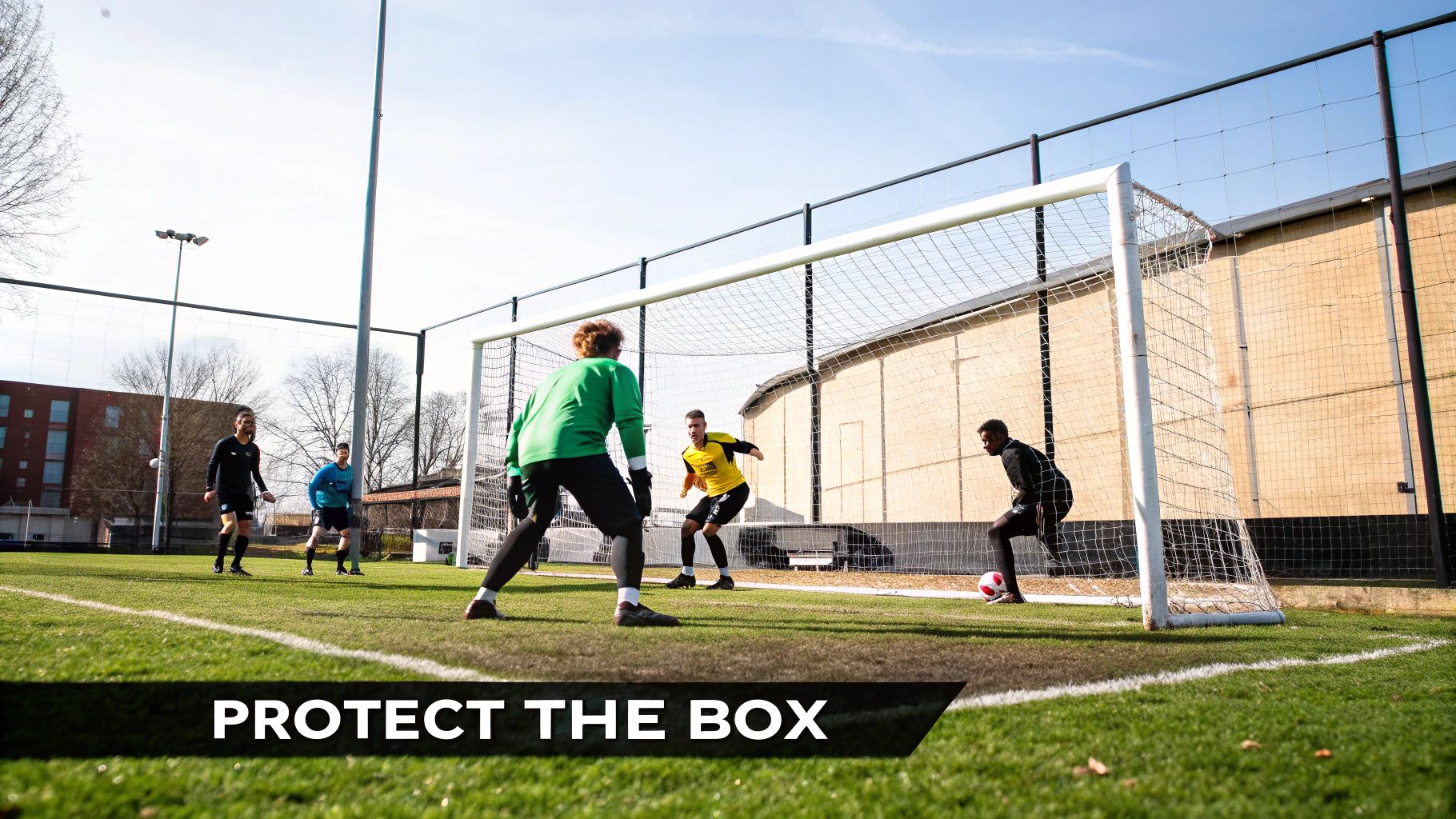
Many goals are conceded from scrambles and disorganisation inside the penalty area. This intensive drill focuses specifically on building a cohesive and impenetrable unit inside the 18-yard box, emphasising communication, marking, aerial dominance, and goalkeeper coordination. It is one of the most critical soccer defence drills for teams looking to eliminate high-danger scoring chances and see out games under pressure.
This drill simulates the chaos of both open-play crosses and set-piece deliveries, forcing defenders to make rapid decisions on who to mark, which space to cover, and when to attack the ball. It’s the training ground where legendary defensive units, like those managed by José Mourinho and Carlo Ancelotti, are forged, building the resilience needed to protect a lead.
Why It Works for Defence
This drill is crucial because it directly replicates the most dangerous phase of defensive play. By repeatedly exposing defenders to crosses, cut-backs, and shots from close range, it hardwires correct positioning and decision-making. Players learn to prioritise threats, organise their body shape to block shots, and communicate effectively with their goalkeeper to command the area. This focused practice is how teams like Atlético Madrid build their renowned box structure, turning their penalty area into a fortress.
Actionable Coaching Tips
To maximise the effectiveness of the box defending drill, concentrate on these key elements:
- Zone Marking and Communication: Use cones to mark key zones (near post, penalty spot, far post). Demand constant, clear communication from the goalkeeper and centre-backs to direct the unit's shape.
- Prioritise the Threat: Coach defenders on a simple hierarchy: Ball > Goal > Runner. Their first priority is their position relative to the ball and goal to block shots, followed by marking the most dangerous attacking runs.
- Attack the Ball Aggressively: Emphasise an aggressive, front-foot mentality for clearing crosses. Defenders should be coached to meet the ball at its highest point and aim for height, distance, and width with their clearances.
- Integrate the Goalkeeper: The goalkeeper is the most important player in this drill. They must be vocal, decisive in their decision to come for a cross or stay, and fully integrated into the defensive organisation.
8. Cover Shadow and Body Positioning Drill
This technical exercise is one of the most fundamental soccer defence drills for teaching the art of intelligent positioning. It isolates the crucial skill of using one's body to block passing lanes and dictate an attacker's movement without making a tackle. Players learn to create a "cover shadow" – an area behind them that is inaccessible to the player on the ball, effectively taking their marked opponent out of the game.
The concept is central to the tactical systems of elite managers like Pep Guardiola and Arsène Wenger, who prioritise organised, proactive defending. By mastering body shape and the cover shadow, a defender can control space, prevent dangerous forward passes, and force the opposition into predictable, less threatening areas. This drill strips defending back to its core geometric principles, building the foundation for all one-on-one and zonal defending.
Why It Works for Defence
This drill is essential because it moves the focus from reactive tackling to proactive prevention. A defender who perfectly executes a cover shadow nullifies an attacking threat before it even develops. It teaches players to think two steps ahead, analysing the positions of the ball, their direct opponent, and potential passing channels simultaneously. This spatial awareness is what separates good defenders from great ones, like Virgil van Dijk, whose mastery of body positioning allows him to dominate attackers with minimal physical contact. Analysing a player's positioning using data from a soccer heat map can provide tangible evidence of their defensive coverage and effectiveness.
Actionable Coaching Tips
To effectively teach the cover shadow and proper body positioning, coaches should focus on these details:
- Side-On Stance: Insist on a low, side-on body shape. This allows the defender to move quickly in any direction and makes it harder for the attacker to dribble past them.
- Constant Adjustment: The defender's feet should never be static. Coach them to make small, quick adjustments (a "pitter-patter" of the feet) as the ball moves to maintain the optimal cover shadow.
- Use the Shadow to Dictate: Teach players to angle their approach and shadow to force the attacker towards the touchline or into a teammate's covering position, setting a defensive trap.
- Enhance Spatial Awareness: Beyond visual cues, a defender's ability to maintain optimal positioning relies heavily on their body's spatial awareness. Incorporating Proprioceptive Training can significantly enhance this crucial 'sixth sense' on the field.
9. Offside Trap and Line Management Drill
Executing a successful offside trap is one of the most intellectually demanding yet rewarding soccer defence drills. This drill focuses on teaching a defensive unit to move as one, stepping up in perfect synchronisation to catch attackers in an offside position. It’s a high-risk, high-reward tactic famously employed by legendary backlines, such as Arsène Wenger’s “Invincibles” at Arsenal and the disciplined units managed by Sir Alex Ferguson and Diego Simeone.
This drill shifts the focus from individual tackling to collective intelligence, timing, and communication. It trains defenders to read attacking cues, such as a midfielder looking up for a through ball, and react instantly with a coordinated push forward. When executed correctly, it completely neutralises a threatening attack and can be a major source of frustration for the opposition.
Why It Works for Defence
The offside trap is a proactive defensive weapon that disrupts the opponent's attacking rhythm and forces them to rethink their approach. It's not just about winning the ball back; it's about controlling space and dictating where the opposition can and cannot play. This drill develops a profound level of non-verbal understanding and trust within the backline, turning four or five individual defenders into a single, cohesive unit. For those looking to fully grasp the rule itself, a detailed guide on explaining offsides in soccer provides essential background knowledge.
Actionable Coaching Tips
To effectively teach the offside trap without leaving your team vulnerable, focus on these key coaching points:
- Walk Before You Run: Start the drill at walking pace, focusing purely on synchronised movement. Only increase the speed once the timing and coordination are perfect.
- Designate a Trigger: One player, typically a central defender, must be the designated leader who makes the call to “Step!” or “Push!”. This single, clear voice prevents confusion and hesitation.
- Use Visual and Verbal Cues: The trigger player’s call should be loud and decisive, but the rest of the line must also learn to read visual cues like their teammates’ body shape and the position of the ball.
- Don't Over-Rely on It: Coach the team to understand when to set the trap and when to drop off. A well-timed run from a clever attacker can beat it, so defenders must also know how to recover their shape quickly.
10. Combination Defending (Coordinated Team Shape Under Pressure)
This is one of the more advanced soccer defence drills that elevates a team from a group of individual defenders into a cohesive, impenetrable unit. Combination Defending drills merge multiple principles like pressing, covering, shifting, and shape adjustment into fluid, game-realistic sequences. Players are forced to react to dynamic attacking scenarios, maintaining compactness and supporting each other across the pitch, which is the hallmark of elite defensive organisation.
This drill moves beyond isolated 1v1 or 2v2 situations to replicate the complex decisions defenders face in a full-scale match. It is the training ground where the sophisticated defensive systems of managers like Pep Guardiola and Mikel Arteta are forged. The focus is on collective intelligence, where every player's movement is synchronised with their teammates in response to the ball, the opposition, and the space.
Why It Works for Defence
Combination Defending is crucial for developing the tactical discipline required at higher levels. It teaches a team to defend as one organism, closing down space, anticipating passes, and seamlessly transitioning between pressing triggers and a compact block. This drill simulates the chaotic yet structured nature of in-game defending, training players to read cues and communicate effectively under pressure to nullify complex attacking plays. The coordination learned here is what separates good defences from great ones.
Actionable Coaching Tips
To effectively implement Combination Defending and build a sophisticated defensive unit, focus on these coaching points:
- Start Simple, Build Complexity: Begin with a smaller-sided format like 6v6 on a reduced pitch. Focus on one or two principles, such as pressing and covering, before gradually adding more players and introducing new attacking patterns like overlaps or third-man runs.
- Emphasise Triggers and Cues: Clearly define the team's pressing triggers. Is it a poor touch, a pass to the touchline, or a player receiving with their back to goal? Constantly reinforce these cues so the team’s reaction becomes instinctive.
- Constant Communication: Demand relentless, specific communication. Players should be constantly relaying information about pressure, cover, marking assignments, and shifts in shape. Silence on the training pitch is a sign of a disorganised defence.
- Coach the "Next Action": Encourage players to think a step ahead. Once a pass is made, where should the unit shift? If a player is beaten, how does the team react to recover? This forward-thinking approach builds a proactive, rather than reactive, defensive mindset.
Comparison of 10 Soccer Defensive Drills
| Drill | 🔄 Implementation Complexity | ⚡ Resource Requirements | 📊 Expected Outcomes | ⭐ Key Advantages | 💡 Coaching Tips |
|---|---|---|---|---|---|
| 4v4 Rondo (Possession in a Confined Space) | Medium — rotations, role swaps required | Low — cones, ball, 8 players (optional GPS) | Faster decision-making, pressing triggers, improved transitions | High repetition; fitness and spatial awareness | Keep grid 12–15 yds — rotate players every 2–3 min — use point system |
| Back Four Defensive Shape Drill | Medium‑High — coordinated lateral movement and line management | Medium — cones, vests, balls, 8–10 players (optional camera) | Consistent defensive line, offside awareness, better covering | Directly transferable to match play; builds organisation | Mark offside line with cones — designate vocal leader — record for review |
| Man-to-Man Marking Drill | Low‑Medium — simple to run but needs discipline | Low — bibs, cones, balls, shin guards | Strong individual marking, physical resilience, opponent reading | Clear accountability; builds competitive mentality | Set clear assignments — emphasise shoulder positioning — practise recovery runs |
| Pressing Triggers Drill (High Press Simulation) | High — requires coordinated recognition and timing | Medium‑High — cones, multiple balls, vests, GPS/camera optional | Increased ball recoveries, higher pressing efficiency, quick counters | Teaches proactive, collective pressing; boosts turnover rate | Start with single-trigger drills — use video to illustrate triggers — define communication signals |
| Defensive Transition Drill (Possession to Defence) | High — complex scenarios and rapid role shifts | Medium — multiple balls, cones, vests, camera/GPS optional | Faster regrouping, compactness after loss, improved anticipation | Directly applicable to match turnovers; builds team cohesion | Begin slow then increase speed — stress first/second defender roles — vary field-location scenarios |
| Channel Defence Drill (Wide Area Coverage) | Medium — pattern work between full-back and centre-back | Medium — cones, balls, vests, adequate wing players | Better wide containment, reduced dangerous crosses, improved cover | Targets modern wing threats; develops full‑back defending | Practise full‑back pressure + centre-back cover — mark channels with cones — vary crossing styles |
| Box Defending Drill (Penalty Area Organisation) | Medium‑High — high intensity and coordination in tight space | Medium — goals, cones, balls, goalkeeper, protective gear | Improved aerial clearances, set‑piece defence, shot blocking | Prevents highest danger chances; measurable clearances/blocks | Always include GK in drills — mark key zones — focus on blocking lanes before marking runners |
| Cover Shadow and Body Positioning Drill | Low — technical repetition focused on stance and angles | Low — cones, bibs, balls, optional video | Better one‑on‑one positioning, fewer fouls, improved balance/agility | Fundamental technique transferable across positions; lowers card risk | Start 1v1 before team work — emphasise side‑on stance and hands placement — review video |
| Offside Trap and Line Management Drill | High — requires precise timing and flawless communication | Medium — cones, balls, vests, goal markers, video optional | Ability to catch runs offside, compressed defensive block | High reward when executed; prevents deep penetration | Walk through movements at low speed — appoint a line trigger voice — balance trap with covering depth |
| Combination Defending (Coordinated Team Shape Under Pressure) | Very High — integrates multiple defensive principles | High — full pitch, multiple balls, cones, vests, GPS, camera | Advanced team cohesion, adaptive shape, superior decision-making | Develops elite-level team defence and resilience | Start simplified (5v5) — use video & GPS for feedback — introduce scenarios progressively |
From Drills to Dominance: Integrating These Techniques into Your Game
You now have a blueprint for building a formidable defensive unit. This collection of ten soccer defence drills isn't just a list of exercises; it's a comprehensive framework for developing individual skill, tactical understanding, and collective resilience. We’ve moved beyond simple tackling practice, exploring the intricate mechanics of a cohesive backline, the tactical nuances of a high press, and the split-second decisions required during defensive transitions. The journey from a porous defence to an impenetrable one is paved with consistent, purposeful practice.
The core principle connecting every drill, from the Back Four Defensive Shape Drill to the Pressing Triggers Drill, is the synergy between individual action and team organisation. A single player’s perfect tackle is valuable, but a synchronised backline moving as one, anticipating play and closing down space, is what wins championships. This is the ultimate goal: transforming isolated skills into an intuitive, collective defensive instinct.
Key Takeaways for Immediate Application
To translate these drills from the training ground to match day, focus on these critical takeaways:
- Communication is Non-Negotiable: Every drill, especially those focusing on group shape like the Offside Trap and Line Management Drill and the Box Defending Drill, reinforces the need for constant, clear communication. Shouts of "step," "drop," "squeeze," and "man on" are the lifeblood of an organised defence.
- Context is Everything: Don't just run the drills. Explain the 'why' behind them. When players understand why they are maintaining a certain body shape in the Cover Shadow Drill or why a specific trigger initiates a press, their decision-making in a live game becomes faster and more intelligent.
- Progressive Overload: Begin with the fundamental mechanics of a drill in a controlled environment. As players master the basics, introduce the progressions and variations we've outlined. Add more attackers, reduce the space, or impose time limits to simulate the pressure and chaos of a real match.
- Repetition Builds Instinct: Defensive actions need to become second nature. The drills for 1v1s, transitions, and channel defending must be repeated until the correct movements and decisions are automatic, freeing up players' mental capacity to read the game on a deeper level.
Your Action Plan for Defensive Mastery
Mastering the art of defence is a marathon, not a sprint. The secret lies not in doing every drill every week, but in a structured, progressive approach. Start by identifying your team's most significant defensive weakness. Are you conceding goals from wide areas? Begin with the Channel Defence Drill. Is your team disorganised during counter-attacks? Focus on the Defensive Transition Drill.
Incorporate one or two of these soccer defence drills into each training session, following the suggested structure: a dynamic warm-up, the focused drill itself, and then a small-sided game designed to replicate the scenario you've just practised. This ensures that the lessons learned are immediately put to the test in a more fluid, game-like environment.
Ultimately, building a dominant defence is about forging an identity. It’s about instilling a collective pride in clean sheets and a relentless desire to win the ball back. These drills are your tools. By using them consistently and intelligently, you can build a defensive wall that frustrates opponents, protects your goal, and provides the secure foundation upon which your team's attacking ambitions can be built. The hard work you put in on the training pitch will directly translate to confidence, control, and victory when it matters most.
To perform at your peak during these intense soccer defence drills, having the right gear is essential. From high-quality training cones and bibs to the latest GPS performance trackers that monitor your defensive work rate, SoccerWares has everything you need to elevate your training sessions. Explore our curated collection of professional-grade equipment at SoccerWares and equip yourself to turn practice into perfection.