

You're due to play, your goalkeeper gloves are ready, and one finger still feels vulnerable after the last awkward save. You reach for the tape because it's quick, familiar and easy to fit under a glove. The important question isn't only how to wrap it. It's whether you're adding light preventive support to a healthy finger, or trying to disguise an injury that needs proper assessment.
For a goalkeeper, that distinction can protect more than a weekend fixture. Good taping can help control unwanted movement, but it can't confirm that a fractured, dislocated or unstable finger is safe to use. The guidance below treats finger tape for goalkeeper use as one part of a wider setup that includes suitable gloves, sound technique, sensible training loads and medical advice when the signs demand it.
Why Goalkeepers Still Tape Their Fingers
A goalkeeper rarely injures a finger through one dramatic moment alone. More often, the problem starts with a shot that catches the hand at an awkward angle, a fingertip that gets folded back during a parry, or a landing where the hand takes force before the rest of the body. Repeated saves place stress on the same small joints, especially when fatigue affects hand shape and catching technique.
That's why tape still has a place even with modern goalkeeper gloves. Gloves can provide cushioning, grip and, in some designs, rigid finger supports. Tape can add localised support around an individual digit, where a glove may not control movement precisely enough. It also gives some players a clearer sense of finger position, which can be useful when returning from a minor, stable problem.
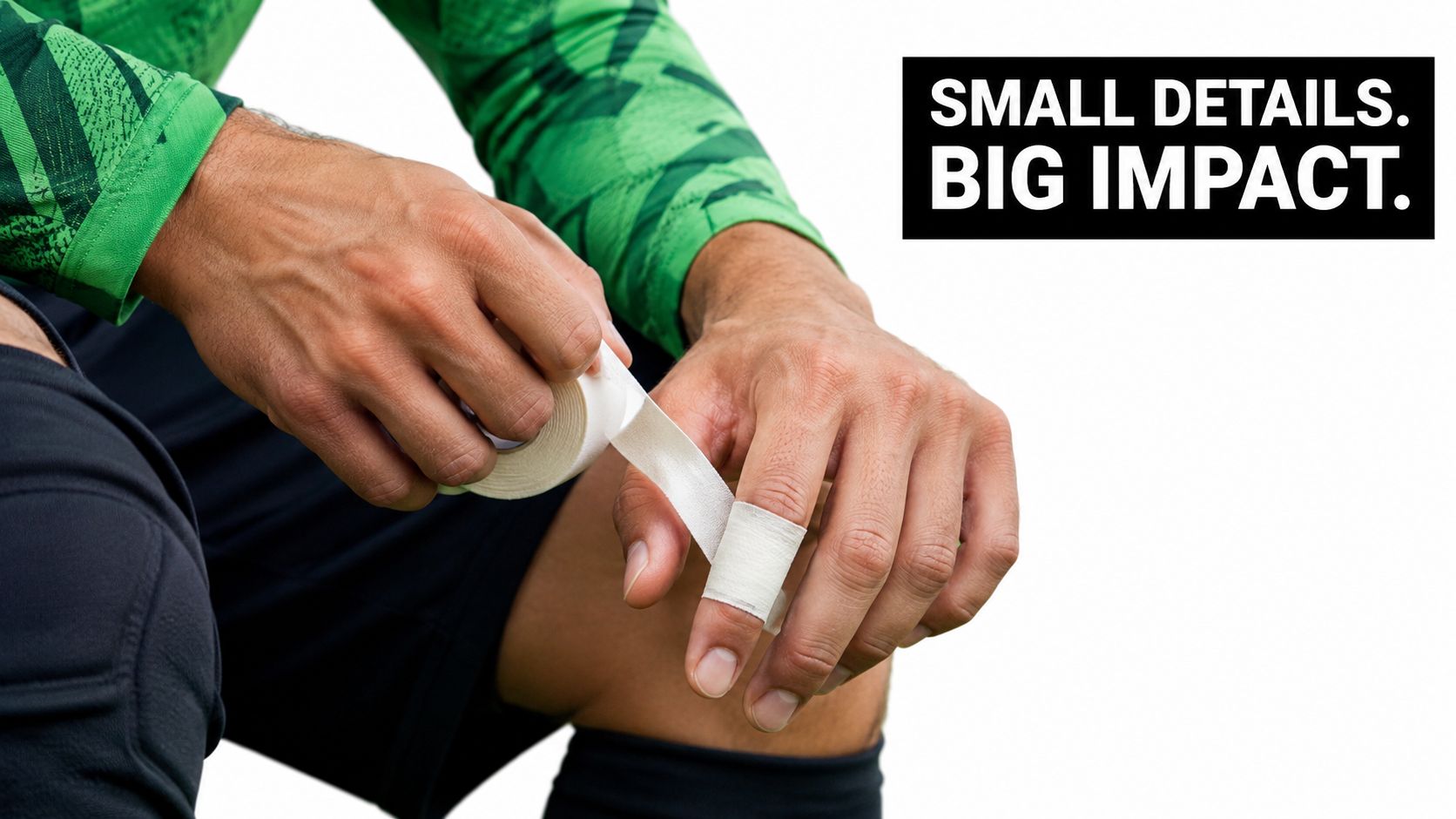
A long tradition of hand protection
The UK has a longer history of goalkeeper hand protection than many players realise. English manufacturer William Sykes received a patent in 1885 for leather football gloves or gauntlets, one of the earliest documented milestones in specialised hand protection. Yet glove use developed slowly. Historical accounts describe goalkeepers using gardening gloves, wool gloves or no specialised protection at all.
By 1925, Huddersfield Town goalkeeper Bill Mercer was documented wrapping bandages around his palms while leaving his fingers free. That arrangement was an early example of supporting the hand without fully restricting the digits. In March 1981, the Football League approved Sondico gloves, reportedly the first official endorsement of goalkeeper gloves by a football governing body. These milestones are discussed in this history of goalkeeper gloves and hand protection.
Modern finger protection moved further with designs such as Adidas Fingersave, introduced during the 1990s with plastic reinforcement intended to reduce injuries caused by fingers being forced backwards. Some goalkeepers disliked early versions because they reduced flexibility. Tape occupies the practical middle ground, offering support to selected fingers while preserving more hand movement than a rigid insert.
For clubs building a sensible equipment routine, tape belongs alongside broader injury prevention equipment, not as a replacement for it. The best setup is the one that lets you close the hand, move naturally and respond to a hard save without ignoring warning signs.
What the Evidence Says About Tape Effectiveness
Tape has a useful mechanical role, but the evidence doesn't support treating it as a guarantee against injury. Goalkeepers repeatedly face jammed, sprained, dislocated and fractured fingers, and the hand is exposed whenever a shot is stopped or deflected at speed.
A systematic review of professional football reported overall upper-limb injury incidence of 0.65 per 1,000 exposure hours. In that dataset, goalkeeper incidence was 0.25 per 1,000 hours, compared with 0.038 for outfield players, giving goalkeepers roughly 6.6-fold greater exposure-adjusted risk. Of 238 recorded hand, wrist and forearm injuries, 170, or 71.4%, involved the hand. These figures come from an international professional-football review, not a national UK injury rate, but they show why hand protection deserves structured attention. The systematic review is available here.
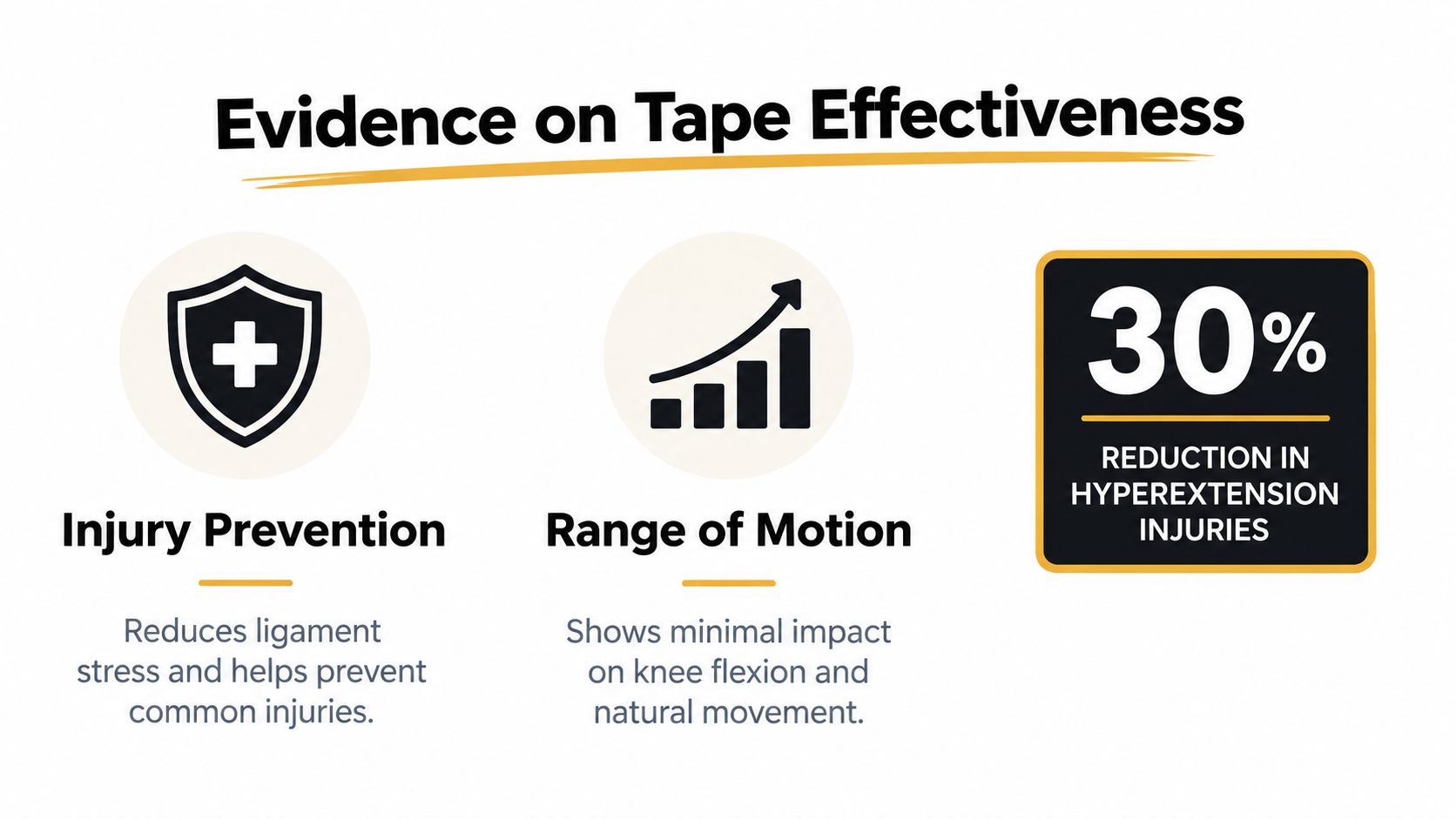
What tape can and cannot do
Long-term goalkeeper research found that every goalkeeper assessed had experienced at least one finger injury, while only 13 of 27, or 48.2%, regularly used gloves with finger-protection elements. The same research reported that 44.4% regularly used finger or wrist taping, alongside greater movement restriction, pain, swelling and instability among goalkeepers than outfield players. The study abstract is available through Thieme Connect.
Those findings support a layered approach. Tape may limit excessive movement and provide external support around a stable joint. It may also improve proprioception, meaning your awareness of where the finger is during gripping and contact. It doesn't reliably prevent every fracture, and it cannot repair a torn ligament or put a dislocated joint back into position.
Practical rule: use tape to manage movement, not to manufacture medical clearance.
Goalkeeper gloves themselves may include rigid plastic spines intended to help prevent jammed, fractured and sprained fingers. Sports-medicine literature indicates that gloves offer considerable protection against hyperextension and wrist injury, while evidence for preventing finger fractures remains modest and scientific validation of glove designs is limited. Tape should therefore supplement a correctly fitted glove, not become an excuse to choose a glove that's too tight or unsuitable for your hand.
English women's football surveillance also recorded 800 wrist, hand, finger and thumb injuries across five seasons, with a higher injury burden in training than matches. That matters for coaches and players who tape only on match day. Finger stress often accumulates during drills, repeated handling and goalkeeper-specific sessions, so prevention needs to cover the whole week. The surveillance study is available here.
Essential Taping Techniques for Different Situations
Start with clean, dry skin and a tape width that fits the finger without creating a bulky ridge. The exact method depends on the problem you're managing. Preventive support should feel secure but allow normal bending, while injury support must follow the advice given for the specific structure involved.
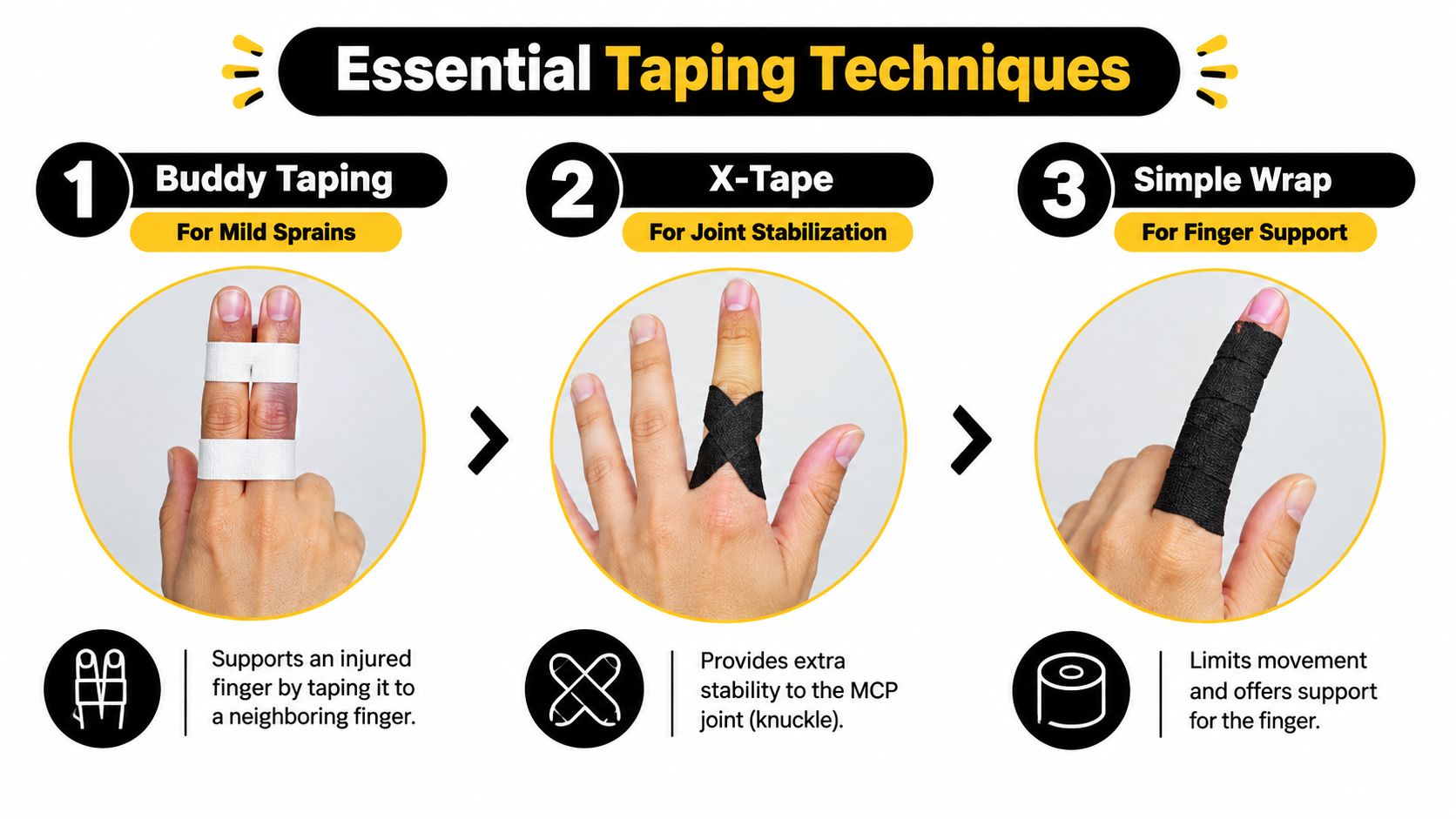
Buddy taping for controlled support
Buddy taping connects an injured or vulnerable finger to the adjacent finger, using the neighbour as a natural splint while preserving some movement. It's generally suited to a mild, stable problem only after serious injury has been ruled out.
- Place gauze or cotton wool between the fingers to reduce rubbing and moisture.
- Apply tape above and below the middle joint, rather than directly across the knuckles.
- Keep the fingers aligned without forcing them into a painful position.
- Bend and straighten both fingers gently to check that movement remains possible.
- Put the glove on and repeat the hand-closure test before taking the field.
UK NHS guidance describes buddy taping as a way to support an injured finger while reducing stiffness. The tape must not restrict circulation. Remove or loosen it if the fingers become swollen, cold, numb, discoloured or develop pins and needles. The NHS guidance explains the method in detail.
X-tape for a stable joint
An X-pattern can provide support around a joint while leaving the fingertip and much of the finger free. Anchor the tape below the joint, cross two strips over the sides of the joint, then secure them above it. Use light, even tension. The aim is to reduce unwanted sideways or backward movement, not to lock the entire finger.
This method is best practised during training rather than improvised during a match. If the tape bunches inside the glove, trim the overlap and retest your grip. A helpful additional reference is this finger tape performance guide, which discusses practical taping considerations beyond goalkeeper gloves.
Simple wraps for preventive support
A simple circumferential wrap can remind a healthy finger to stay controlled during training or matches. Use one or two smooth turns around the relevant section, avoiding the crease of the joint where possible. Don't pull hard enough to create throbbing, tingling or colour change.
Before a match, apply the wrap early enough to catch problems during the warm-up. Mid-game adjustments are different. If tape has become wet, slipped or started cutting into the skin, replace it rather than adding layer after layer over the top. Goalkeepers who are also refining movement and handling can pair this routine with football goal training, where the glove and taped hand can be tested under realistic catching demands.
Use this embedded demonstration as a visual reference, but match the technique to your own finger and seek clinical advice for an injury rather than copying a wrap blindly.
Preventive Support Versus Injury Management
The most important taping decision happens before you tear the roll. Ask whether the finger is pain-free, stable and moving normally. If it is, light preventive support may be reasonable. If it isn't, tape becomes injury management, and that requires more caution than a routine pre-match wrap.
Use preventive tape only when the finger is stable
Preventive support may suit a goalkeeper who has no current pain but wants a small reduction in unwanted movement during training or competition. The tape should sit smoothly, leave the fingertip available for circulation checks and fit inside the glove without forcing the hand open.
Stop and arrange medical assessment after:
- Deformity: the finger looks crooked, shortened or out of line.
- Severe swelling: swelling appears quickly or prevents normal glove fit.
- Numbness: sensation is reduced or pins and needles persist.
- Loss of movement: you can't bend or straighten the finger normally.
- Persistent pain: pain remains after rest or returns with ordinary movement.
- Instability: the joint shifts, collapses or feels unreliable during a gentle test.
A suspected fracture, dislocation or significant ligament injury shouldn't be taped over so you can finish the match. Buddy taping and rigid immobilisation aren't interchangeable. The correct position and support depend on which structure is injured, so a clinician needs to assess the pattern rather than rely on appearance alone.
Keep equipment rules in view
Under The Football Association's Law 4, a goalkeeper may wear non-dangerous protective equipment, including gloves made from soft, lightweight padded material. Players must not use dangerous equipment, and permitted accessories must be safe and securely covered. Officials can require dangerous items to be removed, and covering an unsafe object with tape doesn't make it legal. Read The FA's Law 4 guidance.
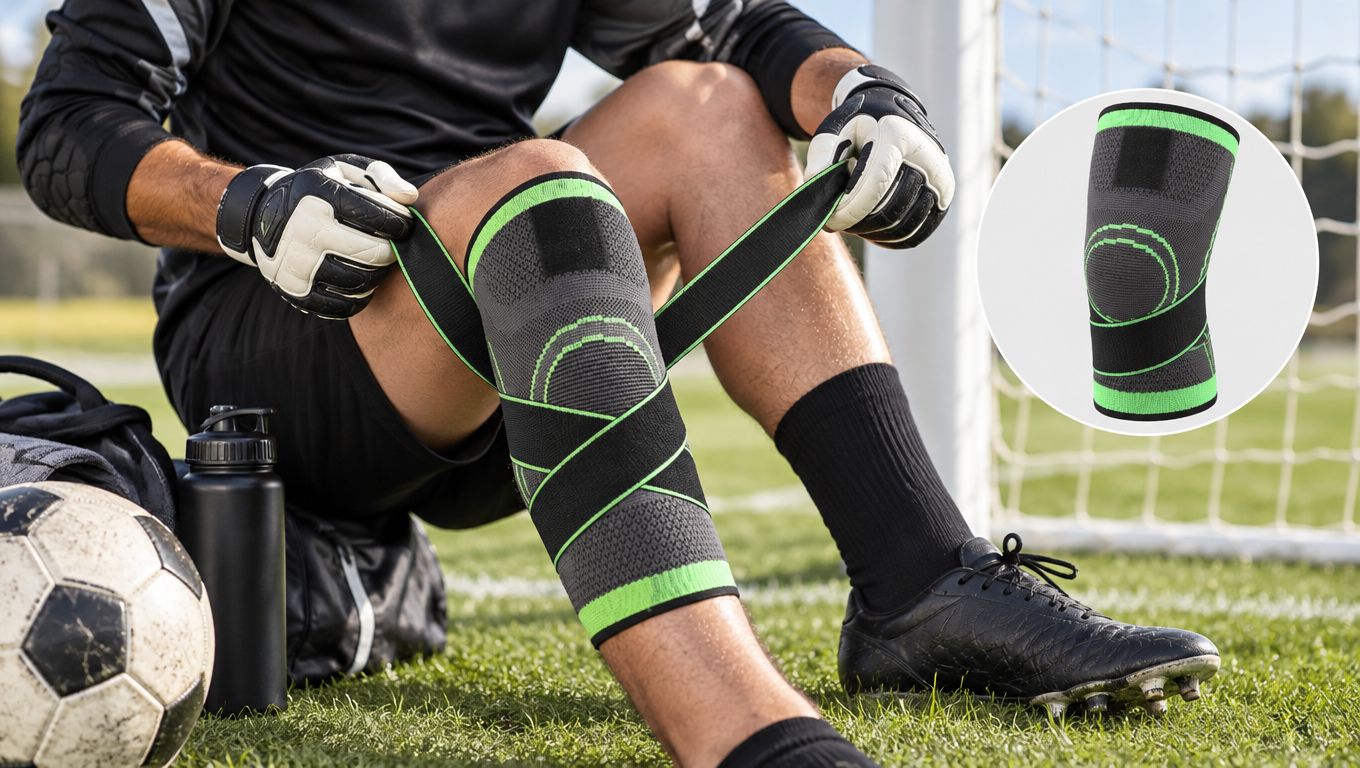
Apply tape smoothly, securely and without exposed sections that could catch another player or interfere with ball handling. The same sensible mindset applies to other protective kit. For example, the Adjustable Patella Stabiliser Knee Support, Compression Sports Knee Brace for Running, Football & Gym Training is described as a breathable polyester support with adjustable straps and a slim profile for training or recovery, but it has no relevance to diagnosing a finger injury.
If your hand is injured, record the affected digit, the mechanism, pain, range of motion and how it responds after training. That record helps a clinician or coach spot a pattern instead of treating each taping session as an isolated fix. You can also review wider protective-kit considerations in this guide to the best shin pads for football.
Choosing Materials and Checking Performance
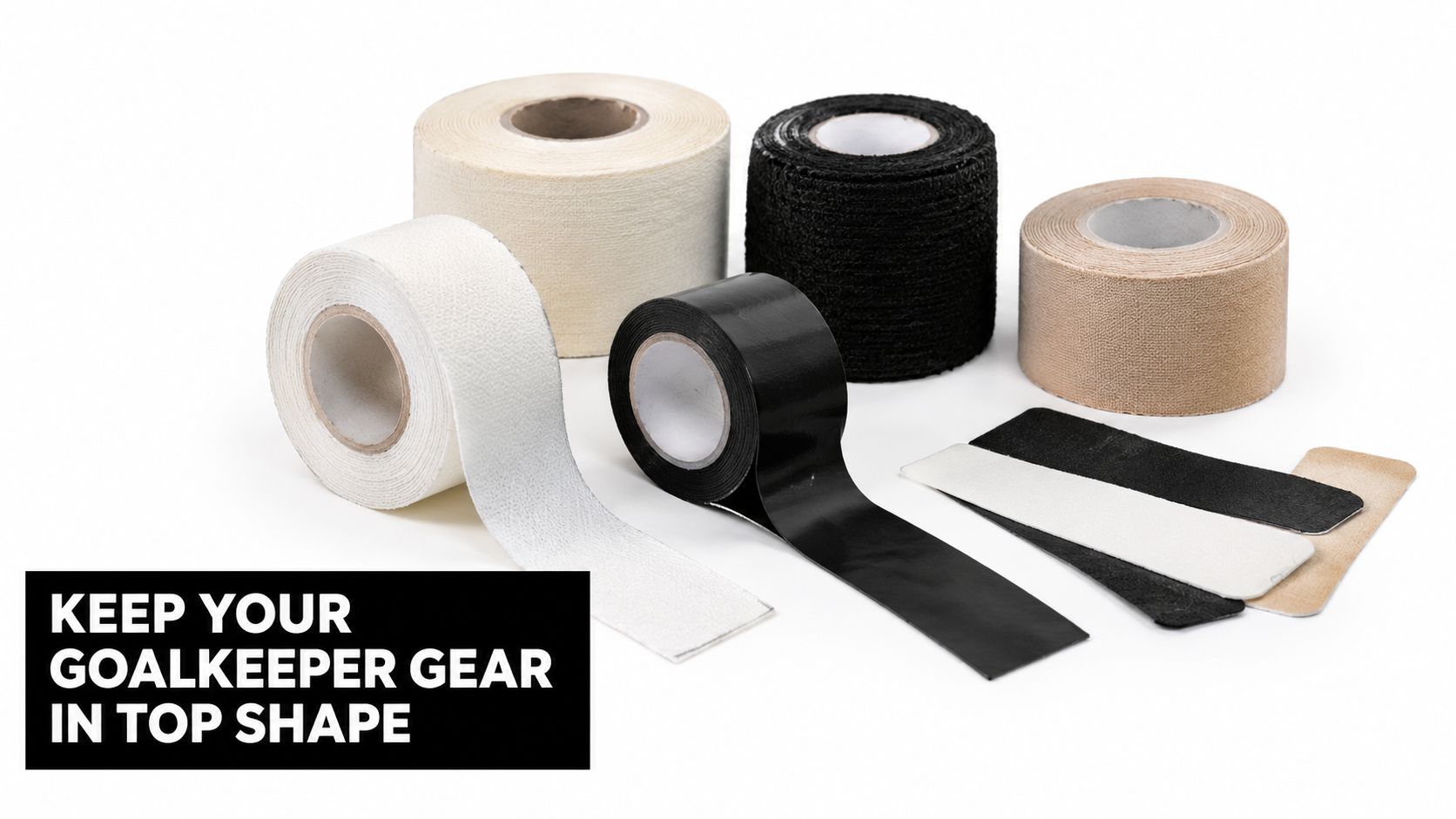
Tape choice affects both protection and your ability to use the glove properly. Rigid, narrow athletic tape can provide firm control but may feel restrictive around a joint. Softer or more elastic tape can be comfortable and easier to fit, though it may stretch, slip or provide less dependable restraint when wet.
Choose based on the job rather than the label:
- For light prevention: use a low-profile tape that leaves enough room for the glove to close naturally.
- For a stable joint: choose a tape with enough structure to hold an anchor and cross pattern without excessive bulk.
- For sensitive skin: use a protective underlayer or a skin-friendly option, and never place adhesive directly over damaged skin.
- For wet sessions: test the tape under the actual glove during training. Sweat and moisture can loosen the wrap and irritate the skin.
Test the complete glove setup
Tape thickness can change how a glove fits. A negative-cut glove may feel close and responsive but leave less spare room for a bulky wrap. A rolled or hybrid cut may offer a different internal feel, yet the only reliable test is to apply the tape, put on the glove and perform goalkeeper actions.
Before playing, check:
- Can you fully close the hand around a ball?
- Can you spread the fingers without sharp pain?
- Does the tape stay flat when you make a fist?
- Are the fingertips their normal colour and warmth?
- Is sensation normal, with no tingling or throbbing?
- Does pressing and releasing the fingertip produce a normal capillary refill response?
Recheck during the warm-up and after handling drills. Remove the tape promptly if colour, warmth or sensation changes. A tight wrap that feels secure in the dressing room can become a circulation problem once the hand swells or the glove gets wet.
For general equipment fit, the same discipline applies to other football protection. SoccerWares carries training and performance equipment, including gloves-adjacent kit such as guidance on how to fit shin guards, but no product can replace checking your own hand response under load.
If you want non-match comfort for a minor, non-acute irritation, a finger sleeve for daily comfort may be worth considering separately from the structured support required for goalkeeper taping. Don't confuse a comfort sleeve with stabilisation for a suspected injury.
Recovery Timelines and Long-Term Finger Health
Tape supports a finger during activity, but it doesn't accelerate biological healing. For some finger injuries, NHS hospital guidance advises strapping continuously for two to three weeks while encouraging gentle movement to reduce stiffness. Return to sport should wait until the finger or hand moves normally without pain. Royal Berkshire NHS recovery guidance also notes that contact sport may need to be avoided for six to eight weeks for some injuries, while another discharge guide advises waiting 12 weeks before contact sport after certain fractures.
Those timelines vary because injuries vary. A taped finger that feels comfortable isn't automatically healed, and pain reduction from support shouldn't be used as permission to resume full contact. Build back through gentle movement, controlled handling, catching technique and gradually increased training demands, stopping if swelling, instability or restricted movement returns.
Long-term finger health comes from combining sensible load management with progressive finger and wrist strengthening, safe landing technique and gloves that fit correctly. Record how the digit responds after each session, and involve a qualified clinician when symptoms persist. The goal isn't to tape every finger forever. It's to keep healthy fingers mobile, protect vulnerable ones appropriately and avoid turning a manageable injury into a season-long problem.
SoccerWares offers goalkeeper-relevant training essentials, protective equipment and football gear for players building a more organised setup around practice and match day. Visit SoccerWares to review the available equipment and choose items that complement, rather than replace, safe finger-taping and recovery habits.