

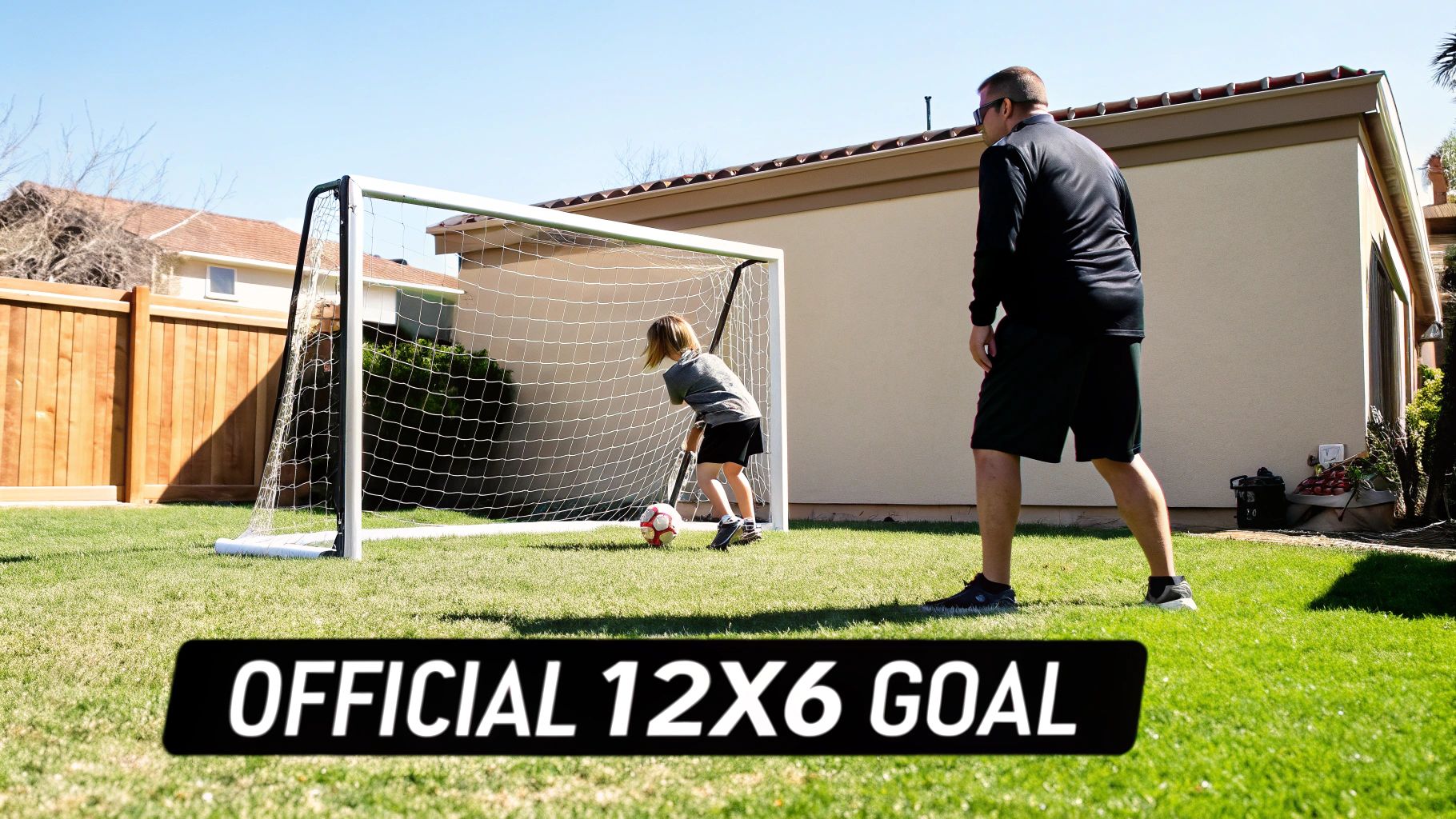
Picking the right size football goal can feel like a minefield, but when it comes to youth football, the answer is often simpler than you might think. A 12 x 6 foot goal is the official, FA-recommended size for Mini-Soccer, making it the gold standard for specific age groups. This isn't just a random measurement—it's a size deliberately chosen to help young players develop their skills effectively.
Why 12 x 6 Is the Standard for Youth Football
The size of a football goal is never an afterthought; it’s carefully matched to the players' developmental stage. For young footballers, particularly those in the Under-9 and Under-10 age brackets, the 12 x 6 goal hits the sweet spot. It offers a challenge without being intimidating, acting as the perfect stepping stone from small-sided kickabouts to the full-sized pitches they'll one day command.
To provide a clear overview, here are the essential details for a 12 x 6 goal.
12 x 6 Football Goal Quick Facts
| Attribute | Specification or Recommendation |
|---|---|
| Official Dimensions | 12 feet (3.66m) wide x 6 feet (1.83m) high |
| FA Recommended Ages | Under-9 and Under-10 |
| Match Format | Primarily for 7-a-side (Mini-Soccer) |
| Primary Use | Official youth matches, garden practice, training drills |
| Best For | Developing shooting accuracy and goalkeeping skills |
This table clearly shows how specific the use case is—it’s a purpose-built tool for a key developmental phase in a young player's journey.
A Foundation for Player Development
Using a goal that’s in proportion to the players and the pitch is fundamental for building both confidence and technique. Imagine a seven-year-old trying to defend a full-size goal—it would be overwhelming, making saves feel impossible and teaching poor positioning habits. A 12 x 6 frame, on the other hand, encourages correct goalkeeping stances and builds a realistic understanding of shot-stopping angles.
The same principle applies to strikers. This size presents a target that demands accuracy and clever shot placement, not just brute force. It ensures they learn the fundamentals correctly from the beginning. The goal's dimensions also align perfectly with the smaller pitches used for 7-a-side matches, creating a cohesive and properly scaled playing environment. To see how pitch sizes affect the game, check out our guide to soccer pitch dimensions.
The 12 x 6 goal isn’t just a smaller version of an adult goal; it’s a specialised piece of equipment designed to create a fair and developmental environment where young players can thrive and genuinely fall in love with the game.
Beyond the official pitch, this size has become a popular choice for garden football. It’s large enough for serious practice but compact enough to fit into most back gardens, making it a brilliant investment for families, coaches, and clubs dedicated to nurturing the next generation of football talent.
How Goal Dimensions Shape the Beautiful Game
Goalposts are more than just a frame to aim at; they are the ultimate arbiters in football, setting the challenge for every single shot. When it comes to youth development, getting those dimensions right is crucial. A standard, consistent goal size isn't just about adhering to rules—it creates a fair and measurable way to track skill, allowing us to appreciate a player's true ability.
For a young footballer, a 12 x 6 goal is perfectly scaled to influence their positioning, sharpen their shooting accuracy, and hone a young keeper's reflexes without feeling impossible. It presents a challenge that is tough but achievable, which is exactly what is needed to build confidence and proper technique.
Creating a Level Playing Field
The real value of a standard goal size is that it creates a universal benchmark. It is the one constant against which all attacking and defensive skill is measured. Whether a child is playing in a Manchester garden or a league match in London, that 12 x 6 target remains the same. This consistency ensures their development is steady and their skills are transferable.
This isn’t just beneficial for individual players; it’s about the integrity of the game itself. It guarantees that every 7-a-side match for Under-9s and Under-10s across the country is played under the same core conditions. This consistency allows for fair competition and helps players progress smoothly through the age groups.
A goal's dimensions are the silent foundation of football's fairness. By keeping the target consistent, we allow talent, strategy, and skill to be the true deciding factors in every match.
This consistency connects achievements across generations. The sport's history is built on these constants, allowing legends to be made and records to be set against a backdrop that never changes, even as tactics and players evolve.
A Benchmark Through Football History
Since the English Football League began in 1888, the goalposts have remained the constant measure of greatness. This historical consistency allows us to properly benchmark goalscoring genius across different eras. For example, Dixie Dean’s incredible record of 60 goals in the 1927-28 season was achieved by aiming at the same size goal we use today.
Fast forward almost a century, and Erling Haaland set a new Premier League single-season record with 36 goals in 2022-23. The game has changed beyond recognition, but the target hasn't. That’s what makes these comparisons so compelling. Legends like Jimmy Greaves (357 league goals) and Alan Shearer (260 Premier League goals) built their legacies shooting at those exact dimensions.
If you fancy a trip down memory lane, you can review top scorer statistics since 1888. It’s a powerful reminder of how important a consistent goal size is to the story of UK football.
Choosing the Right Goal Material for Your Needs
Selecting the right material for your 12 x 6 football goal is a crucial decision. It directly impacts the goal's durability, safety, and portability. Whether you are a parent looking for something for the garden, a coach equipping a youth team, or a groundskeeper installing a permanent fixture, your specific needs will determine the best choice.
At SoccerWares, we focus on the three primary materials for football goals: uPVC, aluminium, and steel. Each has its own strengths, and understanding the differences is key to choosing a goal that will serve you well for years.
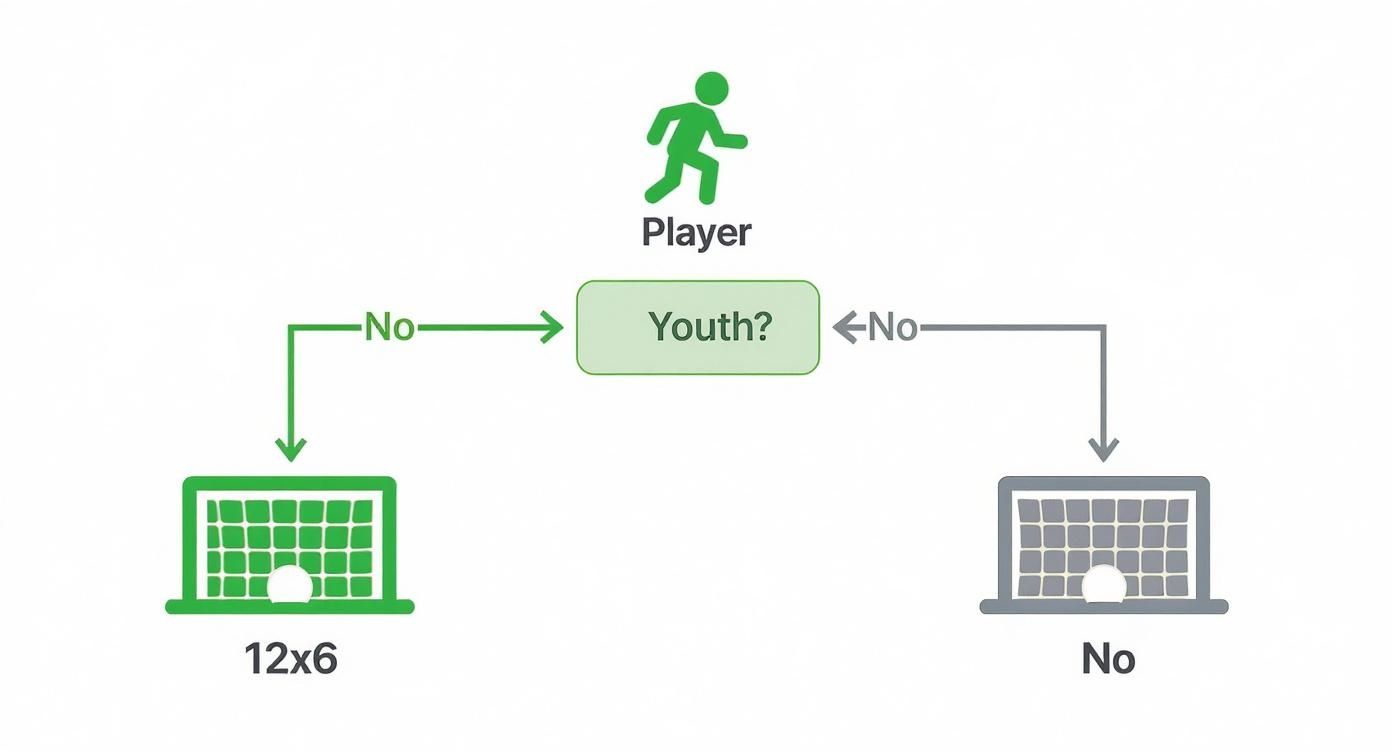
This simple flowchart can help narrow down the options. If you have a youth player, a 12 x 6 goal is almost certainly the right call. The next question is, what should it be made of?
With the size decided, let's explore the materials to find your perfect match.
uPVC: The Lightweight Champion
When you think of a goal for the back garden or a casual kickabout, you're likely picturing one made from uPVC. Unplasticised Polyvinyl Chloride, or uPVC, is the most popular choice for home use, thanks to its lightweight nature and inherent safety. These goals are easy to assemble, move around to protect the grass, and store away when not in use.
The material has some flexibility, which reduces the risk of injury if a young player accidentally collides with it—a significant advantage for parents. Furthermore, uPVC is completely weatherproof. You can leave it out in a typical British downpour, and it won’t rust or rot.
For home use, training academies, and primary schools, uPVC provides the ideal balance of safety, convenience, and weather resistance. It’s the perfect starting point for any young player's football journey.
Aluminium: The Professional's Choice
For a more serious setup, aluminium is an excellent option. This material offers a fantastic strength-to-weight ratio, making it durable enough for competitive youth matches yet light enough for a couple of adults to move into position. You get robustness without needing heavy machinery.
One of the biggest differences is the rebound. A ball hitting an aluminium post sounds and feels more authentic, similar to what players experience in a proper stadium. It is also naturally resistant to corrosion, so it will maintain its structure and smart appearance season after season, making it a solid long-term investment for clubs and schools.
If portability is a top priority, we break down even more options in our detailed guide on portable soccer goals.
Steel: The Heavy-Duty Contender
For ultimate strength and permanence, nothing rivals steel. These are the heavyweights, designed to be installed and left in place at council pitches, sports centres, and professional training grounds.
Their main advantage is sheer toughness. A steel 12 x 6 goal can withstand the hardest shots and endure the worst weather without issue. Although they are heavier and require more effort to install, their durability is unmatched, making them the most vandal-proof and long-lasting option for any fixed location.
Comparing Goal Frame Materials
To make the choice clearer, here’s a side-by-side comparison of the three materials.
| Material | Best For | Pros | Cons |
|---|---|---|---|
| uPVC | Garden use, young children, and informal training sessions. | Lightweight, weatherproof, safest option for kids, and budget-friendly. | Less authentic rebound, not suitable for competitive senior matches. |
| Aluminium | Youth clubs, schools, and serious training environments. | Excellent strength-to-weight ratio, professional feel, rust-proof, portable. | More expensive than uPVC, can still be dented by very hard impacts. |
| Steel | Council pitches, sports centres, and permanent club installations. | Extremely durable, vandal-proof, can withstand the hardest shots. | Very heavy, difficult to move, susceptible to rust if not galvanised. |
Ultimately, the best material depends on your specific circumstances. Whether it's the convenience of uPVC for the garden or the rock-solid reliability of steel for the local pitch, making the right choice now will ensure you have a goal that is fit for purpose for years to come.
What are the Official FA Regulations for 12 x 6 Goals?
When you consider a football goals 12 x 6, you aren't just buying equipment. You're investing in the official standard for youth football development in the UK. The Football Association (FA) has clear guidelines on goal sizes for different age groups, designed to create a fair, safe, and progressive environment for young players.
These regulations are carefully designed to scale the game to the players' size. For any team playing 7-a-side Mini-Soccer in the Under-9 and Under-10 age groups, the 12 x 6 goal is mandatory. This consistency is vital, ensuring every child has the same experience, regardless of where they play.
Why The FA Chose This Specific Size
The logic behind the FA's guidelines is centred on player development. A goal of this size presents a realistic challenge, helping young footballers build the right skills from the very beginning.
From a young goalkeeper's perspective, a 12 x 6 frame is manageable. It allows them to learn how to command their area, practise positioning, and make saves without feeling overwhelmed by a full-size net. This builds confidence and teaches proper technique, rather than forcing them into bad habits to cover an impossibly large space.
For strikers, the target is challenging but fair. It encourages them to focus on shot accuracy and clever placement over sheer power—a crucial skill for their future in the game. They learn to think about how to beat the keeper, not just overpower them.
The FA's regulations ensure that the 12 x 6 goal acts as a perfectly scaled developmental tool. It creates a balanced contest between attacker and goalkeeper, fostering skill and tactical awareness on both sides of the ball.
The Foundation of Fair Play and Progression
Following these official standards is essential for any club, coach, or parent serious about proper youth development. It guarantees that matches are played on a level playing field, with equipment genuinely appropriate for the players' physical and technical abilities.
This kind of standardisation has been part of English football for over a century. The dimensions for a football goal have remained remarkably consistent since the game was first organised in the 19th century. This fixed size sets a clear challenge that allows us to benchmark players' achievements across generations, from the local park to the professional leagues. If you're interested in the history, you can discover more insights about Premier League statistics on footballhistory.org.
By adhering to the FA guidelines, you aren’t just following rules—you’re giving young talent the best possible foundation to grow.
Safe Installation and Essential Goal Maintenance
So, you've invested in a top-quality 12 x 6 football goal. That’s a great first step. However, its safety and longevity depend entirely on correct setup and aftercare. This is the most critical step to prevent accidents and ensure your goal withstands everything it faces, season after season.
An unsecured goal is a serious hazard. Proper anchoring is the most important job you'll do.
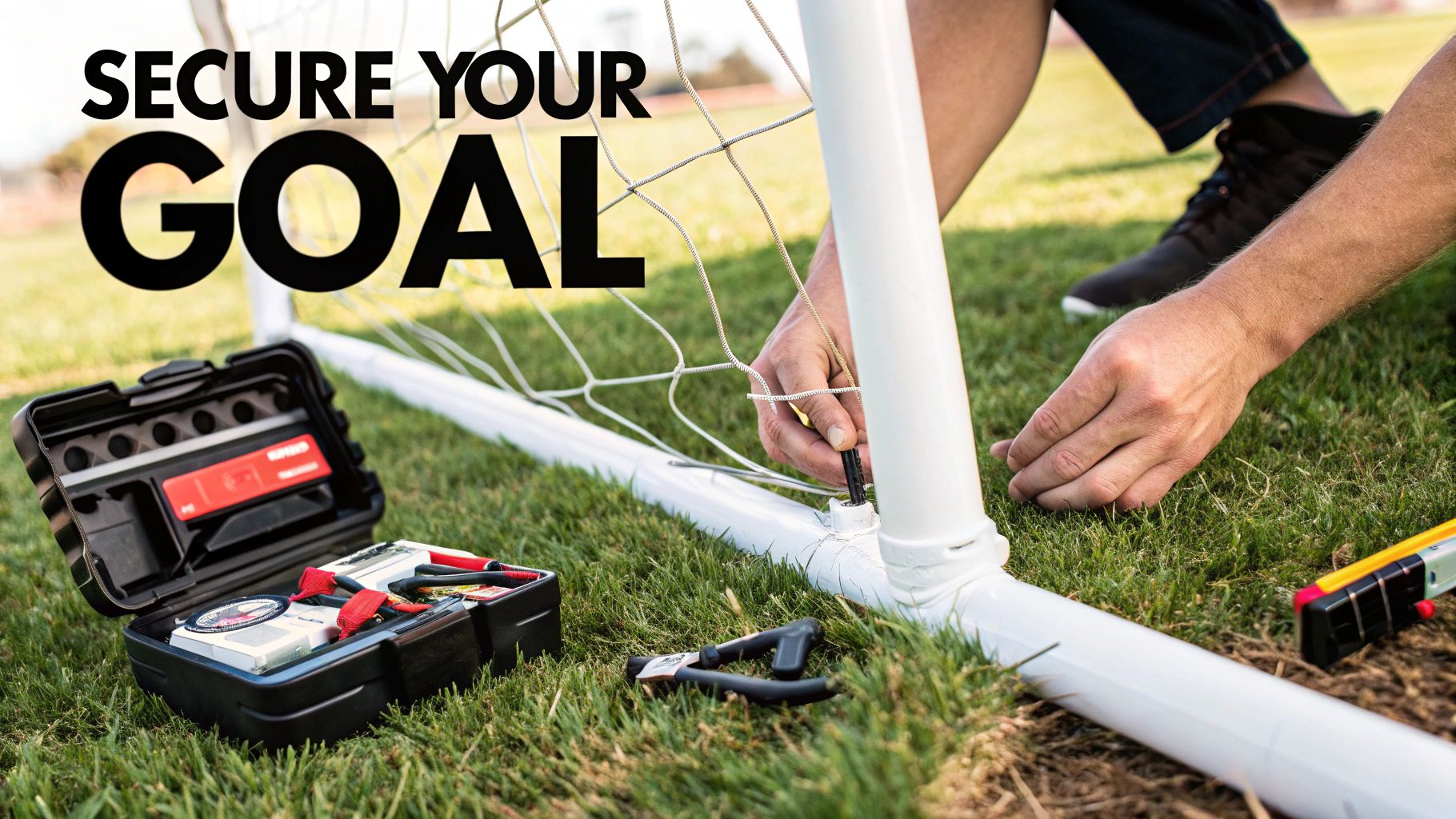
The number one rule is simple: always anchor your goal securely. The method depends on your playing surface.
- For Grass Pitches: The classic choice is U-pegs or ground anchors. These must be driven deep into the soil to lock the frame down. A properly pegged goal will not move, even when facing powerful shots or accidental contact.
- For 3G/Artificial Surfaces: Pegs cannot be used on artificial turf or hard indoor courts as they will damage the surface. For these, counterweights or sandbags are the correct solution. Place these heavy weights over the back bar of the goal to provide the stability needed to prevent it from tipping forward.
It is also worth considering the wider environment. A secure goal on a safe playing area is the ideal combination, so it is beneficial to learn about achieving ultimate safety in playground surfaces.
Your Regular Safety Checklist
Like any equipment, your goal needs regular checks to stay in top condition. A quick inspection before each game or training session can identify a small issue before it becomes a serious problem.
Here’s a simple checklist to follow:
- Check Frame Integrity: Examine the frame for any cracks, bends, or signs of rust (especially on steel goals). Ensure all sections are connected securely.
- Inspect Fittings: Check that all bolts, screws, and locking parts are tight. A loose joint can weaken the entire structure.
- Examine the Net: Look for any rips, tears, or fraying. Also, ensure it is attached correctly to the frame without large gaps.
- Confirm Anchors: Before play begins, double-check that the anchors or weights are still firmly in place and have not shifted.
A goal should be a source of fun, not a hazard. A simple five-minute check provides peace of mind and ensures a safe playing environment for everyone.
Extending the Life of Your Goal
To get years of service from your goal, proper maintenance is key. The cleaning method depends on the material—a quick wipe-down with a damp cloth is usually sufficient for uPVC and aluminium frames. For steel goals, it is vital to touch up any scratches in the paintwork immediately to prevent rust.
If you have a portable goal, correct storage in the off-season makes a significant difference. If possible, disassemble it and store it somewhere dry, like a shed or garage, during the winter. This protects it from the worst of the weather, ensuring it's in excellent condition for the first kickabout in spring. This level of care is just as crucial for larger goals; you can find more tips in our guide to maintaining full-size football goals.
Essential Accessories to Enhance Your Goal Setup
A great 12 x 6 football goal is a brilliant start, but the right accessories can transform a simple frame into a comprehensive training and safety hub. The goal is the foundation, but the add-ons bring it to life.
Investing in a few key extras not only makes playing more enjoyable but also helps you get more out of your goal for years to come. From sharpening a young striker's aim to simplifying transport, these items all serve a valuable purpose.
Training and Performance Boosters
To turn a casual kickabout into a focused drill, a target sheet is an invaluable tool. These sheets clip onto the goal frame and feature holes in the corners, forcing players to aim for the most difficult spots for a keeper to reach. This helps build muscle memory, turning hopeful shots into clinical, well-placed strikes.
Over time, nets inevitably wear out. A frayed or torn net can spoil the satisfaction of scoring. At SoccerWares, our high-quality replacement goal nets are essential for keeping your setup looking and feeling professional. We offer different twine grades; a thicker twine provides greater durability against powerful shots and the British weather.
The best accessories don't just add convenience; they actively improve player skills. A target sheet, for example, provides immediate visual feedback that helps strikers develop pinpoint accuracy.
Safety and Practicality Essentials
We’ve already emphasised that anchoring is non-negotiable for safety. For added convenience with our portable uPVC and aluminium models, a durable carry bag is a game-changer. It makes packing, storing, and transporting your goal straightforward, protecting it from scuffs and keeping all components in one place.
Finally, you can bring a professional feel to your pitch or garden. To boost team spirit and enhance your setup, many teams use custom vinyl banners for sports organizations to display their club crest or sponsors. It’s a simple touch that makes a huge difference.
Got Questions About 12 x 6 Goals? We’ve Got Answers.
Choosing the right goal is an important decision, and it’s natural to have a few questions. We often receive queries from parents and coaches, so we’ve compiled the most common ones to help you feel confident in your choice.
Consider this the final check before making the perfect purchase.
Is a 12 x 6 Goal Too Big for My Garden?
For most medium to large gardens, a 12 x 6 goal is an ideal size. It’s large enough for a proper kickabout and serious shooting practice without dominating your entire lawn. It strikes the perfect balance between a match-day feel and home practicality.
For garden use, we nearly always recommend a good quality uPVC model. They are light, weather-resistant, easy to assemble, and can be moved by one person for mowing the lawn.
What’s the Official FA Size for 7-a-side?
This is a key point for clubs. The official FA-recommended goal size for 7-a-side football—also known as Mini-Soccer—is 12 feet wide by 6 feet high. This is the standard for the Under-9 and Under-10 age groups.
Adhering to the official size is not just about league compliance. It’s about providing young players with an appropriate challenge for their age, helping them develop their shooting accuracy and goalkeeping skills with a goal that is built for them.
"Player safety is paramount. The single most critical step is to securely anchor the goal to the ground at all times to prevent it from tipping over. This simple action is non-negotiable for safe play."
How Do I Make Sure My Goal Is Safe?
Safety is the number one priority, and it starts with one simple rule: always anchor your goal. An unanchored goal is a tipping hazard, and the risk is not worth taking.
Here’s a quick safety checklist:
- Use the Right Anchors: U-pegs are essential for grass. For 3G pitches, AstroTurf, or indoor courts, you will need proper counterweights or sandbags to keep it firmly in place.
- Perform a Quick Check: Before every session, inspect the frame for any cracks or damage. Ensure all joints are tight and the net is properly clipped in.
- Enforce the 'No Climbing' Rule: This is crucial. Never allow anyone to climb, swing, or hang from the crossbar. This is the single biggest cause of serious accidents involving football goals.
At SoccerWares, we are passionate about football. We are dedicated to supplying top-quality goals and training equipment that helps players of all ages enjoy the beautiful game safely. Browse our full collection to find the perfect setup for your team, club, or back garden.
Find your ideal football goal at https://soccerwares.com.