

The most common advice about football goals 6 x 4 is also the most misleading: buy one as a small match goal and expect it to behave like a regulation youth version. It won't. A 6 x 4 goal is primarily a compact training tool, designed for technical work, confined gardens and younger players who need a manageable target.
That distinction matters before you compare frames, nets or prices. The wrong goal can leave a child practising on an opening that doesn't match their competition format, while an unsuitable lightweight frame can become unstable on wet grass or hard ground. Used for the right job, however, a 6 x 4 goal is versatile, portable and excellent for repetition.
What Football Goals 6 x 4 Actually Are
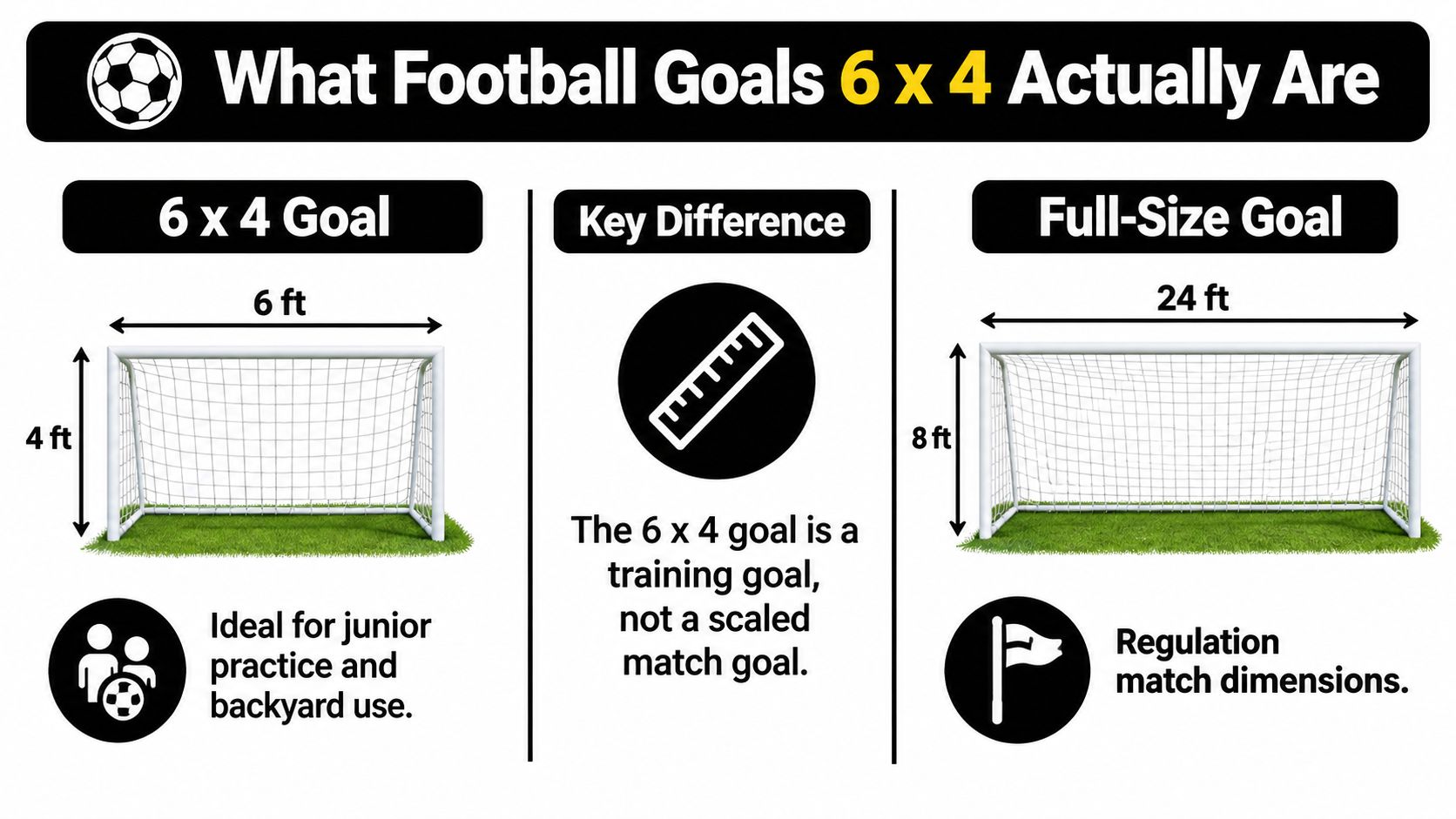
A 6 ft by 4 ft goal is a small target goal, roughly 1.8 m by 1.2 m, as shown in this UK 6 x 4 goal sizing reference. The mistake is treating it like a cut-down match goal. In practice, it works best as specialist training equipment for tight spaces, repeated finishing and technical work where accuracy matters more than match realism.
That is why this size suits a garden, a side strip of grass or a short training lane better than a formal team setup. Yes, players can shoot into it and keepers can work in front of it. What changes is the type of practice you get. The smaller opening asks for cleaner strikes, better body shape and more deliberate passing into the finish.
Where it fits in the development pathway
The FA uses much larger goals for organised youth and adult formats. Its goalpost guidance lists 12 x 6 ft goals for 7-a-side, 16 x 7 ft for 9-a-side, 21 x 7 ft for under-14 11-a-side, and 24 x 8 ft from under-15 through adult football. A 6 x 4 goal sits outside that pathway, so it should not be sold as a straight substitute for competition play.
Used properly, though, it fills a gap that bigger goals do not. It is handy for finishing stations, one-to-one goalkeeper sessions, passing drills through a narrow gate and home practice where space is limited. For younger children, it can also be a more manageable target to move, set up and shoot at without turning every session into a battle with the equipment.
Practical rule: Treat a 6 x 4 goal as specialist practice equipment first, and a small recreational goal second.
One more detail often gets missed by UK buyers. Because these goals are small, people assume setup and safety matter less. They do not. A lightweight frame on wet grass, hard ground or a sloping patch still needs proper anchoring and regular checks, especially if children are dragging it around between drills.
The phrase also has a football trivia angle. 6–4 is a rare top-flight scoreline, with Tottenham Hotspur beating Reading 6–4 on 29 December 2007 as the only such Premier League result recorded by Premier League Scorigami's 6–4 record. Fun detail, but it does not change the job of the goal itself.
Dimensions, Specifications and What the Size Means
A 6 x 4 goal sounds straightforward until you start comparing product pages. In UK listings, it usually means about 1.83 m wide by 1.22 m high, but that can refer to the outer frame, the inner opening or, in some cases, the space the net covers once fitted. If you want the goal for technical work rather than casual kicking about, that difference matters more than the label.
Size changes the session. A small goal does not just shrink the target. It changes the decisions around it.
Set a 6 x 4 beside recognised small-sided dimensions and the role becomes clearer. The FA lists mini-soccer goals at 3.66 m x 1.83 m, or 12 x 6 ft, and also identifies smaller junior goals around 2.44 m x 1.22 m, or 8 x 4 ft in its FA goalpost guidance. That puts a 6 x 4 outside the usual mini-match picture. It is better understood as a tighter technical target than a scaled-down game goal.
That tighter opening sharpens habits quickly. Shooters get less margin for a dragged finish, so body shape, touch out of the feet and the angle of approach all show up faster. The final pass also has to be cleaner. There is less room to rescue a poor setup touch with power alone.
Goalkeepers read it differently too. They cover less width, but positioning errors stand out sooner because one half-step can expose or shut down a big share of the target. For close-range work, that makes the size useful for set shape, reactions and recovery rather than full match-replica handling.
For practical coaching use, a 6 x 4 works well for:
- Passing combinations: a defined end point that rewards clean weight and direction
- Finishing: across-goal shots, near-post disguises and low placement
- First touch: receiving under pressure and creating a clear shooting lane
- Goalkeeper movement: compact set position and second-save reactions
Small-sided rules still matter if you are buying with games in mind. As explained in this 5-a-side football goal size guide, a 6 x 4 sits at the minimum height boundary used in those formats but below the width commonly seen in play. Check the actual opening before you buy, not just the headline size.
Materials, Build Quality and Portability
A small goal doesn't need to be overbuilt, but it does need to survive repeated assembly, wet storage and mishits. The frame material affects more than weight. It determines how the goal feels when a shot catches the side net, how easily joints loosen and whether one person can move it without twisting the structure.
Steel usually offers the most reassuring rigidity for a club or school that leaves the goal in regular use. It can be heavier to carry, and exposed damage to the finish may lead to corrosion if the frame stays wet. Aluminium reduces the lifting burden and suits families who put the goal away after each session, but a lightweight frame can dent or flex if users treat it as a barrier.
Plastic-coated frames offer useful protection against ordinary contact and weather, although the coating won't repair a bent joint or compensate for poor anchoring. The finish should be consistent around corners, connection points and base rails, where rubbing tends to start.
What to inspect before buying
Look beyond a product photograph. A dependable 6 x 4 goal should have:
- Positive frame connections: Tubes should seat fully, with pins, bolts or locking mechanisms that don't rely on friction alone.
- A properly fitted net: Net clips need to stay attached when the ball hits the side or top panel.
- A stable base: A narrow, light base is convenient, but it gives you less margin for movement on uneven ground.
- Useful portability: Folding sections or a sensible carry method help only if the joints remain secure after repeated use.
A folding football goal guide is useful when storage space is the main constraint. Folding is not automatically better for a club. More moving joints create more places for wear, so frequent users should value sturdy connection hardware over the smallest folded package.
For a garden, portability usually wins because the goal needs to move away from mowing areas, wet patches and children who are not playing. For a school or grassroots club, rigidity, replaceable netting and documented safety information deserve more attention than saving a little lifting effort.
Installation, Anchoring and Safe Setup
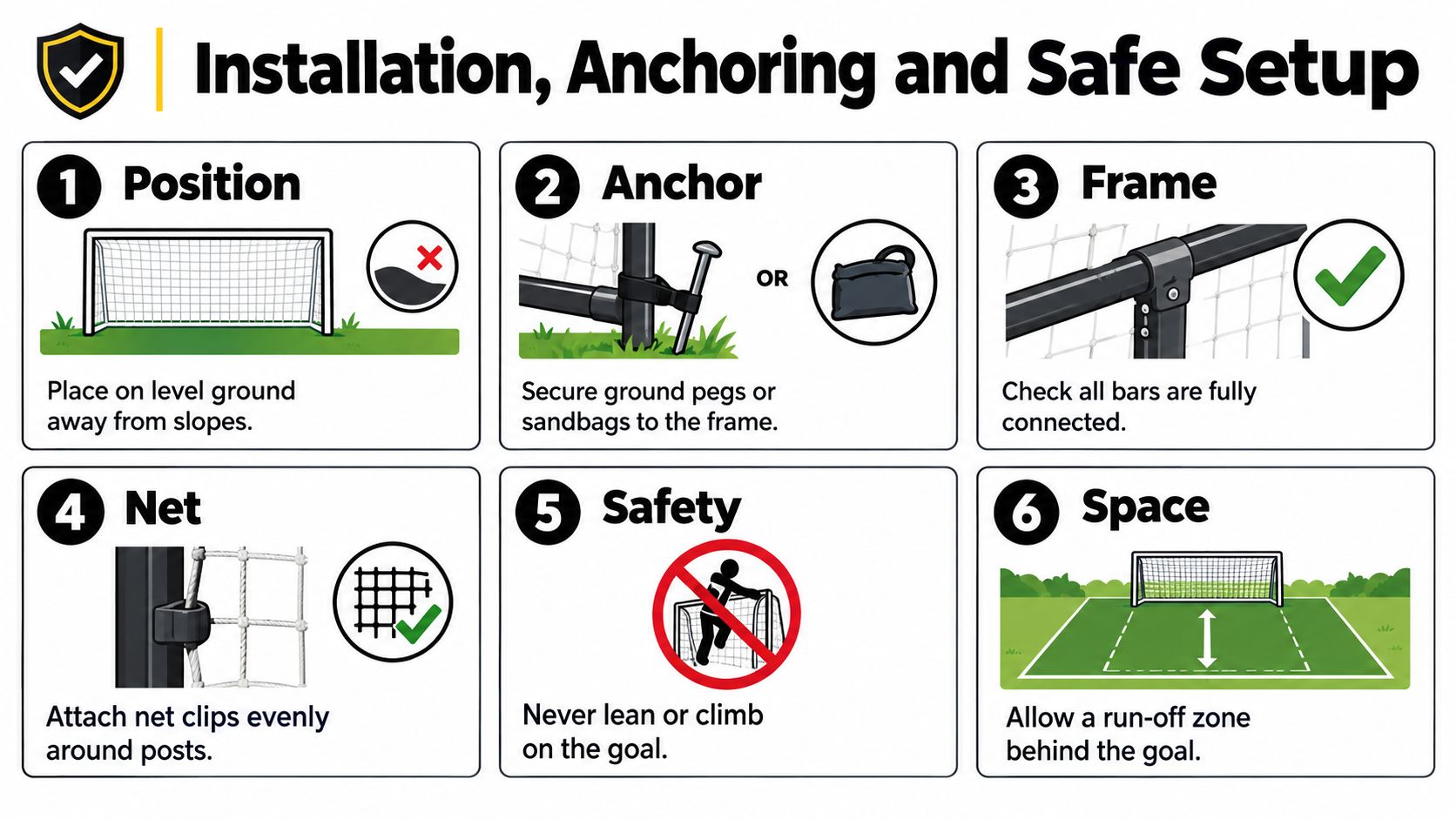
A 6 x 4 goal is compact, but compact doesn't mean incapable of moving. The FA states that freestanding goals of all sizes should be fitted with anchors or weights, and recommends securing them with ground or fence anchors, as described in its goalpost safety guidance.
Start with the surface. On level grass, place the frame square to the playing area, push suitable ground anchors into stable soil and attach them exactly where the manufacturer specifies. On artificial turf, use an anchoring method designed for that surface rather than assuming ordinary pegs will hold. On concrete or paving, use an appropriate weighted base and keep the frame away from edges, slopes and obstacles.
A pre-use setup routine
Before every session, run through the same short sequence:
- Check the position. Make sure the ground is level and the playing area has a clear run-off zone behind the goal.
- Check the frame. Confirm that every bar is fully connected and that no tube is bent, cracked or loose.
- Check the fixings. Look for missing bolts, damaged clips and movement around the base.
- Check the net. Attach it evenly and remove anything that could catch a foot or hand.
- Check the anchoring. Make sure pegs, straps, sandbags or other weights are fitted and secure.
- Set the rules. Nobody should lean, climb or hang from the frame or net.
Don't drag the goal across grass, artificial turf or concrete. Lifting it with help, or following the manufacturer's moving instructions, protects the joints and reduces the chance of a sudden tip or frame distortion. The football nets for kids guidance can also help parents think through net attachment and safe use around younger children.
For a visual demonstration of portable goal setup, use this short installation video:
Maintenance, Inspection and Long-Term Care
Most portable goals don't fail because the idea is wrong. They fail because a loose joint stays loose, a wet net gets packed away and a bent part remains in use. A simple routine catches those problems while replacement parts are still manageable.
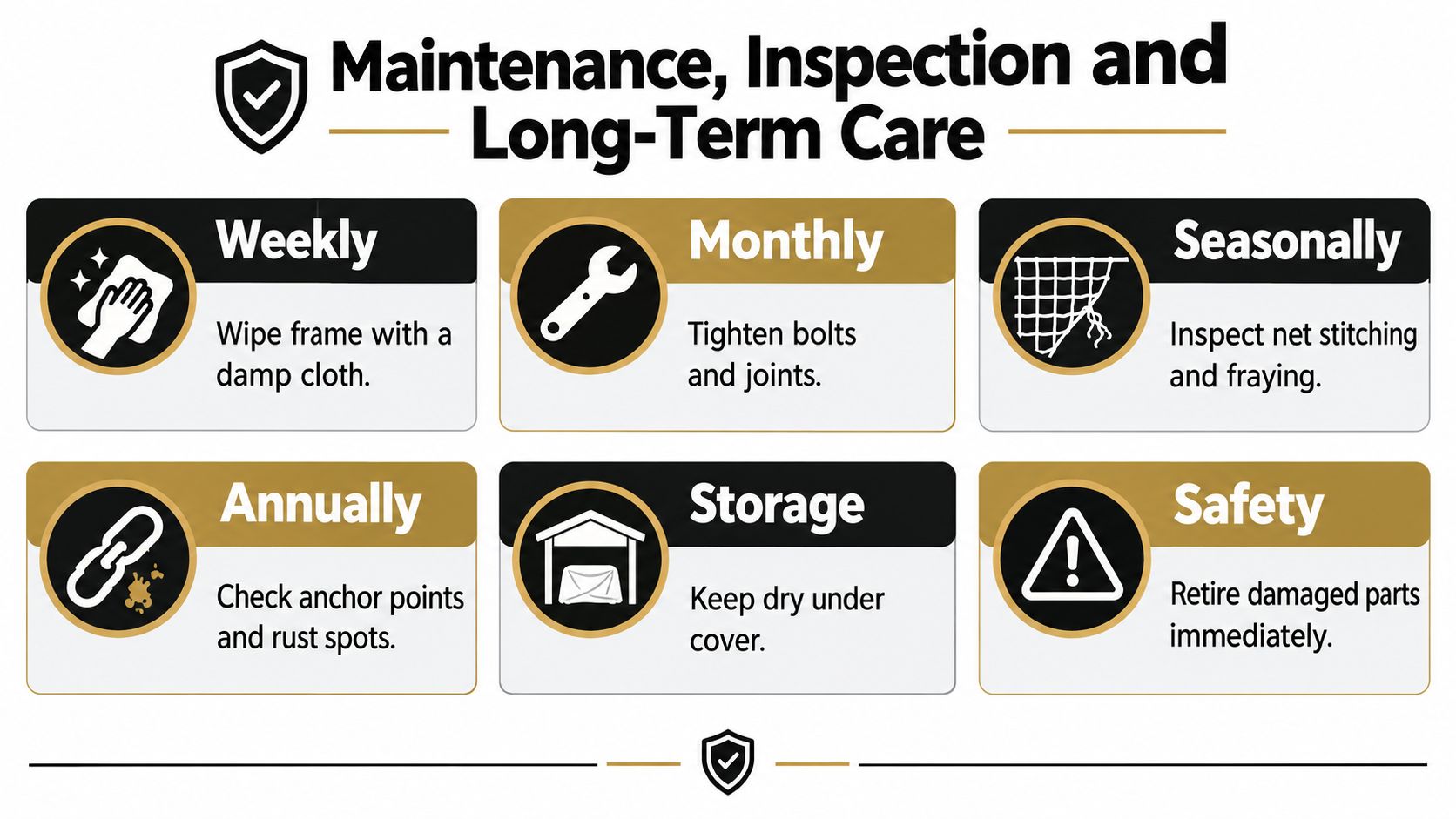
Warwickshire County Council's guidance, aligned with BS EN 16579:2018 and BS EN 748:2018, recommends checking goals before each use, recording inspections at six-month intervals or sooner where necessary, and carrying out annual testing where appropriate. It also says damaged goals should be removed from service, as set out in the portable goal inspection guidance.
A workable ownership schedule
- Before every use: Check frame damage, anchoring, fixings, net condition and corrosion.
- After wet sessions: Wipe mud and moisture from the frame, especially around joints and base rails.
- At regular intervals: Tighten accessible bolts and inspect clips before they become loose enough to disappear.
- At recorded inspections: Look for bent tubes, stretched netting, rust spots and movement in the base.
- Before storage: Dry the goal fully and keep it under cover rather than leaving it exposed to standing water.
Net damage often starts as one loose connection. Repair or replace it before players' feet can catch the opening. Rust around a fixing deserves attention too, because corrosion can weaken the part that carries the load when the frame is moved.
Facility staff managing several goals may also benefit from these checklist guides for facility managers, particularly when inspections need a consistent written record. The same principle works at home. Keep a basic checklist with the goal, record defects and take the equipment out of use when a safety-critical part is damaged.
How to Choose the Right 6 x 4 Football Goal
A 6 x 4 goal is rarely a case of buying the biggest frame you can fit. The right choice depends on who will use it, how often it will be moved, and whether you want quick technical reps or something that sits out for regular sessions.
Match the construction to the user
For home use, I would favour a goal that is easy to lift, simple to reassemble and fitted with net clips or attachments you can replace without fuss. In a small garden, that matters more than a heavier match-style look. These goals get dragged onto grass, propped against fences and put away after use, so awkward assembly soon becomes the reason they stay in the shed.
For schools and grassroots clubs, the priorities change. Repeated use exposes weak joints, loose fixings and poor nets very quickly. Look for a frame built for frequent handling, with replacement parts that are available, and ask the supplier what standard the goal has been tested to, what anchoring method it needs and how inspections should be carried out. For UK buyers, that usually means checking whether the product information references the relevant PAS or BS EN standard for this size and type of goal, rather than accepting vague claims about being suitable for training.
The key question is simple. Will this goal still be practical after a wet month of use, not just on delivery day?
Use this buying filter
- Space: Measure the area properly and leave enough run-off room around and behind the goal.
- Surface: Check that the supplied anchors suit the ground you have, whether that is grass, artificial turf or a harder surface.
- Frequency: If the goal will be used several times a week, spend more on stronger joints, better fixings and replaceable parts.
- Storage: Folding or portable designs help, but only if the locking points feel secure and stay aligned after repeated use.
- Training aim: A 6 x 4 goal is best bought as a precision training tool. It suits finishing, target work and small-area play better than broad match simulation.
- Competition needs: If you need a goal for organised fixtures, check the competition rules separately instead of assuming a training goal will qualify.
The best option is the one that gets used safely and consistently. A heavier frame is not automatically the better buy if it is awkward to move, hard to anchor on your surface or too cumbersome for regular sessions.
Real-World Use Cases and Training Applications
The best use of a 6 x 4 goal is often simple. Put it close enough that players get many touches, define a clear target and make every repetition ask a question. Can the striker finish first time? Can the midfielder receive on the half-turn? Can the goalkeeper reset after the first save?

Technical finishing in a small area
Set the goal at the end of a short passing lane. One player receives with a defender applying passive pressure, takes a touch away from danger and finishes into a nominated corner. The restricted width discourages hopeful shots across the frame. Players must angle the body, disguise the finish and use the goalkeeper's position.
For younger players, keep the exercise uncomplicated. Feed the ball from both sides, encourage the head to come up before contact and praise a controlled finish rather than a hard one. The goal gives them a visible target without requiring a full pitch or a large group.
Goalkeeper reactions
A 6 x 4 goal works well for close-range reaction work because the goalkeeper cannot rely on reaching across a wide opening. Use deflections, short passes and rebounds, but control the distance and pace so the exercise remains about technique rather than fear.
A good sequence might involve a low shot, a recovery movement and a second attempt from a different angle. Keep the net and frame secure before starting, especially when the goalkeeper will land near the posts. Players who spend long sessions on hard surfaces may also want practical footwear support to relieve foot pain on the pitch, particularly when training volume increases.
Small-sided games and family sessions
At home, the goal can serve as a finishing target, a passing gate or one end of a short game. It doesn't need to become a full match every time. Three-touch challenges, weak-foot rounds and score-and-rotate games give children a clear purpose while keeping the space manageable.
For a club, combine it with a rebounder or a second target. A soccer rebounder goal can return the ball for first-touch work, while the 6 x 4 goal provides the final target. That pairing creates more activity without asking one child to stand in goal for every repetition.
Where it doesn't fit
Don't use the size as the reference point for U10 or U11 competition matches in England. England Football specifies 7-a-side football for those age groups and recommends 12 x 6 ft goals, with the goal therefore twice as wide and 50% taller than a 6 x 4 goal, according to England Football's U10 and U11 guidance. The same guidance says children must wear shin pads fully covered by knee-length socks.
A 6 x 4 goal earns its place by making practice convenient and focused. Anchor it, inspect it and give players a clear task, and it becomes a reliable training partner rather than a misleading miniature match setup.
SoccerWares brings together football goals, rebounders, indoor training mats, shin guards and other practical equipment for players and families. Visit SoccerWares to find training essentials that suit your space, your routine and your love of the game.