

A football rebounder is more than just a piece of garden equipment; it's a tireless training partner designed to sharpen your skills without ever getting bored. It transforms static, solo drills into dynamic, match-like situations, helping you build quicker reflexes, a sharper first touch, and pinpoint passing accuracy through consistent, quality repetition.
Why a Rebounder Is Your Secret Training Partner
For any player serious about improving, finding a way to train effectively on your own is a huge advantage. A football rebounder acts as that perfect partner, always ready and consistently pinging the ball back at different angles and speeds. This immediate feedback loop is crucial for building the muscle memory that separates good players from great ones.
Kicking a ball against a brick wall is one thing, but a rebounder brings an element of unpredictability to your practice. The net absorbs and fires back the energy of your pass, forcing you to adjust your body shape and control the ball just as you would when receiving it from a teammate. That process is fundamental to mastering your technique.
Building Skills Worthy of the Biggest Stages
The roar of a massive crowd is the dream, isn't it? That raw passion has been the heartbeat of UK football for generations. Back in the historic 1948 Merseyside derby at Goodison Park, an astonishing 78,299 fans crammed in to watch Everton host Liverpool—a record that shows the incredible devotion of supporters. That same drive fuels today's players, and a rebounder helps you hone skills worthy of that kind of stage.
This simple tool allows you to replicate game-speed scenarios that are almost impossible to practise alone. Here’s how that translates directly to your on-pitch performance:
- First Touch Perfection: The net fires the ball back with pace, forcing you to develop that soft, controlled first touch to bring it under your spell instantly.
- Passing Accuracy: You can drill short, crisp passes or long, driven balls, with the net giving you instant feedback on the quality and weight of your pass.
- Improved Reaction Times: The quick return of the ball sharpens your reflexes, training you to think and react faster when you're under pressure in a real match.
A rebounder doesn't just return the ball; it returns opportunities. Each bounce is a new chance to refine your touch, adjust your stance, and build the instinctive reactions that define a confident player.
From Garden Drills to Game-Day Dominance
The beauty of a football rebounder lies in its versatility. You can zero in on specific weaknesses in your game, session after session, and turn them into strengths. Consistent practice builds not just skill, but genuine confidence.
When you’ve controlled a thousand fast-paced returns from the net, receiving a pass in a competitive match feels natural and composed. That’s where the real value lies.
This piece of kit is one of many modern tools changing how players prepare, much like other grassroots football gadgets that give aspiring athletes an edge. The drills you do with a rebounder are the foundation for the creative, split-second decisions that win matches. It’s all about making excellence a habit.
How to Choose the Right Football Net Bounce Back
Picking the right football net bounce back can genuinely level up your training. Get it right, and you’ve got a reliable partner that’ll see you through thousands of reps, sharpening your touch and reactions. Get it wrong, and you’re left with a flimsy, frustrating bit of kit gathering dust.
The goal is to find that sweet spot between size, durability, and the right features for your specific needs. A net that’s too small won’t challenge you, while one that can’t handle a full-power strike is just as useless. It’s all about matching the rebounder to your space, your skill level, and what you’re trying to achieve.
This quick flowchart breaks down when a rebounder really comes into its own, especially when you're training solo.
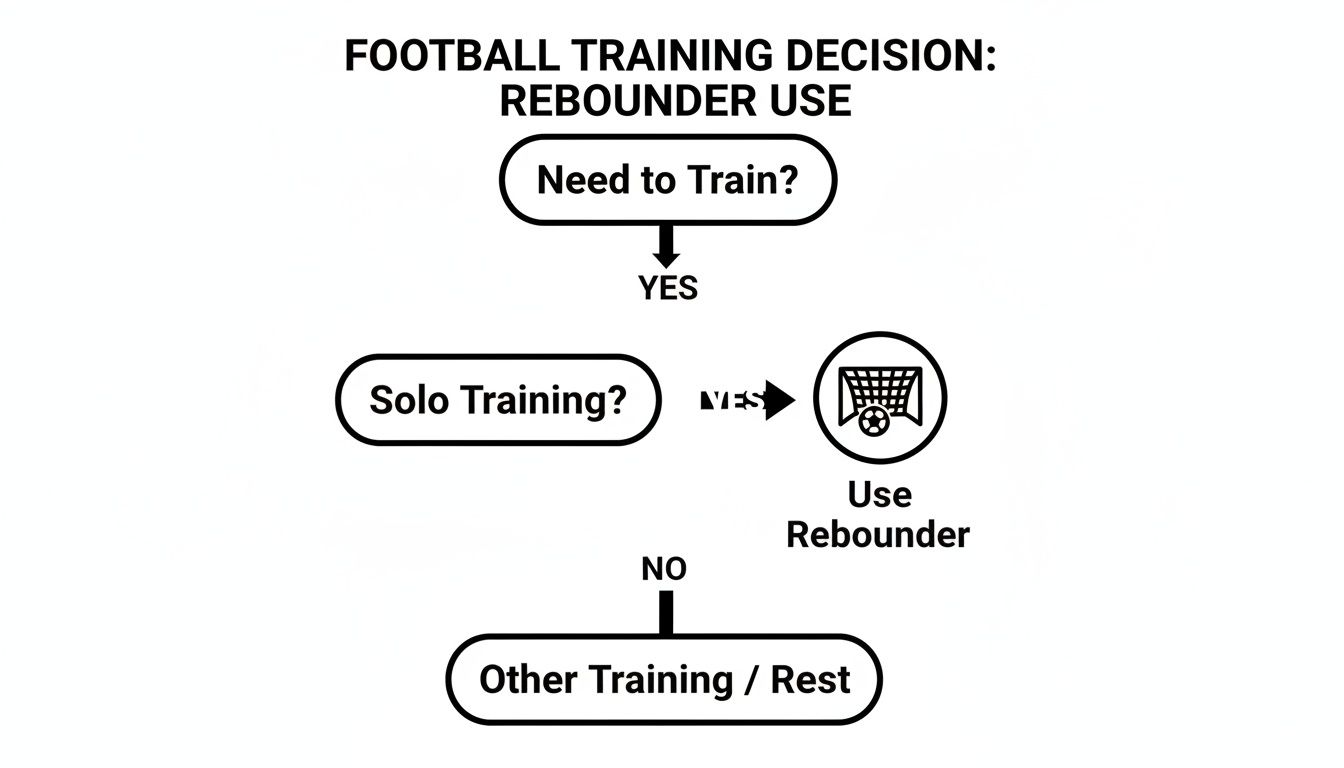
As you can see, it often boils down to needing a consistent, reliable way to practise alone. That’s what makes a good rebounder such a vital piece of equipment for any dedicated player.
Match the Rebounder to Your Training Ground
First things first: where are you going to be using it? Your answer completely changes the type of net you should be looking at. A player with a small back garden has different requirements than a coach setting one up on a full-sized pitch.
- For Small Gardens: If you're tight on space, a compact, portable rebounder is your best friend. Look for something that’s quick to set up and pack away. Here, the focus is all about precision passing and first-touch control in tight areas.
- For Larger Spaces: Got more room to play with? Go for a larger, more robust football net bounce back. These offer a bigger target area, which is perfect for working on driven passes, volleys, and testing your long-range shooting accuracy.
Don’t forget to check the materials. A solid steel frame will withstand powerful, repetitive strikes day in, day out, while a lighter fibreglass frame is much easier to carry. Crucially, make sure the netting is high-tension and weather-resistant. That’s what gives you a consistent, predictable bounce and ensures it lasts more than one season.
Football Rebounder Feature Comparison
To make things clearer, here’s a simple table comparing the main types of rebounders we offer at SoccerWares. It should help you zero in on the best fit for your training.
| Rebounder Type | Best For | Key Features | SoccerWares Example |
|---|---|---|---|
| Compact & Portable | Small gardens, solo drills, warm-ups | Lightweight, easy to assemble, adjustable angles | The Quickster Solo Net |
| Large Frame | Team training, shooting practice, volleys | Heavy-duty steel frame, large surface area, high-tension net | Pro-Level Training Rebounder |
| Double-Sided | Multi-player drills, varied passing practice | Two rebound surfaces (e.g., flat & angled), versatile training options | The Duo Practice Station |
| Handheld | Goalkeeper training, reaction drills | Portable, held by a coach, unpredictable returns | GK Reflex Trainer |
This table is a great starting point, but the real magic comes from a couple of specific features that can completely transform your sessions.
Key Features That Make a Difference
Beyond the basic size and build, a few features separate the good rebounders from the great ones. At the top of that list is adjustability.
A rebounder with an adjustable angle is incredibly versatile. Set it low to the ground, and it’ll fire back a pass that simulates a driven ball from a teammate, forcing you to sharpen your control. Tilt it upwards, and it will loop the ball back into the air, creating the perfect setup for practising volleys, headers, and chest control. This kind of variability keeps your training fresh and prepares you for the unpredictable nature of a real match. If you want to see what's out there, you can explore various rebounder options to get a feel for the different styles available.
Think about your main training objective. Are you a striker wanting to perfect your volleys, or a midfielder needing to sharpen your one-touch passing? Your primary goal should guide your choice, ensuring the rebounder you pick directly addresses the skills you want to improve.
Portability is another massive plus, especially for younger players or anyone who trains at different locations. A lightweight model that folds away neatly is a huge advantage. If you're often on the move, you can learn more about finding the right fit in our guide to choosing a portable football rebounder net. It means you can take your secret training partner with you, wherever you go.
Setting Up Your Rebounder For Peak Performance
Getting a new rebounder is exciting, but a dodgy setup can turn a great training session into a frustrating mess. If it’s not stable, the returns are unpredictable, and you spend more time chasing the frame than working on your touch.
Taking a few extra minutes to get it right from the start makes all the difference. A solid, correctly assembled rebounder is not only safer but also gives you that crisp, consistent bounce you need to actually improve.
First, find the right spot. Always look for a flat, even surface. It sounds obvious, but you’d be surprised how many people try to set one up on a slight slope, only to find the ball comes back at a weird angle or the whole unit starts to slide.
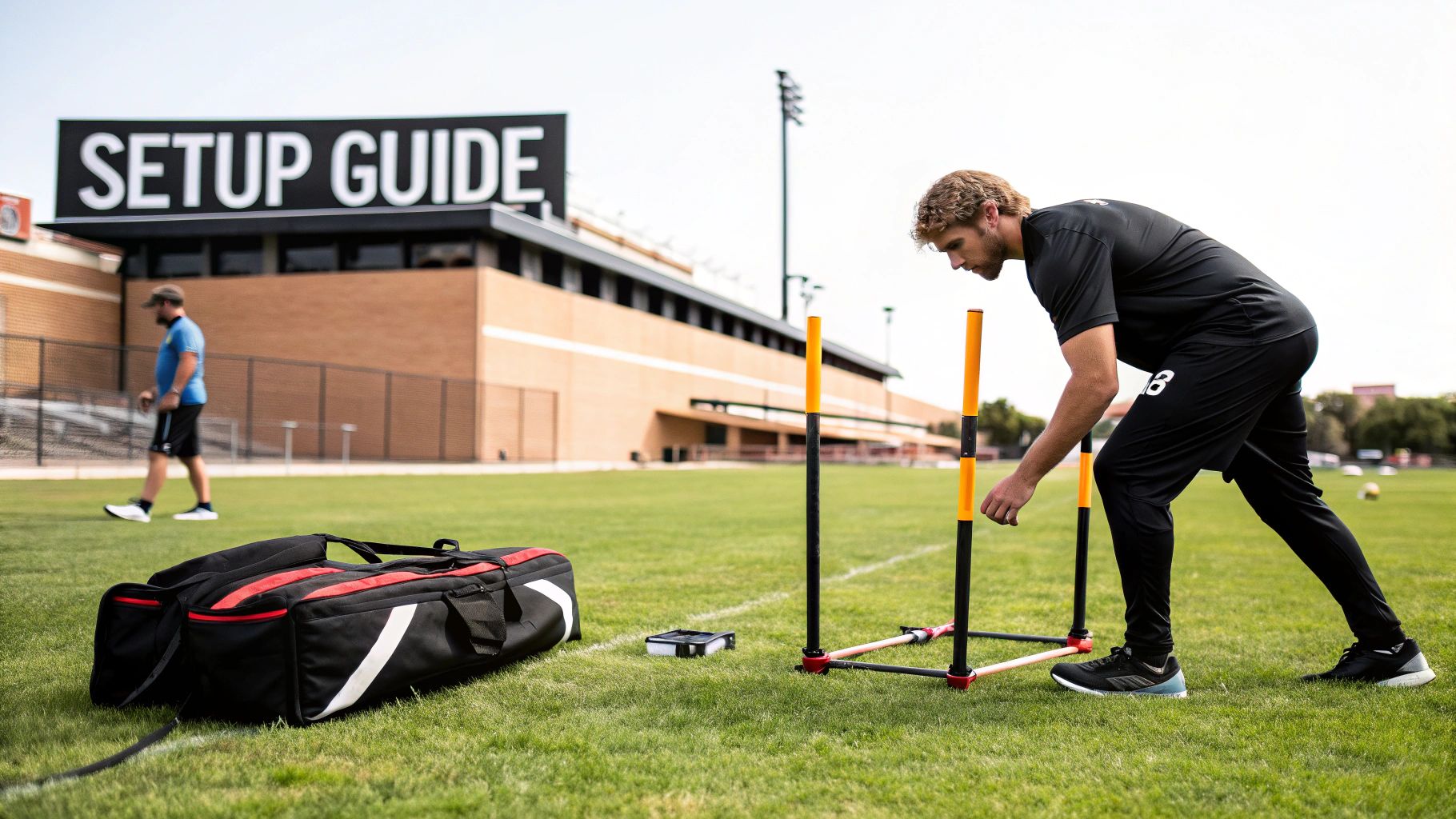
Anchoring For Different Surfaces
How you lock your rebounder down depends on where you’re training. The goal is simple: make it completely immovable, even when you're pinging passes at it with real power.
- On Grass or Soil: Your best friends here are the ground stakes that came in the box. Here’s a pro tip: don’t just push them straight down. Angle them in at 45 degrees. This creates much more resistance and stops them from pulling loose when the frame gets rattled.
- On AstroTurf or Concrete: Stakes are a no-go on hard surfaces. Your go-to solution is weight. Sandbags are perfect – just drape one over each side of the base frame for rock-solid stability. No sandbags? Kettlebells or any other heavy, flat weights will do the job just as well.
A wobbly rebounder is more than just an annoyance—it's a hazard. Taking an extra two minutes to anchor it properly ensures the frame won't move, allowing you to focus completely on your technique rather than chasing a shifting target.
Getting The Net Tension Just Right
With the frame solid, the last piece of the puzzle is the net itself. The tension is everything; it’s what gives you that quality bounce-back. Too loose, and the net will just swallow the ball’s energy, sending it back weakly. Too tight, and it’ll feel like kicking against a brick wall.
Start by attaching the bungees or straps at the four corners. Then, work your way around the frame, pulling each one with roughly the same force. You’re aiming for a taut, firm surface that has very little give when you press on it. This even tension is what produces that sharp, realistic rebound you’re after.
Once you’re all set up, you’ll be ready to get some reps in. If you need a bit of inspiration, we’ve put together a list of great exercises in our guide to football training drills at home that are perfect for using with your new rebounder.
Essential Rebounder Drills to Master Your Skills
Right, your rebounder is set up and anchored. Now for the good bit—turning all that potential into proper, on-pitch skill. This is where solo practice stops feeling like a chore and starts becoming a high-tempo session that actually makes a difference in a real match.The secret is repetition with a purpose. It's about building that muscle memory until the right touch or pass becomes second nature. A good football net bounce back is your perfect training partner for this, giving you the consistent returns you need to drill these fundamentals into your game.
Let's break down some of the most important drills you can do, skill by skill.
Mastering Your First Touch
Your first touch is everything in football. A great one buys you time and space; a poor one invites pressure and kills an attack stone dead. This drill is all about sharpening your control, especially when you have to think fast.
The Drill:
- Position yourself about 3-5 metres away from the net.
- Play a firm pass into the rebounder with your stronger foot.
- As it comes back, your first touch should both kill the ball's speed and move it into space to one side.
- Your second touch is a pass back into the net, this time with your weaker foot. Repeat the whole sequence.
Pro Tip: Pay attention to your body shape. Be on your toes, ready to move. As the ball travels towards you, open up your body so that your first touch naturally takes you away from where an imaginary defender would be. You're not just stopping the ball—you're guiding it into your next move.
Sharpening Your One-Touch Passing
Quick, crisp passing is the heartbeat of any decent team. This drill is designed to make you think and act faster, improving the timing and accuracy of your distribution under pressure.
It’s the perfect way to replicate those frantic moments in a packed midfield where you simply don't have time to take a second touch. You can learn more about making your garden the ultimate training ground with a football rebound wall and really take these drills to the next level.
The Drill:
- Stationary Passing: Start 5-7 metres back. Ping the ball into the net and, without a controlling touch, pass it straight back with the inside of your foot. Make sure you alternate between your left and right feet on each return.
- Passing on the Move: Jog parallel to the rebounder. As you move, pass the ball into the net slightly ahead of you. Control the return with one touch while still jogging, keeping the ball moving with you.
Pro Tip: Lock your ankle when you strike the ball. A firm, locked ankle is the key to a clean, powerful pass. Focus on hitting the centre of the ball for ground passes and just below the middle if you want to practise receiving a slightly lofted return.
Perfecting Volleys and Heading
Adding aerial ability to your game makes you a much bigger threat. This drill helps you nail the timing and technique needed to connect cleanly with balls coming out of the air.
First, adjust your rebounder to a high angle so the ball loops back up and towards you. Stand about 8-10 metres away to give yourself enough room to judge the flight and get into position.
The Volley Drill:
- Chip the ball into the bottom of the net so it launches upwards.
- Move your feet quickly to get your body into the best position.
- Keep your eye on the ball the whole time, get your knee over it, and strike through with your laces for power or the side of your foot for accuracy.
The Heading Drill:
- Simply toss the ball into the net to get it airborne.
- Judge the flight path and attack the ball at its highest point—don't wait for it to drop.
- Use your forehead, keep your neck muscles tight, and direct the header back towards the net or another target.
These are the skills honed on quiet training grounds but showcased in stadiums packed to the rafters. Think about it: Manchester United's Old Trafford saw its record attendance of 76,962 way back in 1939. For any player, that stat is an inspiration—a crowd that size amplifies every touch, every goal. After the Premier League's formation in 1992, average attendance shot up by 67.8% in just a decade, reflecting the rising standards that modern training gear helps players meet.
By consistently working on these core drills with your football net bounce back, you’re building the technical foundation you need to perform when it matters. It’s that dedication that separates the good players from the great ones.
Keeping Your Rebounder in Top Condition
Like any piece of kit, your rebounder will serve you better and last longer if you look after it. A bit of regular care doesn't just protect your investment; it ensures the bounce stays crisp and predictable, which is exactly what you need to sharpen those skills.
Think of it like checking the air in your footballs before a match. A quick once-over before each training session can stop a small issue from turning into a real headache down the line. It’s a simple habit that keeps your gear safe and ready to go when you are.
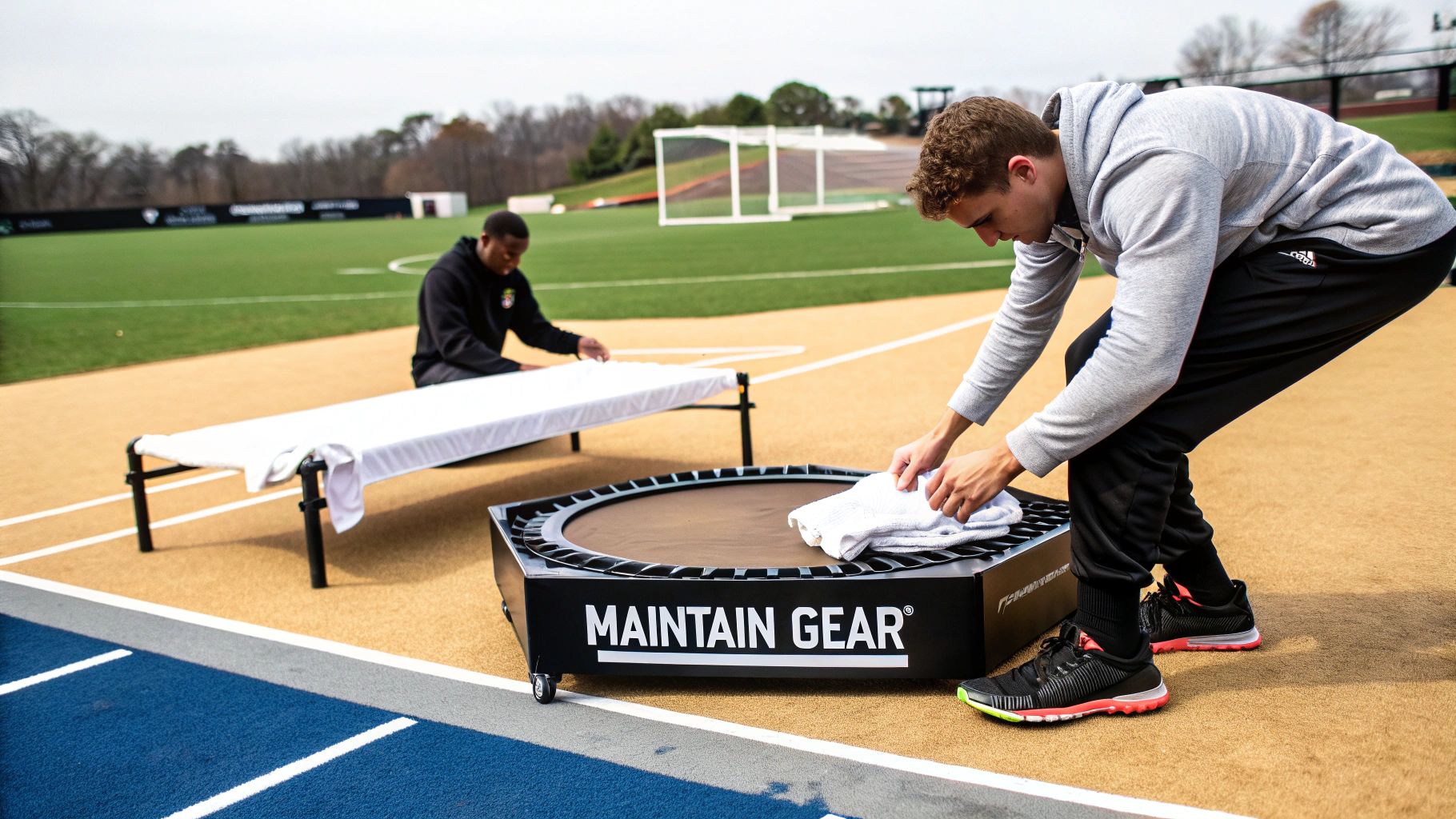
Honestly, a visual check takes less than a minute. Just run your eyes over the frame and net, looking for anything that seems off.
Routine Checks and Cleaning
The best way to keep your rebounder in prime condition is to get into a simple maintenance routine. Pay closest attention to the parts that take the most punishment and are most exposed to the British weather.
Here’s a quick checklist to run through:
- Frame Inspection: Got a steel frame? Keep an eye out for any rust spots or chipped paint. If you spot any, a quick touch-up with rust-resistant paint will stop corrosion in its tracks. Give the bolts and fixings a wiggle to make sure everything is tight.
- Netting Wear and Tear: The net is the heart of the rebounder. Look for any fraying or thinning, especially where it hooks onto the frame. The bungee cords or straps are often the first things to go, so check them regularly.
- Cleaning: After a muddy session, give the frame a quick wipe-down with a damp cloth. It stops muck from building up and keeps it looking fresh.
If you notice the bounce back has gone a bit dead or soggy, it’s almost always down to stretched bungees. It’s a common issue, but luckily, replacing them is a cheap and easy fix that’ll have your rebounder feeling brand new again.
Smart Storage and Hygiene
Where you keep your rebounder when you're not using it makes a massive difference, especially during the off-season or a stretch of bad weather.
If you can, store it in a dry, sheltered spot like a garage or shed. This protects it from the rain and frost that can cause rust and make the net material brittle over time.
Have to leave it outside? A decent waterproof cover is your next best bet. To keep everything in top shape and hygienic, it's worth knowing the right way to clean it properly. For some solid advice on this, check out this guide on the best wipes for gym equipment.
Still Got Questions About Football Rebounders?
Even after seeing all the benefits, you might still be weighing things up before buying a football rebounder. It's a key bit of training kit, so you want to get it right. Here, we'll tackle the most common questions we hear from players, parents, and coaches to clear up any lingering doubts.
We'll get into the practical stuff—like space, different positions, and how to make sure your setup is rock-solid for every single session.
What Size Rebounder Is Best for a Small Garden?
This is probably the number one question we get, and the answer is simpler than you might think. For smaller gardens or tight spaces, a compact and portable rebounder is your best bet. You really don't need a massive frame to get a quality session in.
Look for models around the 1m x 1m mark. They're big enough to give you a decent target for passing and first-touch drills but small enough that they won't take over your entire garden. The fact you can easily pack them away after a session is a massive bonus, too.
A smaller target isn't a downside—it's actually a feature. It forces you to be more precise with your passing and control, which directly sharpens the technical side of your game. Think of a compact rebounder as an accuracy-training tool.
Can Goalkeepers Train With a Football Rebounder?
Absolutely. A football rebounder is a fantastic—and often overlooked—training partner for goalkeepers. While most people associate them with outfield players, keepers can get a massive amount of value from solo drills with a bounce-back net.
Here are just a few ways a keeper can use one:
- Reaction Saves: Throw the ball hard at the net from close range. It’ll ping back unpredictably, perfect for sharpening your reflex saves.
- Catching Technique: Adjust the angle of the rebounder to practise catching balls at different heights and speeds. You can simulate everything from low, fizzing shots to looping crosses.
- Distribution: It's brilliant for working on your throwing and kicking. You can practise quick throws to feet or drill your side volleys over and over, getting hundreds of reps in without needing a partner.
Essentially, it acts as a tireless server, letting you focus 100% on your technique.
How Do I Stop the Rebounder from Moving During Powerful Shots?
There's nothing more frustrating than a rebounder that wobbles or slides around. It completely kills the flow of your training. Making sure it stays put is crucial, especially when you start hitting powerful shots or driven passes at it. How you secure it really depends on the surface.
If you're on grass, always use the ground stakes that come with it. Here’s a top tip: drive them into the ground at a 45-degree angle instead of straight down. This creates far more resistance and stops them from pulling loose.
When you're on a hard surface like a driveway, astro turf, or patio, stakes are obviously a no-go. In that case, weight is your friend. Placing a couple of heavy sandbags or gym weights across the base of the frame will lock it down tight, stopping any movement and keeping every bounce-back consistent and true.
Ready to take your solo training to the next level? Explore our full range of high-quality football rebounders and other essential training gear at SoccerWares. Find the perfect tools to sharpen your skills today by visiting https://soccerwares.com.