

Mastering football training drills at home is the secret weapon for any player looking to gain a serious competitive advantage. This isn't about fancy facilities or expensive coaches; it's about consistent, focused solo practice that builds the muscle memory and confidence needed to turn a good player into a great one.
Why Home Training is Your Secret Weapon for Gaining a Competitive Edge
Ever wonder how the best players seem to have the ball glued to their feet? It isn’t magic. It’s the result of countless hours spent with a ball, and a huge chunk of that time is spent away from the team, practising alone.
Embracing football training drills at home is a genuine game-changer. When you train by yourself, you rack up hundreds of extra touches you simply wouldn't get in a group session where you're waiting for your turn. That focused repetition is where the real progress happens.
Building Confidence and Muscle Memory
Consistent solo practice is what builds that deep-rooted muscle memory for a flawless first touch. It takes the hesitation out of your game, allowing you to control the ball instinctively and make quicker decisions when the pressure is on. This confidence translates directly onto the pitch, empowering you to take on defenders and dictate the flow of the game.
"We saw more growth in one week of short home practices than an entire month of team training." – Parent of a youth player.
This is about more than just skills. It's about forging the discipline and work ethic that truly separates the best from the rest. A simple routine in your back garden or garage can give you a massive edge over opponents who only train twice a week with their team.
The Power of Purposeful Practice
Modern football is all about specific, targeted training. Just look at the data from the game's top levels. Recent insights from The FA show that the vast majority of goals are scored from close range. At Euro 2025, for example, a staggering 88% of open play goals were hammered in from inside the 18-yard box, a trend that's mirrored in the Women's Super League. This tells you exactly what to focus on: drills that sharpen clinical finishing in tight spaces.
To really gain a competitive edge, mastering effective at-home exercise routines can be your secret weapon, allowing for consistent improvement without ever needing a gym. When you combine skill work with football-specific fitness, you start building a well-rounded, resilient player.
Here’s why training at home is so powerful:
- Massive Repetition: You can easily get hundreds of touches in a quick 30-minute session, which massively accelerates how quickly you learn a new skill.
- Targeted Improvement: Got a weaker foot? Struggle with aerial balls? You have the freedom to work exclusively on your weaknesses without holding up a team session.
- No Pressure: Training alone lets you experiment, make mistakes, and perfect your technique without any fear of judgement from teammates or coaches.
- Ultimate Convenience: You can squeeze in a quality session whenever you have a spare moment—no travel or booked pitches required.
Mastering the Ball in Tight Spaces
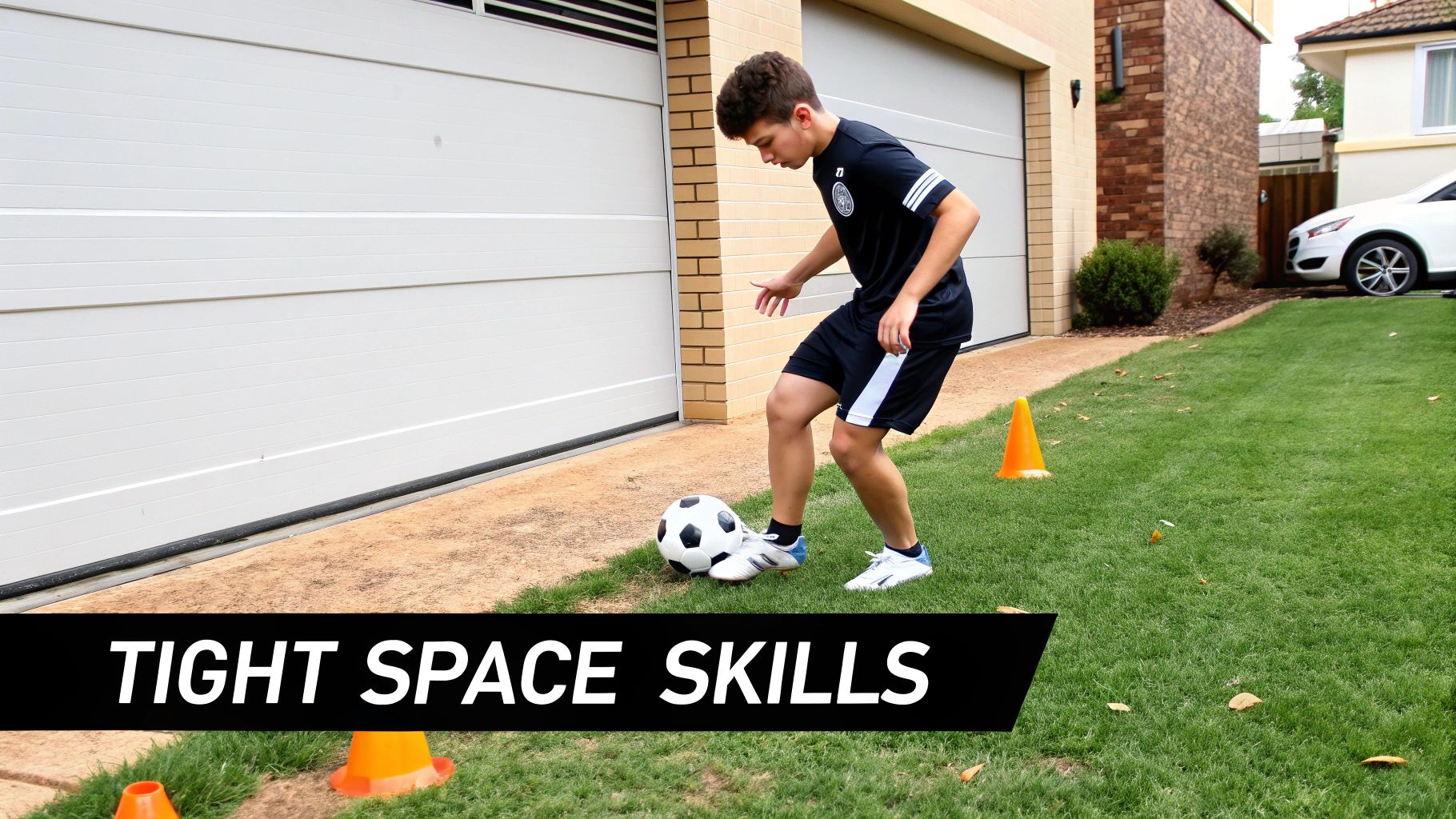
You don’t need a perfectly manicured pitch to build silky skills. In fact, some of the most important technical work happens in tight areas—your garage, a small patch of grass, or even a spacious living room. Working in confined spaces forces you to be quicker, smarter, and more precise with every touch.
Think of these drills as learning the alphabet before you can write a sentence. They build the muscle memory that lets your feet move the ball without conscious thought, freeing up your mind to scan the pitch and make crucial decisions. This is the foundation of true close control.
Beyond the Basics: Drills for Close Control
Right, let’s move past simple toe taps and sole rolls. To truly dominate in tight quarters, you need a toolkit of dynamic moves that create space, unbalance defenders, and help you retain the ball under pressure. These next drills are designed to do exactly that.
A common mistake is players staring at the ball the whole time. The real challenge, and where you’ll see massive improvement, is building the confidence to perform these drills with your head up, just like you would in a match.
1. The V-Turn
This is a classic for a reason. It’s perfect for shielding the ball from a defender and instantly creating a new angle for a pass or a dribble.
- How to do it: Start with the ball slightly in front of you. Use the sole of your dominant foot to drag the ball back towards your body. Just as it reaches your standing leg, use the inside of that same foot to push it forward diagonally, creating a 'V' shape.
- Target: Aim for 20 repetitions on each foot. The key is making that push away sharp and explosive.
2. The L-Drag
Here's a brilliant little skill for changing direction in a flash and leaving a flat-footed defender for dead.
- How to do it: Use the sole of your foot to pull the ball back and across your body. As it moves behind your standing leg, use the inside of the same foot to tap it out, forming an 'L' shape.
- Target: Complete 20 L-drags per foot. Aim for a smooth, continuous two-touch motion.
Combining Drills for Fluidity
Individual drills are great for technique, but linking them together is where you start building real game intelligence. This is how you mimic the rapid-fire decisions needed to wriggle out of a crowded midfield or find space in a packed penalty box.
For this kind of detailed work, having a ball with the right feel makes a huge difference. A high-quality training ball from our collection at Soccerwares.com gives you the perfect touch and response needed to master close control.
The real growth happens when you stop thinking about the drill and start feeling the rhythm. Your feet should flow from one movement to the next without hesitation, creating a seamless dance with the ball.
Try chaining the drills together. For example, perform two V-turns with your right foot, then flow straight into two L-drags with your left. This forces your brain and body to adapt on the fly, just like in a real, unpredictable match.
Building Game Awareness While You Train
One of the biggest advantages of football training drills at home is the chance to focus on details that often get overlooked in team sessions. The big one? Keeping your head up and scanning your surroundings.
Here’s a simple but incredibly effective way to train this:
- Set up visual cues: Scatter a few different coloured cones or objects around your training space.
- Introduce a command: While you’re performing a drill, ask a parent or a friend to shout out a colour.
- React and scan: Your job is to find that coloured object as quickly as you can, all without stopping the drill or losing control of the ball.
This simple tweak turns a basic technical drill into a proper cognitive workout. You’re not just training your feet; you’re training your brain to process information under pressure. This is the absolute bedrock of a high football IQ. Start with 30-second intervals and build up from there. It's a small change that pays off big time on the pitch.
Forging a World-Class First Touch
A player’s first touch is everything. It’s that split-second moment that decides what comes next—a killer pass, a sharp turn to beat a defender, or a powerful shot on goal. A bad first touch? It kills an attack before it has even started. But a great one? It creates time and space out of thin air.
This is where we turn a potential weakness into a genuine weapon.
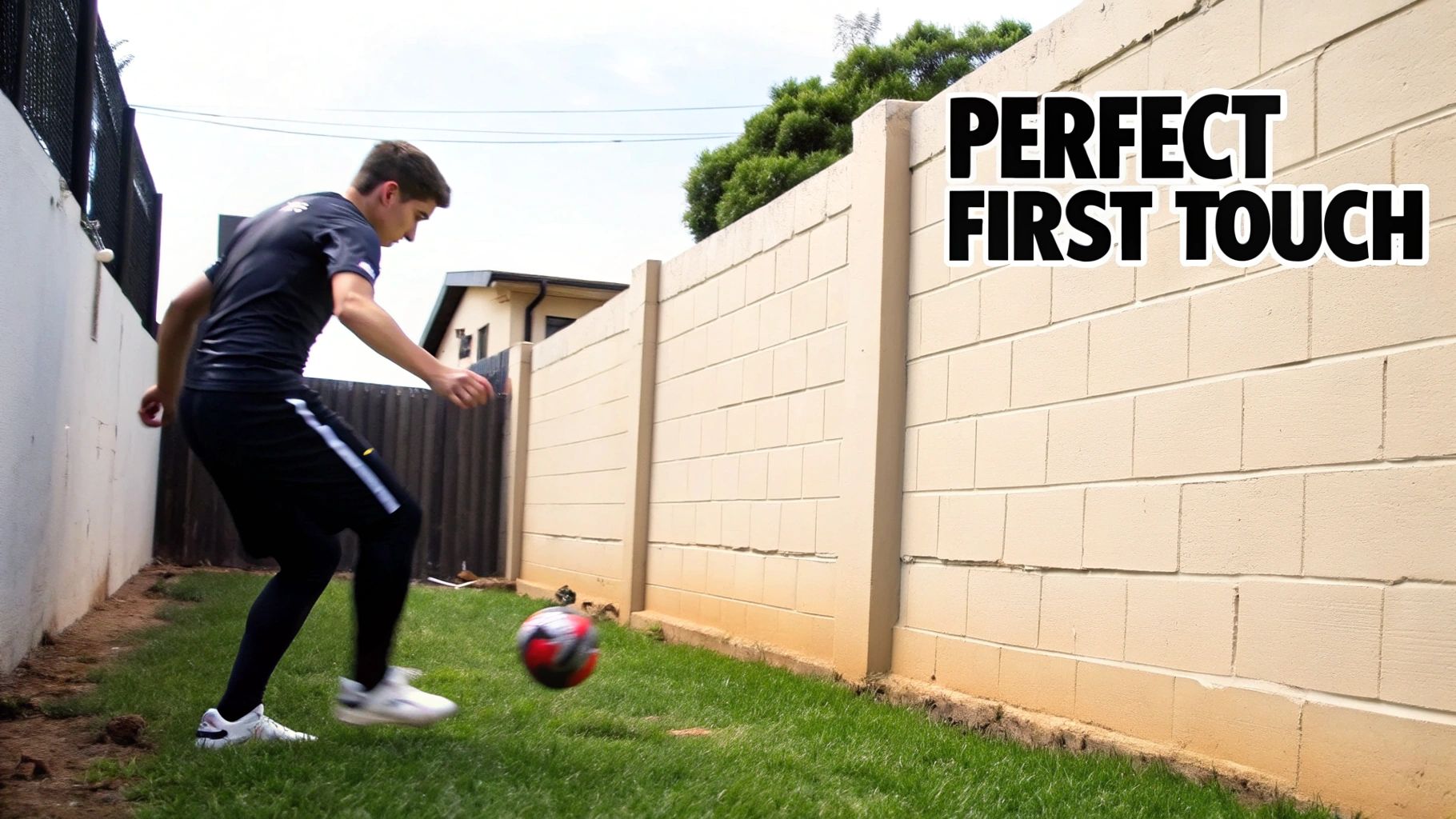
The best tools are often the simplest. All you really need to build an elite first touch is a ball and a solid wall. This timeless method gives you the endless repetition needed to burn quality technique into your muscle memory, so controlling the ball becomes pure instinct.
Controlling Passes on the Ground
The foundation of any great first touch starts with balls played along the floor. The aim isn't just to stop the ball dead; it's to control it with purpose, setting up your next move in one fluid motion. This is a massive part of effective football training drills at home.
Start about five metres from the wall. Pass the ball firmly against it with the inside of your foot and get ready to control the rebound. The trick is to prepare your receiving foot as the ball travels back, opening up your body to take the touch into space.
To level up this basic drill, start mixing it up:
- Inside Foot Control: As the ball returns, cushion it with the inside of your foot. Your touch should guide the ball slightly to the side, preparing you for the next pass. Think two-touch rhythm: pass, control, pass, control.
- Outside Foot Control: Same drill, but this time, use the outside of your boot to kill the rebound. This is a brilliant way to practise shifting the ball away from an imaginary defender closing you down.
- Laces Control (The Wedge): When a ball is fizzed at you with pace, use your laces. As it arrives, lift your toes slightly to create a ramp and let the ball 'wedge' under your foot. It will kill the pace instantly.
Mastering the Aerial Ball
Let's be honest, in a real match, the ball rarely rolls perfectly to your feet. It bounces awkwardly, loops over your head, and drops from a height. Being able to bring those difficult balls under your spell is what separates good players from the truly great ones.
Begin by throwing the ball against the wall so it comes back at an awkward height. Your goal is to tame it with different parts of your body, always aiming to get it settled at your feet with a single touch.
A world-class first touch means the ball does what you want it to, not what it wants to do. It’s about imposing your will on the ball from the very first contact.
Try these variations to get your aerial control sharp:
- Controlling with the Laces: As the ball drops, present the top of your foot (your laces) to meet it. The secret is to withdraw your foot slightly on impact—cushioning the ball down in front of you. Think of your foot as a pillow, not a brick wall.
- Controlling with the Thigh: For balls coming in around waist height, your thigh is the perfect tool. Angle it to direct the ball downwards into your path, ready for your next action.
- Controlling with the Chest: For higher balls, your chest is your best friend. Arch your back slightly as the ball makes contact to create a soft surface that drops it neatly at your feet.
Upping the Intensity with a Rebounder
A wall is a fantastic starting point, but a football rebounder introduces a whole new level of challenge and realism. A flat wall gives you a predictable return every single time. A rebounder, on the other hand, sends the ball back with different speeds, spins, and trajectories.
That unpredictability is far more game-realistic.
Using a rebounder forces you to sharpen your reactions and adjust your body shape in an instant, just as you have to in a match. It’s a smart investment that pays off big time in developing a truly adaptable first touch.
For a deeper look at how they can revolutionise your training, check out our guide on the benefits of a football rebound wall. It's a genuine game-changer for solo practice.
Becoming a Clinical Finisher in Your Own Back Garden
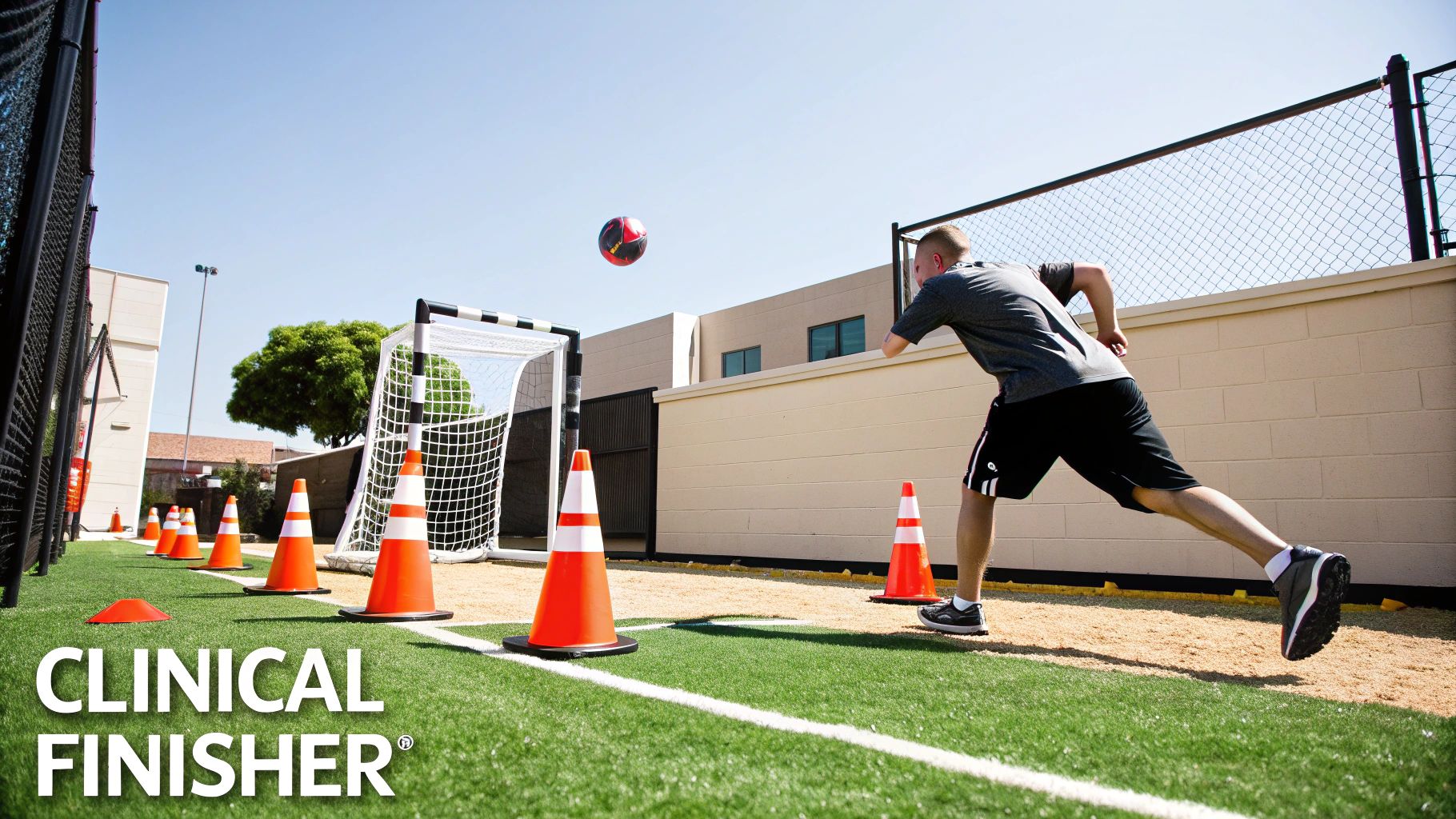
Goals win matches. It’s that simple. And there's really no substitute for the relentless repetition it takes to become a player who can be relied upon to find the back of the net. The good news? You don’t need a state-of-the-art training ground to sharpen your shooting skills. With a few smart football training drills at home, you can turn your back garden into a personal finishing school.
It all starts with the fundamentals. Before you start lashing balls at goal, let's break down the biomechanics of a clean, powerful strike. A pure shot is built on a solid foundation, ensuring every bit of power from your body transfers through the ball.
The Anatomy of a Perfect Shot
Building a consistent shot is all about creating a repeatable sequence of movements. If you can focus on these three key areas every single time you practise, you’ll notice a huge difference in both your power and accuracy.
- Ankle Lock: This is non-negotiable for a powerful strike. Tense the muscles around your ankle to make it firm and rigid, pointing your toes down. Think of your foot becoming a hammer—solid and unyielding on impact.
- Body Shape: Your non-kicking foot needs to be planted firmly beside the ball, pointing straight towards your target. Get your chest leaned slightly over the ball. This is what keeps the shot down and helps you generate more force.
- Follow-Through: The shot doesn't just stop when the ball leaves your foot. Your kicking leg should swing through the ball towards the target in a smooth, fluid motion. A clean follow-through is the sign of a pure, committed strike.
Practical Drills for Sharpening Your Aim
Once you’ve got the technique dialled in, it’s time to get practical. These drills can be set up in minutes and are designed to replicate the kinds of chances you actually get in a real match. The key is to make every shot count.
A portable goal is a fantastic asset for these drills, as it gives you a proper target to aim for. The options we've tested are durable, easy to assemble, and perfectly suited for any home training setup. For more information, you can find our detailed guide on choosing the best portable soccer goals for your space.
1. Shooting Through Gates
This drill is brilliant because it forces you to be accurate, not just powerful. Place two cones about a metre apart, a few steps in front of the goal. The challenge is simple: score by shooting the ball through the gate created by the cones.
Start off with the ball stationary. Take a touch to set yourself up, then focus on that clean strike through the gate and into the net. Once you feel comfortable, progress to dribbling towards the cones before taking your shot on the move.
2. Target Zone Finishing
This is a classic for a reason. Instead of just aiming for the goal in general, divide it into smaller target zones. You can hang old towels or jumpers in the top corners or place cones in the bottom corners to aim for.
The old saying goes, "aim small, miss small." By focusing on hitting a tiny target area, your overall accuracy will improve dramatically, even when you're just aiming for the net in a game.
Challenge yourself to hit each target zone five times. This transforms mindless shooting into a focused, deliberate practice session, and it's the fastest way to improve your ability to place the ball exactly where you want it.
Replicating High-Value Scoring Positions
The best strikers are absolutely lethal from high-percentage areas. If you analyse professional matches, you'll see the majority of goals are scored from inside the penalty area, often from central positions. You can easily replicate these scenarios at home.
Set up a few cones to mark out the 'D' at the edge of where a penalty box would be. Practise receiving a pass (from a wall or a rebounder works perfectly), taking one touch to set the ball, and getting a quick shot off. This drill mimics receiving a cut-back pass from a winger and forces you to get your shot away before an imaginary defender can close you down.
Aim for 15-20 repetitions on this one, focusing on the speed of your first touch and the quality of your finish.
Building Explosive Agility and Football Fitness
The modern game is played at a blistering pace. Raw technical skill is fantastic, but it will only get you so far if you don't have the engine and agility to keep up. This is where we build the explosive speed, quick feet, and match-specific fitness that will make you a nightmare for any opponent.
It’s all about building a body that isn't just fit, but football-fit. We’re going to move beyond boring jogs and focus on circuits that fuse high-intensity cardio with ball work, properly simulating the stop-start chaos of a real match. This way, every drop of sweat translates directly into better on-pitch performance.
Mastering Footwork With Agility Ladders
An agility ladder is one of the best pieces of equipment you can own for developing rapid footwork, coordination, and balance. The goal is simple: get your feet in and out of the rungs as quickly and cleanly as possible. You're training your brain and muscles to fire in perfect, rapid sequence.
Start with simple patterns and don't rush. The real key is staying light on the balls of your feet, keeping your arms pumping for balance and momentum.
- Linear Ickey Shuffle: A classic drill where you step side-to-side through the ladder (in, in, out). It’s perfect for building rhythm.
- Two-Foot In-Out: A more explosive movement. Jump with both feet into a square, then jump with both feet out to the sides as you move down the ladder.
- Lateral High Knees: Move sideways along the ladder, driving one knee up high in each square. This is fantastic for boosting lateral speed and hip mobility.
If you want a complete breakdown of ladder exercises, we've put together some expert advice on how to choose and use a ladder for football training.
The secret to ladder drills isn't just raw speed; it's precision. Nail the pattern perfectly, even if it means starting slowly. Speed will come naturally once your muscle memory locks in.
Cone Drills for Lightning-Fast Direction Changes
Agility isn't just about sprinting in a straight line. It's about slamming on the brakes, changing direction, and exploding away again in the blink of an eye. For that, cones are your best friend.
You can set up simple patterns in your garden or a local park that replicate real game-day scenarios. These drills force you to drop your centre of gravity and push off explosively, building the power you need to dodge a tackle or track a tricky winger.
A brilliant and brutally effective setup is the T-Drill. Just place four cones in a 'T' shape, with about five metres between each one. You sprint from the base to the centre cone, shuffle left, then shuffle all the way across to the right cone, back to the centre, and finally, backpedal to where you started. Use a stopwatch and aim to beat your personal best every time.
This focus on home training is a massive trend across the UK. With football participation soaring—a huge 45 million people played in matches during the 2022-2023 season—players are all looking for that extra edge. Home drills are especially vital for the 17.3 million young players under 25, giving them a structured way to sharpen their skills outside of regular team sessions.
Building Power With Plyometrics
Plyometrics are explosive exercises that build serious power and speed. They work by stretching and contracting your muscles in rapid sequences, which is perfect for developing that explosive first step that leaves defenders for dead. The best part? Many require zero equipment.
Start weaving these into your fitness routine:
- Box Jumps: Find a sturdy box or step. From a standing start, jump up onto it, landing as softly as you can. Step back down, reset, and repeat.
- Squat Jumps: Perform a standard bodyweight squat, but at the top of the movement, explode upwards into a jump. Land softly and flow immediately into the next rep.
- Burpees: The full-body killer. From standing, drop into a squat, kick your feet back into a press-up position, pop back to the squat, and jump up explosively.
To help put it all together, here’s a quick look at how these drills translate to the pitch.
Football Fitness Drills Breakdown
| Drill Name | Primary Physical Benefit | On-Pitch Application |
|---|---|---|
| Agility Ladder Drills | Foot speed, coordination, balance | Quick feet in tight spaces, evading tackles, reacting to loose balls. |
| Cone T-Drill | Change of direction, acceleration | Tracking an attacker's run, creating space from a defender, explosive turns. |
| Box/Squat Jumps | Explosive power, vertical leap | Jumping for headers, holding off strong opponents, that first explosive step. |
| Burpees | Full-body conditioning, stamina | Getting back to your feet quickly after a tackle, maintaining intensity late in the game. |
As you can see, each movement is designed with a specific footballing purpose in mind.
To truly develop your physical attributes for football, incorporating simple at-home workouts is incredibly effective. Integrating these exercises will build a powerful foundation for your on-pitch agility. And if you need the gear to get started, you can find top-quality agility ladders, cones, and training hurdles right here at Soccerwares.com.
Designing Your Personal Weekly Training Plan
Random practice gets you random results. To see real, lasting improvement in your game, you need a structured weekly plan that hits all the key areas: technical skill, fitness, and that all-important recovery time. A solid schedule is what turns scattered effort into consistent, measurable progress.
The trick is to build a routine that actually fits your life and current skill level. If you're just starting out, your focus will be on mastering the basics. A more advanced player, on the other hand, will need to weave in high-intensity fitness and more complex drills. The goal is always the same: create a balanced programme that pushes your limits without burning you out.
Structuring Your Week for Success
Think of your training week as having a few core pillars: technical work, agility and fitness, and recovery. A well-rounded plan gives each pillar the attention it deserves. It’s tempting to just practise shooting every day because it’s the fun part, but the less glamorous work on your first touch or footwork is what builds a complete player.
Here are three simple templates you can adapt to your own needs:
- The Foundational Plan (3 days/week): Perfect for beginners or players in their off-season. Stick to focused 30-45 minute sessions. For example: ball mastery on Monday, first touch drills against a wall on Wednesday, and some basic dribbling and shooting on Friday.
- The Balanced Schedule (4-5 days/week): This is for intermediate players ready to make a serious jump. Sessions get a bit longer (45-60 minutes) and you’ll add a dedicated fitness day. A week might look like this: Technical (Mon), Agility/Fitness (Tues), Rest (Weds), First Touch/Passing (Thurs), Shooting (Fri).
- The Intensive Programme (5-6 days/week): Aimed at dedicated players pushing to get to the next level. These sessions are sharp and intense, often combining different skills. You might do explosive agility work and then immediately move into finishing drills to mimic the fatigue you’d feel in a real match.
Tracking Progress and Staying Adaptable
Remember, your training plan isn’t set in stone. It should grow and change as you get better. Listening to your body is absolutely crucial—if you’re feeling sore or drained, an extra rest day will do you far more good than a sloppy, forced session.
This timeline gives you a great visual for how a young player's physical abilities should progress over time, starting with footwork, moving to changes of direction, and finally building power.
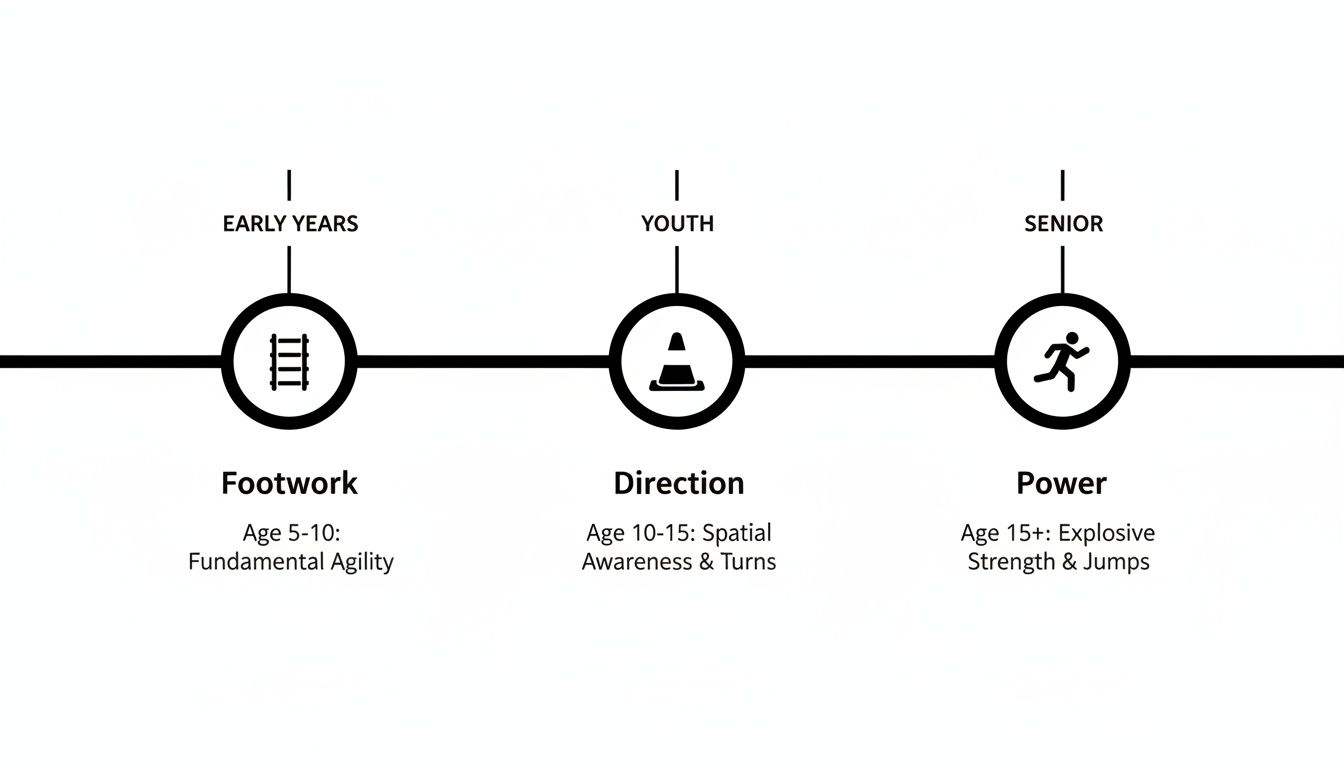
This shows how those fundamental skills create the foundation for more powerful, athletic movements as a player gets older and stronger.
At-home training in the UK is getting seriously sophisticated, taking cues from the tactical shifts we're seeing in the professional game. With a massive 45 million people playing football in the UK in 2022-2023, even simple home setups are getting smarter. For instance, you can use free apps to create heat maps from a 30-minute dribbling session in a tight 2x2 metre space. This method has been shown to boost ball control by as much as 28%. You can learn more about these tactical analysis trends shaping football's future.
The best weekly plan is the one you can actually stick to. It's far better to complete three high-quality sessions every single week than to aim for six and burn out after a fortnight. Consistency is your greatest asset.
Got Questions About At-Home Training? Sorted.
Let's cut through the noise and tackle some of the most common questions people ask about training at home.
How Often Should I Be Training at Home?
The simple answer is that consistency trumps cramming. Aim for 3-4 sessions a week, each lasting about 30-45 minutes. That’s the sweet spot for building muscle memory and sharpening your touch without burning out. It gives your body time to recover and actually absorb the work you've put in.
What's the Bare Minimum Equipment I Need?
Honestly, you can get a surprising amount done with just a ball and a solid wall. That combination is perfect for first touch, passing, and reaction drills.
If you want to take things up a notch, a few cones will open up a world of dribbling patterns, an agility ladder sharpens your footwork, and a small portable goal makes shooting practice far more rewarding.
Is My Tiny Garden Big Enough for These Drills?
Absolutely. In fact, a small space can be a massive advantage. Drills like close-control ball mastery or rapid wall-passes force you to be quicker on your feet and far more precise with every touch. It's the perfect environment to develop that sharp, tight control needed to navigate a crowded pitch.