

To build real, match-winning speed, you need more than just a pair of boots and a patch of grass. The right gear is what turns raw potential into explosive, game-changing pace. Foundational tools like agility ladders, cones, and mini-hurdles are the absolute bedrock of any serious player's training programme. They’re essential for sharpening your footwork, boosting acceleration, and mastering those quick changes of direction that leave defenders for dead.
Building Your Foundation for Explosive Speed
Look, straight-line speed is great, but football isn't a 100-metre sprint. It's a game of quick bursts, sharp turns, and sudden stops. Being the first to a loose ball or ghosting past a defender comes down to how you move in those first few yards.
Before you even think about strapping on a resistance parachute, you have to nail the fundamentals. This is where foundational equipment comes in. This gear isn't about building brute strength; it's about making your movements more efficient. It's about rewiring the connection between your brain and your feet, teaching your body to move instinctively and explosively.
Investing in a quality starter kit is one of the smartest moves any developing player can make.
Why This Basic Gear Is a Game-Changer
Just running sprints will only get you so far. The players who truly dominate are the ones who can accelerate over five yards, slam on the brakes without losing balance, and change direction on a sixpence. This is exactly what foundational equipment trains.
- Agility Ladders: There's no better tool for developing rapid, precise footwork. The drills force you to get your feet up and down quickly, which translates directly to better balance and control when you're dribbling at pace.
- Cones and Markers: Incredibly versatile. You can set them up to mimic any game scenario, from cutting past a defender to closing down an attacker. They’re perfect for mastering acceleration and, just as importantly, deceleration.
- Mini-Hurdles: These are all about building explosive power and promoting proper running form. They force a high knee drive and a powerful push-off from the ground—two critical ingredients for an explosive first step.
"True on-pitch speed isn't just about how fast you can run a 40-metre dash. It's about how quickly you can apply that speed in game-relevant situations. The foundational tools—ladders, cones, hurdles—are what build that practical, functional explosiveness."
To give you a clearer picture, here’s a simple breakdown of what this core equipment does.
Core Football Speed Training Equipment Overview
| Equipment Type | Primary Training Function | Key On-Pitch Skill Developed |
|---|---|---|
| Agility Ladder | Neuromuscular coordination and rapid foot patterns | Quick feet for dribbling, balance, and evading tackles. |
| Cones/Markers | Multi-directional speed, acceleration, and deceleration. | Cutting, weaving, and changing pace to beat opponents. |
| Mini-Hurdles | Plyometric power, knee drive, and stride mechanics. | Explosive first-step quickness and acceleration. |
As you can see, each piece targets a specific, vital component of football speed.
Choosing Your Starter Kit
When you're buying your first set of football speed training equipment, don't get distracted by flashy colours or gimmicks. Focus on durability and versatility.
Look for cones made from a flexible, crack-resistant material—they will get stood on. For your agility ladder, ensure the rungs are flat and adjustable so you can change the difficulty of your drills. Mini-hurdles should be lightweight enough to move easily but stable enough that they don't fall over if you graze them.
A solid starter kit doesn't need to be huge. A set of 20 cones, one agility ladder, and six mini-hurdles gives you more than enough to build a comprehensive speed and agility programme.
Of course, having the right gear is only half the battle. To truly get faster, you need to constantly refine your running mechanics. Combining quality equipment with a solid guide on how to improve on running will lay the groundwork for real, tangible improvements you'll see on match day.
Mastering Drills with Ladders, Cones, and Hurdles
Having the right football speed training equipment is a great first step, but the real magic happens when you know exactly how to squeeze every last drop of potential out of each piece. It's about turning that pile of ladders, cones, and hurdles into a system that works for you. This is what separates players who just train hard from those who train smart.
Think of this as your playbook for mastering the fundamental drills that build explosive, match-ready speed.
The goal isn't just to go through the motions. Every drill here is designed to rewire your neuromuscular system—that's the communication line between your brain and your muscles—so it fires faster and more efficiently. What does that mean on the pitch? Quicker feet, sharper reactions, and more powerful, decisive movements when it matters most.
This flow shows how the foundational gear builds on each other to create a complete speed and agility programme.
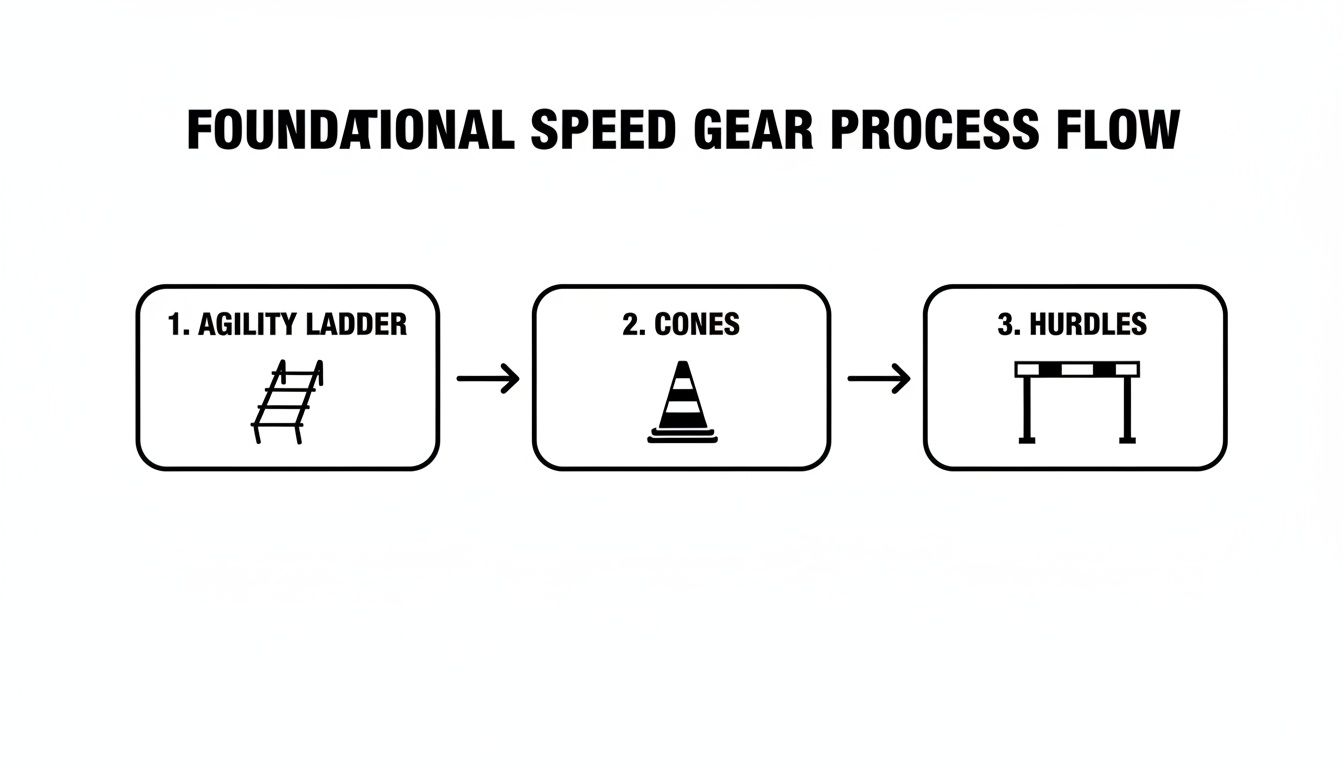
You start with the agility ladder for intricate footwork, move on to cones for sharp changes of direction, and finish with hurdles to build that explosive power. It’s a complete training stimulus.
Rewiring Your Footwork with the Agility Ladder
The agility ladder is the undisputed king of developing rapid foot movement and coordination. It forces you to be light on your feet, keeping your balance while moving at pace. Always start with the basics and nail the technique—quality over quantity, every time.
Foundational Drill: Single-Foot Runs
This is the simplest drill, but also the most important. Just run through the ladder, placing one foot in each square. The key is to minimise your ground contact time. Imagine the ground is hot lava.
- Coaching Cue: Stay on the balls of your feet and drive your legs in a quick, piston-like action.
- Common Mistake: Looking down at your feet. Get your head up and chest proud, just like you would in a real game.
Progression Drill: The Ickey Shuffle
Named after an old-school American football player, this drill is fantastic for building lateral quickness. It’s a simple three-step pattern: step into a square with your outside foot, follow with your inside foot, and then step out to the side with that outside foot again.
This in-and-out pattern perfectly mimics the quick adjustments you need to make to evade a tackle or create that half-yard of space for a shot. It teaches your body to shift weight rapidly without losing control.
For a deeper dive into different patterns, our complete guide to using a training ladder for football offers more advanced drills to mix into your sessions.
Slashing Your Change-of-Direction Time with Cones
Let's be honest, football is rarely played in a straight line. Your ability to accelerate, slam on the brakes, and explode in a new direction is what makes you a nightmare for defenders. Cones are the perfect tool for sharpening that skill.
The Classic T-Drill Setup
This drill is a staple in professional combines for a reason—it tests every single aspect of your agility.
- Set up three cones in a line, five yards apart.
- Place a fourth cone ten yards back from the middle one, forming a 'T' shape.
- Start at the base cone, sprint forward and touch the middle cone.
- Shuffle left to the outside cone and touch it, then shuffle all the way across to the far right cone.
- Finally, shuffle back to the middle cone and backpedal to where you started.
This single drill hits linear sprinting, lateral shuffling, and backpedalling—all crucial movement patterns for a match. Aim for 3-4 sets, but make sure you take a full recovery between each rep. The goal is maximum intensity.
Building Explosive Power with Hurdles
Mini-hurdles are your go-to for developing plyometric power. That’s a fancy term for the ability to produce maximum force in a short burst. It's the secret sauce behind that explosive first step that gets you to the ball before anyone else.
Drill for Power: Hurdle Hops
Set up 6-8 mini-hurdles in a line, about two feet apart. Standing with both feet together, hop over each hurdle one after the other.
- Coaching Cue: Focus on a powerful upward and forward drive. You want to spend as little time on the ground as possible. Don't forget to use your arms to generate extra momentum.
- Common Mistake: Bending too much at the waist. Keep your torso upright. This helps you maintain a powerful posture and transfer energy efficiently.
By truly mastering these fundamental drills, you'll turn your basic football speed training equipment from a simple collection of gear into a system for building elite, game-changing quickness.
Unlocking Power with Resistance Training Gear
Once you've got your footwork dialled in with ladders and cones, it's time to bring in the heavy hitters: resistance gear. This is how you start building the raw, explosive power needed to break tackles, burst past defenders, and completely own those first five to ten yards.
Resistance-based football speed training equipment is all about one simple principle: force your muscles to work harder. Your body has to generate more force with every single stride. Think of it this way—you train under a heavier load, so when that resistance is gone on match day, you feel lighter, quicker, and a hell of a lot more powerful.
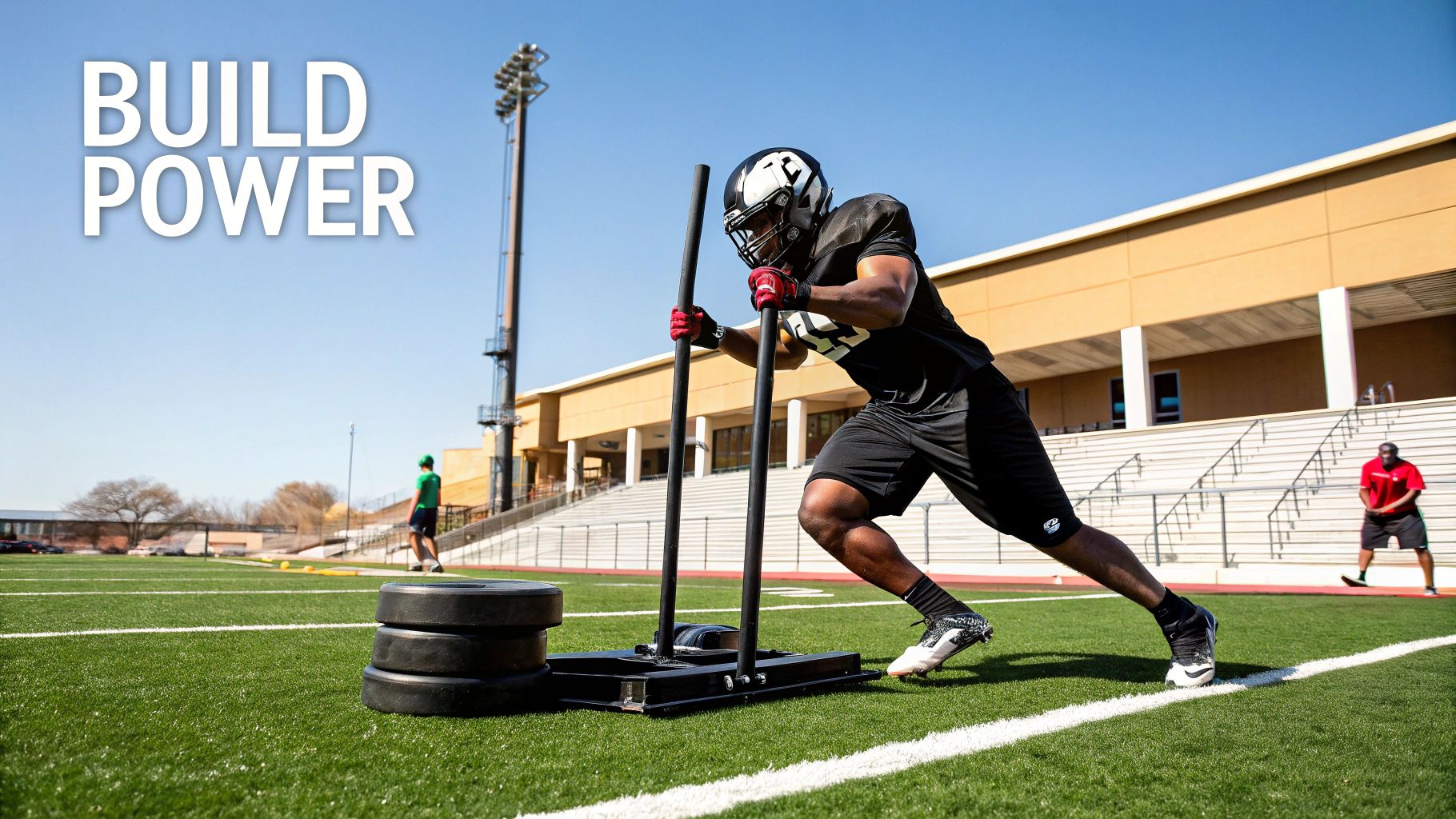
Forging Acceleration with Speed Sleds
When it comes to building pure, straight-line acceleration, the speed sled is king. By adding weight that you physically have to drag, it overloads the exact muscles you need for that explosive drive out of the blocks—your glutes, hamstrings, and quads.
The real beauty of the sled lies in its simplicity. It’s a pure test of horizontal force. While lifting weights in the gym is great for building vertical strength, sled work directly mimics that forward lean and powerful leg drive you need on the pitch.
A classic mistake is to pile on too much weight. The goal here is to challenge your muscles, not completely change how you run.
As a rule of thumb, the added weight should not slow your sprint time by more than 10% over a short distance (say, 10-20 metres). Any more than that, and you risk training your body to be slow, which is the exact opposite of what we're trying to achieve.
The Versatility of Resistance Bands
Resistance bands are easily one of the most versatile and cost-effective bits of kit you can have in your bag. Yes, you can use them for resisted sprints, but their real value comes from their ability to target lateral and multi-directional power.
Just think about these game-specific scenarios:
- Resisted Lateral Shuffles: Get a partner to hold the band while you shuffle from side to side. This is perfect for defenders who need to sharpen their jockeying speed to stay in front of those tricky wingers.
- Resisted Forward Sprints: Attach the band to a goalpost or a solid anchor point and sprint away from it. This gives you a different type of resistance to a sled—one that gets tougher the further you stretch the band.
- Assisted Sprints (Overspeed Training): Have a partner run slightly ahead, pulling you along with the band. This forces your legs to turn over faster than you normally could, helping you smash through speed plateaus.
When you’re buying bands, grab a set with different tension levels. A light band is ideal for dynamic warm-ups and overspeed work, whereas the heavy-duty ones are what you need for building serious power in resisted drills.
Harnessing the Wind with Sprint Parachutes
Sprint parachutes offer a unique kind of resistance. The drag builds as you get faster, providing maximum resistance just as you’re hitting top speed. This makes them brilliant for improving your maximum velocity, while sleds are better for that initial acceleration.
Imagine a winger flying down the touchline. Using a parachute in training teaches their body to maintain good form and power output when running at full tilt. The parachute forces you to drive your arms and knees harder just to fight the air resistance, reinforcing solid sprinting mechanics under pressure.
This shift towards specialised training is happening all over the UK. As investment in grassroots football has grown, so has the use of proper equipment. Between 2015 and 2022, funding from the FA and other bodies for coach education and facility upgrades shot up by about 38%. This had a direct knock-on effect, with sales of speed training aids rising by 25-30% from 2018 to 2022 as more clubs started running structured programmes for their youth players.
Bringing these resistance tools into your weekly plan is how you make the leap from being just quick to being genuinely powerful. They give your body the stimulus it needs to adapt, get stronger, and ultimately, move faster when it counts.
Measuring Your Progress with Modern Tech
Let's be honest: if you aren't measuring, you're just guessing. After all the hard graft with ladders, cones, and resistance bands, you need to see some cold, hard data that proves your efforts are actually working. It's time to ditch your mate with a stopwatch; modern tech offers a level of precision that kills the guesswork and gives you a true picture of your speed gains.
This is where specific bits of football speed training equipment, like timing gates and GPS trackers, really earn their keep. They give you objective feedback, which is vital for seeing where you're improving, spotting weaknesses, and planning your next sessions for maximum impact. Moving from feeling faster to knowing you're faster is a massive motivator.
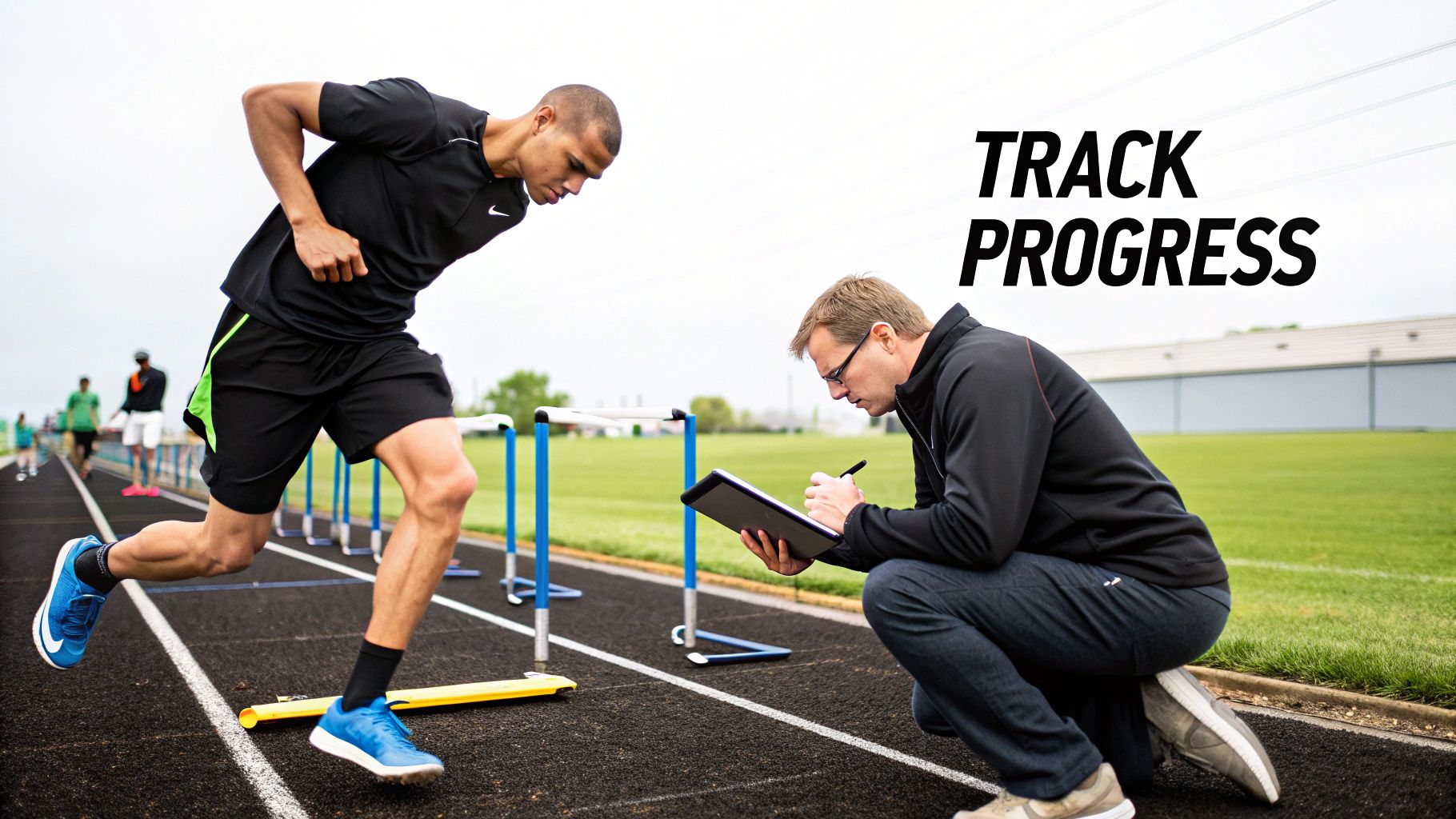
Timing Gates: The Gold Standard for Accuracy
For pure, unfiltered sprint testing, nothing beats a set of electronic timing gates. A manual stopwatch is notoriously unreliable—human error can easily add or subtract precious tenths of a second. Timing gates, on the other hand, are brutally honest. They provide laser-accurate times for your 10, 20, and 40-metre splits.
This data is gold dust for any player. Your 10-metre split shows your explosive acceleration from a standing start, while your 40-metre time indicates your top-end speed. By tracking these numbers, you can see exactly which phase of your sprint is getting better.
You might find your initial burst is powerful, but you start to fade after 20 metres. That insight is huge. It tells you to focus your training, maybe adding more resistance sled work for acceleration or overspeed drills to push your max velocity.
GPS Trackers: Painting the Full Picture
While timing gates are perfect for isolated tests, wearable GPS trackers give you the complete story of your performance during a match or a full training session. These devices, usually worn in a vest between the shoulder blades, collect a massive amount of data that paints a detailed picture of your physical output.
Here are a few of the key metrics you can get your hands on:
- Top Speed: The fastest you hit during the session.
- Total Sprint Distance: How much ground you covered while running at high intensity.
- Number of Sprints: How many explosive bursts you made.
- Accelerations/Decelerations: How often you rapidly sped up or slowed down—a crucial indicator of football-specific agility.
This information is a game-changer. It helps coaches manage player load to prevent injuries and makes sure training sessions are actually replicating the demands of a match. If you want to dive deeper, have a look at our guide on the latest wearable football sensors in 2025.
A Practical Buyer’s Guide to Performance Tech
Choosing the right tech really comes down to your budget and what you want to measure. The market for this kind of gear is booming, which is part of a bigger trend in sports technology.
The global market for speed-training equipment was valued at around $12.3 billion in 2022 and is projected to hit $19.0 billion by 2030. Driven by pro clubs, academies, and a massive grassroots scene, UK demand is a big slice of European sales, especially for high-tech items like sensor-enabled timing systems. You can explore the full research on football equipment growth to see the trends for yourself.
To help you decide what’s right for you, here’s a quick comparison.
| Technology | Best For | Key Benefit | Price Point |
|---|---|---|---|
| Timing Gates | Accurate sprint testing, combines, and trials. | Provides objective, repeatable data on raw speed. | Higher |
| GPS Trackers | In-game and training session analysis. | Offers a holistic view of performance and workload. | Mid to High |
| Radar Guns | Instantaneous speed feedback during drills. | Great for on-the-spot coaching and motivation. | Mid-Range |
For most serious amateur players, a GPS tracker offers the best all-round value. It gives you insights you can apply directly to both your training and your match performance. By investing in the right tech, you can finally put a number on all your hard work and take a data-driven approach to becoming a faster, more effective footballer.
Building Your Weekly Speed Training Plan
Having the best football speed training equipment is a great start, but it's the plan that turns that gear into genuine, on-pitch results. A proper structure is what separates aimless work from targeted improvement, making sure you’re developing the right skills at the right time.
Simply hammering out drills whenever you feel like it won't get you far. You need a weekly schedule that deliberately hits every aspect of speed—your first-step explosion, your ability to slam on the brakes and change direction, and your flat-out top speed. The goal is to walk onto the pitch on match day feeling sharp, powerful, and ready to leave defenders in your dust.
Structuring Your Training Week
A solid week should have dedicated days for different types of speed work. One of the biggest mistakes players make is trying to cram everything—acceleration, agility, top speed—into one killer session. Spreading it out is smarter, giving your body the time it needs to adapt and recover. That's where the real gains happen.
Think of it like building a house. You don't do the foundation, framing, and wiring all on the same day. Each task gets its own time, and they all contribute to the finished product. Your speed training should be no different.
Here’s a practical way to map out your week, blending skill work, strength, and that all-important rest.
A crucial piece of advice: always perform your speed training when you’re fresh. Trying to hit max-effort sprints or agility drills when you’re already tired is a one-way ticket to sloppy form and, even worse, injury. Quality over quantity, every single time.
Sample Plan For The Serious Amateur Player
This schedule is built for a player who’s training several times a week and wants to be at their absolute peak for a weekend match. It’s a smart mix of different speed qualities with other key training elements.
Monday: Acceleration and Power (45-60 mins)
This session is all about that explosive first 5-10 yards. After a good warm-up, you’ll be using resistance to build that raw, off-the-mark power.
- Warm-up: Dynamic stretches and muscle activation exercises.
-
Main Session:
- Speed Sled Sprints: 4 sets of 20-metre sprints. Really focus on a strong forward lean and driving your legs hard through the ground.
- Resistance Band Starts: 5 sets of 10-metre sprints, exploding against the band's tension.
- Mini-Hurdle Hops: 3 sets of 8 hops. This is all about building plyometric pop.
- Cool-down: Static stretching.
Wednesday: Agility and Change of Direction (30-45 mins)
Mid-week is the perfect time to sharpen your ability to move in every direction. This session is designed to improve your footwork and your reaction time in game-like scenarios.
- Warm-up: Get your feet firing with ladder drills like the Ickey Shuffle.
-
Main Session:
- T-Drill: 4 reps at high intensity. Time yourself and chase that personal best.
- Box Drill (with cones): 4 reps. Concentrate on making sharp, aggressive cuts and bursting out of each turn.
- Technical Work: Finish with 15 minutes of dribbling through a cone weave. This helps apply your new agility skills with a ball at your feet.
- Cool-down: A light jog followed by some foam rolling.
Friday: Max Velocity and Taper (20-30 mins)
Think of this as a tune-up for match day. It’s a short, sharp session designed to get your central nervous system firing without causing any fatigue. It’s all about hitting top gear.
- Warm-up: Don't skip this; a thorough warm-up is essential.
-
Main Session:
- Flying 30s: Build up your speed over 20 metres, then hit an all-out sprint at 100% effort for 30 metres. If you have timing gates, now’s the time to use them. Do 3-4 reps, but take a full recovery of 3-4 minutes between each one.
- Cool-down: Very light, gentle stretching.
This kind of structured approach ensures you’re ticking every box for speed development during the week. Feel free to adapt this template by swapping in different drills or tweaking the volume based on how your body is feeling. When you combine a smart plan with the right football speed training equipment, you’ve got a powerful system for getting faster, season after season.
Your Football Speed Training Questions Answered
Let's clear up some of the common questions I hear from players and coaches about speed training. Getting straight answers will help you sharpen your approach, fix common problems, and ultimately get more out of your football speed training equipment.
How Often Should I Do Speed and Agility Training?
For most players, 2-3 dedicated speed and agility sessions a week is the sweet spot. These sessions need to be high-intensity but short and sharp—think 20-30 minutes of proper, focused work.
It's absolutely crucial to schedule them on non-consecutive days. Your muscles and central nervous system need that downtime to recover and adapt; that’s when the real gains are made. Never, ever do maximal speed work when you’re already tired. The risk of injury shoots up, and you get next to no performance benefit.
Can I Get Faster Without Any Equipment?
Absolutely. You can definitely build raw speed and power with just your own bodyweight. Sprints, bounds, and plyometric jumps are brilliant fundamentals, and you can make serious progress without a single piece of gear.
However, dedicated football speed training equipment adds another layer to your training. It gives you targeted resistance and opens up drills that directly hammer your acceleration, change of direction, and top-end speed in ways that bodyweight work alone can't. It’s all about adding structure, variety, and a way to measure your progress—which is vital for long-term development.
It's a classic mistake to think more equipment is always better. The key is using the right equipment, the right way, to attack your specific weaknesses. A simple set of cones used consistently beats an expensive speed sled that just gathers dust.
What Is the Most Important Piece of Equipment For a Beginner?
If you're just starting out, a set of cones is hands down the most versatile and valuable tool you can buy. They might seem simple, but they unlock an almost endless variety of drills.
With cones, you can immediately start working on the skills that define a footballer:
- Acceleration and Deceleration: Setting up basic start-and-stop drills.
- Change of Direction: Laying out T-drills, box drills, or weaving patterns.
- Game-Specific Movement: Mimicking real scenarios like cutting inside a defender or closing down an attacker.
Once you’ve nailed the basics with cones, an agility ladder would be the next logical step to start honing your footwork and coordination.
Is All This Equipment Just For On-Pitch Training?
Not at all. While most of your speed work will happen on the grass, a lot of these tools and principles are now central to injury prevention and rehab. The pro game's reliance on quantifiable speed-testing equipment is a perfect example.
Between 2016 and 2023, for instance, many English professional clubs started building repeat-sprint tests and specific sprint benchmarks into their return-to-play protocols for hamstring injuries. This has led to the widespread use of timing gates and GPS metrics during medical screenings. Getting objective data, like a player hitting over 95% of their pre-injury top speed, has been shown to slash re-injury rates by around 10-18% in some clubs. You can read more about the industry-wide focus on equipment and its growing impact.
At SoccerWares, we stock the high-quality gear you need to build explosive speed and dominate on match day. From foundational tools to advanced tech, find everything you need to take your game to the next level. Shop our full collection of training essentials today!