

GPS tracking is not just about measuring how far a player has run. It's about understanding the story behind their performance—the sprints, the sharp turns, the moments of fatigue, and the bursts of energy that decide a match.
This technology has broken out from the elite labs of professional clubs and is now in the hands of coaches and players at all levels. It's a powerful way to manage player fitness, sharpen tactics, and push your team to its physical peak without guesswork.
The Secret Weapon in Modern Sport
Picture this: final minutes of a cup final. The score is level, legs are heavy, but your star winger—who you’ve carefully managed all season—still has gas in the tank. She makes one last explosive run, beats her marker, whips in a perfect cross, and your striker heads home the winner.
That’s not luck. That’s the result of smart, data-driven coaching made possible by GPS tracking.
What was once a niche gadget for multi-million-pound clubs is now a must-have for teams at every level. These small devices, tucked into a vest between the shoulder blades, capture the invisible data behind every movement on the pitch. They turn a coach's hunch into hard evidence, giving a serious edge to anyone who uses them.
Why GPS is a Game-Changer
The magic of GPS trackers lies in their ability to measure physical effort with incredible accuracy. Coaches no longer have to rely on what they think they saw or how a player says they feel. Instead, they can look at real numbers to make smarter decisions.
This objective feedback helps in three massive ways:
- Injury Prevention: By keeping an eye on a player’s workload, you can spot when they’re being pushed too hard and dial things back before a non-contact injury happens.
- Performance Optimisation: Are your training sessions tough enough to get players match-fit? The data tells you if they’re hitting the intensity needed for a competitive game.
- Tactical Execution: Heatmaps and positional data show you if players are sticking to the game plan, holding their shape, and doing their jobs when the pressure is on.
The demand for this technology is booming. The UK outdoor sports GPS device market is growing fast, driven by teams wanting to get more precise with their athlete monitoring. In fact, analysis suggests the market is set to expand significantly between 2025 and 2031.
This guide will walk you through everything you need to know. We’ll break down the key metrics and show you how to apply them on the pitch to build stronger, faster, and more resilient athletes.
By the end, you’ll see how accessible tools like the performance trackers at SoccerWares.com put professional-level insights into the hands of players and coaches everywhere, helping them unlock their true potential.
What GPS Trackers Actually Measure
A GPS tracker isn’t just a dot blinking on a map. Think of it less like a car's satnav and more like an engine diagnostic tool for a player. It’s a seriously clever bit of kit that tells the full story of an athlete’s physical output—not just where they went, but exactly how they got there. We’re talking every burst of speed, every sudden stop, and the total effort involved in a session.
To get the most out of GPS tracking, you need to speak its language. These devices capture far more than just location. If you're curious about the science behind it, understanding the basics of how GPS works is a great starting point, as this core technology is what allows for such detailed and reliable performance data.
This diagram nails it, showing how GPS data has become central to the three pillars of modern sports management.
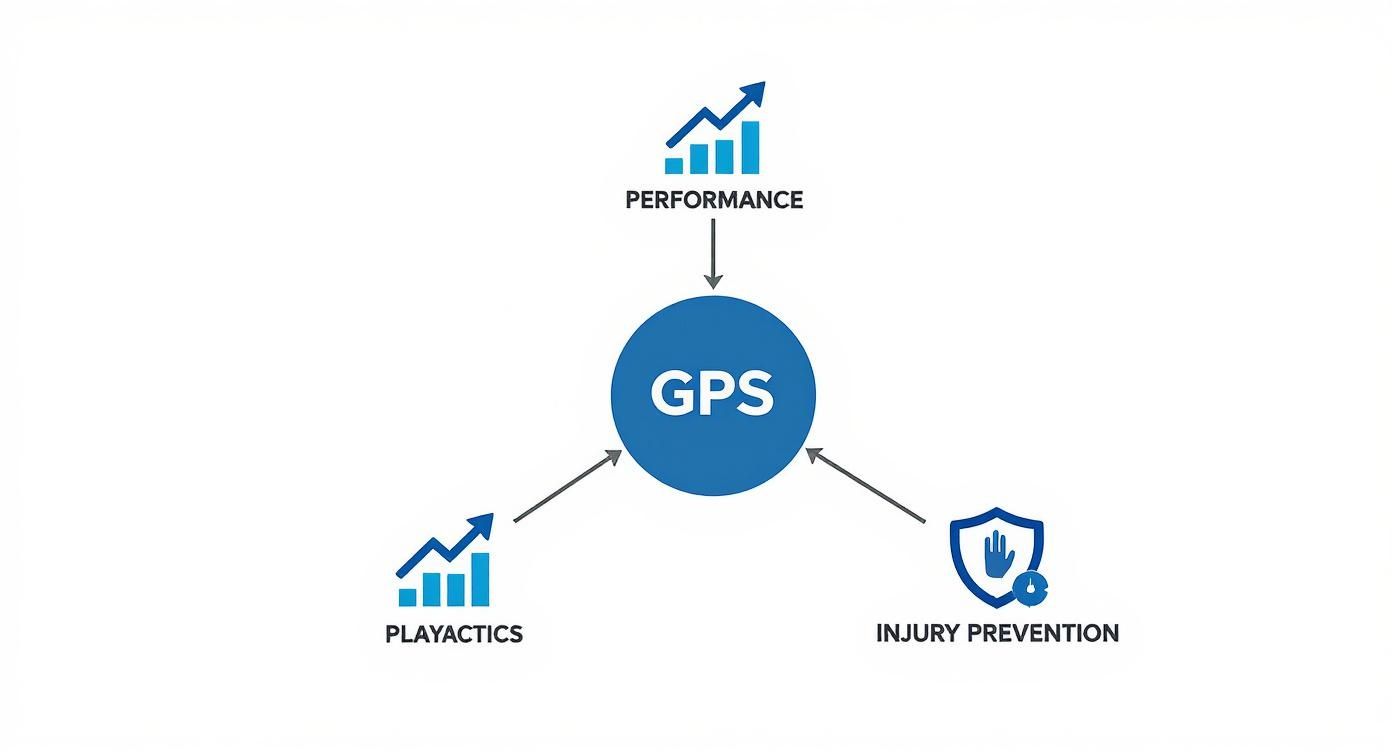
As you can see, it’s all connected. The data you get directly feeds into boosting performance, sharpening team tactics, and keeping players off the physio table. It's a must-have tool for any serious team.
The Core Four Performance Metrics
While a tracker can produce dozens of data points, most coaches zero in on a handful of key metrics to get started. Get your head around these, and you’ll have a powerful snapshot of a player’s performance and fitness.
- Total Distance: This one’s simple. It’s the total ground a player has covered in a session or match. It gives you a great baseline for their overall work rate.
- Top Speed: This captures a player's maximum velocity, usually in metres per second (m/s) or kilometres per hour (km/h). It's a raw measure of their explosive potential.
- Sprint Distance: This is the total distance a player ran while at high speed (running faster than a set threshold). It’s crucial for seeing a player's high-intensity output and their ability to make those game-changing runs.
- Number of Sprints: This counts how many times a player hit that high-speed threshold. It tells you how often they’re performing those explosive, high-intensity actions during a game.
These four metrics give you a solid foundation, but the real story often lies in the forces behind the movements.
Understanding Accelerations and Decelerations
Football isn't played in straight lines or at one steady pace. The game is all about sharp, explosive movements—that sudden press to win the ball, or the quick slam on the brakes to change direction and leave a defender for dead. This is where accelerations and decelerations come into play.
These metrics measure how quickly a player changes their speed. A high number of intense accelerations shows a player is dynamic and powerful. On the flip side, a high number of decelerations points to their agility and ability to control their body.
Crucially, these high-intensity changes in speed are far more physically taxing than just jogging. A player might have a low total distance covered but an incredibly high number of accelerations, meaning they’ve had a really tough session on their muscles and nervous system.
This data helps coaches see the true physical cost of a drill or match, moving beyond just how far someone ran. It’s a vital piece of the puzzle for managing fatigue and preventing the soft-tissue injuries often caused by these powerful braking and bursting actions. Knowing you can trust this data is key, which is why we put together a guide on GPS tracker accuracy in youth football.
Player Load: The Ultimate Effort Metric
If you had to pick just one metric to sum up a player's total effort, it would have to be Player Load. This is a single number that represents the total physiological stress put on an athlete during a session. It’s calculated using accelerometer data, which captures every single movement—jumps, turns, impacts, and changes of direction.
Think of Player Load as a 'physical effort budget'. Every player has a certain amount they can 'spend' each week before their risk of fatigue or injury shoots up. By tracking this one combined metric, coaches can manage weekly workloads with incredible precision, making sure players are firing on all cylinders come match day.
Turning Raw Data into Winning Decisions
Collecting streams of GPS data is just the first step. The real magic happens when you translate those numbers into smarter coaching decisions—the kind that give your team a real edge on the pitch. This is where the theory hits the grass, turning raw metrics into actions that win matches, prevent injuries, and build more resilient players.
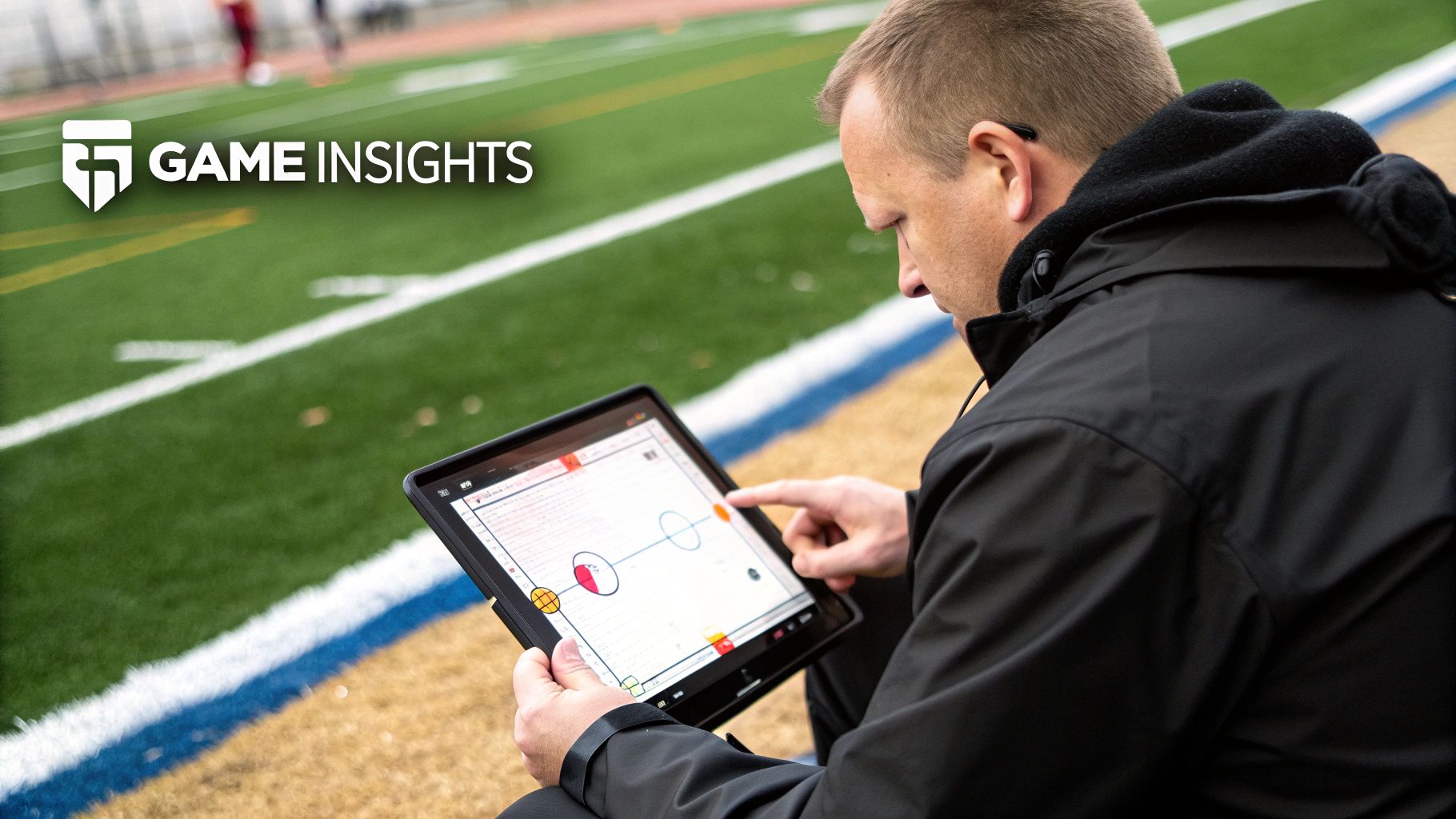
Don't worry, this process isn't just for elite sports scientists. With a handle on a few key applications, any coach can start making data-informed choices. Let’s break down the most practical ways to turn those numbers into winning strategies.
Managing Training Load to Peak on Match Day
One of the most powerful uses of GPS tracking in sport is managing player workload. Think of each player's physical capacity as a bucket. Every sprint, drill, and training session fills that bucket. If it overflows, you’re looking at fatigue, burnout, and injuries. If it’s too empty, players won't be sharp enough come match day.
GPS data lets you see exactly how full each player's bucket is. By tracking metrics like Player Load and Sprint Distance through the week, you can tweak training to make sure every player arrives on Saturday in peak condition.
- Spotting Fatigue Early: Did a player’s sprint count drop off a cliff in Thursday's session compared to last week? That could be an early warning sign, giving you a chance to adjust their load before it becomes a real problem.
- Tapering Before a Game: Most coaches have a tough session early in the week and then ease off. GPS data confirms if you're getting it right, showing a clear drop in workload as you approach kick-off.
- Individualised Plans: Your box-to-box midfielder who covers 11km a match has different needs than a centre-back who covers 8km. GPS helps you ditch the one-size-fits-all approach for good.
Analysing Positional Play with Heatmaps
Beyond the physical numbers, GPS trackers paint a vivid picture of your team’s tactical discipline. Heatmaps are a brilliant way to visualise this, showing exactly where a player spent most of their time. It's a simple, powerful way to see if players are sticking to the game plan.
Is your winger drifting inside too often and leaving you exposed out wide? Is your holding midfielder actually holding their position to screen the back four? A heatmap gives you instant, objective feedback you can use to reinforce your instructions.
For instance, a heatmap might reveal a massive gap between your defence and midfield. Armed with that visual proof, you can design a training session focused on team compactness to shut down those dangerous pockets of space. Getting the hang of these visualisations is a key skill; for a deeper look, check out our guide on how to read football GPS data.
Designing and Validating Training Drills
Every coach designs drills with a goal in mind, whether it's building explosive power, boosting endurance, or embedding tactical shape. GPS data is your quality control, telling you if a drill is actually delivering the physical punch you intended.
Let's say you set up a small-sided game to mimic the intensity of a real match. You can set specific targets for it, such as:
- Each player must hit at least 10 high-intensity accelerations.
- The drill should produce an average Player Load of 50-60 units.
- Wing-backs must reach 85% of their top speed at least twice.
After the session, a quick look at the data shows if you hit those marks. If not, you can tweak the drill—maybe change the pitch size, player numbers, or the rules—to make sure it delivers the right impact next time. This feedback loop makes your training sessions far more purposeful.
This reliance on data is exploding across sports. The global sports tracking market size was valued at around USD 3.22 billion in 2025 and is projected to hit USD 4.36 billion by 2029. The UK, as Europe's leading sports tech market, is a huge part of this trend, proving just how central data has become.
Of course, raw GPS is just one piece of the puzzle. Advanced sources like Opta Player Stats offer deeper insights into what players do on the ball, complementing the physical data. By combining physical output with event data like passes and tackles, coaches get a complete picture of a player’s contribution.
How to Get Your Team Started with GPS
Ready to bring GPS tracking to your team? Adopting new technology can feel like a massive undertaking, but breaking it down into a few simple steps makes it manageable for any club, no matter the size or budget. This is your practical roadmap, taking you from picking a system to actually making sense of your first data report.
The goal isn't to become a data scientist overnight. It’s about building a simple, repeatable process that adds real value to your coaching. It’s about backing up your gut feelings with solid evidence.
Step 1: Choosing the Right System
The first hurdle is often just picking a GPS tracking system. The market has exploded with options for every budget, from single-player units to full professional team kits. Don't feel you need the most expensive setup on the market to get started.
When you're weighing up your options, keep these points in mind:
- Budget: Figure out what you can realistically afford. There are plenty of excellent systems that won’t break the bank.
- Ease of Use: Look for a system with an app or software dashboard that you can actually understand. The data is useless if it’s a pain to access.
- Key Metrics: Make sure the tracker gives you the core data you need, like Total Distance, Top Speed, Sprints, and Player Load.
- Support: Good customer support can be a lifesaver when you're learning the ropes. Check what other coaches are saying in reviews.
For a reliable choice that balances performance and value, you can explore the range of trackers over at SoccerWares.com, which are designed for players at every level. A smart choice here sets you up for success down the line.
Step 2: Getting Players On Board
Introducing any kind of monitoring technology requires buy-in from your players. The key is to frame GPS tracking in sport as a tool for their development and safety, not as a 'big brother' way to scrutinise them. Explain that it helps you manage their fitness, prevent injuries, and make sure they’re peaking on match days.
Transparency is everything. Show them the data. When a player sees how their sprint distance in training translates directly to better performance on Saturday, they’ll get on board fast.
A small but crucial detail that’s often overlooked is the fit of the vest holding the tracker. If it's too loose, the device bounces around, which throws off the accelerometer data and makes metrics like Player Load unreliable.
Make sure each player has a snug-fitting vest. It should feel like a compression top—tight enough to hold the device securely between their shoulder blades but without restricting movement. This tiny detail makes a huge difference to the quality of your data.
Step 3: Establishing a Simple Routine
To get real value from a GPS system, consistency is king. You need to build a simple routine that becomes second nature for both you and your players.
Try following these simple steps for every single session:
- Distribution: Assign each player a numbered tracker that they use every time. This is vital for tracking their individual data consistently.
- Wear the Gear: Players should put on their vests and pop in their trackers before the warm-up even starts.
- Collection: After the session, have a designated spot where players drop off their trackers. A simple box or bag will do.
- Download: Sync the data as soon as you can post-training. Most modern systems do this automatically through an app on your phone.
By making this a non-negotiable part of your training routine, you guarantee you’ll always have the data you need to make smarter decisions for the next session or match.
Choosing the Right GPS Tracker for You
Trying to find the right GPS tracker can feel like wading through a crowded midfield, but a little guidance can clear the path. Whether you're a coach looking to get the whole squad kitted out or a parent investing in a single device for your aspiring star, making the right choice means you get real value and, more importantly, genuinely useful data.
The trick is to look past the price tag and see the whole picture—the hardware, the software, and how comfortable it is to wear. A great tracker should feel like it's not even there during a match but deliver powerful, easy-to-digest insights straight after.
Key Factors to Consider
When you start comparing different trackers, zero in on the features that will actually make a difference on and off the pitch. A flashy device with overly complicated data is far less useful than a reliable one that gives you the core metrics you need in a simple, clear format.
Here’s a quick checklist to guide you:
- Data Accuracy and Reliability: How precise is it, really? Look for systems that have been tested for positional and speed accuracy. If the data isn't trustworthy, you can't base coaching decisions on it.
- Battery Life: The last thing anyone wants is for a tracker to die halfway through the second half. Check the battery life to make sure it can easily last through your longest training sessions and matches on one charge.
- Comfort and Fit: The tracker sits in a vest worn under the jersey, so it has to be lightweight, breathable, and snug. If it moves around, it can distort the data and annoy the player.
- Software and App Usability: Great hardware is only half the story. The app or web dashboard that comes with it should be intuitive. You shouldn't need a sports science degree to figure out what the numbers mean.
Remember, the goal is to find a tool that makes your life easier, not more complicated. The best systems help you spot trends, compare performances, and share insights with your players effortlessly.
Individual Player vs Team Systems
Your needs will obviously change depending on whether you're buying for one player or an entire team. Individual units are perfect for personal development, giving a player a direct way to track their own progress and share their data with their coach.
Team systems, on the other hand, give you a central dashboard to compare player stats, manage the whole squad's workload, and analyse tactical performance as a group. They're a bigger investment, but they provide a complete picture of your team's physical output. For grassroots teams, finding that sweet spot between features and cost is key, and our guide on the best GPS tracker for grassroots football can help you figure out the options.
Making a Smart Investment
The use of GPS tracking in sport has become a massive part of modern athlete development, especially here in the UK where the sports economy is booming. The UK sports industry brings in around £39 billion to the national economy, which shows just how much is being invested in technologies that give teams a competitive edge. This is exactly why so many professional and amateur teams now count on GPS wearables. If you want to see the scale of this sector, you can find more insights into the UK's vibrant sports economy.
By thinking carefully about accuracy, comfort, and software usability, you can make a smart investment that will pay off where it matters most—on the pitch.
It's Not Just About the Numbers: Player Privacy and Trust
Bringing GPS trackers into a team environment is about much more than just sprint distances and top speeds. It’s a conversation. It’s about building a culture where technology is seen for what it is: a tool for support, not surveillance. The second a player feels like they're being watched instead of helped, the value of all that data pretty much disappears.
The foundation of this is simple: open communication. Coaches need to be upfront and explain that the goal is to help players perform at their peak and, crucially, stay injury-free. It’s not a tool to punish someone for a bad day. When athletes understand that the data helps tailor training to them, they buy in and become partners in their own development.
So, Who Actually Owns the Data?
This question always comes up, and it’s a fair one. The best way to tackle it is head-on with a clear, transparent team policy. Keep it simple: the data belongs to the player, but it’s collected and used by the club for the sole purpose of improving their performance and wellbeing.
This approach gives players a sense of ownership and control, which builds confidence. It makes it clear that their data is a constructive tool—something to guide recovery, manage training load, and inform tactics—not something to be held against them in a meeting.
The golden rule should always be that data is used to empower and develop athletes. Think of it as a feedback loop designed to help them hit their potential safely, offering objective insights that complement a coach’s eye and a player’s own intuition.
Staying Compliant and Keeping Data Secure
In the UK and Europe, any personal data—and yes, that includes athletic performance metrics—is covered by the General Data Protection Regulation (GDPR). This might sound like a headache, but the core principles are just common sense. Teams have to get consent, store the data securely, and only use it for the reason they said they would.
To keep everything above board and maintain that trust, just stick to these guidelines:
- Be Totally Transparent: Tell players exactly what data you're collecting and how you plan to use it. No surprises.
- Lock It Down: Use systems with solid security to protect the data from anyone who shouldn’t see it.
- Stick to the Point: Use the data for performance analysis and injury prevention. Don’t start pulling it into contract negotiations unless that’s been explicitly agreed upon beforehand.
Building this foundation of trust isn’t optional. It’s what ensures everyone is on the same page, creating an environment where data can genuinely help your team get better.
Common Questions About GPS Trackers
Thinking about bringing GPS trackers to your team? It’s natural to have a few questions. You might be wondering about accuracy, the official rules, or whether you need a degree in data science just to figure out the stats. Let's clear up some of the most common queries.
The good news is, this technology is far more accessible and easier to use than you might think.
How Accurate Are These Trackers?
This is usually the first question people ask, and rightly so. If the data isn't solid, it's pretty much useless.
Consumer-level GPS trackers have come a long way and are now incredibly accurate, getting very close to the performance of the elite systems you see in professional leagues. While the pro gear might have a few extra bells and whistles, the core metrics—distance, speed, and sprint counts—are captured with high precision by quality trackers available to everyone.
Recent tests, like the ones run by FIFA for its Electronic Performance and Tracking System (EPTS) standard, show that top-tier systems are achieving positional accuracy rated "well above industry standard." That level of quality is now filtering down to the trackers you can buy for your own team, meaning the data is more than reliable enough to base important training decisions on.
Are Players Allowed to Wear GPS in Matches?
Yes, in most cases, they are. The rules around wearable technology in football have relaxed a lot over the past few years. Governing bodies like FIFA and The FA now allow players to wear approved GPS tracking devices during official matches, as long as they’re worn safely and don’t pose a risk to anyone on the pitch.
The standard way to wear them is in a special pocket inside a compression vest, tucked away under the player's jersey. This keeps the device secure and out of the way. It's always a good idea to check the specific rules for your league but, generally, GPS tracking in sport is now widely accepted from grassroots all the way to the top flight.
The bottom line? This technology is no longer just for training. You can now get that crucial match day data to see how your players really perform when the pressure is on.
Do I Need to Be a Data Scientist?
Absolutely not. This is probably the biggest myth out there. Modern GPS software is built for coaches, not data analysts.
The dashboards are designed to be intuitive, with simple charts, colour-coded stats, and clear summaries that get straight to the point. You can see at a glance who put in the biggest shift, who hit their top speed, and who might be showing signs of fatigue.
Most systems are all about providing actionable insights, not just drowning you in raw numbers. You don’t need to be a stats whizz to notice that a player’s sprint distance has dropped by 30% over the last two weeks. The software does all the heavy lifting, leaving you to do what you do best: coach.
Ready to see just how simple and effective GPS tracking can be? SoccerWares offers a hand-picked selection of high-performance soccer GPS trackers designed for players at every level. Check out our collection and start turning data into a real advantage on the pitch.