

Tuesday night. One half of the pitch is waterlogged, the floodlights are patchy, and every third pass in the warm-up is bobbling away from someone's foot. A few players start forcing it. A few stop talking. The session drifts.
That's usually the moment coaches think they need a more advanced drill.
Most of the time, they need a simpler one.
Simple football passing drills still do a huge amount of the work in player development, especially at grassroots level. Not because football is simple, but because matches punish basic mistakes over and over again. A loose first touch. A pass played to the wrong foot. A teammate who never scans before receiving. Those details decide whether a team keeps the ball, plays forward, or spends the next minute chasing.
Why Simple Passing Drills Still Win Matches
Matches at grassroots level are often decided by ordinary passes done well, or done badly.
The turnover that hurts you is rarely a missed Hollywood ball. It is the five-yard pass into a teammate's wrong foot. It is a centre-mid receiving square because no one checked a shoulder early enough. It is a winger calling for it short when the channel is open behind. On tight pitches and heavy surfaces, those details show up fast.
Simple football passing drills still matter because they give players habits they can repeat under pressure. Clean weight. Better support angles. A first touch that takes the next problem away instead of inviting it on. Early information. Clear calls. Those habits travel into matches far better than a clever pattern players only ever see on a dry training pitch.
At the top end, passing is still built on repetition. England Football also frames passing work around decisions, not just technique, in its passing and receiving to score session resource. That is the bit grassroots sessions sometimes miss.
Repetition helps. Decision-led repetition changes games
I have no issue with pair passing to get players warm and focused. I do have an issue with leaving it there.
A simple drill earns its place when players must read the picture before the ball arrives. Can they spot whether the pass should go into feet or into space? Can they open up to play forward with one touch if the pressure is behind them? Can they give the receiver something useful with their body shape and timing, not just stand in line and wait? Those are small decisions, but they are the ones that decide whether a move keeps going.
That is why the best simple passing drills in grassroots football usually need one added constraint, not a full tactical lecture. Scan before receiving. Call the colour of a cone behind you. Pass only on the back foot. Bounce it round the corner if the defender shows inside. On a cramped 3G area, that kind of rule gives you match value without needing more space or more kit.
Practical rule: If players can complete the drill neatly with their heads down and the same pass every time, the practice is too clean to reflect Saturday football.
Who benefits most from this approach
These drills are especially useful for:
- Grassroots coaches: Small-space practices give more touches, fewer queues, and clearer coaching pictures.
- Parents or helpers training players outside team sessions: A wall, a partner, or a tiny grid is enough if the player still has a decision to make.
- Players short on confidence: Simpler practices let them repeat good actions, then progress into pressure instead of getting swamped early.
The aim is not to make the session look clever. The aim is to produce players who can move the ball cleanly when the pitch is slick, the space is tight, and the next pass matters.
What You Need Before You Start Passing
On a cold Tuesday on a tight bit of 3G, the session is often decided before the first pass. Mark out too much space and players drift. Squeeze it too early and every touch becomes a tackle. Leave one station with six waiting and the sharpness goes out of the practice inside five minutes.
Set up for the space and surface you have available. On a cramped 3G corner, a school hall, or a bobbly grass pitch, pairs and threes usually give you better work than one large pattern. Players get more touches, the coaching picture is clearer, and you can add small decisions without needing extra room.
Keep the kit close and the changes quick. If you are using mini goals, flat markers, mannequins, or a rebound board, place them so you can shrink or stretch an area in seconds. That matters in grassroots sessions, because one group may be ready for one-touch work while another still needs two touches and shorter distances. If you want a simple way to add accuracy targets without overcomplicating the drill, these football practice targets fit well into small passing grids.
Keep the equipment simple
You do not need much. You do need the right few things.
- A ball players know well: Familiarity matters more than fancy kit. If players trust the bounce and weight, the technique settles quicker.
- Flat markers in tight areas: Disc cones work better than tall cones when players are checking away, opening out, and turning at speed.
- Footwear for the surface: On wet grass or a slick cage pitch, bad footing ruins body shape before you can coach the pass.
- One extra tool if you have it: A rebounder, small goal, wall, or indoor mat helps you turn a basic passing pattern into work with angle changes and quicker reactions.
Nike UK's football practice guidance gives coaches a simple starting point for distances. For short passing, players can work from 5 yards using the inside of the foot. For longer passing, they can move out to 15 to 20 yards and strike with the top of the foot (Nike UK football practice drills).
Three foundations to coach first
Before the drill starts, make sure players know what a good pass looks like and what decision sits behind it.
- Body shape: Receiving side-on gives players two pictures. They can set it back if pressure is tight, or play forward if the lane opens.
- Scanning: Check before the ball travels, not once it arrives. Even in a simple pair drill, that habit changes the quality of the next action.
- Communication: Be clear and early. “Feet” means secure it. “Space” means lead the runner. “Set” tells the receiver the next pass is coming first time.
Those details matter more in small spaces, because the wrong choice shows up straight away. A pass to feet can be right on a sticky pitch with pressure close. The same pass can kill the move if the runner has room to spin in behind. Build that choice into the practice early and the drill starts to look more like grassroots football instead of cone traffic.
Use short cues players can remember:
- Half-turn
- Check shoulder
- Feet or space
- Play the right foot
- Move after the pass
If those cues are missing, the drill can still look tidy. It just will not carry much into Saturday.
Simple Football Passing Drills You Can Run Today
The best simple football passing drills are easy to set up, easy to repeat, and easy to progress. Start with one clear action. Then add movement, pressure, or a decision.
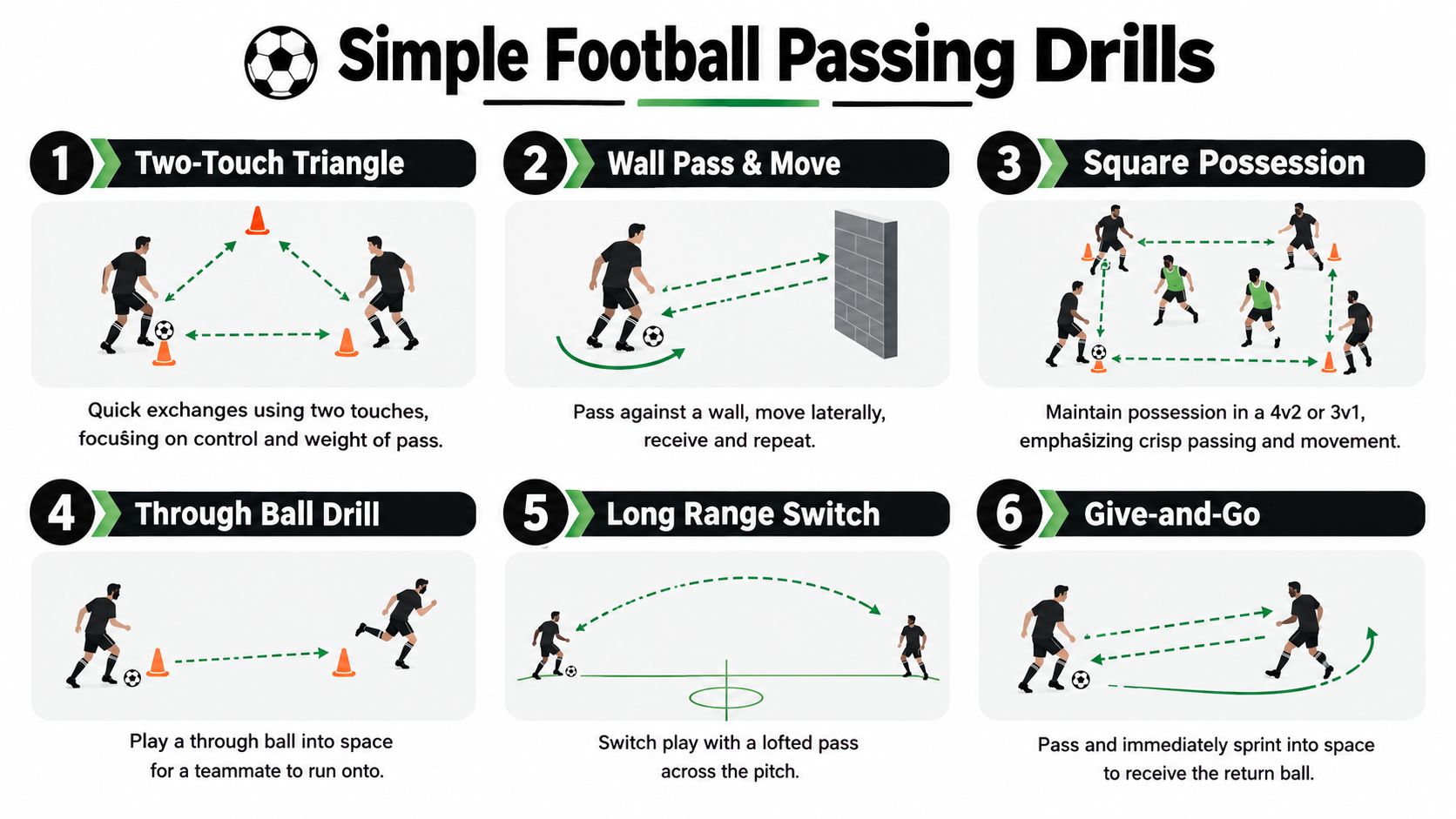
Pair passing with movement
Players: 2
Setup: Two players face each other with a small gate to shuffle across after passing.
Distance: Use short-passing distance first, then increase if quality holds.
Play a firm pass, receive across the body, and move a step or two before the return. Keep it two-touch to begin with. The key is that players don't stay planted after releasing the ball.
Coaching cues
- Receive side-on
- First touch out of feet
- Pass to the correct foot
- Move as the ball travels
Quick progression
Call “feet” or “space” before each pass. If the receiver says “feet”, play directly to them. If they say “space”, lead them into the gate.
This is also where rebound work helps. If you're using a board or wall, solo players can repeat the same ideas with angle changes and tempo shifts. These soccer rebounder drills suit that kind of technical passing work.
The three-cone technical circuit
A British youth coaching resource from Footy4Kids uses a very clear format for this kind of work. Put players in pairs with one ball and three flat cones in a short line, then rotate through seven passing actions for 30 seconds each, including first-time left-foot and right-foot returns, bouncing serves with half-volleys, aerial serves with volleys, and an aerial serve headed back (Footy4Kids passing drills).
This drill works well when players need lots of clean contacts in a short time.
What works
- Short, focused bouts
- Clear technical theme
- Plenty of repetition without long explanation
What goes wrong
- Players rush and technique gets sloppy
- Distances drift too far apart
- Weaker foot gets avoided unless you insist on it
Square passing with follow movement
Players: 4 or more
Setup: Make a square with one player on each cone.
Execution: Pass and follow your ball, or pass and support diagonally depending on level.
This is one of the easiest simple football passing drills to run with mixed ability groups because everyone can see the shape. It also teaches the habit of moving immediately after the pass instead of admiring it.
Coaching cues
- Open hips before receiving
- Take the first touch to the next action
- Don't kill the ball under your feet
- Arrive early as support
Progression
Add one central defender. Now players must decide whether the next pass should go safely into feet or around pressure into space.
Here's a quick comparison you can use on the pitch.
| Drill | Setup and Distance | Core Focus | Quick Progression |
|---|---|---|---|
| Pair passing with movement | Two players at short range, moving across a small gate | Clean technique and support after pass | Call “feet” or “space” before receiving |
| Three-cone technical circuit | Pairs with one ball and a short cone line | Repetition, foot usage, clean contact | Reduce touches or alternate feet |
| Square passing | Four players in a square, moderate spacing | Body shape and movement after pass | Add a central defender |
| Rondo keep-ball | Small outside group versus defenders | Tempo, scanning, support angles | Limit touches or add target passes |
| End-zone passing game | Two teams and scoring end zones | Penetration and timing of forward pass | Score only if the receiver runs onto the ball |
| Pass-turn-dribble action | Server, receiver, defender, target zone | Receiving under pressure and turning | Add recovering pressure from behind |
A visual helps some players more than a long talk. Use this if you want a quick session prompt.
Rondo keep-ball in a tight grid
Simple drills start looking more like football.
Recent UK coaching content increasingly leans towards compact, game-like passing practices such as rondos and conditioned games, especially when space and time are limited. England Football materials also add communication constraints such as calling “feet” or “space” before the pass, which fits real grassroots conditions far better than endless static pair work (England Football festival week passing and receiving resource).
Why it works
Players must scan, angle their body, and support quickly because pressure is live. Even a basic 3v1 or 4v2 gives more realistic information than an unopposed square.
The best simple drill often isn't the one with the most repetitions. It's the one that forces the clearest decisions without becoming chaotic.
End-zone passing game
Players: Small teams
Setup: Mark an end zone at each end of a small pitch.
Scoring: A team scores by passing into a teammate in the end zone.
The FA's grassroots coaching materials use passing-led small-sided formats including 5v5 breakout games and end-zone passing tasks, and a six-week session programme for 12-16s is built around improving passing and receiving. Independent UK coaching libraries also list 214 football passing drills, which tells you how passing is treated as a foundation skill in British development (The FA grassroots coaching guide).
Use this drill to teach timing and penetration. If the pass goes too early, it gets intercepted. Too late, and the space disappears.
Progression
Only count the score if the receiving player has checked away first, then moved onto the pass.
Pass, receive, turn, attack space
England Football Learning recommends a passing-and-moving session where one attacker and one defender start outside the area, the ball is played into the area for the attacker to receive, and the attacker tries to turn and dribble to a scoring zone behind them while the defender attempts to win it back (England Football dribbling session with passing and moving).
That format is excellent for teaching players that the pass is only the start of the action. The receiving player must judge body shape, pressure, and which touch creates the escape.
If players keep receiving flat and getting caught, simplify the entry pass first. If they're handling it easily, tighten the area or speed up the defender's release.
How to Build a Complete Passing Session Plan
On a tight, cold pitch on a Tuesday night, a passing session goes wrong for the same reason most matches do. Players can pass when the picture is simple, then freeze once the space closes and the next decision arrives. A good session plan fixes that by building from clean technique into realistic choices.
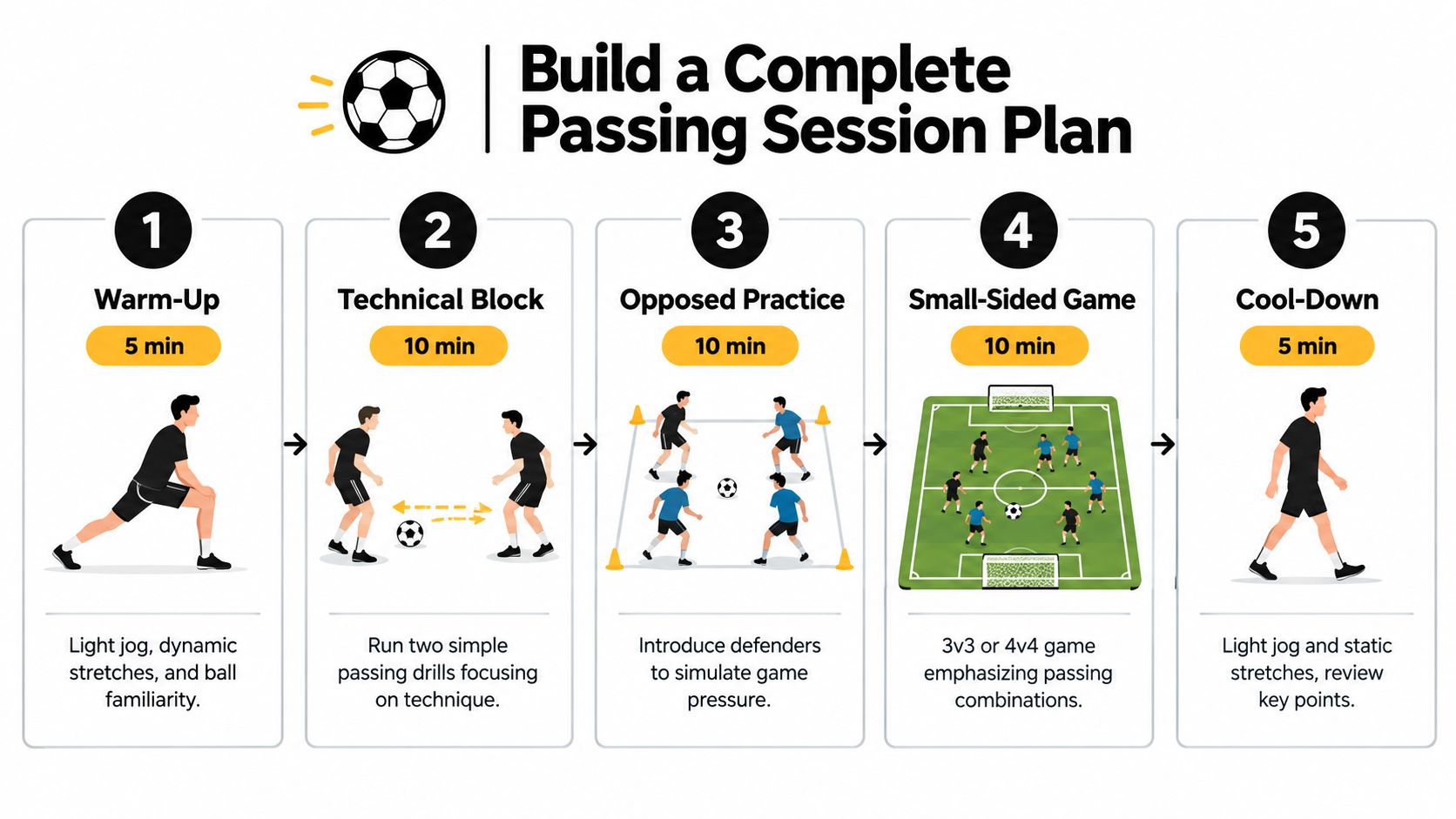
A practical weekly structure
A 30 to 45 minute passing session usually works best with one theme and clear progressions. If the theme is passing, every block should still ask for more than passing alone. Body shape, scanning, communication, and the choice between feet or space all need to show up.
-
Warm-up
Start with pair or triangle passing on the move. Add a simple scan rule before the ball arrives, or ask players to call "feet" or "space" early so the passer has a real cue to work from. -
Technical block
Use one drill with repeatable detail, such as square passing or a three-cone pattern. Keep the distances realistic for your age group and pitch. On poor surfaces, shorter distances and firmer passes usually give you better habits than stretching the practice too early. -
Decision-led opposed practice
Move into a rondo, gate game, or receive-and-turn practice where the player on the ball must read pressure. This is the point where players learn the trade-off. Pass to feet if the receiver is marked tight and needs security. Pass into space if they can travel onto it and play forward. -
Small-sided game
Finish with a game that rewards the behaviour you coached. End zones, target players, or directional overloads work well because they force players to recognise when to keep it, when to break a line, and when to support underneath. These small-sided soccer games fit well here if you want game-like repetition without losing the passing theme. -
Short review
Keep the review to one or two coaching points. Ask what players saw, not just what they did. That helps them connect the pass to the picture around it.
Build the session by changing the decision, not just the pattern
Cone patterns have a place. They help players settle the technique and find a rhythm.
They are only the start.
The next step is to change what the player has to notice. One round might reward passes to feet. The next might only count if the receiver runs onto the ball in space. You can also add a communication condition, such as the receiving player calling the side they want it on, or a scanning condition where they must check over a shoulder before the pass is played.
That keeps the session closer to what happens in matches on grassroots pitches, where space is tight, support is late, and the first option is not always the right one.
Keep the error rate under control
A session should challenge players, but it should not collapse into constant turnovers. If the ball is breaking down every second pass, the practice is too hard or the area is wrong.
In practice, that usually means:
- Shorter work periods: Stop and reset before the quality falls off badly.
- Better angles of support: Many bad passes start with poor spacing, not poor technique.
- One clear intervention: Fix the biggest issue first, then let the practice run.
- Smaller adjustments in bad weather: On wet or bobbly pitches, reduce the area slightly or remove one defender before asking for more speed.
I would much rather see a group complete the right action consistently, then increase pressure, than struggle through a drill that is beyond them and learn nothing from it.
Adapt for age, ability, and small spaces
For younger or mixed-ability groups, keep the decision but reduce the load. Bring the distances in. Give the receiver a head start. Limit the defender's release. Those changes keep the idea of the practice intact without turning it into a mess.
Small spaces can help if you coach them properly. They force quicker scanning, earlier support, and clearer communication. The mistake many coaches make is shrinking the area without changing the task. If the pitch is tight, ask for fewer touches, sharper angles, and more detail in the first touch. If the group is struggling, remove one decision, not all of them.
As noted earlier, good passing sessions progress best when players are asked to recognise the right pass, not just complete a set pattern.
Common Passing Mistakes and How to Fix Them
Most passing mistakes aren't random. They follow patterns. Once you spot the pattern, the fix is usually simple.
The five issues that appear every week
| Symptom | Likely cause | Quick cue |
|---|---|---|
| Player receives square and gets closed down | Poor body shape before the pass | Open up early |
| First touch runs into pressure | No scan before receiving | Check shoulder first |
| Pass arrives behind teammate | Passer didn't see the receiving angle | Play the picture |
| Ball keeps dying under feet | First touch is dead instead of purposeful | Touch to next action |
| Players keep colliding or passing blind | No communication | Say it early |
These problems often stack up. A player doesn't scan, receives square, takes a poor touch, then forces a rushed pass. That looks like a technical issue, but it often starts with information.
On-pitch fix: Correct one thing at a time. If you coach body shape, scanning, and pass weight all in the same stoppage, most players won't hold onto any of it.
When to simplify and when to add pressure
Simplify the drill if players can't complete the basic action cleanly. Bring distances in. Remove a defender. Slow the entry pass. That isn't making it easy. It's protecting the quality of the habit.
Add pressure when players are passing neatly without needing to think. A second defender, a touch limit, or a call of “feet” or “space” before receipt usually gives enough decision stress without wrecking the session.
If first touch is causing half the passing problems, some separate soccer ball control drills can clean that up quickly before you layer more pressure onto the passing work.
Don't let bad reps pile up
Short bouts help. So does fast feedback. If a pattern falls apart, stop the group, show the angle, restart, and get out of the way.
Long lectures in the cold don't improve passing. Better pictures do.
How to Track Progress and Keep Improving
If you don't standardise the drill, it's hard to know whether players are improving or just getting used to the pattern.
A UK validation study of the Loughborough Soccer Passing Test found it to be a valid and reliable way to examine soccer skill performance in young players, which supports a simple coaching principle. Keep the distance, target size, foot usage, and time pressure consistent when you want a fair comparison over time (validation of the Loughborough Soccer Passing Test in young soccer players).
Use that idea informally in grassroots sessions:
- Repeat the same setup: Same grid, same target, same conditions.
- Watch the type of success: Are players just completing passes, or are they choosing better moments and angles?
- Know when to move on: If the drill no longer demands scanning, movement, or a decision, add one of them next.
The point isn't to turn every session into a test. It's to make sure the passing is improving and not just looking tidy in isolation.
If you want to build better passing sessions with the right gear around them, SoccerWares offers training essentials such as rebounders, goals, indoor mats, shin guards, GPS trackers, and supporter kit for football families. It's a practical place to find equipment that suits the kind of small-space, repeatable passing work that helps players improve week by week.