

You're in the garden with a ball, a few cones and a player who wants to practise, but nobody else is available to pass. A wall gives you the same hard return every time, and chasing the ball after each shot wastes the session. A good soccer rebounder trainer gives the player an active training partner without needing another person.
The right model can sharpen first touch, passing, reactions and finishing. The wrong one can flex on impact, move across the grass, make irritating noises and spend more time being stored than used. The difference comes down to return behaviour, frame stability, setup space and how much outdoor maintenance you're prepared to accept.
What a Soccer Rebounder Trainer Actually Does
A football rebounder is an angled, sprung or tensioned frame that sends the ball back after the player strikes it. It's commonly used for first touch, passing and shooting drills, especially when a player needs controlled repetitions without a partner, as explained in this football training equipment guide.
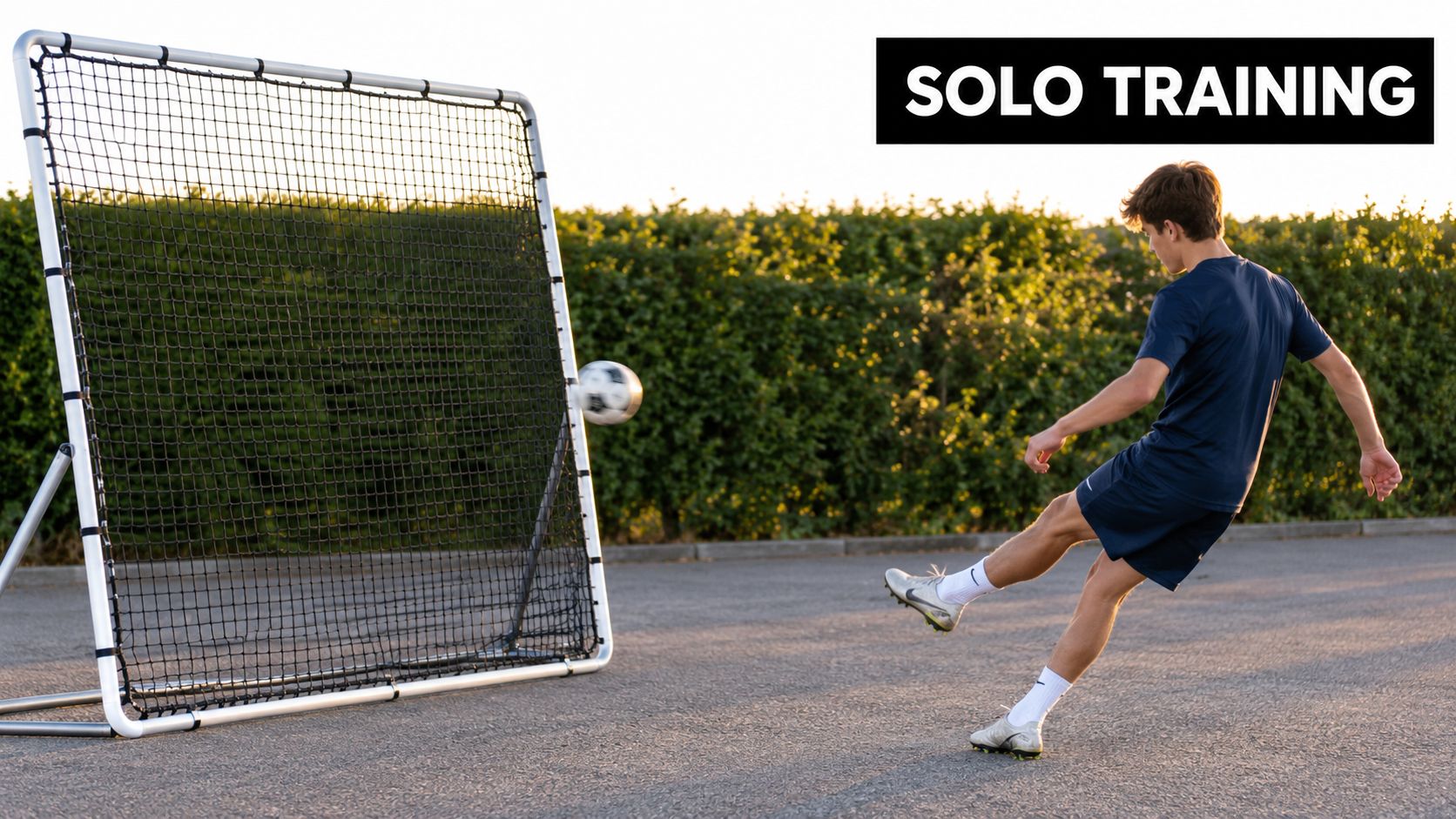
The mechanics are straightforward. Frame angle controls the direction of the return, while net tension and mesh construction influence its speed and predictability. A flatter setup tends to keep the ball closer to the ground. A steeper angle can lift the return towards the chest, head or volley zone. A tighter, more consistent net suits repetition work. A looser or knotted surface creates a more varied response that forces the player to adjust.
That makes a rebounder more useful than just kicking against a wall for certain sessions. A wall is reliable, but it doesn't change angle, absorb impact or offer much control over the return. A rebounder can be moved, angled and used for ground passes, lifted balls, awkward first touches and finishing after a deflection.
Coach's rule: Use the rebounder to create the type of return you want to practise, not just to keep the ball moving.
A player working alone can pass into the lower section, receive on the back foot and play again. They can strike harder and react to a faster return, or reduce the distance and focus on clean technique. That flexibility is the reason a rebounder earns its space in a garden, garage or training bag.
Why Rebounder Training Builds Real Match Skills
Rebounder practice earns its place because matches rarely give players perfect service. The ball can glance off a defender, spill from a goalkeeper or arrive at an awkward height after a clearance. Players who can adjust their feet, body shape and contact point quickly are better prepared for those moments.
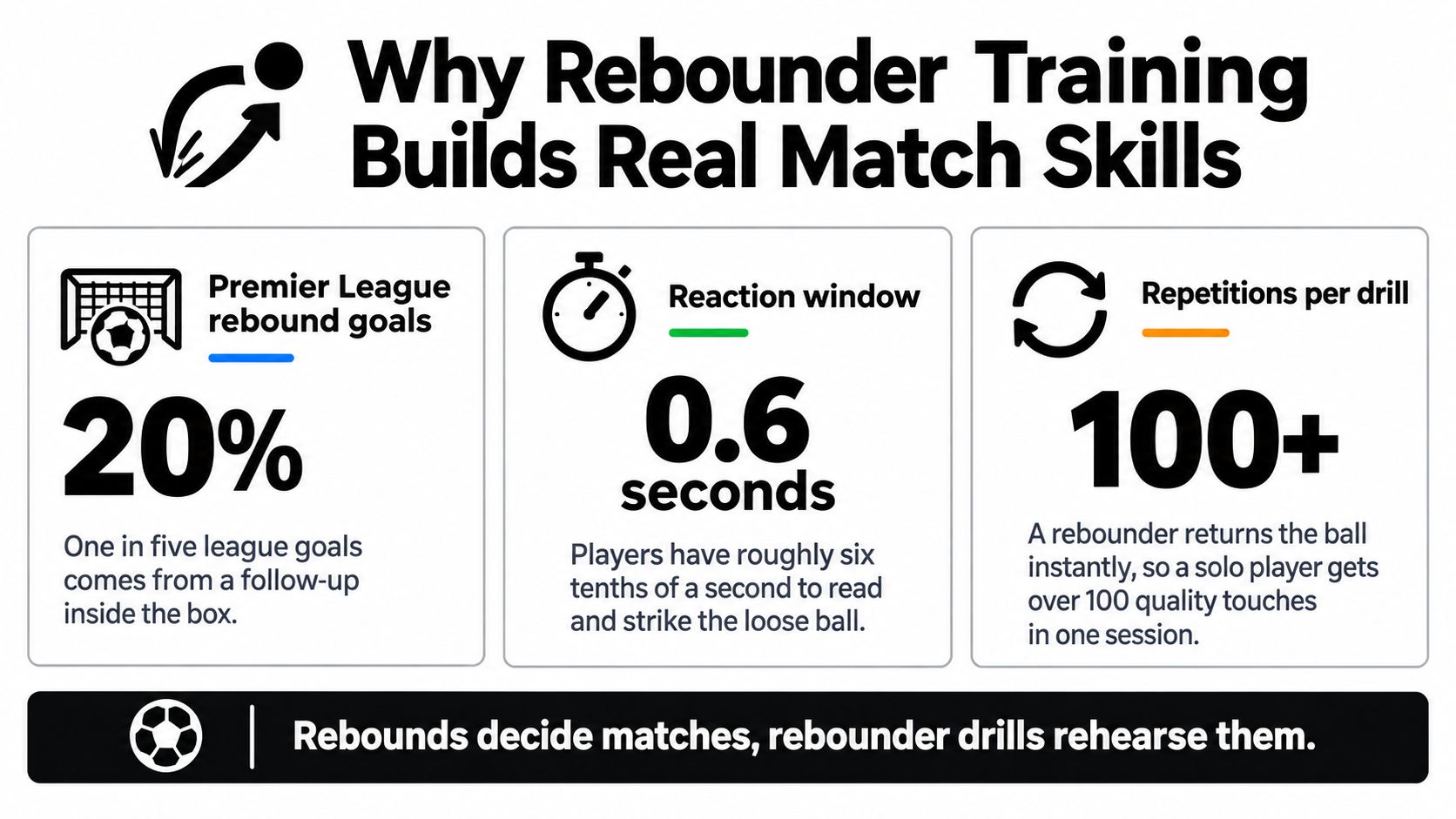
A 2024 study covering English Premier League matches from the 2012/2013 through 2018/2019 seasons recorded 554 rebound goals from 7,263 total goals. Rebounds accounted for 7.6% of goals, and they appeared in 502 of 2,660 matches, or 18.9% of matches analysed, according to the study details linked through this UK football product resource. That doesn't mean every player should chase rebounds blindly. It does show that second-ball situations are a regular part of elite football.
The transfer from repetition to match play
The useful transfer isn't the rebounder itself. It's the behaviour the player rehearses:
- First-touch players learn to cushion or redirect a return instead of waiting for a perfect pass.
- Midfielders can repeat firm passes, receive across the body and play with either foot.
- Attackers can practise striking a ball that arrives at an inconvenient angle.
- Goalkeepers can work on quick hands, recovery steps and second saves.
- Young players gain frequent contact with the ball without standing in a queue.
Solo training also has one advantage that partner work can't always match. The player can repeat the same action immediately, adjust the angle, then repeat it again while concentrating on one detail. That makes a rebounder particularly effective for technique building. It won't replace scanning, contact, decision-making or pressure from opponents, but it can make the underlying movement more automatic.
A useful session finishes with transfer work. After controlled passes, add a turn. After first-touch returns, move into space before the next contact. After volley practice, finish towards a defined target. The rebounder supplies the return, but the player must add the movement and decision that make the skill relevant to a match.
Types of Soccer Rebounder Trainers and Who They Suit
Not every rebounder deserves the same job. A compact net can be excellent for passing but frustrating for powerful shooting. A large steel frame can produce better returns but become a nuisance if you have nowhere to store it.
Soccer Rebounder Trainer Types at a Glance
| Type | Portability | Return Consistency | Best For |
|---|---|---|---|
| Flat-panel net rebounder | High | Moderate | Quick passing and small gardens |
| Angled steel-frame rebounder | Moderate | High when anchored correctly | First touch, passing and finishing |
| Dual-sided rebounder | Moderate to high | Varies by side | Two players or mixed drills |
| Small target rebounder | High | Moderate to high | Accuracy work and younger players |
Flat-panel net rebounders are the easiest to move and usually the quickest to set up. They suit a player who wants short passing sessions, clean receiving and basic control. Their weakness is limited variation. If the panel stays close to one angle, the player gets a dependable return but less opportunity to practise high balls or changing trajectories.
Angled steel-frame models are my preferred choice for serious garden use. A firm frame and proper ground contact reduce unwanted movement, especially when the player hits with pace. Adjustable models are more versatile. The EXIT Kickback, for example, offers settings from 35° to 90°, giving the player a broad range of return heights and directions, as shown in EXIT's UK rebounder range.
Mesh matters as much as the frame. UK product data comparing RapidFire constructions identifies 48mm knotted mesh as producing a less predictable return, while 30mm knotless mesh gives a more consistent bounce for repetition-based work. Choose the former for variation and reaction training. Choose the latter when accuracy and rhythm matter more.
Dual-sided rebounders make sense for siblings, teammates or a coach working with two players. One side may suit low passing while the other supports higher returns. The trade-off is that each face can be narrower or less specialised than a dedicated trainer.
Small freestanding targets work well for children, limited spaces and accuracy exercises. They won't give an older player the same return quality after a driven strike, but they're easy to carry and less intimidating for beginners.
For wider sports-equipment context, Backyard Hoop Reviews' basketball rebounder guide is useful because it explains how frame stability and return behaviour affect training across rebound-based sports. For football-specific target ideas, see SoccerWares' guide to football practice targets.
Five Rebounder Drills That Actually Improve Your Game
A rebounder only improves a player when the drill demands a specific response. Set it up safely, keep the first repetitions clean and change the task before technique becomes sloppy. UK football guidance recommends at least 5–7 metres of clear working space. Use 3–5 metres for controlled passing and first touch, 5–8 metres for reaction drills and 8+ metres for driven passes and shooting patterns, as outlined in this rebound-board setup guide.
One-touch passing circuit
Stand 3–5 metres away. Pass into the lower section and play the return first time with the inside of the foot. Alternate feet and aim for the same section of net.
This trains passing weight, ankle stability and rhythm. Progress by moving slightly wider after each return, so the player has to adjust their body before playing the next pass. A knotless net and firm frame work best here.
Reaction first touch
Move back to 5–8 metres and angle the rebounder so the ball returns across the body. Let the ball travel, then receive with the far foot into space before playing the next pass.
The player shouldn't trap the ball underneath them. The target is a first touch that creates the next action. Increase difficulty by changing the angle between repetitions or receiving with the outside of the foot.
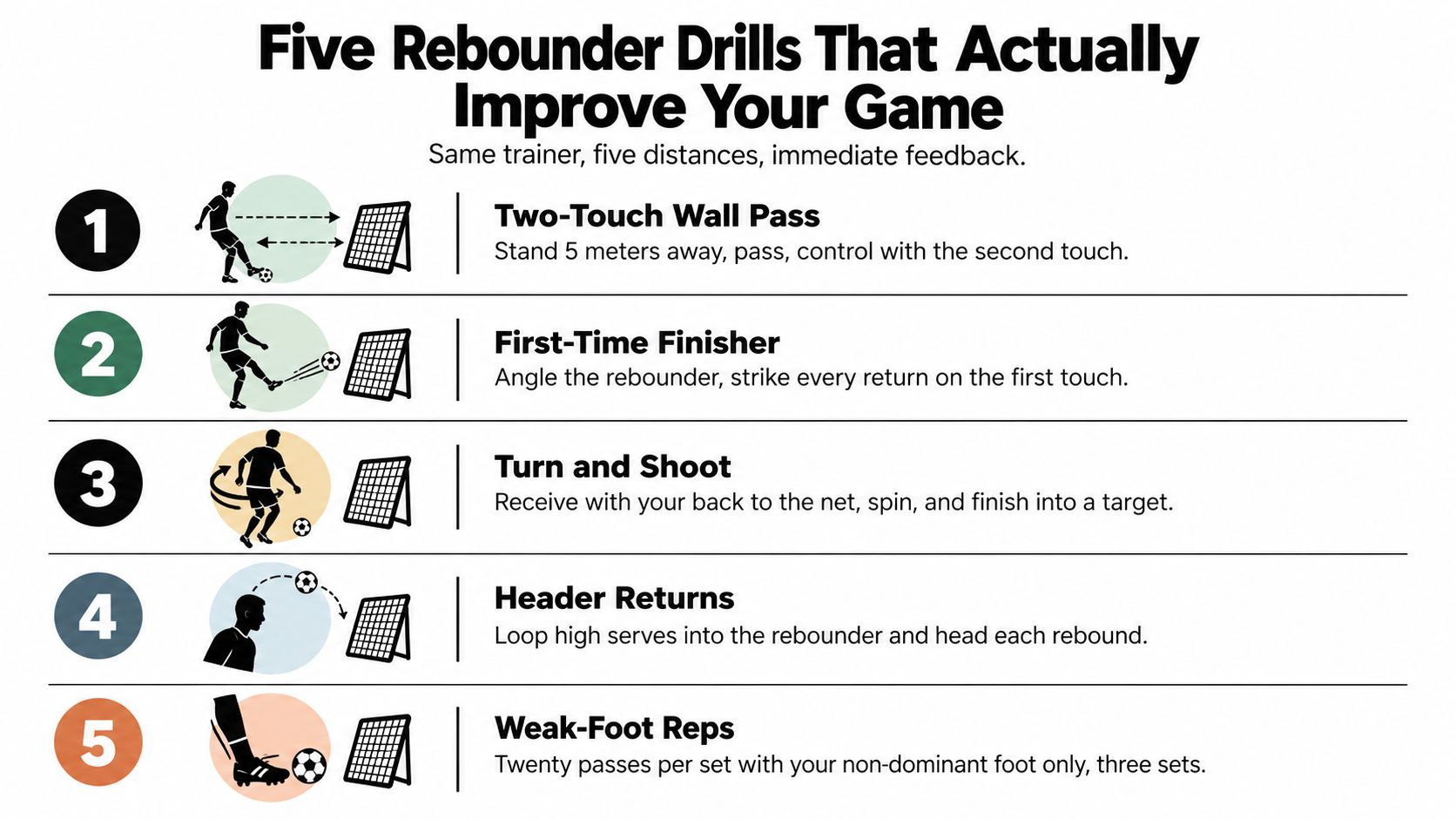
Volley finishing
Use a mid-to-high angle and stand far enough away for the ball to rise into a striking zone. Start with controlled volleys using the laces, then vary the contact point between the instep and side foot.
Keep the plant foot stable and land balanced. This works best with an adjustable steel-frame rebounder that can provide a repeatable lifted return.
Weak-foot isolation
Stand at a manageable passing distance and use only the non-dominant foot. Pass, receive and pass again without switching sides when the ball arrives awkwardly.
The purpose isn't to smash the ball. It's to make the weaker foot responsible for the whole sequence. Change the angle once the player can control the return comfortably. A predictable mesh helps the player focus on technique rather than random bounce.
Goalkeeper reflex returns
A goalkeeper can use a flat-panel rebounder from close range. Serve the ball into different parts of the panel, then set the feet, catch or parry, recover and prepare for the next return.
Keep the early work controlled. Add low corners, chest-height returns and deflections only when the goalkeeper moves safely. The SoccerWares soccer rebounder drills guide offers further ideas for building sessions around these actions.
Maintaining Your Rebounder for Long-Term Outdoor Use
Garden use exposes every weak point. Rain reaches the joints, wet grass softens the ground and repeated impact tests the net tension. A rebounder that feels solid on its first session can become noisy or unstable if you leave it assembled without checking it.
UK product FAQs identify several ownership issues that buyers often discover late. Stability bars may be intentionally loose, metal-sprung frames can develop squeaks, and support arrangements can vary by warehouse region, as documented in this UK rebounder product FAQ.
Checks that prevent most problems
- Inspect the anchors: Push the ground pegs fully into firm soil and reset them if the frame starts walking.
- Check the net tension: A sagging panel changes the return and places more strain on attachment points.
- Dry wet components: Wipe the frame and net before storage, particularly around joints and spring housings.
- Listen for squeaks: A new noise usually indicates friction at a spring, connector or moving joint. Use only suitable manufacturer-approved lubricant.
- Look for corrosion: Treat small marks early. Rust around a load-bearing joint is a reason to stop using the frame until it's assessed.
Don't assume a loose stability bar means the trainer is faulty. Some designs allow movement by intention, but the bar still needs to sit correctly and keep the frame supported. Check the manual before tightening anything aggressively.
A net panel can often be replaced while the frame remains serviceable. Replace the whole rebounder when the frame bends, anchors no longer hold or the return becomes inconsistent because the structure has lost its shape. In the UK, I wouldn't leave a rebounder outside all year unless the manufacturer clearly allows it. Disassemble it during prolonged wet or cold periods, keep the net dry and store the frame off damp ground. A practical guide to building a soccer rebounder can also help you understand how the parts should sit before you start modifying or repairing anything.
How to Choose the Right Soccer Rebounder Trainer
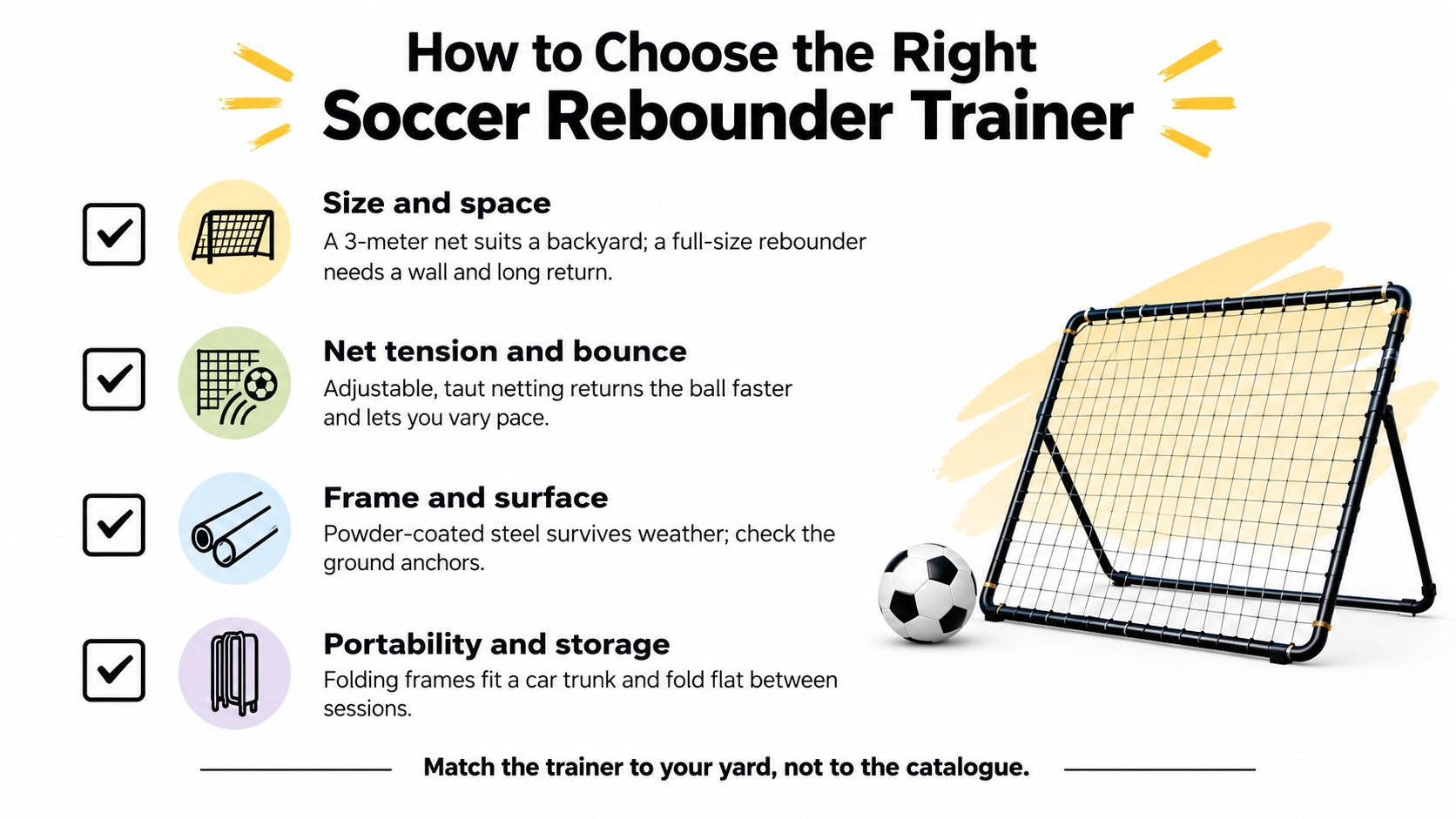
Start with the garden, not the product catalogue. A player with limited space needs a compact panel that can be packed away quickly. A teenager practising driven passes needs a frame that stays planted and offers enough distance for the ball to travel safely.
Match the trainer to the player
A younger beginner usually benefits from a simpler, lighter model with an approachable return. The priority is learning to receive, pass and move without wrestling with a large frame. Older players who strike the ball harder should favour a rigid steel construction, reliable ground anchors and an adjustable angle.
Your storage situation matters just as much. If the rebounder has to pass through a shed door or live in a hallway, folding design and weight may matter more than an extra target surface. If you have a permanent training area, stability and return quality deserve priority.
Spend according to use
Entry-level models can be sensible for occasional passing and younger players, but they usually offer fewer adjustments and less durable construction. Mid-range trainers tend to balance portability with a sturdier frame and more useful return angles. Performance-grade models make sense when several players will use them regularly, or when wet-weather exposure and powerful striking demand better materials.
Don't pay for features you won't use. Adjustable angles are valuable if you'll practise low passes, lifted returns and finishing. They're wasted if the trainer stays in one position for short garden sessions.
Demand is clearly seasonal in the UK marketplace. A niche analysis estimated 371,000 searches for football rebounders in the past 12 months, around £226,000 in annual revenue, an average selling price of £22.84, and demand peaking in November to December, according to UK football rebounder market data. That makes autumn a sensible time to compare construction, storage and replacement support before buying in a rush.
SoccerWares stocks rebounders alongside training equipment such as goals, shin guards and indoor training mats, so you can build a session around the trainer rather than treating it as a standalone purchase. Target nets can add a defined finish to shooting work, while an independent SoccerWares rebounder review guide can help you compare models before committing.
Choose the trainer that matches your available space, the player's striking power and your willingness to maintain it. A modest rebounder that gets used every week beats a larger model that stays folded in the shed.
Visit SoccerWares to compare rebounders, goals and supporting training equipment for garden, indoor and club practice. Choose a trainer that matches your player's age, space and training goals, then use it with a structured drill plan rather than relying on random touches.