

You clip on the boots, check the WhatsApp group, and hope the weather holds. On a wet Saturday morning, a coach at a grassroots club might be doing the same thing while fastening a small vest-mounted unit to a centre-back before warm-up. By full time, the guesswork's gone, because he can see who covered the most ground, who was still sprinting late on, and who probably needs Monday off.
That's the answer to what is a GPS tracker used for. It's not just a gadget for cars, and it's not only a fitness toy. In football, it turns movement into usable information, and in other parts of UK life it does similar work, from vehicle recovery to location oversight and fleet monitoring. The value comes from the same basic idea each time, a receiver catches satellite signals, turns them into position data, and sends that data somewhere people can use it.
Why a GPS Tracker on a Training Pitch Changes Everything
A session can look lively from the touchline and still hide problems. A winger may keep chasing, a midfielder may stay busy, and a centre-back may appear solid, yet the coach still does not know who worked at match speed and who coasted through the drills. A GPS tracker gives that missing layer of proof.
From opinion to evidence
The process is simple on the pitch. The player wears a vest, the unit records movement in the background, and the staff reviews the session afterwards. You can see who pushed hard in the drills, who faded near the end, and who spent too long outside the tempo of the group.
That changes the conversation for the player as well. “You need to do more” becomes a clearer discussion about where the running dropped off and what kind of work is missing. It also helps parents on the touchline, because the talk shifts to load, recovery, and progress, rather than a vague sense of whether their child looks fit.
A tracker also fits into wider training habits, such as warm-ups, recovery work, and injury prevention equipment. In that setting, the numbers help staff check whether the session and the protection around it match the player's workload.
The point is not to replace a coach's eye. It is to keep that eye from carrying the whole load.
Satellites broadcast timing signals continuously. The vest listens for them, the way a player reads a defender's movement and reacts to the space that opens up.
How a GPS Tracker Works From Satellite to Screen
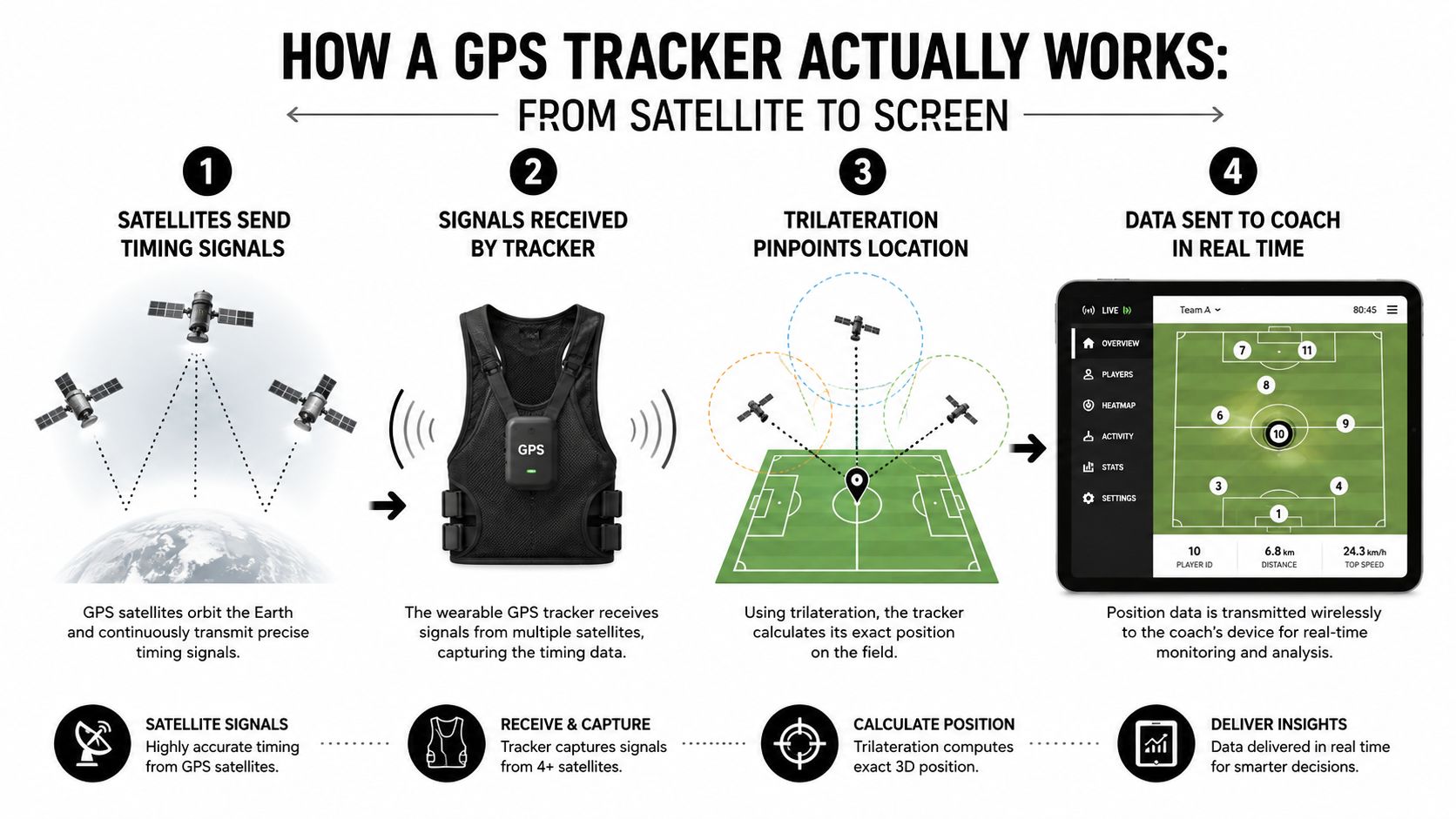
A GPS tracker may look simple on the outside, but the path from sky to screen has several steps. Satellites broadcast timing signals continuously, the wearable receives them, onboard software calculates position, and the coach sees the output later on a tablet or dashboard. If any part of that chain slips, the numbers become harder to trust.
Step by step in football language
Satellites send timing signals all the time, and the vest listens for them. The receiver works out position by comparing signal timing from multiple satellites, which is how the unit knows where the player is on the pitch. In football terms, it is the difference between guessing a run and watching the run line up with the ball.
The tracker then samples movement very quickly. In football wearables, that matters because the device has to catch short bursts, turns and repeated accelerations, not just a rough outline of where the player went. The onboard processor strips out some noise before the data leaves the unit.
Simple way to read it: the tracker does not “see” football. It measures position, then software turns that position into running data.
The session then syncs to a dashboard. That is where the coach reviews the work, compares players, and checks what happened rather than what it felt like. Clear sky helps the signal, so roofs, stands and other cover can weaken it. Ordnance Survey notes that RTK GNSS can reach few-centimetre level real-time accuracy, while DGNSS can provide sub-metre accuracy in real time, and that network RTK quality across England and Wales is typically 10-20 mm horizontally and 15-35 mm vertically when conditions are strong Ordnance Survey GNSS guidance. That level of precision suits careful logging, while also showing why the environment matters so much.
For a football-specific follow-up, SoccerWares' guide to wearable football sensors 2025 fits well beside this technical breakdown.
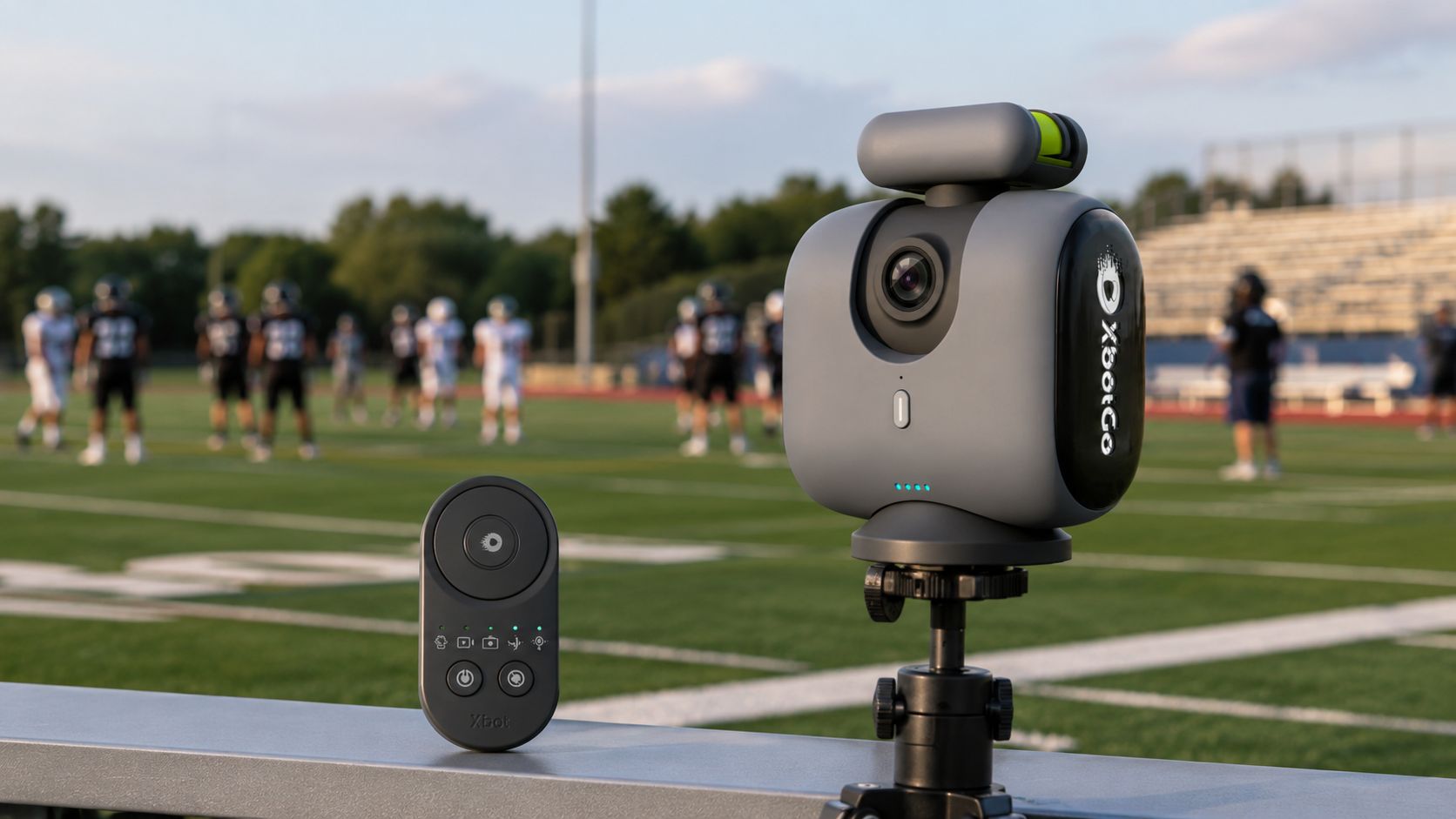
A camera follows the action on video. A GPS wearable records player movement. The XbotGo Chameleon AI Sports Tracking Camera – 4K Auto-Tracking, Live Streaming AL and a vest solve different problems, so the right choice depends on whether you want footage, movement data, or both.
The Four Numbers a Football GPS Tracker Measures
A football GPS tracker can spit out a lot of jargon, but most of the useful stuff sits in four families of numbers. Coaches don't need a science degree to use them. They just need to know what each family answers on a Tuesday session and what it means by the weekend.
Distance, speed, position and load
Distance tells you how much ground a player covered, both in total and across zones. If the winger's total distance is low compared with the rest of the group, the coach asks a fair question, did the session suit the player, or did they drift out of the work? In the UK, football-specific testing has shown low-cost GPS systems can measure total distance and velocity validly and reliably, with total distance SEE at 3.1% and intra-device CV at 2.0%, and velocity SEE at 3.4% with CV at 4.7% University of Gloucestershire football GPS study-The-accuracy-of-a-low-cost-GPS-system-during-football.pdf). That tells you the category can work well enough for training management when used properly.
Speed is about who stayed sharp when fatigue started creeping in. Peak speed and threshold work can show whether a full-back still had legs in the last 10 minutes or whether the sprint output tailed off early. For football coaches, that matters because pace is often the first thing to go when legs are heavy.
Position becomes heatmaps, spacing checks and shape questions. Did the midfield really stay compact, or did the distances between lines open up too much? In the real world, GPS becomes tactical rather than just physical, because it helps you see where the player spent time, not just how hard they ran.
Load tries to capture how hard the session felt in a broader sense. That can include accelerations, decelerations and impacts, or an arbitrary load measure tied to how the staff define the session. For youth players, this is the family of numbers that keeps a heavy Wednesday from becoming a ruined Saturday.
| Metric Family | What It Captures | Training Question It Answers |
|---|---|---|
| Distance | Total running and zone-based movement | How much ground did the player actually cover? |
| Speed | Peak pace, sprint work and threshold running | Who was still sharp late in the session? |
| Position | Heatmaps, shape and time in zones | Did the team stay compact and disciplined? |
| Load | Session stress, accelerations and overall effort | Was this too much for the player today? |
Coaching note: one number rarely tells the full story. The value comes from comparing the numbers with what you saw, not from staring at a dashboard in isolation.
For readers who want the gear side as well as the data side, SoccerWares' best GPS tracker for grassroots football guide is a useful next stop.
Turning Tracker Data Into Training and Tactical Decisions
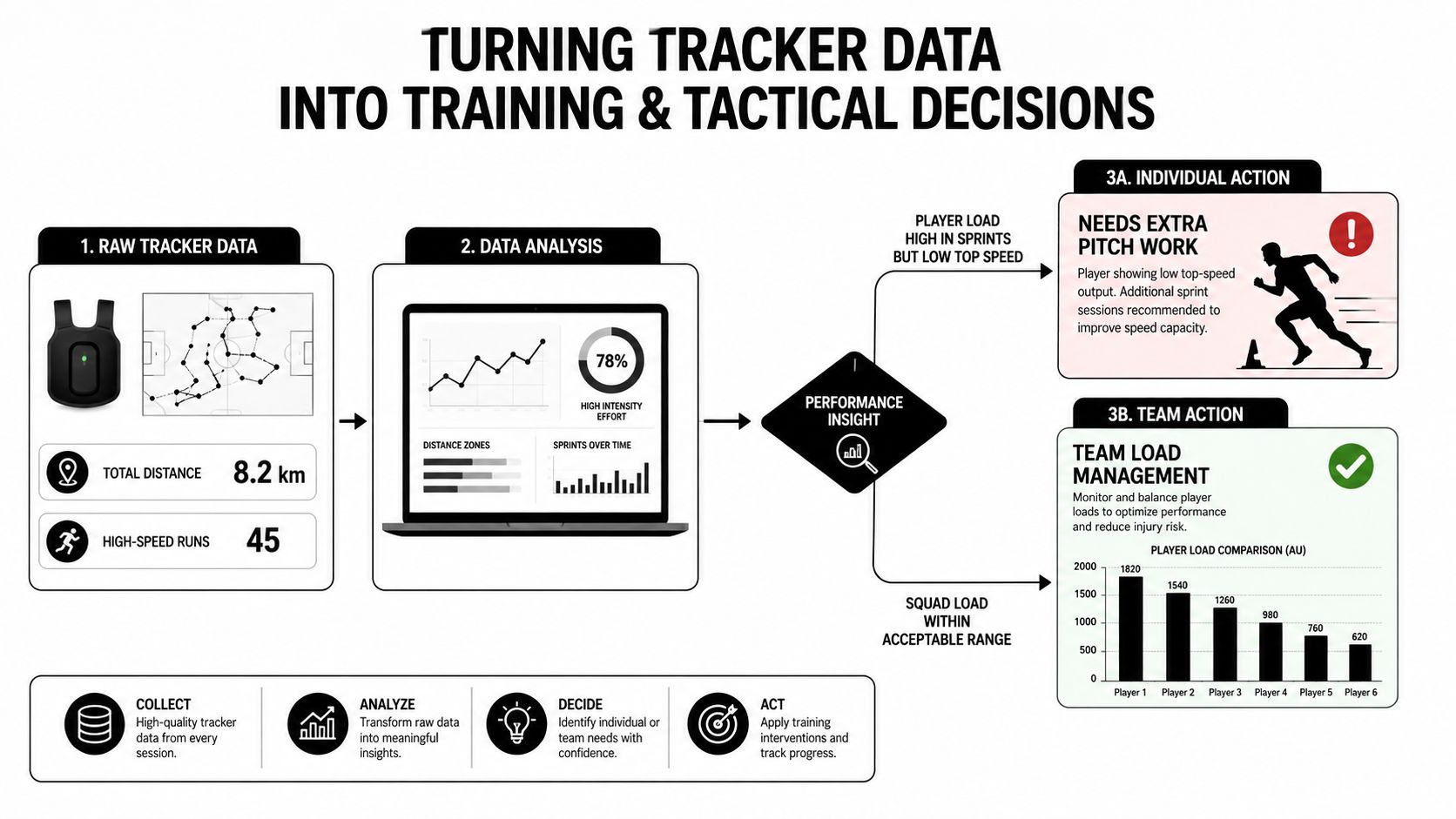
Raw data means nothing until a coach turns it into a decision. That's where a GPS tracker earns its keep. A player who posted lower total distance and fewer high-speed efforts than usual might need a sharper pitch session, while a returning centre-back with a higher load figure might need a lighter week and more recovery.
What the weekly workflow looks like
The cleanest workflow is simple.
- Capture the session: fit the unit, train as normal, and record the output without changing the drill just because the tracker is on.
- Review the key numbers: check distance, speed, position and load after the session.
- Adjust the next session: add extra pitch work, reduce intensity, or change the drill pattern.
- Watch recovery: use the next couple of days to see whether the player bounces back as expected.
A right-back who tops the sprint count may not need praise for being busy if the plan was to attack the space behind the opposition. A centre-mid who covers less ground than the winger might be drifting out of the role the team needs. The data doesn't make the football call on its own, it confirms, challenges or sharpens what the coach already suspects.
One useful habit is to ask one decision question before you look at the numbers. Do you want to know who needs recovery, who needs extra conditioning, or whether the shape held? If you don't know the question first, the dashboard just becomes noise.
The UK side of GPS use reinforces that point. In another setting, the Ministry of Justice reports that location monitoring devices made up 54% of all individuals fitted and monitored, totalling 14,386 people in the latest published statistics, and those devices are used to monitor exclusion zones, required attendance and whereabouts through trail monitoring, with GPS recording movements 24 hours a day Ministry of Justice electronic monitoring statistics. Football doesn't use trackers for the same reason, but the principle is familiar, the data has to serve a clear oversight purpose or it's just more information.
Choosing the Right Type of GPS Tracker for Your Game
The right tracker depends on who's wearing it and what the coach wants from it. A boot-mounted unit feels different from a vest, a wrist wearable behaves differently again, and a team system adds software and workflow on top of the hardware. Pick the form factor that matches the level of control you need.
Side by side comparison
| Form Factor | Sampling Rate | Best For | Price Band |
|---|---|---|---|
| Boot-mounted unit | Usually lower to mid-range | Academy players who want minimal interference | Entry to mid-range |
| Vest-based system | Often higher and more stable | Full training weeks, clubs and serious performance work | Mid to higher range |
| Wrist wearable | Varies, but generally simpler | Sunday league players and general fitness tracking | Lower to mid-range |
| Team-level system | Built for multi-player workflows | Coaching staff managing squads and weekly load | Higher range |
Boot-mounted options keep bulk off the torso, which some younger players prefer. They can feel less intrusive, but comfort and data depth may be more limited than a vest system. Vest-based units are the clearest fit when a club wants cleaner performance data, especially if the staff are already using training plans and recovery decisions.
Wrist wearables are easier to live with, but football movements can be awkward for optical readings during fast changes of direction. Team-level systems make sense when multiple players need the same process, same software and same review habit. If you're choosing at club level, that's usually the point where analysis depth matters more than the convenience of a single device.
Use case check: if the tracker only needs to tell you whether someone had a decent run-out, a simple wearable can work. If it has to support weekly planning, you're in vest or team-system territory.
If you're weighing that decision for a club, SoccerWares' GPS tracker battery life guide is a sensible companion to this section because battery life affects how realistic each form factor is across a full football week.
For a broader training kit context, SoccerWares also sells football wearables and equipment alongside fan gear, so a club can keep performance tools and support items under one roof without turning the choice into a research project.
Beyond the Pitch Everyday UK Uses for GPS Trackers
A lot of people still think GPS trackers are just for stolen cars. That's too narrow. In the UK, the same satellite-plus-receiver setup shows up in fleet vans, family safety devices, asset tracking and compliance tools, because location data solves more than one problem.
The government's GNSS disruption summary says GNSS and GPS-based systems are used by insurance companies to gather driving-behaviour information that would otherwise be hard to collect, and a major UK tracker network says it has recovered over 30,983 stolen vehicles worth more than £661 million since 1993, including 1,286 vehicles worth £31 million+ in the first nine months of 2025 UK GNSS economic impact summary. That's why vehicle recovery remains such a big real-world use case.
For small haulage firms and tradespeople, the appeal is simpler. A tracker helps with mileage logs, route awareness and keeping an eye on who's using the van and when. For families, it can mean peace of mind around a teen's first car or a dog on a walk in the Peak District, where a pet or vehicle can disappear from view very quickly.
Compliance matters too. UK guidance treats location data as sensitive, and employee tracking needs a lawful basis, fairness and transparency. The privacy side isn't a footnote, it's part of the device's job. If you're looking at fleet hardware and want a procurement checklist with that in mind, the SME fleet GPS vendor checklist from Fleetalyse is a useful practical resource.
The same principle applies whether you're tracking a van, a footballer or a trailer. The receiver gathers location, the software organises it, and the user needs a clear reason for collecting it in the first place.
Your Practical GPS Tracker Checklist
A tracker works best when it solves one clear job. Start with the decision you need to make this season, then pick the device that gives you the right signal for that job. If you cannot name the decision, you probably do not need the tracker yet.
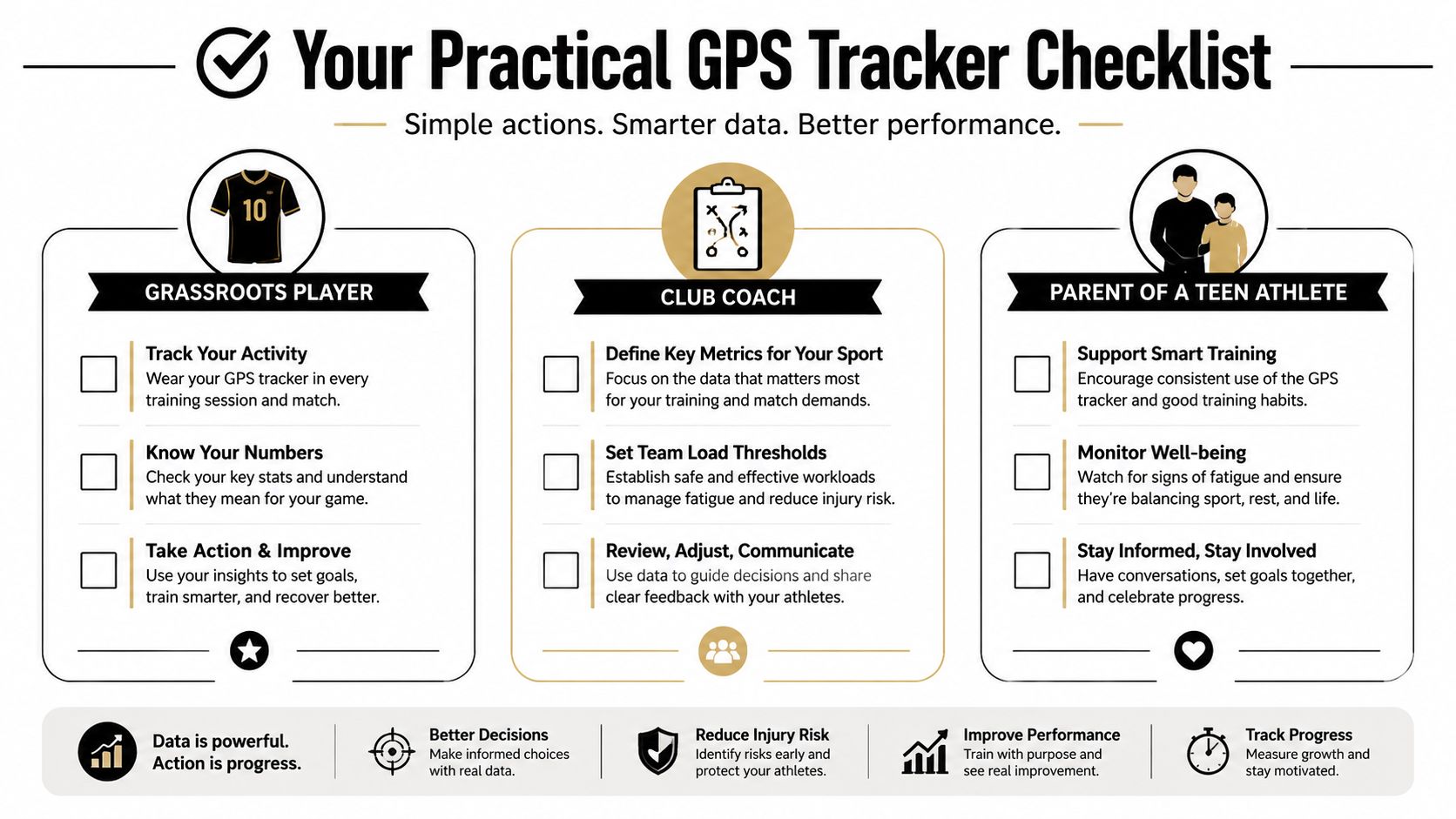
Grassroots player
- Check the sample rate first: for football, aim for 10 Hz or better so short bursts and changes of pace are not missed.
- Decide how you will wear it: a vest gives cleaner training data, while a wrist device is better if you only want simple fitness context.
- Watch the battery line: if it drops under 90 minutes, it is a poor fit for a full session.
Club coach
- Define the key metrics: distance, speed, position and load should each answer a real coaching question.
- Set one weekly action: extra pitch work, lighter recovery, or a tactical shape tweak.
- Use the numbers with your eyes: the screen should support what you saw, not replace it.
Parent of a teen athlete
- Ask what the tracker is for: training feedback, safety, or compliance with a team routine.
- Keep privacy in view: location data should be shared only for a clear purpose.
- Choose the simplest device that does the job: extra features do not help if nobody uses them well.
Chest-strap heart rate stays more reliable than wrist optical sensors during repeated sprints, so do not let a shiny screen distract you from the basics. Battery claims matter too. A device with a strong spec sheet still fails if it runs flat before the session finishes, which is why checking a GPS tracker battery life guide before you buy can save frustration later.
For a different kind of tracking question on the family side, a private detective can sometimes be the right contact when location questions sit alongside a wider fact-finding need, especially where privacy and consent need careful handling.