

You've probably seen it in a garden or on an artificial-turf pitch. A player stands in front of a rebound board, strikes the same pass repeatedly, and feels productive because the ball keeps coming back. Then match day arrives, a teammate closes them down, the next touch runs away, and the familiar movement disappears.
That gap is where bounce board football either becomes useful or turns into busy work. A rebound surface can give a player valuable repetitions, but only if the session progresses from predictable returns to controlled movement, scanning and decisions. The board is a tool for building technique, not a substitute for playing with people.
Why Bounce Board Football Works for Modern Players
A large-pitch training session gives players space, opponents and teammates, but it doesn't always give one player enough clean repetitions. A defender may touch the ball only occasionally. A young midfielder might spend much of a session waiting for the ball, while an adult training alone has no realistic way to recreate a passing pattern.
A rebound board changes that environment. The return is immediate, so the player can repeat the connection between body shape, first touch, pass weight and recovery movement. That repetition matters because receiving isn't just about stopping the ball. The player must judge its speed, adjust their feet, choose a surface of the foot and prepare the next action before the ball arrives.
Bounce-board football isn't a historically codified UK football code with its own governing laws, national competitions or official participation statistics. It's better understood as a modern training activity built around rebound surfaces. Its roots sit within England's wider football development. Before 1863, football followed different local and school rules, and on 26 October 1863 representatives met at the Freemasons' Tavern in London to establish a unified association-football code, as recorded by the National Football Museum's account of the 1863 laws.
Constraint creates useful repetition
The Football Association then drafted 13 laws in December 1863, creating a common framework for association football. The Sheffield tradition also mattered. Sheffield Football Club was founded in 1857, the Youdan Cup was played under Sheffield Rules in 1867, and the Sheffield Association adopted FA laws in 1877, according to the historical record linked above.
The point isn't that Victorian footballers were using modern rebounders. They weren't. The useful connection is that British football has long developed through structured constraints, changing rules and controlled environments. A board provides a small, repeatable constraint that helps players work on passing, control, first touch and ball direction.
Practical rule: Repetition only counts when the touch resembles the one you need in a match.
A player who kicks the ball back with the same foot from a fixed stance may improve contact consistency, but not necessarily their ability to receive under pressure. To make the work transfer, add the opposite foot, angled rebounds, a check away from the board and a scan before receiving. That is where agility in football connects with rebound training. The feet must adjust, the hips must open and the player must move after the pass rather than admire it.
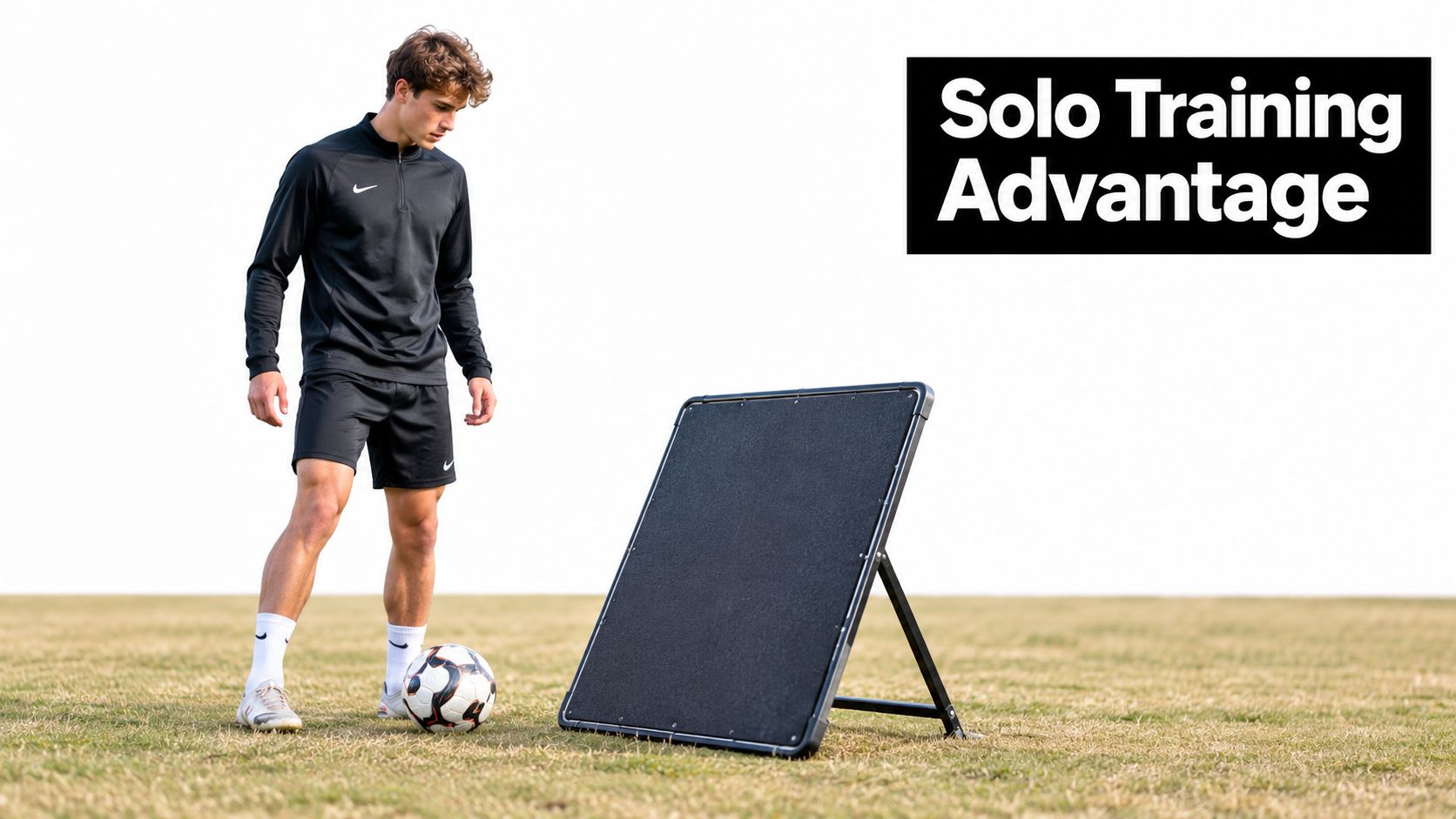
The board can't reproduce a defender's body position, a teammate's poor pass or the pressure of a match. It can, however, give a player a dependable stream of contacts. Used properly, it develops the mechanical habits that team training can then test in a less predictable setting.
Setting Up Your Rebound Board for Maximum Efficiency
A poor setup creates poor practice. If the board shifts, sits on an uneven surface or returns the ball at an inconsistent angle, the player starts adapting to equipment errors rather than learning reliable technique.
Start by choosing a flat area with enough clearance behind and beside the board. Grass can provide grip, but soft or uneven ground may let the frame move. Artificial turf usually offers a more consistent base, provided the board is properly secured. Indoor floors can work for suitable equipment, but the ball speed, noise and surrounding walls need careful consideration.
Build a consistent starting position
The FA's small-sided-football guidance states that permanent or portable rebound boards should be at least 1.2 metres high, giving a concrete UK benchmark for keeping the ball in play in a small-sided environment. Use the FA small-sided pitch guidance when assessing a board-based practice area.
Set up in this order:
- Check the frame: Make sure hinges, supports, net tension and joining points are secure. A loose frame changes the rebound and can become a trip hazard.
- Anchor the base: Use the supplied or suitable ground stakes outdoors. Indoors, place the board on a stable surface and keep it away from polished areas where the frame could slide.
- Mark the distance: Begin 2–4 metres from the board for controlled passing. This distance gives the player time to prepare without turning the exercise into a long-range striking drill.
- Choose the return angle: A square face creates a more predictable central return. A slightly angled face sends the ball across the player's body and demands better footwork. Don't introduce variable angles until the basic receiving shape is sound.
- Clear the area: Remove loose balls, bags, garden furniture and other obstacles. Keep walls, windows and spectators outside the likely rebound path.
A futsal-style ball should have a controlled response. The FA states that, for UK futsal, the ball's first rebound should be between 50 and 65 centimetres when dropped from 2 metres, as described in the FA futsal ball law. That standard isn't a universal requirement for every garden session, but it illustrates why an excessively lively or dead ball undermines consistency.
Match the board to the player
Children often benefit from slower, more forgiving returns. Older or more experienced players can handle firmer rebounds and sharper angles. Footballs commonly range from size 3 to size 5 by age group, so choose the ball used in the player's normal environment rather than making every session harder for the sake of it.
The Professional Soccer Rebounder – Durable Training Equipment for All Skill Levels is described as a portable rebound net with adjustable angle, galvanised steel construction and a weather-resistant PE net. Its listed dimensions are 140 x 90 x 80 cm and its listed weight is 3.5 kg, with ground stakes and bungee cord buckles included. Those details make it relevant for gardens, training pitches, schools and community fields, but the setup still needs to suit the surface and the player's rebound objective.
For a practical equipment checklist, portable training equipment should be judged by stability, transport and storage as much as by the size of the striking surface. A portable board is only useful if players can position it safely and reproduce the same practice conditions.
Progression Drills From First Touch to Volleys
The first session often looks simple. A player stands in front of the board and passes with their preferred foot. The ball returns, they pass again, and the rhythm feels smooth. That is a reasonable starting point, but it should be treated as the first rung, not the finished drill.
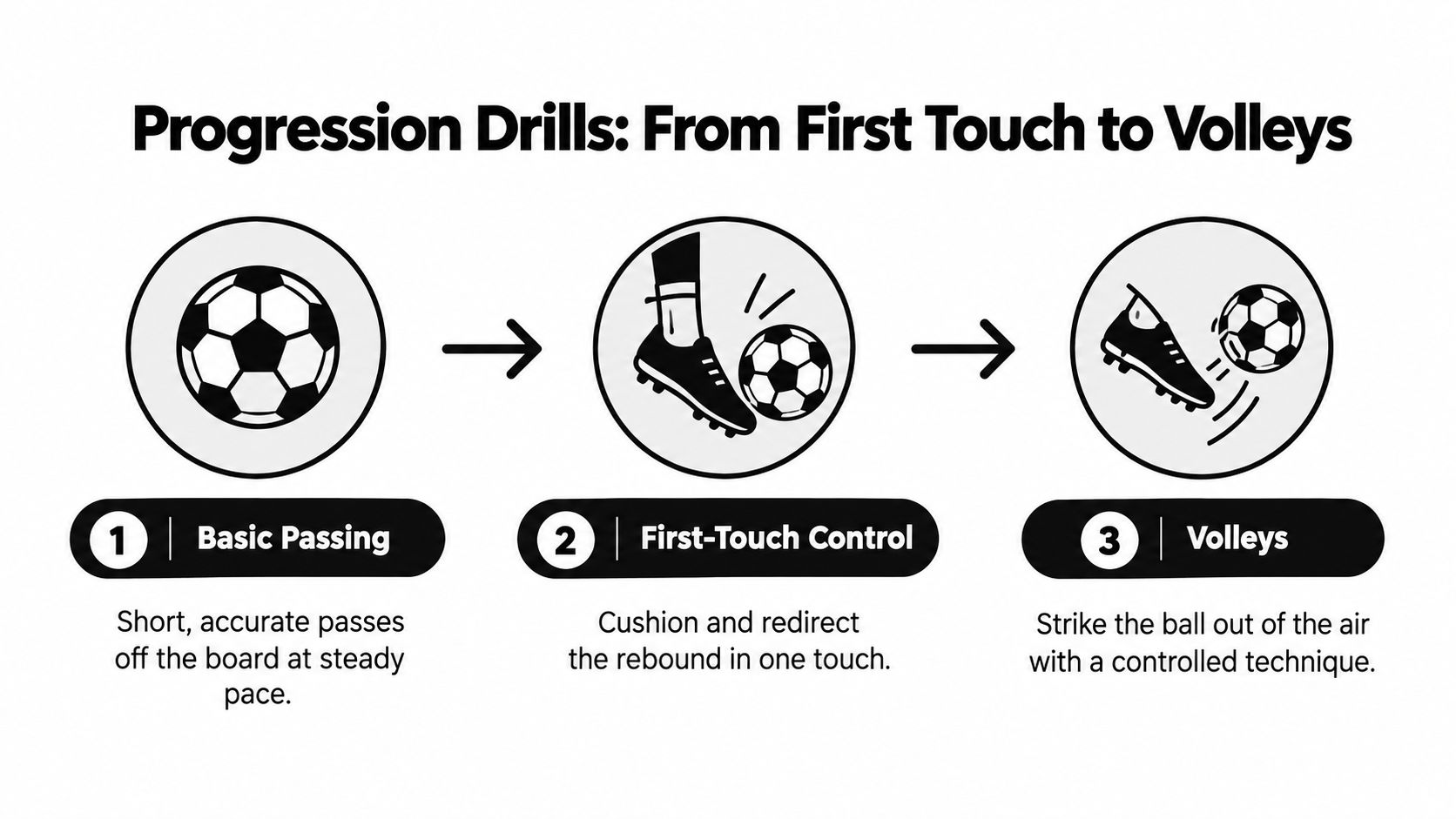
A useful progression changes one demand at a time. First make the pass accurate. Then make the reception purposeful. Finally add height and timing. The following sequence takes a player from a stable return to actions that need anticipation.
Stage one basic passing
Stand 2–4 metres from the board with your knees relaxed, chest over the ball and hips facing the return. Pass through the centre of the board using the inside of one foot, then receive with the other foot and return the ball. The opposite-foot requirement matters because it prevents the player from building a one-sided habit.
Keep the supporting foot beside the ball and point its toes towards the intended target. Strike through the middle of the ball with a firm but controlled contact. The aim isn't maximum power. It is a return that arrives at a manageable height and speed.
Use a predictable central rebound first. Work for 4–6 minutes, record successful first-touch-and-return sequences, rest briefly, and repeat for at least three rounds, following the structure set out in The FA's coaching guidance on realistic practice.
Common faults include:
- Standing tall: A straight-legged stance delays the first adjustment.
- Using one foot: This hides weaknesses on the non-dominant side.
- Passing too hard: Excessive pace turns the next reception into survival.
- Watching the board: Track the ball, but keep your head available to check the space before it arrives.
The score is not just how many times the ball comes back. Count clean sequences where the first touch remains controlled and the return reaches the board accurately.
Stage two first-touch control
Once the player can return the ball with both feet, change the objective. Instead of passing straight back, cushion the rebound across the body, then move into the newly created space.
Receive with the inside of the foot and withdraw the contact slightly on impact. That softens the ball rather than blocking it. If the ball comes towards the right side, use the right foot to take it across the body, open the left hip and take the next pass with the left foot. Reverse the pattern on the other side.
Start with a central return, then use an angled board position so the ball arrives across the player. Add a small check away from the board before the reception. The player should scan over one shoulder before the ball reaches the foot, receive into space and recover quickly enough to play the next pass.
A clean first touch isn't the one that stops the ball closest to your boot. It's the one that leaves you ready for the next decision.
A common mistake is treating every touch as a trap. In a match, the best reception often moves the ball away from pressure. If the player cushions the ball directly under their body, they may record a controlled touch while losing the time and space needed for the next action.
Use soccer rebounder drills for ideas, but keep the progression specific. Change the angle, distance or movement only after the player can maintain body control under the existing demand.
Stage three volleys
Volleys require a different rhythm. The player must read the rebound early, move into line and strike the ball before it reaches the ground or after a controlled bounce, depending on the drill.
Begin with a gentle lift into the board. Keep the chest over the ball, lock the ankle and use the laces for a controlled strike. The supporting foot should land under the body, not trail behind it. A player who leans back will usually lift the volley too high and lose control.
Progress from a simple instep volley to a movement volley. Start slightly to one side, pass into the board, shuffle across the likely return line and strike with the opposite foot. The board should create a manageable return, not a random flight that rewards frantic reactions.
The Football Association recommends realistic, game-related practice, frequent decision-making, transition elements and at least 70% ball-rolling time in its coaching approach. A volley block should therefore sit inside a movement circuit, not dominate the whole session. Follow a volley with a grounded pass, a check away or a short acceleration so the player links the aerial contact to football actions that occur in games.
A video demonstration can help players see the timing and body position before they attempt the harder variations:
Stop the drill when technique collapses. More contacts aren't automatically better contacts. The useful progression is predictable return, controlled first touch, scan and move, then aerial timing.
Measuring Progress and Avoiding Plateaus
A rebound board can make a player feel sharp while the actual improvement stays flat. I've seen plenty of players rack up contact after contact in the garden, then struggle the moment they have to open the body, check a shoulder and play the next action at a different angle. If you only count touches, you miss the part that matters.
Use a repeated test that stays the same each time. Fix the board size, rebound angle, distance, ball pressure, surface, work period and pass sequence. The Loughborough University Soccer Passing Test is a useful reference point here because it uses 16 prescribed passes with four coloured targets in a set order. A bounce board test is different, but the lesson holds. If the setup changes every session, the score means very little.
Record four separate outputs
Run three trials on the same day. Record the average and the spread, not one clean run that flatters the player. That matters with board work because a slightly different rebound or a tired last round can shift the result more than people think.
| Output | What it tells you |
|---|---|
| Successful return percentage | Whether the player can play back into the board with control and direction |
| First-touch retention | Whether the first contact stays in a playable area |
| Sequence completion time | Whether the player is getting quicker without the touch falling apart |
| Non-dominant-foot errors | Whether the weaker side is still slowing the whole pattern down |
Test, train for two or three weeks, then repeat the same test under the same conditions. A simple individual marker is to set a baseline over 30 controlled returns, then only progress when the player keeps at least 80–85% clean receptions and accurate returns across all rounds. Treat that as a training threshold, not proof of match performance.
The quality check is simple. The player should not improve the score by creeping closer to the board, avoiding the weaker foot or accepting a touch that would be a turnover in a game. Add a scan before every alternate reception as well. That small habit starts to shift board work away from staring at the rebound and toward game-realistic receiving.
Test the transfer under pressure
Good board numbers do not automatically carry into matches. On the pitch, the player has to move before the ball arrives, recognise pressure, protect space and decide quickly. That is why predictable rebounds are only the first stage. Real progress shows up when the player can leave that tidy rhythm and still receive well.
Research on small-sided play helps explain the gap. In Manchester Metropolitan University work on technical demands in youth football, 4v4 produced 135% more passes, 225% more 1v1 encounters and 280% more dribbling actions than 8v8, as reported in the published study on technical demands. Those figures are not bounce-board outcomes. They show why a player who looks polished in a fixed rebound pattern can still struggle once the game speeds up and the pictures keep changing.
After a board block, the best check is a conditioned 3v3 or 4v4 game. Watch three things closely: pass completion under pressure, receiving orientation and whether the player keeps possession after the first touch. If the board score climbs but those habits stay the same, the player is probably getting better at the drill rather than better at football.
That is usually where plateaus start. The answer is not always more reps. Often it is a change in demand: alternate feet, a forced scan, a movement trigger before the pass, or a target zone after the return. The board should teach the player to see, adjust and move, not just send the same ball back all afternoon.
Safety, Surfaces, and Injury Prevention
A rebound board can make the ball unpredictable enough to expose poor movement control. A player may sprint to a short return, decelerate abruptly, plant the foot awkwardly and twist while trying to keep the ball in play. Children can also focus so intensely on the ball that they ignore wet ground, loose stakes or a nearby wall.
UK-relevant sports research found that technique instruction and dynamic strengthening can improve knee-flexion mechanics during landing, while static balance training alone did not significantly reduce landing-risk factors, as discussed in the Coventry University sports research paper. That supports a balanced approach. Teach soft landings, controlled deceleration and ankle and knee alignment instead of treating passing against a board as risk-free.
Use a pre-session check
- Inspect the frame: Look for damaged tubing, loose joints, broken bungee cords and unstable supports.
- Secure the base: Recheck ground stakes after wet weather or repeated strikes.
- Assess the surface: Avoid holes, slippery patches and uneven ground. Artificial turf should be clear of loose objects, while indoor floors need enough grip for stopping.
- Control the clearance: Keep spectators, windows, fences and walls outside the rebound path.
- Prepare the player: Use a gradual warm-up with movement, landing mechanics and deceleration rather than beginning with full-power volleys.
- Clean shared areas: Clubs and schools should also consider hygiene on rubber or synthetic surfaces. A practical guide to bacteria on gym surfaces can help coaches think beyond visible dirt when equipment is used by several players.
The board angle should match the player's ability. Beginners need predictable returns so they can learn body position and receiving technique. A chaotic rebound may look more realistic, but it often produces rushed contact and awkward steps without teaching a clear solution.
For equipment decisions, injury prevention equipment should support stable movement rather than encourage players to chase increasingly wild returns. Stop the session if pain, repeated loss of balance or deteriorating landing technique appears. Consistent training depends on leaving the pitch healthy enough to train again.
Integrating Rebound Training into Weekly Plans
Keep board work short and purposeful. A beginner can use a few rounds of basic passing and first-touch control alongside team training. An experienced player can add angled returns, scanning and volleys, but should still protect time for small-sided games and opposition-based practice. Use an active recovery workout guide when planning lighter days, and treat rebound training as reinforcement, not a replacement for team football.
Start the next session with a stable setup, record clean receptions, progress only when control holds, and finish with a movement or decision-making game whenever possible.
SoccerWares offers training essentials including rebounders, goals, indoor training mats, shin guards and football GPS trackers, alongside club-inspired apparel and drinkware. Visit SoccerWares to compare equipment that can support your bounce board football routine, then choose the setup that matches your surface, space and training objective.