

You've got twenty minutes before training starts. The boot is already full, the garden is still damp, and the rebounder, cones, footballs and pop-up goal are spread across the hallway. By the time everything reaches the grass, someone has lost a peg and the useful part of the session has been shortened.
That's the hidden cost of portable training equipment. A product can fold into a bag and still be awkward to carry, slow to assemble, unstable on uneven ground or unsafe in a small garden. The right choice isn't the item with the longest feature list. It's the kit that gets from storage to useful practice quickly, survives repeated movement and suits the space where you'll really use it.
The opportunity is substantial. The UK sports equipment market was valued at USD 17.1 billion in 2021 and is projected to reach USD 30.8 billion by 2030, with a projected 6.8% CAGR across 2022-2030, according to Promotion Sports' UK market outlook. Ball games represented 33.92% of revenue in 2021, while fitness and strength equipment is identified as the fastest-growing segment. Portable football tools sit inside that established market, serving clubs, families, schools and individual players rather than a narrow specialist audience.
Defining Portable Football Gear
A parent can carry a mini goal from the shed to the garden and still discover that it is not really portable. If the frame takes too long to unfold, the net tangles, the anchors do not suit the ground or the whole unit takes over the boot, the product adds friction instead of removing it.
For football, portability has three practical tests:
- Fast setup: Equipment should be ready for a useful drill within a few minutes, without tools or complicated instructions.
- Manageable transport: Weight should sit across a sensible frame and carry bag, rather than in one awkward bundle.
- Flexible use: The same kit should work in a garden, park, driveway, indoor hall or match-preparation area, provided the surface and available space are safe.
Fixed club infrastructure offers stability and scale. A full-size goal, permanent rebound wall or marked pitch suits regular training, but it cannot follow a coach to a public park or fit beside a family car. Portable gear earns its place by allowing a session to move with the player.
What mobile equipment needs to solve
UK coaching guidance treats cones, markers, bibs, footballs, agility equipment, portable goals, slalom poles, hurdles, mannequins and soccer-tennis kits as standard session tools. TeamStats' football coaching equipment guide also shows how compact equipment supports home practice and small-space sessions.
A travelling academy player might need a rebounder and a small goal for first-touch work after school. A grassroots coach may need modular equipment that turns an empty patch of grass into several stations. A parent may need only a solo trainer that lets a child practise passing without chasing the ball into a hedge.
The useful test is simple: can you carry it, set it up and put it away without the equipment becoming the main event?
Practical rule: If setup regularly takes longer than the drill you planned, the kit is too complicated for that routine.
Fold-flat goals show how design affects daily use. UK retailers describe portable and folding goals that compress into carry bags for gardens, parks and match preparation. This reduces setup time only when the frame remains easy to tension and the bag still holds the net, poles and anchors after repeated use.
Portability also depends on the venue. A lightweight frame is convenient between locations, yet may need careful anchoring on a windy open pitch. A compact rebounder can fit in a hallway, while its training area may be too small for an older player. Portable means appropriately mobile for the player, drill and surface, and rarely means universally suitable.
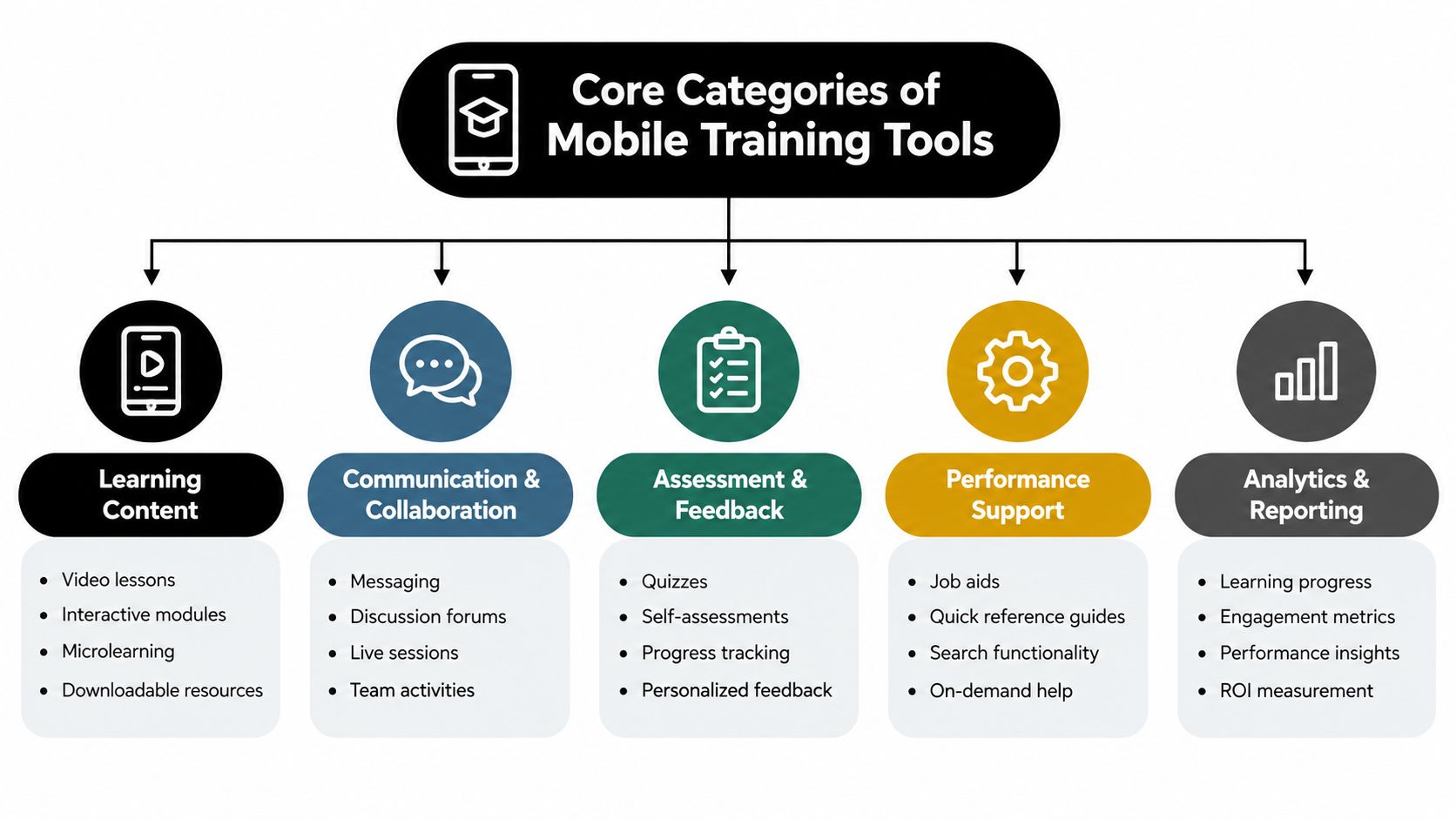
Core Categories of Mobile Training Tools
A useful kit starts with the skill you want to train, not the product category that looks most impressive online. Portable football equipment should create a clear feedback loop, more repetitions, better movement quality or a more structured session.
Rebounders for first touch and reaction
A fold-flat rebounder gives the player a repeatable return instead of requiring a partner. It can develop receiving technique, short passing, volleys, reaction speed and body positioning, but the frame angle matters. UK listings for portable rebounders and goal-rebounder combinations emphasise adjustable rebound geometry, including dual-angle and double-sided surfaces. Changing the angle changes the return trajectory and difficulty, allowing one unit to support controlled passing before progressing to sharper reactions and volleys. This guide to soccer rebounder trainers is useful when comparing those training uses.
Look for a tensioned surface that stays predictable. A loose net creates random returns, which can make a drill lively but less useful for teaching consistent technique.
Portable goals for finishing and decision-making
Pop-up goals suit quick finishing games, target practice and small-sided work. Modular goals offer more structure and can be preferable for coaches who need equipment that withstands repeated assembly. The trade-off is obvious: a larger target improves realism but increases frame weight, storage volume and anchoring demands.
Ladders, poles and hurdles for movement
Agility ladders encourage controlled foot placement, rhythm and coordination. Slalom poles add changes of direction and spatial awareness, while hurdles can introduce quick ground-contact patterns and low-level coordination work. None of these tools automatically creates football intelligence. They work best when paired with a ball, a visual cue, a change of direction or a decision after the movement pattern.
Solo belts for repeated ball contact
A solo training belt keeps the ball connected to the player through an elastic return cord. It's particularly practical for children learning to control the ball, pass with either foot and adjust body position after contact. It won't recreate an opponent or a live teammate, so it should supplement, rather than replace, pressure-based practice.
A compact session also needs recovery fuel. Parents planning longer outdoor routines may find portable high-protein snack ideas helpful for keeping food organised alongside the football kit.
Trackers and cameras
Boot-mounted GPS trackers and smart cameras add a different layer. They can record movement, clips or session information without adding another training surface, but they don't fix poor drill design. They're most useful when the player, parent or coach knows what question the technology should answer, such as whether a session included enough high-intensity movement or whether a finishing technique needs review.
Evaluating Cost and Durability Trade-offs
The cheapest portable item often looks attractive until it has been folded, dragged through wet grass and pushed into a car boot repeatedly. The most expensive option can also be wasteful if a child is growing quickly or the equipment will only be used occasionally.
UK guidance gives a useful spread for common purchases: portable goals at £30 to £150 per pair, rebounders at £70 to £130, agility ladders and hurdles at £30 to £60, and mannequins at £25 to £50 each, as reported in Pembee's UK coaching equipment guide. Those bands don't tell you which product will last. They show why buyers need to compare construction and expected use rather than price alone.
Portable Gear Investment Guide
| Equipment Type | Typical Price Band | Best Suited For | Key Durability Check |
|---|---|---|---|
| Portable goals | £30 to £150 per pair | Parents, solo players and grassroots sessions | Inspect folding joints, pole sleeves, net stitching and anchor points |
| Rebounders | £70 to £130 | First-touch, passing and reaction practice | Check frame tension, surface attachment, adjustment mechanism and replacement parts |
| Agility ladders and hurdles | £30 to £60 | Footwork, coordination and movement stations | Look for tough rungs, secure straps and connectors that won't split when packed |
| Mannequins | £25 to £50 each | Passing lanes, dribbling and defensive shapes | Check base stability, pole flexibility and resistance to repeated impacts |
What parents should prioritise
For a growing child, buy for safe repeat use and simple setup. A smaller rebounder with a reliable angle adjustment may deliver more value than a large goal that rarely leaves the shed. A belt trainer, cones and a compact goal can create varied practice without demanding much storage.
Avoid paying for features the player won't use. If the equipment is difficult to assemble, a child won't practise independently and a parent will become the permanent setup assistant.
What coaches should inspect
Coaches face a harsher test. Gear moves between schools, parks, AstroTurf and changing weather, often with several players using it in the same session. Check whether the manufacturer supplies replacement nets, poles, connectors and bags. Replacement support can matter more than a marginal reduction in purchase price because one failed component shouldn't retire an otherwise useful frame.
Buy once where the stress is repeated: frame joints, net attachment points, anchor systems and carry bags deserve more attention than cosmetic branding.
A coach's kit should also be modular. Several smaller goals or rebounders can support rotating stations, whereas one oversized unit may create a queue. For families, lightness and storage usually matter more than professional-level ruggedness. For clubs, consistent construction and repairability usually justify spending further up the range.
Actionable Drills for Small Spaces
Small-space practice works when the drill has a defined boundary, a clear objective and a progression. A garden doesn't need to imitate a full pitch. It needs to give the player enough room to repeat the right action safely.
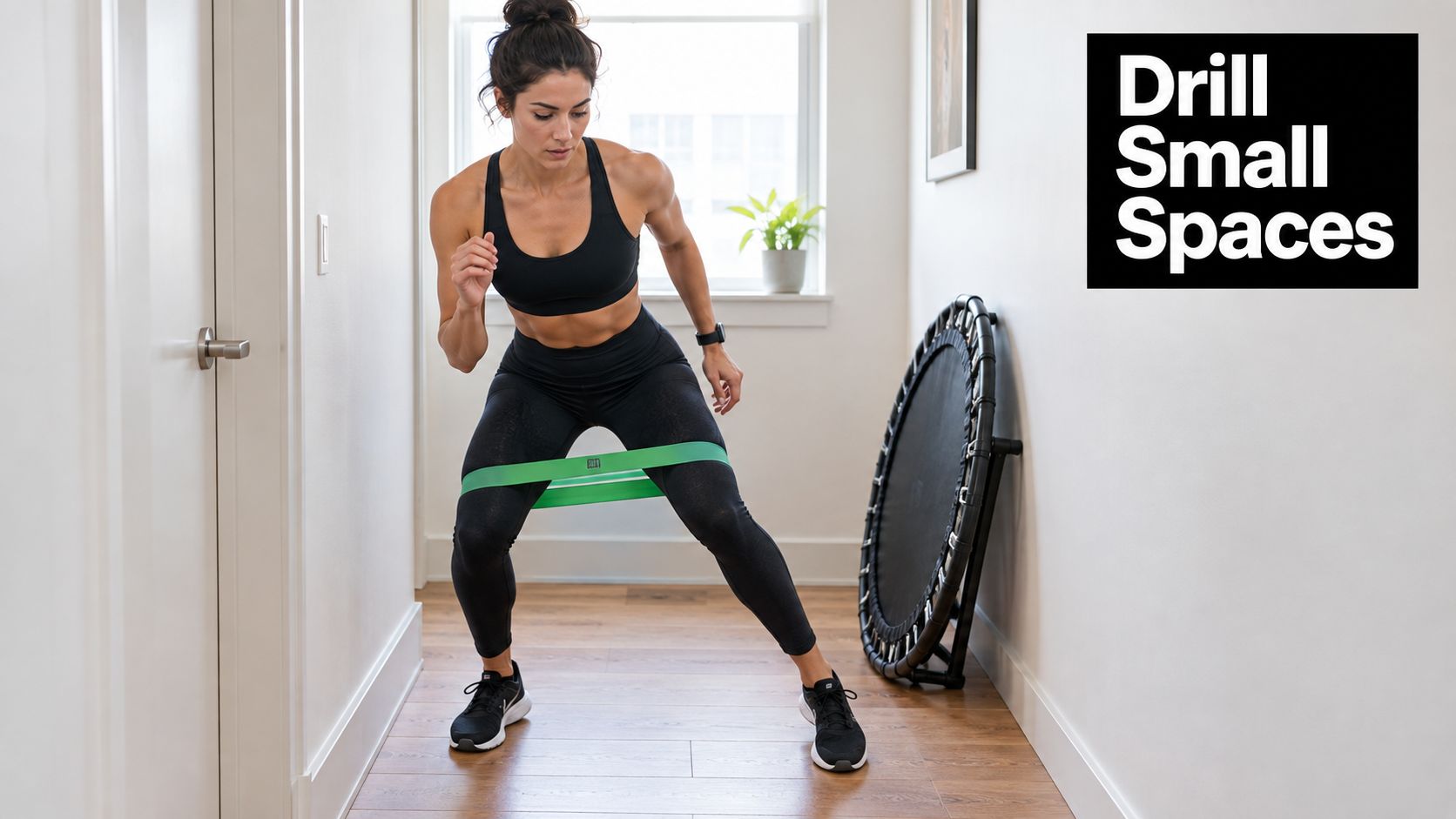
Rebounder volley control
Set the rebounder on a stable surface with the return angle low at first. Stand close enough to receive the ball under control, but leave room to move through the ball.
- Pass firmly into the lower section.
- Receive with the inside of the foot.
- Cushion the return into the working area.
- Repeat with the other foot.
- Progress by raising the rebound angle or alternating foot, thigh and chest control.
The setup should take only a short moment once the frame is assembled. The skill target is first touch under changing flight, not striking the ball as hard as possible. If the return flies unpredictably, reduce the angle and check the surface tension before increasing difficulty.
For more ideas suited to limited rooms and halls, use these indoor soccer training drills. If you're comparing non-football equipment for compact spaces, this guide can help you compare top compact cardio machines, though football drills should still be planned around ball control and movement rather than general fitness alone.
Belt trainer tight-circle dribbling
Fit the adjustable belt securely around the player's waist and check that the cord has a clear path. Use a small marked circle, keeping the player far enough from walls, furniture and glass.
The player alternates touches around the body, using the sole, inside and outside of both feet. Start with controlled touches and a steady return. Progress by changing direction on command, using weaker-foot-only touches or receiving the ball across the body before turning.
This setup develops close control and recovery after a misplaced touch. The elastic return creates repetition, but it won't provide the unpredictable pressure of another player. Keep the routine short and technically clean rather than turning it into a frantic kicking contest.
Pole gates for quick feet
Place slalom poles as gates rather than creating a long straight lane. That arrangement suits narrow gardens and lets the player work on short changes of direction.
- First pass: Move through the gates without a ball, keeping the hips low and the steps quiet.
- Second pass: Dribble with the dominant foot and take the first touch away from each pole.
- Third pass: Add a turn at the end and return through the gates with the other foot.
- Progression: Have a parent or coach call left, right or stop, so the player must react rather than memorise the route.
Use floor tape indoors to mark limits, and remove loose household objects before starting. A compact setup is valuable because it can be repeated often, but only if the player has enough clearance to stop without colliding with equipment.
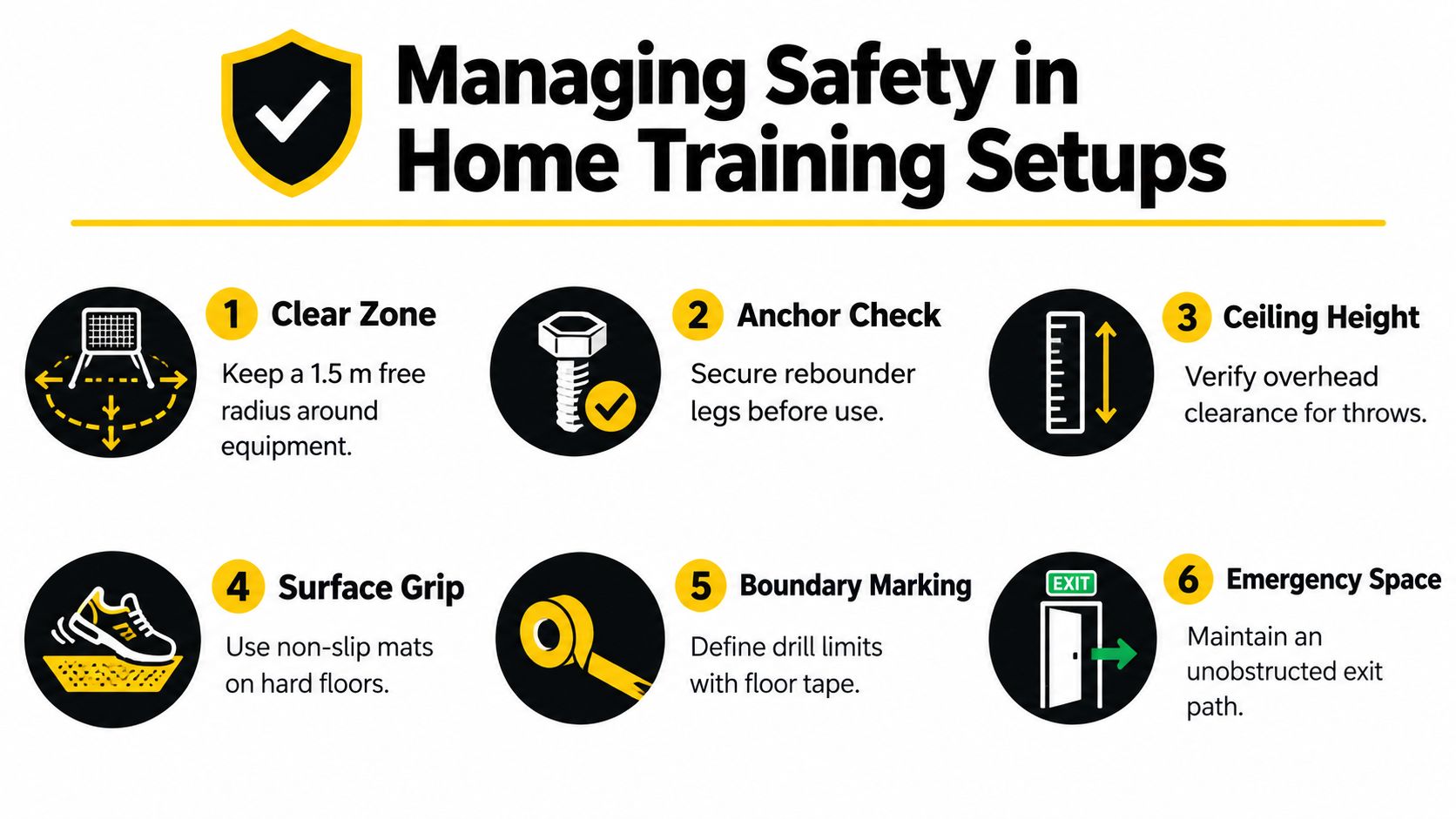
Managing Safety in Home Training Setups
A garden or driveway isn't automatically a safe training venue because it's familiar. Hard surfaces, parked cars, low ceilings, windows, slippery patches and improvised barriers can change the risk of an otherwise simple drill.
One UK-focused buying guide cites a 2025 FA Grassroots Survey in which 65% of the UK's 1.6 million youth players train at home weekly. The same guide claims poor home angle-training setups can increase injury risk by 22% in U12s. Those figures appear in SoccerWares' UK home training guide, and they underline the need to discuss setup, not just equipment.
Start with the surface
Grass generally offers more forgiving footing than concrete, but wet grass can make goal anchors unreliable. Driveways need particular care because a slip, fall or poorly controlled rebound exposes the player to a hard surface. Indoor halls should use suitable non-slip flooring or mats, and shoes must match the surface.
Keep windows, doors, fences and parked vehicles outside the likely ball path. A rebounder facing a wall may save space, but it can also return the ball quickly and leave no room for a safe recovery step.
Treat angle as a safety decision
A higher rebound angle can turn a simple pass into a lofted return. Younger players may struggle to judge the flight, especially when they're close to the frame. Begin with a controlled angle, increase distance gradually and avoid volley drills until the player can receive the return with balance.
The safety guidance for work equipment from the Health and Safety Executive emphasises suitability, maintenance, inspection where necessary and adequate training for users. PUWER applies to work equipment, not every child's garden football session, but its principles are sensible: use equipment for its intended purpose, keep it in good repair and make sure users understand the risks.
Make the space predictable
Before each session, check:
- Anchoring: Secure goals and rebounders according to the manufacturer's instructions.
- Clearance: Remove stones, toys, furniture and other trip hazards.
- Boundaries: Mark the drill area so the player knows when to stop.
- Overhead space: Check ceiling height before lofted passes or throws.
- Supervision: Keep younger players within active adult supervision, especially around hard surfaces.
- Exit routes: Don't block doors, gates or access paths with equipment.
For injury-focused equipment choices and setup ideas, see SoccerWares' injury prevention equipment guide. The safest kit is still unsafe if the player is rushing, the ground is slippery or the frame has been placed too close to a hazard.
Maintenance and Packing Strategies
Portable equipment fails at the points people neglect. Mud dries inside ladder straps, net cords stay damp in closed bags and pop-up goal poles get forced into shape rather than folded along their intended curve.
Pack for the next session, not just the end of the current one.
Clean before storage
Brush mud from ladder rungs and pole bases while it's still soft. Wipe rebounder frames and net edges, then allow fabric components to dry before closing the carry bag. Damp storage encourages unpleasant smells and can weaken materials over time.
Inspect elastic cords on solo trainers for fraying, flattened sections or damaged stitching. Replace a worn cord before it snaps during a strike. Check goal nets for loose attachment points, and make sure every peg returns to the same small pouch.
Fold without forcing
Pop-up goals rely on flexible poles and tension. Follow the folding sequence rather than bending the frame against resistance. If the poles start to twist unevenly, stop, release the net tension and reset the frame. Forcing a stubborn fold is a quick way to damage fibreglass sections or connectors.
A small storage space can help if home storage is tight. Some families use a compact unit, and American Mini Storage rental options illustrate the kind of space-saving approach people consider when sports equipment competes with household storage.
Use a packing checklist
Keep the checklist inside the main bag:
- Session hardware: Goals, rebounders, poles, ladders and hurdles.
- Small parts: Pegs, anchors, connectors, straps and adjustment pins.
- Ball essentials: Footballs, pump, spare needle and a pressure gauge.
- Organisation: Bibs, cones, tape and a dry towel.
- Weather protection: Waterproof outer bag or separate cover for wet equipment.
- After-session care: Cleaning cloth and a bag for muddy items.
Don't crush footballs under heavy frames. Release excess air only when storage requires it, and use this practical guide on how to deflate a football to avoid damaging the valve.
Choosing the Right Setup for Your Needs
A kit that looks practical online can become awkward in a small garden or muddy park. Check who carries it, how long setup takes, where it will be stored and how many players need regular touches. Parents usually need low setup friction. Grassroots coaches need equipment that supports rotation and survives repeated handling. Performance-focused players may want tracking or video, but only after the physical training system works.
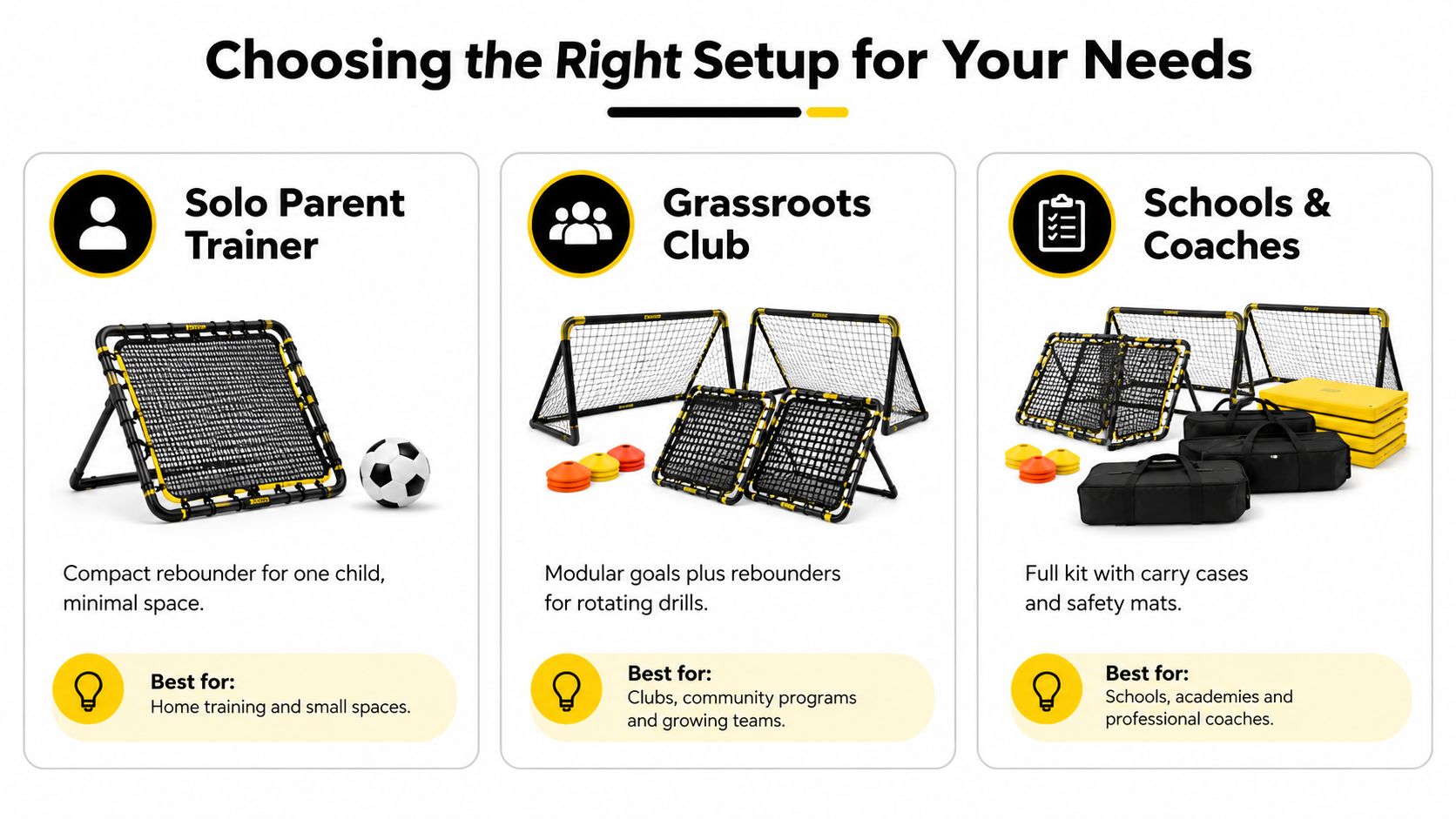
For a parent and one child
Start with a compact rebounder or adjustable solo belt, a small set of cones and a portable goal if the available space can accommodate it. A secure frame, dependable carry bag and quick assembly matter more than extra features. Equipment that requires an adult to wrestle with poles will soon be left unused.
The goal is a routine the child will repeat. A short first-touch session with a few reliable tools can produce more practice than a large kit that remains in storage.
For a grassroots coach
Build around stations rather than one central activity. Portable goals, rebounders, cones, bibs, ladders and slalom poles allow several players to work at once, reducing queues and idle time. Modular frames are easier to transport between venues than one oversized goal, especially when a coach is also carrying balls and team supplies.
Spend more on parts that take constant strain, including nets, joints, anchors and carry bags. Labelled components also help volunteers return the right pieces after training and reveal missing parts before the next session.
For an athlete using technology
Add a GPS tracker or smart camera only when the information will change the next session. Video can support review of body shape, receiving technique and finishing choices. Tracking can record sessions, but it cannot provide a technical objective on its own.
SoccerWares offers football training essentials including rebounders, goals, indoor mats and soccer GPS trackers, alongside fan merchandise. Choose items around the player's space, training priorities and storage limits.
The best setup is the one that leaves the bag regularly. Choose fewer pieces, make them work hard and keep the routine ready for the next session.
If the current kit is slow to assemble, heavy to carry or unsafe for the available space, replace the part causing the most friction first. Visit SoccerWares to compare practical football training essentials, then build a routine for gardens, parks, halls and match preparation areas.