

Welcome to the beautiful game! Starting your football journey is an exciting step, but mastering the fundamentals is key to building confidence and skill on the pitch. The secret to becoming a capable player lies in perfecting the basics through consistent, focused practice. This guide provides a clear roadmap with eight essential football drills beginners must learn to develop control, awareness, and technique.
We will provide step-by-step instructions for each drill, highlight common mistakes to avoid, and suggest the right gear to help you train effectively. From mastering your first touch to improving your shooting accuracy, these exercises are designed to build a solid foundation. Committing to these routines will not only enhance your skills but also improve your overall fitness. To sustain your progress and ensure a long and healthy football journey, understanding and implementing effective injury prevention strategies is also crucial.
Whether you dream of scoring goals or simply want to enjoy a kickabout with friends, these foundational drills will set you on the path to success. Let’s get started.
1. First Touch Progression Drill
A player’s first touch is arguably the most crucial skill in football. It’s the split-second action that determines whether you maintain possession under pressure or lose the ball. This foundational drill is designed to systematically build a beginner's ability to receive and control a pass, setting them up for their next move. It focuses on using different surfaces of the foot to cushion the ball, turning a pass into a perfectly controlled asset.
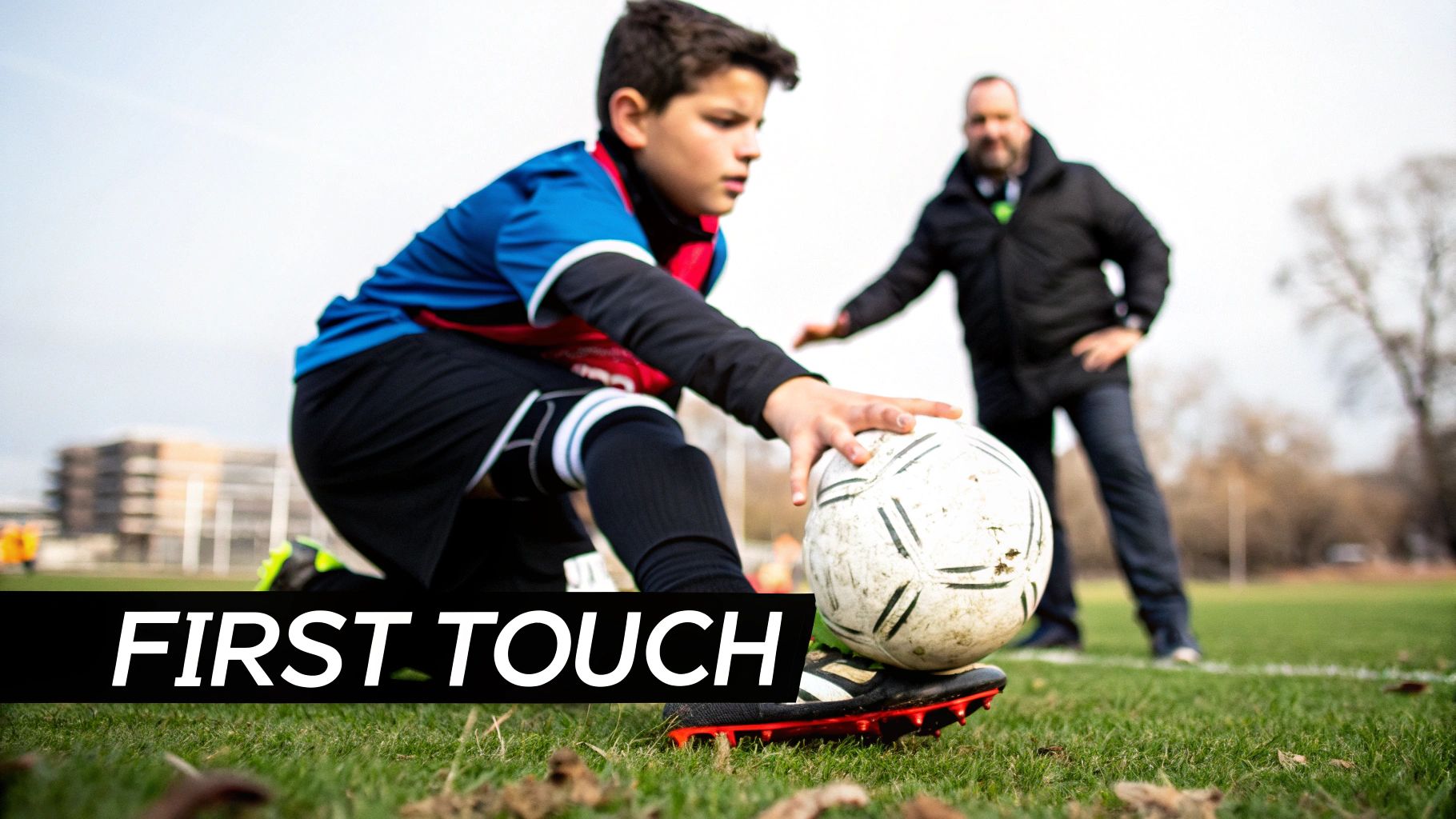
This drill is a staple in elite academies for a reason. Top youth setups build entire sessions around progressive first-touch exercises. They understand that a good first touch is the foundation for everything that follows: dribbling, passing, and shooting. By mastering control, beginners build the confidence needed to play with their head up, aware of the game around them.
How to Implement the Drill
- Stationary Start: Begin with players in pairs, about 5-10 metres apart. One player passes the ball along the ground to their partner. The receiving player focuses on using the inside of their foot to stop the ball dead.
- Introduce Movement: The receiver now takes a touch into space, either left or right, preparing for a second action. This simulates moving away from a defender. The goal is to take a soft, directional touch that sets up an easy return pass.
- Vary the Service: Start introducing different types of passes. The server can play the ball firmer, slightly in the air (requiring a thigh or chest control), or to the player’s weaker foot.
Key Insight: The aim isn't just to stop the ball, but to control it in a way that makes the next action easier. A perfect first touch puts the ball exactly where you want it for a pass, dribble, or shot.
Tips for Success
- Both Feet: Emphasise using both the left and right foot from the very beginning to develop well-rounded players.
- Body Shape: Encourage players to be on their toes, with their body open to the pitch. This improves balance and awareness.
- Progressive Pressure: As skills improve, a third player can be added to apply light, passive pressure on the receiver, forcing them to think and act faster.
- Essential Gear: Ensure all participants wear shin guards. Even in a simple passing drill, accidental knocks can happen. Using quality training cones, like those available at soccerwares.com, helps to create specific receiving zones and adds structure to the drill.
2. Cone Weaving and Dribbling Course
Dribbling is the art of moving the ball up the pitch, and the cone weaving course is the fundamental drill that teaches this skill. This classic exercise develops close ball control, sharp changes of direction, and the coordination needed to keep the ball glued to your feet. By navigating through a series of cones, beginners get instant feedback on their touch and learn to manipulate the ball with precision.
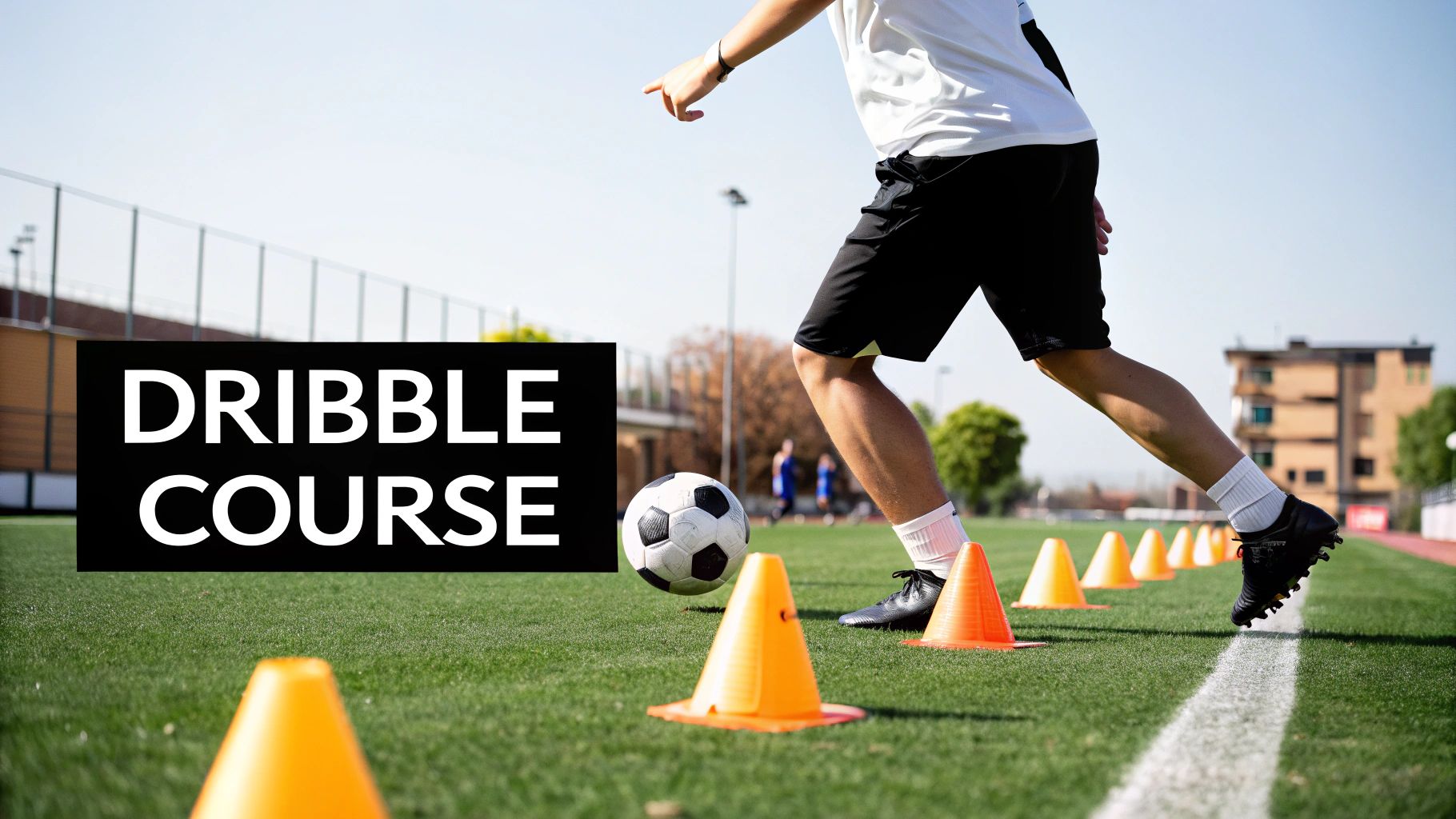
This drill is a cornerstone of youth development at professional clubs worldwide. Many top academies integrate varied cone courses into daily training to ensure their young prospects develop exceptional dribbling abilities under pressure. It’s one of the most effective football drills for beginners because it directly translates to game situations where players must evade defenders in tight spaces.
How to Implement the Drill
- Straight Line Weave: Set up 6-8 cones in a straight line, about 1-2 metres apart. Players dribble through the cones, weaving in and out using only the inside of their feet. Then, they repeat the drill using only the outside of their feet.
- Zig-Zag Pattern: Arrange the cones in a zig-zag formation. This forces players to make sharper turns and use both feet to push the ball from one cone to the next, improving their agility and directional control.
- Introduce Speed: Once a player is comfortable, encourage them to increase their pace. The challenge is to maintain close control while moving faster, simulating a game-day scenario. Time the drills to provide a benchmark for improvement.
Key Insight: The goal is to use lots of small, soft touches rather than big kicks. Keeping the ball close allows for rapid changes of direction and makes it much harder for a defender to tackle.
Tips for Success
- Head Up: Encourage players to try and look up as they dribble, not just at the ball. This builds awareness of their surroundings.
- Use Both Feet: Insist on players alternating between their left and right foot to become equally comfortable on either side.
- Vary the Spacing: Gradually decrease the distance between cones to challenge players and force them to refine their close-control skills.
- Quality Equipment: Use high-visibility training cones to create clear pathways. For more advanced agility work, you can explore combining cones with other tools; you can learn more about adding soccer training poles to create complex courses.
3. Short Pass and Move (One-Two/Wall Pass) Drill
The one-two, or wall pass, is the cornerstone of combination play in football. It’s a simple yet devastatingly effective manoeuvre where a player passes to a teammate, moves into open space, and immediately receives a return pass. This drill ingrains the fundamental principles of passing accuracy, timing, and intelligent off-the-ball movement, teaching beginners how to create and exploit space as a team.
This simple pass-and-move sequence is the building block for some of the most sophisticated attacking philosophies in the sport. FC Barcelona's legendary 'tiki-taka' style was built on a foundation of quick, precise one-two combinations that dismantled defences. Professional academies worldwide introduce this drill early, understanding that mastering it is essential for progressing to more complex team-based football drills for beginners.
How to Implement the Drill
- Static Foundation: Players pair up, standing about 5 metres apart. One player (the 'wall') remains stationary. The other player passes the ball to the 'wall' and immediately runs forward into a new space.
- Add the Return Pass: The 'wall' player plays a one-touch return pass into the path of the moving player. The focus is on the accuracy and weight of the pass, ensuring it's easy for the runner to control. Players then swap roles.
- Incorporate a 'Defender': Introduce a third player or a cone to act as a passive defender. The attacker must now use the one-two to play the ball around the obstacle, learning to use the wall pass to beat an opponent.
Key Insight: The most crucial element is the timing of the run. The player initiating the pass should begin their forward movement the instant the ball leaves their foot, not after.
Tips for Success
- Weight of Pass: Emphasise a soft, well-weighted pass over a powerful one. A gentle pass is far easier for the 'wall' player to control and return accurately.
- Pace and Progression: Start the drill at a walking pace to perfect the timing and technique. As confidence and accuracy improve, gradually increase the tempo.
- Two-Footed Play: Encourage players to practise executing the pass-and-move on both their left and right sides to build all-round competence.
- Essential Gear: In group settings, using training bibs helps differentiate attackers from the 'wall' players. Always ensure players wear shin guards, as even simple passing drills can lead to accidental kicks in close quarters. For more in-depth guidance on this exercise, you can find a comprehensive guide on this pass and move football drill.
4. Receiving Under Pressure Drill
Controlling a pass in open space is one thing; doing it with a defender closing in is another. This drill bridges the gap between unopposed technical practice and the chaos of a real match. It teaches players to scan the pitch, protect the ball with their body, and make quick, intelligent decisions under game-realistic conditions. It is a vital step in turning technical skill into effective game play.
This type of drill is fundamental in modern football coaching. Professional clubs incorporate light-pressure drills into their developmental programmes to build resilient and aware players. It forces beginners to think a step ahead, transforming them from passive receivers into proactive playmakers who can handle the physical and mental demands of the game.
How to Implement the Drill
- Set Up the Area: Create a group of three. One player is the server (passer), one is the receiver, and one is the defender. Mark a small area with cones for the receiver to operate in.
- Apply Light Pressure: The server passes the ball to the receiver. As the ball travels, the defender approaches from behind or the side to apply light, passive pressure. The defender's initial job is just to be a physical presence, not to win the ball aggressively.
- Encourage a Turn or Shield: The receiver's goal is to use their first touch to either turn away from the defender into space or to effectively shield the ball, protecting it with their body before passing it back or to another target.
Key Insight: The most important action happens before the ball arrives. The receiver must "scan" by looking over their shoulder to see where the defender is. This awareness dictates whether their first touch should be to turn, shield, or play a one-touch pass.
Tips for Success
- Scan, Scan, Scan: Constantly remind the receiver to check their shoulders before the pass is made. This builds a crucial habit for game awareness.
- Body Between Ball and Opponent: Teach players to use their arms (legally) for balance and to keep their body between the defender and the ball when shielding.
- Gradual Intensity: Start with very light, "shadow" pressure and slowly increase the defender's intensity as the receiver becomes more confident.
- Safety First: As this is one of the introductory contact-based football drills for beginners, it is essential that all players wear appropriate shin guards. Ensure a proper warm-up is completed and have a first aid kit nearby.
5. Shooting and Finishing Drill (Gates and Goals)
Scoring goals is the ultimate aim of football, and this drill is designed to build a beginner's confidence and technical ability in front of the net. The "Gates and Goals" exercise breaks down the art of finishing into manageable steps, focusing on accuracy and technique over raw power. It encourages players to shoot from different angles and scenarios, developing the muscle memory required to become a reliable goalscorer.
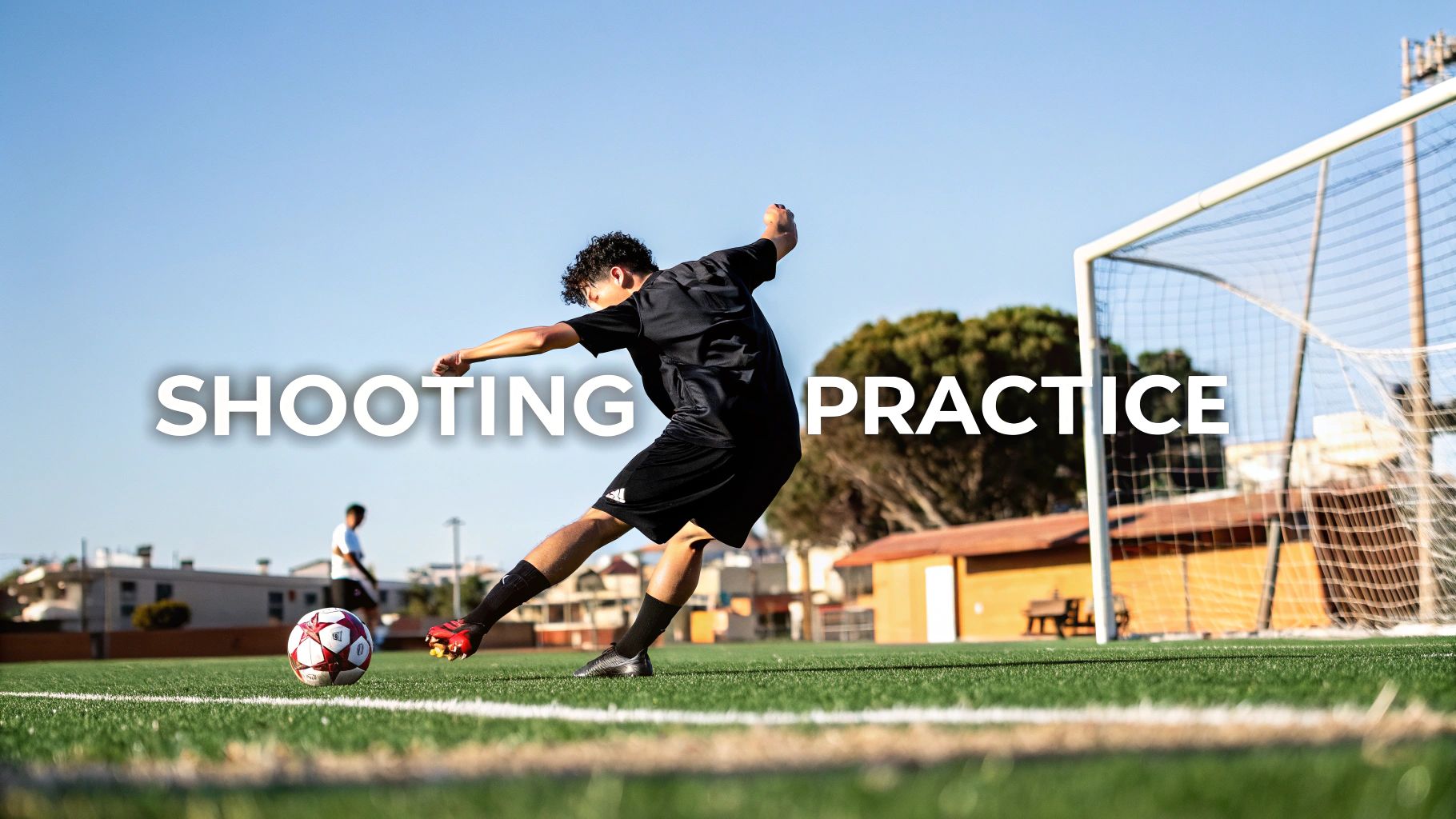
This methodical approach to finishing is a cornerstone of professional training. Top academies emphasise technical placement and composure in their young forwards, understanding that precision often beats power. Legends of the game are known for their relentless, repetitive finishing drills, honing every type of shot. This drill provides beginners with a foundational version of that elite practice.
How to Implement the Drill
- Set Up the Gates: Place several cones to create small "gates" (about 2 metres wide) at various angles and distances from the main goal. Start with gates positioned 10-15 metres away.
- Dribble and Shoot: The player starts with a ball, dribbles through one of the gates, and then takes a shot at the goal. This simulates creating a shooting opportunity for oneself.
- Receive and Finish: A partner or coach passes the ball to the player, who is positioned near a gate. The player must control the pass and finish, ideally with their first or second touch. This replicates shooting from a teammate's pass.
Key Insight: The purpose of the gates is to force players to shoot from varied positions and angles, preventing them from only practising their "favourite" shot. This builds a more versatile and unpredictable finisher.
Tips for Success
- Technique Over Power: Initially, focus on striking the ball cleanly with the inside of the foot for placement. Power will develop naturally as technique improves.
- Both Feet: Alternate between shooting with the left and right foot at each gate. A two-footed player is a significantly greater threat to defenders.
- Track Progress: Keep a simple count of goals scored out of ten attempts from each gate. This provides tangible feedback and motivates improvement.
- Essential Gear: Consistent practice is far more effective with the right equipment. Using a high-quality rebounder or one of the many portable soccer goals available on soccerwares.com ensures the drill runs smoothly and provides instant feedback on accuracy.
6. Small-Sided Game (3v3 or 4v4)
While isolated drills build specific skills, small-sided games are where football truly comes to life. Unrestricted play on a smaller pitch forces beginners to combine dribbling, passing, and decision-making in a dynamic, game-realistic environment. With fewer players, each individual gets significantly more touches on the ball, accelerating learning and building confidence far quicker than in a full-scale 11-a-side match.
This approach is the cornerstone of modern youth development. Barcelona’s legendary La Masia academy built its philosophy on small-sided games to foster technical mastery and tactical intelligence. The principles of Dutch 'Total Football' were also honed in these tight spaces, demanding that every player be comfortable on the ball. It's one of the most effective football drills beginners can engage in because it teaches skills within the context of the actual game.
How to Implement the Drill
- Set Up the Pitch: Use training cones to mark out a small pitch, roughly 30 metres long by 20 metres wide. Use small pop-up goals or simply designate a scoring zone with cones at each end.
- Form Teams: Divide players into two teams of three or four. Use different coloured training bibs to make teams easily identifiable.
- Start the Game: Begin with a simple possession-based objective, like completing five consecutive passes for a point. Once players are comfortable, introduce scoring in the goals. Keep games short, around 8-12 minutes, to maintain high intensity.
Key Insight: The magic of small-sided games is that they naturally recreate a multitude of game scenarios. Players are constantly faced with decisions: when to pass, when to dribble, how to defend, and how to create space.
Tips for Success
- Clear Objectives: Before starting, establish a clear goal for the game. This could be focusing on quick passing, protecting the ball, or creating shooting opportunities.
- Encourage Movement: Coach players to constantly move off the ball to create passing lanes and support their teammates.
- Rotate Positions: Regularly switch players between teams and positions to ensure everyone gets varied experiences and plays with different people.
- Essential Gear: Proper shin guards are non-negotiable to protect against inevitable knocks. Marking the pitch clearly with durable training cones, like those available at soccerwares.com, ensures the game stays structured and contained.
7. Positional Awareness and Movement Drill
Many beginners are drawn to the ball, creating chaotic bunches and leaving vast spaces open. This drill tackles the root cause: a lack of positional understanding. It’s a foundational tactical exercise that teaches players where to be on the pitch in relation to the ball, their teammates, and the opposition. This shift from 'ball-watching' to 'space-awareness' is a game-changer for any aspiring player.
This concept is the bedrock of every professional team's strategy. Top teams' structured build-up play and intense pressing systems both rely on every player understanding their role and position perfectly. By introducing these concepts early, this football drill for beginners helps build the tactical intelligence needed to play organised, effective football, turning a group of individuals into a cohesive unit.
How to Implement the Drill
- Static Formation (No Ball): Set up players in a basic formation (e.g., 4-4-2) using cones to mark each position. Walk players through their specific roles and responsibilities without a ball. The coach acts as the ball, moving to different areas of the pitch, and players adjust their positions accordingly to maintain team shape.
- Add the Ball (Slow Play): Introduce a ball and have players pass it slowly amongst themselves. The focus remains on maintaining shape. If the ball moves to the right wing, the entire team shuffles across to support that side of the pitch.
- Introduce Passive Opposition: Add a few opponents (using different coloured bibs) who can jog and apply light pressure. This forces the team in possession to think more about creating passing angles and maintaining their defensive structure when they lose the ball.
Key Insight: Great positioning isn't about standing still; it's about constant, small adjustments. A player might only move a few metres, but that movement can be the difference between being available for a pass or being marked out of the game.
Tips for Success
- Explain the 'Why': Don't just tell a player to stand somewhere. Explain why that position is important for attacking or defending, helping them understand the tactical reasoning.
- Use Visual Aids: Use training cones or flat markers to create zones for each position. This gives beginners a clear visual reference point for where they should be.
- Rotate Positions: Allow players to experience different positions. A defender who has played as a forward will have a better understanding of how to mark one.
- Clear Identification: Using distinct training bibs, like the brightly coloured sets from soccerwares.com, is essential. It helps players instantly recognise teammates and opponents, making it easier to maintain tactical discipline.
8. Ball Mastery and Foot Skills Drill
Ball mastery is the art of making the football an extension of your body. It's about developing an intimate feel for the ball, allowing you to manipulate it effortlessly in tight spaces. This drill focuses on high-repetition touches using all surfaces of the foot, particularly the sole, to build supreme confidence and control. For beginners, mastering these fundamental movements is the first step towards becoming a technically proficient and creative player.
This type of training is non-negotiable at the highest levels. Barcelona's famed La Masia academy builds its entire philosophy on this foundation, ensuring young players are comfortable with the ball before anything else. Legends of the game are known for their incredible close control, a skill honed through countless hours of these foundational football drills for beginners. It’s about creating a relationship with the ball, making it respond to your every command.
How to Implement the Drill
- Sole Rolls: Start by standing with the ball in front of you. Place the sole of one foot on top of the ball and roll it from side to side, from just outside your big toe to just outside your little toe. Keep your head up as you get more comfortable.
- Pull-Push: Use the sole of your foot to pull the ball back towards your body, then gently push it forward with the inside of the same foot. Alternate between your right and left feet, establishing a smooth rhythm.
- Inside-Outside Taps: Gently tap the ball back and forth between the inside and outside of one foot. The ball should barely move, with the focus being on quick, soft touches to develop foot speed and coordination.
Key Insight: The goal is not speed, but rhythm and control. Thousands of consistent, soft touches are far more valuable than a few fast, clumsy ones. This drill builds the muscle memory required for instinctive dribbling.
Tips for Success
- Daily Practice: Dedicate just 10-15 minutes a day to these exercises. The cumulative effect on your ball control will be immense.
- Both Feet: Always practise every movement with both your left and right foot to become a balanced, unpredictable player.
- Stationary to Moving: Master each skill while standing still before attempting to perform them while walking slowly, and eventually jogging.
- Use Cones: Set up training cones to create small, defined spaces. This forces you to keep your touches tight and controlled. You can find more ideas for solo practice by reading about football training drills to do at home.
8-Drill Comparison: Beginner Football Skills
| Drill | Complexity 🔄 | Resources & Setup ⚡ | Effectiveness ⭐ | Expected Outcomes 📊 | Ideal Use Cases & Key Advantage 💡 |
|---|---|---|---|---|---|
| First Touch Progression Drill | Low → Moderate (progressive levels) | Minimal — ball, cones, small area | ⭐⭐⭐⭐ — strong for touch confidence | Faster, cleaner first touch; both-foot development | Warm-ups & beginner sessions; scalable, quick to run |
| Cone Weaving and Dribbling Course | Low (simple patterns) | Minimal — cones, ball, optional stopwatch | ⭐⭐⭐ — excellent for close control | Improved dribbling,coordination; measurable via times | Solo practice & agility work; timed progress tracking |
| Short Pass and Move (One‑Two/Wall Pass) Drill | Low (partner-based) | Minimal — ball, cones, 2+ players | ⭐⭐⭐⭐ — high match transfer | Better passing accuracy, timing, off‑ball movement | Small-group drill; builds team play foundations |
| Receiving Under Pressure Drill | Moderate (controlled contact) | Partners/defenders, cones, protective gear | ⭐⭐⭐⭐ — strong for game realism | Faster decision-making, shielding, scanning skills | Transition to match scenarios; develops mental toughness |
| Shooting and Finishing Drill (Gates and Goals) | Low → Moderate (space-dependent) | Goals/rebounders, multiple balls, safe area | ⭐⭐⭐⭐ — high motivation & measurable results | Improved shooting technique and scoring confidence | Finishing practice for individuals/groups; very motivating |
| Small‑Sided Game (3v3 or 4v4) | Moderate (less structure, coach supervision needed) | Space, multiple players, bibs, small goals | ⭐⭐⭐⭐⭐ — highest for holistic development | Tactical awareness, more touches, real decision-making | Game-realistic learning and match prep; high engagement |
| Positional Awareness & Movement Drill | Moderate (conceptual teaching) | Cones, bibs, optional video/GPS | ⭐⭐⭐ — strong for tactical understanding | Improved positioning, team shape, reduced ball‑watching | Tactical sessions; teaching roles and formation discipline |
| Ball Mastery & Foot Skills Drill | Low (repetitive solo work) | Just a ball, small space, optional mat/camera | ⭐⭐⭐⭐ — excellent technical foundation | Better close control, foot coordination, muscle memory | Daily solo practice/home training; foundational technique |
From Practice Pitch to Match Day: Your Next Steps
You've now explored a comprehensive toolkit of eight fundamental exercises designed to build your footballing foundation. From mastering your first touch and weaving through cones to executing precise passes and finishing with confidence, these football drills for beginners are the building blocks of a well-rounded player. They are not just isolated exercises; they are interconnected skills that, when combined, elevate your entire game.
The journey from a novice to a confident player is paved with repetition and a deep understanding of these core mechanics. Remember, the goal isn't just to complete the drills, but to understand the why behind each movement. A clean first touch sets up your next pass, sharp dribbling creates space, and intelligent movement off the ball turns a simple possession into a goal-scoring opportunity.
Key Takeaways for Your Training Journey
To truly integrate these skills, focus on these core principles as you practise:
- Technique Over Speed: Always prioritise perfect form. A slow, controlled touch is far more valuable than a fast, clumsy one. Speed will come naturally as your muscle memory develops.
- Consistency is Crucial: Progress is built on habit. Dedicating consistent time to these drills, even in short bursts, will yield far greater results than infrequent, long sessions. As you commit to these drills, maintaining momentum is crucial for long-term improvement. For valuable insights into building lasting habits, consider learning how to stay consistent with your training.
- Embrace Small-Sided Games: Drills are for development, but games are where you apply them. Regularly playing 3v3 or 4v4 matches is the best way to test your skills under pressure and improve your decision-making.
- Be Your Own Analyst: Pay attention to your mistakes. Did you take your eye off the ball? Was your body shape incorrect when receiving a pass? Self-correction is a powerful tool for rapid improvement.
Charting Your Path Forward
Your development doesn't end here. The true challenge is to take the controlled environment of the practice pitch and translate these skills to the unpredictable flow of a real match. Start by setting small, achievable goals for yourself. Perhaps this week, you'll focus entirely on the ‘First Touch Progression Drill’ until it feels second nature. Next week, you might concentrate on your movement and awareness in a small-sided game.
By consistently practising these football drills for beginners, you are investing in your future on the pitch. You are building the confidence to demand the ball, the technique to control it under pressure, and the vision to make a difference for your team. Stay patient with the process, celebrate your small victories, and never lose sight of the joy of the beautiful game. Your hard work will undoubtedly pay off when you step onto the pitch on match day.
Ready to gear up for your training sessions? From durable agility cones and high-quality footballs to the latest performance kits, SoccerWares has everything you need to practise like a pro. Visit SoccerWares today to explore our full range of training equipment and official fan apparel.