

A football rebound board is the ultimate solo training partner. Think of it as a wall that never gets tired and always passes the ball back perfectly.
This simple bit of kit is designed to sharpen a player's first touch, passing accuracy, and ball control, all without needing a teammate. It’s no surprise it's become a must-have piece of training equipment for players at every level, from the back garden to the academy ground.
What Are Football Rebound Boards?
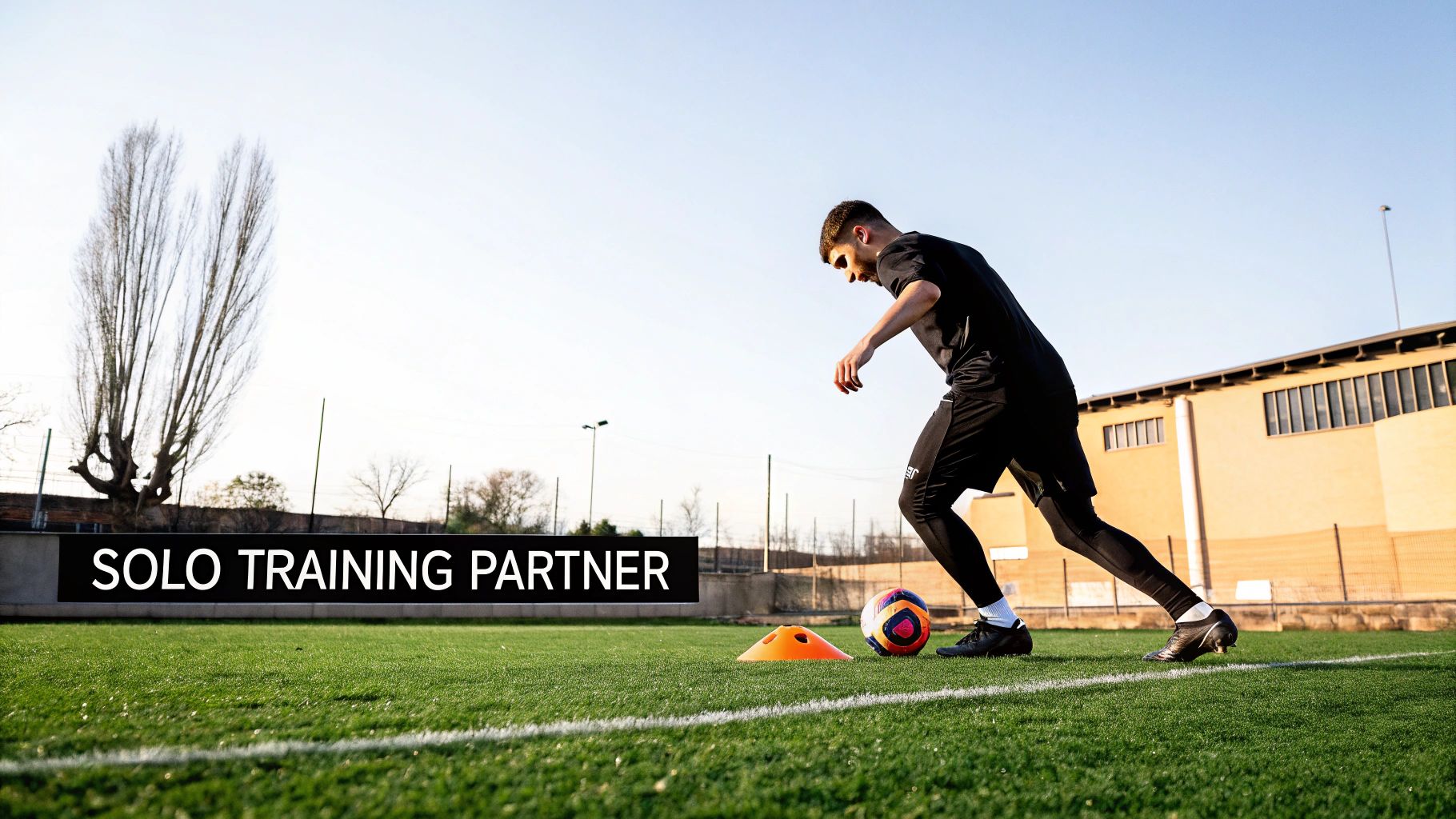
Imagine a training partner that never misplaces a pass and is always ready for one more drill. That, in a nutshell, is a football rebound board. It is a specially designed surface, usually made from tough materials like high-density polyethylene, that pings the ball back with a crisp, reliable return every single time.
Unlike simply kicking a ball against a brick wall, a rebound board is engineered to mimic the pace and flight of a real pass. This consistency is vital for building muscle memory and refining technique through repetition. Its main job is to act as a dependable "pass-back" wall, allowing you to get hundreds of touches in a short space of time.
Why They Are Essential Training Tools
The real magic of using rebound boards for football training lies in their efficiency and versatility. Whether you are a young player in the garden or an academy prospect putting in extra hours, this tool provides a way to get meaningful practice whenever you want. You no longer need to wait for a friend to be free; you can take your development into your own hands.
This single piece of equipment helps to hone several core football skills:
- First Touch and Control: The steady return forces you to perfect how you receive the ball, teaching you to cushion it and set up your next move in an instant.
- Passing Accuracy: You can aim for specific spots on the board, working on the precision and weight of your passes with both your left and right foot.
- Reaction Speed: Firing off quick, repetitive passes builds faster reflexes, helping you to think and act quicker in a proper match.
A rebound board transforms simple kickabouts into focused, high-repetition sessions that forge the technical foundation every modern footballer needs. It’s all about making every touch count.
Because of these benefits, the rebound board has evolved from a simple accessory to a cornerstone of modern coaching. For a deeper look at the different types of rebounders available, check out our guide on the football rebound wall and how to use it. It demonstrates how simple ideas can make a huge difference in a player's journey.
What Are The Real Benefits of Rebound Board Training?
Let's be honest, you can only do so many kickabouts before you stop seeing real improvement. This is where a rebound board comes in. It’s not just a wall to kick a ball against; it’s a tool that turns aimless practice into sharp, high-intensity sessions that genuinely make you a better player. The board gives you a consistent, game-like return every single time, building the muscle memory and confidence you need to execute skills when it matters.
One of the first things you will notice is a huge improvement in your first touch. A rebounder forces you to receive and control the ball in one fluid motion, just like a pass fizzing in from a teammate. Repeating this over and over develops that instinctive ability to cushion the ball and immediately set up your next move—be it a pass, a dribble, or a shot.
This kind of focused practice is how a clumsy touch becomes a silky one. The board does not lie. A lazy pass comes back awkwardly, but a crisp, well-struck pass returns perfectly to your feet. It is this instant, honest feedback that speeds up your learning more than almost any other solo drill.
Master Your Technique and Reactions
Beyond your first touch, a rebound board is brilliant for building confidence on both feet. It is easy to rely on your stronger side in training, but the board gives you endless chances to work on your weaker foot without any pressure or judgement. Consistent drills quickly build up the coordination and power you need, making you a far more balanced and unpredictable player.
The benefits for passing and receiving are massive. By aiming at different parts of the board, you can sharpen specific skills:
- Passing Accuracy: Hitting small targets over and over will make your passing laser-sharp.
- Weight of Pass: You will learn to judge the right amount of power for everything from short, snappy exchanges to longer, driven returns.
- Receiving on the Half-Turn: Practising how to open up your body as the ball arrives is a crucial skill, especially for midfielders looking to play forward.
Consistent drills with a rebound board forge the critical link between your brain and your feet, dramatically cutting down reaction times and making quick decisions second nature during a match.
The Ultimate Convenience for Gaining an Edge
Perhaps the biggest advantage is its convenience. You do not need a training partner or a massive pitch to get a top-quality session in. You can set up a rebound board in the garden, at the local park, or even on a driveway, meaning you can get your practice in whenever you have a spare moment.
This simple accessibility has made it a core piece of kit in UK football training, from grassroots clubs to elite academies. In fact, with over 2 million registered youth players in England, recent data shows that 65% of grassroots coaches now use rebound boards every week. Why? Because they have seen it boost first-touch accuracy by up to 40% in specific drills. You can find more insights on football training equipment trends at Market Report Analytics.
What does this all mean for you? More touches on the ball, more focused repetition, and faster skill development. Adding a rebound board to your training routine is not just about buying another piece of equipment—it is giving yourself a serious competitive advantage.
Essential Drills to Master Your Skills
Alright, you understand why a rebound board is a great bit of kit. Now for the fun part: putting it to work. The right drills are what turn this simple wall into your most reliable training partner, building the muscle memory you need to stay sharp under pressure. By starting with the basics and adding layers of difficulty, you can laser-focus on specific parts of your game and see real, fast improvement.
Let's walk through some of the core drills, broken down by skill level. Think of these as the building blocks that top academies use to forge technically brilliant players.
Beginner Drills: Nailing the Fundamentals
When you are just starting out, it is all about one thing: repetition. Getting a clean first touch is everything in football, and these drills are designed to build that solid foundation.
- One-Touch Passing: Stand about 3-5 metres from the board. Ping the ball firmly against it with your stronger foot, focusing on controlling the return with a single, clean touch. Do this 20 times, then switch to your weaker foot. The aim is not just to stop the ball, but to make your first touch a productive one that sets you up for your next move.
- Inside Foot Control: This one is all about receiving the ball cleanly on the turn. Pass into the board, and as it comes back, open up your body. Use the inside of your foot to cushion the ball and guide it slightly to your side in one smooth motion. It is the perfect way to practise receiving a pass in a match and instantly shielding it from a defender.
Intermediate Drills: Adding a Bit of Chaos
Once the basics feel second nature, it is time to add movement and variety to mimic the unpredictable flow of a real match. These drills will test your coordination and force you to think a step ahead.
The secret to levelling up is to stop standing still. The best players are always on the move, and these drills force you to receive and play the ball while your body is in motion—just like on a Saturday afternoon.
- Receive and Turn: Stand with the board to your side. Get a teammate to play the ball into the board (or just pass it yourself). As the ball rebounds, let it run across your body, then execute a sharp turn and accelerate away into space. This is a crucial skill for midfielders and strikers who need to take the ball under pressure and get turned towards goal in a flash.
- Volley and Half-Volley Training: This is a good one. Tilt the rebound board back at a slight angle. From a few metres out, chip the ball into the board and get ready to strike the return on the volley or half-volley. It is brilliant for improving your timing and coordination, helping you to strike a moving ball cleanly – perfect for sharpening up your finishing inside the box.
Advanced Drills: Recreating Match Intensity
Advanced drills are where it all comes together. We are talking about blending multiple skills into fluid, high-tempo sequences that feel like a competitive game. These demand concentration, precision, and a good level of fitness.
- Pass, Move, and Receive: Set up two cones a few metres apart. Start at one cone, pass the ball into the rebound board, and then sprint to the other cone to meet the return pass. Control it, play it back, and immediately sprint back to the first cone. This is a lung-buster, but it forces you to maintain your technical quality even when you are tired.
- Combination Play with a Mannequin: Place a training mannequin between yourself and the board to act as a defender. Now, practise playing quick one-two passes around it, using the rebounder as your teammate. This is fantastic for developing your spatial awareness and learning how to unlock a tight defence with clever, quick passing.
After you have mastered these drills, a great way to get inspired is by watching the pros. You can find out how to watch World Cup Qualifiers to see how the best players in the world apply these skills in real-time. If you want to explore more routines you can do in your own back garden, do not miss our complete guide on football training drills at home.
How to Choose the Right Football Rebound Board
Picking the perfect rebound board for football training can feel a bit daunting, but it does not have to be. If you focus on a few key things—size, material, and adjustability—you can find the ideal training partner for your goals, space, and budget. Get this choice right, and you will have a reliable piece of kit that will serve you for countless training sessions.
Your decision should start with thinking about how and where you will be using it. A young player just starting out in the back garden has very different needs from a semi-pro looking for intense, high-repetition drills.
This flowchart helps visualise which drills are best suited for different player levels, which can guide your choice of rebound board.
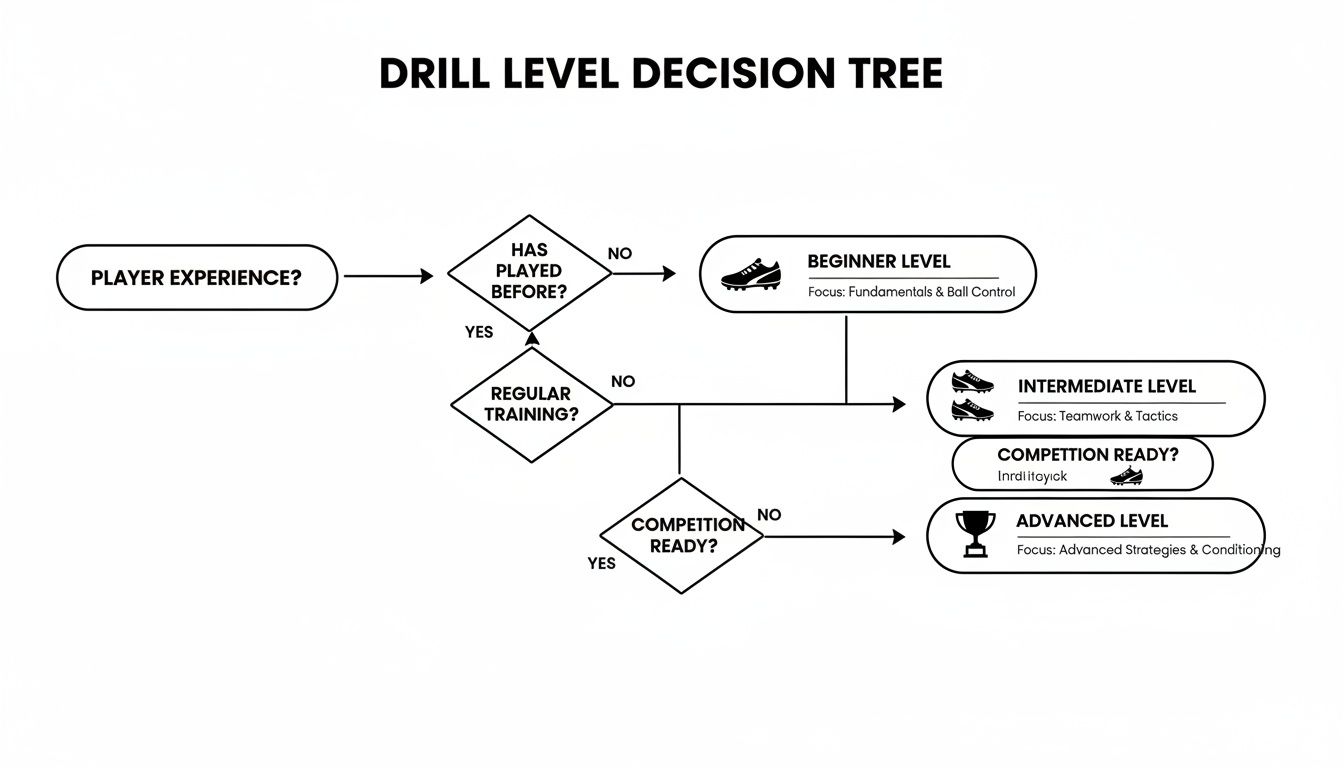
As you can see, the complexity of training ramps up with skill. That is why a versatile rebound board is such a smart investment.
Size and Portability
The size of the rebound board directly impacts the types of drills you can perform. A larger surface area offers more versatility, letting you practise long-range passes and providing a bigger, more forgiving target for beginners. However, bigger boards are heavier and harder to move around.
- Small Boards (under 100cm): These are fantastic for tight spaces and solo drills focused on close control and snappy one-twos. Their portability makes them perfect for putting in the car and taking to the park.
- Large Boards (over 100cm): Better suited for a more permanent setup in a garden or at a club, these offer a more realistic passing target for all sorts of drills, including volleys and driven passes.
Material and Durability
A rebound board's material does not just determine its lifespan; it dictates the quality of the ball's return. A cheap, flimsy surface will give you an inconsistent, weak bounce, which defeats the purpose of the drill.
Look for high-density polyethylene (HDPE). This material is tough, weather-resistant, and provides that crisp, game-like rebound you need for effective training. A sturdy steel frame is also a must for stability.
In the UK, the demand for durable training gear has soared. Rebound boards have played a huge role in bridging the gap between recreational and professional training. In fact, 71.22% of mass-market sales are for amateurs and children—exactly SoccerWares' audience of parents and lifestyle fans. The children's segment is growing at a 6.26% annual rate, largely thanks to school programmes where rebound boards have been shown to boost dribbling success by a remarkable 32%.
Adjustability and Angles
A fixed, upright board is great for ground passes. However, a model with adjustable angles unlocks a whole new level of training possibilities. By tilting the board, you can simulate different in-game scenarios and work on a much wider range of techniques.
An adjustable board lets you practise:
- Lofted Returns: Tilting the board back will pop the ball up into the air, perfect for working on volleys, half-volleys, and chest control.
- Bouncing Passes: A slight forward angle can create a low, skidding return that mimics a tricky pass on a wet pitch.
This versatility makes adjustable models a far better long-term investment. They might cost a little more upfront, but the ability to constantly vary your drills keeps training fresh and challenging. If you are curious about different types of rebounders, you might be interested in our article on the portable football rebounder net.
To help you decide, here is a quick rundown of what to look for in a rebound board.
Comparing Rebound Board Features
A comparison of different rebound board features to help you select the best option for your training needs.
| Feature | What to Look For | Best For |
|---|---|---|
| Size | Small (<100cm) for portability, Large (>100cm) for varied drills | Beginners and clubs benefit from larger boards; solo trainers prefer smaller, portable ones. |
| Material | High-Density Polyethylene (HDPE) board with a steel frame | Anyone serious about training. It ensures a consistent rebound and long-term durability. |
| Adjustability | Multiple angle settings from 90° to angled | Players who want to practise volleys, chest control, and varied pass returns. |
| Portability | Lightweight design, carry handles, or folding mechanisms | Players who train in different locations, like parks, or need to store their gear away. |
Ultimately, choosing the right board comes down to matching these features with your specific needs. A versatile, durable board will quickly become one of the most valuable tools in your training arsenal.
Combining Rebound Boards with Other Gear
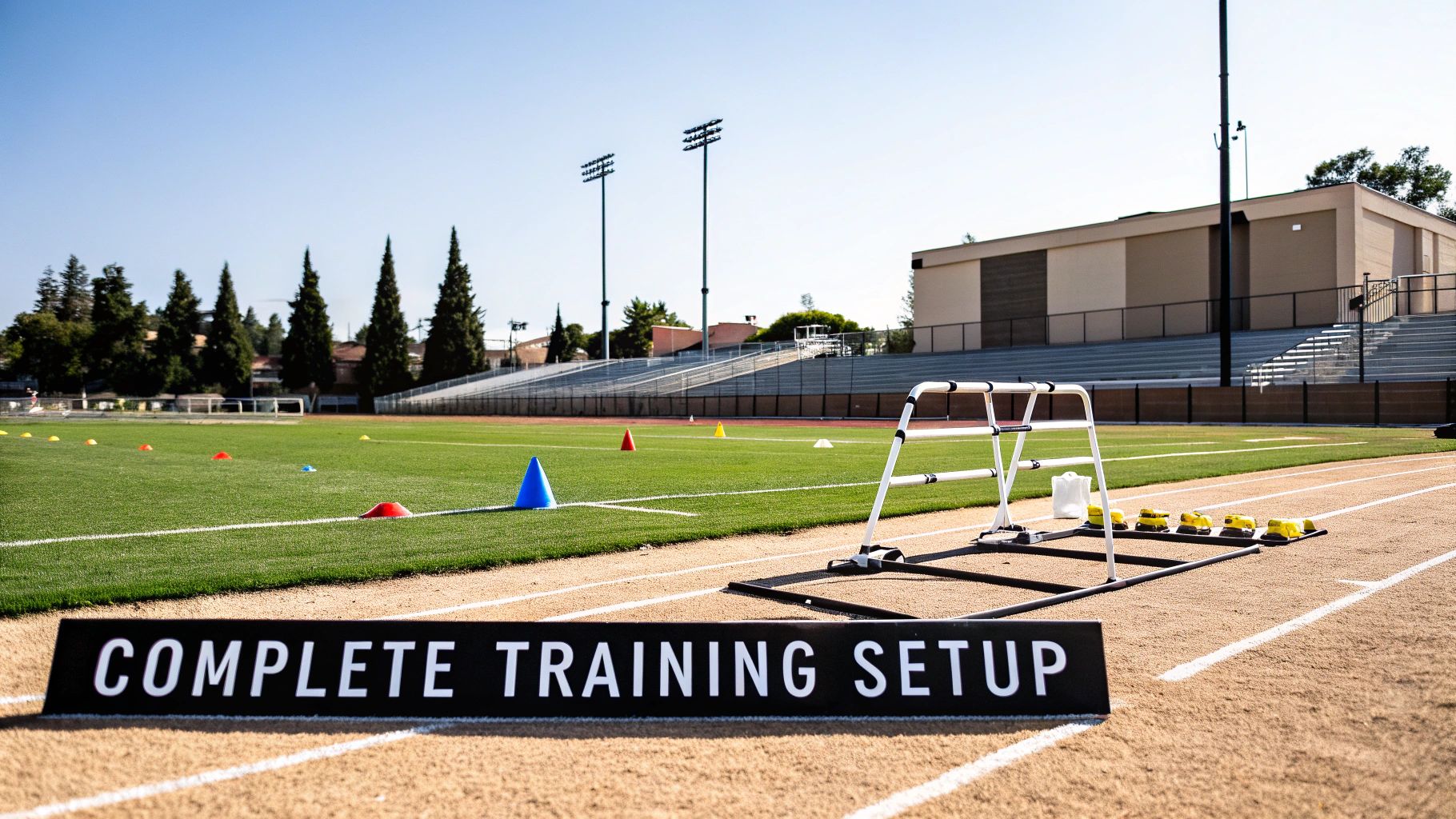
A rebound board is fantastic on its own, but its real magic happens when you start combining it with other bits of kit. Think of it less as a solo tool and more as the heart of a proper training circuit. By doing this, you turn a simple touch-and-return drill into a dynamic, match-like scenario that sharpens much more than just your control.
This is how you get the most out of it. The rebounder becomes your reliable teammate, always ready to play a pass back. But it is what you do before and after that pass that truly elevates your game. It is about building a complete training ground in your own garden, focusing on agility, finishing, and spatial awareness all at once.
Creating Dynamic Training Circuits
The easiest place to start is by combining a rebound board for football with a few cones. This simple pairing forces you to add sharp, explosive movements before you even think about receiving the ball.
For example, set up a basic slalom course. Weave through the cones with the ball, play a crisp pass against the rebounder, and then focus on controlling the return. Suddenly, you are not just passing; you are simulating the exact moment you beat a defender and need to find a teammate immediately.
Here are a few combinations to get your creative juices flowing:
- Rebounder and Cones: Lay out an agility ladder or a grid of cones. Power through a footwork drill, then burst towards the rebounder to play a quick one-two. This is brilliant for building technical sharpness when you are already tired.
- Rebounder and Hurdles: Set up some mini-hurdles a few feet from the board. Perform some quick, plyometric jumps over them before receiving a pass to really work on your explosive power and coordination.
- Rebounder and Goal: This one is a classic. Position the board to the side of a small goal. Practise taking the return pass on the turn and hitting a first-time shot. It is pure instinct-building for any aspiring goalscorer.
Building a Complete Setup
This integrated approach is not just a gimmick; it mirrors modern coaching philosophies. Rebound boards in UK football have been around for a while, but their use has exploded since the early 2020s. In fact, during the 2022-2023 season, EFL clubs reported a 35% improvement in passing accuracy among their U18 squads that used rebound boards daily. After the pandemic, with home training becoming essential, 52% of parents invested in tools like these.
By combining your rebounder with other gear, you are essentially building a personal training ecosystem. Each piece of equipment targets a different skill, but together they create a well-rounded player.
This method gives you total control to customise your sessions and address your weaknesses head-on. Whether it is your agility, finishing, or ability to play under pressure that needs work, combining your rebounder with other equipment is the single most effective way to level up. For more ideas on putting together the ultimate training kit, check out our guide on essential football training gear.
Got Questions About Rebound Boards? We've Got Answers
So, you are thinking about adding a rebound board to your training setup. It is a smart move, but like any new bit of kit, a few questions always crop up. Getting straight answers is the key to ensuring you are not just buying a piece of plastic, but a tool that will genuinely improve your game.
Let's clear up some of the most common queries we get from players and parents. We will cover where you can use it, how goalkeepers can get in on the action, and how to keep it in top condition.
What's the Best Surface to Use a Rebound Board On?
Honestly, most decent rebound boards for football are built tough and can handle almost any surface you throw at them. For the best performance, however, a flat grass pitch or an artificial turf surface is ideal. This gives the board's legs or spikes a solid base to grip, preventing it from sliding about.
That said, they work just as well on harder ground, which is great for getting some practice in at home:
- Patios or driveways: Perfect for a quick session when you cannot get to the pitch. The ball might come back a bit quicker, but that is great for reaction work.
- Indoor sports halls: A brilliant option for training all year round. No more cancelled sessions because of a bit of rain.
The main thing is to make sure the board feels stable before you start kicking a ball against it. If the ground is a bit uneven, just give it a little wiggle and adjust it until it is solid. It makes all the difference.
Can Goalkeepers Use Rebounders?
Absolutely. It is easy to think of them as just for outfield players, but a rebound board can be a goalkeeper's secret weapon. It provides a consistent, powerful return that is often harder to replicate than a shot from a teammate.
A rebound board can be a goalkeeper's best friend for sharpening reflexes. The unpredictable deflections and rapid returns from different angles are perfect for simulating saves from deflected shots and close-range blocks.
Get a coach or a teammate to fire the ball at the board from different angles. You can create all sorts of scenarios, from low, zipping returns that test your handling down low, to high, looping bounces that force you to work on your footwork and positioning.
How Should I Look After My Rebound Board?
Keeping your board in good shape is easy, but it is vital if you want it to last. After you have finished training, just give it a quick wipe-down with a damp cloth to get any mud or grass off. This stops dirt from building up and keeps the rebound surface clean and true.
For long-term care, it is a good idea to store it somewhere dry like a shed or garage, especially if the weather is bad. Most are made from weather-resistant materials like HDPE, but keeping it out of constant rain or strong sun will add years to its life. Every now and then, just check the bolts and fixings are still tight to keep it safe and stable.
Ready to take your training up a notch? At SoccerWares, we have a fantastic range of high-quality rebound boards built for performance and durability. Explore our collection and find the perfect training partner to sharpen your skills.